
A complete issue · 44 pages · 1910
Life — April 21, 1910
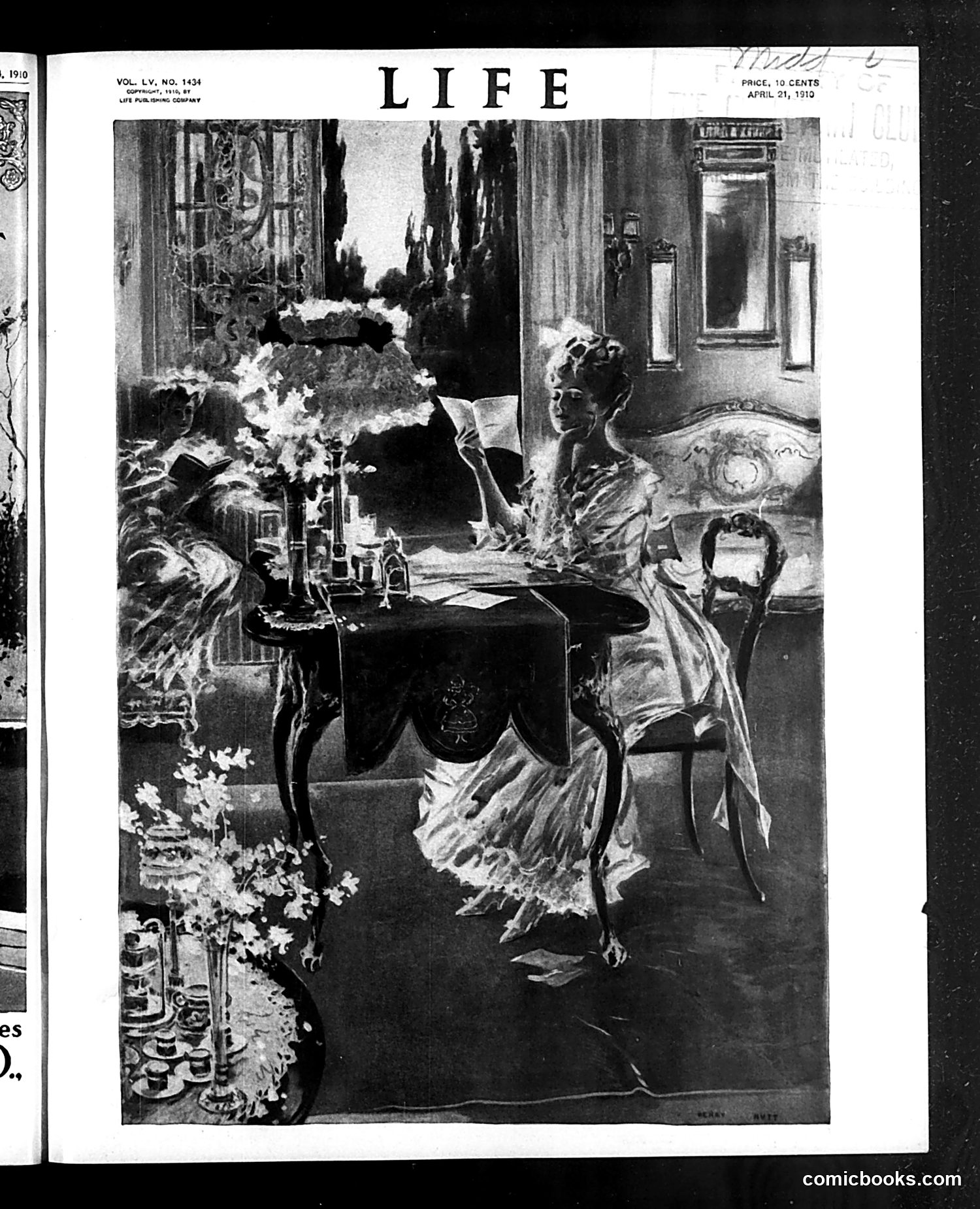
This is an elaborate allegorical illustration rather than a political cartoon. It depicts an ornate interior scene with classical allegorical female figures (likely representing virtues or nations) arranged around a central desk or altar. Elaborate drapery, flowers, and architectural elements fill the composition in a theatrical, romantic style typical of early 20th-century illustration. Without additional caption text visible in the OCR, the specific political or social commentary is unclear. The formal, ceremonial arrangement suggests commentary on diplomacy, governance, or international relations, but I cannot definitively identify which specific historical event or figures this references. The artistic style and composition indicate this was likely the magazine's cover illustration for that date.
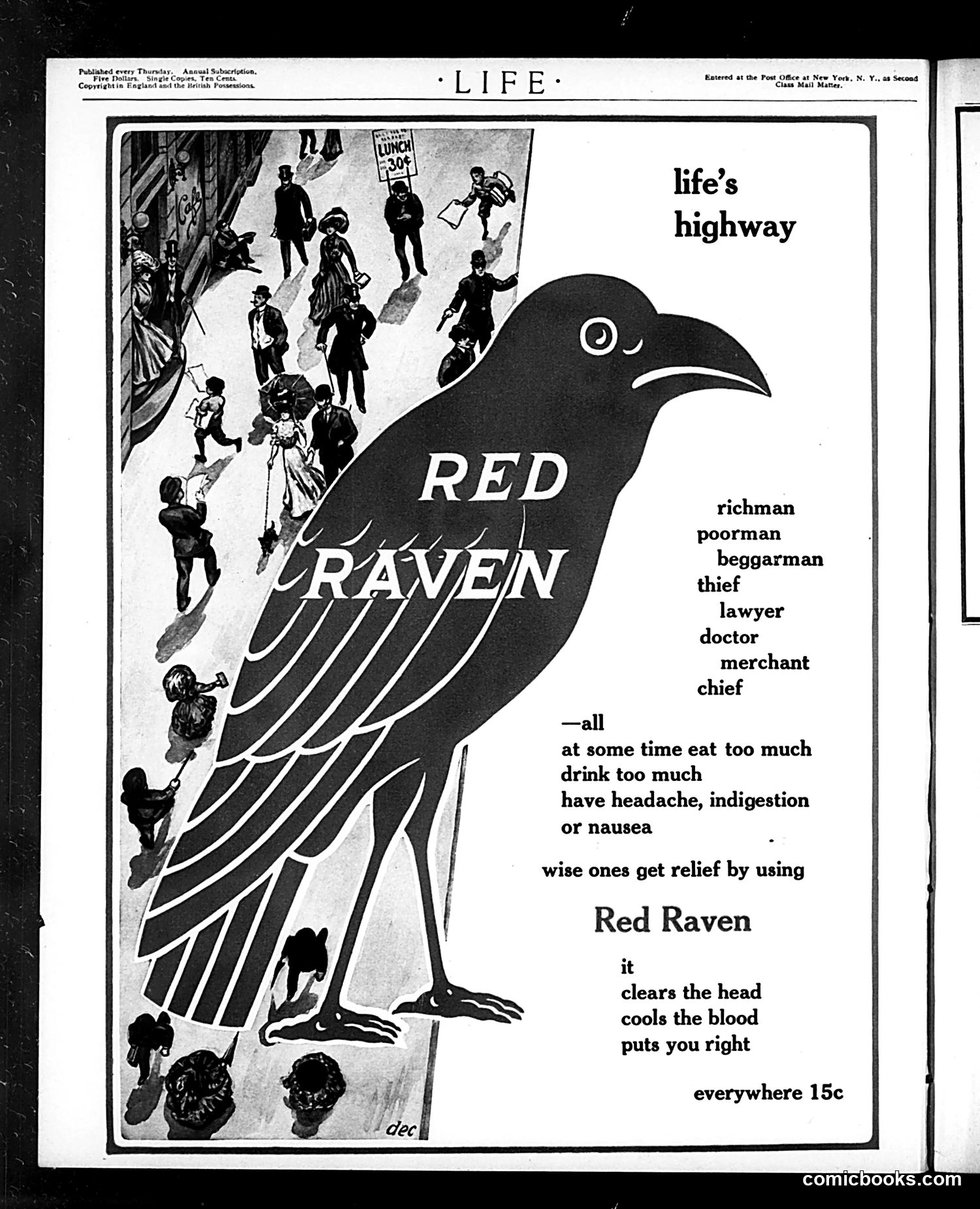
This is primarily a **product advertisement** for "Red Raven," a patent medicine or digestive remedy. The satire is social rather than political. The illustration depicts "life's highway"—a metaphorical procession of different social types (richman, poorman, beggarman, thief, lawyer, doctor, merchant, chief) all traveling together down a path, echoing the children's nursery rhyme. The joke is that **despite their vastly different stations in life, all these people share common digestive problems**: overeating, drinking too much, headaches, and indigestion. The advertisement's humor lies in this democratic leveling—wealthy and poor alike suffer the same ailments and need the same remedy (15 cents everywhere). This reflects early 20th-century advertising's appeal to universal human experiences while gently mocking social hierarchies.
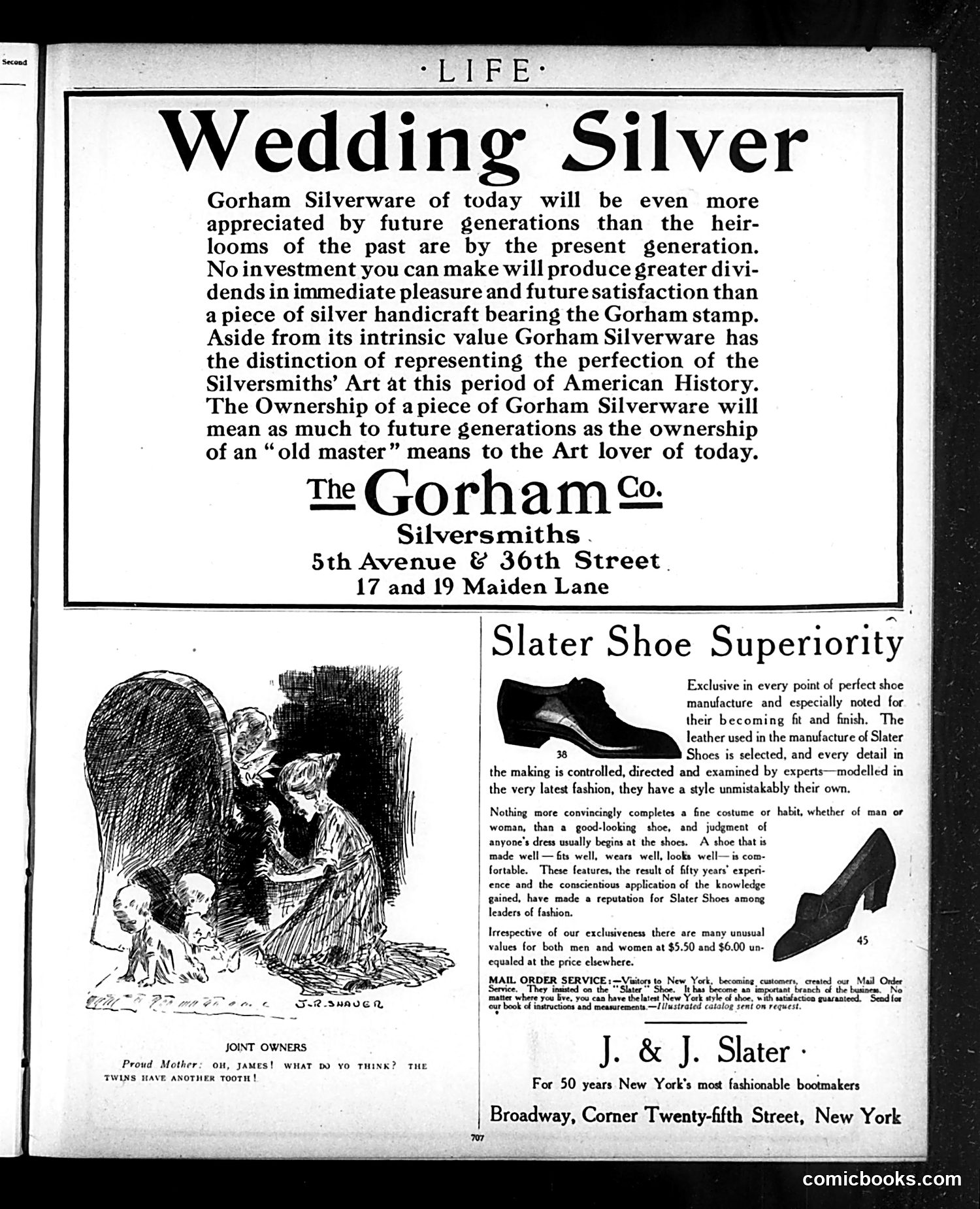
This page is primarily **advertising**, not political satire. It contains three commercial advertisements: 1. **Gorham Silverware** (top): Promotes wedding silver as a heirloom investment, positioning Gorham as representing "perfection of the Silversmiths' Art." 2. **"Joint Owners" cartoon** (bottom left): A domestic humor sketch showing a proud mother with twins, saying "Oh, James! what do you think? the twins have another tooth!" The joke plays on the absurdity of treating minor baby developments as major family announcements—typical early-20th-century domestic humor. 3. **J. & J. Slater Shoes** (right): Advertises women's footwear, emphasizing quality construction and fashionable design for "New York's most fashionable bootmakers." The page reflects 1910s-era consumer culture and domestic comedy rather than political commentary.
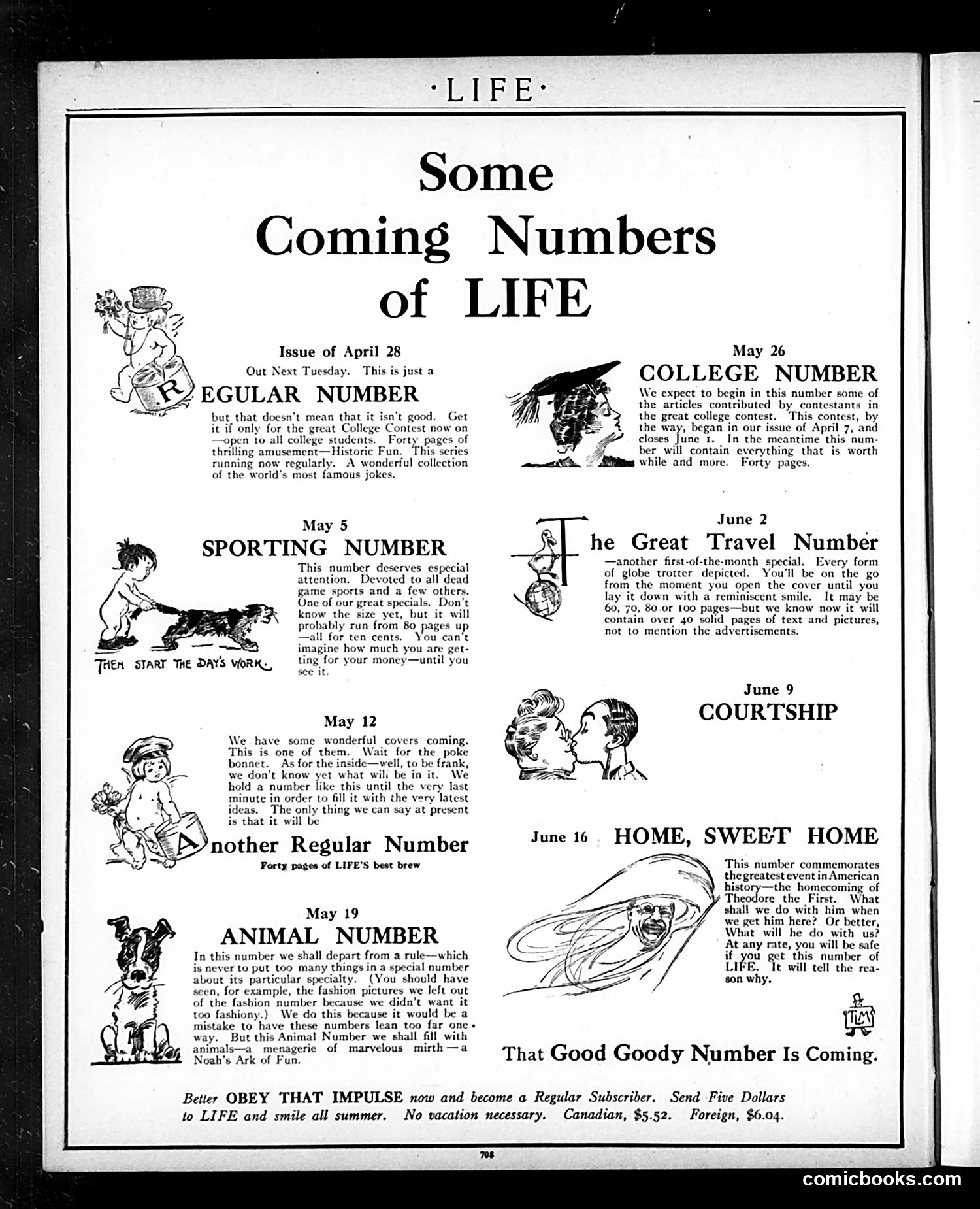
This page announces upcoming special issues of *Life* magazine through June. Each issue targets different reader interests: - **Sporting Number** (May 5): Features sports coverage and games - **Animal Number** (May 19): Focuses on animals and "marvelous birth" - **College Number** (May 26): Targets college students with a contest - **Great Travel Number** (June 2): Promises globe-trotter content - **Courtship** (June 9): Romantic/relationship themed - **Home, Sweet Home** (June 16): References Theodore Roosevelt's homecoming, suggesting domestic/family content The cartoons are light, humorous illustrations accompanying each announcement. The page functions primarily as promotional content encouraging subscriptions by highlighting diverse editorial themes. The tone is playful rather than satirical—marketing different magazine editions to appeal to various audiences.
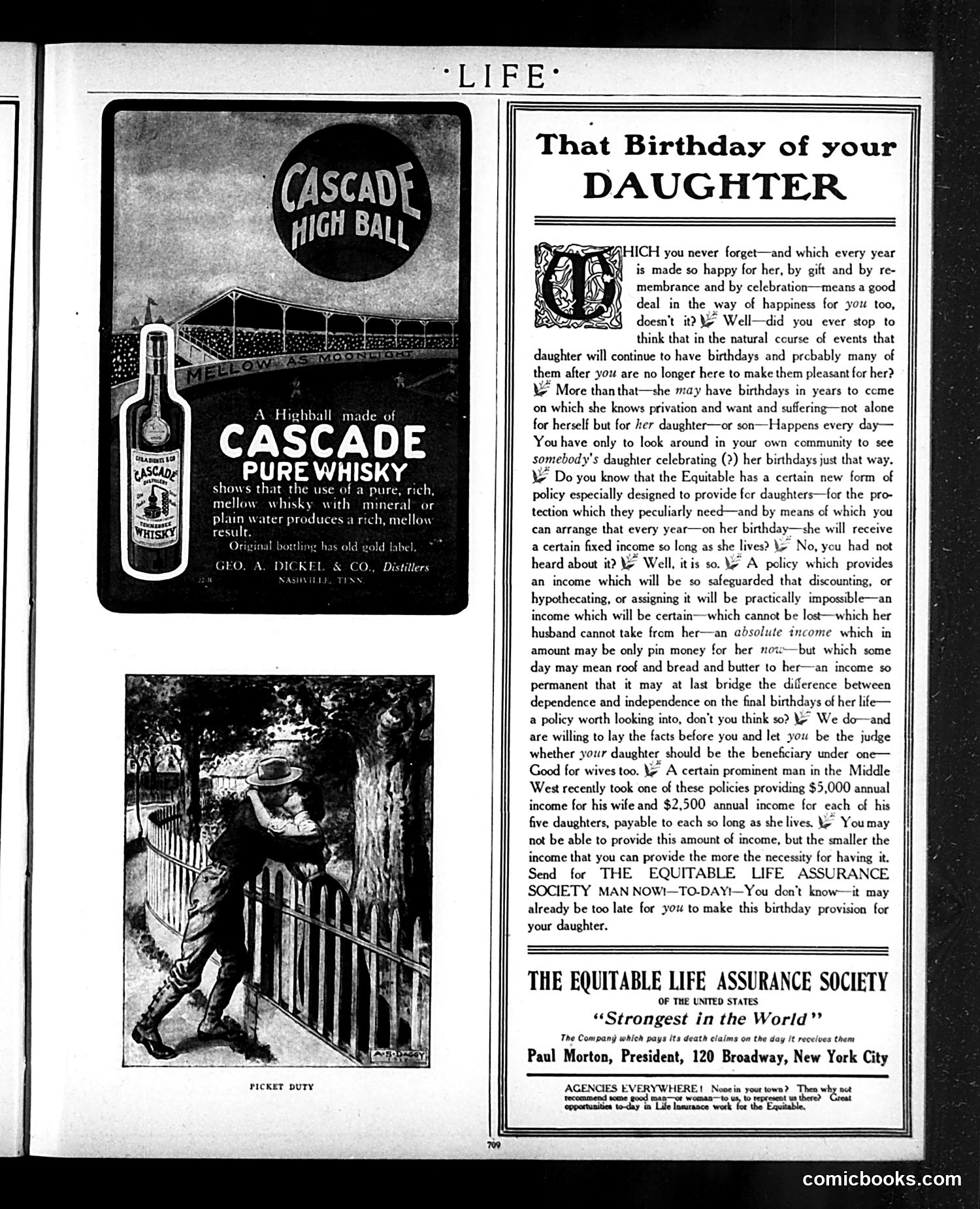
This page contains two distinct elements: a whiskey advertisement (left) and a life insurance advertisement (right). **Left side:** A Cascade Pure Whiskey ad emphasizes the product's quality through a "highball made of CASCADE PURE WHISKEY" served at what appears to be a social gathering. The lower image labeled "PICKET DUTY" shows a man standing guard outside, likely depicting a humorous scenario (though the specific satire isn't clear from context alone). **Right side:** An Equitable Life Assurance Society ad addresses fathers about securing their daughters' financial futures through life insurance policies. It uses emotional appeals—suggesting daughters may face hardship after parents die—to promote purchasing insurance that guarantees daughters fixed incomes. The ad targets wealthy readers capable of substantial premiums ($3,000+ annually mentioned). Both ads reflect early 20th-century consumer culture and gender assumptions about women's financial dependence.
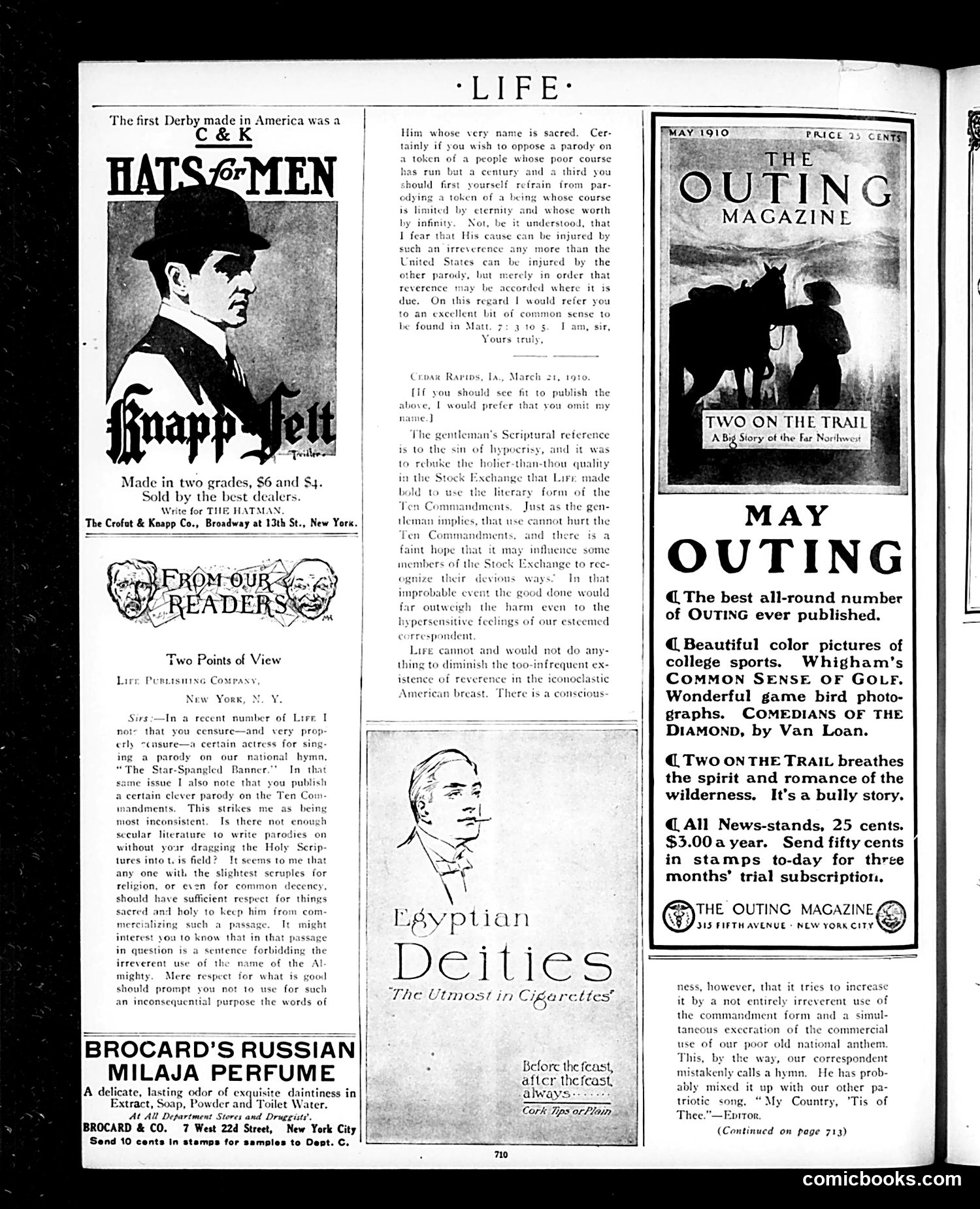
This page is primarily **advertising and editorial content** rather than political satire. The visible advertisements include: - **Knapp Felt hats** ("Hats for Men") - **Egyptian Deities cigarettes** - **Brocard's Russian Milaja Perfume** - **The Outing Magazine** cover promotion The "From Our Readers" section contains a letter debating whether Life should have published a parody on "The Star-Spangled Banner," suggesting religious sensitivity concerns about using sacred national symbols for satire. The only cartoon visible is a portrait sketch labeled "Egyptian Deities" for cigarette advertising. This page reflects post-WWI American commercial culture rather than political commentary.
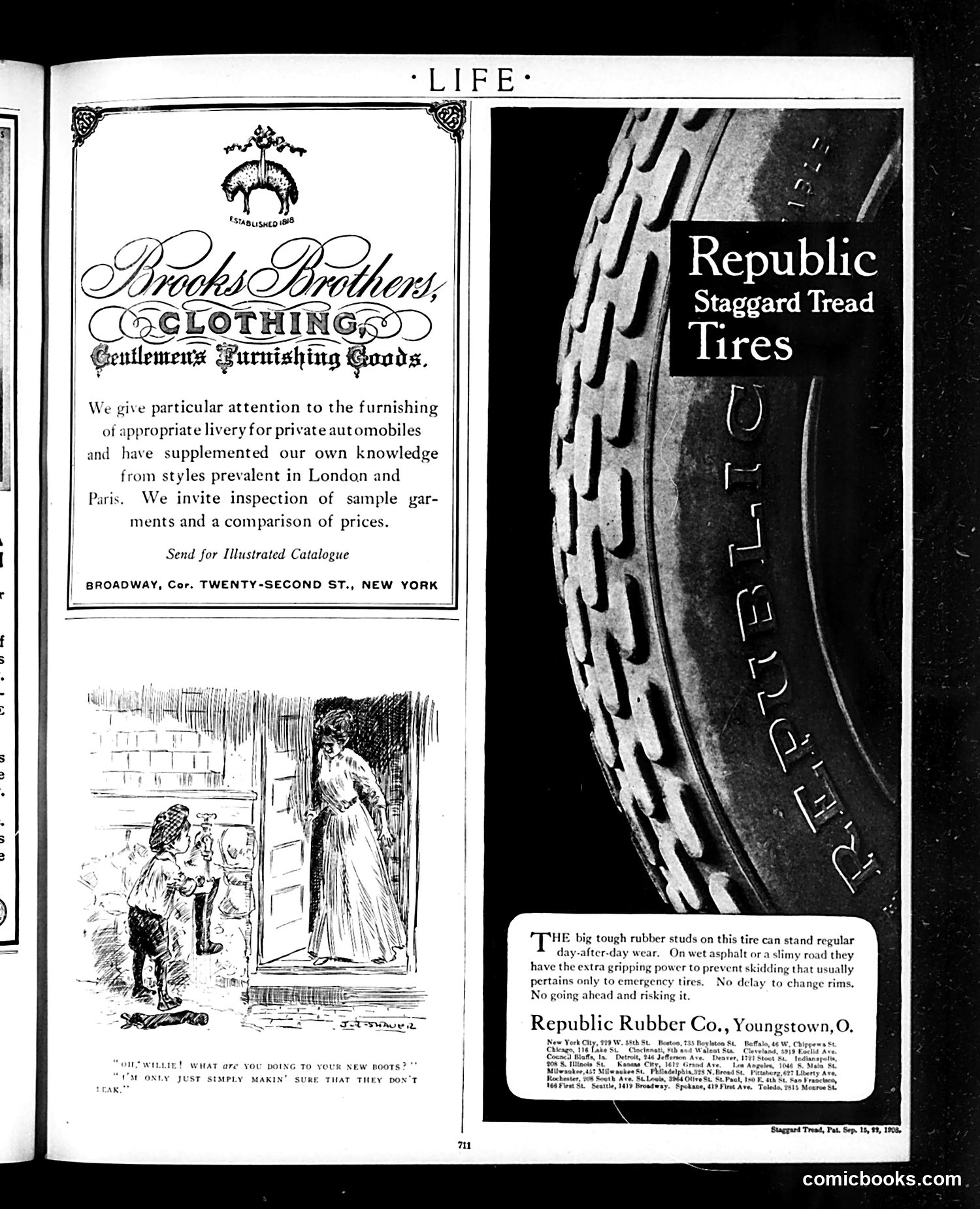
This page contains two unrelated advertisements rather than political cartoons. **Left side:** Brooks Brothers clothing advertisement for "Gentlemen's Furnishing Goods," emphasizing livery for private automobiles, with a sketch showing a woman addressing a young servant boy. The caption reads: "OH! WILLIE! WHAT ARE YOU DOING TO YOUR NEW BOOTS?" / "I'M ONLY JUST SIMPLY MAKIN' SURE THAT THEY DON'T ASK." The joke appears to be about servant class anxieties—the boy is deliberately scuffing new boots to avoid them looking too fine, which might prompt criticism or additional demands from employers. **Right side:** Republic Rubber Company advertisement for "Staggard Tread Tires," featuring a close-up photograph of tire treading and text promoting durability on asphalt and slippery roads. Both are straightforward commercial advertisements typical of the era.
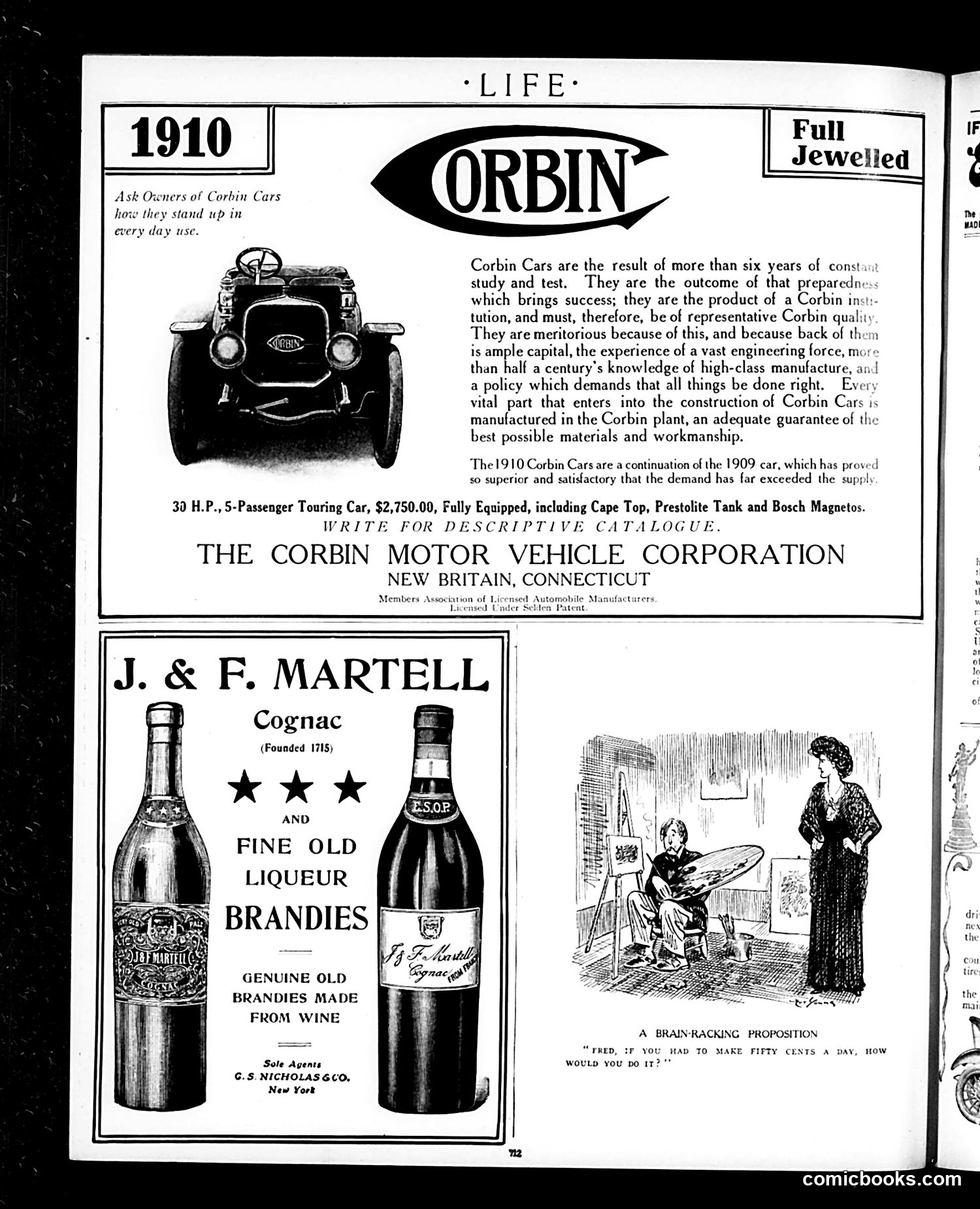
This page is primarily **advertising**, not political satire. The top half features a **Corbin automobile advertisement** (1910 model, $2,750), emphasizing quality manufacturing and engineering reliability—typical early automotive marketing. The bottom half advertises **J. & F. Martell Cognac and brandies**, founded 1715. The only cartoon element is the small illustration labeled "A Brain-Racking Proposition," showing a man and woman with the caption: "Fred, if you had to make fifty cents a day, how would you do it?" This is a **domestic humor piece** about economic anxiety—likely satirizing the working-class struggle to earn modest wages. The cartoon's point appears to be gentle mockery of financial difficulty rather than pointed social commentary.
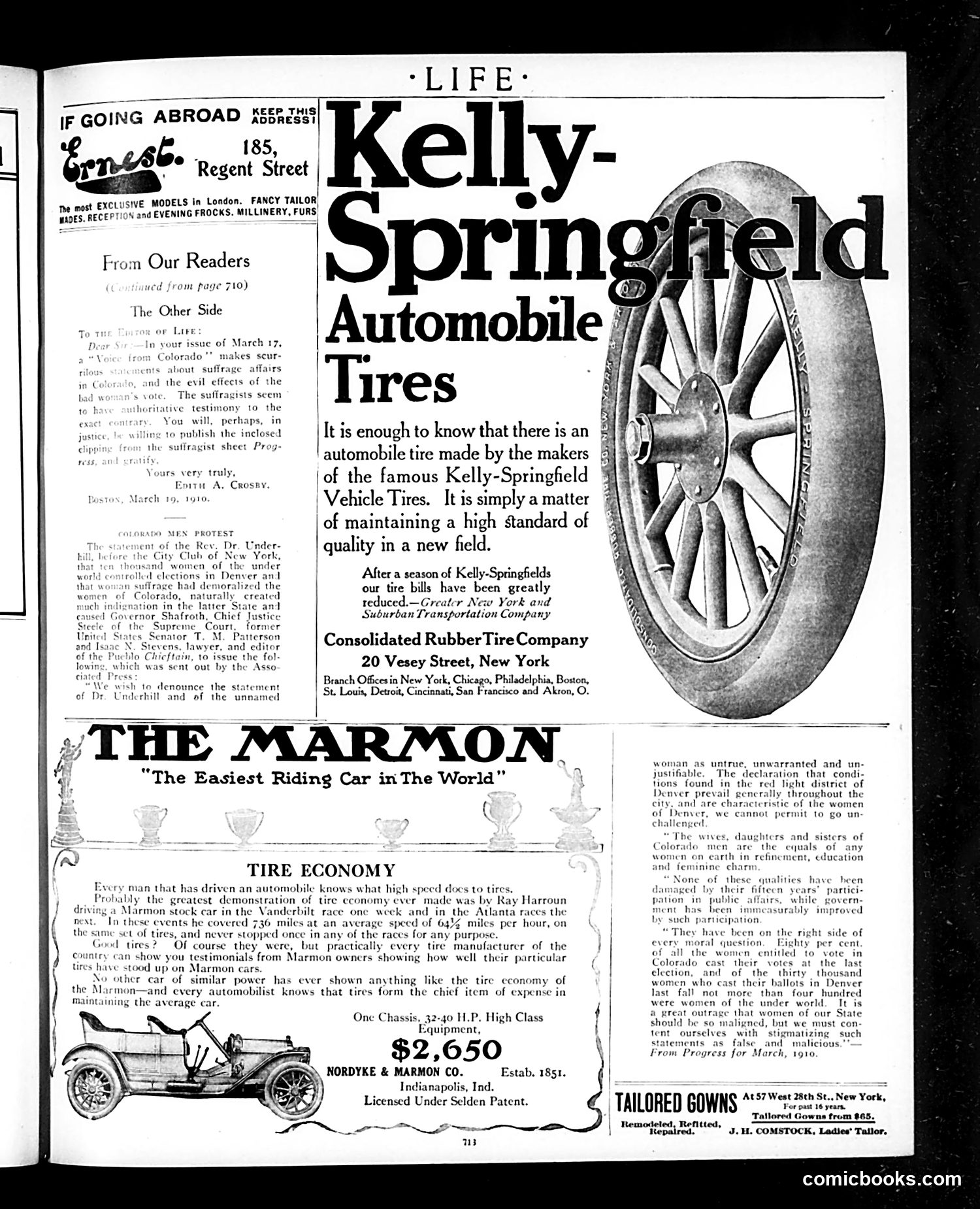
This page is primarily **advertising-heavy**, featuring commercial content rather than satirical cartoons. The main advertisements are: 1. **Kelly-Springfield Automobile Tires** - A large tire image with text claiming quality maintenance in a new market 2. **The Marmon automobile** - Marketed as "The Easiest Riding Car in The World," priced at $2,650, emphasizing tire economy 3. **Tailored Gowns** advertisement The only editorial content is a small "From Our Readers" letter section titled "The Other Side," which appears to be reader correspondence about women's suffrage in Colorado. The letter expresses concern about women's voting power, suggesting this page dates to the early 1910s during suffrage debates. The page reflects Life's dual role as both satirical magazine and advertising medium of that era.
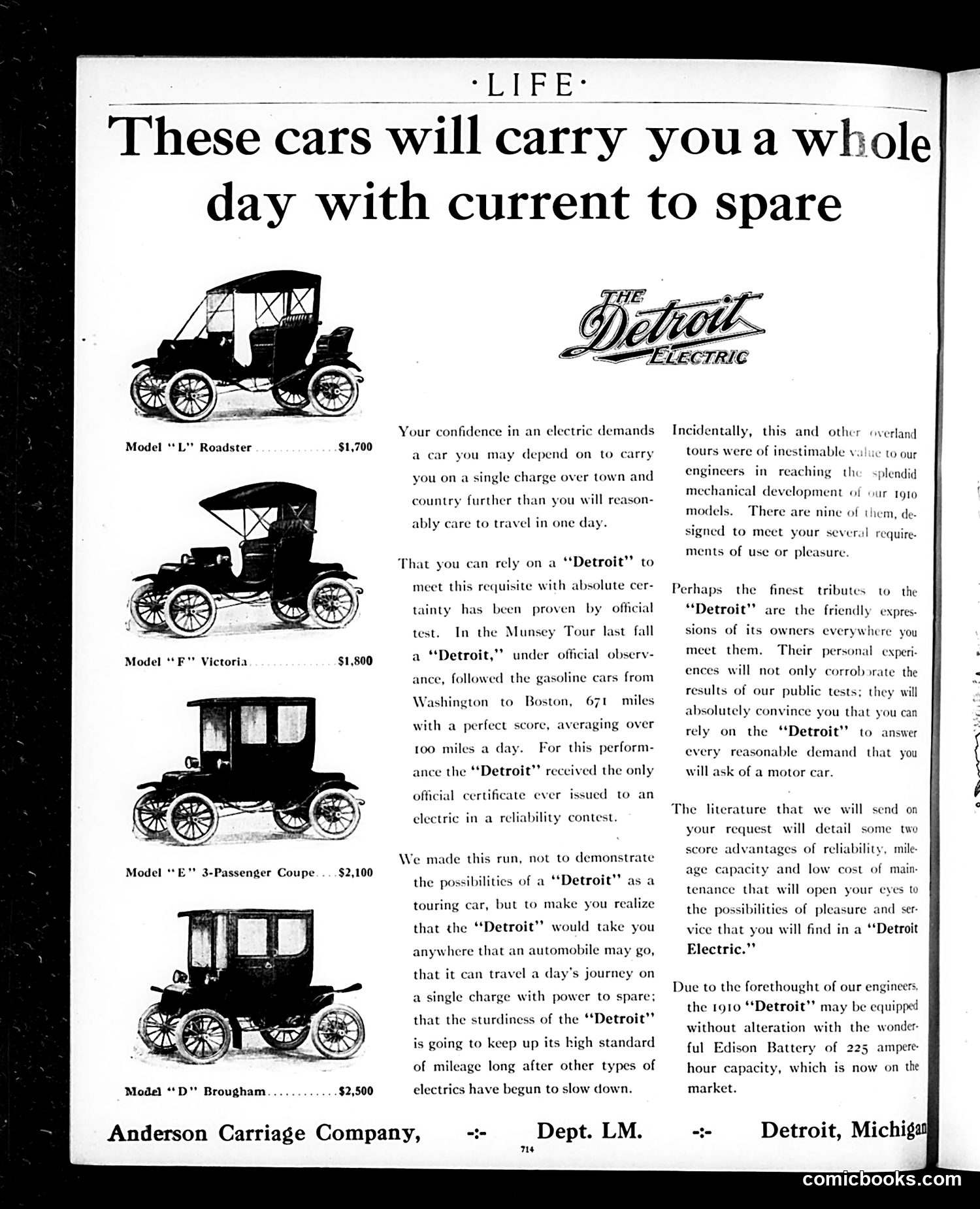
This is **not a cartoon or satire page**, but rather a **straightforward advertisement** for Detroit Electric automobiles, placed in *Life* magazine. The page showcases four electric car models (Roadster, Victoria, Coupe, and Brougham) with prices ranging from $1,700 to $2,500. The ad emphasizes reliability, citing an official Munsey Tour test where a Detroit Electric traveled 671 miles with a "perfect score." The marketing pitch targets affluent readers concerned about range anxiety—a then-contemporary concern about early automobiles. The ad promises a full day's travel "with current to spare" and highlights the Edison Battery's 225 ampere-hour capacity. This represents early 20th-century electric vehicle promotion before gasoline engines dominated the market.
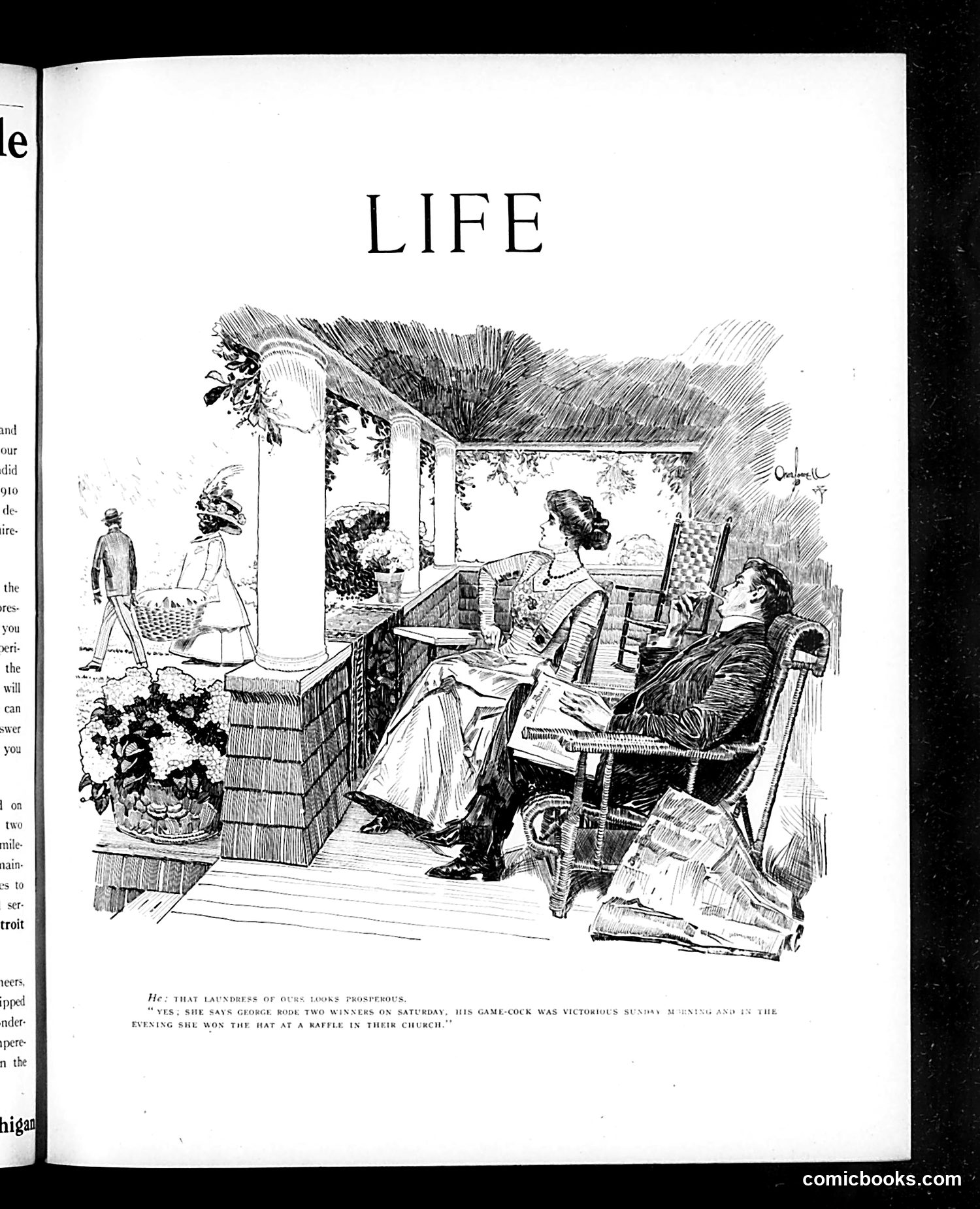
This page features a single illustration titled "LIFE" showing a domestic scene on a porch. Two well-dressed figures sit in rocking chairs reading newspapers, while a couple (man carrying a basket, woman in a hat) approaches from the left. The caption reads: "He: 'That laundries of Ducks looks prosperous.' Yes, she says George took two winners on Saturday. His game-cock was victorious Sunday morning and in the evening she won the hat at a raffle in their church.'" The satire targets working-class or middle-class families' reliance on gambling—horse racing ("Ducks"), cockfighting, and church raffles—as income sources. The joke suggests this family's financial stability depends entirely on gambling luck rather than honest work, mocking both their precarious finances and the prevalence of gambling in American life.
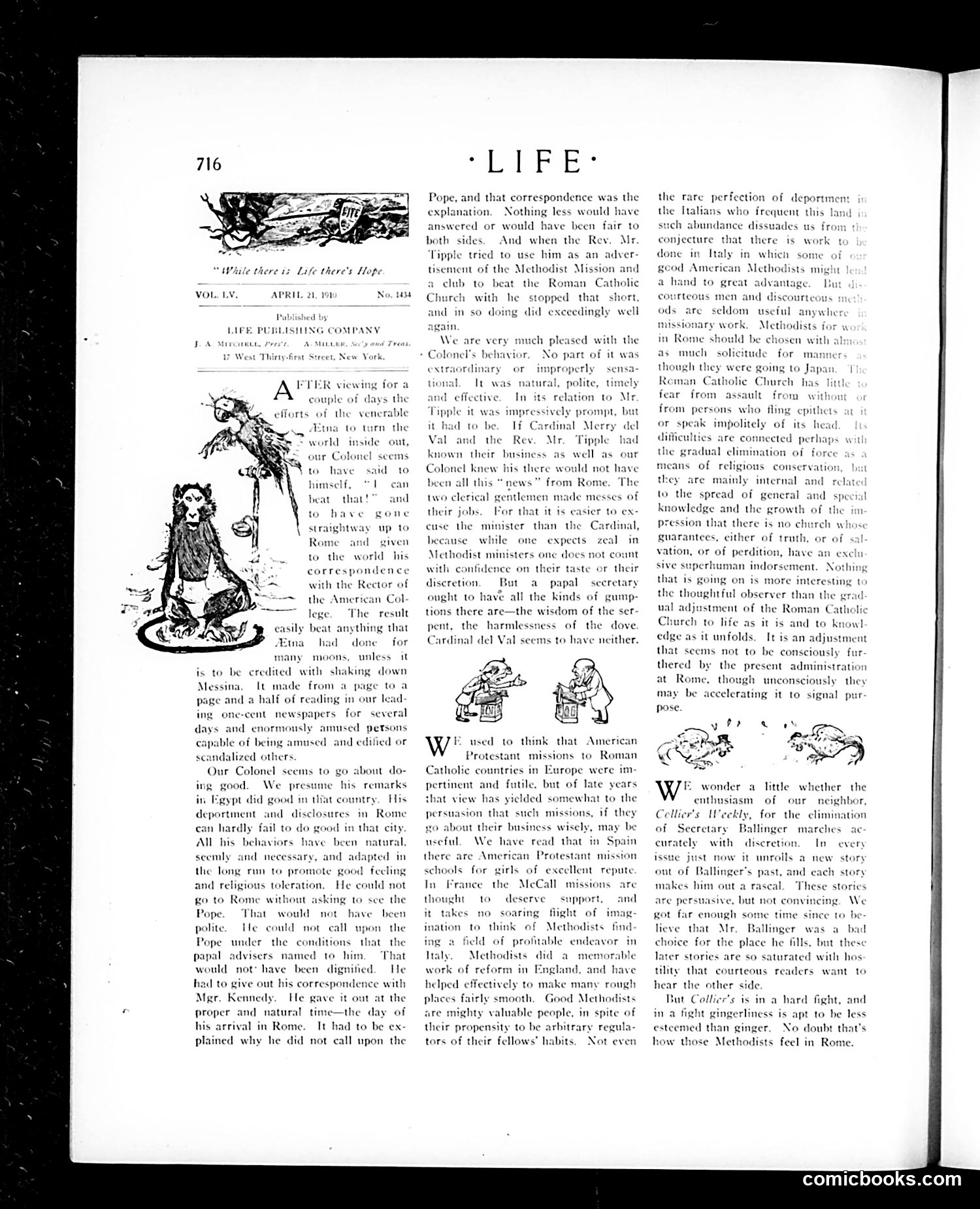
This page contains editorial text discussing American Methodist missionary work in Rome and Europe, rather than political cartoons. The decorative illustrations—small sketches of cherubs or putti (baby figures) and what appears to be a tree with figures—are ornamental rather than satirical. The content criticizes the Roman Catholic Church's opposition to Protestant Methodist missions in Catholic countries like Spain and Italy. The author defends Methodist efforts as legitimate religious work, while noting the Church's resistance to Protestant competition. The piece also discusses Cardinal Merry del Val and references Colonel Etna's diplomatic activities. This reflects early 20th-century Protestant-Catholic tensions over missionary work and religious influence in Europe.
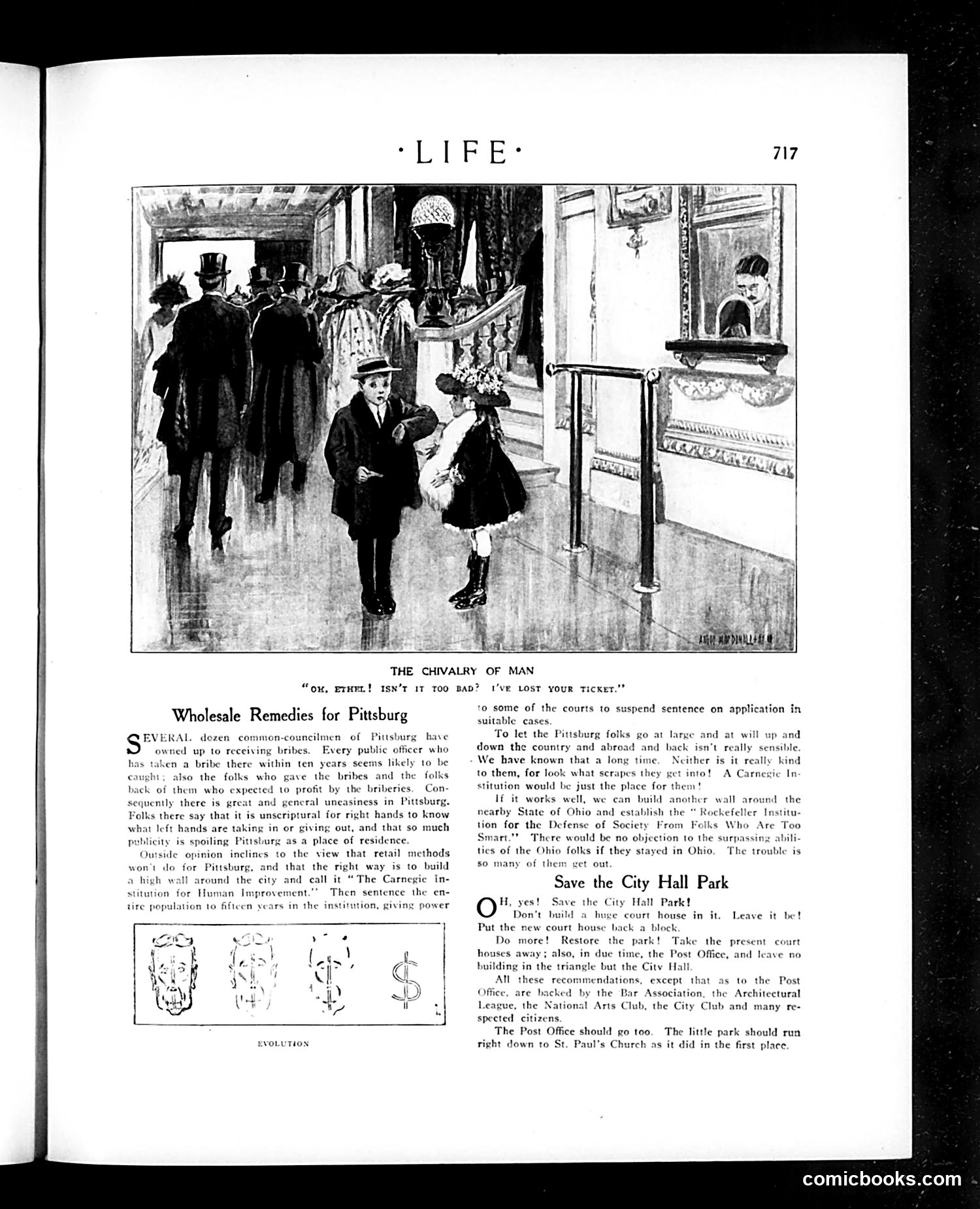
The cartoon depicts a scene in what appears to be a public building or institution. A well-dressed man and young girl interact in the foreground while other formally-dressed visitors pass through in the background. The caption reads: "Oh, Ethel! Isn't it too bad? I've lost your ticket." This appears to satirize genteel hypocrisy—the man's polite, chivalrous demeanor contrasts with his convenient "loss" of the girl's ticket, suggesting he's using courteous behavior as cover for minor dishonesty or manipulation. The formal setting and proper dress emphasize how such deceptions operate within respectable society, making the satire about how social propriety masks less noble intentions. The accompanying article discusses Pittsburgh civic corruption and reform proposals.
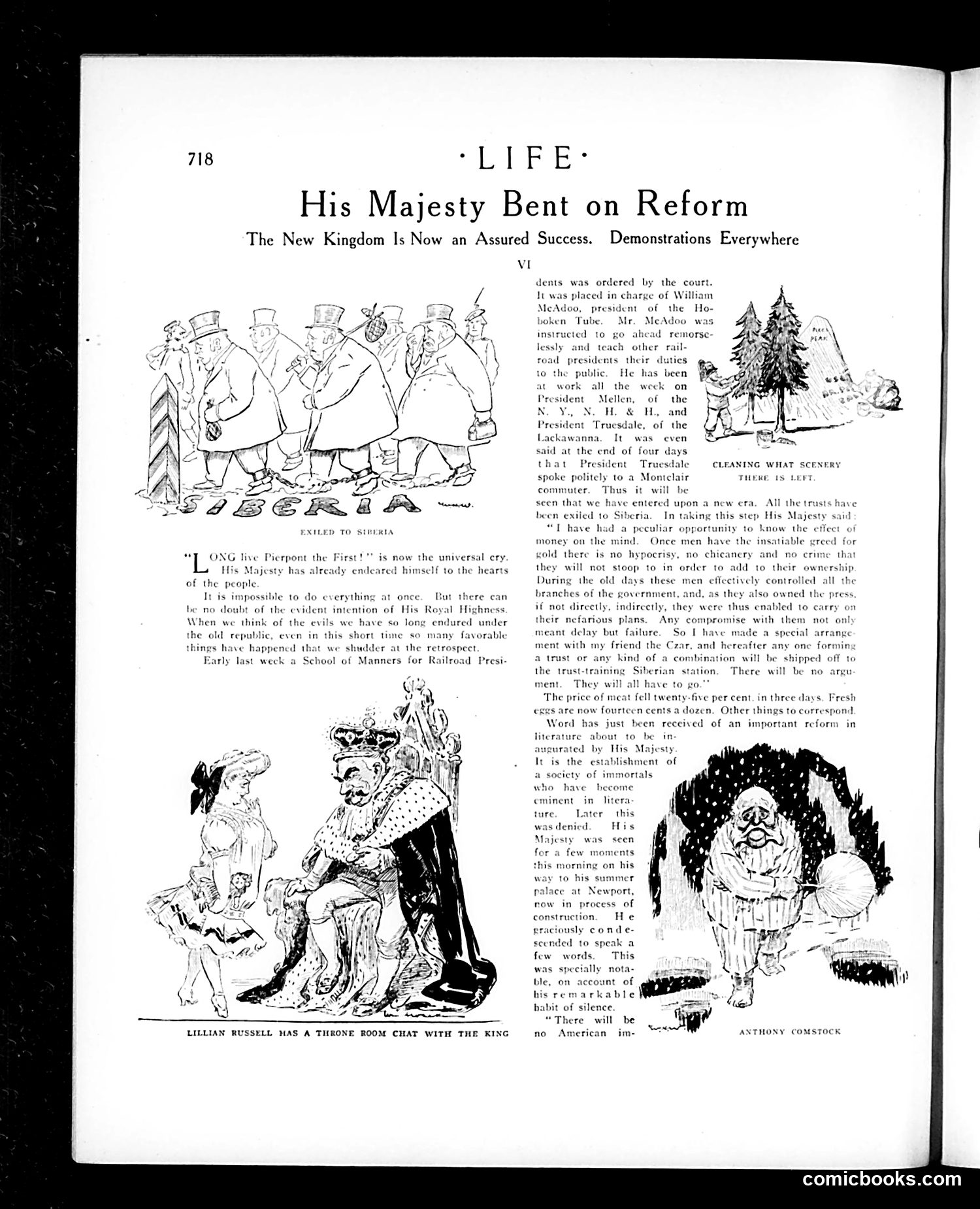
This *Life* magazine page satirizes President Theodore Roosevelt's anti-trust campaign through an imaginary "New Kingdom" where railroad executives and monopolists are "exiled to Siberia" as punishment for their corruption. The cartoon "Lillian Russell Has a Throne Room Chat with the King" depicts the famous actress meeting with the president (caricatured as a monarch), mocking the grandiose tone of reform rhetoric. The text celebrates supposed victories: railroad president McAdoo forcing competitors to behave ethically, meat prices falling after corporate punishment, and establishment of a "society of immortals" in literature—all framed as if Roosevelt were an absolute ruler restructuring society through decree rather than law. The satire's point: Roosevelt's trust-busting, while popular, is being mocked as theatrical authoritarianism rather than genuine reform. By comparing him to an autocratic king exiling dissidents, *Life* suggests the reforms are more show than substance, and that real systemic change requires more than executive posturing and symbolic punishment.
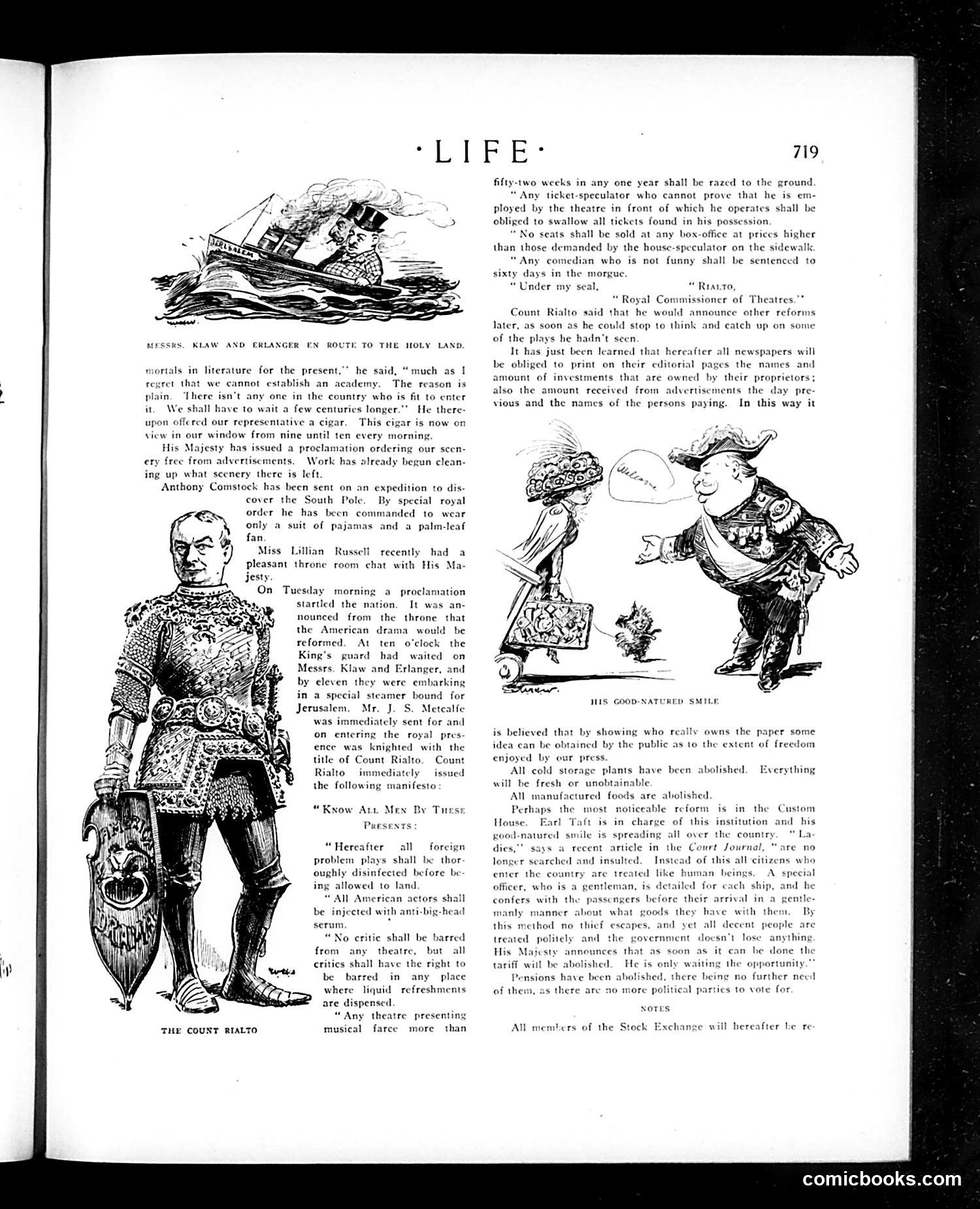
This page satirizes theatrical and political reform through the fictional "Count Rialto," apparently a stand-in for reformist authority. The main cartoon shows the Count in ornate dress, positioned as a theatrical autocrat issuing absurd decrees. **Key targets:** - **Klaw and Erlanger** (theater producers shown being deported to Jerusalem) — likely criticized as exploitative theater magnates - **Anthony Comstock** (the famous vice crusader, referenced as banished to the South Pole in pajamas) — mocked for his puritanical censorship efforts - **Theatrical abuses**: ticket speculation, inflated prices, bad comedians, and critic exclusion - **Press freedom**: reforms requiring newspapers disclose their financial interests and advertisement sources - **Earl Taft** (at the Customs House) — appears to be receiving praise for courteous treatment of immigrants The satire's point: sweeping theatrical and governmental reforms that sound noble but contain comical exaggerations and impracticalities. The overall tone mocks both theater industry corruption and overzealous reform movements.
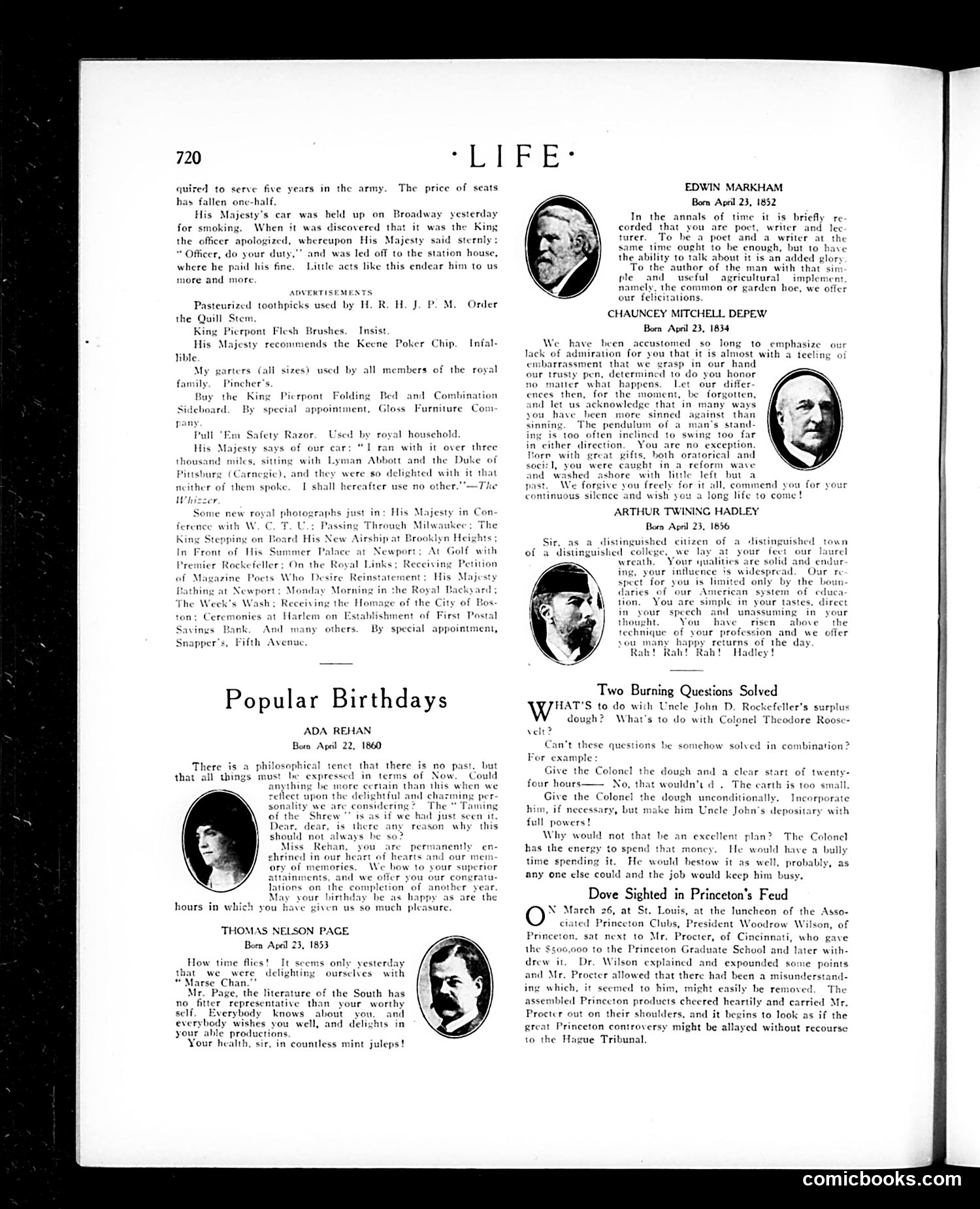
This page contains birthday tributes to notable Americans and satirical advertisements mocking a visit by a foreign dignitary (referred to as "His Majesty"). ## The Satire The advertisements parody royal endorsements, suggesting a king visiting America had endorsed various products (toothpicks, poker chips, razors, furniture) and posed for photographs at American landmarks. The opening anecdote—where the king is ticketed for smoking on Broadway but told by a police officer to "do your duty"—satirizes American egalitarianism: even royalty must obey traffic laws. The phrase "Little acts like this endear him to us more and more" ironically suggests Americans appreciate when foreigners respect democratic rules. ## The Birthday Section The page features tributes to four prominent figures born in April: actress Ada Rehan, writer Thomas Nelson Page, poet Edwin Markham, and politician Chauncey Mitchell Depew. Each tribute is lighthearted, mixing genuine praise with gentle mockery (the final line to Page jokingly toasts him "in countless mint juleps," referencing Southern stereotypes). The satire gently mocks both foreign pretension and American celebrity culture.
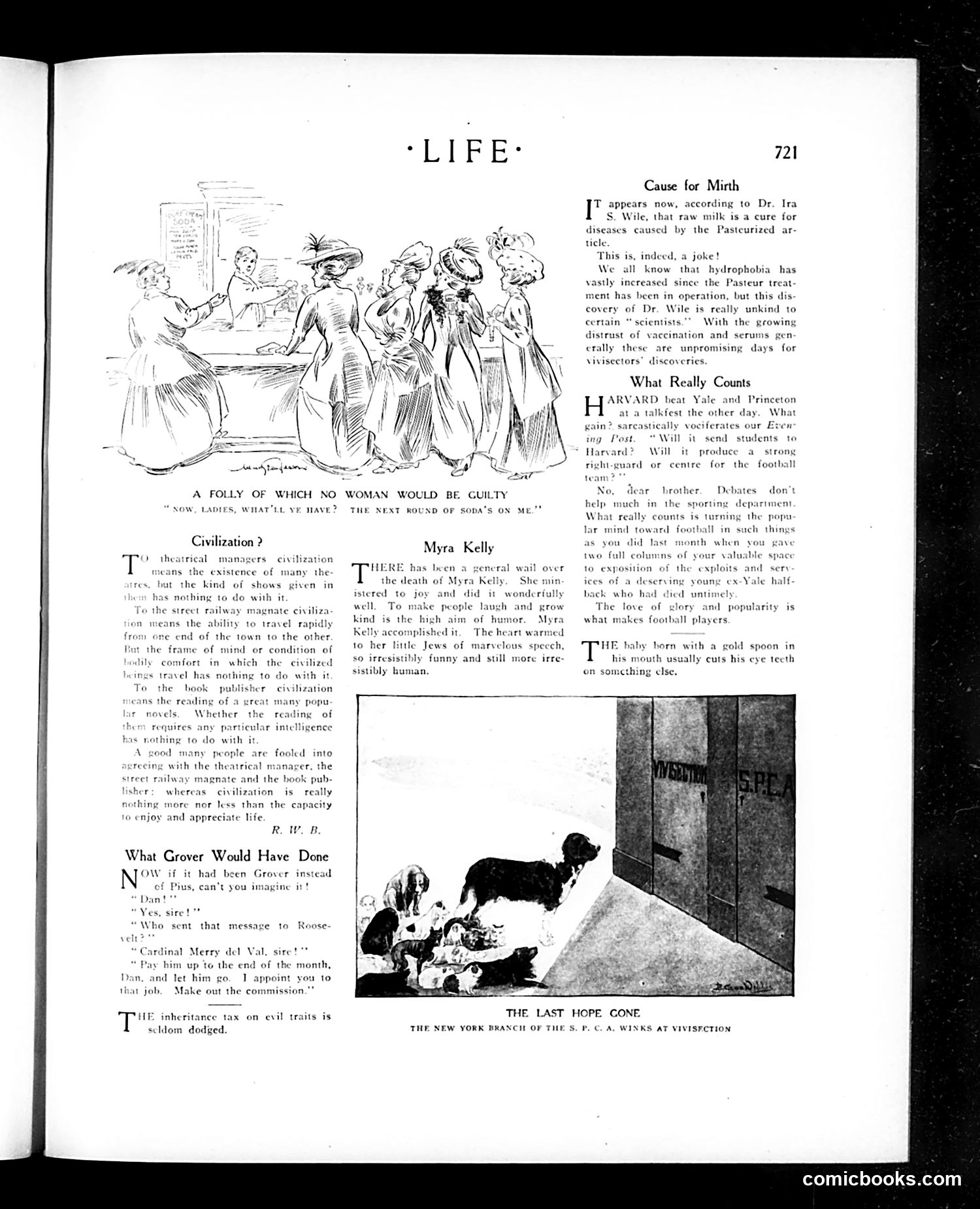
**Top Cartoon** ("A Folly of Which No Woman Would Be Guilty"): A sketch of women at what appears to be a social gathering, with the caption quoting a bartender offering drinks. The satire mocks the contradiction between women's claimed moral superiority and their actual behavior in social settings. **"What Grover Would Have Done"**: A hypothetical scenario imagining President Grover Cleveland's response to a papal message from Cardinal Merry del Val. The joke satirizes Cleveland's perceived corruption or favoritism by suggesting he'd bribe church officials—a commentary on political patronage and machine politics of the era. **"Civilization?"**: A philosophical critique arguing that "civilization" means nothing more than the capacity to enjoy life, not the supposed intellectual achievements theater managers and railway companies claim to represent. **Bottom Image** ("The Last Hope Gone"): A photograph showing the S.P.C.A. (Society for the Prevention of Cruelty to Animals) ignoring animal cruelty, sarcastically captioned to criticize the organization's apparent indifference to vivisection—a heated contemporary debate.
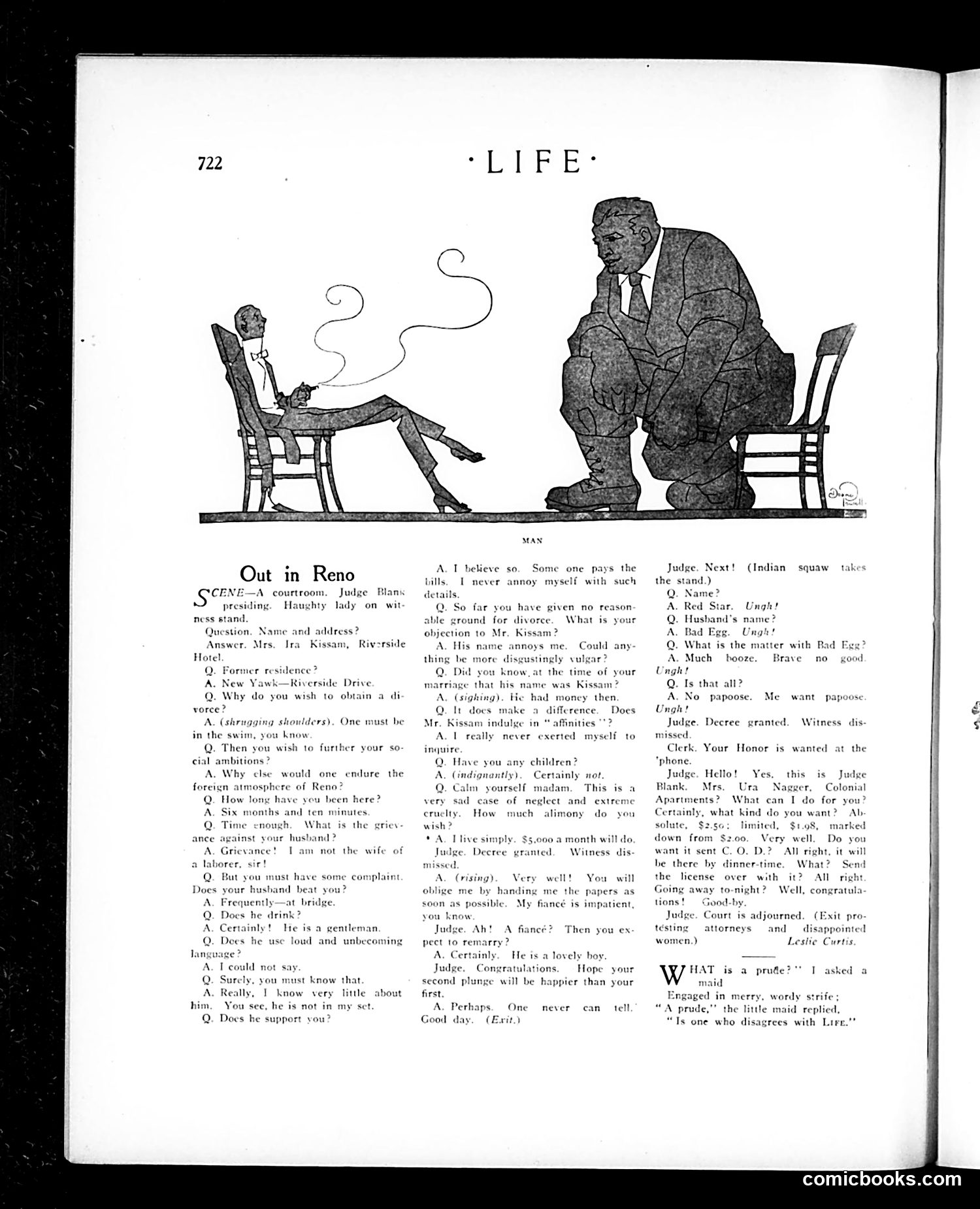
This page satirizes Reno, Nevada's notorious divorce industry in the early 20th century. The main cartoon depicts a wealthy woman obtaining a divorce with stunning ease and cynicism. She admits she married for money, has no genuine grievance against her husband beyond his name being "vulgar," and immediately expects to remarry—all while demanding $5,000 monthly alimony ($180,000+ today). The satire targets the absurdity of Reno's lenient divorce laws, which attracted wealthy Americans seeking quick separations. The woman's shallow materialism and the judge's casual processing of her case mock both frivolous divorces and gold-digger culture. A secondary scene ridicules the system's class disparities: an "Indian squaw" also obtains divorce but receives nothing, highlighting how Reno's accommodations served the wealthy elite. The bottom joke about "prude" definitions extends the critique of modern morality and changing social values.
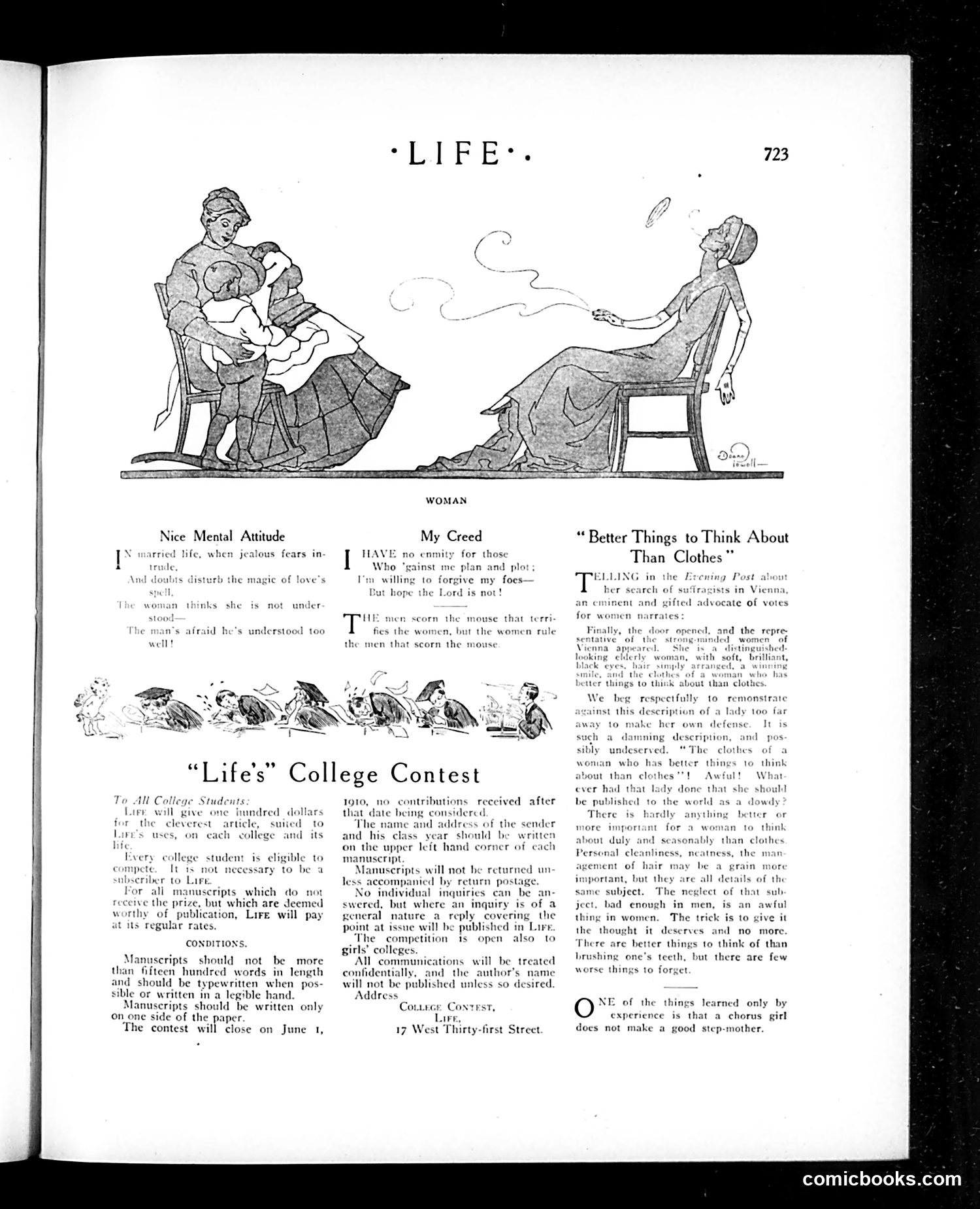
This page features social commentary on women's roles and fashion in early 1910s America. **Top Cartoon:** Depicts two women—one actively mothering children, the other lounging idle—illustrating the tension between traditional domestic duties and leisured contemplation. The accompanying verses mock male hypocrisy: men scorn women's fear of mice yet remain ruled by women. **"Better Things to Think About Than Clothes":** Responds to a Viennese women's advocate who dismissed fashion concerns as trivial. The rebuttal argues that personal grooming and dress—cleanliness, neatness, appearance—are legitimate, important matters for women, not frivolous vanity. The satire critiques the dismissive attitude toward women's practical concerns about presentation. **College Contest:** Life announces a $100 prize for the best college article, open to male and female students. **Bottom Quip:** A cynical aside about chorus girls as poor stepmothers—likely referencing showgirls' reputations as unsuitable mothers. The page reflects contemporary debates over feminism, women's education, and evolving social roles.
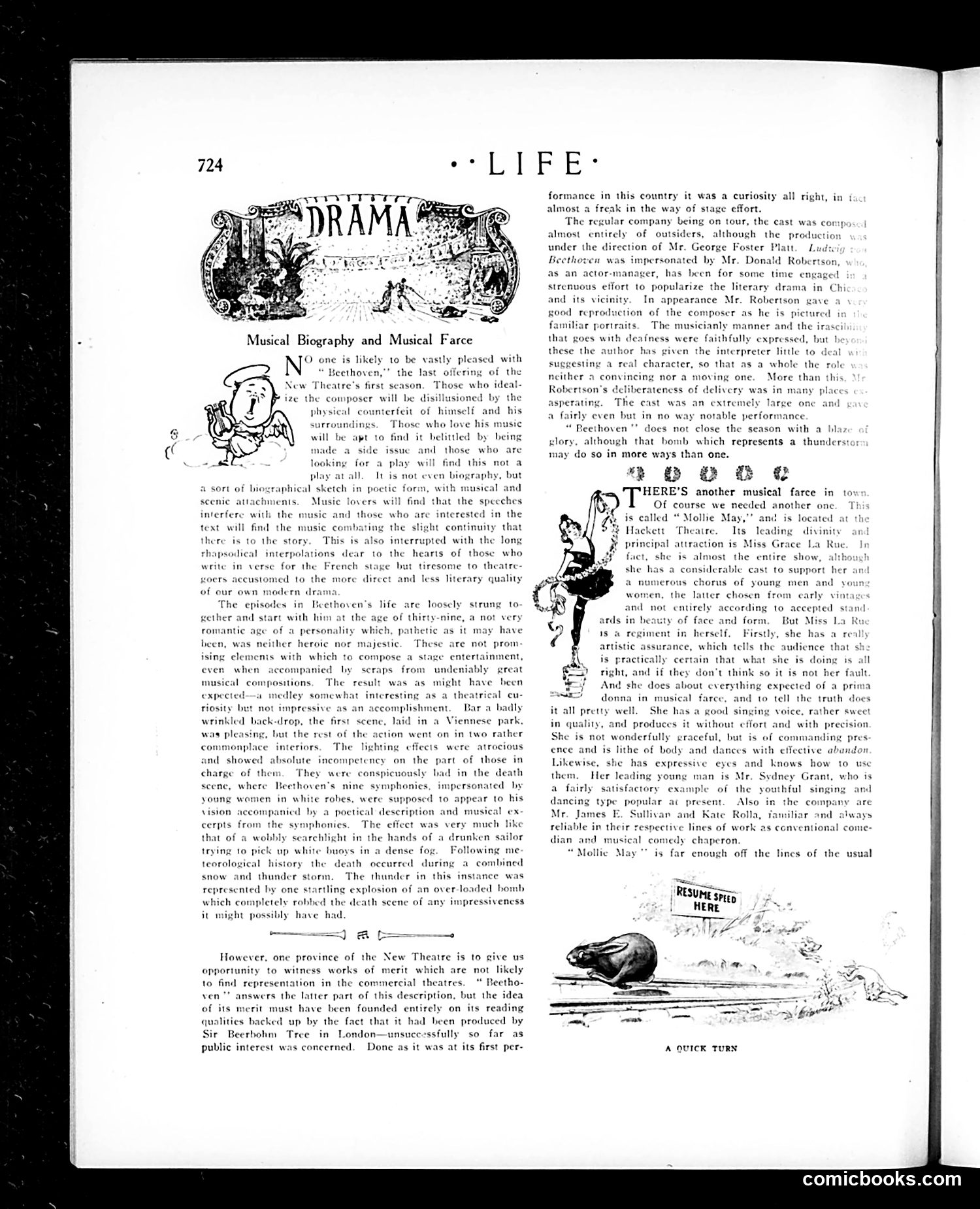
This is a theater review of a production called "Beethoven" at New York's New Theatre. The critic dismisses it as neither satisfying drama, biography, nor musical performance—a "medley" that fails on all fronts. The production attempted to dramatize composer Beethoven's life through poetic dialogue interspersed with excerpts from his symphonies. The critic finds this hybrid approach disastrous: music lovers resent speeches interrupting the compositions; drama lovers find no real plot; the biographical framework is weak, starting at Beethoven's age 39 and including awkward elements like the symphonies represented by "young women in white robes." The staging is mocked as incompetent—bad lighting effects, a "wobbly searchlight" quality during the death scene, and an overloaded bomb sound effect meant to represent thunder. The review grudgingly acknowledges the New Theatre's mission to stage literary works unavailable commercially, but concludes this production—originally produced unsuccessfully in London by Sir Beerbohm Tree—proved that not all artistically ambitious works translate successfully to stage.
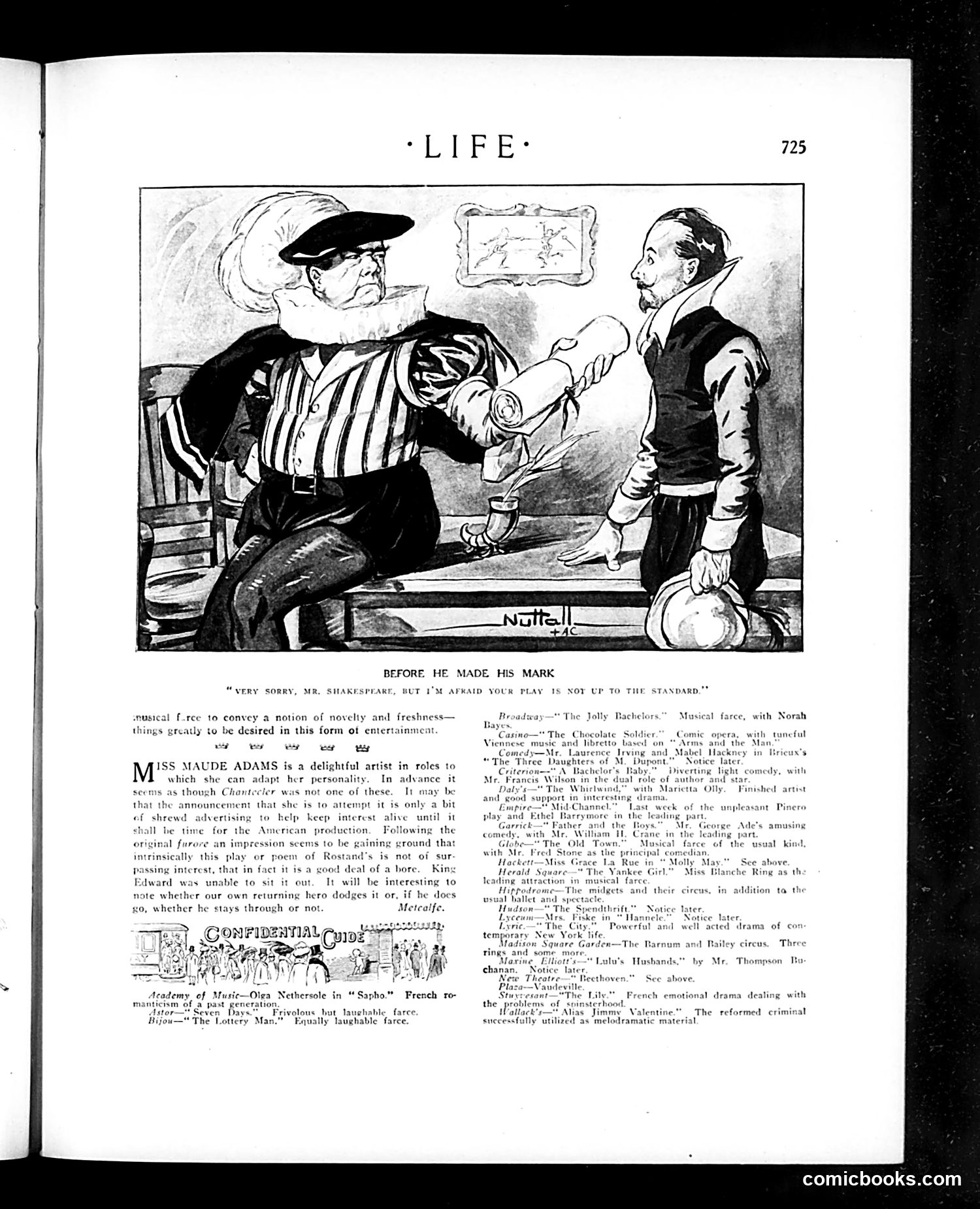
The main cartoon satirizes theatrical gatekeeping and rejected genius. It depicts a dismissive theater manager or producer rejecting a playwright's manuscript, telling "Mr. Shakespeare" his play doesn't meet standards—a clear absurdist joke suggesting that even history's greatest dramatist would be rejected by contemporary theatrical arbiters. The page accompanies a broader article about actress Maude Adams, discussing her upcoming role in Edmond Rostand's *Chantecler*. The satire critiques how Broadway producers and critics operate: they claim to uphold high standards while potentially missing or undervaluing genuine artistic merit. By invoking Shakespeare specifically, the cartoon mocks the pretension and poor judgment of theater gatekeepers—implying that modern producers might similarly reject masterpieces if presented anonymously today. The surrounding theater reviews suggest contemporary debates about entertainment quality and commercial viability.
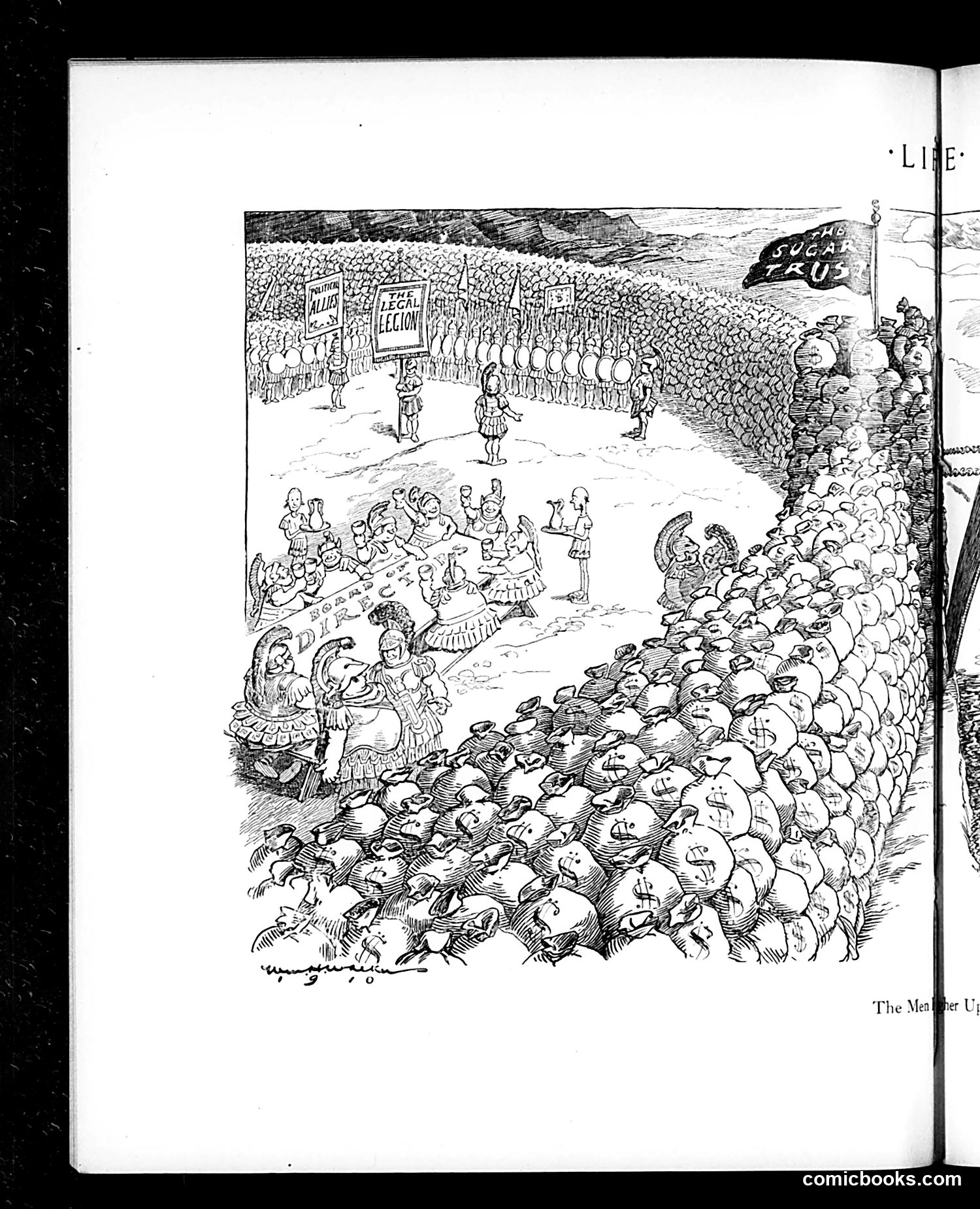
This is a political cartoon satirizing fascism and militarism, likely from the 1930s-1940s era based on the style. The image depicts a massive crowd of soldiers or military figures (shown as identical helmeted heads marked with dollar signs) being assembled for what appears to be a military rally or parade. A flag labeled "Sucho's" (unclear reference) flies above. The contrast between the dehumanized, identical soldiers and the smaller, differentiated civilian figures suggests the cartoon critiques how fascist regimes reduce individuals to interchangeable military units while profiting from war (the dollar signs emphasize commercialization of conflict). The caption "The Melter Up" (partially visible) likely refers to how such systems "melt" individual identity into collective militarism. This is anti-war, anti-fascist propaganda in Life magazine's satirical tradition.
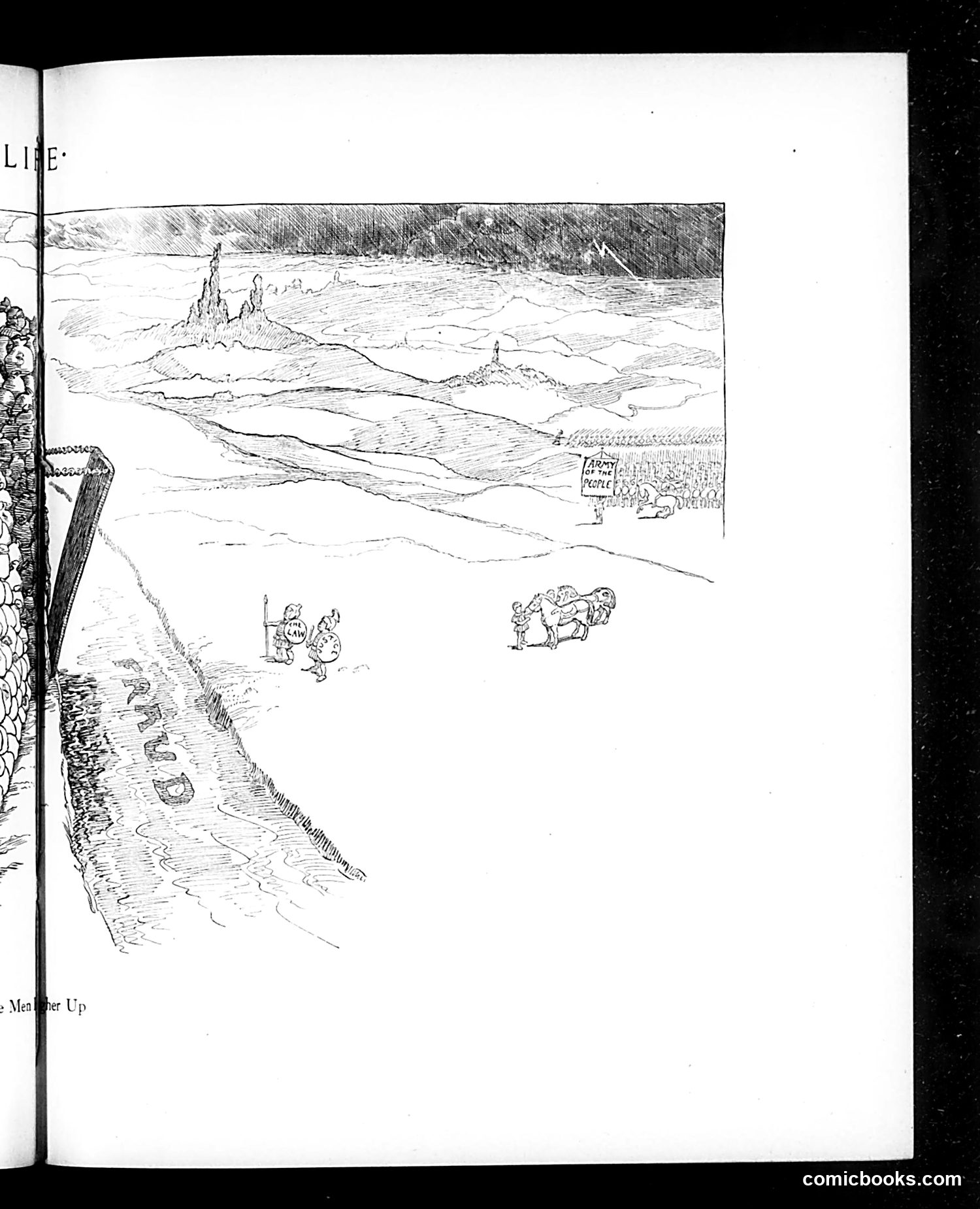
This page appears to be from Life magazine and contains a satirical landscape illustration. The drawing depicts what seems to be a vast, undulating terrain with scattered figures and groups of people distributed across it. In the foreground on the left, there's a detailed shoreline or embankment. In the distance, various small human figures and groups are positioned throughout the landscape, with what appears to be military or organized formations visible. However, without clearer text visible on the page or additional context, I cannot definitively identify the specific political figures, historical event, or satirical point being made. The style and composition suggest social or political commentary typical of Life magazine's satirical approach, but the specific subject matter remains unclear from this image alone.
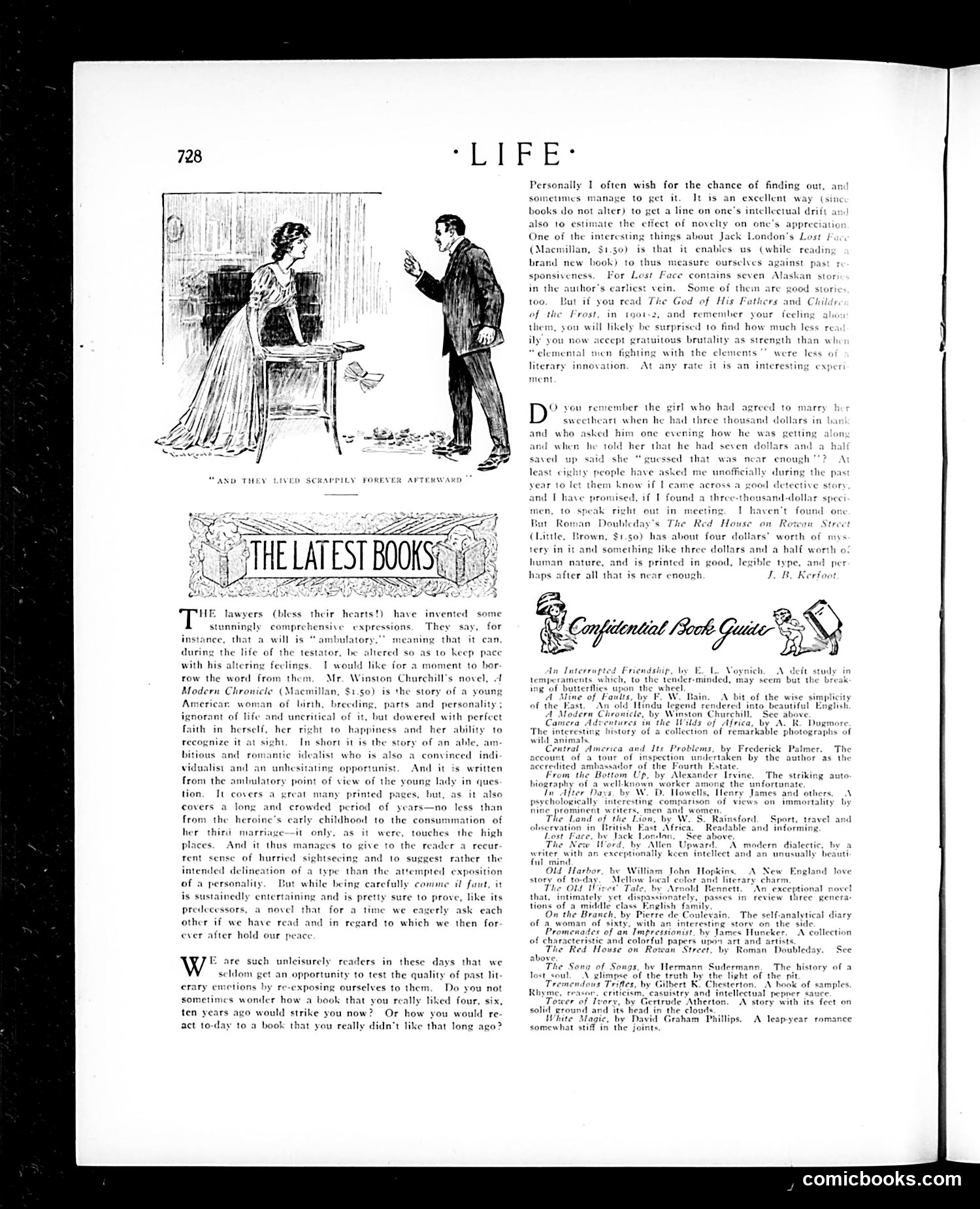
This is a literary review page from *Life* magazine featuring two cartoon illustrations and book reviews. The upper cartoon, captioned "And They Lived Scrappily Forever After," depicts a couple—apparently a man and woman in domestic conflict—suggesting satirical commentary on marriage or romantic relationships. The page's content focuses on newly published books, particularly Jack London's *Lost Face* and Winston Churchill's *Modern Chronicle*. The reviewer discusses how reading old versus new works reveals changing aesthetic tastes, and notes an apparent demand for detective stories. The "Confidential Book Guide" section lists contemporary publications. The cartoons and text together reflect *Life*'s mission as a satirical magazine: using humor to comment on contemporary culture, including evolving social attitudes toward literature, romance, and modernism. Without additional context, the specific marital scenario in the cartoon remains unclear, though it likely referenced recognizable social commentary of the period.
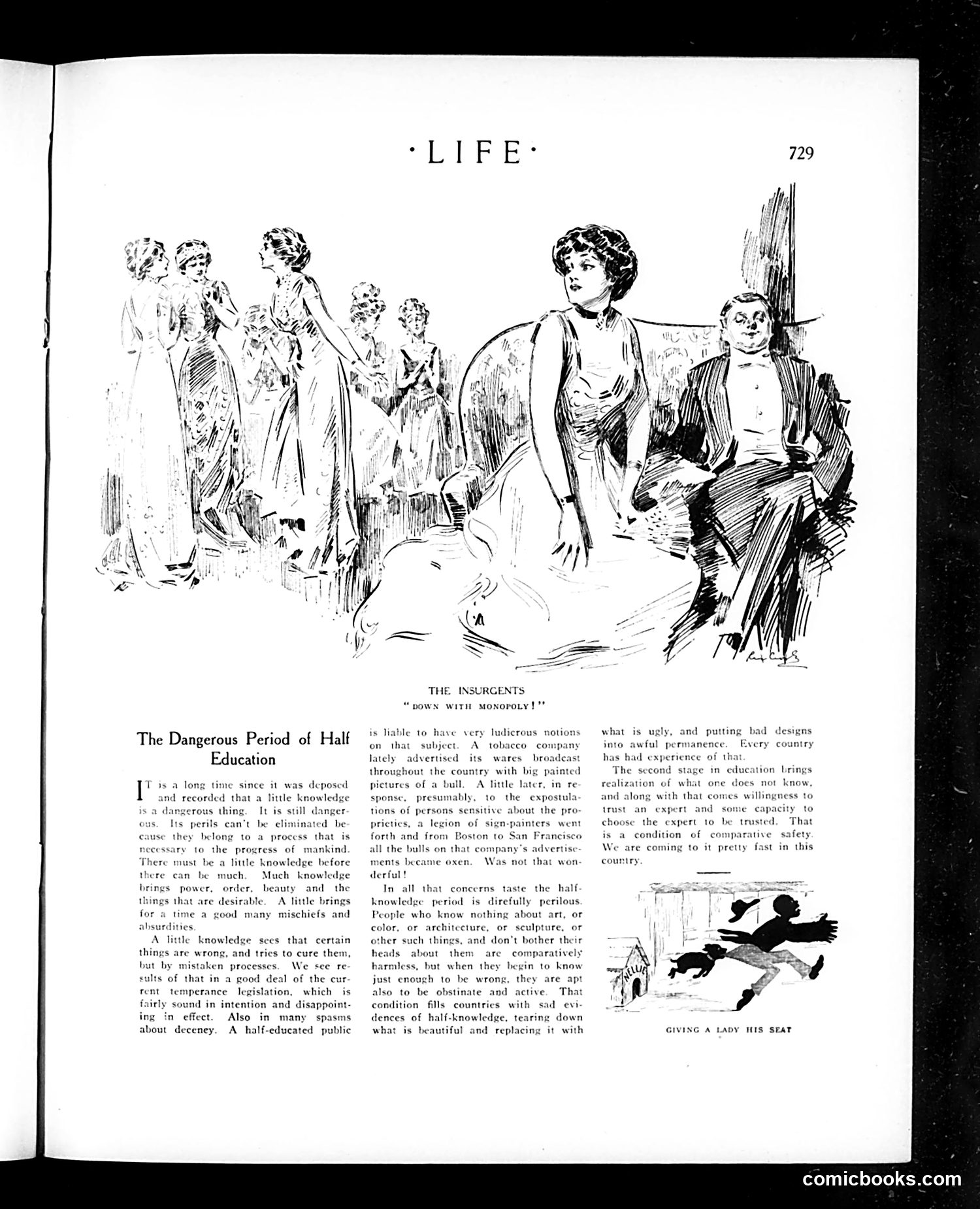
This editorial piece satirizes the risks of partial education and half-informed activism. The text argues that people with *some* knowledge but incomplete understanding are more dangerous than the fully ignorant—they become zealous reformers who destroy good things while trying to "fix" them. The cartoon "The Insurgents" (captioned "Down with Monopoly!") illustrates this: it depicts well-dressed activists aggressively confronting what appears to be a seated gentleman, representing overeager reformers attacking established systems without full understanding. The specific example provided is a tobacco company's advertising featuring bulls; when semi-educated activists objected to the imagery, sign-painters allegedly "corrected" all the bulls to oxen—a petty, absurd "victory" that demonstrates how half-educated crusaders create ridiculous outcomes. The second cartoon, "Giving a Lady His Seat," appears to humorously reference modern courtesies or social reforms. The piece warns that without complete education, activists cause more harm than good.
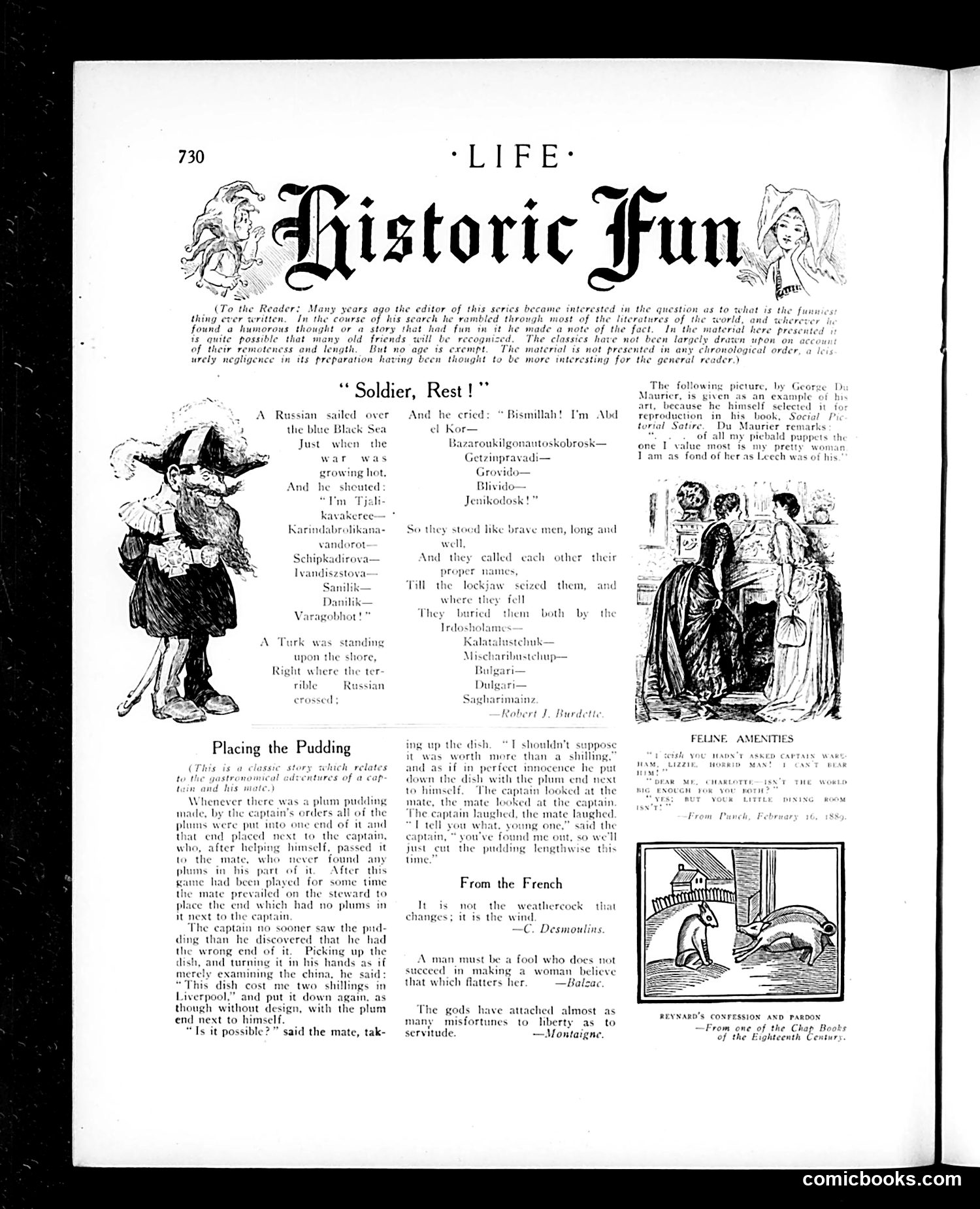
This Life magazine page contains three distinct pieces of humor: **"Soldier, Rest!"** mocks the Russo-Turkish War through a Russian soldier's comically unpronounceable name (a string of Slavic-sounding gibberish), satirizing stereotypes about Russian language difficulty and the absurdity of war itself. **"Placing the Pudding"** is a classic shipboard trick tale: a captain and mate play games with a plum pudding, each trying to cheat the other by positioning the plum-filled end away from their rival. When discovered, they resolve their conflict—a gentle satire on human vanity and self-interest that ultimately yields to cooperation. **"From the French"** presents philosophical quotations attributed to French thinkers (Desmoullins, Balzac, Montaigne), offering witty commentary on human nature and society. The page also includes illustrations and a small woodcut titled "Reynard's Confession and Pardon," referencing the medieval *Reynard the Fox* fables. Overall, the page exemplifies Life's satirical tradition combining literary humor, social commentary, and whimsical storytelling.
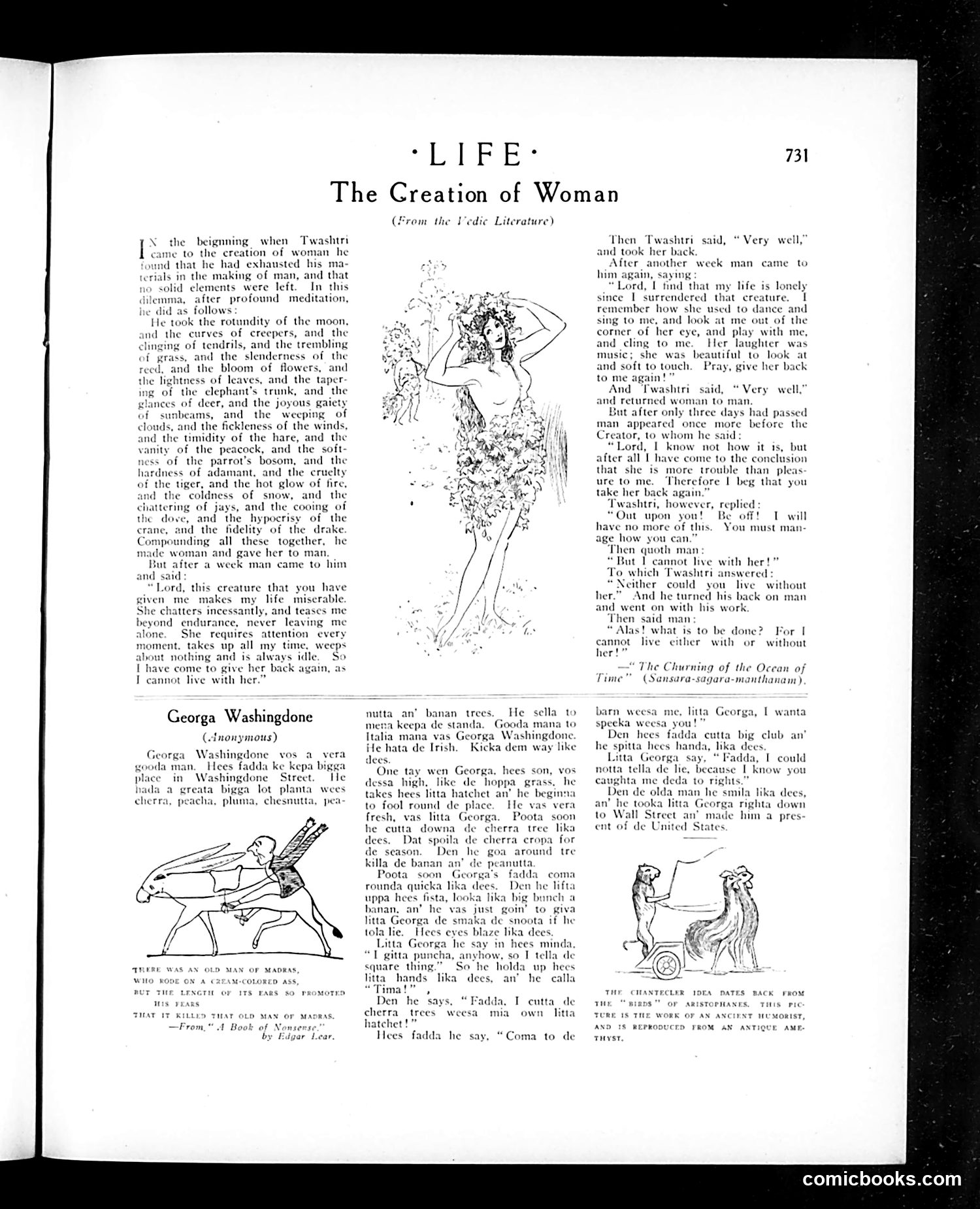
This page contains two distinct pieces of satirical content: **"The Creation of Woman"** (top) is a literary excerpt from Vedic sources presenting a humorous origin myth. It satirizes gender relations by depicting woman as composed of nature's most contradictory elements—beauty mixed with fickleness, tenderness with hypocrisy. The joke culminates in man's complaint that woman is unbearable, yet when she's taken away, he misses her. Twashtri's final refusal to intervene mocks male indecision about women, suggesting men must simply endure the situation they've created. **"Georga Washingdone"** (bottom) is a dialect piece using broken English phonetics, likely mocking Irish or immigrant speech patterns. It references the apocryphal young George Washington cherry-tree story, but replaces the famous "I cannot tell a lie" moral lesson with a different narrative about property destruction. The crude dialect humor was typical of early 20th-century American magazines, though such content would be considered offensive today. Both pieces use humor to explore male-female dynamics and social hierarchies.
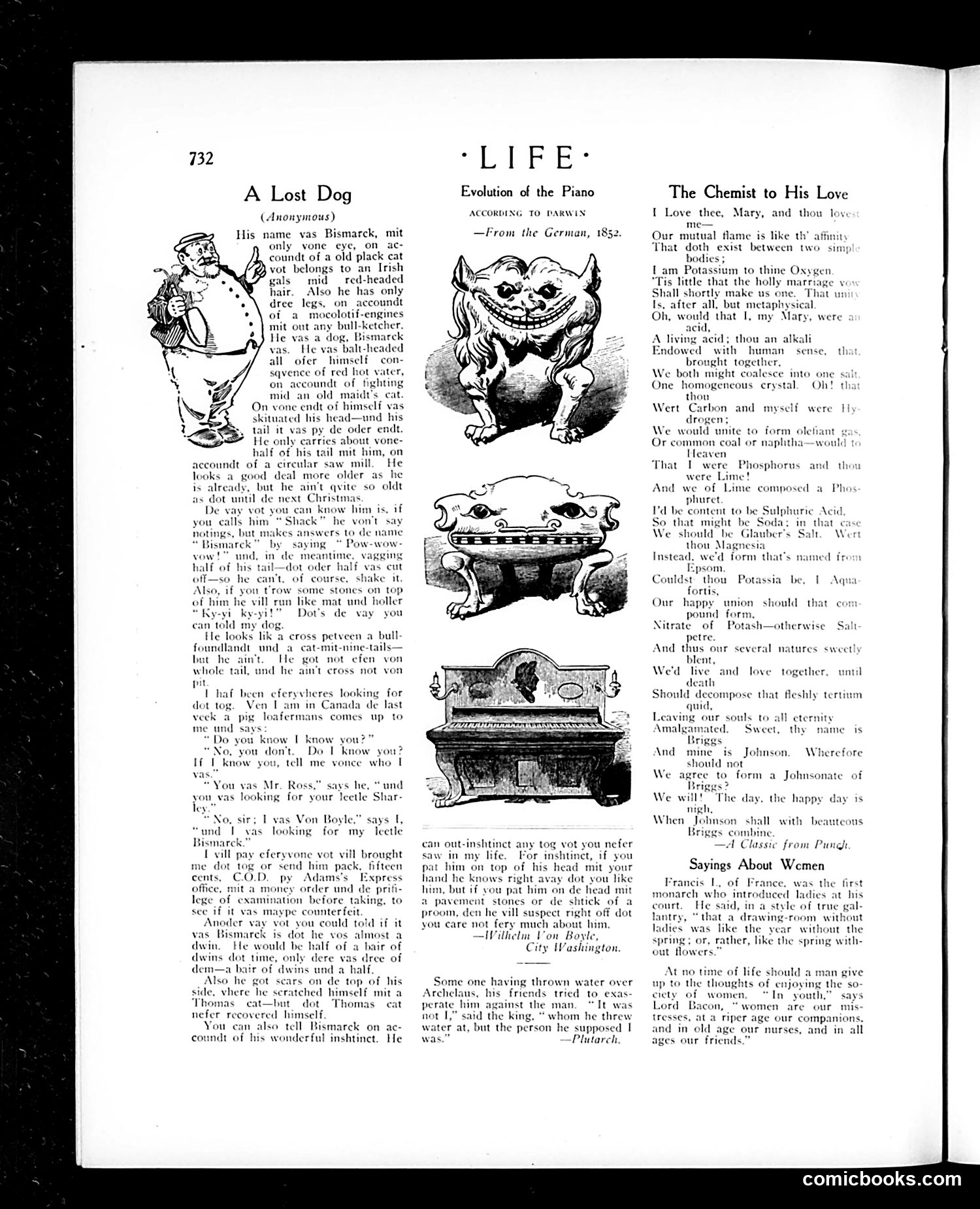
This is a humorous lost-dog advertisement written in exaggerated German-accented English ("vone," "vay," "dot"). The joke targets German immigrants' distinctive speech patterns, which were popular comedic fodder in late-19th-century American satire. The dog "Bismarck" (named after the famous German chancellor) is described through absurdist, contradictory details: one-eyed, three-legged, bald, missing half its tail. The advertisement's labyrinthine sentences and malapropisms pile up ridiculousness—the dog "vos almost a dwin" (twin), bears scars from fighting a cat, and responds to "Pow-wow-vow!" The satire mocks both the immigrant accent itself and the earnest, overwrought lost-pet notices common in newspapers. The final touch—offering a $15 C.O.D. reward through Adams's Express—mimics genuine classified ads while the absurd description renders the whole thing nonsensical.
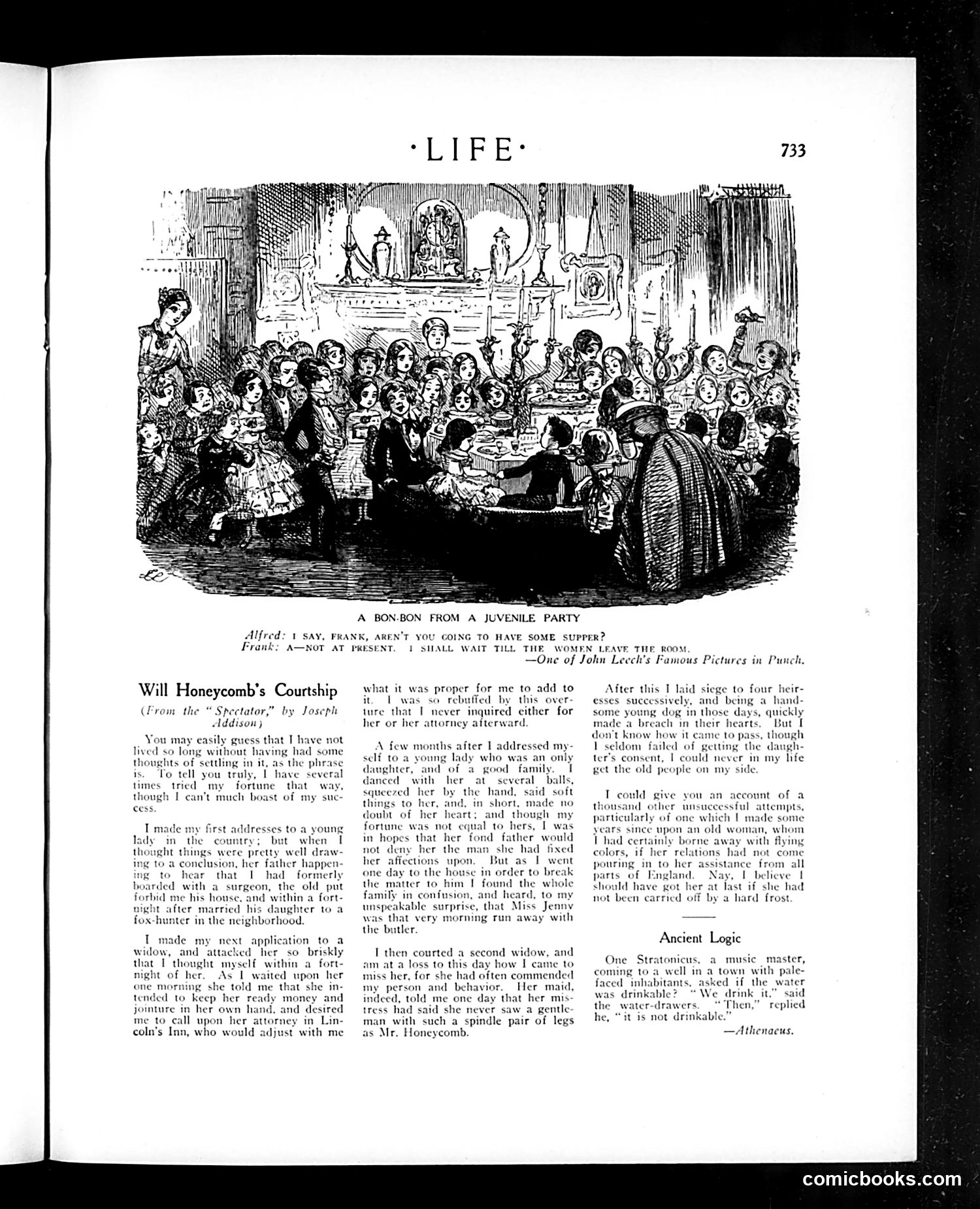
This page reprints a classic satirical essay by Joseph Addison from *The Spectator* (early 1700s), paired with a John Leech cartoon from *Punch*. **The text** presents Honeycomb's comically unsuccessful courtship attempts. Each rejection exposes social anxieties of the era: a prospective father-in-law rejects him for his past association with a surgeon (low social status); a widow demands he consult her attorney about finances; a young lady elopes rather than marry him; heiresses' parents block the match despite the women's interest. **The satire targets**: male vanity (Honeycomb thinks himself a "handsome young dog"), mercenary marriage practices, parental control over daughters' choices, and social class rigidity. **The cartoon** shows a juvenile party where Alfred asks Frank about supper while Frank deliberately waits until "the women leave the room"—likely satirizing male behavior: boys prioritizing food over politeness, or avoiding female company. Both pieces mock courtship conventions and social pretension through accumulated small failures rather than dramatic events.
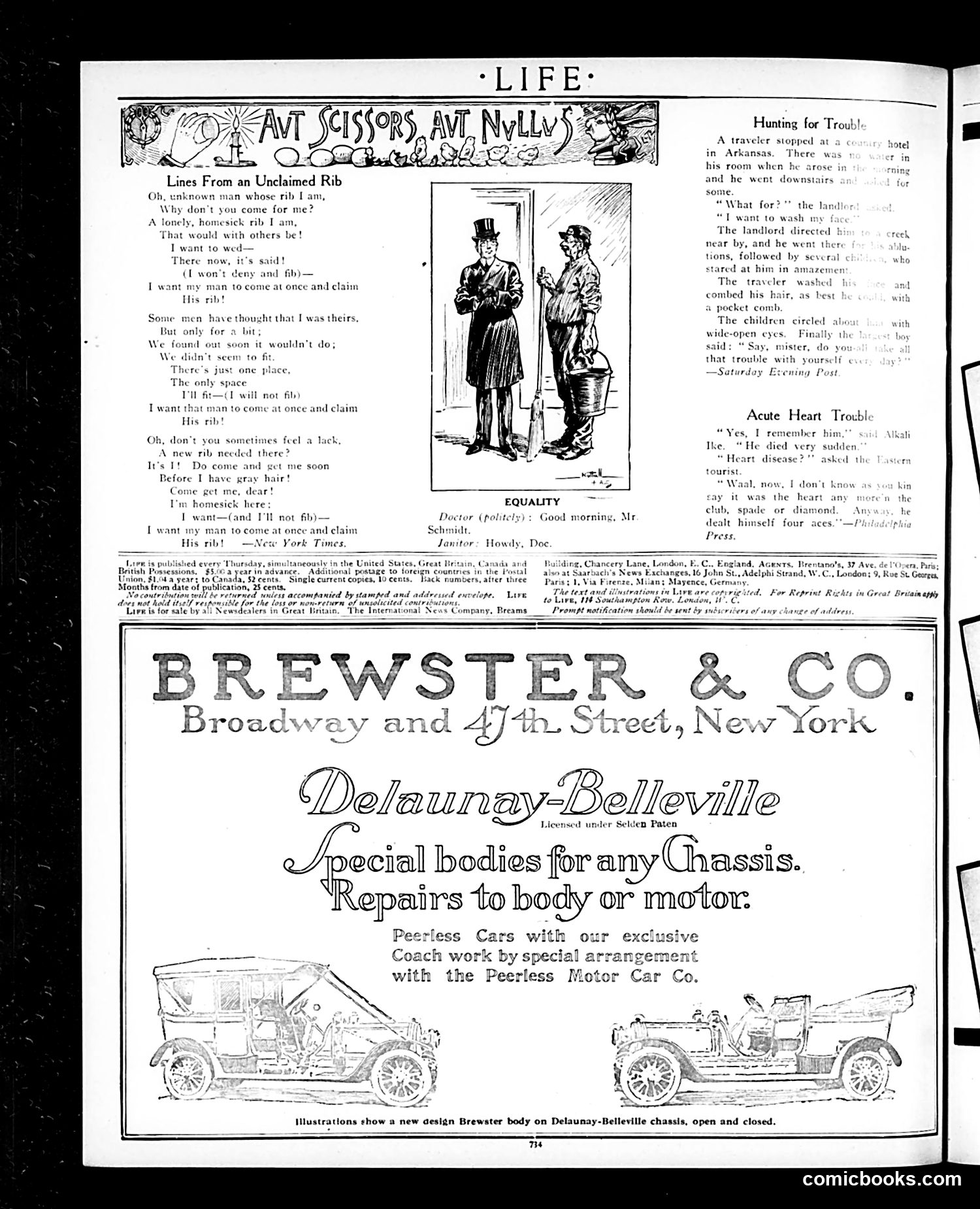
This page contains satirical poetry and light humor rather than political cartooning. **"Lines From an Unclaimed Rib"** is a humorous poem playing on the biblical Genesis creation story (God creating woman from man's rib). The conceit treats a rib as a lonely, homesick entity seeking its original owner—a whimsical personification that works as absurdist comedy about separation and incompleteness. **The cartoon "Equality"** shows a doctor greeting a janitor with identical familiarity ("Good morning, Mr. Schmidt" / "Howdy, Doc"), suggesting social commentary about treating all people with equal respect regardless of class or profession. **"Hunting for Trouble"** and **"Acute Heart Trouble"** are brief anecdotal humor pieces about a traveler's misadventures and a widow's health concerns—typical light-hearted Life magazine filler content. The page is primarily **advertising** for Brewster & Co. automobiles (Delaunay-Belleville chassis), occupying the lower half with product illustrations and specifications.
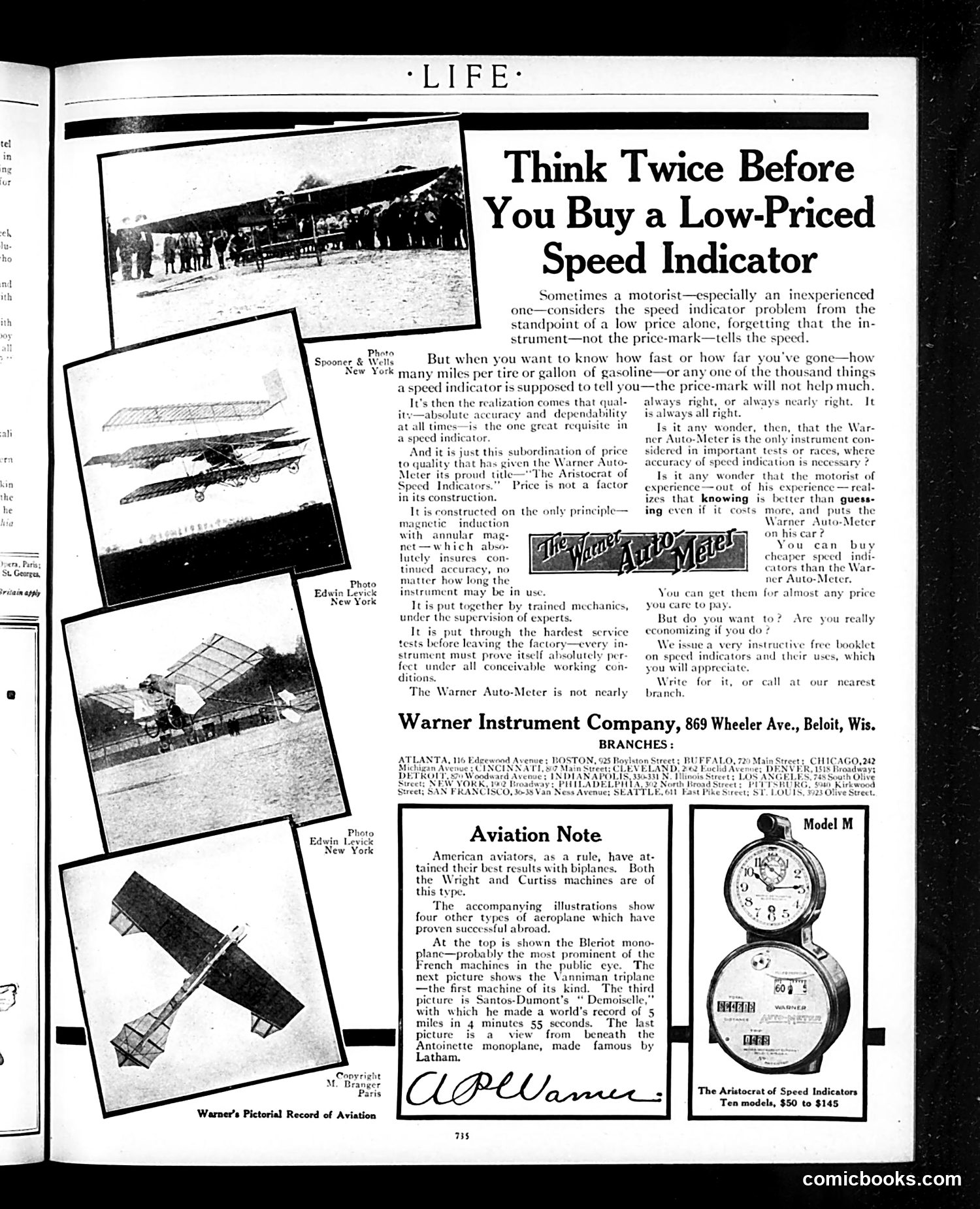
This page is primarily **advertising**, not satire or political commentary. The main content is a Warner Auto-Meter advertisement urging motorists not to buy cheap speed indicators. The argument: price doesn't determine accuracy—only quality matters. The Warner Auto-Meter is positioned as "the Aristocrat of Speed Indicators," proven reliable in important races where precision is necessary. The accompanying photographs show early aviation examples (Blériot monoplane, Wright/Curtiss biplanes, Santos-Dumont's "Demoiselle"). These illustrate successful aircraft designs, likely included to associate Warner's precision manufacturing with cutting-edge technology of the era (early 1900s). The page reflects early automotive concerns: as cars became common, reliable speedometers became important safety and legal equipment. This is straightforward consumer marketing, not editorial commentary.
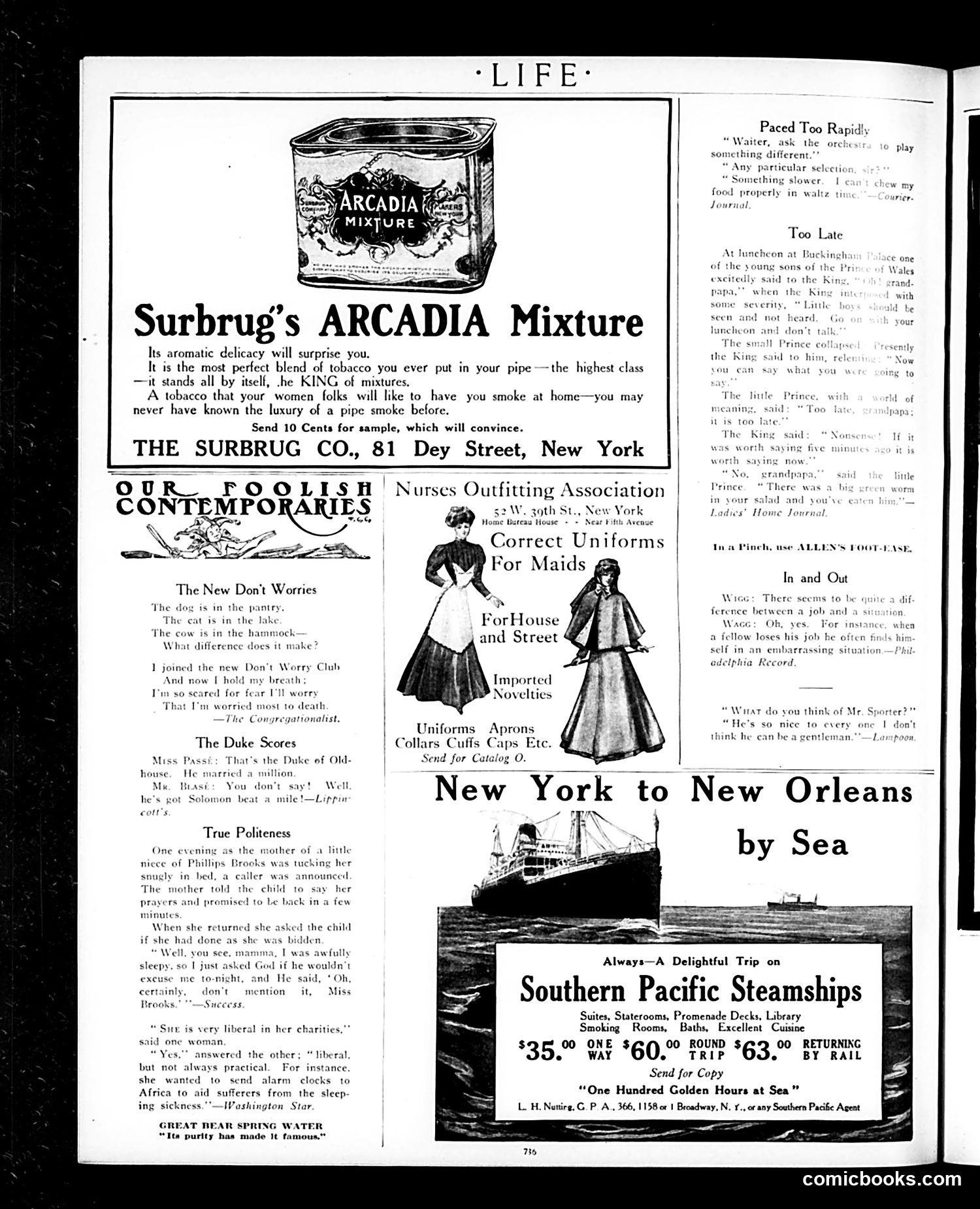
This page is primarily **advertisements and humor columns** rather than political cartoons. The content includes: **Main Items:** - Surbrug's Arcadia Mixture tobacco ad (top) - "Our Foolish Contemporaries" humor section featuring brief jokes about worry, titled pieces like "The Duke Scores" and "True Politeness" - Nurses Outfitting Association and maid uniform advertisements - Southern Pacific Steamships travel ad **The Humor:** The jokes target genteel society anxieties—worrying obsessively about worry itself, snobbish attitudes about marrying wealthy partners, and the gap between stated charitable impulses and practical charity (sending alarm clocks to Africa for sleeping sickness victims). **For Modern Readers:** These are gentle, class-conscious satirical observations typical of early 20th-century satirical magazines. They mock upper-middle-class pretensions and social contradictions without sharp political bite. The page reflects period concerns about propriety, wealth, and modernity—not substantive political commentary.
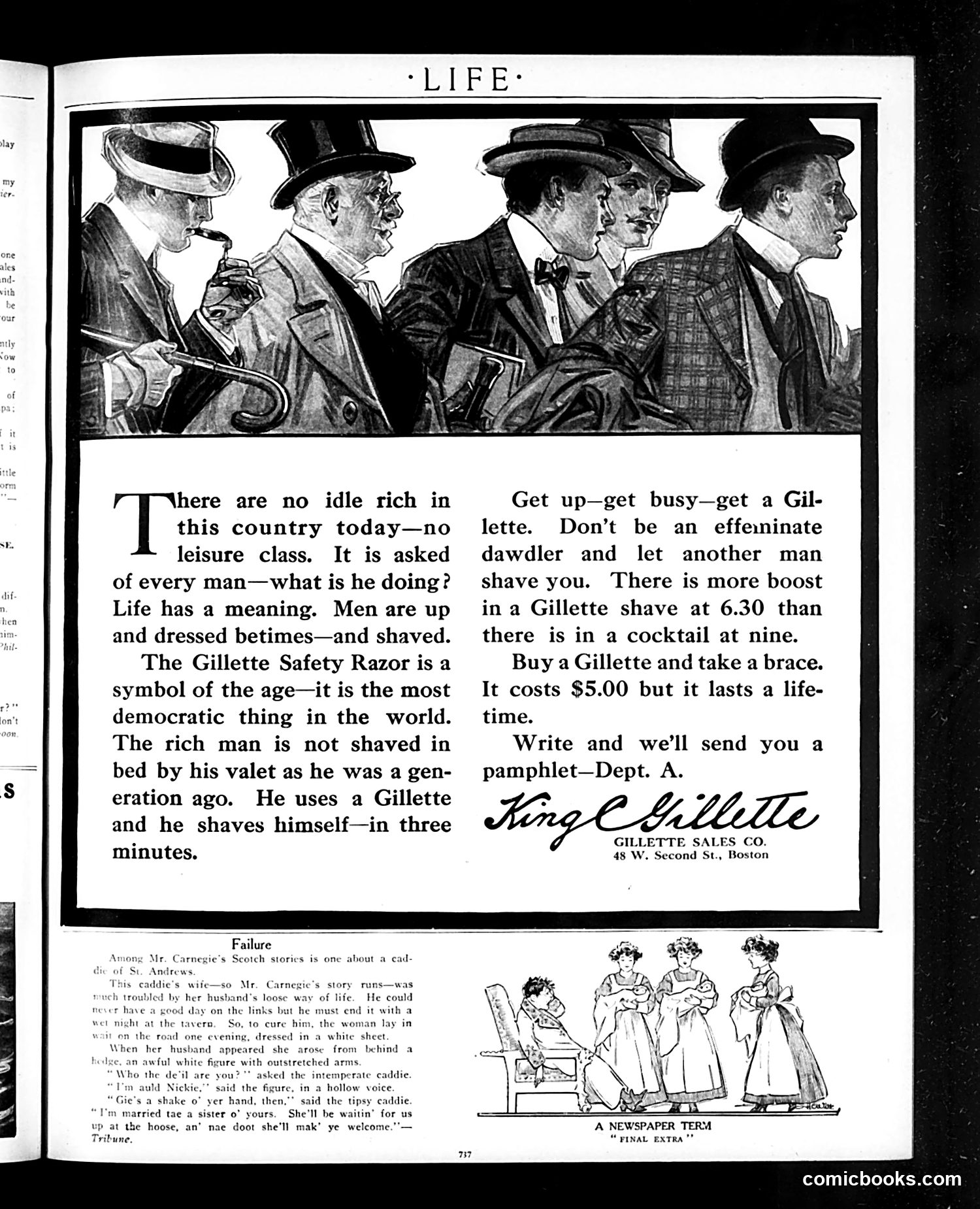
This page contains a **Gillette Safety Razor advertisement** disguised as social commentary, plus an unrelated short anecdote below. ## The Advertisement The upper section features five illustrated men in profile and argues that the Gillette razor represents modern democratic values. The ad claims there are "no idle rich" anymore—even wealthy men now shave themselves rather than employing valets, making self-shaving a symbol of the age's egalitarianism. It positions the Gillette as a tool of progress and masculinity, urging readers not to be "effeminate" or lazy. The ad's rhetoric ties personal grooming to national productivity and vigor, appealing to early-20th-century ideals of self-reliance and action. ## The "Failure" Section Below is an unrelated comic anecdote attributed to Andrew Carnegie about a Scottish caddie and his troubled marriage, ending with a ribald punchline. Its connection to the page's main content is unclear.
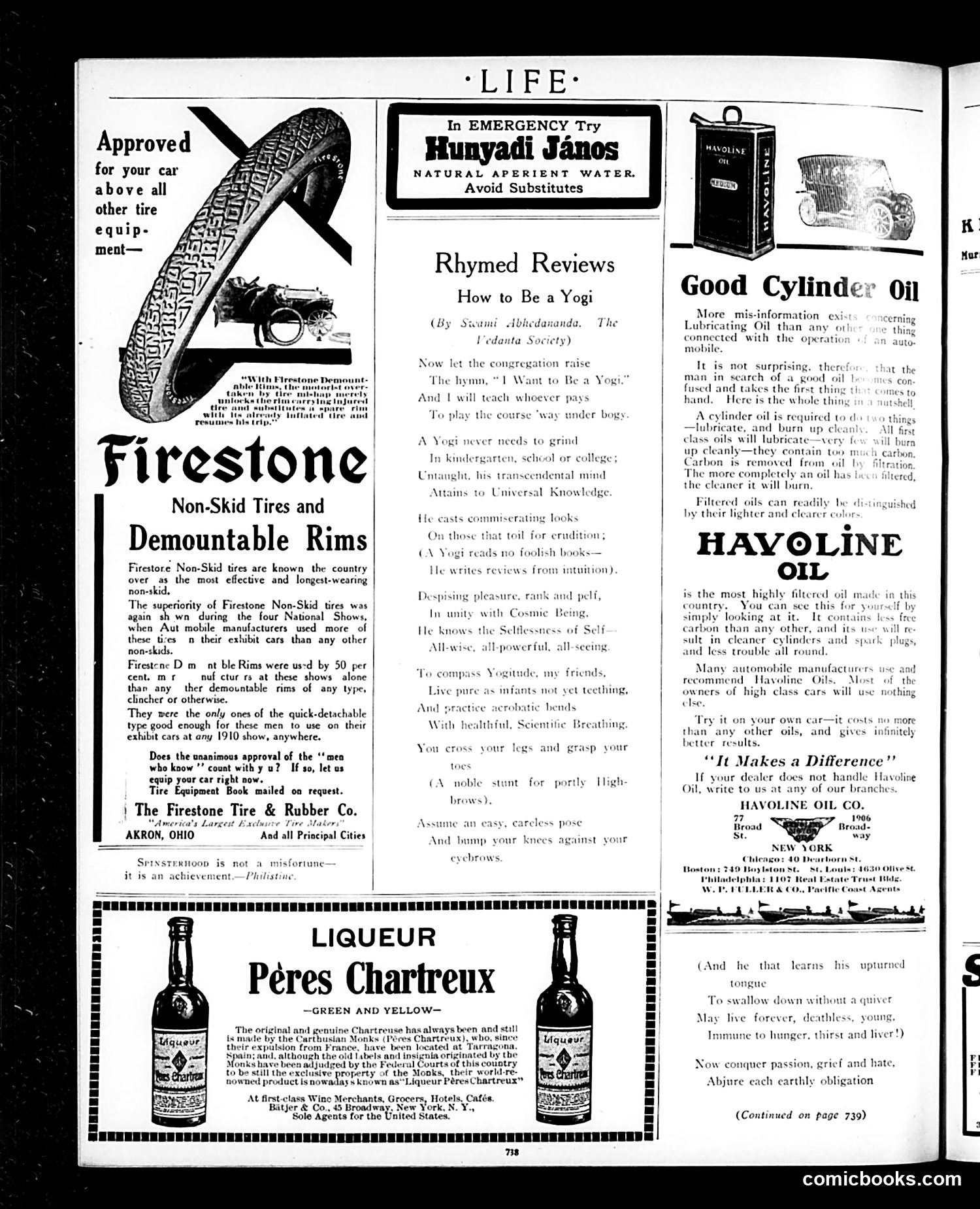
This page is primarily **advertisements interspersed with light satirical content**, not political cartoons. The main satire is the "Rhymed Reviews" column mocking a book called *How to Be a Yogi* by Swami Abhedananda. The poem humorously depicts yoga instruction as absurdly simple—yogis need not study, read books, or think; they simply achieve enlightenment through contorted poses ("practice aerobatic bends") and touching their knees to their eyebrows. The satire targets both trendy Western interest in Eastern mysticism and the pretentiousness of self-help instruction. Phrases like "writes reviews from intuition" mock superficial expertise. The remaining content consists of **period advertisements**: Firestone tires, Havoline motor oil, Hunyadi János water (a laxative), and Péres Chartreux liqueur. These reveal early 1910s consumer goods and marketing approaches. The page reflects early 20th-century American attitudes toward yoga as exotic, fashionable nonsense rather than serious spiritual practice.
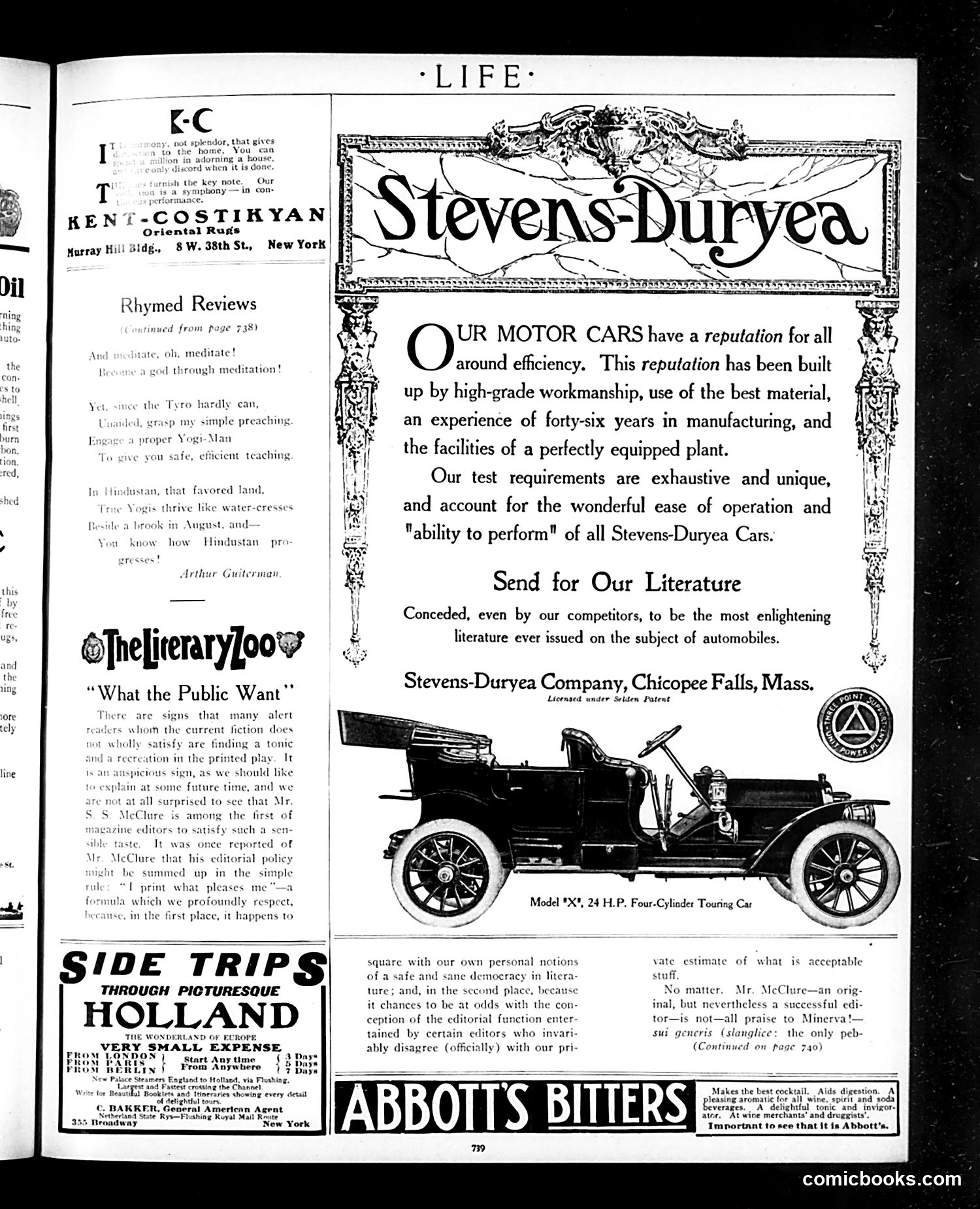
This is primarily an **advertising page** from Life magazine, not a political cartoon page. The main content consists of three advertisements: 1. **Stevens-Duryea Motor Cars** (center): A luxury automobile company advertisement emphasizing their 46-year manufacturing reputation, quality workmanship, and rigorous testing standards. The image shows a Model "X" touring car. 2. **Side Trips Through Holland** (lower left): A travel agency advertisement promoting package tours to Holland at modest expense. 3. **Abbott's Bitters** (lower right): A patent medicine advertisement claiming the product aids digestion and works as a cocktail mixer. The page also includes minor editorial content: a "Rhymed Reviews" poetry section and a piece titled "What the Public Want" discussing S.S. McClure's editorial philosophy for magazine content. No political satire or cartoon commentary is present on this page—it's a straightforward commercial publication typical of early 20th-century magazine layouts.
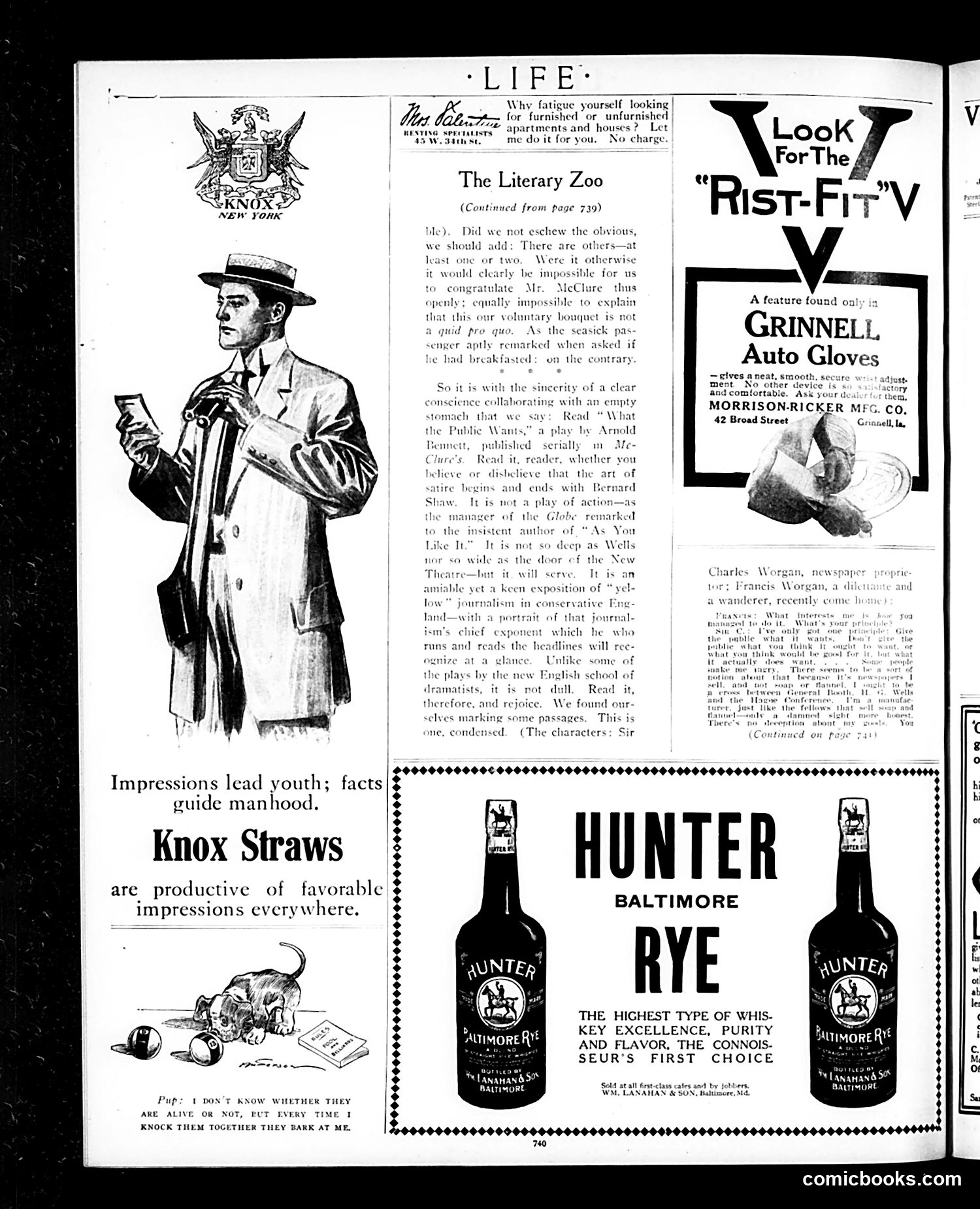
This page mixes editorial content with advertising. The main cartoon features a well-dressed man in a coat and hat holding a book, accompanying text about "The Literary Zoo" — a theater review discussing plays including one by Arnold Bennett called "What the Public Wants." The satire critiques theatrical pretension and journalistic analysis of drama. The caption "Impressions lead youth; facts guide manhood" paired with Knox Straws advertising uses a small cartoon of a pup being struck repeatedly but barking each time — suggesting impressions (repeated blows) versus reality (whether the pup is actually alive). This is a humorous critique of advertising's reliance on repetition over substance. The page also includes advertisements for Grinnell Auto Gloves and Hunter Baltimore Rye whiskey, which dominate the lower portion. The content reflects early 20th-century American consumer culture and theater criticism.
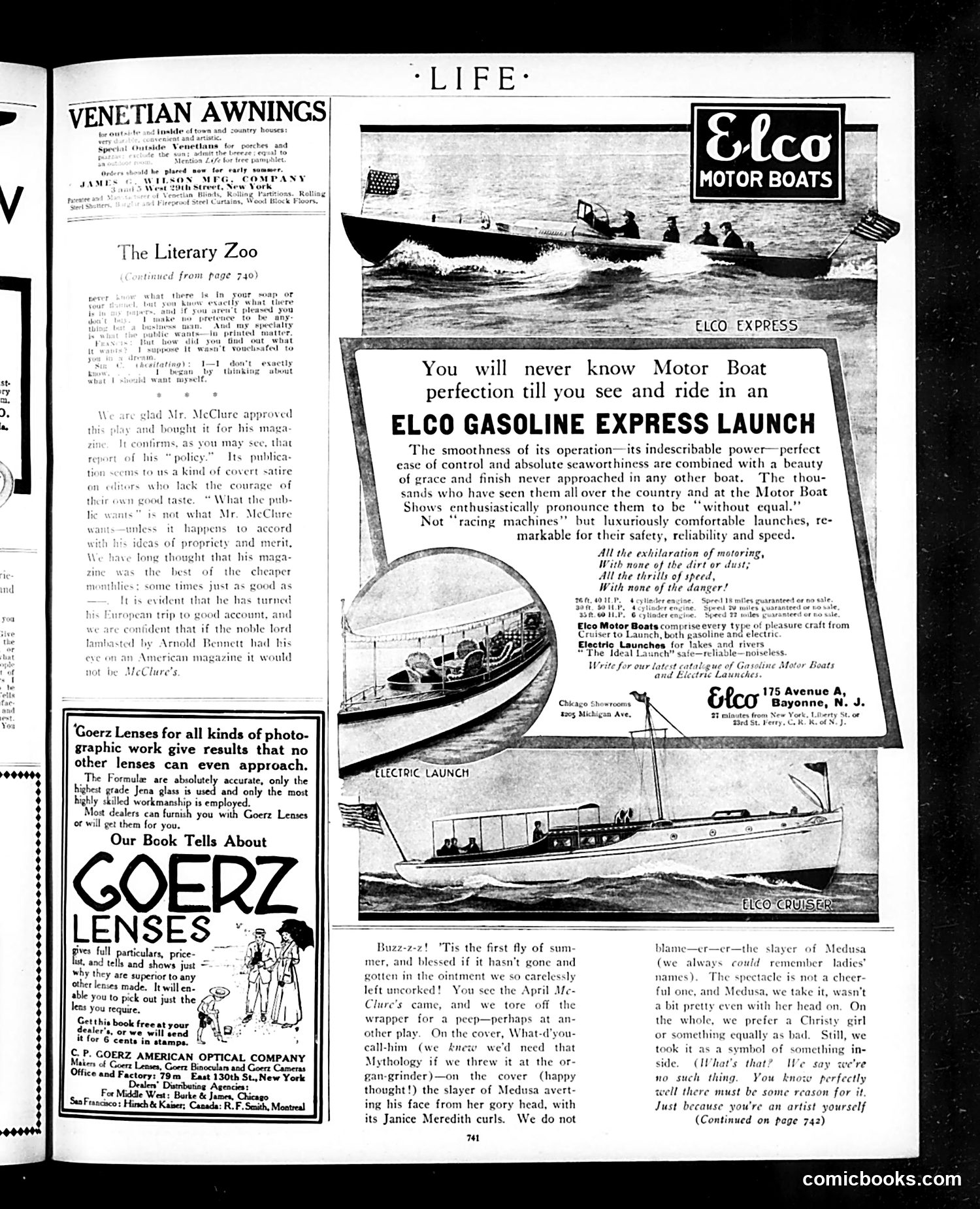
This page is primarily **advertising**, not satire or political commentary. It features three commercial advertisements: 1. **Goerz Lenses** - promoting German optical equipment for photographers 2. **Elco Motor Boats** - advertising gasoline and electric recreational launches, emphasizing safety, reliability, and smooth operation 3. Brief text excerpts from "The Literary Zoo" article discussing McClure's magazine editorial decisions The only editorial content is a short piece critiquing *McClure's* magazine's choice to feature the mythological figure of Perseus (who slayed Medusa) on its April cover. The author humorously questions this artistic decision, suggesting it was a poor editorial choice without obvious merit—though the text acknowledges some unstated symbolic reason may exist. There is no political cartoon or satirical imagery. The page represents typical early 20th-century Life magazine layout: mixing literary commentary with advertisements for consumer goods.
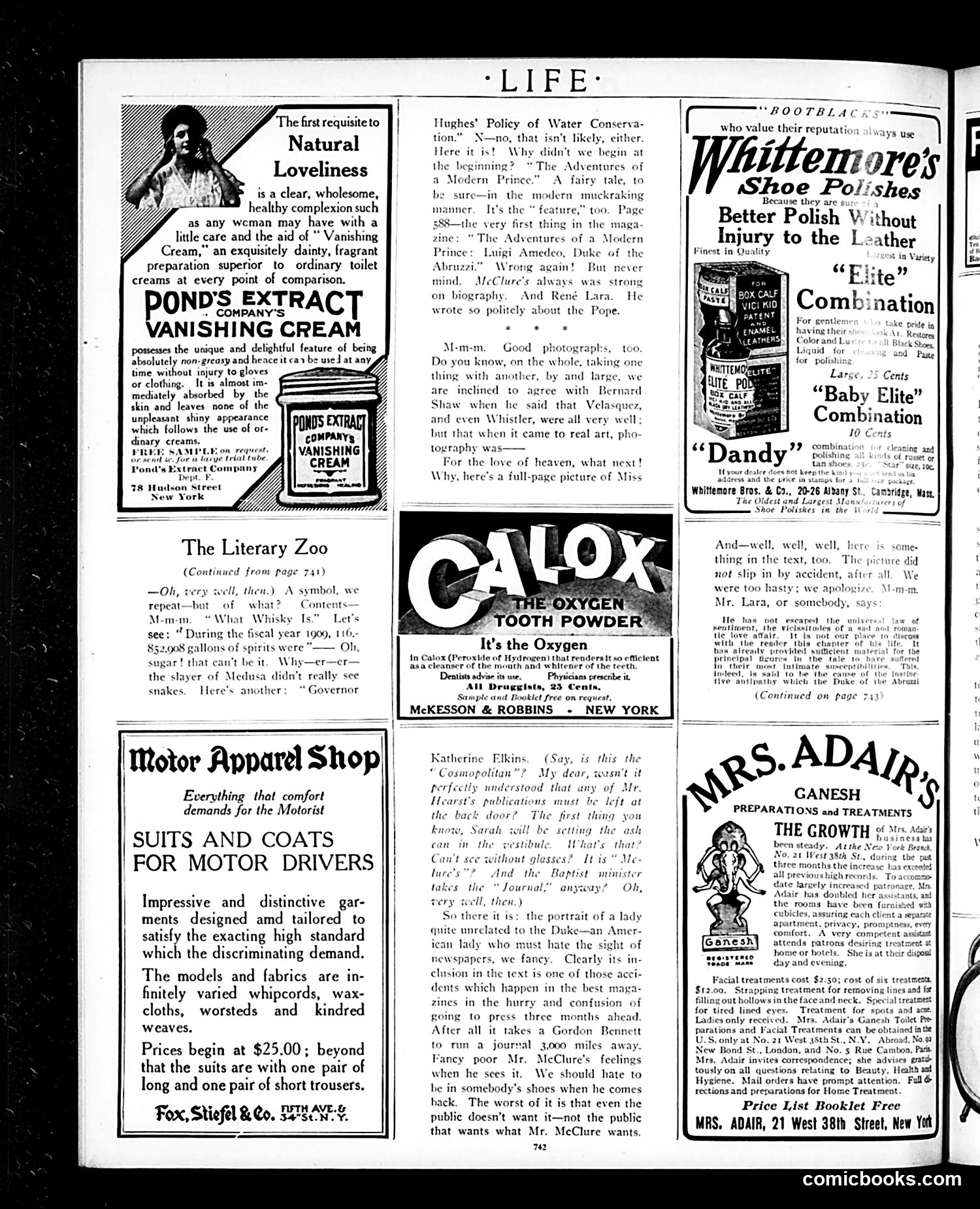
This is a **Life magazine page mixing editorial content with period advertising** (circa 1910s). The main editorial section, "The Literary Zoo," is a **book review column** critiquing contemporary magazines—particularly *McClure's*. The critic mocks the magazine's editorial choices: it leads with a fairy tale about an Italian duke instead of substantive content, and includes an unrelated portrait of a woman that seems randomly placed. The satire targets *McClure's* for poor editorial judgment and careless layout decisions—mixing highbrow pretense (discussing fine art and polite biography) with accidental, jarring image placement. The surrounding **advertisements** are period products: Pond's vanishing cream, motor driving suits, tooth powder, and hair treatments—typical of 1910s consumer marketing emphasizing grooming and fashion. These ads provide historical context about what middle-class readers valued. The overall page reflects *Life's* role as a satirical magazine critiquing both literature and contemporary culture.
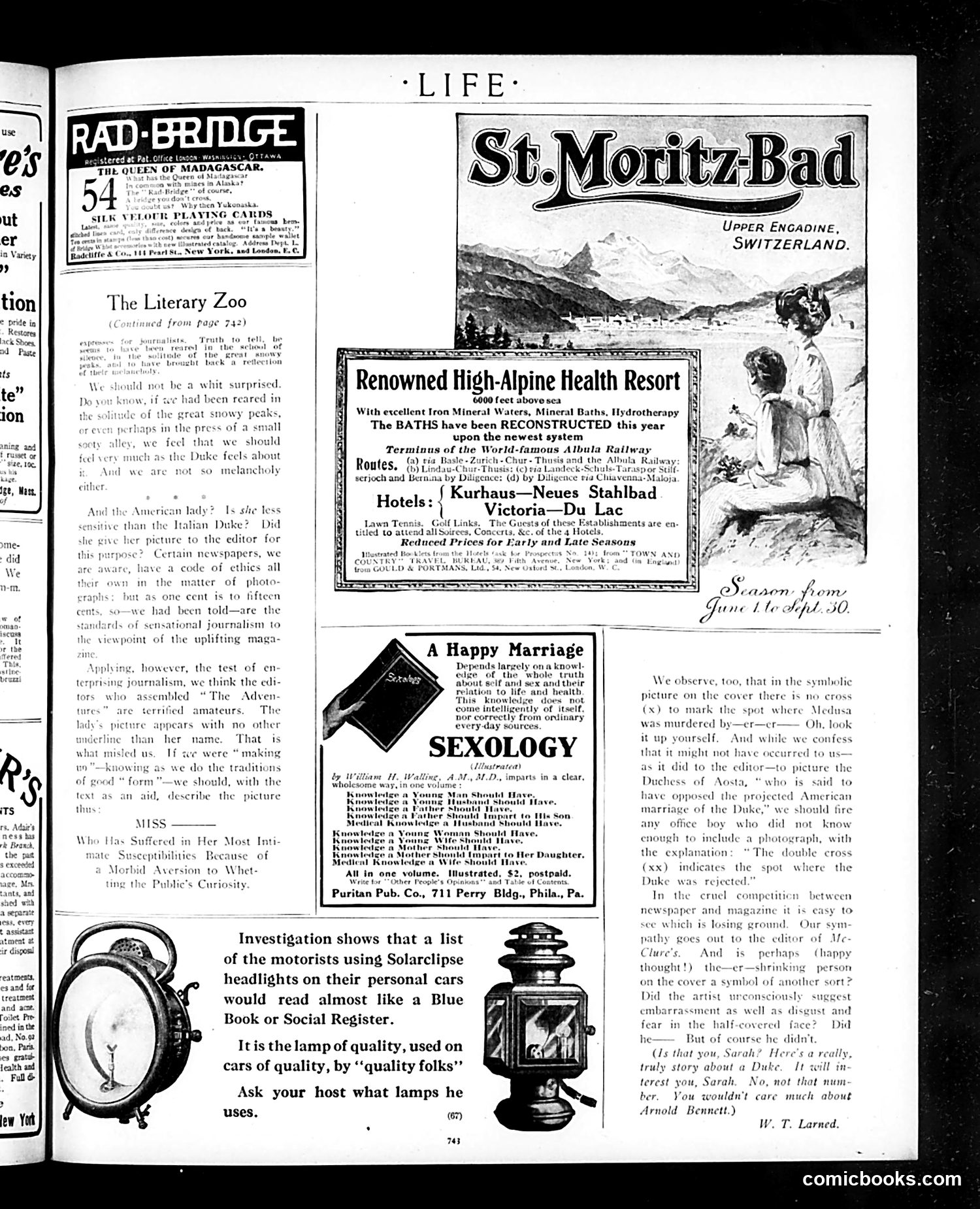
This page from *Life* magazine features a satirical essay "The Literary Zoo" (continued from page 742) criticizing sensationalist journalism and amateur photography in newspapers. **The Main Satire:** The author mocks newspapers' obsession with publishing photographs of society figures—particularly American ladies—without proper editorial judgment. The specific example targets coverage of a "Duke" and "Duchess of Aosta," likely referencing a controversial or scandalous marriage involving European nobility that American papers sensationalized. **The Point:** The essay ridicules how newspapers hire "terrified amateurs" as photographers and editors who lack professional standards. The author sarcastically notes that a proper editor should include photographs "with the explanation" marking significant locations—using the absurd example of marking where Medusa was murdered in a painting of the Duchess. The closing mock-dialogue between "Sarah" and an unnamed speaker further satirizes how newspapers exploit readers' curiosity about aristocratic scandals and romantic drama, treating them as entertainment rather than news. **Context:** This reflects early 20th-century tensions between "quality" journalism and sensationalist tabloid culture.
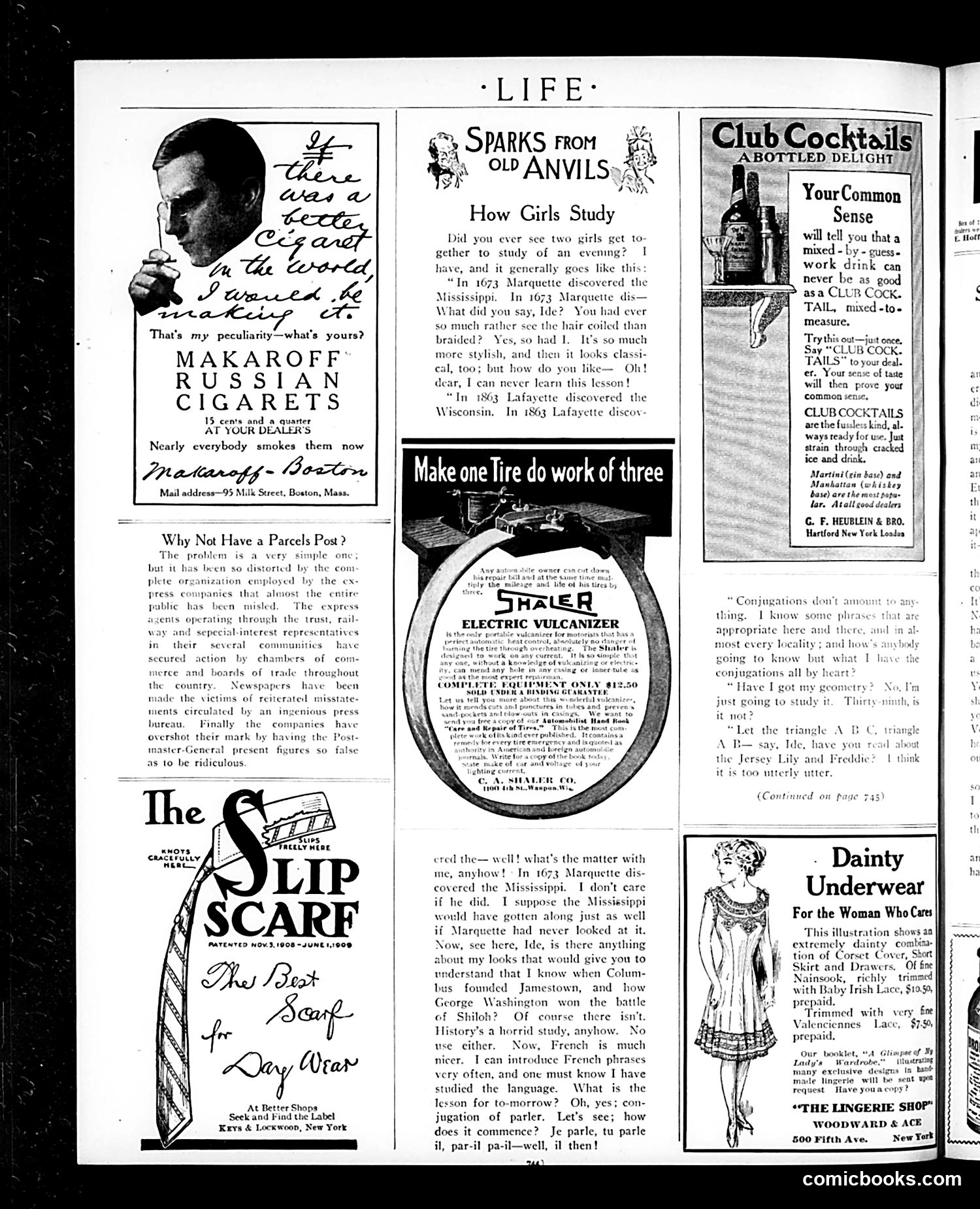
This page is primarily **advertising with one satirical article**. The main content is "How Girls Study," a humor piece mocking young women's study habits. The author portrays two girls attempting to memorize historical facts (dates of discoveries by Marquette, Lafayette, etc.) but constantly getting distracted by appearance and gossip—braided versus coiled hair, compliments, French phrases to impress others. The satire suggests women students are frivolous and incapable of serious academic focus. The surrounding ads—for Russian cigarettes, electric vulcanizers, slip scarves, cocktails, and lingerie—represent typical 1910s-1920s consumer products. The Parcels Post article discusses postal service reform, arguing express companies spread misinformation against establishing government package delivery. The humor reflects period gender stereotypes depicting women as superficial rather than intellectually serious. Modern readers would recognize this as dated sexism masquerading as comedy.
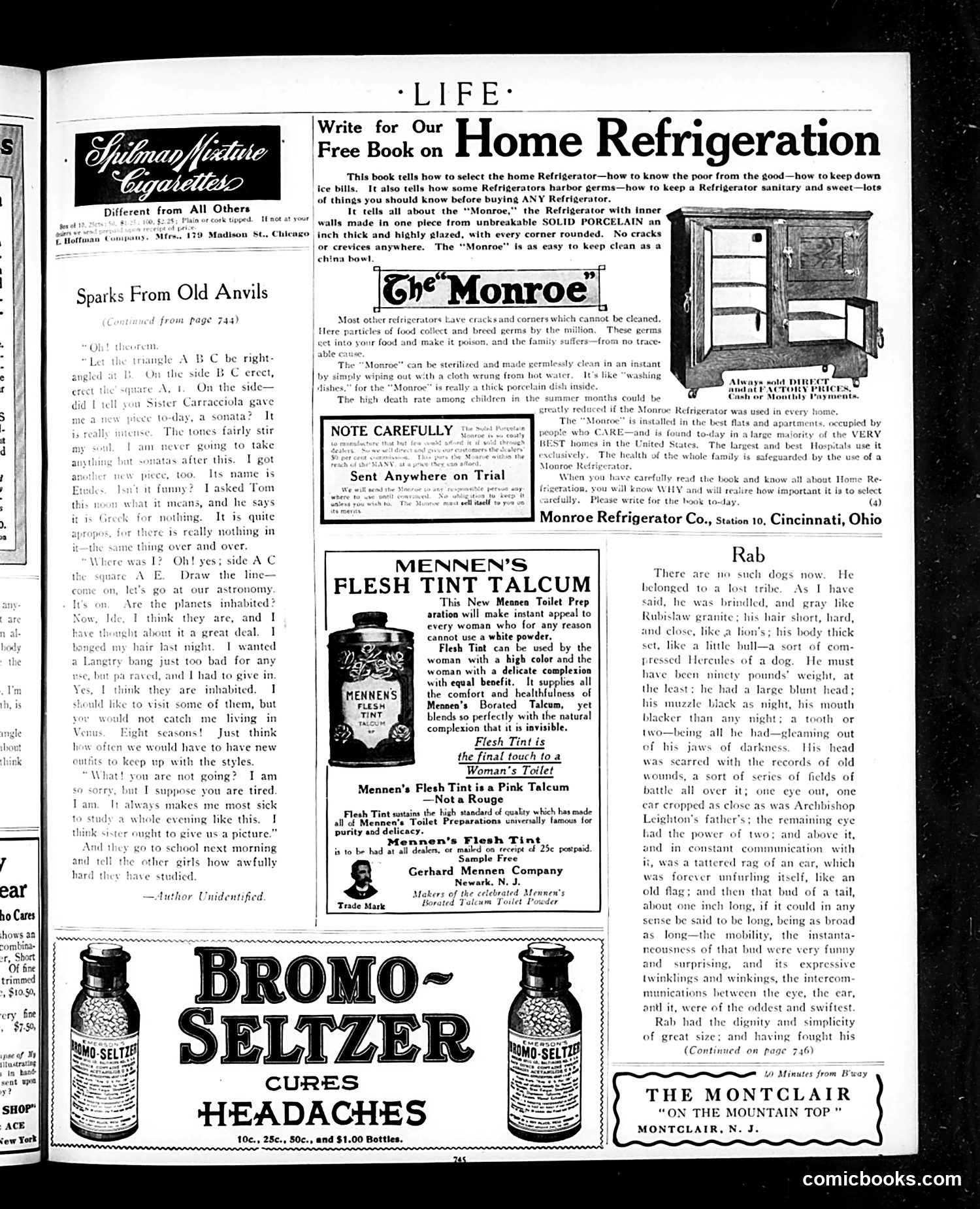
This page is **primarily advertising**, not political satire. It contains: **Main Content:** - A serialized short story titled "Sparks From Old Anvils" (continued from page 744), featuring domestic dialogue about astronomy and social visits—typical light fiction for Life's readers. - An unrelated narrative piece called "Rab" about a dog, apparently sentimental animal literature popular in the era. **Advertisements:** - Monroe Refrigerator (prominent, with product illustration) - Mennen's Flesh Tint Talcum powder - Bromo-Seltzer for headaches - The Montclair resort The page reflects early 20th-century Life magazine's mix of humor, fiction, and consumer advertising. There is **no political cartoon or satire visible**—this appears to be a standard editorial/advertising page from the magazine's non-satirical sections.
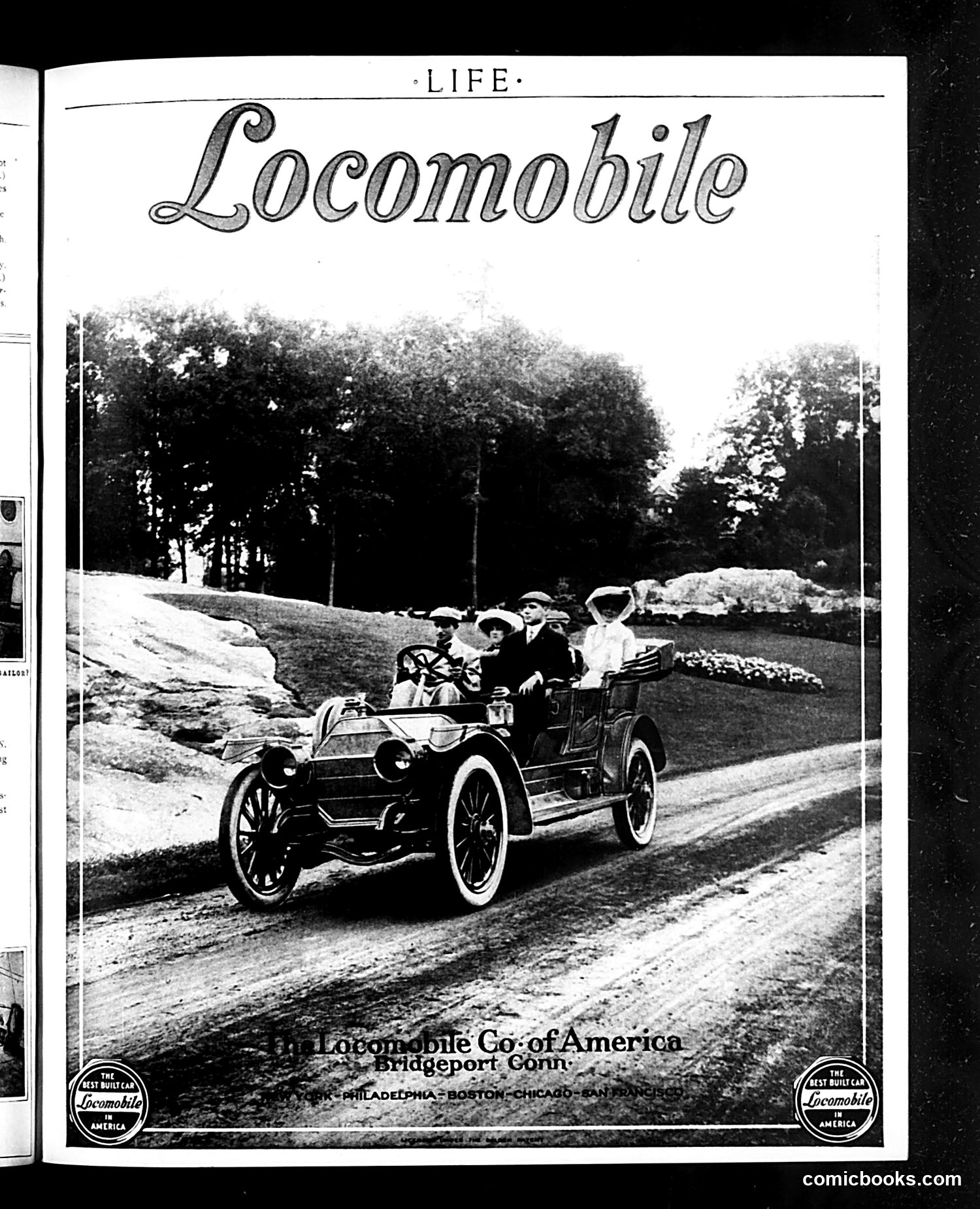
This is a **product advertisement** rather than political satire. It promotes the Locomobile automobile, manufactured by the Locomobile Co. of America in Bridgeport, Connecticut, with offices in Philadelphia, Boston, Chicago, and San Francisco. The image shows an early motorcar with well-dressed passengers in a scenic park setting, emphasizing the vehicle's elegant design and the leisure lifestyle it enabled. The "Best Built" seal appears twice, suggesting quality craftsmanship. This represents early automotive advertising targeting affluent consumers. The bucolic countryside backdrop and refined passengers convey that owning a Locomobile signaled status and provided access to recreational pleasures—a common marketing strategy for luxury automobiles in the early 20th century.
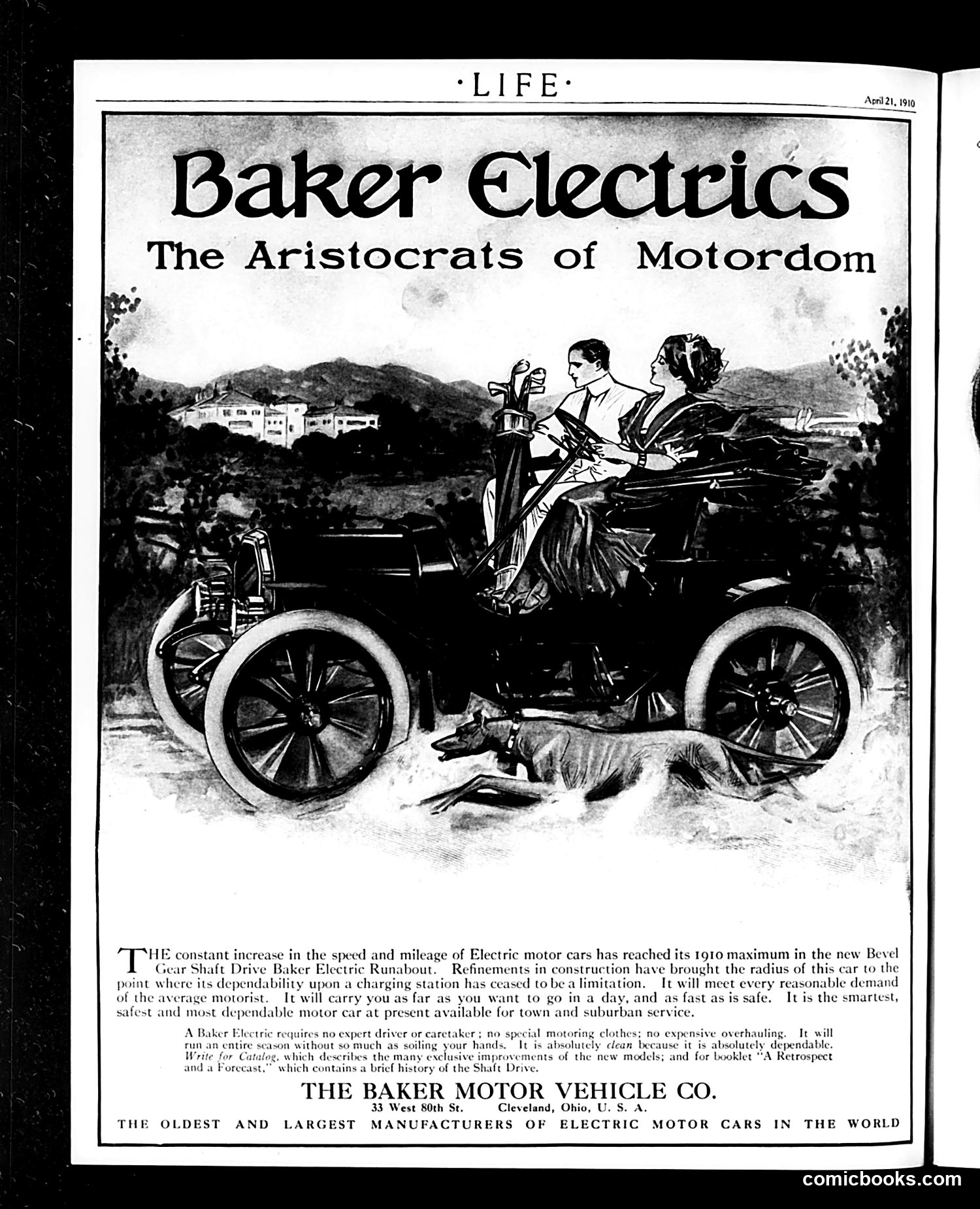
This is primarily a **Baker Electric automobile advertisement**, not a political cartoon. It appeared in *Life* magazine on April 21, 1910. The image depicts an elegantly dressed couple (a man and woman in fashionable 1910 attire) driving a Baker Electric motorcar, with a dog resting beside the vehicle. A pastoral mansion is visible in the background. The ad's satire is subtle and social rather than political: it markets electric cars as vehicles for the wealthy and refined—"aristocrats of motordom." The pitch emphasizes cleanliness, reliability, and ease of use (no need to soil your hands, no expert driver required), positioning electric cars as superior to gasoline vehicles for the genteel class. The humor lies in the aspirational messaging: owning this car signals sophistication and leisure. By 1910, electric vehicles were indeed marketed to affluent women and urban dwellers as cleaner, quieter alternatives to temperamental gas engines.