
Life, 1910-04-21 · page 24 of 44
Life — April 21, 1910 — page 24: what you’re looking at
What you’re looking at
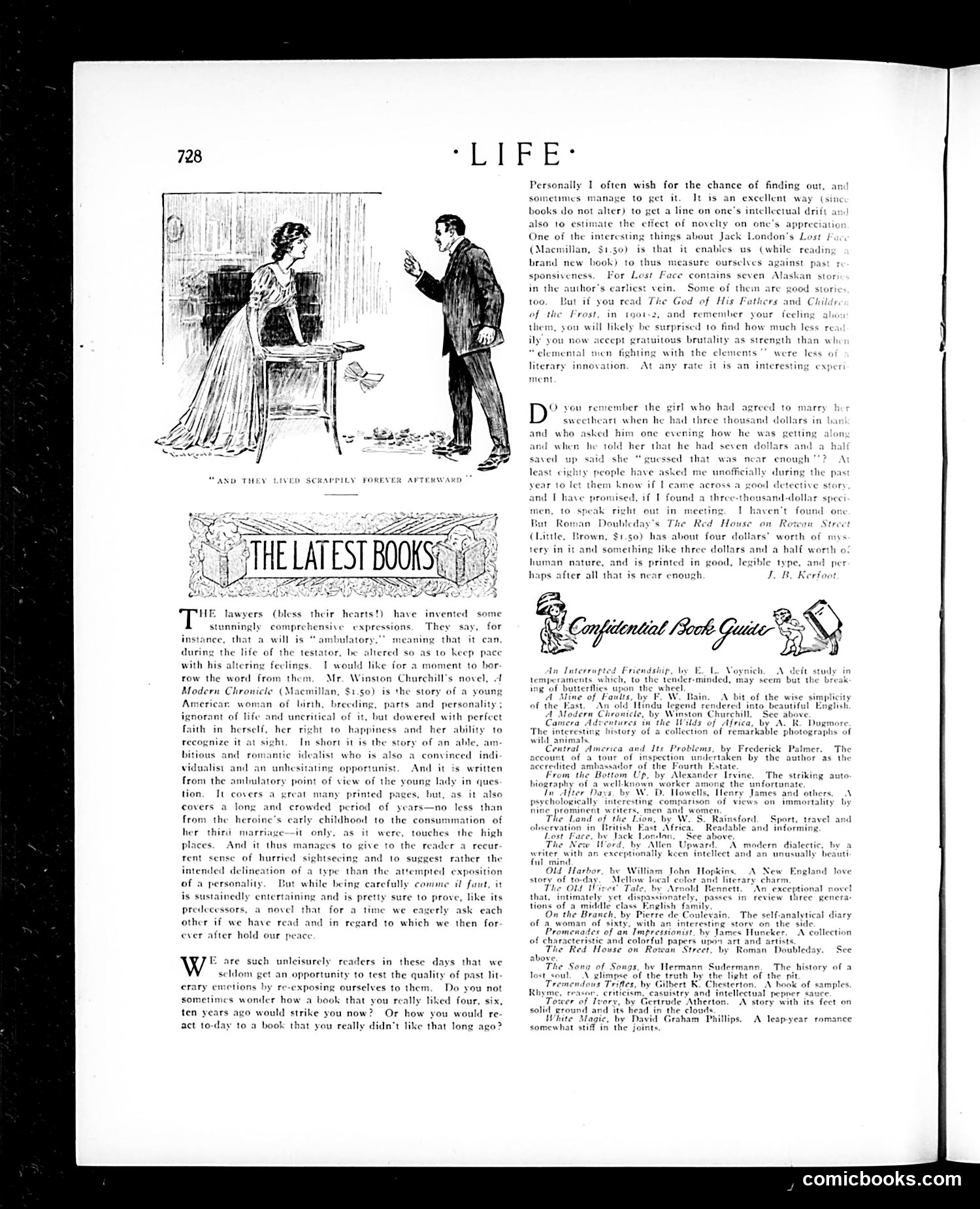
This is a literary review page from *Life* magazine featuring two cartoon illustrations and book reviews. The upper cartoon, captioned "And They Lived Scrappily Forever After," depicts a couple—apparently a man and woman in domestic conflict—suggesting satirical commentary on marriage or romantic relationships. The page's content focuses on newly published books, particularly Jack London's *Lost Face* and Winston Churchill's *Modern Chronicle*. The reviewer discusses how reading old versus new works reveals changing aesthetic tastes, and notes an apparent demand for detective stories. The "Confidential Book Guide" section lists contemporary publications. The cartoons and text together reflect *Life*'s mission as a satirical magazine: using humor to comment on contemporary culture, including evolving social attitudes toward literature, romance, and modernism. Without additional context, the specific marital scenario in the cartoon remains unclear, though it likely referenced recognizable social commentary of the period.
📄 Transcribed text from this page (OCR, searchable)
Machine-transcribed from the original scan — historical spelling and the odd misread are preserved.
LDF E Personally I often wish for the chance of finding out, ar sometimes manage to get It is an excellent way (sine books do not alter) to get a line on one’s intellectual drift ai also 10 estimate the effect of novelty on one's appreciatic One of the interesting 1 about Jack London's L: é (Macmillan, $1.50) is that it enables us (while readin: brand new book) to thus measure ourselves against pas: siveness. For Lest Face cc nins seven Alaskan stor in the author's earliest vein. Some of them are good stori too. But if you read The God of His Fathers and Childr of the Frost, in + 2. and remember your feeling atv ther ou will likely be surprised to find how much less re ily’ you now accept gratuitous brutality as strength than wl “elemen t fighting with the clements were less 0: literary innovation. At any rate it is an interesting exper ment D° you remember the girl who had agreed to marry sweetheart when he had three thousand dollars in bar and who asked him one evening how he was getting and when he told her that he had seven dollars and ah saved up said she “guessed that was near gh"? A least cighty people have asked me unofficially during the pas year to let them know if I came across a zood detective stor and I have promised, if T found a three-thousand-dollar spec n, 10 speak right out in meeting. [I haven't four oS: — Zz But Roman Doubleday's The Red House on Re Sa: (Little, Brown, $1.50) has about four dollars’ worth tery in it and something like three dollars and a half w human nature, and is printed in good, legible type, and per haps after all that is near enough JOB, Kerf LOPE lawyers (bless their hearts!) have invented some ningly comprehensive expressions f ance, that a will is “ ambulatory during the life of the testator, be altered so as to keep pace with his altering feelings. I would like for a moment to bor: In Interrupted Friend pL. Voynich. A deft study in row the word from them. Mr. Winston Churchill's novel, temperaments which, to the tender-minded, may seem but the break fodern Chronicle (Macmillan, $1.50) is the story of a you ing of butterfi nthe wheel Modern Chronicle (Macmillan, $1.50) is the story of a you i its, by E" We Bain. A bit of the wise simpli American woman of birth, breeding, parts and personality; of the old 'Ilindy legend rendered into beautiful E: ignorant of life and uncritical of it, but dowered with perfect G dleders CAronicle, by Winston Charehill. | See above faith in herself, her ri to happiness and her ability to The incest history of a collection of r recognize it at sight, In short it is the story of an able, am 5 Eags bitious and romantic idealist who is also a convinced indi 3 of inspection vidualist and an unhesitating opportunist. And it is written accred 2 ador of the Fo from the ambulatory point of view of the young lady in ques tion. It covers a great many printed pages, but, as it also f covers a long crowded period of years—no less than Rine prominent ch ant eon. from the heroine's early childhood to the consummation rhe Land of the Tion. by W. S. Rainsford. Sp her third marriaze—it only, as it were, touches the high | OPO ? “See thaves p And it thus man ive to the reader a recur The New Word ward A modern dialectic writer with an exceptionally keen intellect and an unusually. be ful mind intended delineation of a type than the attempted exposition Old Harbor, by William Joha Hopkins. A New England love of a personality. But while being carefully comme il fant, it story of tenday. _Mellew local calor and Nterary. charms et is sustainedly entertaining and is pretty sure to prove, like its that, intimately yet dispassionately. passes in review three genera: tions of a middle class English £: i On the Branch, by Pierre de Coule The self-analytical diary other if we have read and in regard to which we then for of 3 woman of sixty. with an interesting story. on, the side ee old Our pe Pro) cs of an Impressionist. by James Muneker, A collection ever after hold our peace of characteristic and colorful papers upon and artists The Red House on Rowan Str. by Roman Doubleday See W are such unleisurely readers in these days that we abos f Songs, by Hermann’ Sudermann, ‘The history of a seldom get an opportunity to test the quality of past lit impse of the truth hy the light of the p . sometimes wonder how a book that you really liked four, six, Tower ory, by Gertrude Athert: A story with its feet on ten years ago would strike you now? Or how you would re oo ran ne is Read io the loos isa: A: leapyeat’ romance act to-day to a book that you really didn’t like that long ago? somewhat stiff in the joints. rent sense of hurried. sightse. and to suggest rather the predecessors, a novel that for a time we eagerly ask each comicbooks.com