
Life, 1910-04-21 · page 27 of 44
Life — April 21, 1910 — page 27: what you’re looking at
What you’re looking at
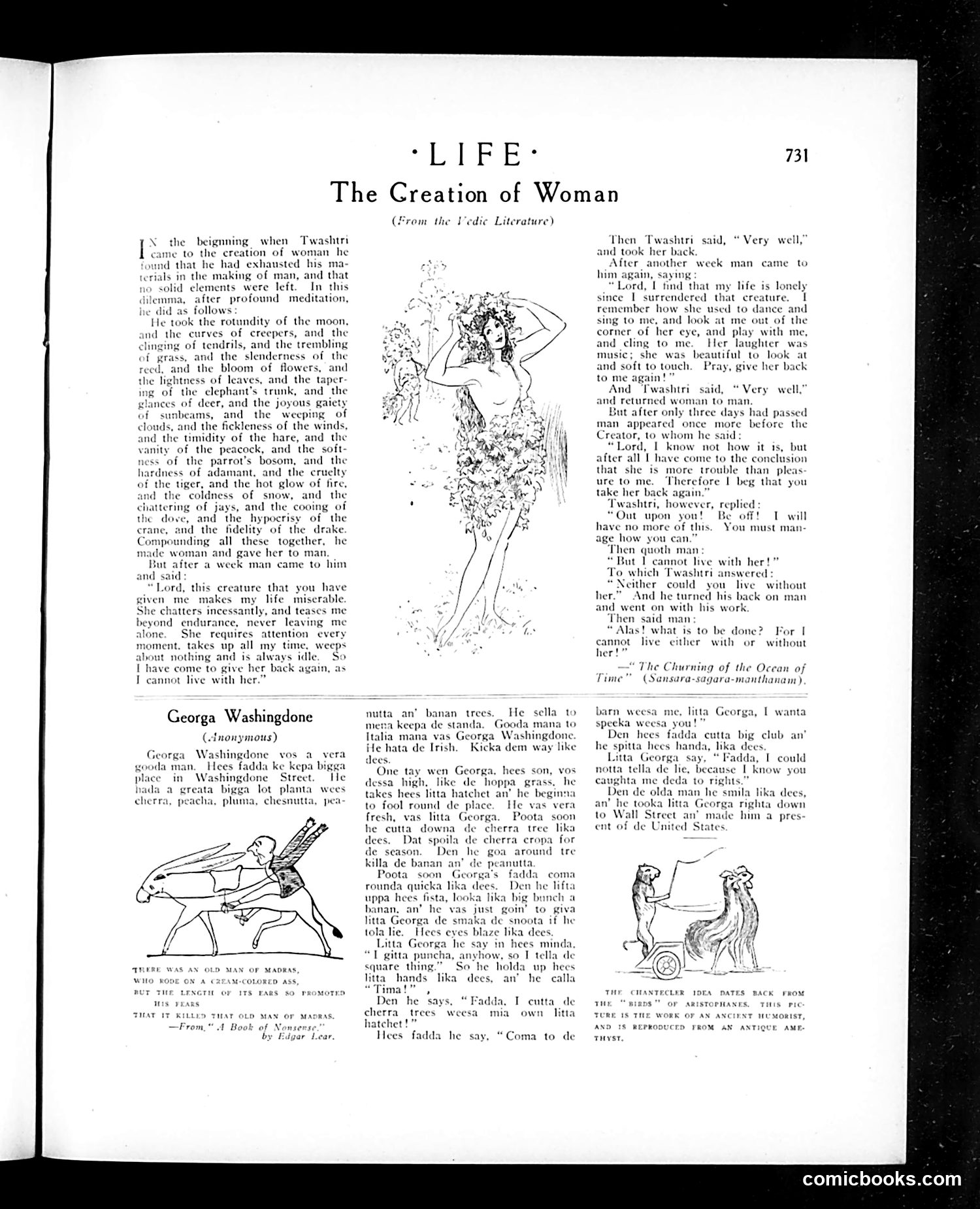
This page contains two distinct pieces of satirical content: **"The Creation of Woman"** (top) is a literary excerpt from Vedic sources presenting a humorous origin myth. It satirizes gender relations by depicting woman as composed of nature's most contradictory elements—beauty mixed with fickleness, tenderness with hypocrisy. The joke culminates in man's complaint that woman is unbearable, yet when she's taken away, he misses her. Twashtri's final refusal to intervene mocks male indecision about women, suggesting men must simply endure the situation they've created. **"Georga Washingdone"** (bottom) is a dialect piece using broken English phonetics, likely mocking Irish or immigrant speech patterns. It references the apocryphal young George Washington cherry-tree story, but replaces the famous "I cannot tell a lie" moral lesson with a different narrative about property destruction. The crude dialect humor was typical of early 20th-century American magazines, though such content would be considered offensive today. Both pieces use humor to explore male-female dynamics and social hierarchies.
📄 Transcribed text from this page (OCR, searchable)
Machine-transcribed from the original scan — historical spelling and the odd misread are preserved.
‘LIP E* The Creation of Woman X the beignning when Twashtri I came to the creation of woman he yund that he had exhausted his ma terials in the making of man, and that ne id elements were left. In this jilemma, after profound meditation, « did follows: He took the rotundity of the moon, nd the curves of creepers, and the clinging of tendrils, and the trembling of grass, and the slenderness of the reed, 1 the bloom of flowers, and the lightness of leaves, and the taper: ing of the clephant’s trunk, and. the deer, and the joyous gaiety of ms, ‘and the weeping of clouds, and the fickleness of the winds, and the timidity of the hare, and the vanity of the peacock, and the soft- ness of the parrot’s bosom, and the hardness of adamant, and the cruelty of the tiger, and the hot glow of fir 1 the coldness of snow, and the chattering of jays, and the cooing of the dove, and the hypocrisy of the ne, and the fidelity of the drake. pounding all these together, he ade woman and gave her to man. But after a week man came to him and said “Lord, this creature that you have iven. me makes my life miserable. She tters incessantly, and teases me beyond endurance, never leaving me alone. She requires attention every moment, takes up all my time, weeps about nothing and is always idle. So e come to give her back again, as ‘annot live with her.” Georga Washingdone (dnonymous) Georga Washingdone vos a_ vera nan. Hees fadda ke kepa bigga in Washingdone Street. He a gre lot planta’ wees cherra, peacha, plima, chesnutta, pea AMERE WAS AN OLD MAN OF MADRAS WHO RODE ON A ¢ COLORED ASS, nur tue trxerit STARS $0 PRA Wis YEARS UAT IT KiLtED THAT MAN OF MADRAS. —From,“ f Nonsens y Edgar Icar. rom the ledic Literature) trees. He sella to Gooda mana to ga Washingdone Kicka dem way like an’ banan pa de standa. Italia mana vas Ge ¢ hata de Irish One tay wen Georga. hees son, vos dessa high, like de hoppa grass, he cs hees litta hatchet an’ he beginna to fool round de place. He vas vera fresh, vas litta Geor; Poota he cutta downa de cherra tree I dees, Dat spoila de cherra eropa for de season. Den he goa around tre killa de banan an’ de peanutta Poota soon fadda coma rounda quicka lika dees. Den he lifta uppa hees fista, looka lika big bunch a banan, an’ he vas just goin’ to giva litta Georga de smaka de snoota if he tola lie. Hees eves blaze lika dees, Lita orga he say in hees minda, “TL gitta punt nyhow, so I tella de square thing. he holda up hees litta hands lika dees, an’ he calla “Tima!” , Den he says, “F 5 7 cherra weesa mia soon cutta de trees own litta te Hees fadda he say, “Coma to de Then Twashtri said, “ Very well,” and took her back After another week man him again, saying “Lord, I find that my life is lonely since I Surrendered that creature, I remember how she used to dance and sing to me, and look at me out of the corner of her eye, and play with me, and cling to me.” Her laughter was music; she was beautiful to. loc and soft to touch. Pray, give her back to me again And Twashiri said, “ Very and returned woman to man. But after only three days had passed man appeared once more before the Creator, to whom he said “Lord, | know not how it is, but after all I have come to the conclusion that she is more trouble than pleas ure to me. Therefore I beg that you take her back again.” Twashtri, however, replic “Out upon you! "Be off! Twill have no more of this. You must man- age how you can.” Then quoth man “But 1 cannot live with her!” To which Twashtri answered : Neither could you live without her.” And he turned his back on ma and went on with his work. Then said man “Alas! what is to be done? annot live cither with or her!” came to well For | without The Churning of the Occan of Time (Sansara-sagara-manthanam) barn weesa me, litta Georga, I wanta speeka weesa you!” Den hees fadda cutta big club an’ he spitta hees handa, lika dees Litta Georga say, “Fada, T could 1 tella de lie, because [know you caughta me deda to rights.” Den de olda man he smila lika dees, an’ he tooka litta Georga righta down to Wall Street an’ made him apres ent of de United States THY CHANTECLER 1DE8 Te “ miaps" oF DATES BACK FROM ARISTOPHANES. TIS PIC TURE IS THE WORK OF AN ANCIENT HUMORIST, AND IS REPRODUCED TROM AN ANTIQUE AME: comicbooks.com