
Life, 1910-04-21 · page 26 of 44
Life — April 21, 1910 — page 26: what you’re looking at
What you’re looking at
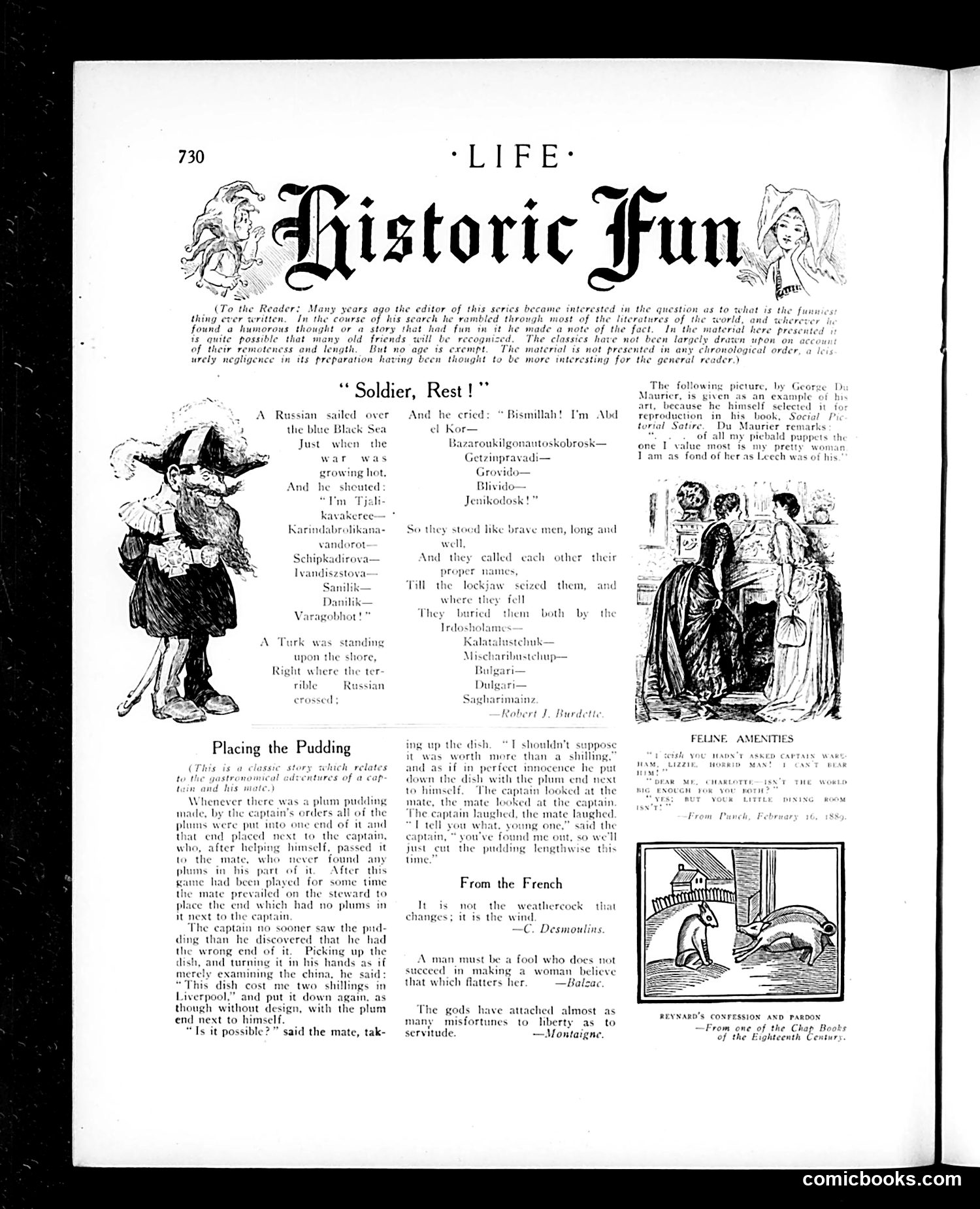
This Life magazine page contains three distinct pieces of humor: **"Soldier, Rest!"** mocks the Russo-Turkish War through a Russian soldier's comically unpronounceable name (a string of Slavic-sounding gibberish), satirizing stereotypes about Russian language difficulty and the absurdity of war itself. **"Placing the Pudding"** is a classic shipboard trick tale: a captain and mate play games with a plum pudding, each trying to cheat the other by positioning the plum-filled end away from their rival. When discovered, they resolve their conflict—a gentle satire on human vanity and self-interest that ultimately yields to cooperation. **"From the French"** presents philosophical quotations attributed to French thinkers (Desmoullins, Balzac, Montaigne), offering witty commentary on human nature and society. The page also includes illustrations and a small woodcut titled "Reynard's Confession and Pardon," referencing the medieval *Reynard the Fox* fables. Overall, the page exemplifies Life's satirical tradition combining literary humor, social commentary, and whimsical storytelling.
📄 Transcribed text from this page (OCR, searchable)
Machine-transcribed from the original scan — historical spelling and the odd misread are preserved.
(To the R thing ritten LIFE tor a story th old friends ts preparation hy f is not presented Been thought to be more interesting for the ‘Soldier, Rest!” ian sailed over the ble Black Sea Just when the war wa growing hot. And he sheuted “Tm Tal kavakere Karindabrolike Schipkadirova— Ivandiszstova. Sanilik— Danilik obhot ! irk was st upon the Lt where th rible | Ru relates Whenever there was a plum pudding by the cap : of the plums were put into one end of it and that end placed next to the captain, who, after helping himself, passed it to the ma who never found any plums in his part of it. After this game had been played for some time the mate prevailed on the steward to place the end which had no plums in it next to the captain The ¢ no sooner saw the pud- ding than he discovered that he had the wrong end of it. Picking up the dish, and turning it in his hands as if merely examining the china, he said: “This dish cost me two shillings in Liverpool,” and put it down again, though without design, with the plum end next to himself. “Is it possible?” said the mate, tak- And he cried el Kor— Bazaroukilgonantoskobrosk— Getzinpravadi— Grov Blivido: Jenikodosk !” So they stocd like brave men, long and well And they called cach other their names, lockjaw seized © they fell ried them both Kalat, tchuk— Mischaribustehu Bulgari— Dulgari— ing up the dish. “T shouldn't suppose it was worth more than a_ shilling.” and as if in perfect innocence he put down the dish with the plum end next to himself, The ca looked at the mate, the mate looked at the captain The captain Jaughed, the mate laughed “TL tell you what. young one,” said the captain, “ you've found me out, so we'l just cut the pudding lengthwise this time.” From the French It is not the weathereock that changes; it is the wind —C. Desmoutlins \ man must be a fool who di succeed in making a woman believe that which flatters her. —Balzac The go s have attached almost as many misfortunes to. liberty as. to servitude —Montaigne. Bismillah! ['m Abd naterial v draven followin ef, iS given as an’ example because he f selected reproduction. in book, Soci Satire. | of all my piebald p je most is my pretty Lof ker as Leech was « FELINE, AMENITIES REVNARD'S CONFESSION AND PARDON “Eran ane of the Chap Books of the Eighteenth Centur comicbooks.com