
Life, 1910-04-21 · page 20 of 44
Life — April 21, 1910 — page 20: what you’re looking at
What you’re looking at
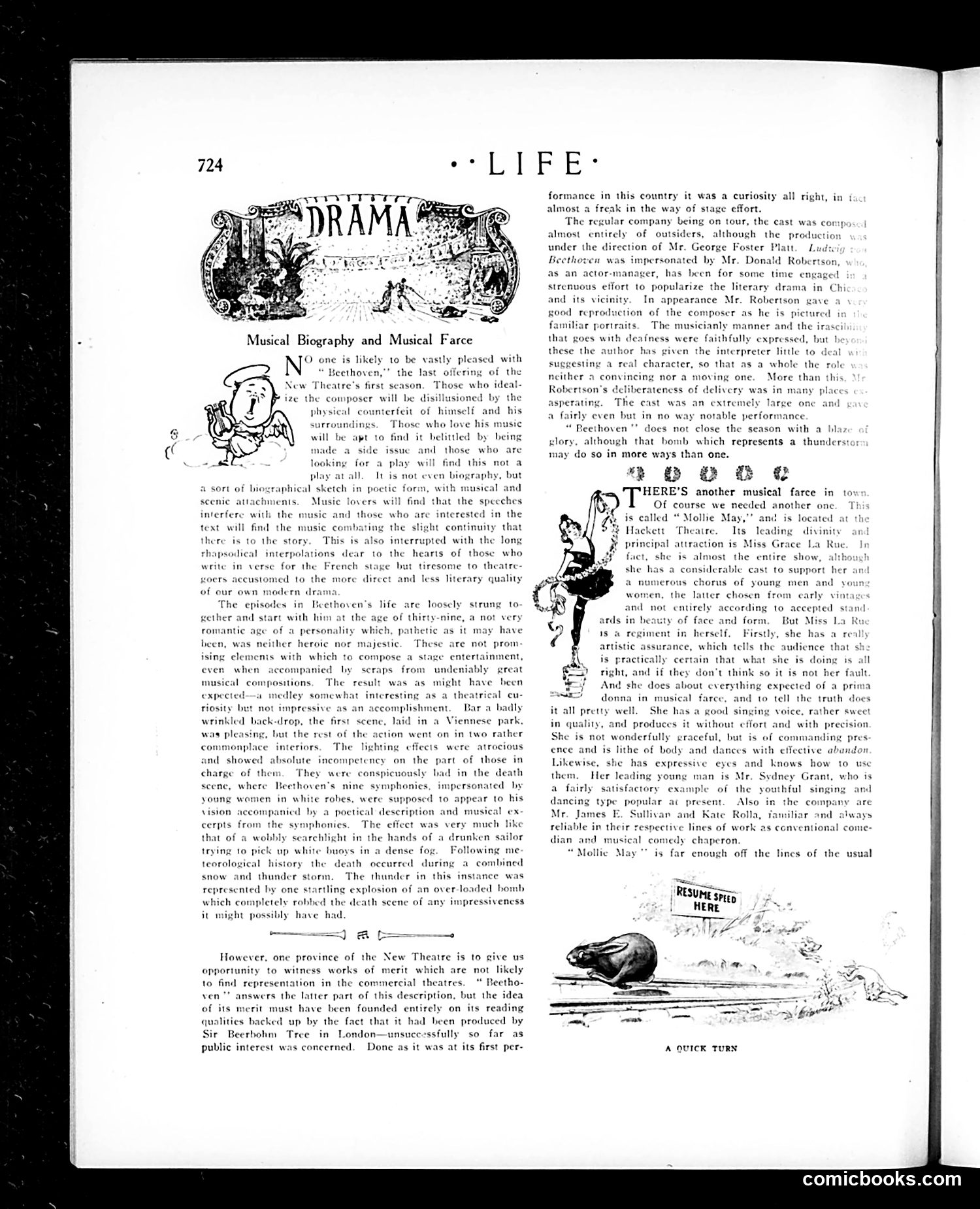
This is a theater review of a production called "Beethoven" at New York's New Theatre. The critic dismisses it as neither satisfying drama, biography, nor musical performance—a "medley" that fails on all fronts. The production attempted to dramatize composer Beethoven's life through poetic dialogue interspersed with excerpts from his symphonies. The critic finds this hybrid approach disastrous: music lovers resent speeches interrupting the compositions; drama lovers find no real plot; the biographical framework is weak, starting at Beethoven's age 39 and including awkward elements like the symphonies represented by "young women in white robes." The staging is mocked as incompetent—bad lighting effects, a "wobbly searchlight" quality during the death scene, and an overloaded bomb sound effect meant to represent thunder. The review grudgingly acknowledges the New Theatre's mission to stage literary works unavailable commercially, but concludes this production—originally produced unsuccessfully in London by Sir Beerbohm Tree—proved that not all artistically ambitious works translate successfully to stage.
📄 Transcribed text from this page (OCR, searchable)
Machine-transcribed from the original scan — historical spelling and the odd misread are preserved.
Musical Biography and Musical Farce N° one is likely to be vastly pleased with “ Beethoven,”’ the last offering of the New Theatre’s first season. Those who ideal- ize the composer will be disillusioned by the physical counterfeit of himself and his surroundin Those who love his music will be apt to find it helittled by being side issue and those who are looking for a play will find this not a play at all. It is not even biography, but a sort of biographical sketch in poetic form, with musical and scenic attachments. Music lovers will find that the speeches: in the continuity that interfere with the music and those who are interes! text will find the music cor ng the sli there is 10 the story. This is also interrupted with the long rhapsodical interpolations dear to the hearts of those who write in verse for the French stage but tiresome to theatre koers accustomed to the more dircet and less literary quality of our own modern dram, The episodes in Beethoven's life are loosely strung to gether and start with him at the age of thirty-nin romant a not very age of a personality which, pathetic as it may have been, was neither heroic nor majestic. These are not prom ising clemenis with which to compose a stage entertainment, even when accompanied by scraps from undeniably great musical compositions, The result was as might have been expected—a inedley somewhat interesting as a theatrical cu- Bar a badly Viennese park, riosity but not impressive omplishment wrinkled back-drop, the first scene, Jaid in was pleasiny on in two rather . but the rest of the action wer commonplace interiors. The lighting effects were atrocious and showed absolute incompeteney on the part of those in charge of th They were conspicuously bad in the death scene, where Beethoven's nine symphonies, impersonated by young women in white robes, were supposed to appear to his Mision accompanied by a poctical description and musical ex- cerpts from the symphonies. The effect was very much like that of a wobbly searchlight in the hands of a drunken sailor trying 10 pick up white buoys in a dense fog. Following me: teorological history the death occurred during a combined snow and thunder storm. The thunder in this instance was represented hy one startling explosion of an overloaded bom! which completely robbed the death scene of any impressivencss it might possibly have had —_————) However, one province of the New Theatre is to give us opportunity to witness works of merit which are not likely * Beetho- ven? answers the latter part of this description, but the idea to find representation in the commercial theatres. of its merit must have been founded entirely on its reading qualities backed up by the fact that it had heen produced by Sir Beerbohm Tree public interest was co London—unsuce-ssfully so far as cerned. Done as it was at its first per- in this country it was a curiosity all right almost a freak in the way of stage effort. The regul ing on tour, the cast was comp most entirely of outsiders, although the producti under the direction of Mr. George Foster Platt. npersonated by Mr. Donald Robertson, as an actor-manager, Beethoven was has been for some time eng strenuous effort to popularize the literary drama i and its vicinity. In appearance Mr. Robertson ¢ good repre the composer as he is p familiar portr: The musicianly manner and the irasci that goes with deafness were faithfully expresse: these the hor has given the interpreter little to deal suggesting a real character, so that as a whole the role neither a convincing nor a moving one. More than this Robertson's deliberateness of delivery was in m aspera The cast was an extremely large one a fairly even but in no way notable performance “PB hoven "* does not close the season with a blaz glory, although that bomb which represents a thunders: may do so in more ways than one. * © & OG & HERE'S another musical farce in to’ (> Of course we needed another onc. I is is called “ Mollie May,’’ and is located at t o% Theatre. Its leading divinity al attraction is Miss Grace La Rue is almost the entire show, onsiderable cast to support her anil yerous chorus of young men and you women, the latter chosen fr arly vinta and not entirely according to accepted stand ards in beauty of face and form. But Miss La R 18 a regiment in herself, Firstly, she has a rea artistic assurance, which tells the audience that st is practically certain that what she is doing is all right, and if they don’t think so it is not her fault And she does about everything expected of a prima donna in musical farce, and to tell the truth d it all pretty well. She has a good singing voice, rather sweet produces it without effort and with precision not wonderfully graceful, but is of commanding pres ence and is lithe of body and dances with effective abandon Likewise, she has expressive eyes and knows how to them. Her leading young man is Mr. Svdney Grant, who is a fairly satisfactory example of the youthful singing and dancing type popular ac presen Mr. James E. reliable in their s of work as conventional come- dian and musical comedy chaperon. “Mollie Ma Also in the company are Sullivan and Kate Rolla, fami pd always espective | is far enough off the lines of the usual A OVICK TURN comicbooks.com