
A complete issue · 36 pages · 1910
Life — February 24, 1910
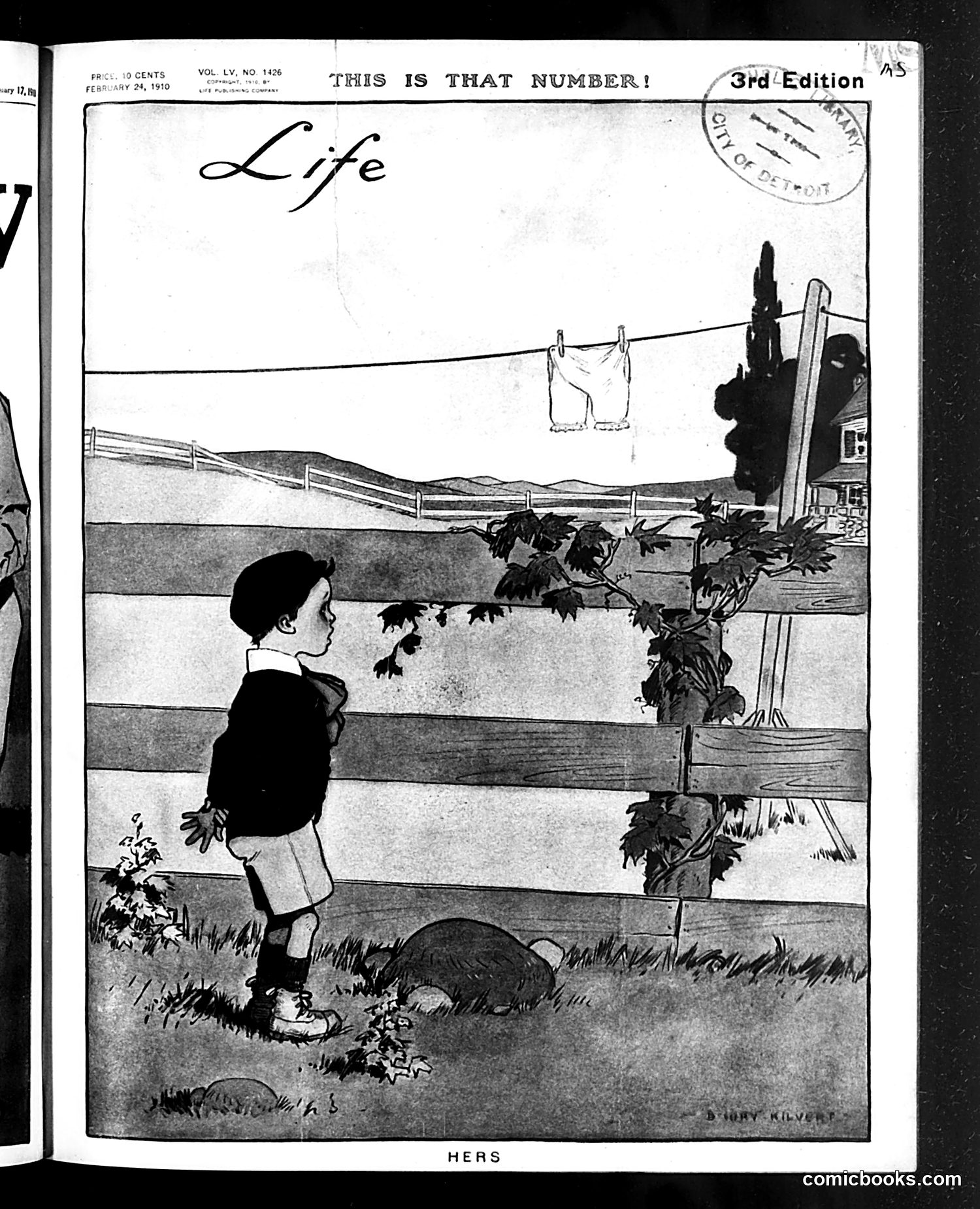
This cover depicts a simple domestic scene: a young child in a yard looks at laundry hanging on a clothesline, with what appears to be a cat or small animal nearby. A potted plant sits on a fence post. The caption reads "HERS," suggesting the image comments on women's domestic domain or responsibilities. The title "THIS IS THAT NUMBER!" indicates this is a special edition (3rd Edition noted). Given the era and Life's satirical nature, this likely comments on gender roles or domesticity—possibly satirizing women's "proper sphere" of housework and childcare. However, without additional context or visible text explaining the specific social reference, the precise satirical target remains unclear. The image appears straightforward rather than overtly caricatured.
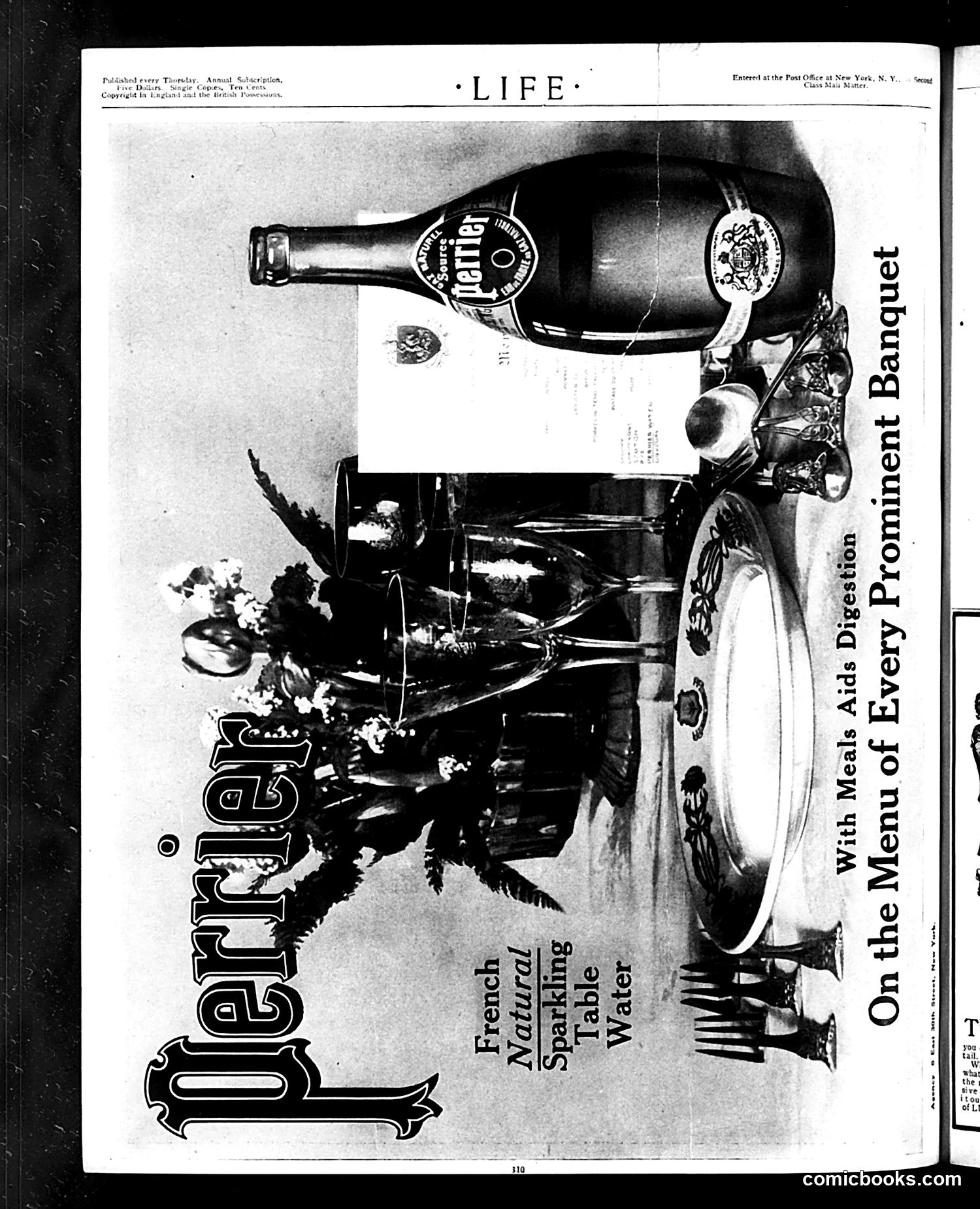
This page is primarily an **advertisement for Perrier sparkling water**, not political satire. The image shows a bottle of Perrier positioned above an elegant dining scene with fine dishes, flowers, and table settings. The ad's text emphasizes Perrier as "French Natural Sparkling Table Water" and promotes it for formal dining occasions ("With Meals Aids Digestion / On the Menu of Every Prominent Banquet"). The satirical magazine *Life* context suggests this was likely humorous advertising—positioning a French mineral water as essential to upscale American entertaining during the early-to-mid 20th century. The advertisement appeals to aspirational readers by associating Perrier with sophistication and refined dining culture. No political figures or references appear to be present.
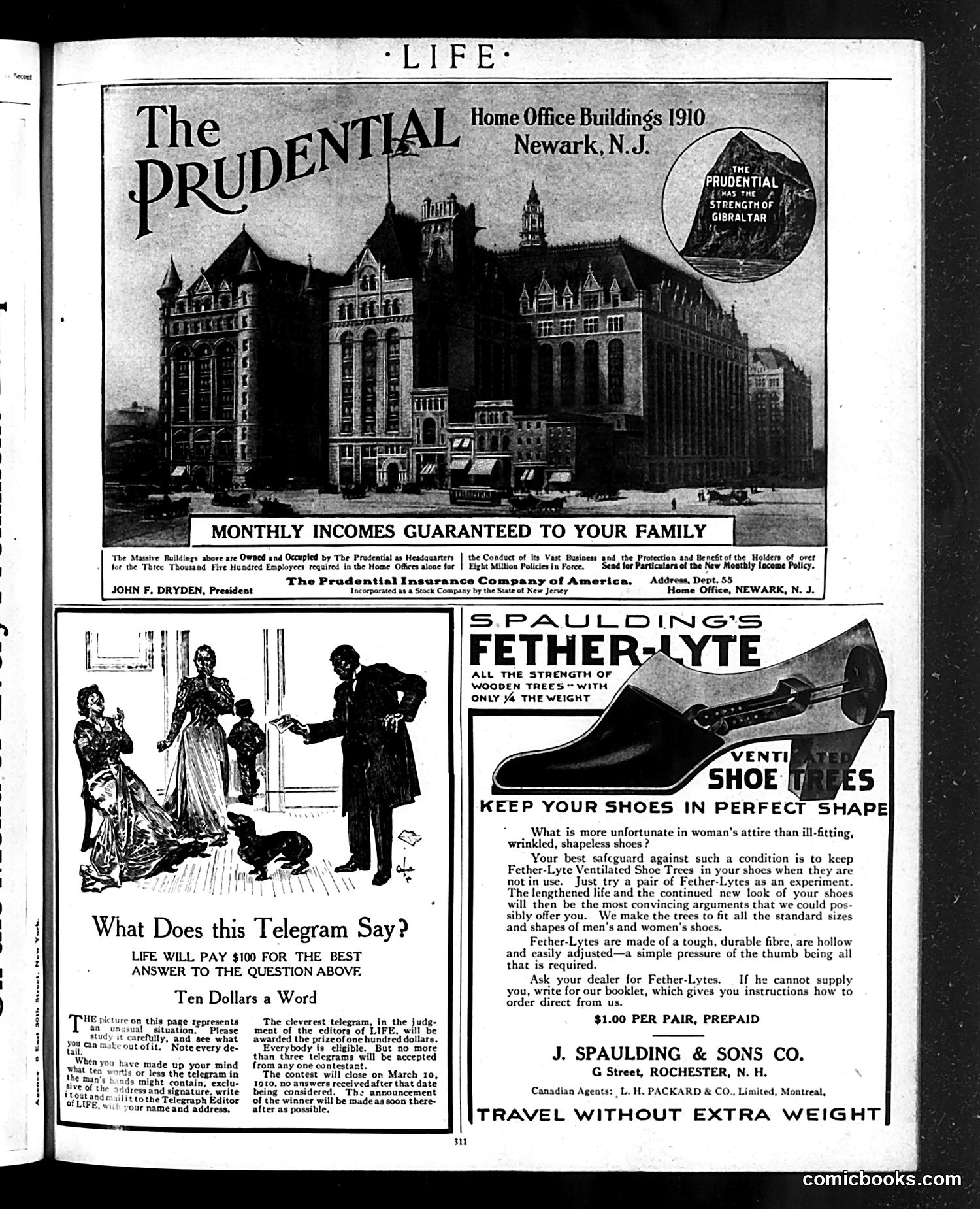
This page is primarily **advertising**, not political satire. The dominant feature is a large advertisement for Prudential Insurance's "Home Office Buildings" in Newark, N.J. (1910), emphasizing financial security and guaranteed monthly income for families. Below that is a puzzle feature titled "What Does this Telegram Say?" offering $100 for the best answer—a reader-engagement gimmick typical of Life magazine's era. The remaining advertisements promote practical consumer goods: Spaulding's "Fether-Lyte" ventilated shoe trees (for shoe preservation) and travel luggage. There is no political cartoon or social satire visible. This represents Life's mixed content model: humor magazine interspersed with commercial advertisements, reflecting early 20th-century publishing practices.
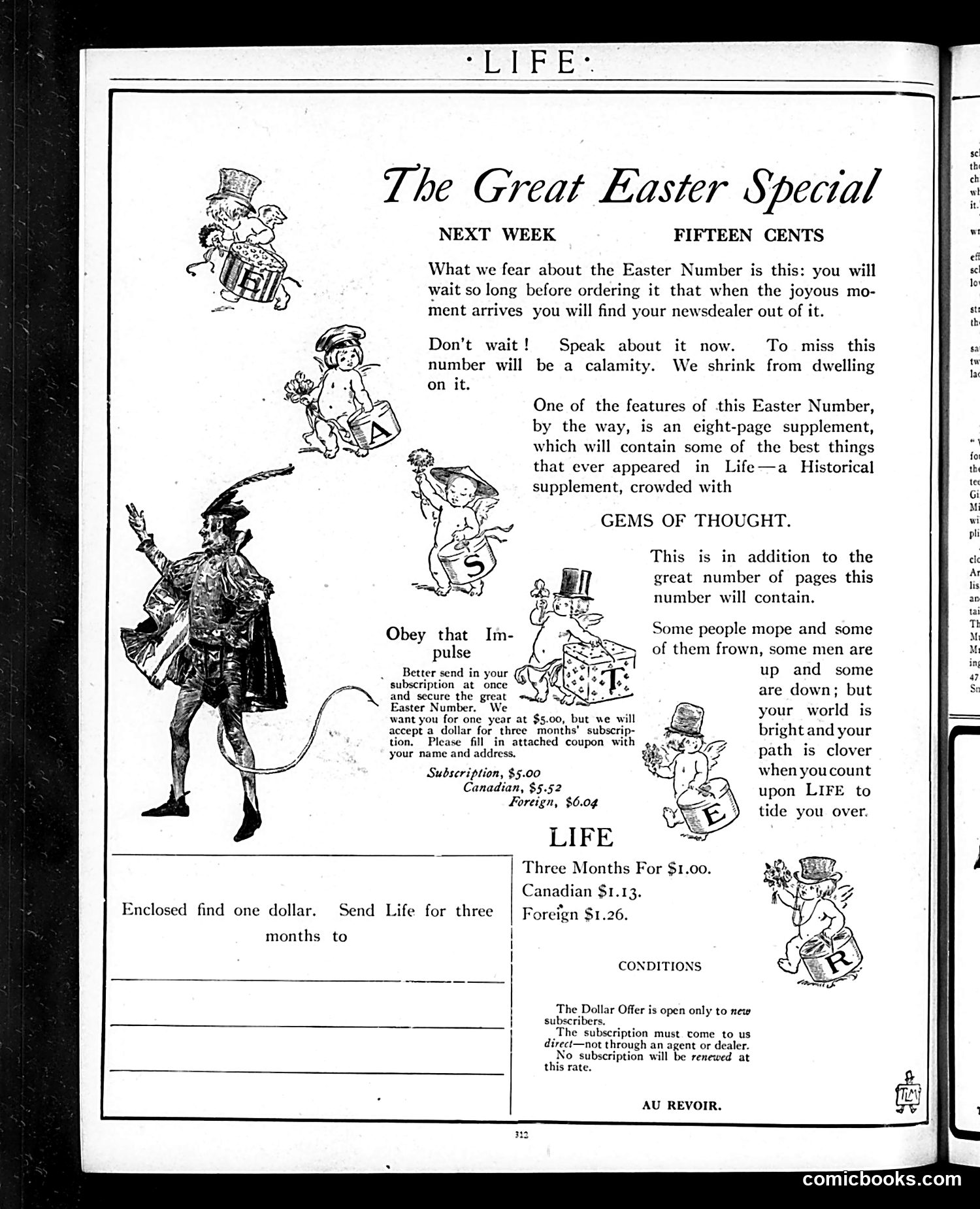
This is primarily a **subscription advertisement** for Life magazine's Easter issue, priced at fifteen cents. The elaborate illustrations—featuring a pied piper figure, cherubs, and Easter-themed characters—are decorative rather than satirical. The text uses playful persuasion, warning readers not to miss the Easter Number or "newsdealer[s]" will sell out. It promises an eight-page historical supplement with "Gems of Thought," though specifics aren't detailed. The subscription offer itself is the main content: one dollar for three months domestic service. A "pied piper" character (bottom left) serves as visual hook, conducting readers toward subscribing. This appears to be a straightforward marketing piece rather than political satire.
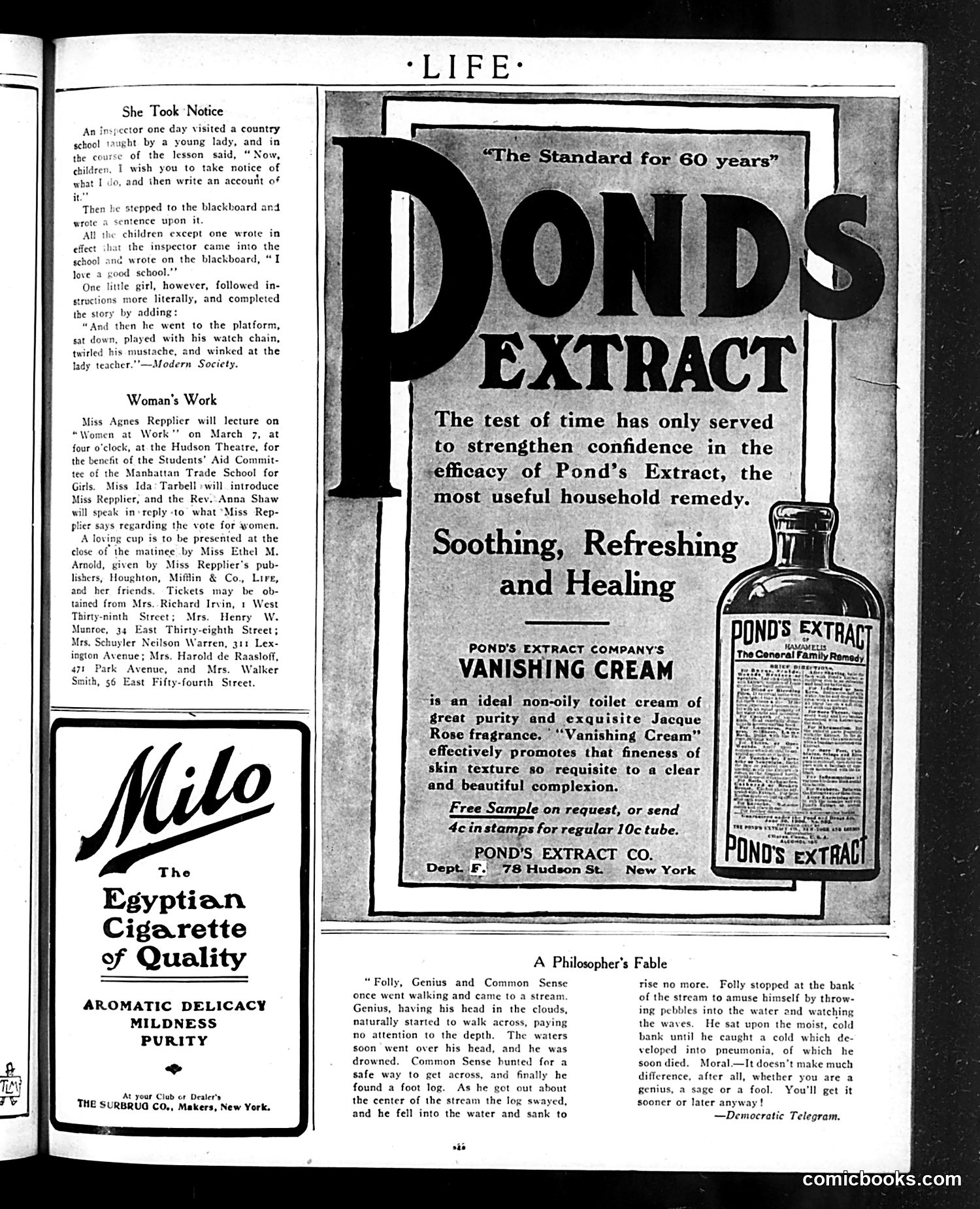
This page is **primarily advertising** rather than editorial satire. The dominant content is a large advertisement for Pond's Extract, a medicinal product marketed as "The Standard for 60 years," claiming efficacy as a household remedy with "Soothing, Refreshing and Healing" properties. The ad emphasizes the product's longevity as proof of effectiveness. The left column contains minor items: a brief anecdote titled "She Took Notice" about a schoolteacher's classroom exercise, a notice about a women's lecture, and a Milo Egyptian Cigarette advertisement. Below is "A Philosopher's Fable"—a short moral story about Folly, Genius, and Common Sense crossing a stream, concluding that genius succeeds while folly fails. No political cartoons or significant satire appears on this page.
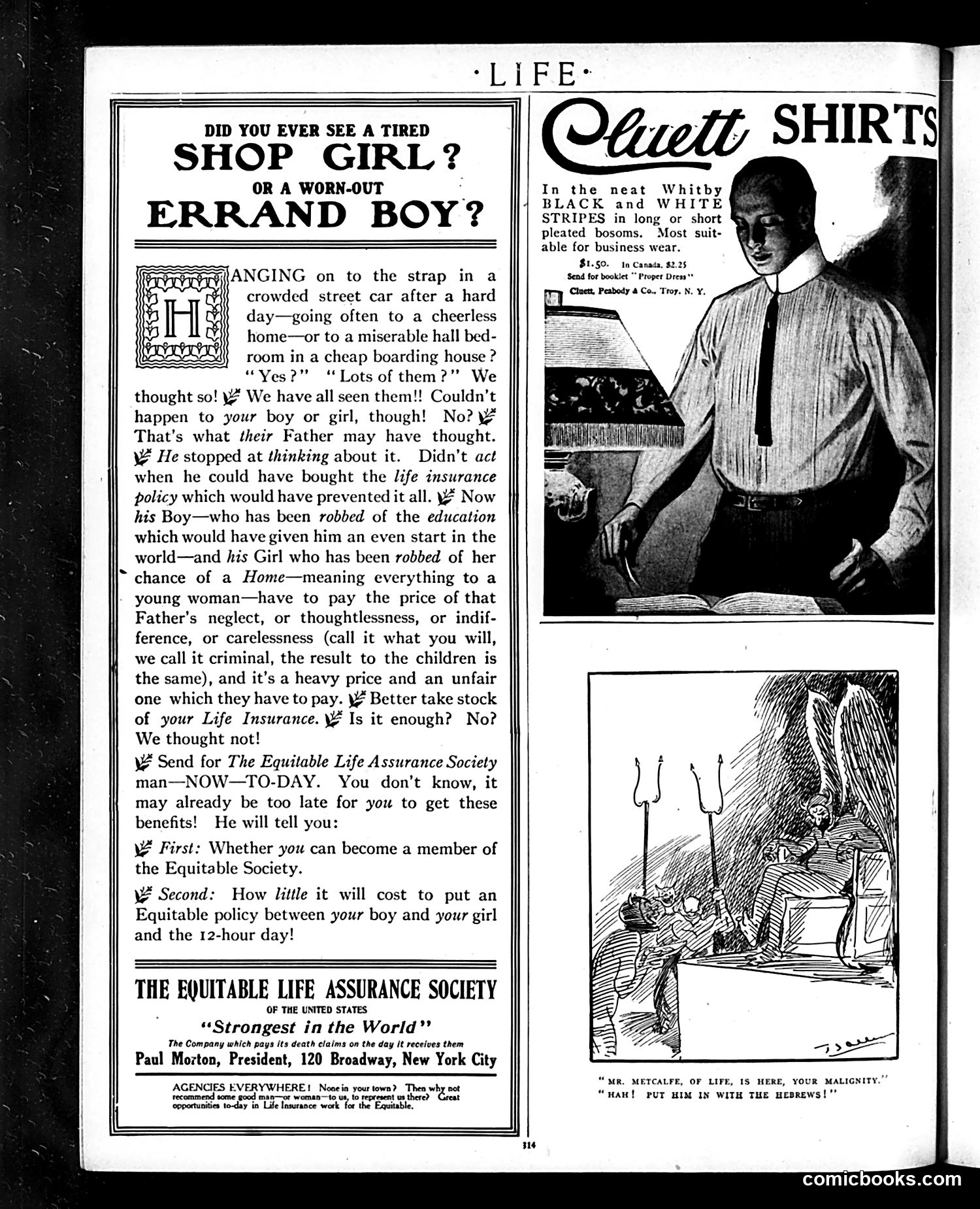
This page contains two distinct elements: **Left side:** A life insurance advertisement from The Equitable Life Assurance Society using emotional appeal. It warns fathers against neglecting to purchase life insurance, suggesting that failure to do so constitutes "criminal" neglect toward their children's futures. The ad uses dramatic language about children being "robbed" of education and homes due to parental indifference. **Right side:** A Cluett shirt advertisement (top) and a cartoon (bottom) depicting what appears to be a satirical hell scene. The cartoon's caption references "Mr. Metcalfe of Life" and includes an antisemitic slur, suggesting the figure represents someone being condemned. This reflects the magazine's occasional use of offensive stereotypes in its satirical humor—a problematic aspect of early 20th-century American media.
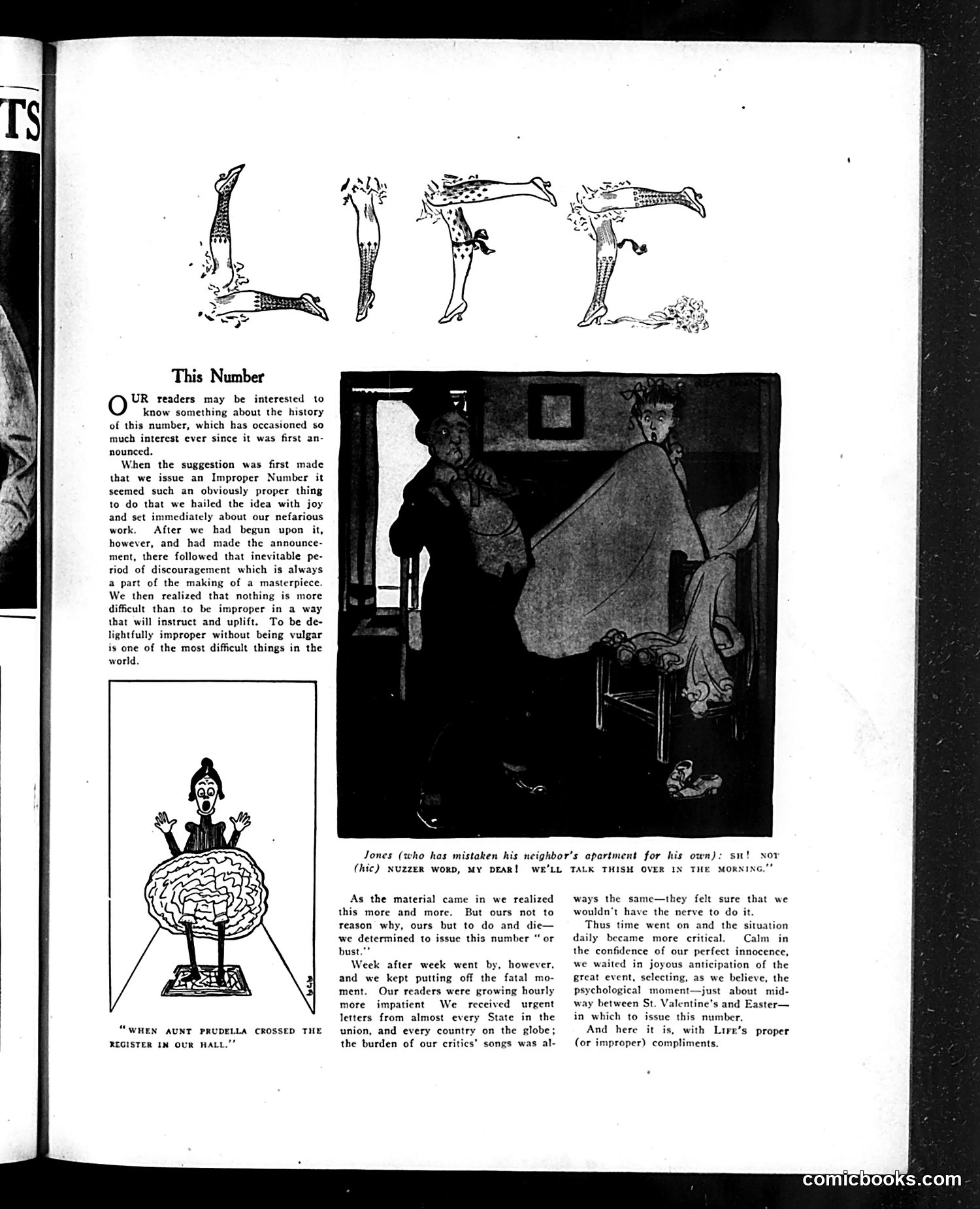
This page explains Life's decision to publish an "improper" issue—likely featuring risqué or controversial content. The editorial discusses the challenge of being "improperly improper" without vulgarity, and describes receiving urgent letters from readers nationwide demanding they proceed despite critics' objections. The illustration titled "When Aunt Prudella Crossed the Register in Our Hall" depicts a scandalized older woman confronting what appears to be a nude male figure emerging from a brain-shaped structure—a surreal image suggesting the intellectual/psychological discomfort of propriety being violated. The photograph shows two figures in what appears to be an awkward domestic confrontation, with a caption about mistaking one's neighbor's apartment. The overall theme satirizes Victorian prudishness and American hypocrisy around sexuality and decency.
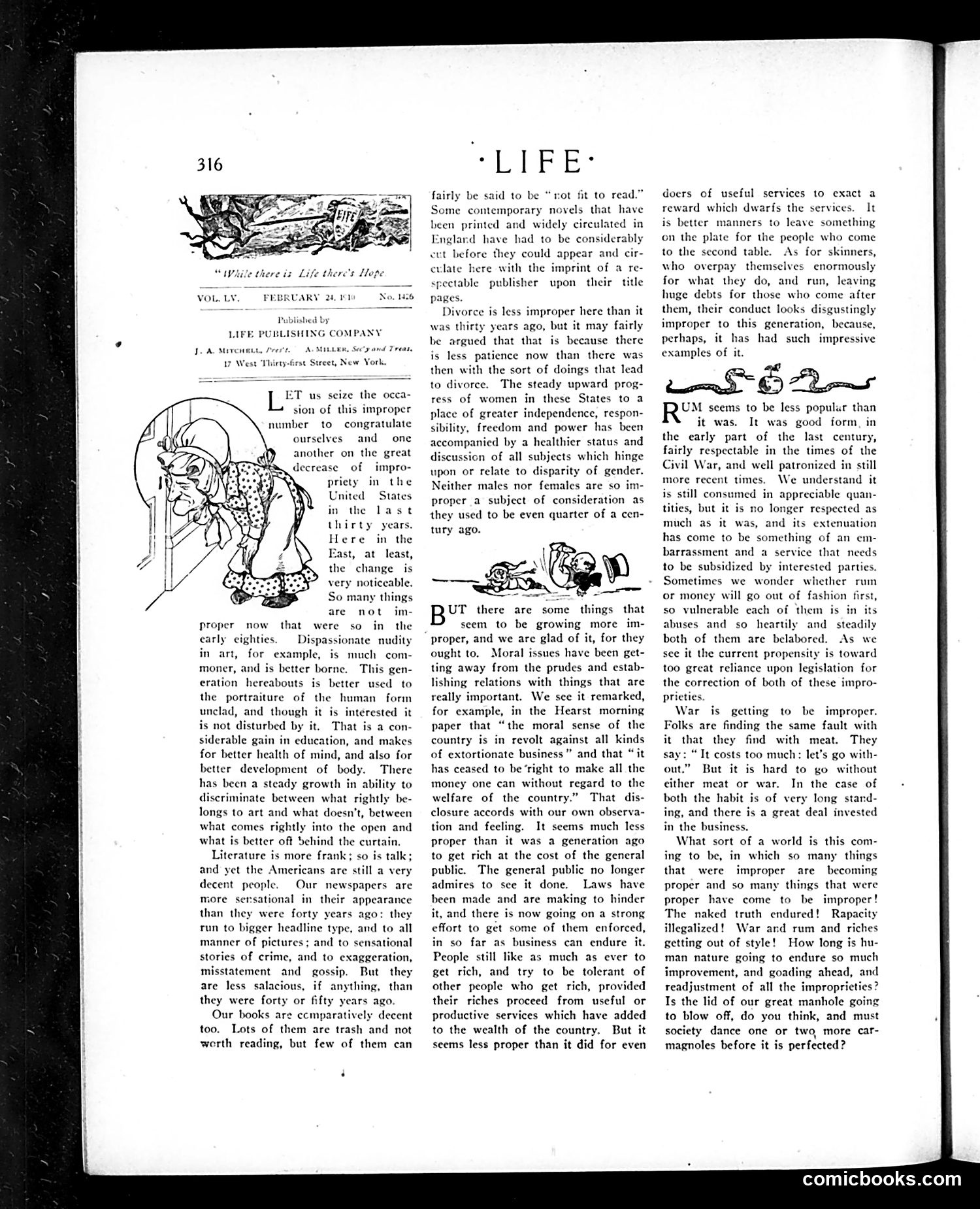
This page contains editorial commentary rather than political cartoons. The main illustration shows a figure in what appears to be early 20th-century dress looking out a window with a somewhat bewildered or concerned expression. The text discusses social changes in America, particularly regarding divorce, women's independence, and evolving moral standards. The author argues that impropriety is becoming more socially acceptable, and that "war is getting to be improper"—a satirical observation that war, traditionally accepted, is now questioned while other formerly scandalous behaviors gain acceptance. The piece criticizes wealth accumulation without productive contribution to society and questions whether society should tolerate such improprieties. It's social commentary on rapidly changing American values and morality during this period.
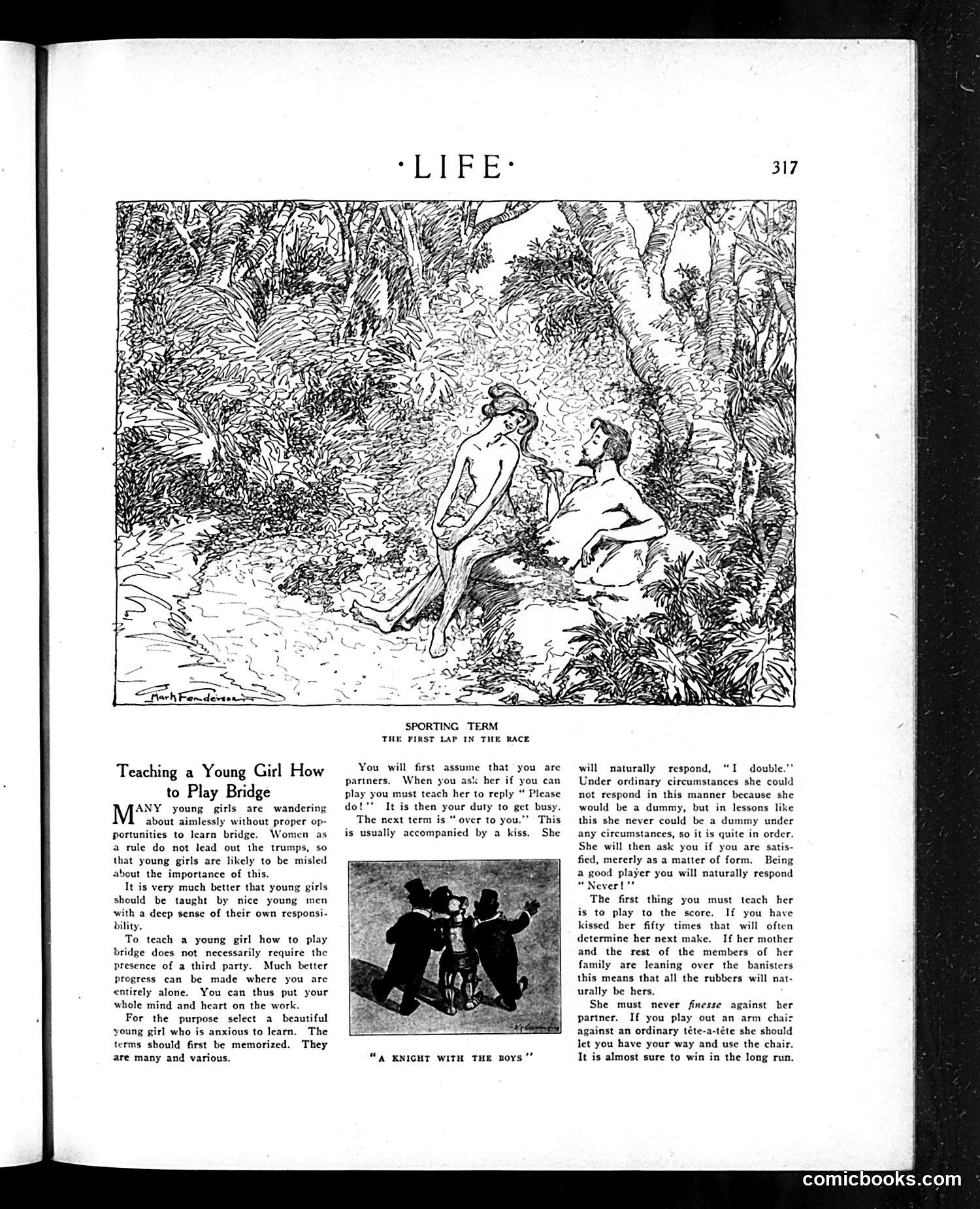
This page contains instructional content on teaching young women to play bridge, a card game that was a major social activity among the leisure class in early-to-mid 20th century America. The top illustration labeled "SPORTING TERM: THE FIRST LAP IN THE RACE" depicts two nude figures in a forest setting—likely a humorous visual pun playing on the idea of "laps" in racing versus physical contact. The lower photograph captioned "A KNIGHT WITH THE BOYS" shows men in formal attire playing cards, illustrating typical bridge social gatherings of the era. The accompanying article provides etiquette guidance for teaching bridge to young women, emphasizing proper responses, scoring knowledge, and gracious playing style—reflecting period concerns about women's social refinement and marriageability through leisure activities.
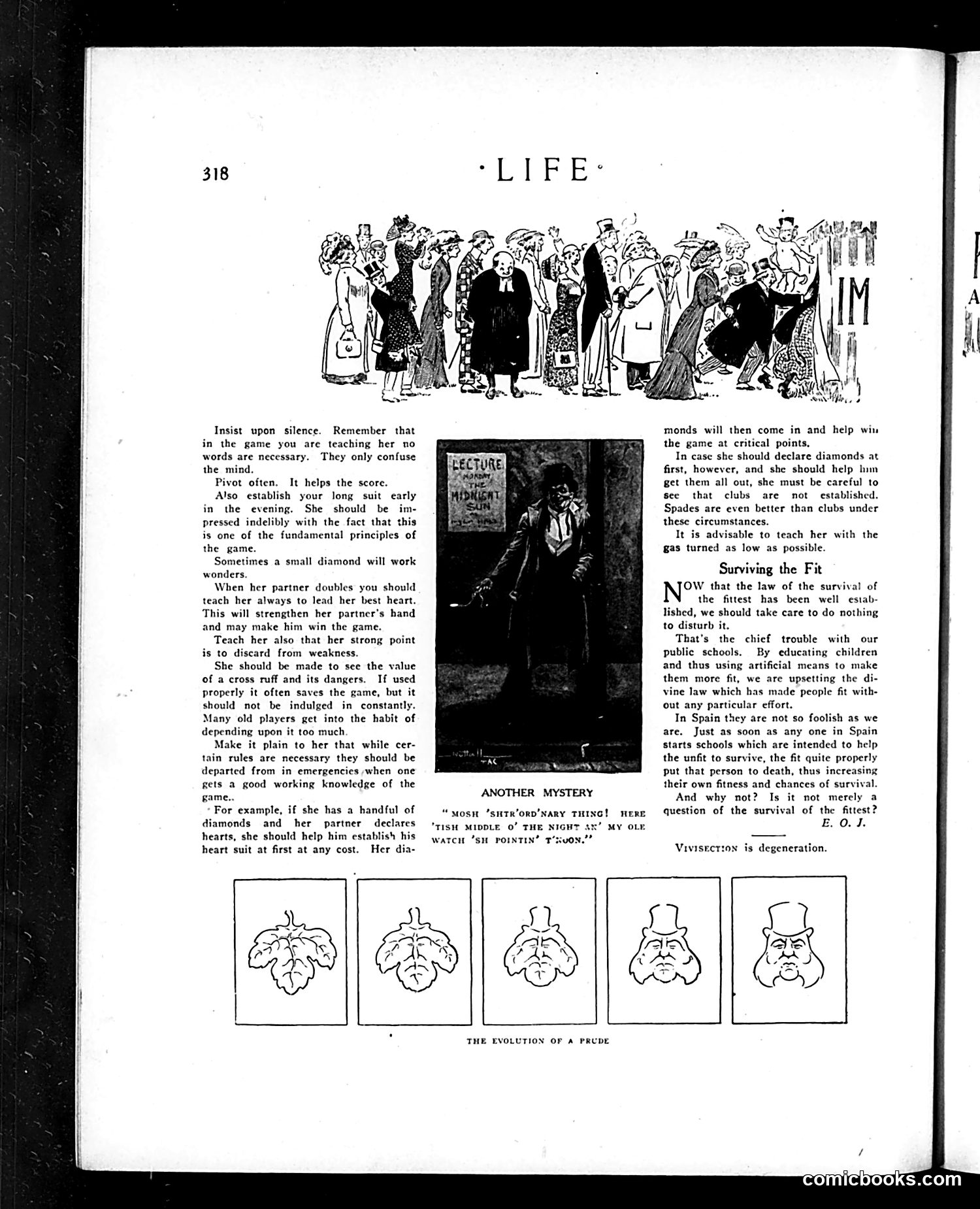
This page contains bridge instruction mixed with social commentary. The main text teaches contract bridge strategy, emphasizing silence during play and proper card technique. The illustration titled "Another Mystery" appears to show a séance or spiritualist gathering—a popular phenomenon in this era—with the caption suggesting someone is communicating through "the night" using pointing gestures. At the bottom, "The Evolution of a Prude" shows five progressive drawings of a face becoming increasingly stern or prudish, likely satirizing changing social attitudes or standards of propriety. The overall page juxtaposes genteel pastimes (bridge, spiritualism) with subtle mockery of social pretension and evolving moral attitudes—typical of Life magazine's satirical approach to American middle-class culture.
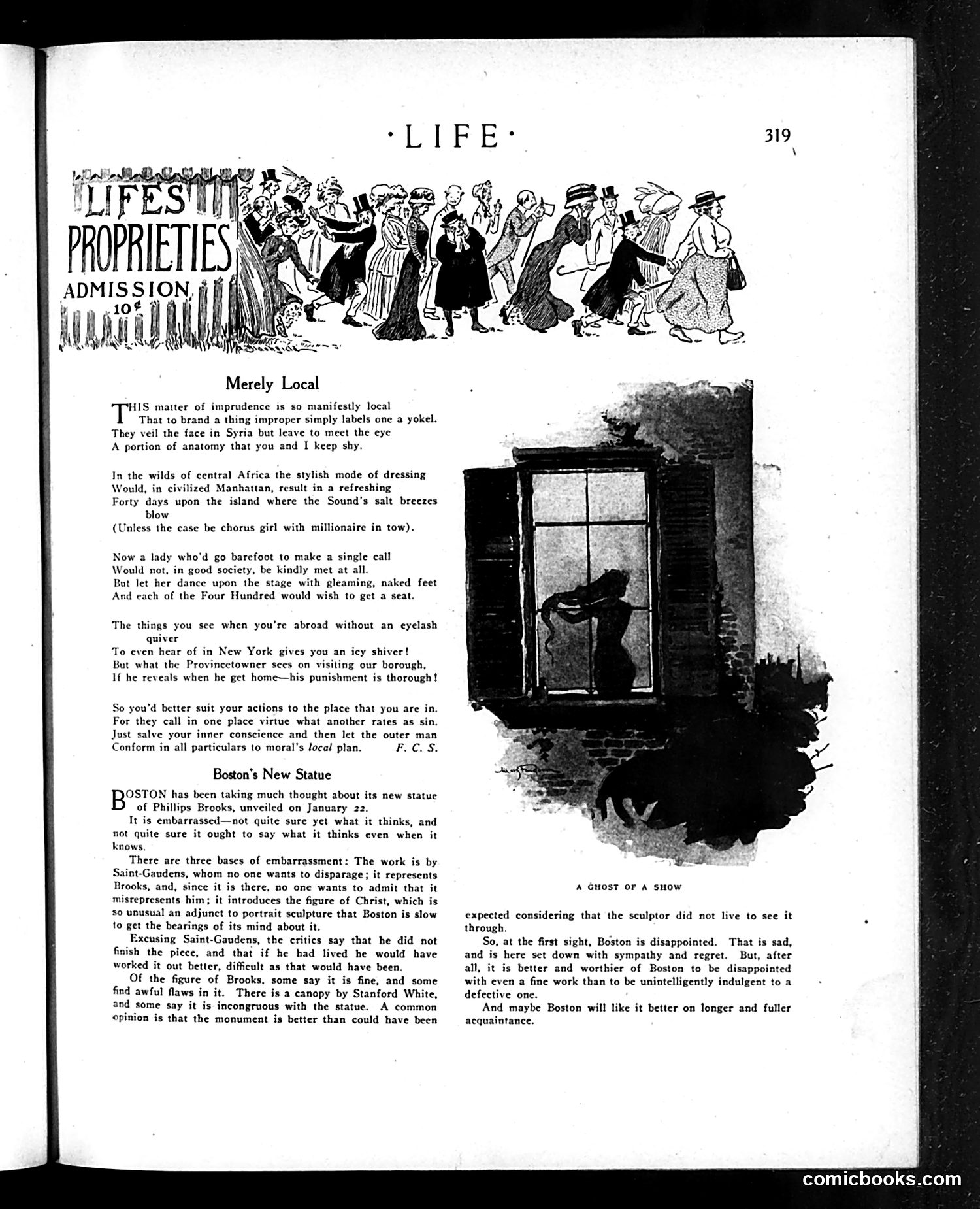
This page contains two satirical pieces about propriety and social conventions. **"Merely Local"** mocks provincial attitudes about morality. The poem argues that impropriety is "local"—what's scandalous in one place (like a woman dancing naked) might be acceptable elsewhere. The satire suggests people shouldn't judge others by narrow hometown standards, but rather recognize that different cultures have different norms. The piece cynically advises conforming to wherever you are rather than adhering to absolute moral principles. **"Boston's New Statue"** discusses Saint-Gaudens' statue of Philips Brooks. The article humorously notes Boston's embarrassment about the work—uncertain whether it's good. It catalogs three sources of embarrassment: the sculptor's reputation, the subject's importance, and theological concerns about depicting Christ. The piece gently mocks Boston's provincial anxiety over artistic judgment.
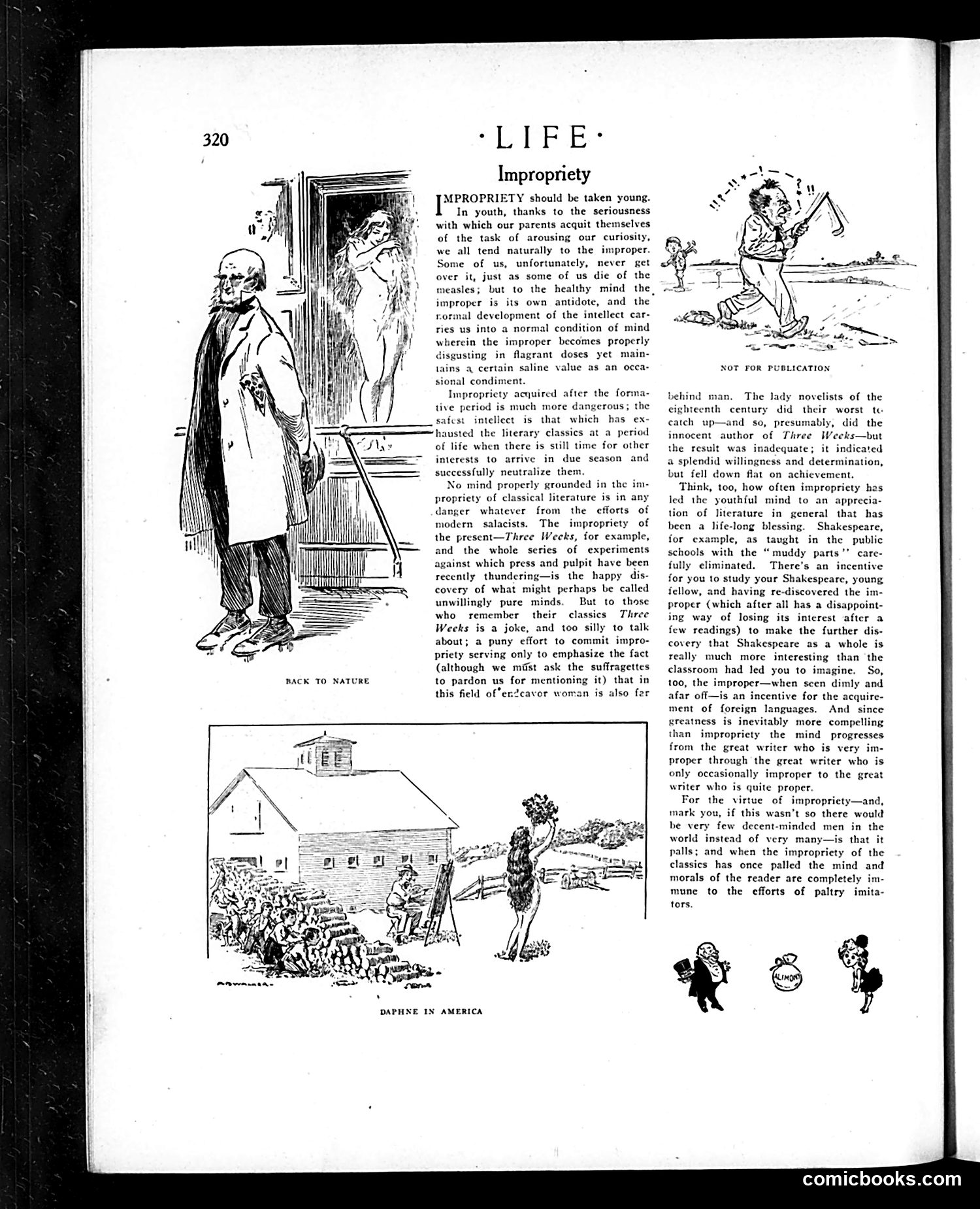
This page discusses social propriety and literary standards. The essay argues that impropriety serves a healthy function in developing proper intellect, contrasting "proper" classical literature with contemporary works like *Three Weeks* (a scandalous 1907 novel). The cartoons illustrate this theme: - **"Back to Nature"**: Shows a man observing a partially nude woman, satirizing claims of "natural" behavior to justify improper conduct. - **"Daphne in America"**: References the Greek myth of Daphne (transformed into a laurel tree), here depicting her appearing before gathered Americans, likely mocking how classical mythology was invoked to excuse modern impropriety. The overall message critiques how people rationalize indecent behavior through appeals to nature or classical precedent.
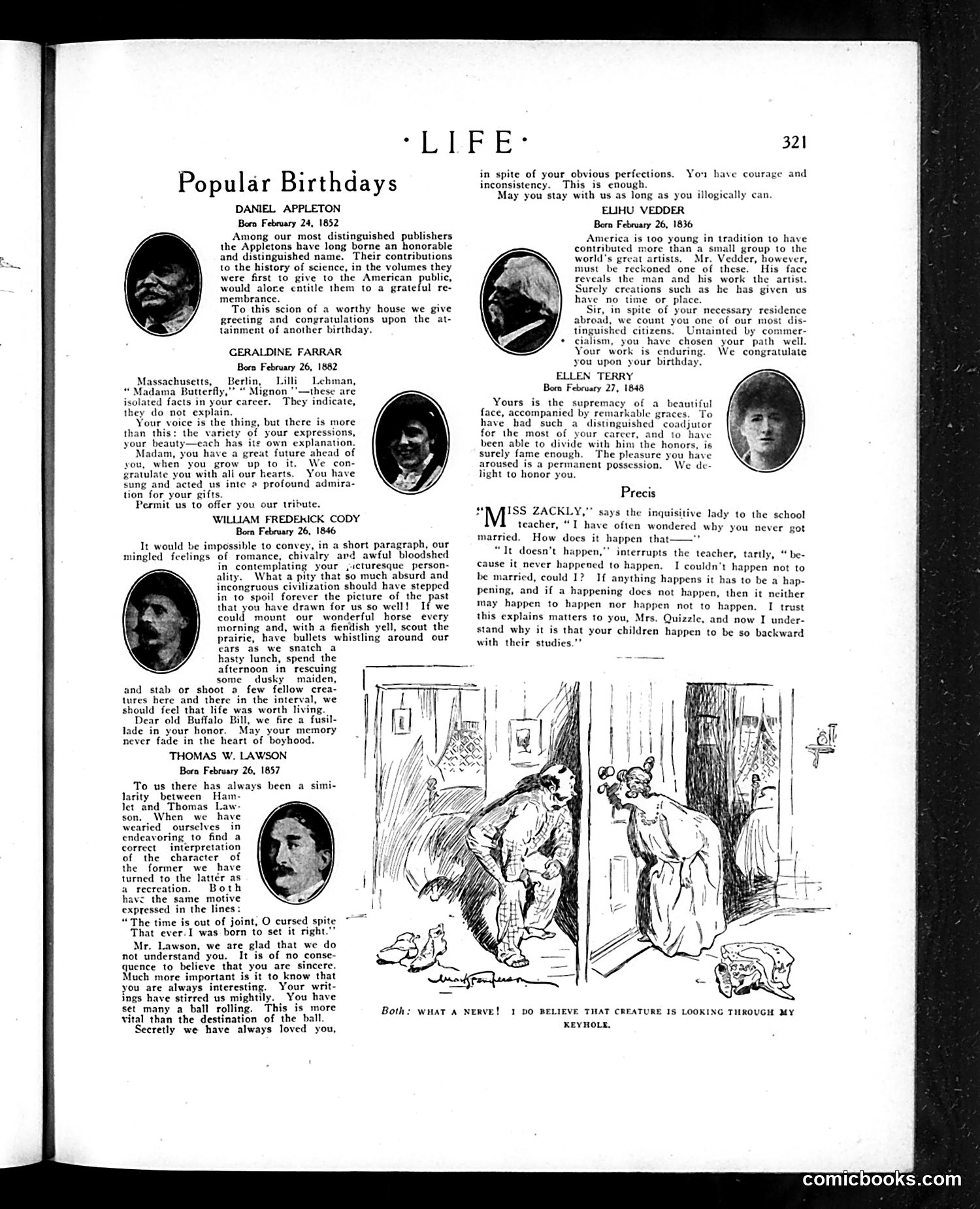
This page celebrates notable birthdays of prominent figures (Daniel Appleton, Geraldine Farrar, William Frederick Cody, Thomas W. Lawson, Elihu Vedder, and Ellen Terry). The bottom section titled "Precis" contains a humorous anecdote about a school teacher, Miss Zackly, discussing why unmarried women remain single—a joke playing on Victorian-era attitudes about marriage and spinster teachers. The accompanying cartoon depicts what appears to be a domestic scene with a woman peering through a keyhole while another figure reacts with surprise. The caption reads: "Both: What a Nerve! I do believe that creature is looking through my keyhole"—satirizing voyeurism, privacy violations, and the absurdity of mutual accusations. This reflects early 20th-century humor about domestic espionage and social propriety.
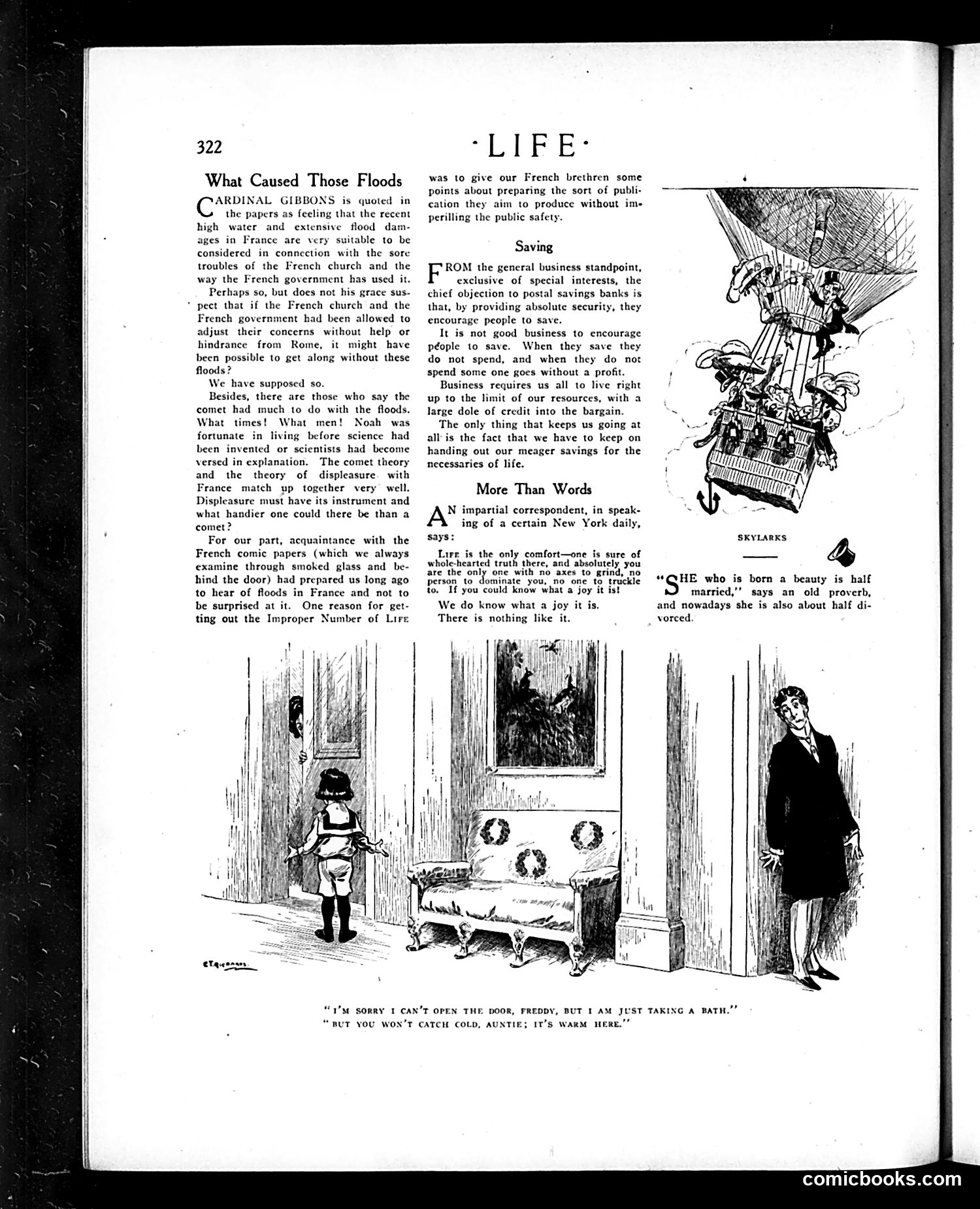
This page contains three distinct satirical pieces: **"What Caused Those Floods"** mocks Cardinal Gibbons's suggestion that French floods relate to church-state conflicts. Life sarcastically implies the Church and government could coexist peacefully without Vatican interference, and jokes that French comic papers are so scandalous they're dangerous to public safety. **"Saving"** attacks postal savings banks as bad for business. The satire argues that encouraging thrift is economically harmful because consumer spending—funded by debt and credit—drives commerce. Saving threatens profits, so the system requires citizens to spend beyond their means. **"More Than Words"** and **"Skylarks"** are brief humorous observations: one praises truthful journalism; the other riffs on an old proverb that beautiful women marry easily, adding the modern twist that they also divorce easily—a jab at marital instability. The bottom cartoon shows a woman in a bathtub refusing to open the door, claiming it's warm inside, while presumably someone outside worries about her catching cold—a simple domestic humor piece.
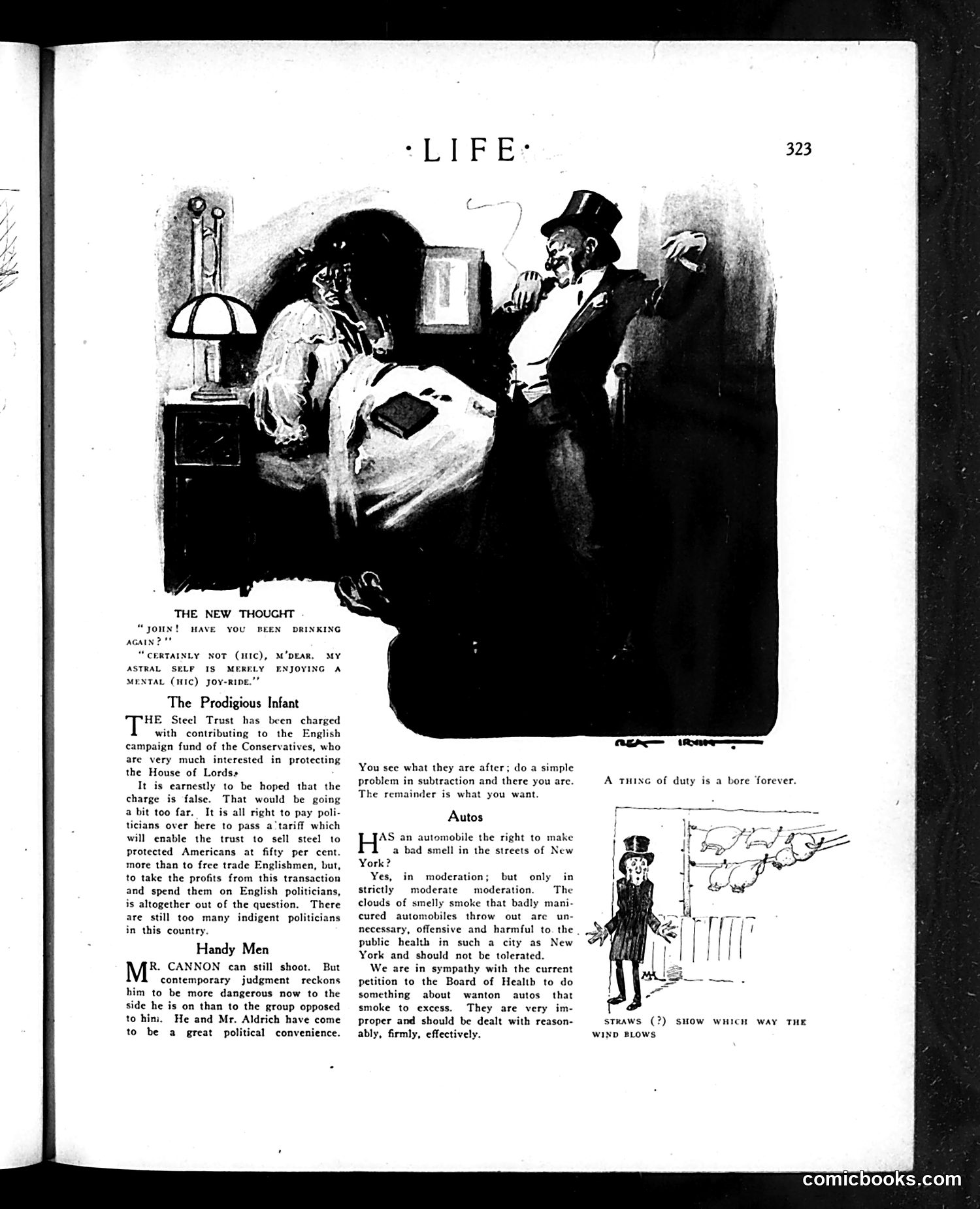
**Main Cartoon "The New Thought"**: Depicts a drunken man defending his inebriation by invoking "New Thought" philosophy—claiming his "astral self" is merely enjoying a "mental joy-ride" while his physical body drinks. This satirizes the trendy New Thought movement (early 1900s spiritual philosophy) as an excuse for bad behavior. **"The Prodigious Infant"**: Criticizes the Steel Trust for allegedly funding English Conservative politicians to protect the House of Lords while already profiting excessively from American tariff protections. The satire mocks this as greed taken too far—even corrupt American politicians find it outrageous. **"Handy Men"**: References politicians Uncle Joe Cannon and Nelson Aldrich, suggesting they've become liabilities to their own Republican side despite their power. **"Autos"**: Brief commentary on automobile pollution in New York City—a modern nuisance requiring Board of Health intervention. The page reflects Progressive-era concerns: corporate monopolies, political corruption, New Age fads, and urban pollution.
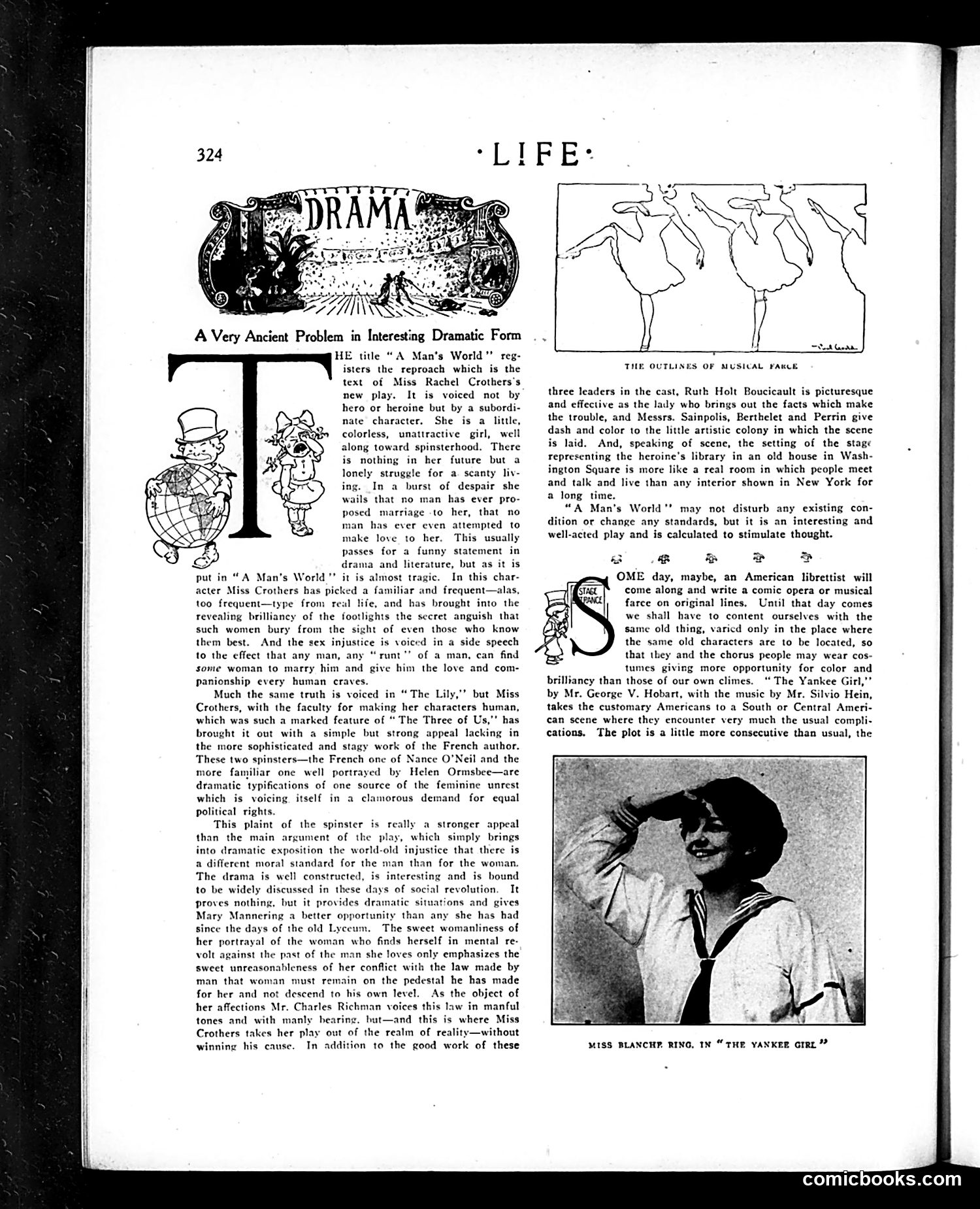
This page reviews Rachel Crothers's play "A Man's World," a drama addressing gender inequality. The critic praises the play for depicting the "feminine unrest" of women demanding equal political rights—a reference to the early 20th-century suffrage movement. The review highlights a secondary character: an unmarried, aging woman whose despair at never receiving a marriage proposal becomes tragic rather than comedic. This represents the reviewer's recognition of real social injustice—that women's worth and survival depended entirely on male approval and marriage. The play's central conflict involves a double standard: men and women face different moral expectations regarding relationships and sexuality. The critic notes the play doesn't "prove" anything but effectively dramatizes this persistent inequality. The small cartoon at top-left appears to illustrate this spinster character's plight. The photograph shows Blanche Ring in "The Yankee Girl," a competing musical production.
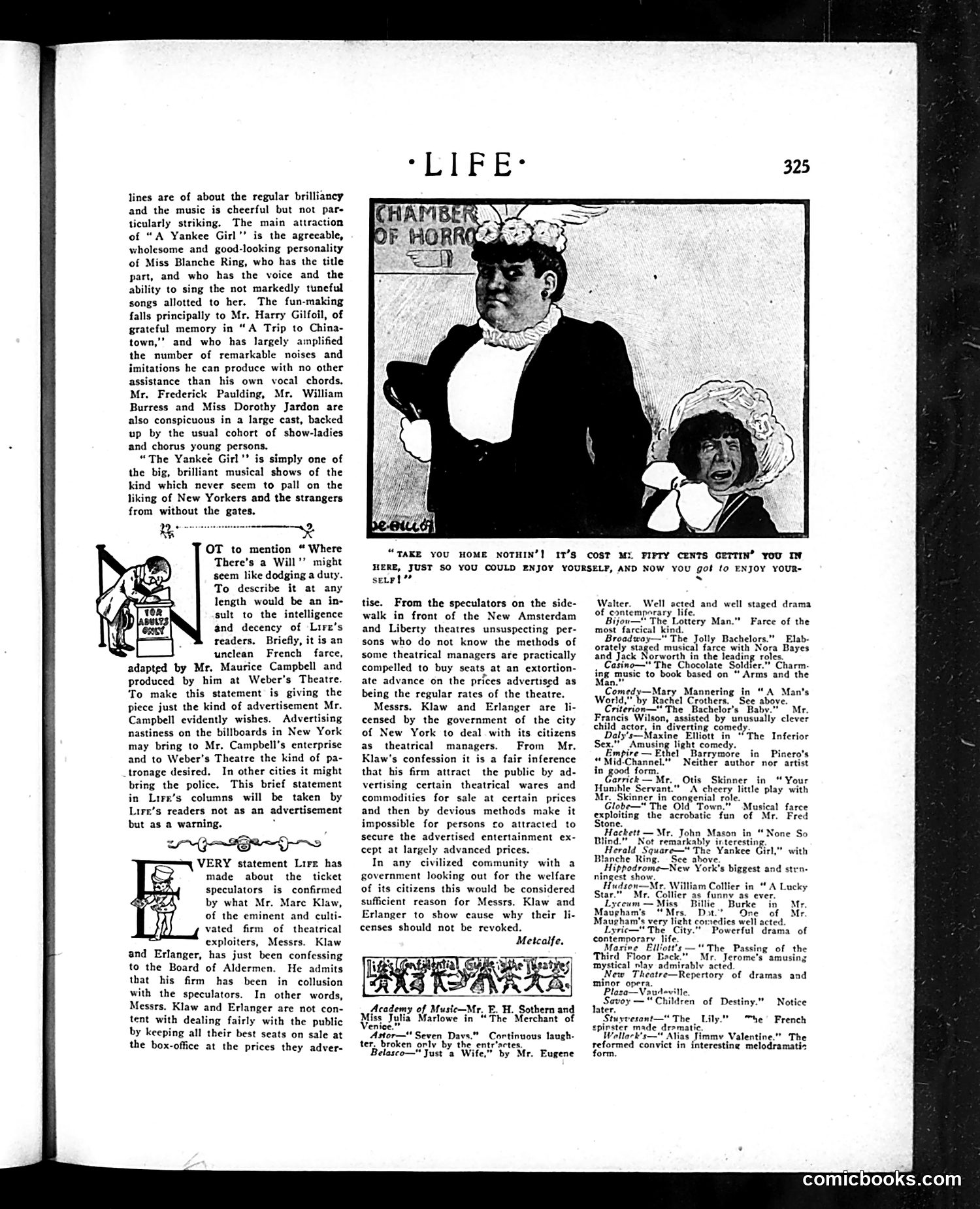
This page critiques theatrical practices in early 1900s New York. The main cartoon (upper right) depicts a ticket speculator confronting a patron, with the caption showing the speculator's aggressive pitch—essentially admitting he's extracting an extortionate surcharge ("fifty cents") on top of advertised prices just to access the show. The accompanying text exposes a collusion scheme between major theater operators **Messrs. Klaw and Erlanger** (prominent theatrical producers) and street-side ticket scalpers. The magazine accuses them of deliberately underpricing tickets at box offices while tacitly allowing speculators to resell at inflated rates on the street, making it practically impossible for ordinary patrons to purchase at advertised prices. Life frames this as fraud deserving license revocation by city government. The piece also briefly reviews theatrical productions including "A Yankee Girl" (starring Blanche Ring) and harshly dismisses "Where There's a Will" as an indecent French farce. The satire targets exploitative theater monopolies deceiving the paying public through coordinated scalping.
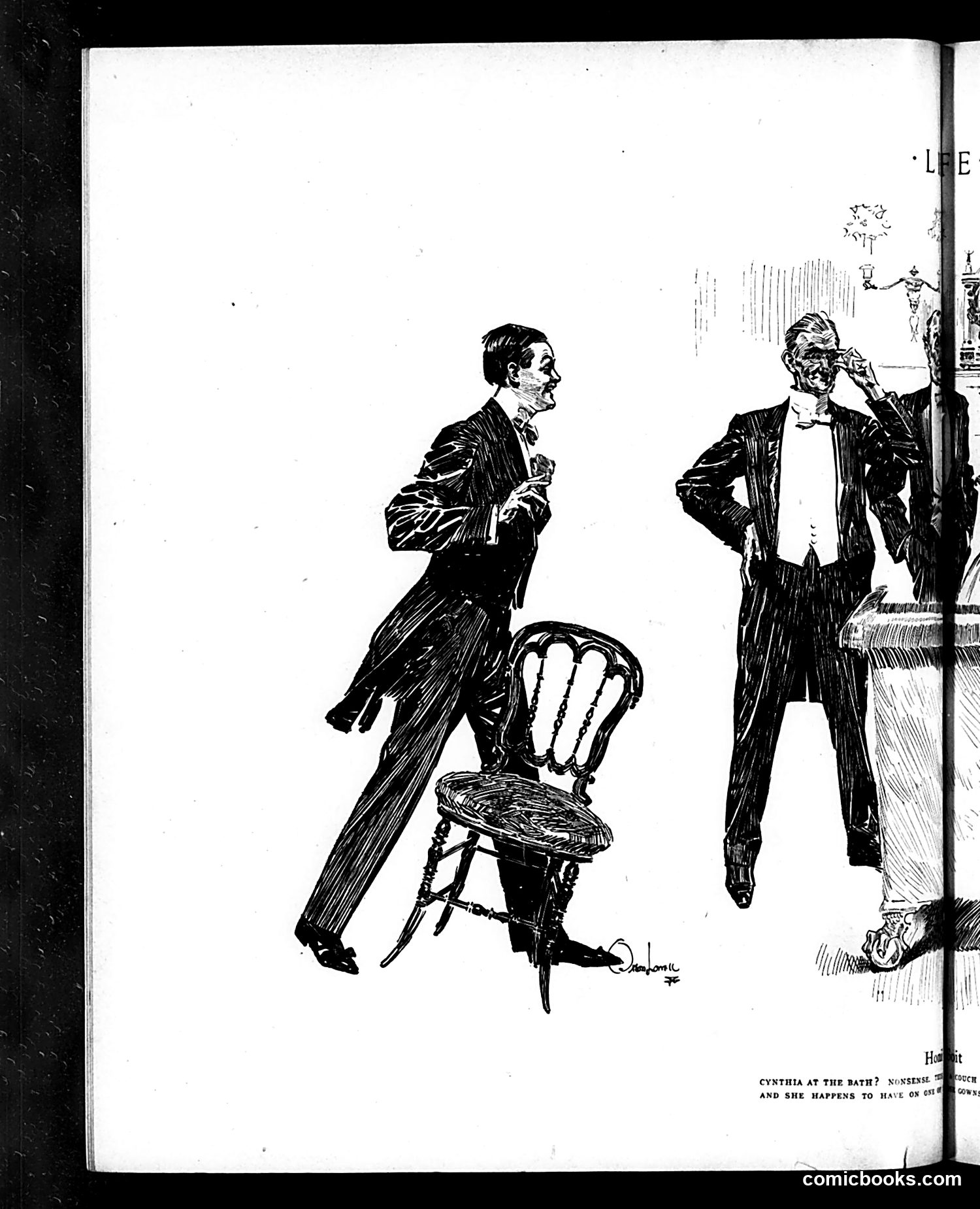
This page contains a satirical illustration showing two men in formal evening wear (tuxedos). The OCR text is fragmentary but appears to reference "Cynthia at the Bath" and mentions "costume" and "cows," suggesting a theatrical or social comedy scenario. The cartoon depicts what appears to be a domestic or social embarrassment scene—one man is leaning against a chair in an awkward pose while another stands nearby. The style and composition suggest humor derived from social pretension or an awkward social situation, likely involving someone (Cynthia) appearing in an inappropriate or compromising state of undress, with the "cows" reference possibly implying rural/rustic disruption of refined society. Without the complete caption and broader context, the specific satire remains unclear, though it appears to mock Victorian-era social conventions around propriety and dress.
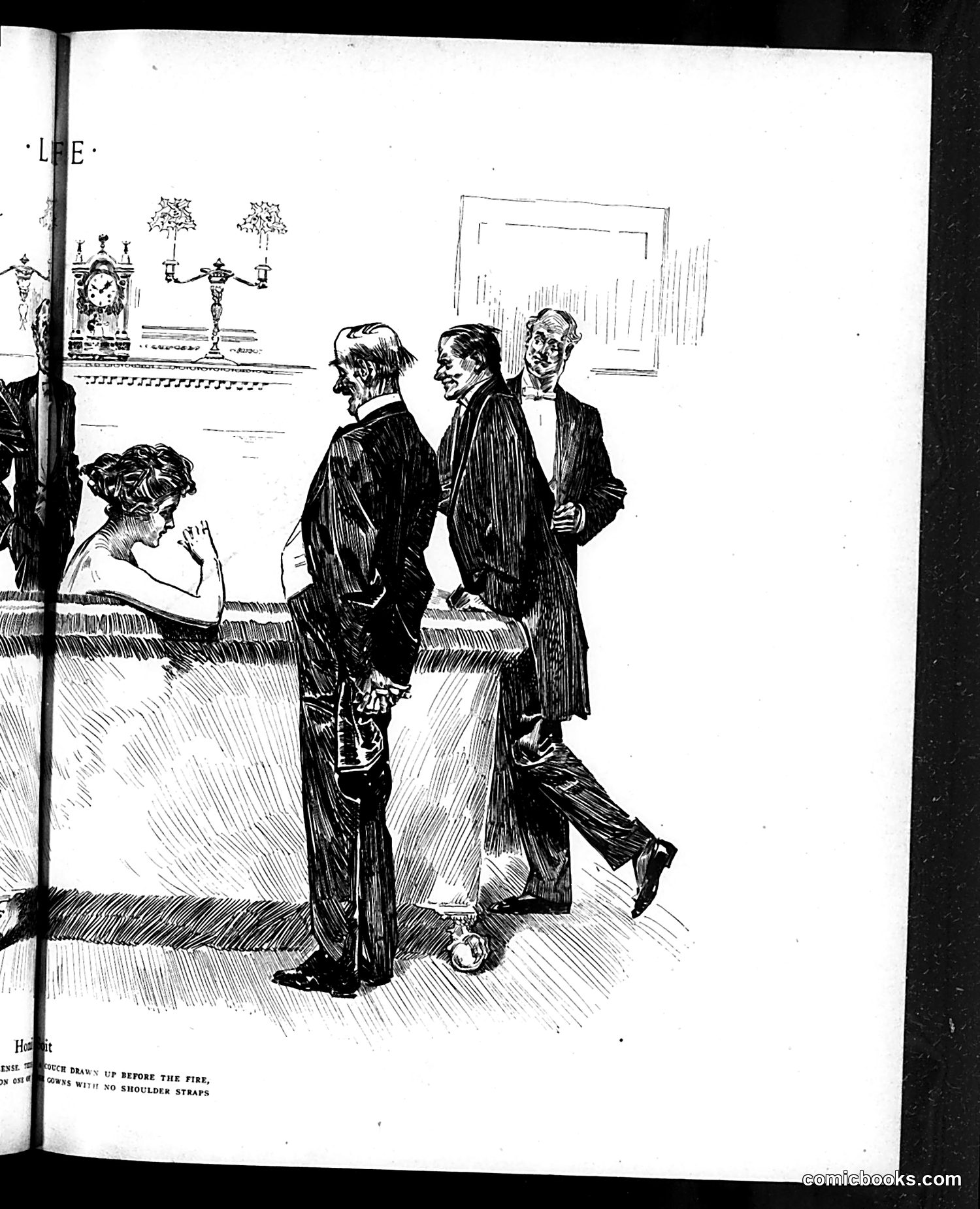
This appears to be a satirical illustration from *Life* magazine showing three men in formal attire at what looks like a hotel or formal establishment, with a woman visible on the left. The caption references dressing "up before the fire" and mentions "gowns with no shoulder straps." The satire likely concerns **formal dress codes and social conventions**, possibly mocking either: - Men's rigid formal wear requirements versus women's more relaxed fashion standards - Contemporary debates about appropriate evening wear - Social pretension around formal dress The contrast between the elaborately dressed men and the woman's simpler attire, combined with the shoulder strap reference, suggests commentary on **gendered expectations** or **fashion double standards** of the era. However, without additional context about the specific historical moment or *Life* magazine's editorial stance, the exact political or social target remains unclear.
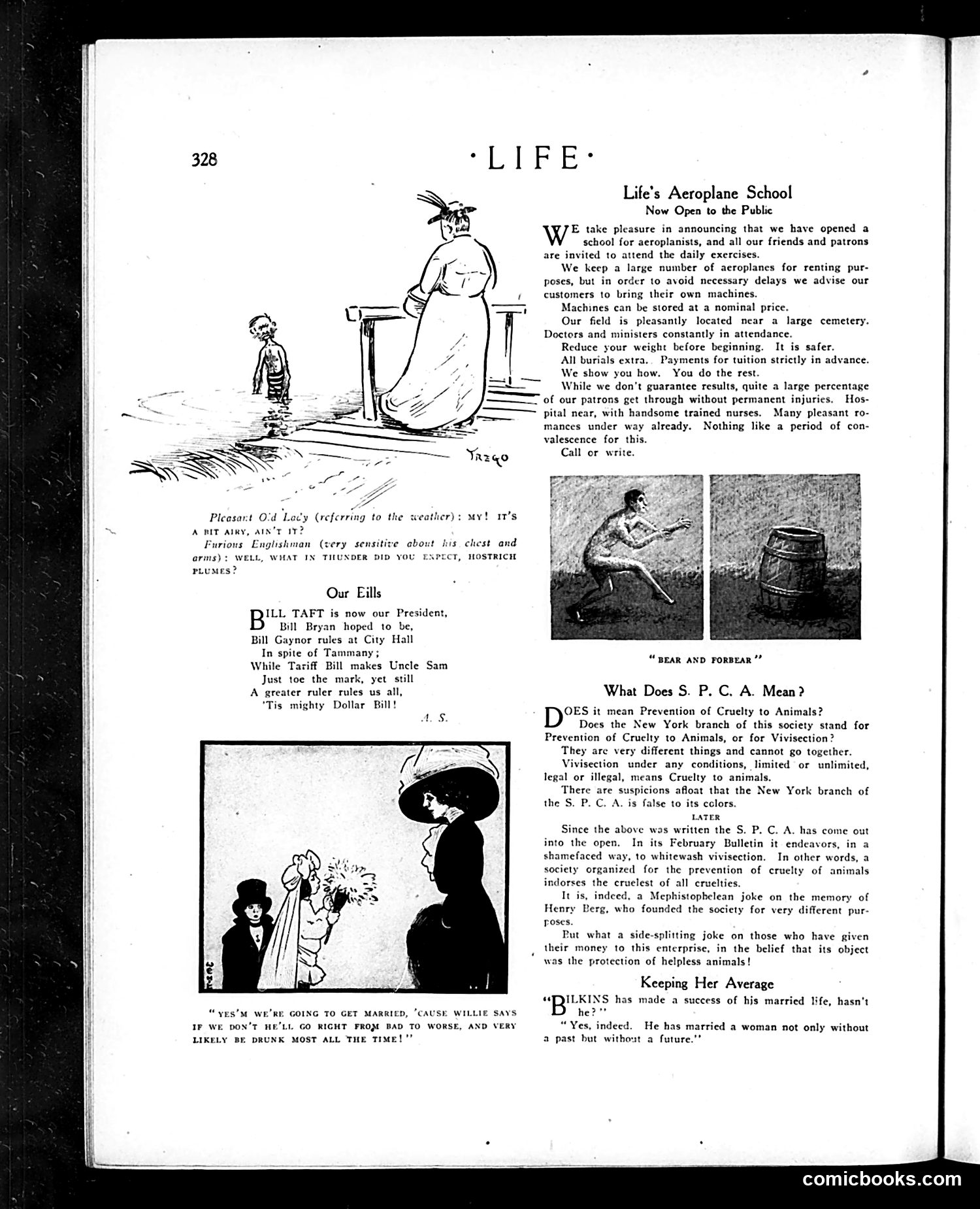
This page from *Life* magazine (likely early 1900s) contains three satirical pieces: **1. "Life's Aeroplane School"** – Dark humor about early aviation's extreme danger. The "school" advertises near a cemetery with doctors and ministers on staff, jokes about weight reduction and burials, and admits most students get "through without permanent injuries." This mocks the nascent, highly fatal aviation industry. **2. "Our Bills"** – Political verse naming current officeholders: President Taft, William Jennings Bryan (defeated candidate), NYC Mayor Gaynor, and "Tariff Bill" (likely referring to tariff legislation). The satire concludes that the "mighty Dollar Bill" rules all—a commentary on money's dominance in politics. **3. "What Does S.P.C.A. Mean?"** – Criticizes the Society for Prevention of Cruelty to Animals' New York branch for endorsing vivisection (animal experimentation), contradicting its stated mission. The text, added later ("LATER"), notes the organization publicly defended vivisection in its February bulletin.
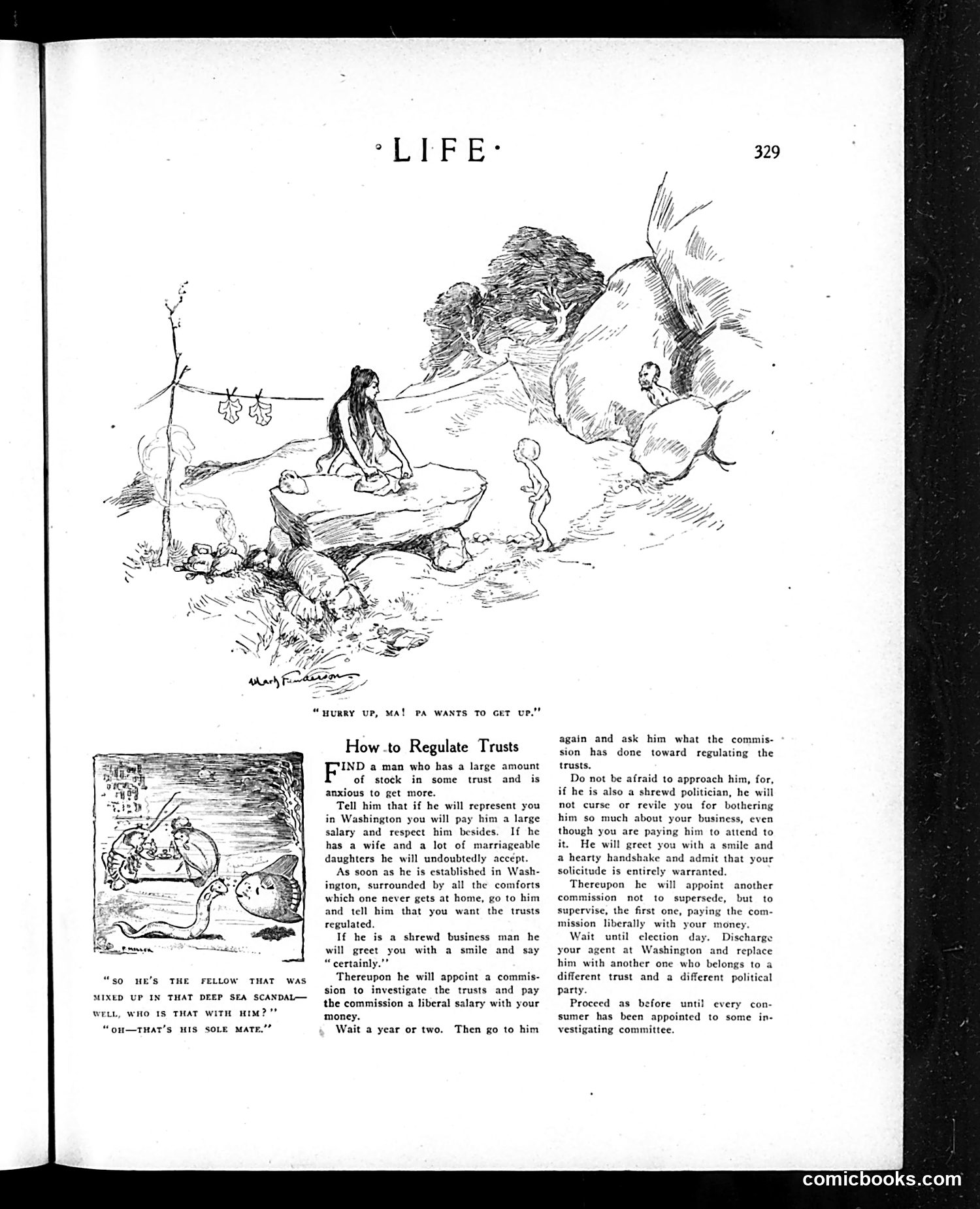
This page contains two distinct satirical pieces from *Life* magazine: **Top cartoon**: A crude joke about a scandal involving someone from a "deep sea scandal" (unclear reference without date/context), depicted meeting his "sole mate"—a pun on "soul mate." **Main article "How to Regulate Trusts"**: A biting satirical how-to guide mocking the ineffectiveness of trust regulation in the early 20th century. The piece ridicules the system where wealthy businessmen appoint politicians to Washington with high salaries to *appear* to regulate monopolies ("trusts"), but instead these politicians simply create investigation commissions that drain money and accomplish nothing. The satire suggests this cycle repeats endlessly—whenever asked for results, the politician appoints *another* commission, and every election cycle brings the same scheme with a different politician from a different party. The joke is that everyone becomes complicit in the system through these perpetually investigating committees.
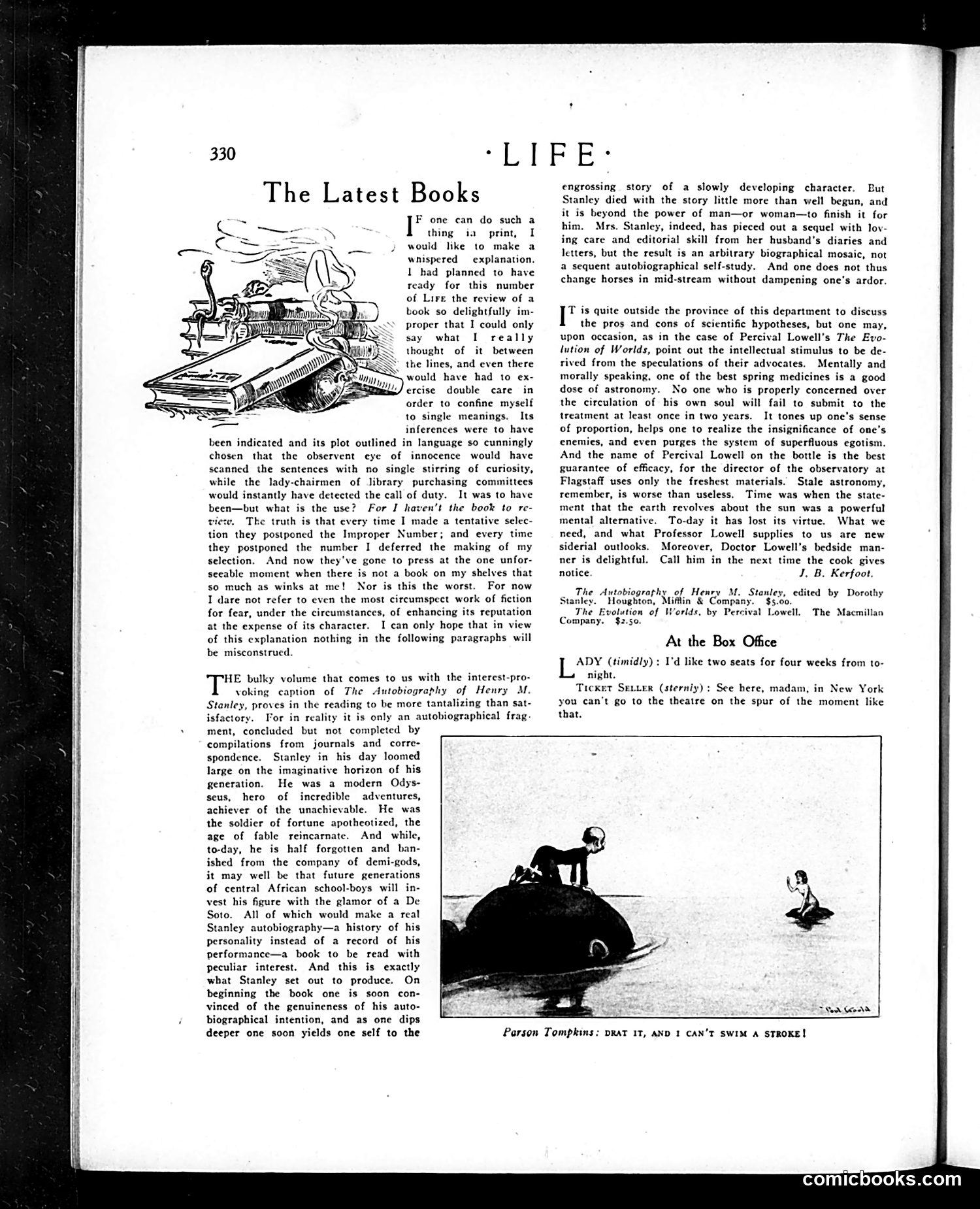
This is a book review column from *Life* magazine discussing two major works: Henry M. Stanley's autobiography (edited posthumously by his widow) and Percival Lowell's *The Evolution of Worlds*. The opening section is editorial commentary about an "Improper Number" the magazine couldn't complete—a humorous complaint that the reviewer keeps missing a delightfully scandalous book to review because publication schedules keep shifting. The cartoon below shows **Parson Tompkins** saying "Drat it, and I can't swim a stroke!" while appearing to be knocked or tossed by an automobile—likely satirizing the then-novel hazard of automobiles to pedestrians, particularly clergy or older gentlemen unfamiliar with the new technology. The reviews themselves treat Stanley's incomplete autobiography seriously (frustrated by its fragmentary nature) and Lowell's astronomy book as intellectually stimulating—comparing it to "spring medicine" for the soul. The tone is sophisticated but accessible.
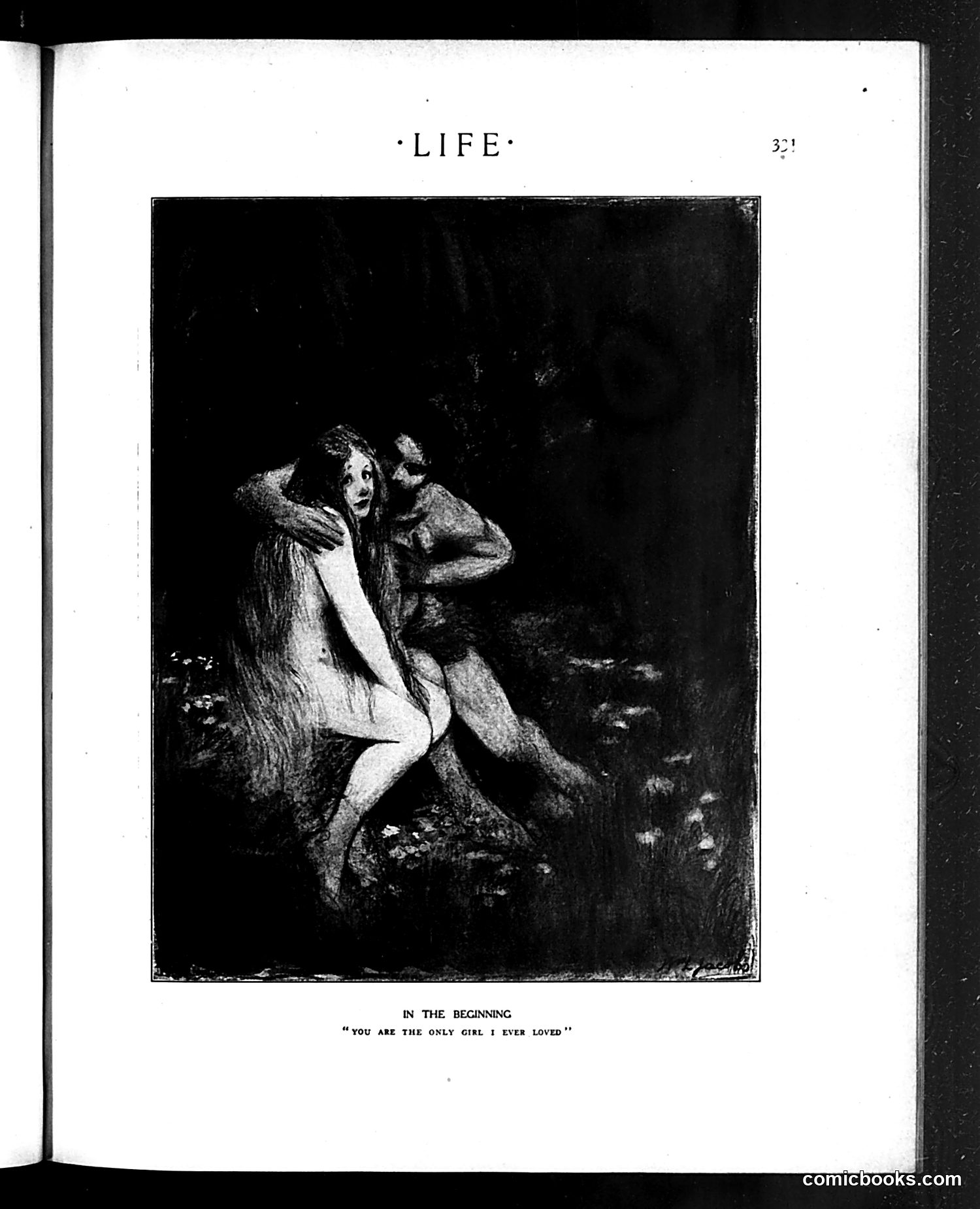
This page from *Life* magazine presents a satirical illustration titled "In the Beginning" with the caption "You are the only girl I ever loved." The image depicts a mythological or allegorical scene: a nude woman with long flowing hair is shown with a winged male figure (likely representing Cupid or a similar classical love deity) against a dark background. The satire appears to target the clichéd nature of romantic declarations. By pairing this grandiose classical imagery—suggesting eternal, mythological love—with the banal pickup line "You are the only girl I ever loved," *Life* mocks the pretentiousness of men who invoke romantic ideals while delivering shallow, formulaic compliments. The joke lies in the absurd contrast between the lofty visual presentation and the mundane, insincere flattery, suggesting the hollowness of such declarations.
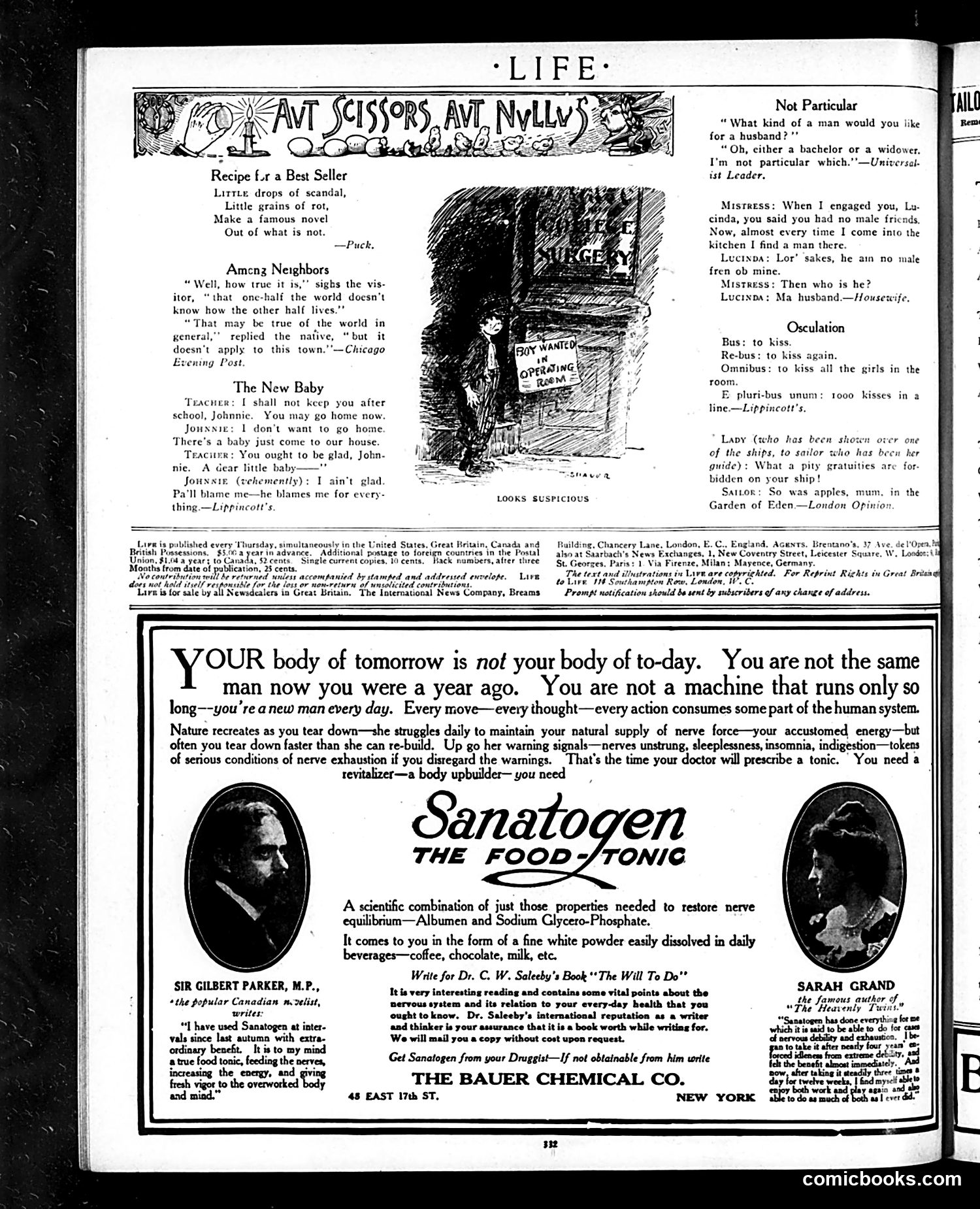
This page combines satirical humor pieces with period advertising. The top section features short jokes and quips typical of *Life* magazine's format—brief comedic observations on everyday life. "The New Baby" jokes about a boy dreading his newborn sibling because his father blames him for everything. "Among Neighbors" satirizes the saying "one half the world doesn't know how the other half lives." A small cartoon labeled "Looks Suspicious" depicts what appears to be a domestic scene. The page's dominant feature is a full-page advertisement for **Sanatogen**, a "food-tonic" marketed as nerve restoration. It reflects early 20th-century medical pseudoscience, promoting the product to address "nerve exhaustion"—a common Victorian/Edwardian diagnosis. The ad features testimonials from Sir Gilbert Parker (a Canadian novelist) and Sarah Grand, leveraging celebrity endorsements typical of the era. The advertising copy warns that the human body constantly depletes itself and requires tonic supplementation—a dubious health claim by modern standards that exemplifies period marketing practices.
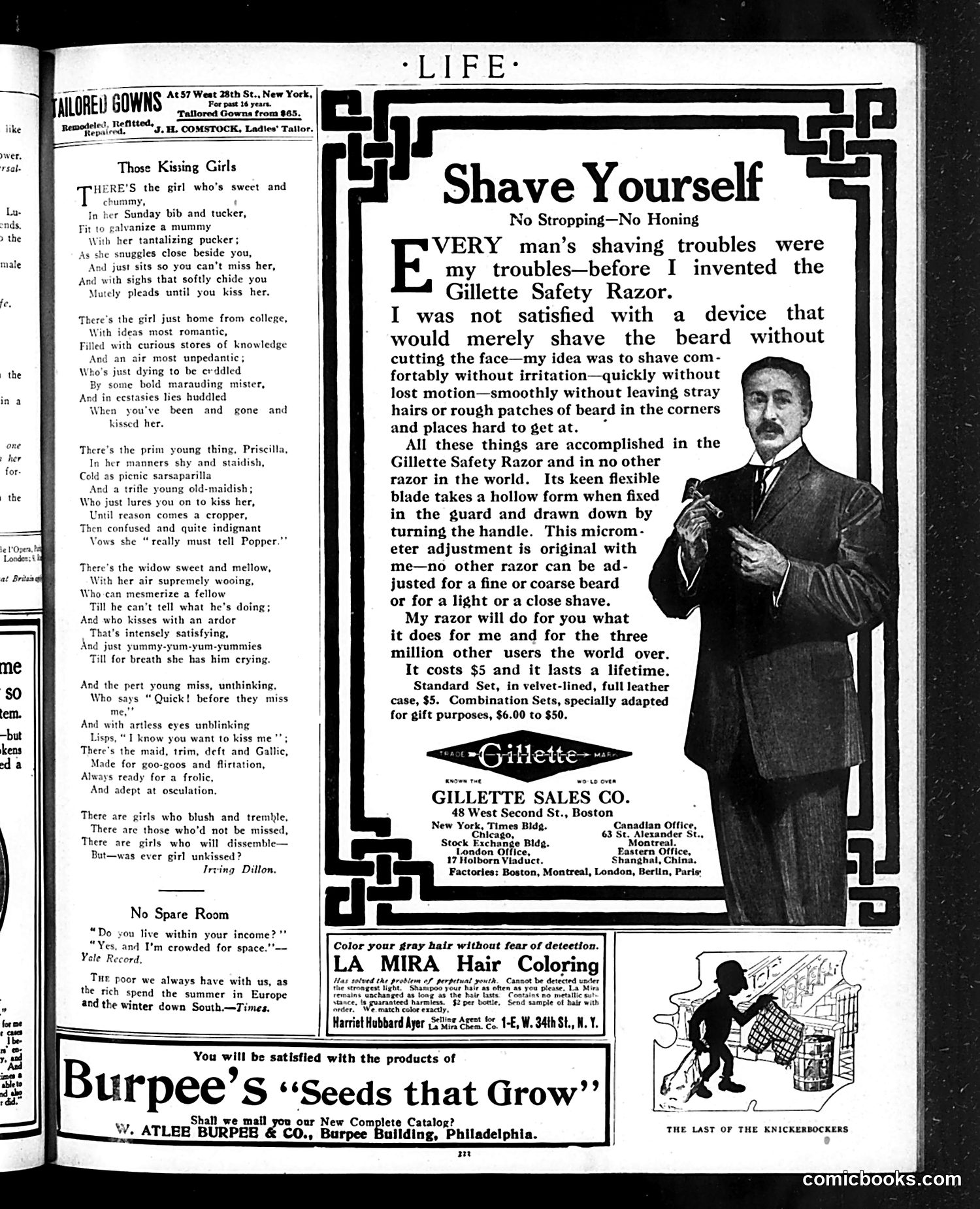
This page contains primarily **advertising and light social commentary** rather than political satire. The main content is a poem titled "Those Kissing Girls" by Irving Dillon, which humorously catalogs different female stereotypes of the era—the coquettish girl, the romantic college student, the prim spinster type, the merry widow, and the French maid—all characterized by their kissing behavior. It's lighthearted social observation about courtship customs, ending with the rhetorical question "was ever girl unkissed?" The dominant advertisement is for the **Gillette Safety Razor**, featuring a man's testimonial about the product's superiority. This was likely an innovative product at the time, marketed as requiring no stropping or honing. Additional ads appear for LA MIRA Hair Coloring, tailored gowns, and Burpee Seeds. There is a small cartoon titled "The Last of the Knickerbockers" (illegible details), but the page is overwhelmingly commercial rather than satirical in nature.
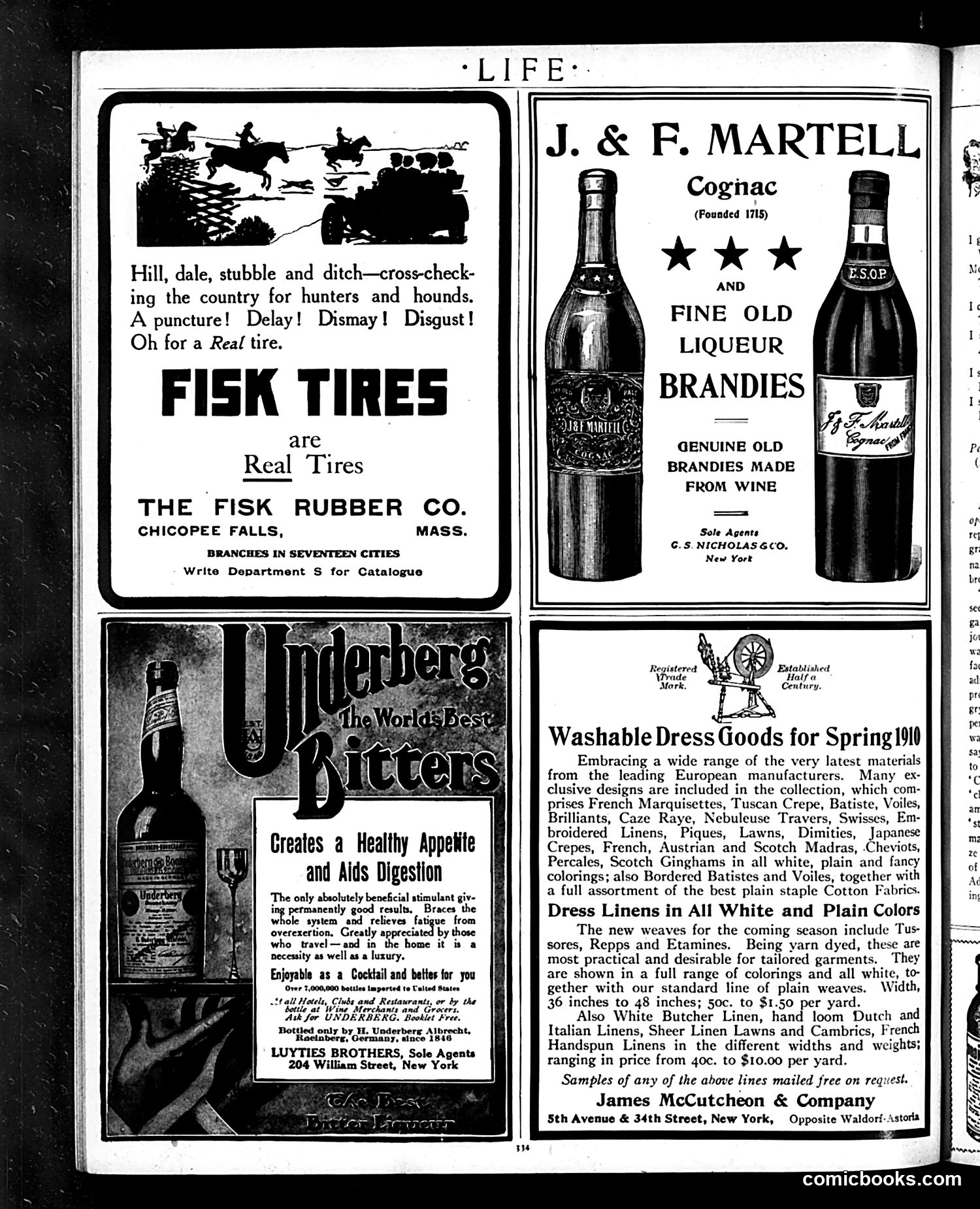
This page consists entirely of **advertisements**, not editorial cartoons or satire. Four products are promoted: 1. **Fisk Tires** (top left): A humorous ad depicting hunting frustration—riders crossing rough terrain encounter a punctured tire, prompting the tagline "Oh for a *Real* tire." The joke is that Fisk tires are "Real Tires," implying competitors' tires fail easily. 2. **J. & F. Martell Cognac** (top right): A luxury liquor advertisement displaying two brandy bottles, emphasizing their age and quality ("Founded 1715"). 3. **Underberg** (bottom left): A digestive liqueur marketed as a health stimulant that aids digestion and provides energy for travelers—presented as medically beneficial rather than purely recreational. 4. **James McCutcheon & Company** (bottom right): A textile merchant advertising spring 1910 dress fabrics from European manufacturers. The page reflects early 1900s consumer culture and advertising conventions, with no political or satirical content.
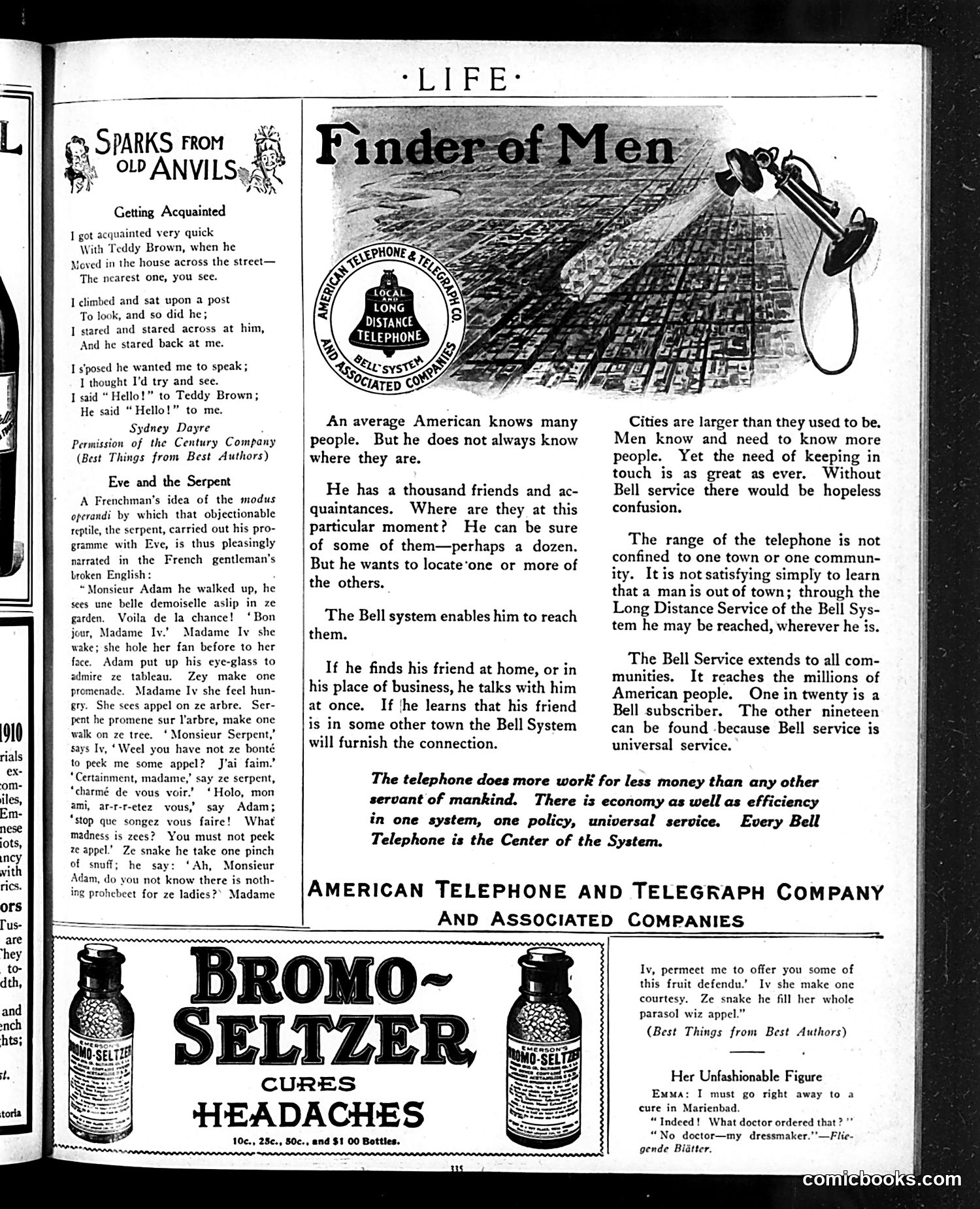
This page mixes light humor with corporate advertising. The top features three brief humorous pieces: "Getting Acquainted" depicts a child's first meeting with a neighbor boy through simple observation and greeting; "Eve and the Serpent" is a comedic French-accented retelling of the Biblical temptation story, where the serpent persuades Eve through flattery and politeness rather than deception; and "Her Unfashionable Figure" jokes about a woman needing a spa cure because her dressmaker (not a doctor) finds her figure unfashionable. The dominant content is a Bell Telephone advertisement titled "Finder of Men," which argues that modern cities require telephone service to locate dispersed acquaintances. The ad promotes the Bell System's universal reach and Long Distance Service as essential infrastructure. Below sits a Bromo-Seltzer headache remedy advertisement—typical patent medicine marketing of the era. The overall page reflects early-20th-century concerns about urbanization, social connectivity, and consumer products positioned as modern solutions to contemporary problems.
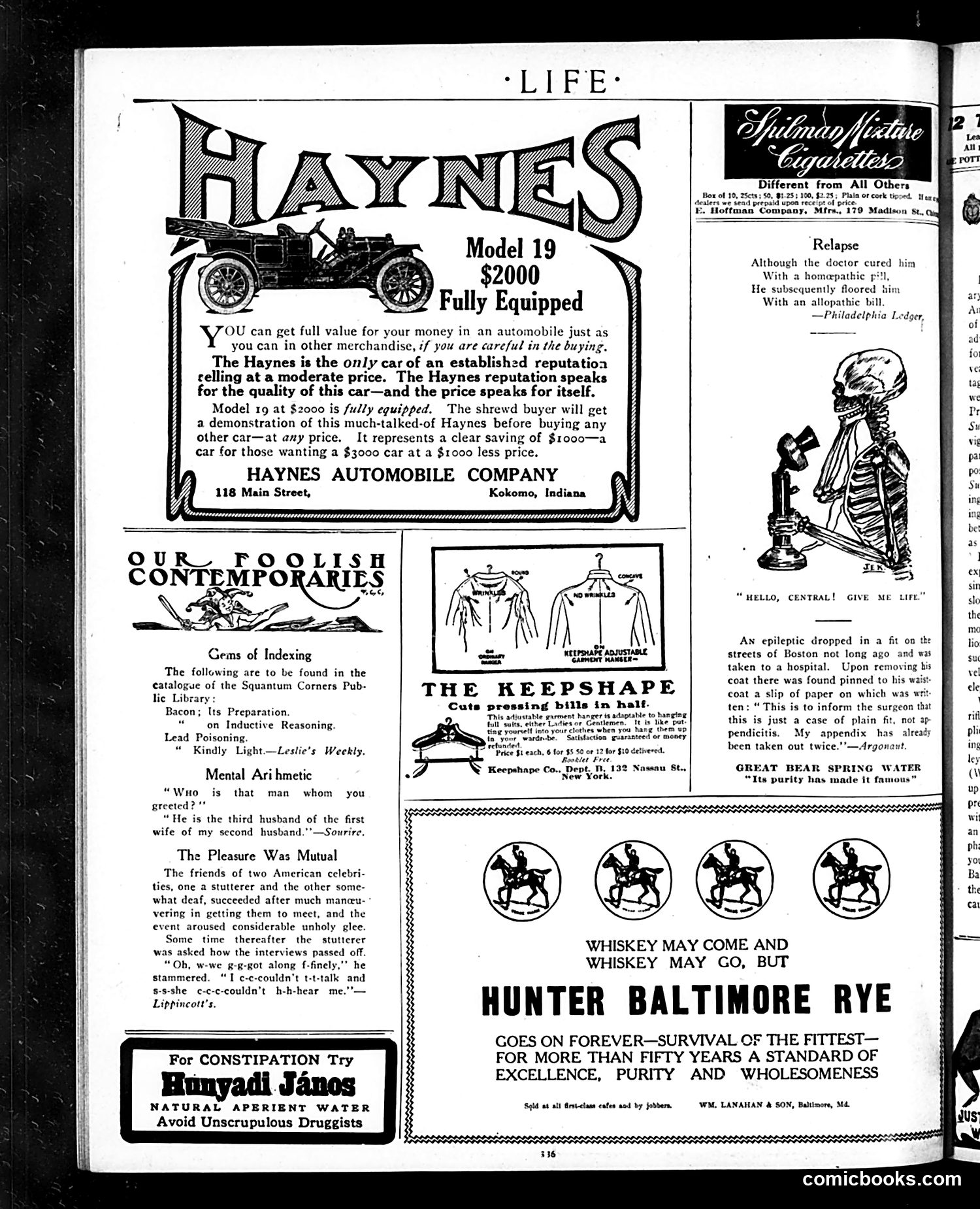
This page is primarily **advertising**, typical of early 1900s magazines. The content mixes commercial ads with humorous filler pieces: **Main Advertisement**: Haynes automobile (Model 19, $2000) emphasizes value and established reputation—a sales pitch common when automobiles were luxury items. **Humor Pieces**: Short jokes scattered throughout include: - A medical satire about homeopathic vs. allopathic bills (poking fun at doctor costs) - Library catalog absurdities (indexing jokes about "Lead Poisoning" under wrong categories) - A deaf-and-dumb joke about two celebrities who "got along finely" because neither could communicate - A Boston epilepsy anecdote about a man who pre-emptively denies appendicitis **Period Product Ads**: Humorously advertise laxatives, spring water, and whiskey—typical patent medicine era offerings presented as solutions to various ailments. The cartoon labeled "Hello, Central! Give Me Life" depicts a skeleton operator, punning on telephone operators' standard greeting. Overall, this reflects early-1900s advertising standards and casual humor styles now considered dated or insensitive.
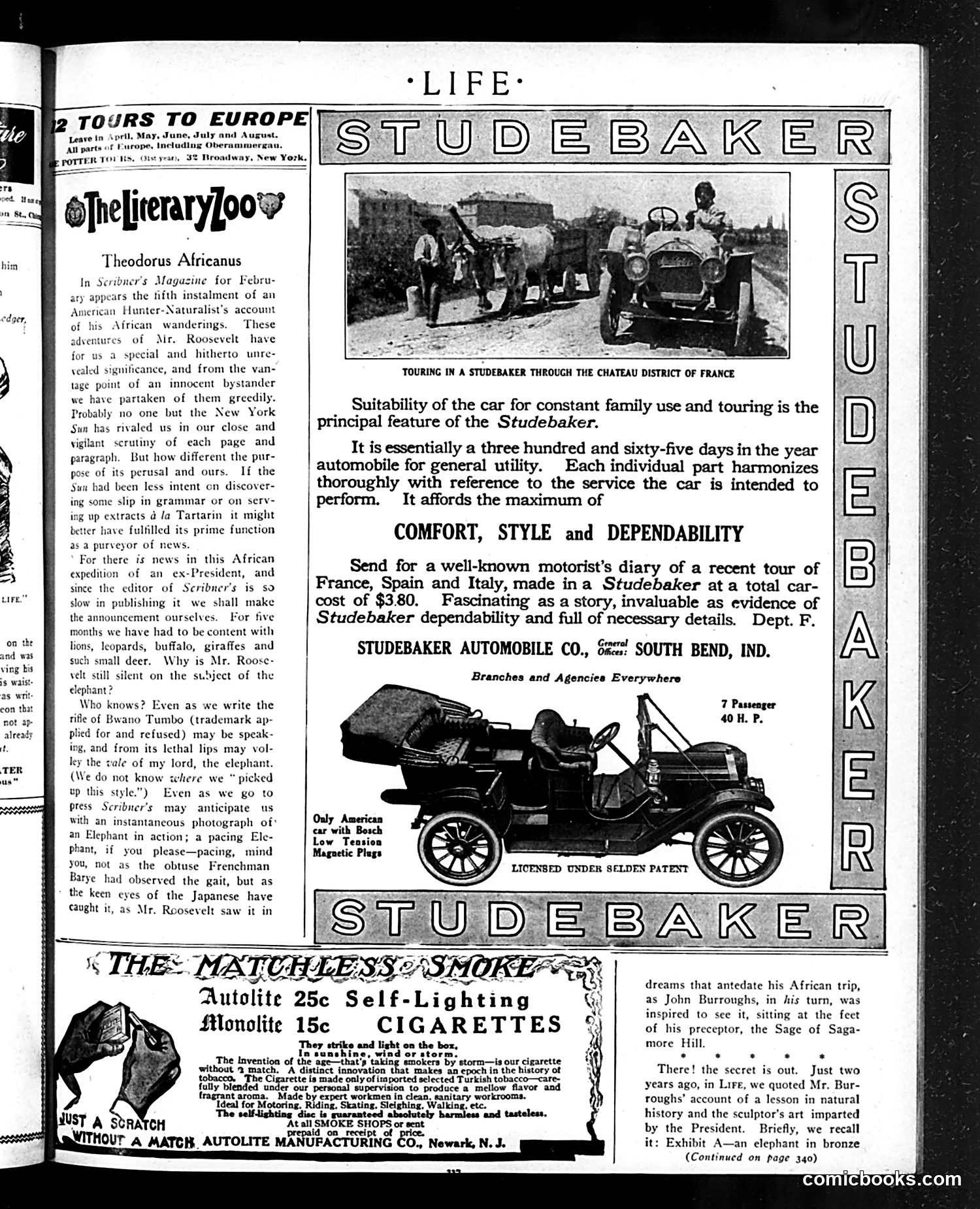
This page is primarily **advertising and product promotion**, not political satire. The main content features a **Studebaker automobile advertisement** emphasizing the car's suitability for family touring and year-round use, with an accompanying photograph of a Studebaker touring the French countryside. The left column contains a brief article titled "Theodorus Africanus" about former President **Theodore Roosevelt's African expedition**, which appeared serially in *Scribner's Magazine*. The Life editors humorously complain that *Scribner's* is publishing Roosevelt's account too slowly, so they're announcing the news themselves. They playfully speculate about Roosevelt shooting an elephant and joke about the literary style they're adopting from the adventure narrative. Below is a cigarette advertisement for "The Matchless Smoke" (Autolite and Monolite brands). The page concludes with continuation of an article referencing naturalist **John Burroughs** and sculptor observations about animal movement—connecting back to Roosevelt's wildlife experiences.
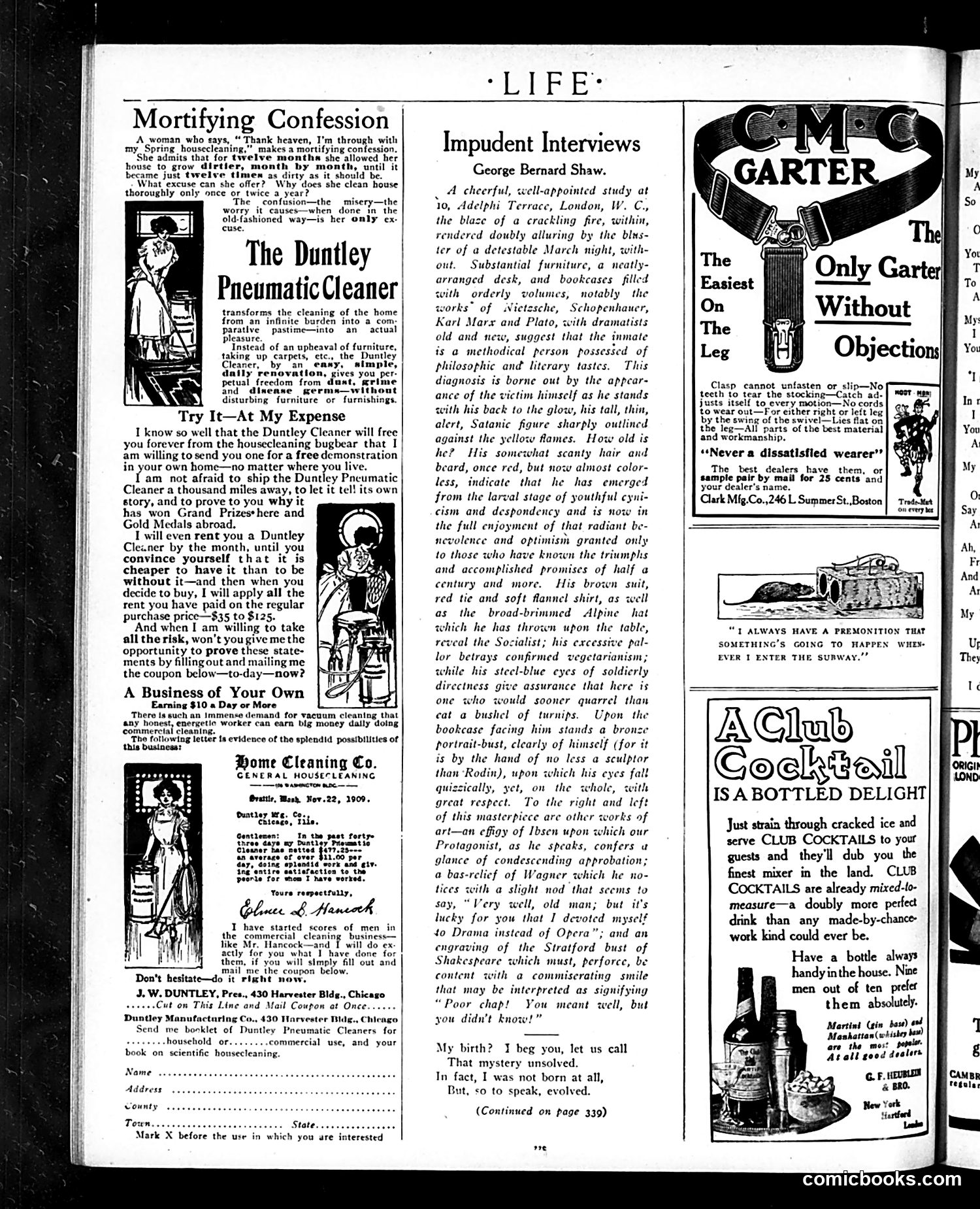
This page contains primarily **advertisements and a celebrity interview**, not political satire. The main content is an "Impudent Interview" with **George Bernard Shaw**, the Irish playwright and critic. The text describes Shaw's study at his London residence, noting his intellectual furnishings (works by Nietzsche, Marx, Plato) and his distinctive appearance—tall, thin, with reddish hair and beard turning gray. The piece appears to be a profile rather than a satirical critique. The advertisements promote the **Duntley Pneumatic Cleaner** (a vacuum) and **Club Cocktails**. The cleaner ad humorously shames housewives for allowing homes to become "twelve times as dirty" by cleaning only seasonally rather than regularly—typical early 20th-century marketing using guilt as persuasion. There is no visible political cartoon on this page. It's primarily commercial advertising with a celebrity profile, representative of Life's mixed editorial-commercial format.
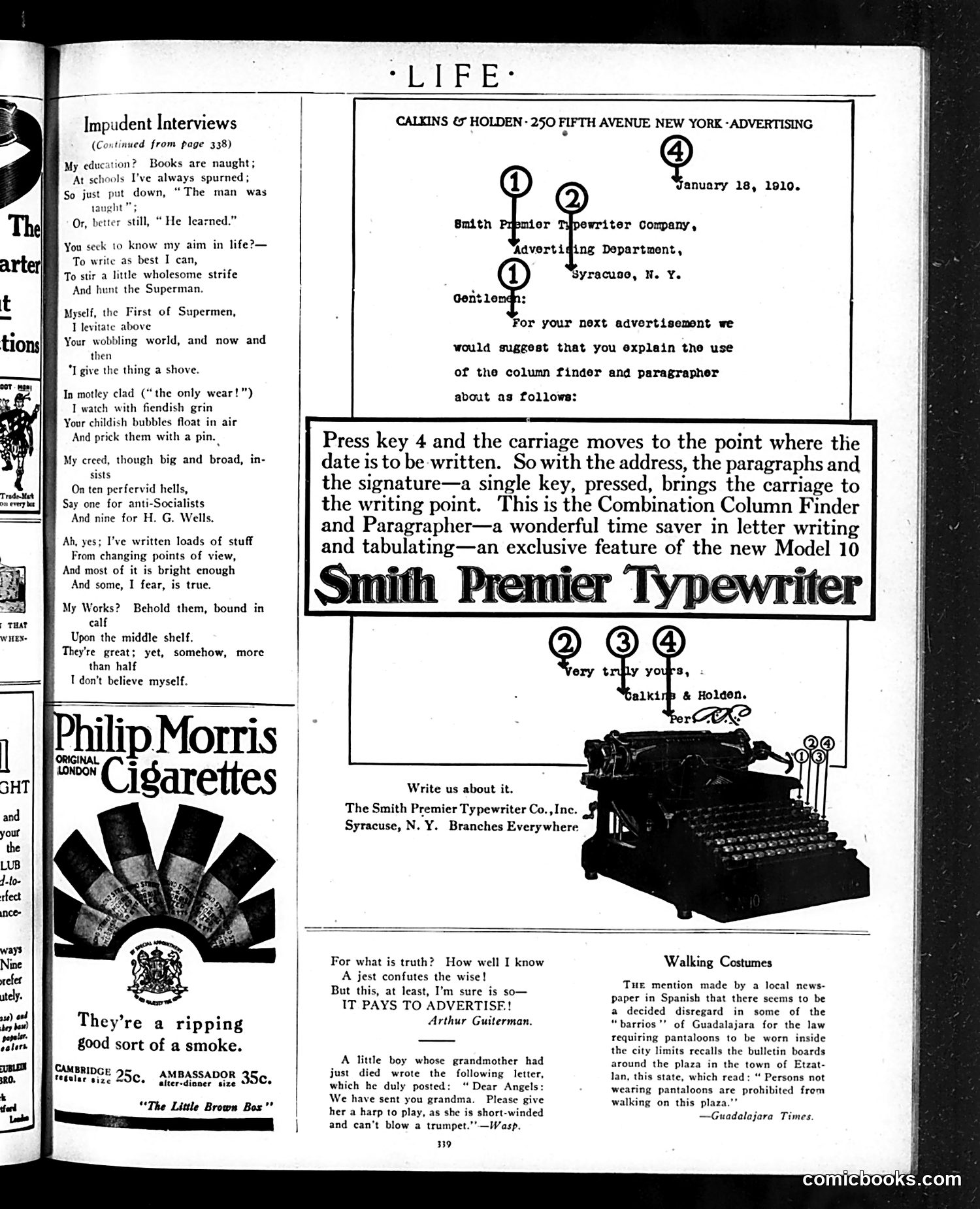
This page combines satirical poetry with commercial advertising. The left column features "Impudent Interviews," likely a recurring Life feature where the magazine mocks public figures or types through humorous verse. The poem portrays a self-aggrandizing intellectual—"the First of Supermen"—who claims superiority while admitting most of his prolific writings he doesn't believe himself. This appears to satirize H.G. Wells and/or Nietzschean philosophy popular among pretentious intellectuals of the era. The center showcases a Smith Premier Model 10 typewriter advertisement disguised as business correspondence, demonstrating the machine's "Combination Column Finder and Paragrapher" feature for efficient letter-writing. The page also includes brief humor items: a Philip Morris cigarette ad, and anecdotes about Spanish pantaloon laws and a child's letter to angels about his grandmother—typical light filler content for Life magazine's satirical-humor approach.
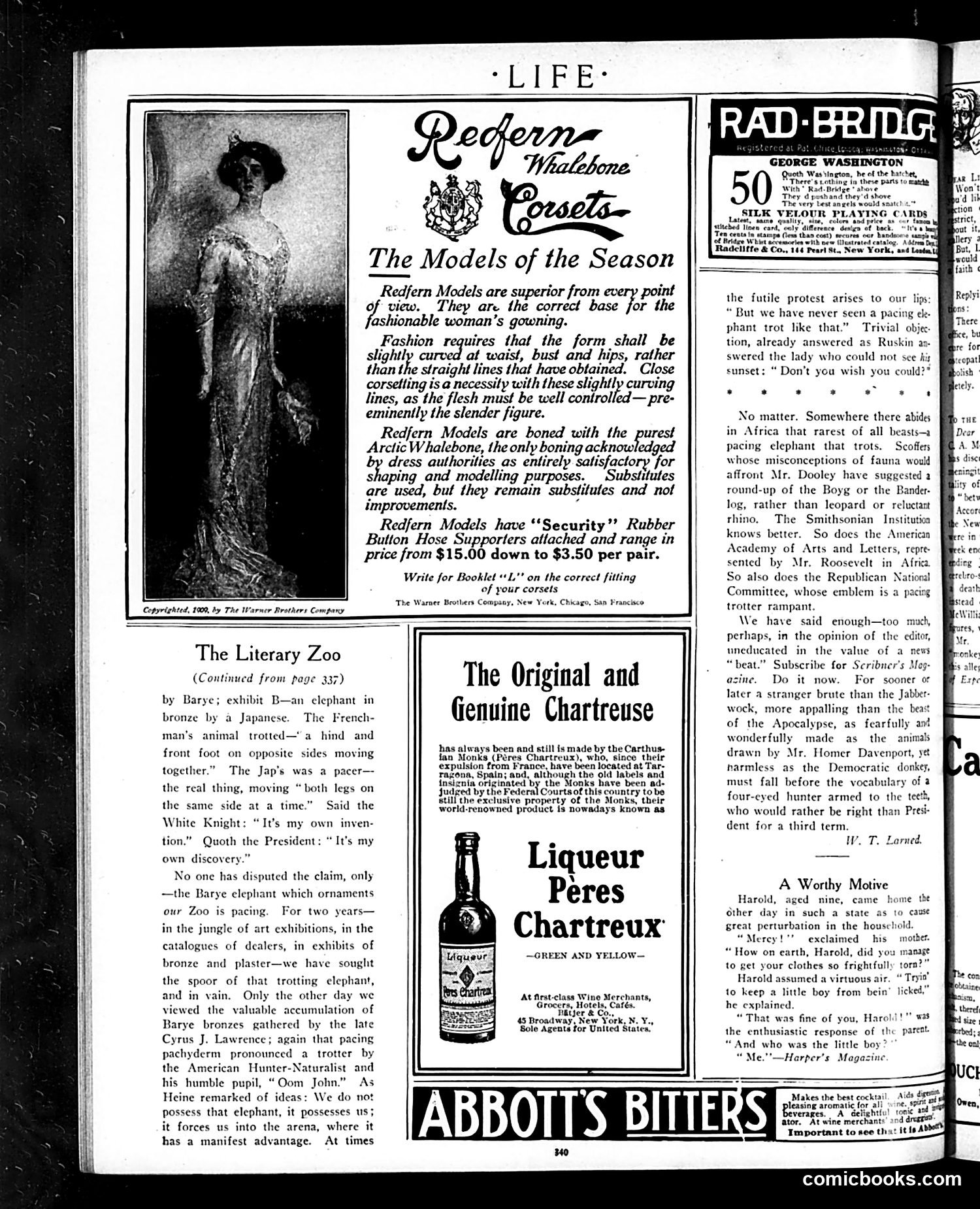
This piece mocks the Republican Party through an extended metaphor about an elephant. The text describes a decades-long search for a "pacing elephant" in art collections—allegedly a trotter that no one can actually locate. The satire's target becomes clear in the final paragraph: "the Republican National Committee, whose emblem is a pacing trotter rampant." The joke suggests Republicans, like the mythical pacing elephant, make grand claims about themselves that don't hold up to scrutiny. The author uses literary references (Barye's bronzes, Carroll's White Knight) to elevate what is fundamentally a jab at Republican credibility—implying their symbols and boasts are as illusory as this nonexistent elephant. The piece exemplifies *Life* magazine's satirical approach: clever, erudite mockery targeting political opponents through layered literary allusion rather than direct attack.
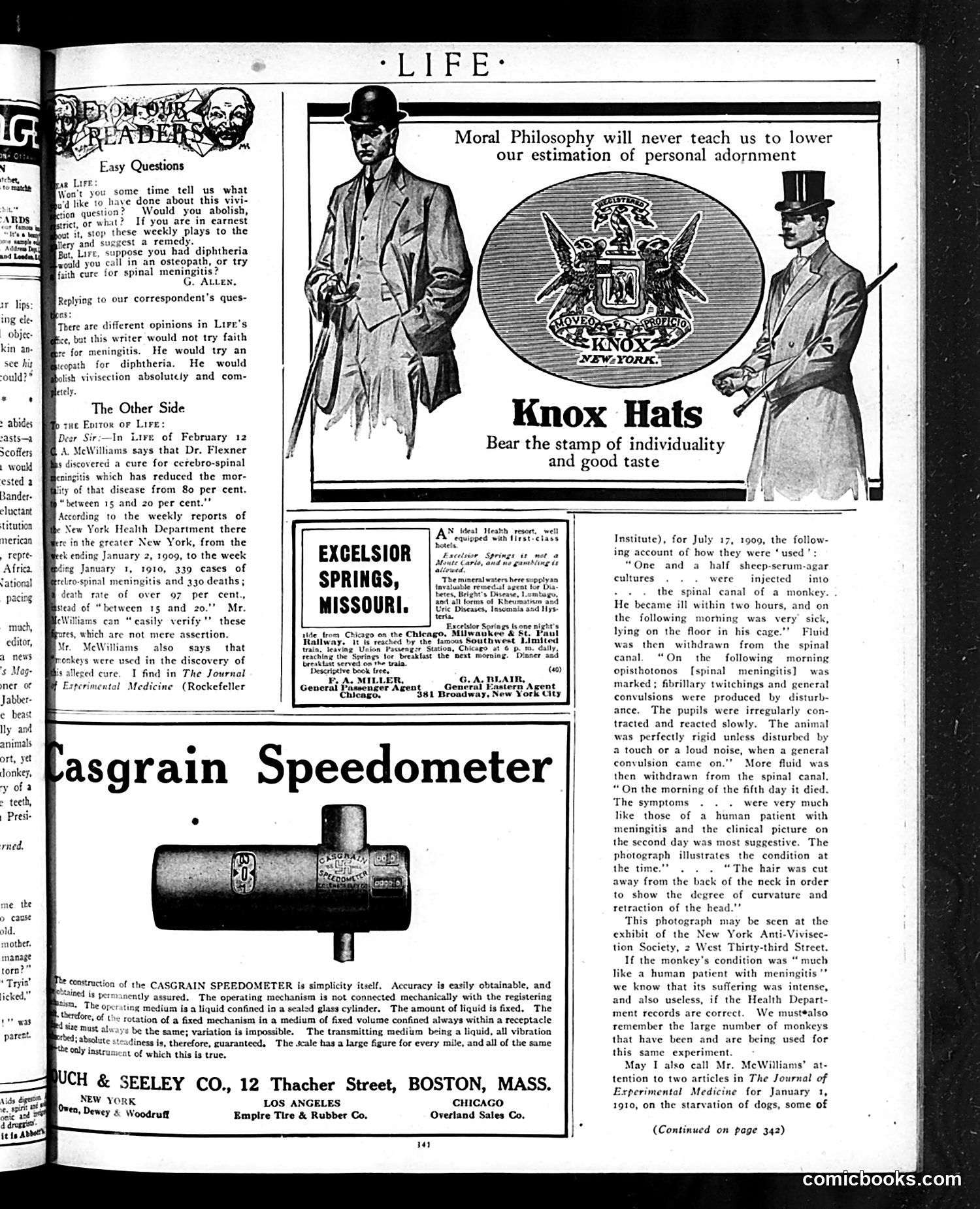
This page contains reader correspondence and advertisements rather than editorial cartoons. The main content is a debate about medical ethics, specifically vivisection (animal experimentation). **The Core Debate:** A reader challenges Dr. Flexner's claims about discovering a meningitis cure through animal testing. The response details a painful monkey experiment where cerebrospinal fluid was injected into the animal's spine, causing severe suffering and death. The author argues the monkey's symptoms "were very much like those of a human patient," implying the suffering was unjustifiable if results were uncertain. **The Satire/Point:** This represents anti-vivisection activism gaining traction in the Progressive Era. The detailed description of animal suffering—combined with the exhibit at the Anti-Vivisection Society—suggests Life is highlighting the moral contradiction of inflicting intense pain on animals for uncertain medical benefit. **Other Content:** The page also includes Knox Hats advertising and Casgrain Speedometer ads, typical of the era's magazine layout.
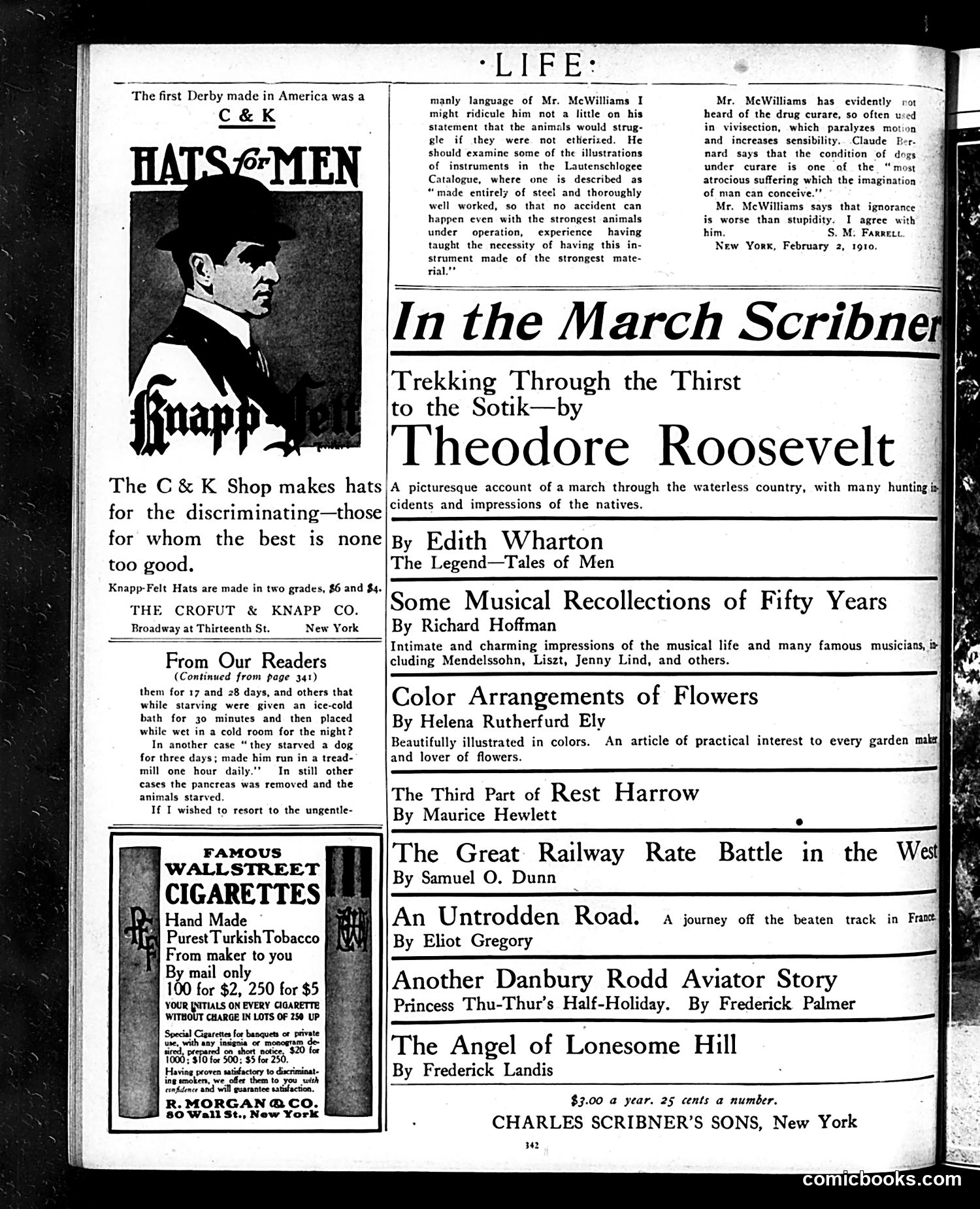
This page primarily contains **advertisements and editorial content** rather than political cartoons. The main visual element is a **Knapp hat advertisement** featuring a man in profile wearing a fedora. The substantive content is a **debate about animal vivisection** in the "From Our Readers" section. A correspondent criticizes Mr. McWilliams's defense of animal experimentation, citing brutal practices: starving dogs, subjecting them to ice baths, forcing them to run on treadmills, and surgically removing organs. The writer invokes Claude Bernard's authority that animals under the paralytic drug curare experience "atrocious suffering." This reflects **early 20th-century anti-vivisection activism**—a significant reform movement that questioned scientific ethics and animal welfare. The passionate tone indicates this was a heated public controversy. The page otherwise advertises Wallstreet cigarettes and promotes upcoming Scribner's magazine articles, including Theodore Roosevelt's hunting narrative.
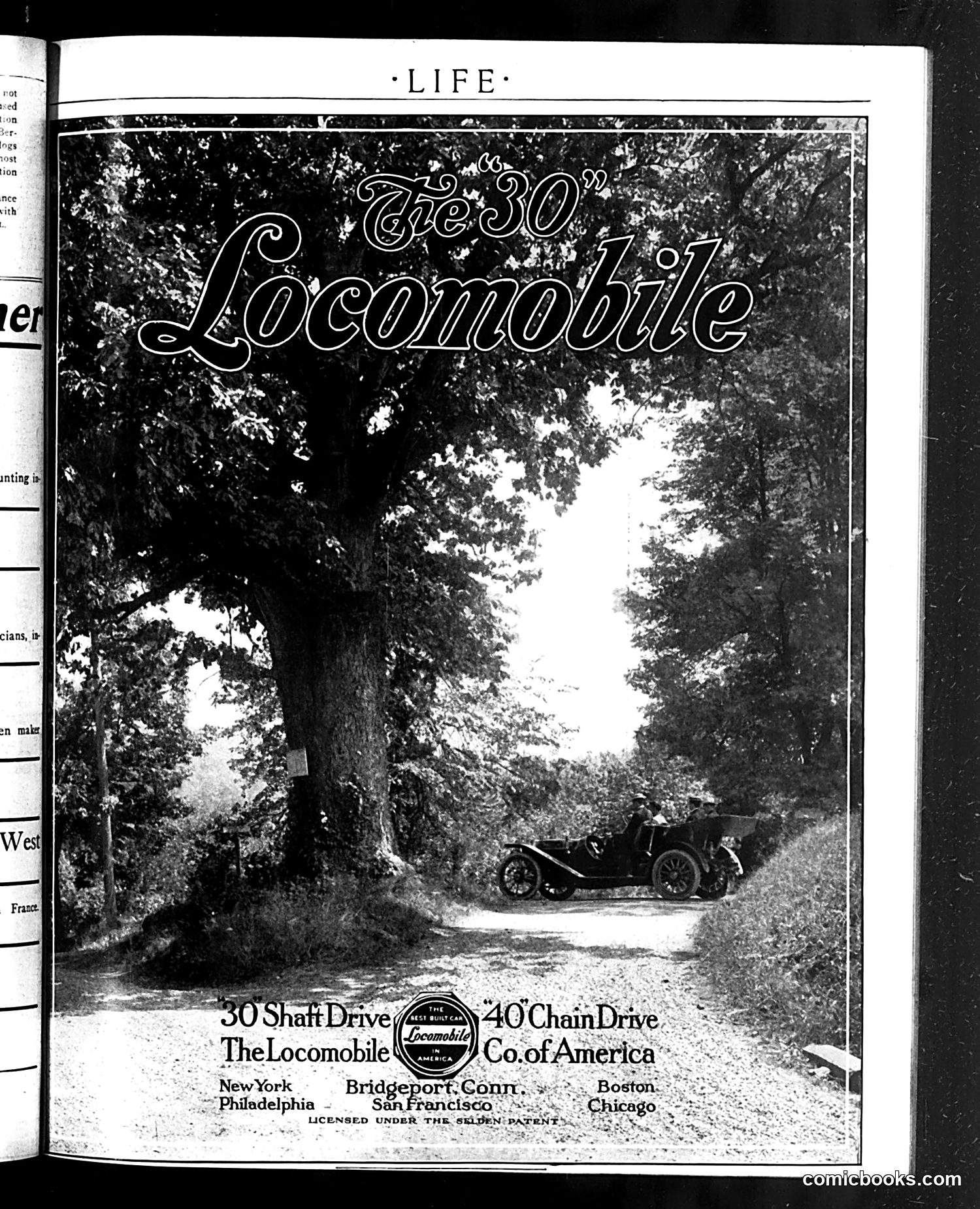
This is primarily an **advertisement page**, not political satire. It features a full-page ad for the 1930 Locomobile automobile, published in *Life* magazine. The image shows a vintage car parked on a tree-lined country road, emphasizing the vehicle's suitability for leisurely drives. The ad highlights two drivetrain options: "30 Shaft Drive" and "40 Chain Drive," technical specifications that would have mattered to early automobile buyers. The Locomobile Company of America lists multiple headquarters (New York, Philadelphia, Bridgeport Connecticut, San Francisco, Boston, Chicago), indicating it was a major national manufacturer during this era. The pastoral setting and elegant typography reflect 1930s marketing aesthetics, positioning the Locomobile as a refined, quality automobile for affluent consumers.
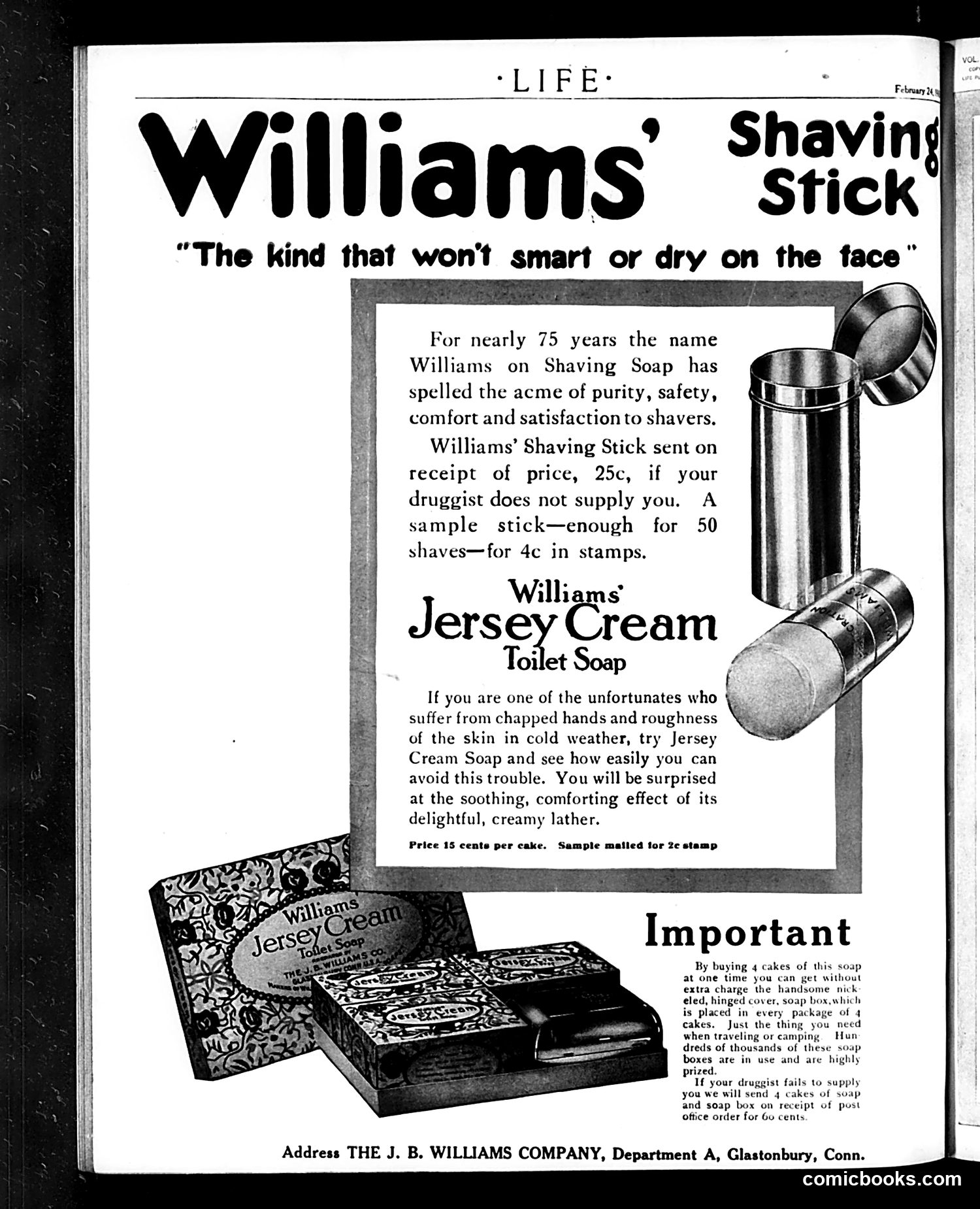
This page is **not a cartoon or satire**—it's a straightforward advertisement for The J. B. Williams Company's toiletries, published in *Life* magazine (likely early 1900s based on the typography and pricing). The ad promotes two products: **Williams' Shaving Stick** (25 cents) and **Jersey Cream Toilet Soap** (15 cents per cake). The copy emphasizes the brand's 75-year reputation and positions Jersey Cream as a solution for chapped hands and rough skin—a common winter complaint. The "Important" section highlights a promotional offer: buying 4 soap cakes includes a free nickel-plated hinged soap box, marketed as useful for travelers and campers. Mail-order options are available for customers whose local drugstores lack stock. This represents typical early-20th-century advertising: product-focused claims, premium packaging incentives, and multiple distribution channels to reach consumers.