
Life, 1910-02-24 · page 8 of 36
Life — February 24, 1910 — page 8: what you’re looking at
What you’re looking at
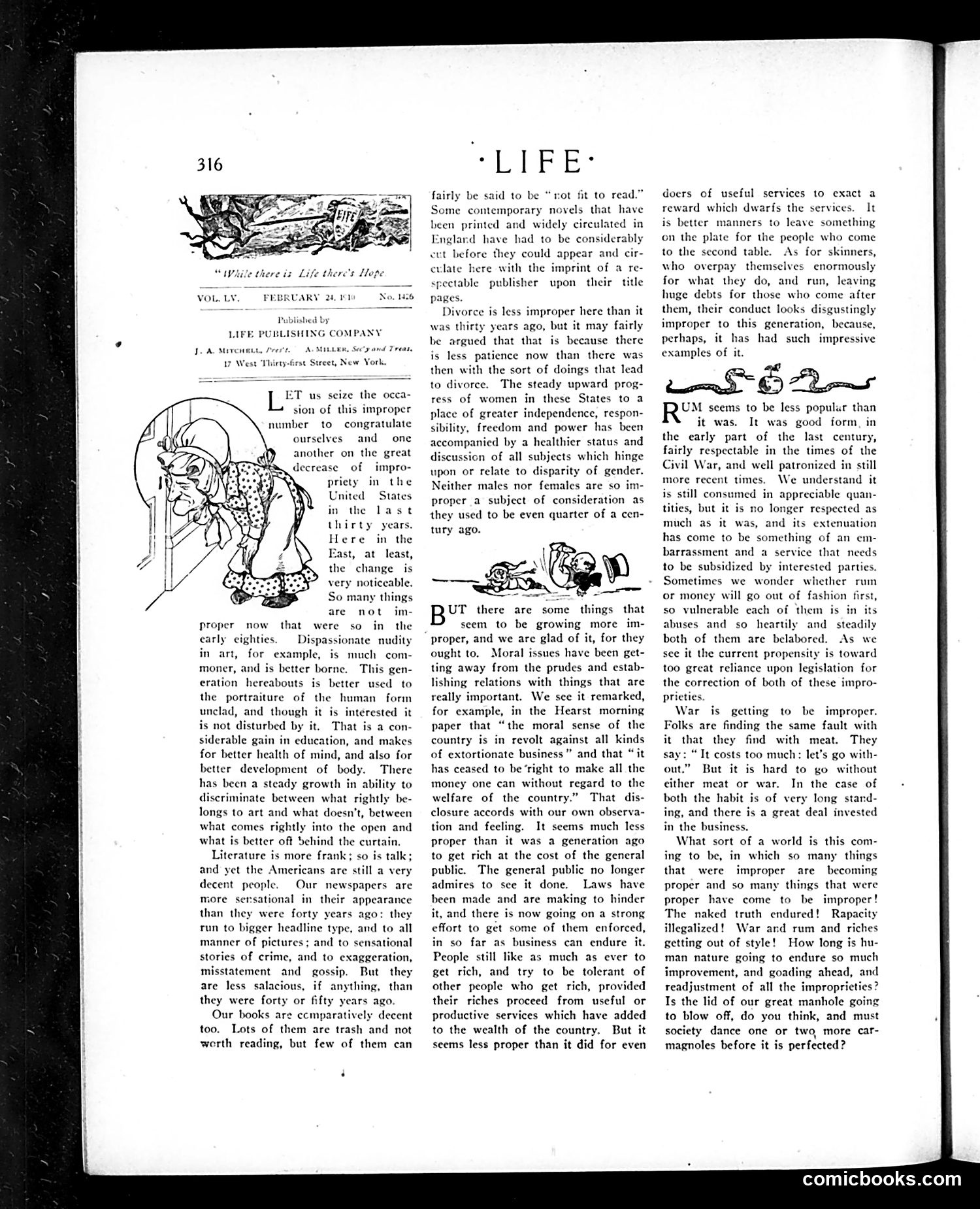
This page contains editorial commentary rather than political cartoons. The main illustration shows a figure in what appears to be early 20th-century dress looking out a window with a somewhat bewildered or concerned expression. The text discusses social changes in America, particularly regarding divorce, women's independence, and evolving moral standards. The author argues that impropriety is becoming more socially acceptable, and that "war is getting to be improper"—a satirical observation that war, traditionally accepted, is now questioned while other formerly scandalous behaviors gain acceptance. The piece criticizes wealth accumulation without productive contribution to society and questions whether society should tolerate such improprieties. It's social commentary on rapidly changing American values and morality during this period.
📄 Transcribed text from this page (OCR, searchable)
Machine-transcribed from the original scan — historical spelling and the odd misread are preserved.
Published by LIFE PUBLISHING COMPANY JA Mivement, Prete 17 West Thirty-first Street, New Vork. ET us seize the occa- sion of this improper number to congratulate ourselves and one another on the great decrease of impro- priety in the United States in the last thirty years. Here in the East, at least, the change is very noticeable. So many things are not. im- that were so in the early eighties. Dispassionate nudity in art, for example, is much com- moner, and is better borne. This gen- eration hereabouts is better used to the portraiture of the human form unclad, and though it is interested it is not disturbed by it. That is a con- siderable gain in education, and makes for better health of mind, and also for better development of body. There has been a steady growth in ability to discriminate between what rightly be- longs to art and what doesn’t, between what comes rightly into the open and what is better off behind the curtain. Literature is more frank; so is talk; and yet the Americans are still a very decent people. Our newspapers are more sersational in their appearance than they were forty years ago: they run to bigger headline type, and to all manner of pictures; and to sensational stories of crime, and to exaggeration, misstatement and gossip. But they are less salacious, if anything, than they were forty or fifty years ago. Our books are ccmparatively decent too. Lots of them are trash and not werth reading, but few of them can proper now “LIFE: fairly be said to be “rot fit to read.” Some contemporary novels that have been printed and widely circulated in England have had to be considerably et before they could appear and cir- culate here with the imprint of a re- publisher spectable upon their title pages. Divorce is less improper here than it was thirty years ago, but it may fairly be argued that that is because there patience now than there was then with the sort of doings that lead to divorce. The steady upward prog- ress of women in these States to a place of greater independence, respon- sibility, freedom and power has been accompanied by a healthier status and discussion of all subjects which hinge upon or relate to disparity of gender. Neither males nor females are so im- proper a subject of consideration as they used to be even quarter of a cen- tury ago. is les UT there are some things that seem to be growing more im- proper, and we are glad of it, for they ought to. Moral issues have been get- ting away from the prudes and estab- lishing relations with things that are really important. We sce it remarked, for example, in the Hearst morning paper that “the moral sense of the country is in revolt against all kinds of extortionate business” and that “it has ceased to be ‘right to make all the money one can without regard to the welfare of the country.” That dis- closure accords with our own observa- tion and feeling. It seems much less proper than it was a generation ago to get rich at the cost of the general public. The general public no longer admires to sce it done. Laws have been made and are making to hinder it, and there is now going on a strong effort to get some of them enforced, in so far as business can endure it. People still like as much as ever to get rich, and try to be tolerant of other people who get rich, provided their riches proceed from useful or productive services which have added to the wealth of the country. But it seems less proper than it did for even docrs of useful services to exact a reward which dwarfs the services. It is better manners to leave something on the plate for the people who come to the second table. As for skinners, who overpay themselves enormously for what they do, and run, leaving huge debts for those who come after them, their conduct looks disgustingly improper to this generation, because, perhaps, it has had such impressive examples of it. R™ scems to be less popular than it was. It was good form, in the early part of the last century, fairly respectable in the times of the Civil War, and well patronized in still more recent times. We understand it is still consumed in appreciable quan- tities, but it is no longer respected as much as it was, and its extenuation has come to be something of an em- barrassment and a service that needs to be subsidized by interested parties. Sometimes we wonder whether rum or moncy will go out of fashion first, so vulnerable each of them is in its abuses and so heartily and_ steadily both of them are belabored. As we see it the current propensity is toward too great reliance upon legislation for the correction of both of these impro- prieties. War is getting to be improper. Folks are finding the same fault with it that they find with meat. They say: “It costs too much: let’s go with- out.” But it is hard to go without either meat or war. In the case of both the habit is of very long stand- ing, and there is a great deal invested in the busines What sort of a world is this com- ing to be, in which so many. things that were improper are becoming proper and so many things that were proper have come to be improper! The naked truth endured! Rapacity ilegalized! War and rum and riches getting out of style! How long is hu- man nature going to endure so much improvement, and goading ahead, and readjustment of all the improprieties? Is the lid of our great manhole going to blow off, do you think, and must society dance one or two, more car- magnoles before it is perfected? comicbooks.com