
Life, 1910-02-24 · page 12 of 36
Life — February 24, 1910 — page 12: what you’re looking at
What you’re looking at
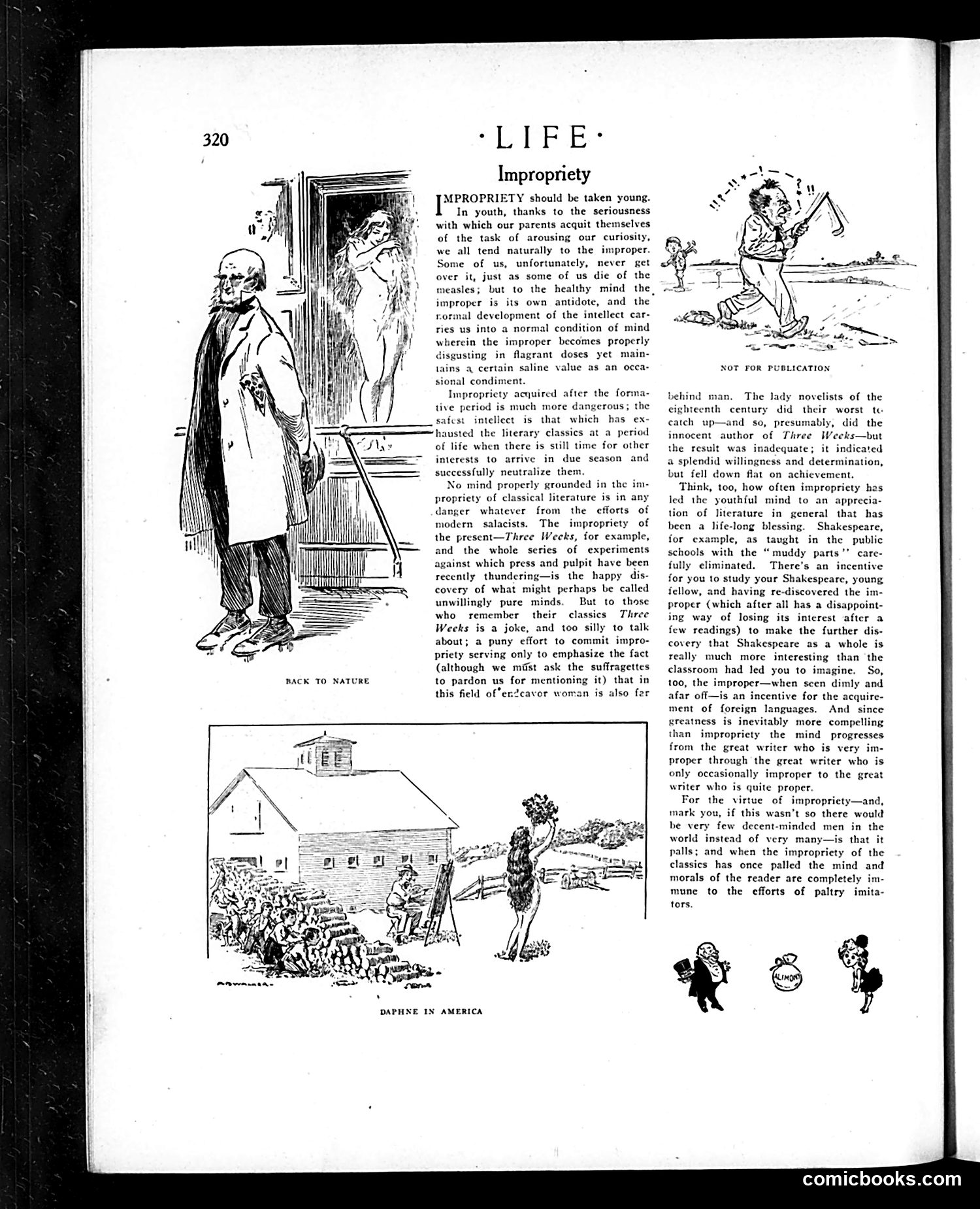
This page discusses social propriety and literary standards. The essay argues that impropriety serves a healthy function in developing proper intellect, contrasting "proper" classical literature with contemporary works like *Three Weeks* (a scandalous 1907 novel). The cartoons illustrate this theme: - **"Back to Nature"**: Shows a man observing a partially nude woman, satirizing claims of "natural" behavior to justify improper conduct. - **"Daphne in America"**: References the Greek myth of Daphne (transformed into a laurel tree), here depicting her appearing before gathered Americans, likely mocking how classical mythology was invoked to excuse modern impropriety. The overall message critiques how people rationalize indecent behavior through appeals to nature or classical precedent.
📄 Transcribed text from this page (OCR, searchable)
Machine-transcribed from the original scan — historical spelling and the odd misread are preserved.
BACK TO NATURE «1. FP Be Impropriety MPROPRIETY should be taken young. In youth, thanks to the seriousness with which our parents acquit themselves of the task of arousing our curiosity, we all tend naturally to the improper. Some of us, unfortunately, never get over it, just as some of us die of the measles; but to the healthy mind the, improper is its own antidote, and the rormal development of the intellect car- ries us into a normal condition of mind wherein the improper becomes properly disgusting in flagrant doses yet main- tains a certain saline value as an occa- sional condiment. Impropricty acquired after the forma- tive period is much more dangerous; the safest intellect is that which has ex- hausted the literary classics at a period of life when there is still time for other interests to arrive in due season and successfully neutralize them. No mind properly grounded in the im- propriety of classical literature is in any danger whatever from the efforts of modern salacists. The impropriety of the present—Three Weeks, for example, and the whole series of experiments against which press and pulpit have been recently thundering—is the happy dis- covery of what might perhaps be called unwillingly pure minds. But to those who remember their classics Three Weeks is a joke, and too silly to talk about; a puny effort to commit impro- priety serving only to emphasize the fact (although we mist ask the suffragettes to pardon us for mentioning it) that in this field of’endcavor woman is also fer DAPHNE IN AMERICA NOT FOR PUBLICATION behind man. The lady novelists of the eighteenth century did their worst tc catch up—and so, presumably, did the innocent author of Three Weeks—but the result was inadequate; it indicated a splendid willingness and determination, but fell down flat on achievement. Think, too, how often impropriety has led the youthful mind to an apprecia- tion of literature in general that has been a life-long blessing. Shakespeare, for example, as taught in the public schools with the “muddy parts’ care- fully eliminated. There's an incentive for you to study your Shakespeare, young fellow, and having re-discovered the im- proper (which after all has a disappoint- ing way of losing its interest after a few readings) to make the further dis- covery that Shakespeare as a whole is really much more interesting than the classroom had led you to imagine. So, 100, the improper—when scen dimly and afar off—is an incentive for the acquire- ment of foreign languages. And since greatness is inevitably more compelling than impropriety the mind progresses from the great writer who is very im- proper through the great writer who is only occasionally improper to the great writer who is quite proper. For the virtue of impropriety—and, mark you, if this wasn’t so there would be very few decent-minded men in the world instead of very many—is that it palls; and when the impropriety of the classics has once palled the mind and morals of the reader are completely im- mune to the efforts of paltry imita- tors. comicbooks.com