
Life, 1910-02-24 · page 33 of 36
Life — February 24, 1910 — page 33: what you’re looking at
What you’re looking at
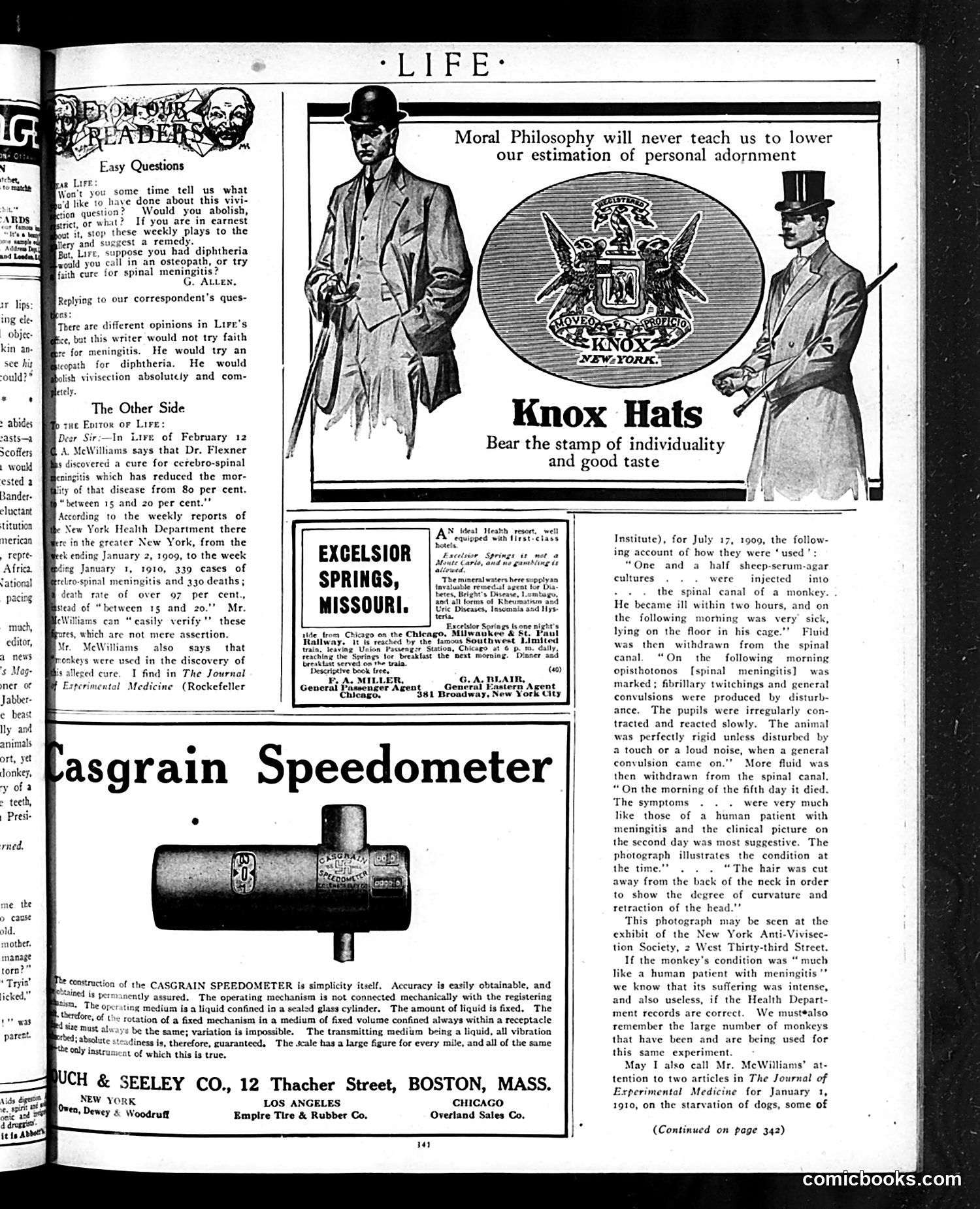
This page contains reader correspondence and advertisements rather than editorial cartoons. The main content is a debate about medical ethics, specifically vivisection (animal experimentation). **The Core Debate:** A reader challenges Dr. Flexner's claims about discovering a meningitis cure through animal testing. The response details a painful monkey experiment where cerebrospinal fluid was injected into the animal's spine, causing severe suffering and death. The author argues the monkey's symptoms "were very much like those of a human patient," implying the suffering was unjustifiable if results were uncertain. **The Satire/Point:** This represents anti-vivisection activism gaining traction in the Progressive Era. The detailed description of animal suffering—combined with the exhibit at the Anti-Vivisection Society—suggests Life is highlighting the moral contradiction of inflicting intense pain on animals for uncertain medical benefit. **Other Content:** The page also includes Knox Hats advertising and Casgrain Speedometer ads, typical of the era's magazine layout.
📄 Transcribed text from this page (OCR, searchable)
Machine-transcribed from the original scan — historical spelling and the odd misread are preserved.
Moral Philosophy will never teach us to lower our estimation of personal adornment Would you abolish, Ririct, or what? If you are in earnest ict Oop these weekly plays to the saad suggest a remedy. Eire, suppose you had diphtheria {d you call in an osteopath, or try fth cure {or spinal meningitis? G Replying to our correspondent’s ques- ing ele- . ; There are different opinions in Live's objec ce, bat this writer would not try faith kin an. for meningitis, He would try an see hiz [Brccpath for diphtheria. He would could?* [Molish vivisection absolutely and com- ely. se The Other Side > abides ¢ Epitor or LiF sts—a r:—In Live of February 12 apa . Scoffers ‘A. McWilliams says that Dr. Flexner Bear the stamp of individuality woul [Eps discovered a cure for cerebro-spinal and good taste is which has reduced the mor- fity of that disease from 80 per cent. “between 15 and 20 per cent.’’ According to the weekly reports of itution New York Health Department there N ideal Heath resort, well merican re in the greater New York, from the Seine WHR Mistress, Institute), for July 17, 1909, the follow- Africa. ding January 1, 1910, 339 cases of a One and a half. sheep-serum: “ational ae nal meningitis and 330 deaths; SPRINGS, * cultures . . were injected into ested a Bander- eluctant vacig (doit rate of over 97 percent. : oe: +. the spinal canal of a monkey. : between 15 and 20."" Mr. MISSOURI. , : : He became ill within two hours, and on ; ing’ ean “easily verity"*. these " the following morning was very’ sick, teh i ses, which are-not mere: assertion. aol Stir yey lying on the floor in his cage.’ Fluid editor, TRV, Mewitlams also says that , 5 was then withdrawn from the spinal a nes Becckers were used in the discovery of teaching tbe Seine tor br ister aed anal. “On the following morning 5 Mag- ieee Talia The Jone Desetoaie bes wo opisthotonos [spinal meningitis) was ner oF ferimental Medicine (Rockefeller General fimencer Agent _ General Eastern Agent marked; fibrillary twitchings and general Jabber- Chieages ‘$81 Broadway, York city convulsions were produced by disturb- S heat see ess ance. The pupils were irregularly con- ty and tracted and reacted slowly. The animal cs was perfectly rigid unless disturbed by a touch or a loud noise, when a general convulsion came on.” More fluid was Jonkey, then withdrawn from the spinal canal. y of a “On the morning of the fifth day it died. teeth, The symptoms . . . were very much Pres- like those of a buman patient with : meningitis and the clinical picture on the second day was most suggestive. The photograph illustrates the condition at the time”... “The hair was cut away from the back of the neck in order to show the degree of curvature and retraction of the head."’ This photograph may be scen at the exhibit of the New York Anti-Vivisec- tion Society, 2 West Thirty-third Street. If the monkey's condition was “ much like a human patient with meningitis"? x; Construction of the CASGRAIN SPEEDOMETER is simplicity itself. Accuracy is easily obtainable, and we know that its suffering was intense, tained is perm: ently assured. The operating mechanism is not connected mechanically with the registering and also useless, if the Health Depart- ¢ medium is a liquid confined in a sealed glass cylinder. The amount of liquid is fixed. The 'e rotation of a fixed mechanism in a medium of fixed volume confined always within a receptacle be the same; variation is impossible, The transmitting medium being a liquid, all vibration remember the large number of monkeys cadiness is, therefore, guaranteed. The Jeale has a large figure for every mile, and all of the same that have been and are being used for wat ee nen this. same experiment May I also call Mr. McWilliams’ at- CH & SEELEY CO., 12 Thacher Street, BOSTON, MASS. tention to two articles in The Journal of ste i Experimental Medicine for January 1, Cia dad York LOS ANGELES CHICAGO 1910, on the starvation of dogs, some of » Dewey & Woodruff Emplre Tire & Rubber Co. Overland Sales Co. ort, yet ment records are correct. We mustéalso size must alw: Prbed; absoli (Continued on page 342) comicbooks.com