
Life, 1910-02-24 · page 17 of 36
Life — February 24, 1910 — page 17: what you’re looking at
What you’re looking at
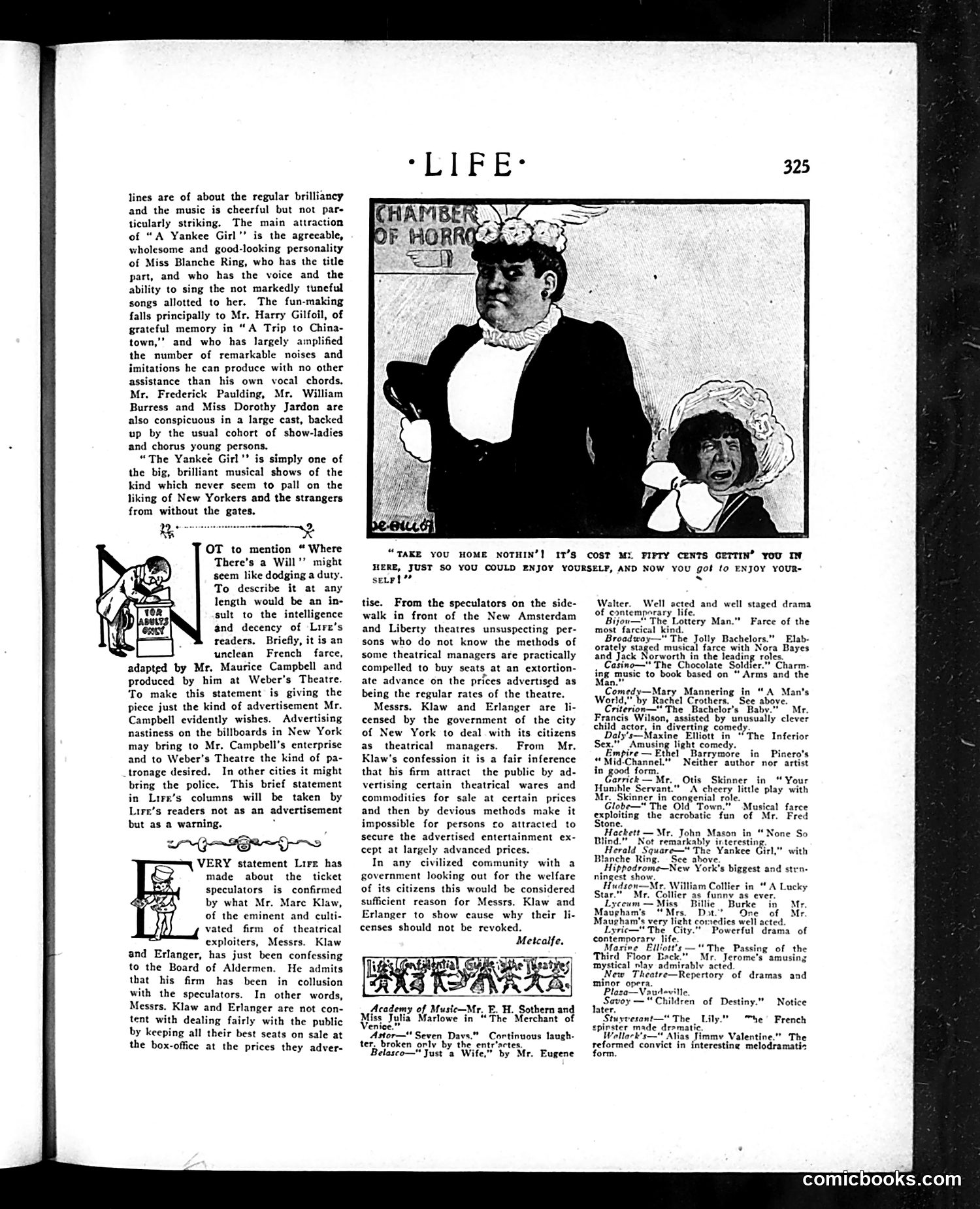
This page critiques theatrical practices in early 1900s New York. The main cartoon (upper right) depicts a ticket speculator confronting a patron, with the caption showing the speculator's aggressive pitch—essentially admitting he's extracting an extortionate surcharge ("fifty cents") on top of advertised prices just to access the show. The accompanying text exposes a collusion scheme between major theater operators **Messrs. Klaw and Erlanger** (prominent theatrical producers) and street-side ticket scalpers. The magazine accuses them of deliberately underpricing tickets at box offices while tacitly allowing speculators to resell at inflated rates on the street, making it practically impossible for ordinary patrons to purchase at advertised prices. Life frames this as fraud deserving license revocation by city government. The piece also briefly reviews theatrical productions including "A Yankee Girl" (starring Blanche Ring) and harshly dismisses "Where There's a Will" as an indecent French farce. The satire targets exploitative theater monopolies deceiving the paying public through coordinated scalping.
📄 Transcribed text from this page (OCR, searchable)
Machine-transcribed from the original scan — historical spelling and the odd misread are preserved.
lines are of about the regular brilliancy and the music is cheerful but not par- ticularly striking. The main attraction of “A Yankee Girl’’ is the agrecable, wholesome and good-looking personality of Miss Blanche Ring, who has the title part, and who has the voice and the ability to sing the not markedly tuneful songs allotted to her. The fun-making falls principally to Mr. Harry Gilfoil, of grateful memory in “A Trip to China- town,"’ and who has largely amplified the number of remarkable noises and imitations he can produce with no other assistance than his own vocal chords. Mr. Frederick Paulding, Mr. William Burress and Miss Dorothy Jardon are also conspicuous in a large cast, backed up by the usual cohort of show-ladies and chorus young persons. “The Yankee Girl’? is simply one of the big, brilliant musical shows of the kind which never seem to pall on the liking of New Yorkers and the strangers from without the gates. a OT to mention “Where There’s a Will’’ might seem like dodging a duty. To describe it at any length would be an in- sult to the intelligence and decency of Lire’s readers. Briefly, it is an unclean French farce, adapted by Mr. Maurice Campbell and produced by him at Weber's Theatre. To make this statement is giving the piece just the kind of advertisement Mr. Campbell evidently wishes. Advertising nastiness on the billboards in New York may bring to Mr. Campbell's enterprise and to Weber's Theatre the kind of pa- tronage desired. In other cities it might bring the police. This brief statement in Lire’s columns will be taken by Lire’s readers not as an advertisement but as a warning. : eee Cree ee VERY statement Lire has made about the ticket speculators is confirmed by what Mr. Mare Klaw, of the eminent and culti- vated firm of theatrical exploiters, Messrs. Klaw and Erlanger, has just been confessing to the Board of Aldermen. He admits that his firm has been in collusion with the speculators. In other words, Messrs. Klaw and Erlanger are not con- tent with dealing fairly with the public by keeping all their best seats on sale at the box-office at the prices they adver- TAKE YOU HOME NOTHIN’! 11’S COST Mi FIFTY CENTS GETTIN’ YOU IW HERE, JUST SO YOU COULD ENJOY YOURSELF, AND NOW YOU got fo ENJOY YOUR- s secrl’? tise. From the speculators on the side- walk in front of the New Amsterdam and Liberty theatres unsuspecting per- sons who do not know the methods of some theatrical managers are practically compelled to buy seats at an extortion- ate advance on the prices advertised as being the regular rates of the theatre. Messrs. Klaw and Erlanger are li- censed by the government of the city of New York to deal with its citizens as theatrical managers. From = Mr. Klaw's confession it is a fair inference that his firm attract the public by ad- vertising certain theatrical wares and commodities for sale at certain prices and then by devious methods make it impossible for persons co attracted to secure the advertised entertainment ex- cept at largely advanced prices. In any civilized community with a government looking out for the welfare of its citizens this would be considered sufficient reason for Messrs. Klaw and Erlanger to show cause why their li- censes should not be revoked. Metcalfe. Academy of Music Mise Julia Marlowe in Venice.” Astor—"' Seven Davs.” ter. broken only by the en! Belasco—" Just a Wife, E. H. Sothern and The Merchant of Cortinuous laugh- ‘actes. by Mr. Eugene Walter. Well acted and well staged drama of contemporary life. Bijow—" The Lottery Man.” Farce of the most farcical kind. Broadway—" The Jolly Bachelors.” Elab- orately staged musical farce with Nora Bayes and Jack Norworth in the leading roles. | Casino—* The Chocolate Soldier.” Charm. ink music to book based on “Arms and the Man. Comedy—Mary Mannering in “A Man's World,” by Rachel Crothers.. See above. Criterion—" The Bachelor's Baby.” | Mr. Francis Wilson, assisted by unusually clever child actor, in diverting comedy. Daly's—Maxine Elliott in “The Inferior Sex." Amusing light comedy. Empire — Ethel Barrymore in Pinero’s *Mid-Channel."" Neither author nor artist in good form. Garrick — Mr. Otis Skinner in “Your Hunuhle Servant.” A cheery little play with Mr. ‘Skinner in congenial role. Globe—" The Old Town." Musical farce exploiting the acrobatic fun of Mr. Fred Stone. Hackett — Mr. John Mason in “None So Blind.” Not remarkably interesti Herald Square" The Yankee Girl,” with Blanche Ring. See above. Hippodrome—New York's biggest and strn- ningest show. Hudson—Me. William Collier in “A Lucky Star." Mr. Collier as funny as ever. Lyceum — Miss Billie Burke in. Mr. Maugham’s “Mrs. Dot.” One of Mr. Maugham's very licht comedies well acte: Lyric—" The City.” Powerful drama of contemporary life, Marine Elliott's“ The Passing of the Third Floor Back.” Mr. Jerome's amusing mystical nlay admirably acted. New Theatre—Repertory of dramas and minor opera. Pl ville. Children of Destin: Lily." he Notice Stuyvesant spinster made, dromatic. Wollack's—" Alias Jimmy Valentine.” The reformed convict in interesting melodramatic form. French comicbooks.com