
Life, 1910-02-24 · page 16 of 36
Life — February 24, 1910 — page 16: what you’re looking at
What you’re looking at
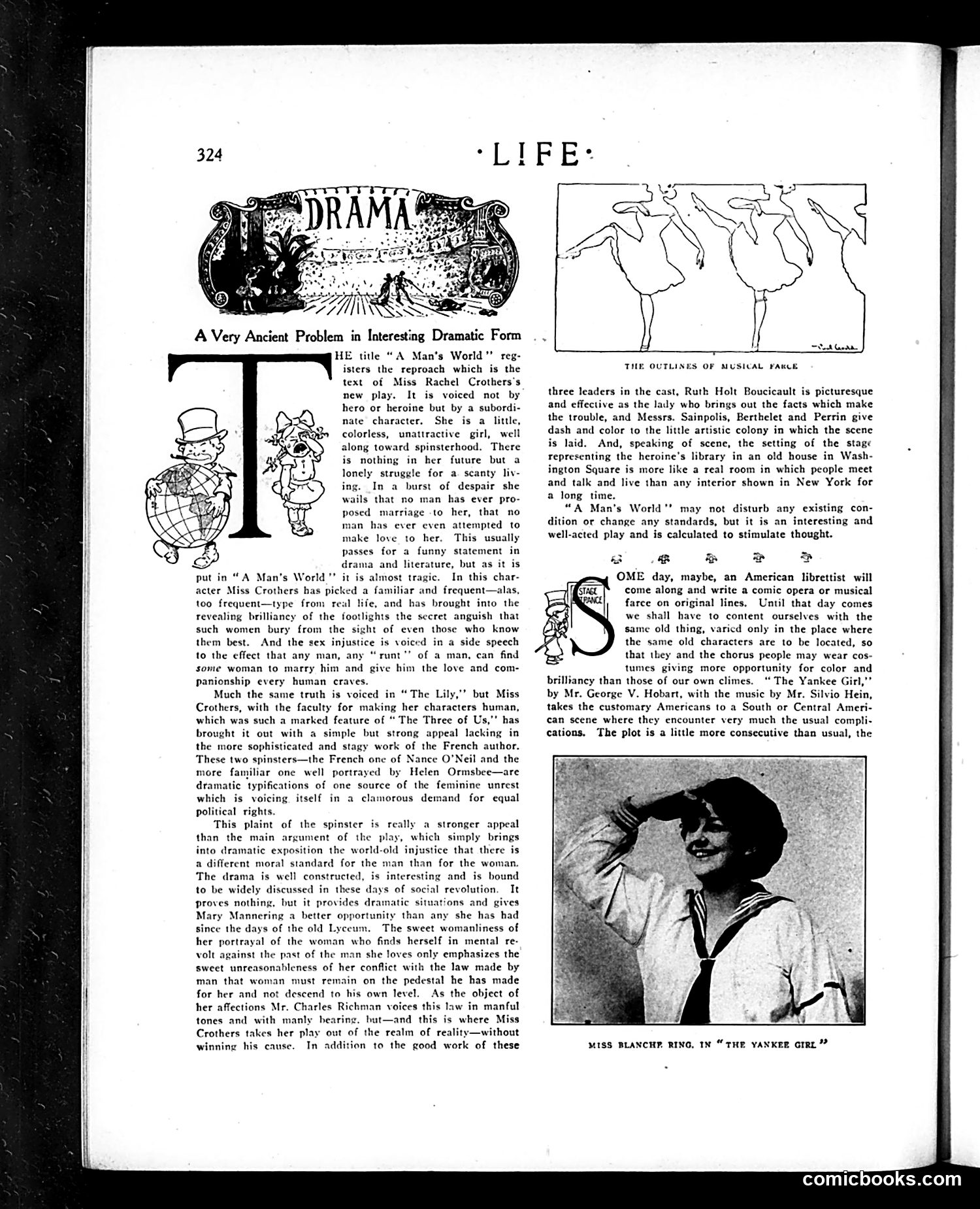
This page reviews Rachel Crothers's play "A Man's World," a drama addressing gender inequality. The critic praises the play for depicting the "feminine unrest" of women demanding equal political rights—a reference to the early 20th-century suffrage movement. The review highlights a secondary character: an unmarried, aging woman whose despair at never receiving a marriage proposal becomes tragic rather than comedic. This represents the reviewer's recognition of real social injustice—that women's worth and survival depended entirely on male approval and marriage. The play's central conflict involves a double standard: men and women face different moral expectations regarding relationships and sexuality. The critic notes the play doesn't "prove" anything but effectively dramatizes this persistent inequality. The small cartoon at top-left appears to illustrate this spinster character's plight. The photograph shows Blanche Ring in "The Yankee Girl," a competing musical production.
📄 Transcribed text from this page (OCR, searchable)
Machine-transcribed from the original scan — historical spelling and the odd misread are preserved.
A Very Ancient Problem in Interesting Dramatic Form HE title “A Man's World” reg- isters the reproach which is the text of Miss Rachel Crothers's new play. It is voiced not by hero or heroine but by a subordi- nate character, She is a little, colorless, unattractive girl, well along toward spinsterhood. There is nothing in her future but a lonely struggle for a. scanty liv- ing. In a burst of despair she wails that no man has ever pro- posed marriage to her, that no man has ever even attempted to make love to her. This usually passes for a funny statement in drama and literature, but as it is put in “A Man's World” it is almost tragic. In this char- acter Miss Crothers has picked a familiar and frequent—alas, too frequent—type from rexl life, and has brought into the revealing brilliancy of the footlights the secret anguish that such women bury from the sight of even those who know them best. And the sex injustice is voiced in a side speech to the effect that any man, any “ runt’? of a man, can find some woman to marry him and give him the love and com- panionship every human craves. Much the same truth is voiced in “The Lily,"? but Miss Crothers, with the faculty for making her characters human, which was such a marked feature of “ The Three of Us," has brought it out with a simple but strong appeal lacking in the more sophisticated and stagy work of the French author. These two spinsters—the French one of Nance O'Neil and the more familiar one well portrayed by Helen Ormsbee—are dramatic typifications of one source of the feminine unrest which is voicing itself in a clamorous demand for equal political rights. This plaint of the spinster is really a stronger appeal than the main argument of the play, which simply brings into dramatic exposition the world-old injustice that there is a different moral standard for the man than for the woman. The drama is well constructed, is interesting and is hound to be widely discussed in these days of social revolution. It proves nothing, but it provides dramatic situations and gives Mary Mannering a better opportunity than any she has had since the days of the old Lyceum. The sweet womanliness of her portrayal of the woman who finds herself in mental re- volt against the past of the man she loves only emphasizes the sweet unreasonableness of her conflict with the law made by man that woman must remain on the pedestal he has made for her and not descend to his own level. As the object of her affections Mr. Charles Richman voices this law in manful tones and with manly bearing. but—and this is where Miss Crothers takes her play out of the realm of reality—without winning his cause. In addition to the good work of these THE OUTLINES OF MUSICAL FAKE three leaders in the cast, Ruth Holt Boucicault is picturesque and effective as the lady who brings out the facts which make the trouble, and Messrs. Sainpolis, Berthelet and Perrin give dash and color to the little artistic colony in which the scene is laid. And, speaking of scene, the setting of the stage representing the heroine's library in an old house in Wash- ington Square is more like a real room in which people meet and talk and live than any interior shown in New York for a long time. “A Man's World’? may not disturb any existing con- dition or change any standards, but it is an interesting and well-acted play and is calculated to stimulate thought. a eB & cy 2 OME day, maybe, an American librettist will come along and write a comic opera or musical farce on original lines, Until that day comes we shall have to content ourselves with the same old thing, varicd only in the place where the same old characters are to be located, so that they and the chorus people may wear cos- tumes giving more opportunity for color and brilliancy than those of our own climes. “ The Yankee Girl,"” by Mr. George V. Hobart, with the music by Mr. Silvio Hein, takes the customary Americans to a South or Central Ameri- can scene where they encounter very much the usual compli- cations. The plot is a little more consecutive than usual, the ((orer MISS BLANCHP. RING. IN “THE YANKEE GIRL”? comicbooks.com