
Life, 1910-02-24 · page 22 of 36
Life — February 24, 1910 — page 22: what you’re looking at
What you’re looking at
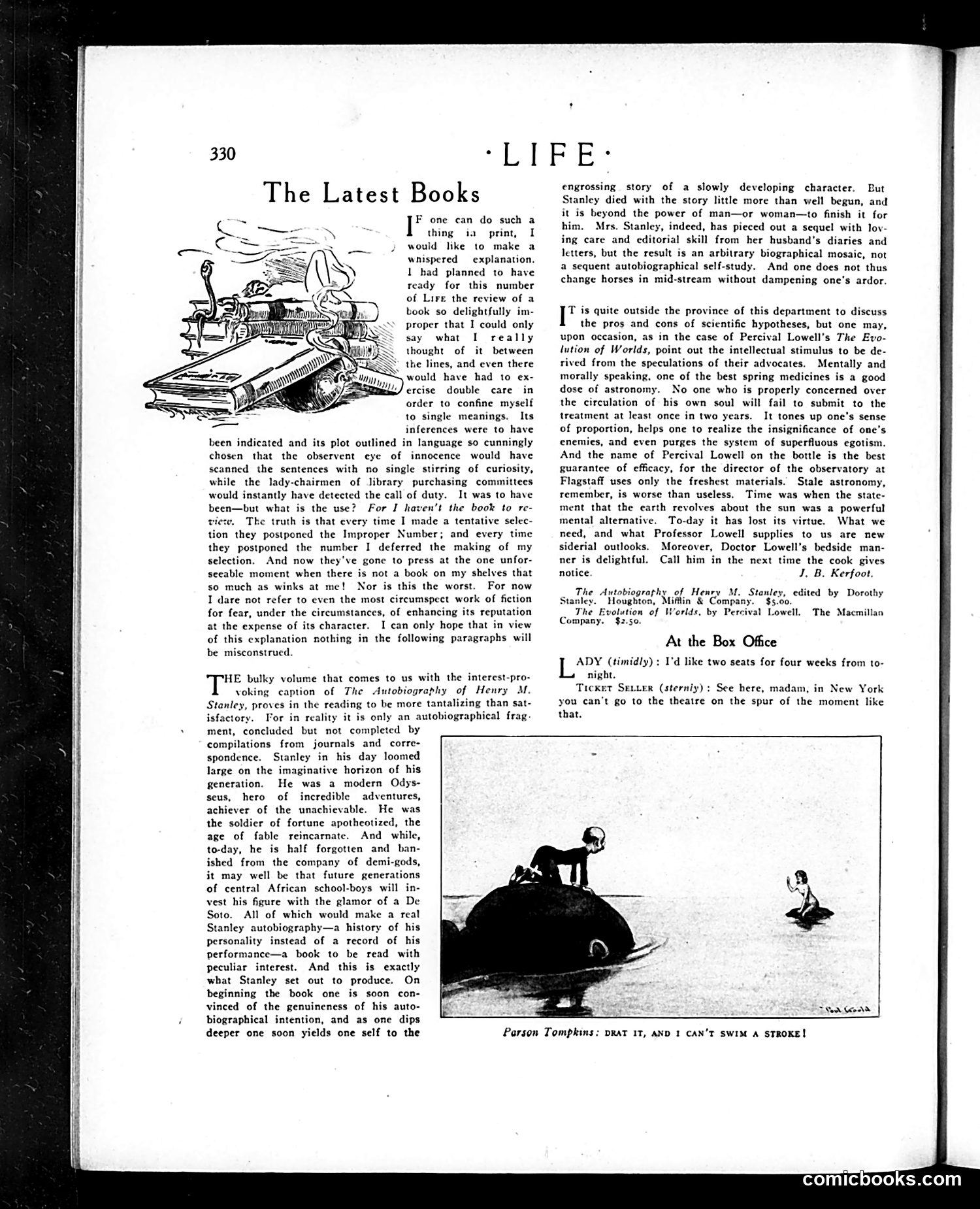
This is a book review column from *Life* magazine discussing two major works: Henry M. Stanley's autobiography (edited posthumously by his widow) and Percival Lowell's *The Evolution of Worlds*. The opening section is editorial commentary about an "Improper Number" the magazine couldn't complete—a humorous complaint that the reviewer keeps missing a delightfully scandalous book to review because publication schedules keep shifting. The cartoon below shows **Parson Tompkins** saying "Drat it, and I can't swim a stroke!" while appearing to be knocked or tossed by an automobile—likely satirizing the then-novel hazard of automobiles to pedestrians, particularly clergy or older gentlemen unfamiliar with the new technology. The reviews themselves treat Stanley's incomplete autobiography seriously (frustrated by its fragmentary nature) and Lowell's astronomy book as intellectually stimulating—comparing it to "spring medicine" for the soul. The tone is sophisticated but accessible.
📄 Transcribed text from this page (OCR, searchable)
Machine-transcribed from the original scan — historical spelling and the odd misread are preserved.
‘LIFE The Latest Books F one can do such a thing ia print, I would like to make a whispered — explanation. I had planned to have ready for this number of Lire the review of a book so delightfully im- proper that I could only say what I really thought of it between the lines, and even there would have had to ex- ercise double care in order to confine myself to single meanings. Its inferences were to have been indicated and its plot outlined in language so cunningly chosen that the observent eye of innocence would have scanned the sentences with no single stirring of curiosity, while the lady-chairmen of Jibrary purchasing committees would instantly have detected the call of duty. It was to have been—but what is the use? For I haven't the book to re- view, The truth is that every time I made a tentative selec- tion they postponed the Improper Number; and every time they postponed the number I deferred the making of my selection. And now they've gone to press at the one unfor- seeable moment when there is not a book on my shelves that so much as winks at me! Nor is this the worst. For now I dare not refer to even the most circumspect work of fiction for fear, under the circumstances, of enhancing its reputation at the expense of its character. I can only hope that in view of this explanation nothing in the following paragraphs will be misconstrued. HE bulky volume that comes to us with the interest-pro- voking caption of The Autobiography of Henry M. Stanley, proves in the reading to be more tantalizing than sat- isfactory. For in reality it is only an autobiographical frag ment, concluded but not completed by engrossing story of a slowly developing character. But Stanley died with the story little more than well begun, and it is beyond the power of man—or woman—to finish it for him. Mrs. Stanley, indeed, has pieced out a sequel with lov- ing care and editorial skill from her husband's diaries and letters, but the result is an arbitrary biographical mosaic, not a sequent autobiographical self-study. And one does not thus change horses in mid-stream without dampening one’s ardor. T is quite outside the province of this department to discuss the pros and cons of scientific hypotheses, but one may, upon occasion, as in the case of Percival Lowell’s The Evo- lution of Worlds, point out the intellectual stimulus to be de- rived from the speculations of their advocates. Mentally and morally speaking, one of the best spring medicines is a good dose of astronomy. No one who is properly concerned over the circulation of his own soul will fail to submit to the treatment at least once in two years. It tones up one’s sense of proportion, helps one to realize the insignificance of one's enemies, and even purges the system of superfluous egotism. And the name of Percival Lowell on the bottle is the best guarantee of efficacy, for the director of the observatory at Flagstaff uses only the freshest materials. Stale astronomy, remember, is worse than useless. Time was when the state- ment that the earth revolves about the sun was a powerful mental alternative. To-day it has lost its virtue. What we need, and what Professor Lowell supplies to us are new siderial outlooks. Moreover, Doctor Lowell’s bedside man- ner is delightful. Call him in the next time the cook gives notice J. B. Kerfoot. _ The Antobiograthy of Henry M. Stanley, edited by Dorothy Stanley. Houghton, Mifflin & Company. $5.00. The Evolution of Worlds, by Percival Lowell. The Macmillan Compan: $2.5 At the Box Office L*Y (timidly) : I'd like two seats for four weeks from to- night. Ticket Setter (sternly): See here, madam, in New York you can't go to the theatre on the spur of the moment like that. compilations from journals and corre- spondence. Stanley in his day loomed large on the imaginative horizon of his generation. He was a modern Odys- seus, hero of incredible adventures, achiever of the unachievable. He was the soldier of fortune apotheotized, the age of fable reincarnate. And while, to-day, he is half forgotten and ban- ished from the company of demi-gods, it may well be that future generations of central African school-boys will in- vest his figure with the glamor of a De Soto. All of which would make a real Stanley autobiography—a history of his personality instead of a record of his performance—a book to be read with peculiar interest. And this is exactly what Stanley set out to produce. On beginning the book one is soon con- vinced of the genuineness of his auto- biographical intention, and as one dips deeper one soon yields one self to the TAKA Parson Tompkins: peat 1T, AND 1 CAN'T SWIM A STROKE! comicbooks.com