
A complete issue · 52 pages · 1909
Life — November 4, 1909
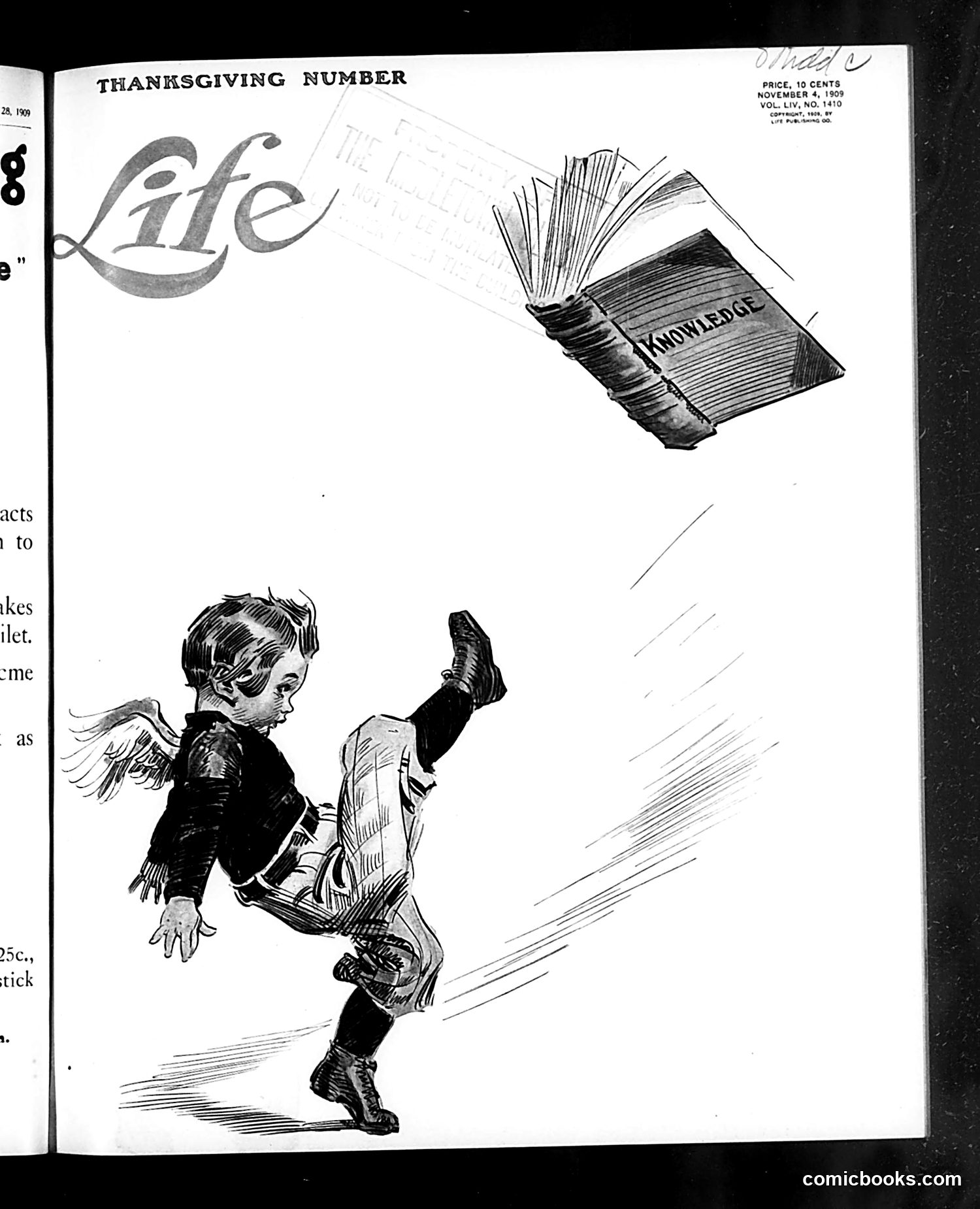
This is the cover of Life's Thanksgiving issue. The illustration depicts a cherub or cupid figure with wings, appearing to kick or propel a large open book labeled "KNOWLEDGE" upward into the air. The book's pages are splayed and radiating light. The satire likely comments on the value and power of knowledge or education—particularly how knowledge propels human progress forward with vigor and enthusiasm. The celestial cherub suggests this is presented as an almost divine or blessed enterprise. Given the Thanksgiving theme, this may be celebrating American educational advancement or emphasizing knowledge as something for which to be grateful. The dynamic, forceful movement conveys optimism about intellectual development during this Progressive Era period.
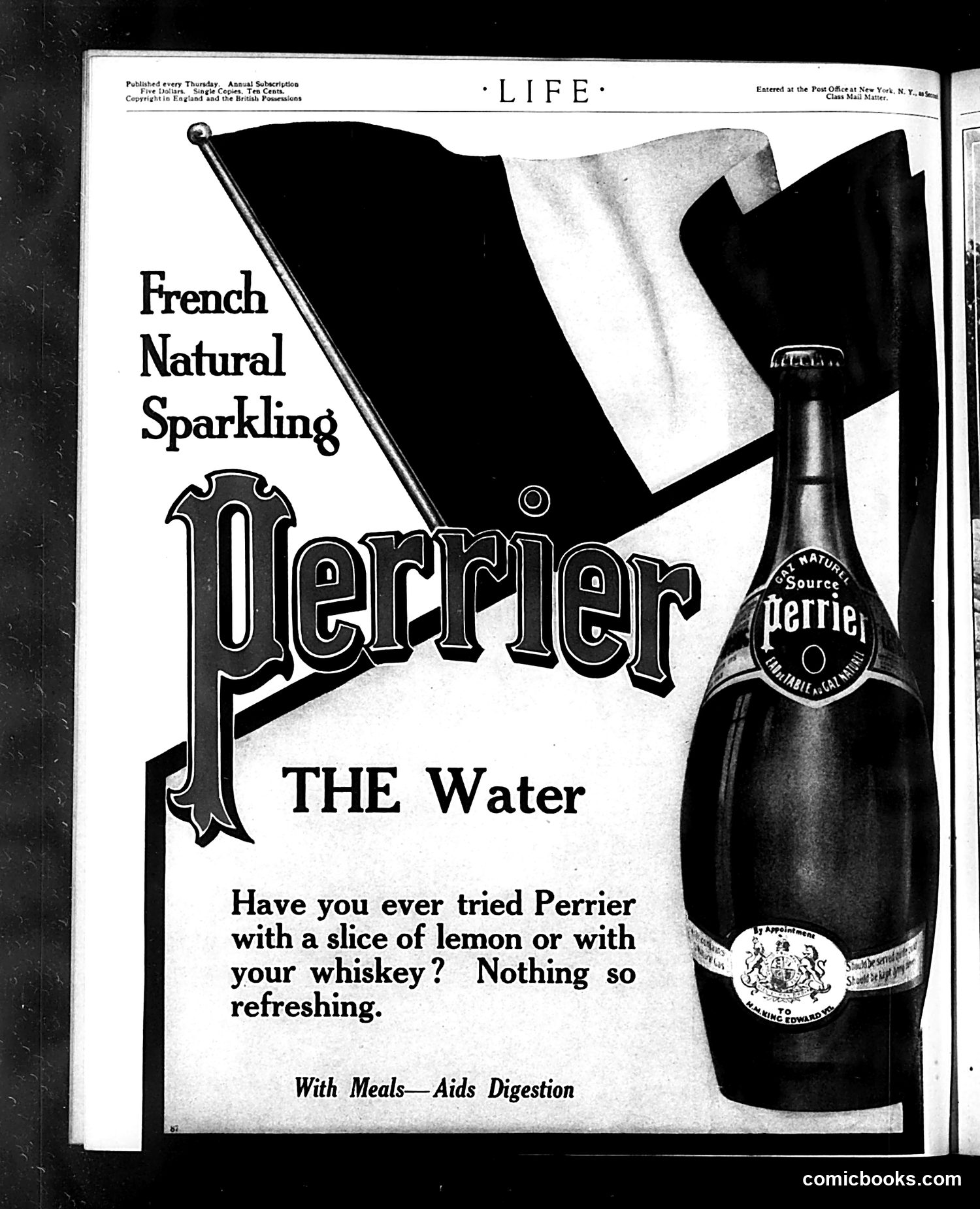
This page is **primarily an advertisement**, not a political cartoon. It advertises Perrier, a French natural sparkling water, appearing in *Life* magazine. The ad features the French flag prominently, likely appealing to American consumers' association of France with sophistication and quality. The tagline "Have you ever tried Perrier with a slice of lemon or with your whiskey? Nothing so refreshing" suggests versatile uses for the beverage. The phrase "With Meals—Aids Digestion" reflects early 20th-century marketing claims about sparkling water's health benefits, a common advertising strategy of that era. There is no political satire visible here—this is straightforward commercial advertising emphasizing the product's French origin and perceived elegance.
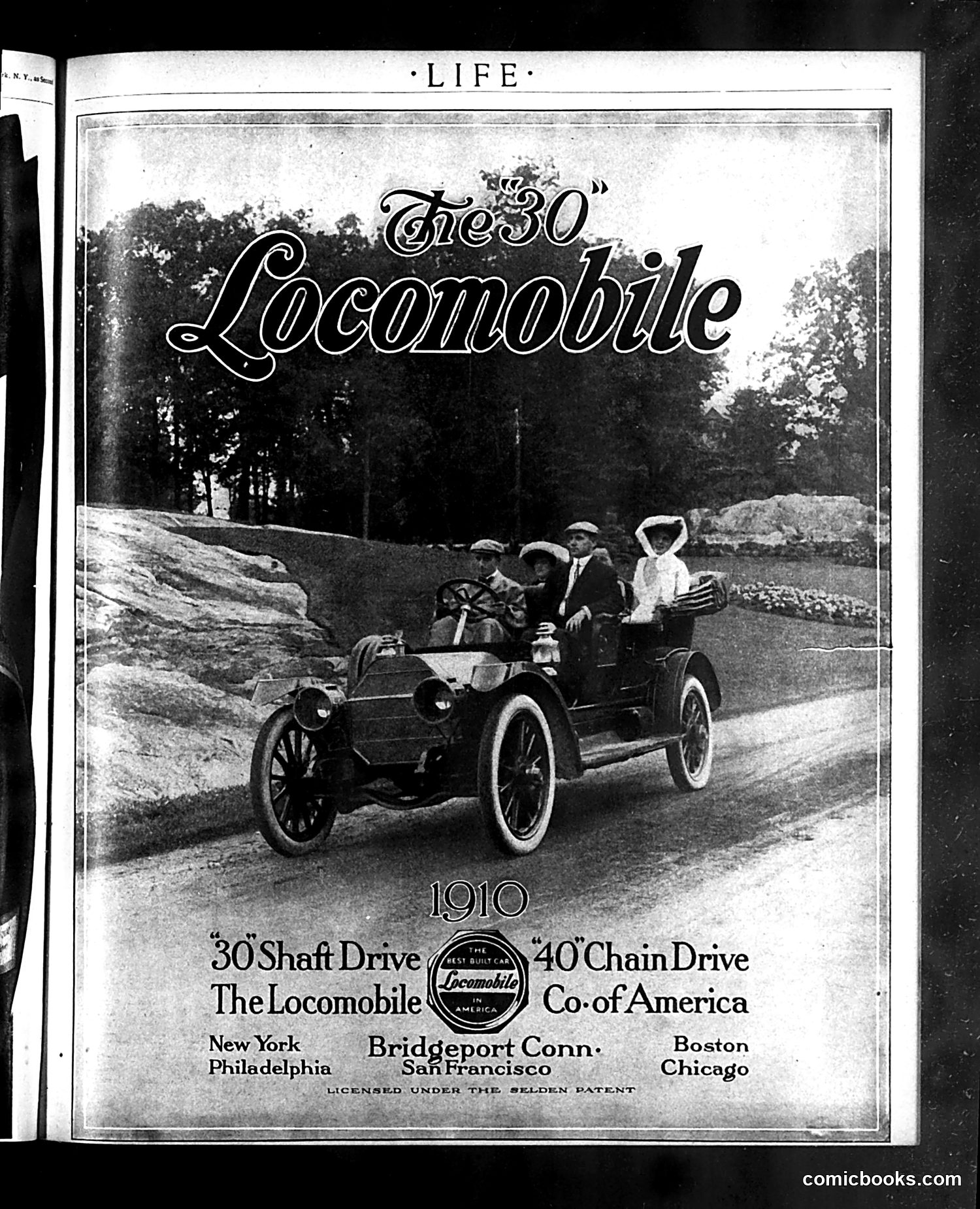
This page is primarily **advertising, not satire or political commentary**. It's a 1910 advertisement for the Locomobile automobile, published in *Life* magazine. The ad features a photograph of an early motorcar with five passengers driving through a scenic landscape with trees and a large rock formation. The "30 Shaft Drive" and "40 Chain Drive" refer to two model variants. The Locomobile Company of America, based in Bridgeport, Connecticut, had offices in major cities: New York, Philadelphia, Boston, Chicago, and San Francisco. The ad emphasizes the vehicle's capacity and capability for leisure driving—a luxury pursuit for wealthy Americans in this early automotive era. The tagline "Best Built Car in America" promotes quality and prestige.
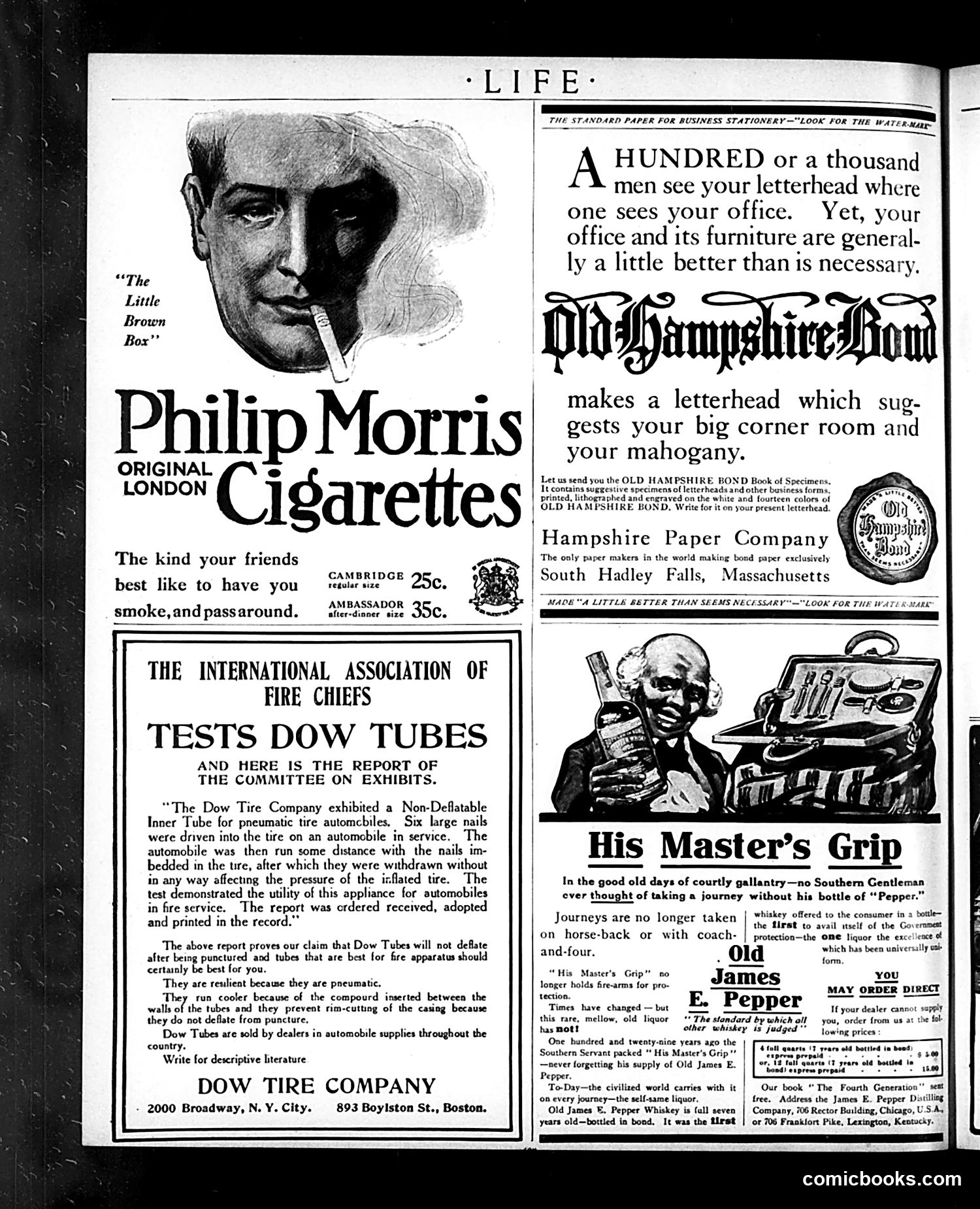
This page is primarily **advertising** rather than political satire or commentary. The left side features a Philip Morris cigarette advertisement with an illustrated male smoker and the tagline "The kind your friends best like to have you smoke, and pass around." Below is a Dow Tire Company ad about pneumatic tire testing by the International Association of Fire Chiefs. The right side contains ads for Old Hampshire Bond letterhead paper and Old James E. Pepper whiskey ("His Master's Grip"). These appear to be luxury goods marketed to businessmen. No political cartoons or satirical commentary are present on this page. The content reflects early-20th-century consumer advertising targeting professional men, emphasizing status products like premium cigarettes, quality paper, and spirits.
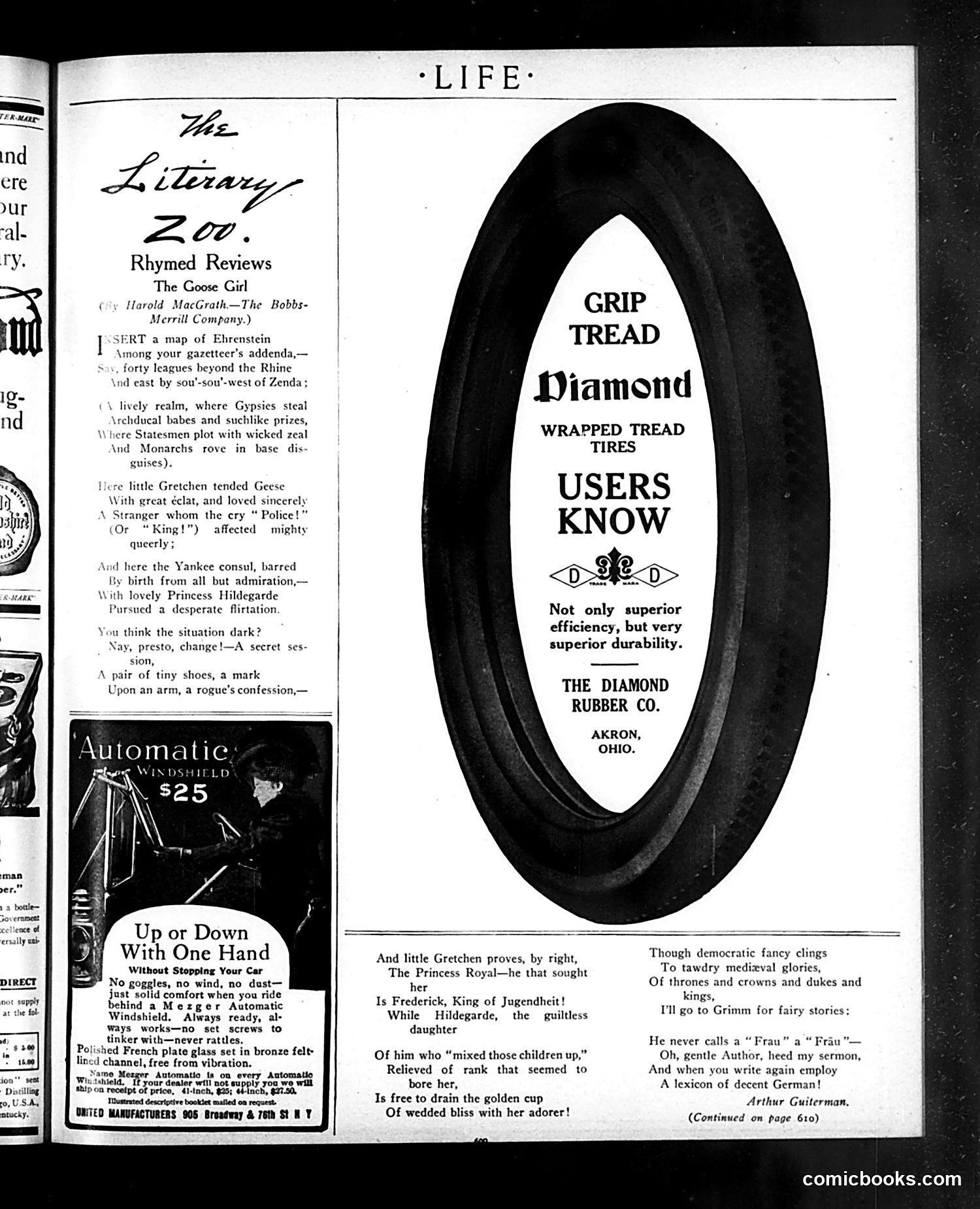
This page is primarily **advertising**, not editorial content or satire. The dominant right-hand image is a **Diamond Rubber Company advertisement** for "Grip Tread" wrapped-tread tires, manufactured in Akron, Ohio. The ad emphasizes superior efficiency and durability through the visual of a large tire. The left side contains **"The Literary Zoo,"** a column of rhymed book reviews, specifically reviewing "The Goose Girl" by Harold MacGrath. The review is lighthearted verse commentary on the novel's plot involving European intrigue, a Yankee consul, and a princess. Below that is an **Automatic Windshield advertisement** for a $25 product that operates "up or down with one hand." There is **no political cartoon or satire** on this page—it represents typical early-20th-century magazine layout mixing editorial content with advertisements.
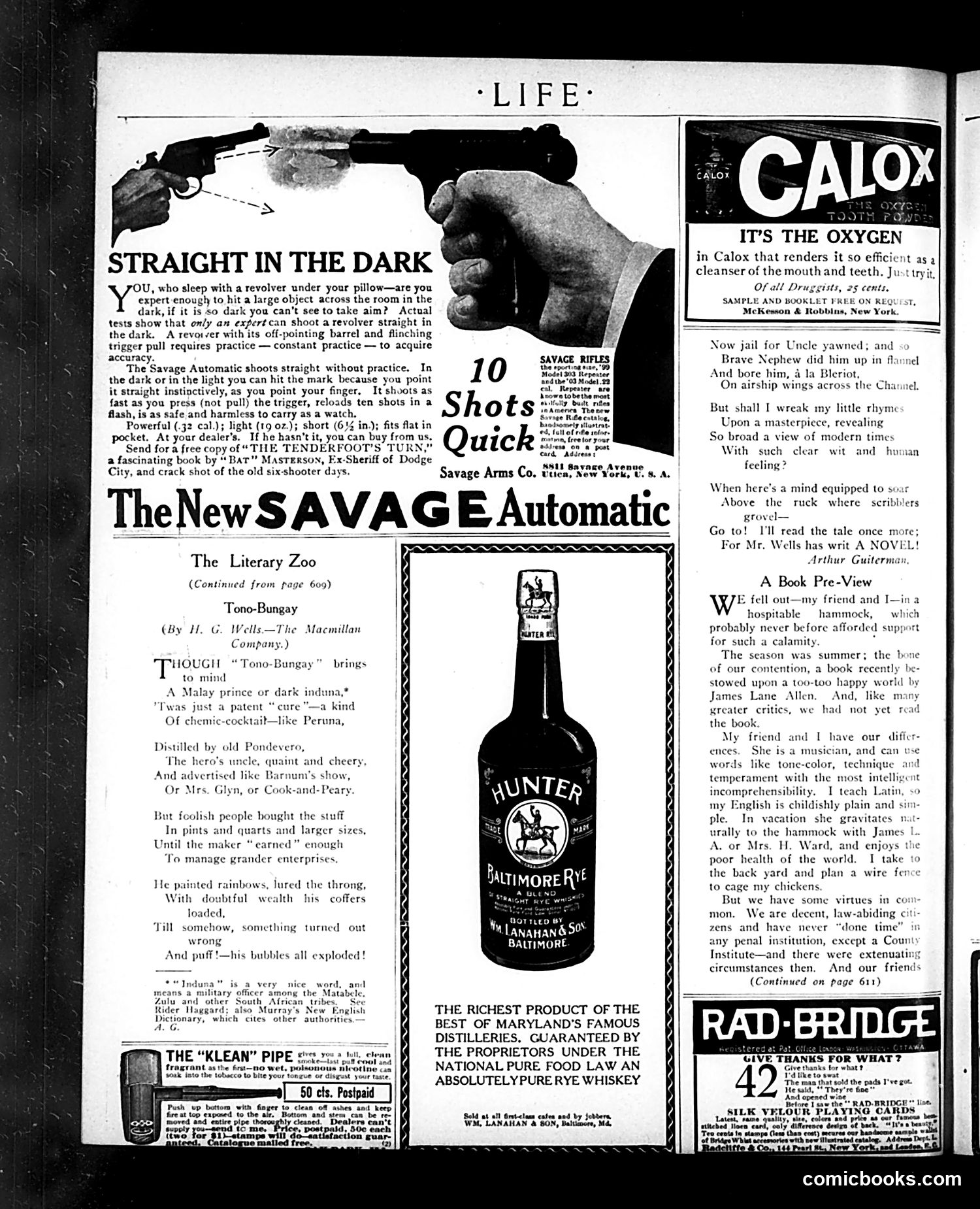
This *Life* magazine page is primarily **advertising**, not political satire. The dominant content consists of product advertisements: 1. **Savage Rifles ad** ("Straight in the Dark"): Promotes the New Savage Automatic rifle, emphasizing its accuracy in low-light conditions—a practical sales pitch rather than social commentary. 2. **Calox toothpaste** and **Hunter Baltimore Rye whiskey** ads: Standard early 20th-century product marketing. 3. **Rad-Bridge silk playing cards**: Another commercial pitch. The only non-advertising content is "The Literary Zoo," a poem by H.G. Wells about a character named "Tono-Bungay" (likely referencing Wells's own novel). This appears to be satirical fiction rather than political commentary. The page reflects early 1900s magazine content: commercial advertising mixed with literary pieces.
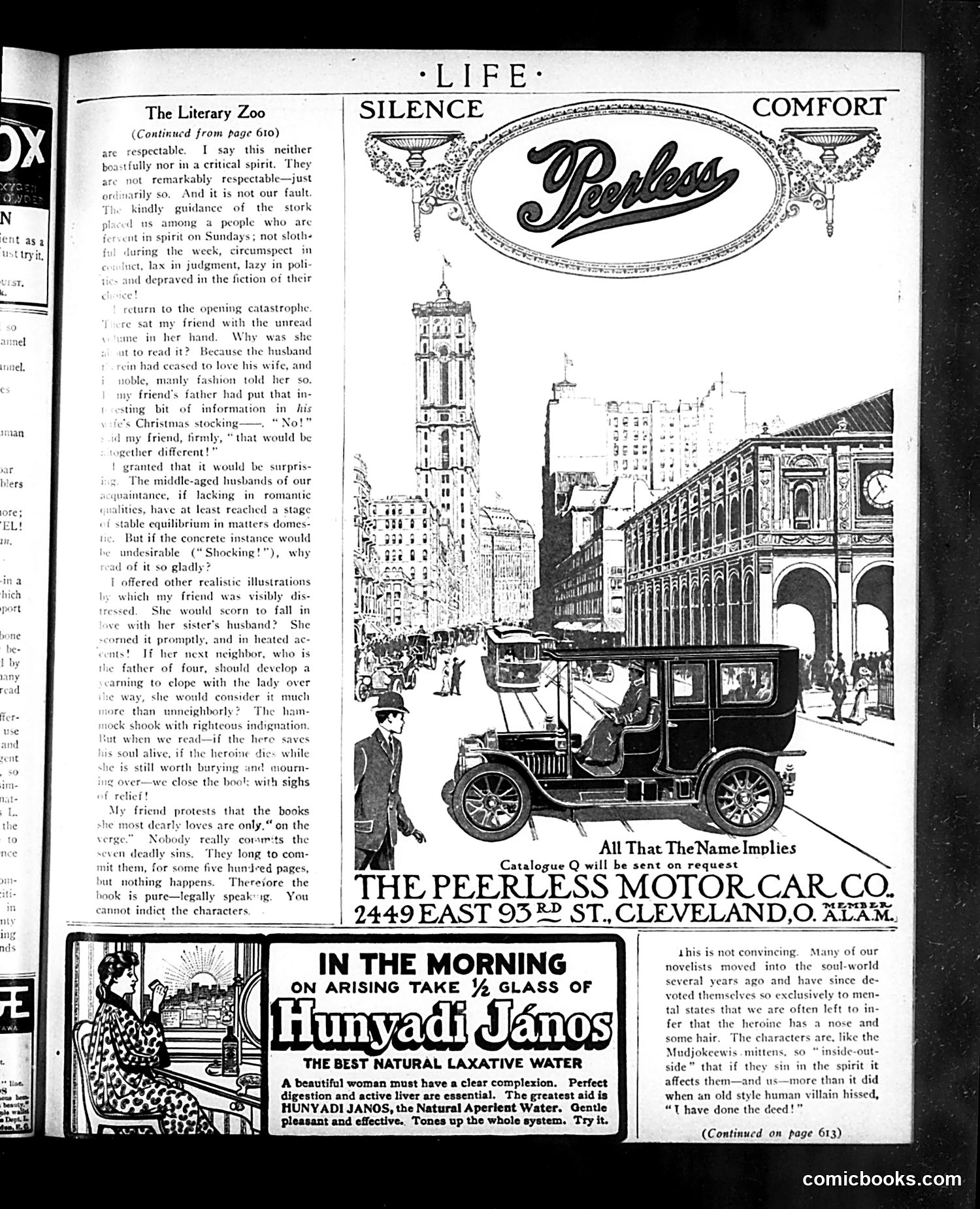
This page is primarily **advertising** rather than political content. The dominant feature is a large advertisement for the Peerless Motor Car Company (Cleveland, Ohio), showing an elegant automobile in an urban street scene with classical architecture—typical luxury car marketing of the early 20th century. The page also contains: - **"The Literary Zoo"** column (left), a satirical piece critiquing literary characters and husbands' behavior in fiction - **"Hunyadi János"** advertisement (bottom left), promoting a natural laxative water with messaging about women's complexions - **"Silence" and "Comfort"** as page headers The content reflects early 1900s concerns: literary criticism, consumer products, and class-conscious advertising targeting affluent readers.
This page is primarily **editorial promotion**, not satire or political cartoon. Life magazine is announcing upcoming special issues to readers. The main content promotes: 1. **"The Horse Show Number"** — arriving next week, featuring horses and "pretty girls scattered around" (typical subject matter for the era's society coverage) 2. **"That Improper Number"** — readers have been requesting it; the magazine is working to release it 3. **Christmas Number** — coming soon, featuring illustration by Charles Dana Gibson (the famous Gibson Girl artist) 4. **A call for subscriptions** — urging readers to subscribe before the Christmas issue arrives and to recommend Life to friends The decorative illustrations are stylized figures in formal dress, typical of Life's visual branding. This is essentially a **house advertisement** encouraging magazine subscriptions, not political commentary or satire.
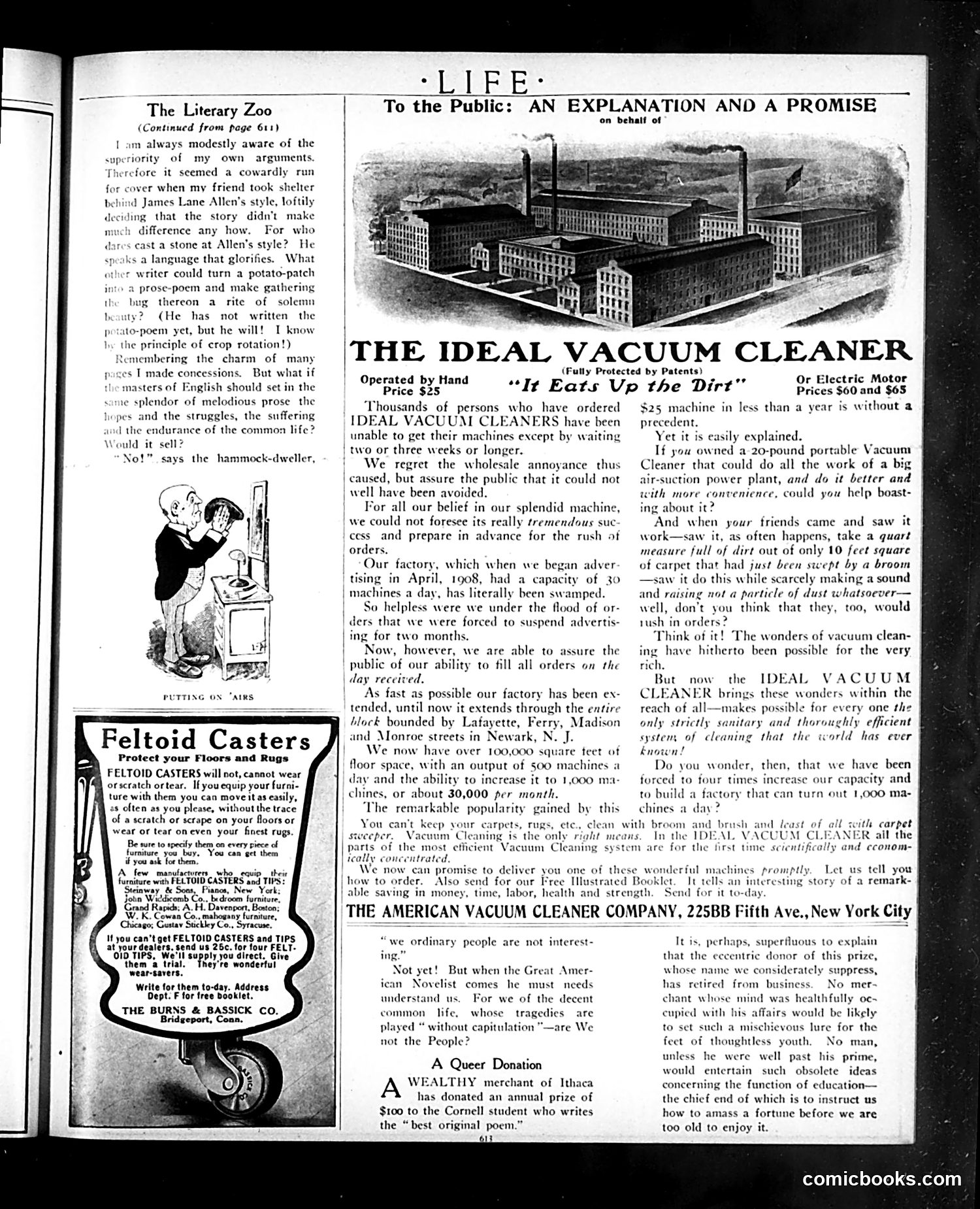
This page is primarily **advertising and editorial content**, not political satire. The left column contains "The Literary Zoo," a brief essay by an unnamed author defending their modest writing style against criticism from a friend (James Lane Allen). The accompanying illustration shows a figure cowering behind a hammock, humorously depicting the author's self-described cowardice in the literary debate. The bulk of the page advertises **The Ideal Vacuum Cleaner** (hand or electric-operated, $25-$65), claiming unprecedented cleaning efficiency and the company's expanded factory capacity to meet demand. Below this is an ad for **Feltoid Casters** (floor protectors), and a note about a "$100 annual poetry prize" from a wealthy Ithaca merchant for Cornell students. The vacuum cleaner ad's grandiose claims about capacity and efficiency appear somewhat exaggerated, typical of early 1900s marketing hyperbole, though this isn't presented as satire here.
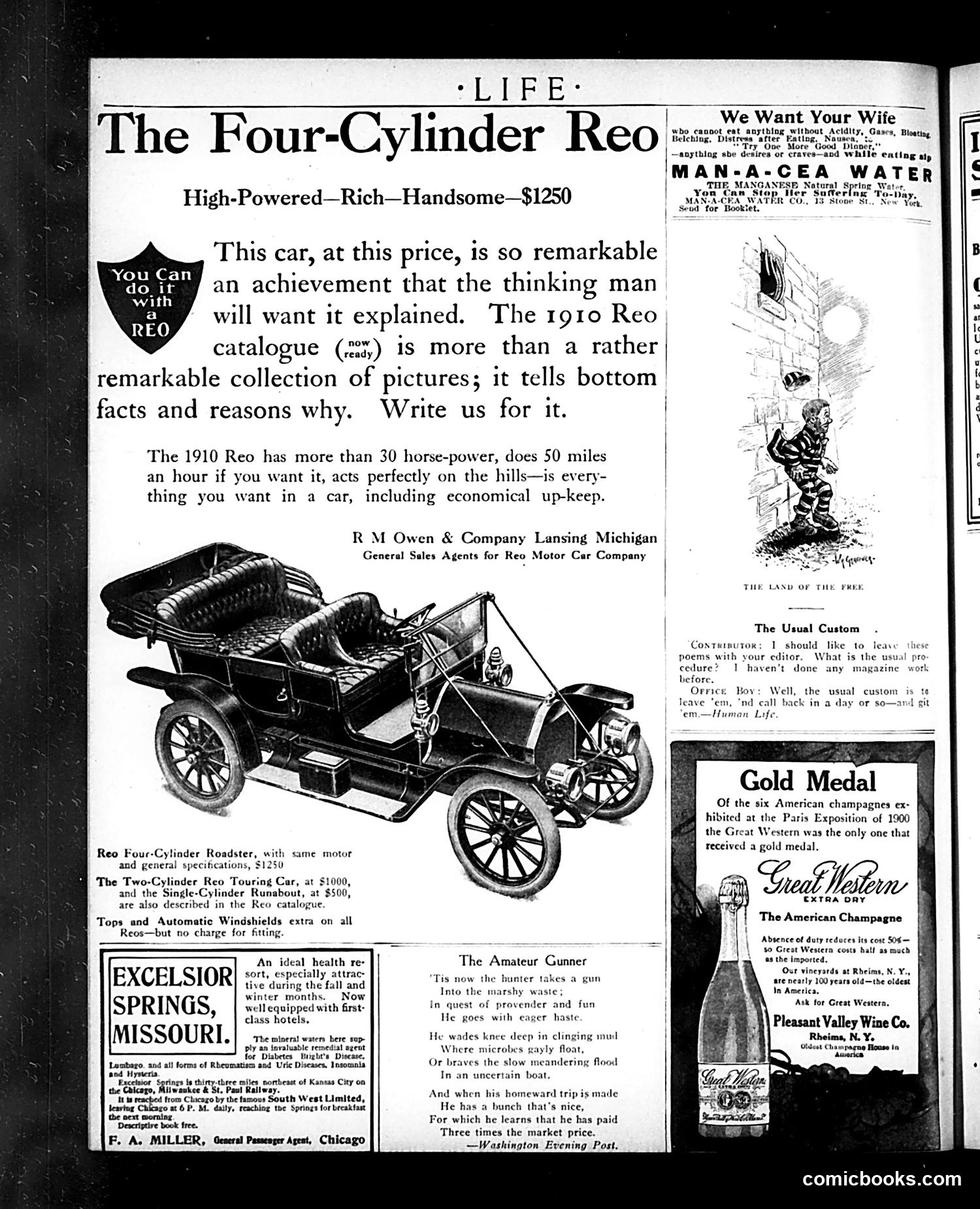
This cartoon depicts a man being struck or knocked down, illustrating the phrase "The Land of the Free" with clear irony. The image appears to critique American society's gap between its ideals and reality—specifically the promise of freedom versus actual treatment of citizens. The cartoon accompanies "The Usual Custom," a brief editorial exchange where a contributor suggests leaving town before the next magazine issue, and the editor responds that readers should "leave 'em, 'n' call back in a day or so." The cartoon visually reinforces this satirical commentary on American freedoms and social conditions, suggesting that despite the nation's founding principles, citizens face practical hardships or injustices.
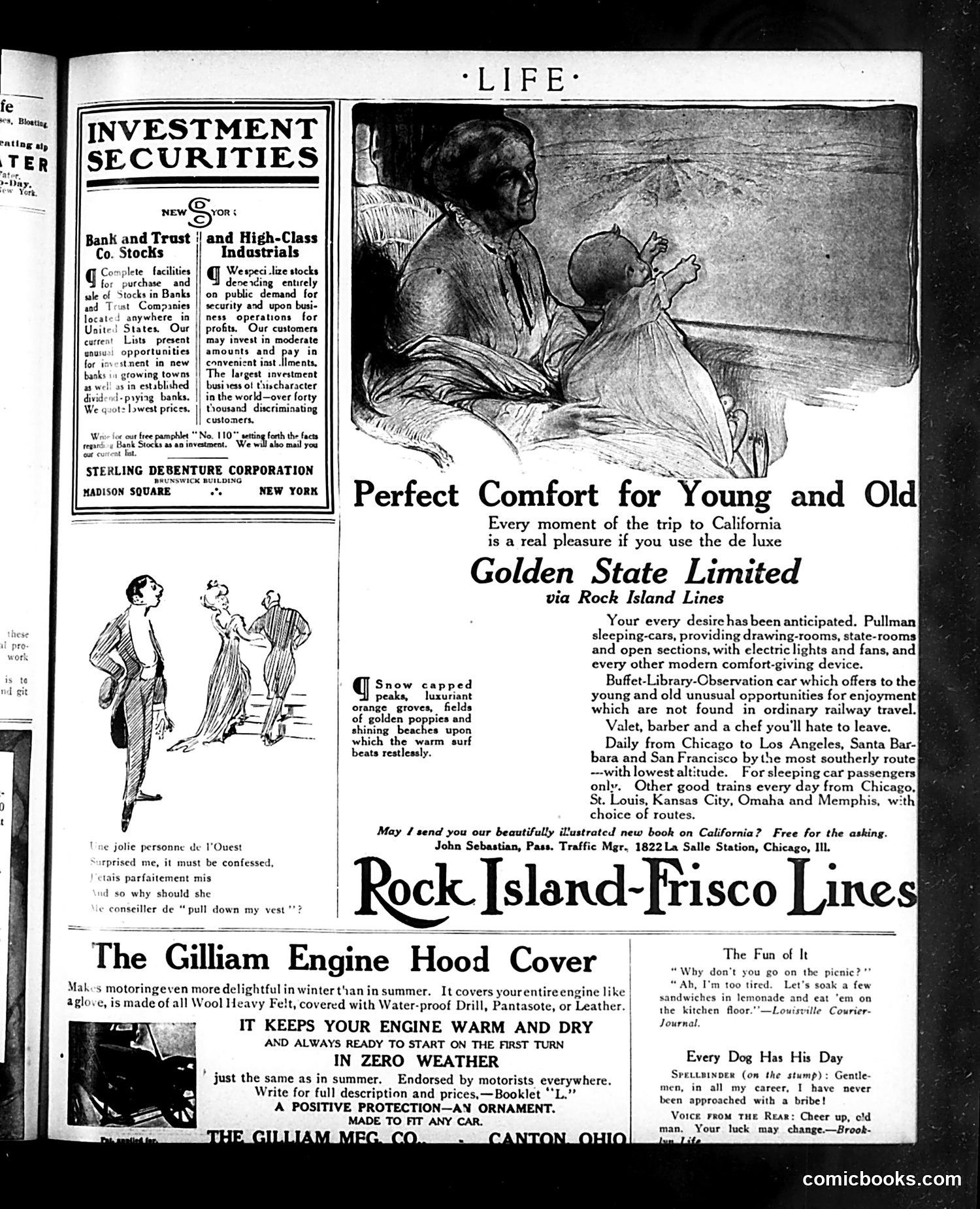
This page is primarily **advertising content** rather than editorial satire. The dominant advertisement is for the "Golden State Limited" train via Rock Island Lines, featuring an illustration of a comfortable passenger in a sleeping car—appealing to travelers seeking luxury cross-country rail service to California. Below that is an ad for the **Gilliam Engine Hood Cover**, a motorist product promising winter engine protection in cold weather. A small cartoon at bottom-left appears to be a domestic humor sketch about a woman wanting to "soak a few stitches in lemonade" on the kitchen floor, likely poking gentle fun at household domestic life. The page also contains a Sterling Debenture Corporation investment securities advertisement. This is primarily a **commercial page**, not political satire.
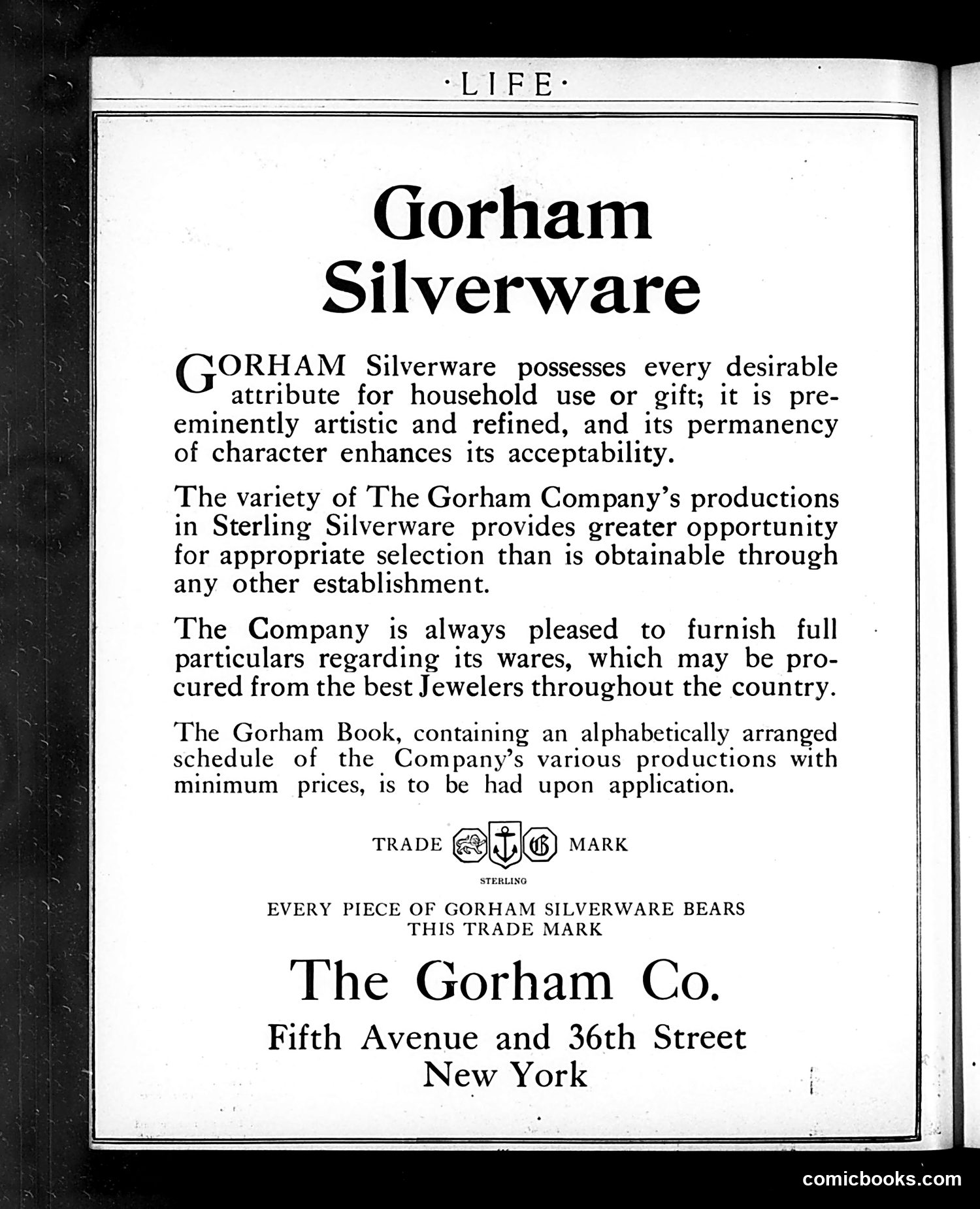
This is an advertisement page, not a cartoon or satirical content. It promotes **Gorham Silverware**, a sterling silver manufacturer located at Fifth Avenue and 36th Street in New York. The ad makes marketing claims typical of the era: that Gorham pieces are "artistic and refined" with "permanency of character," suitable for household use or gifts. It emphasizes the company's variety of products and distribution through jewelers nationwide. The page includes Gorham's distinctive **trade mark**—a shield containing an anchor and "G"—which the company asserts appears on all authentic pieces. The ad offers to provide product catalogs with pricing upon request. This represents straightforward early 20th-century luxury goods advertising in *Life* magazine, with no satirical or political content present.
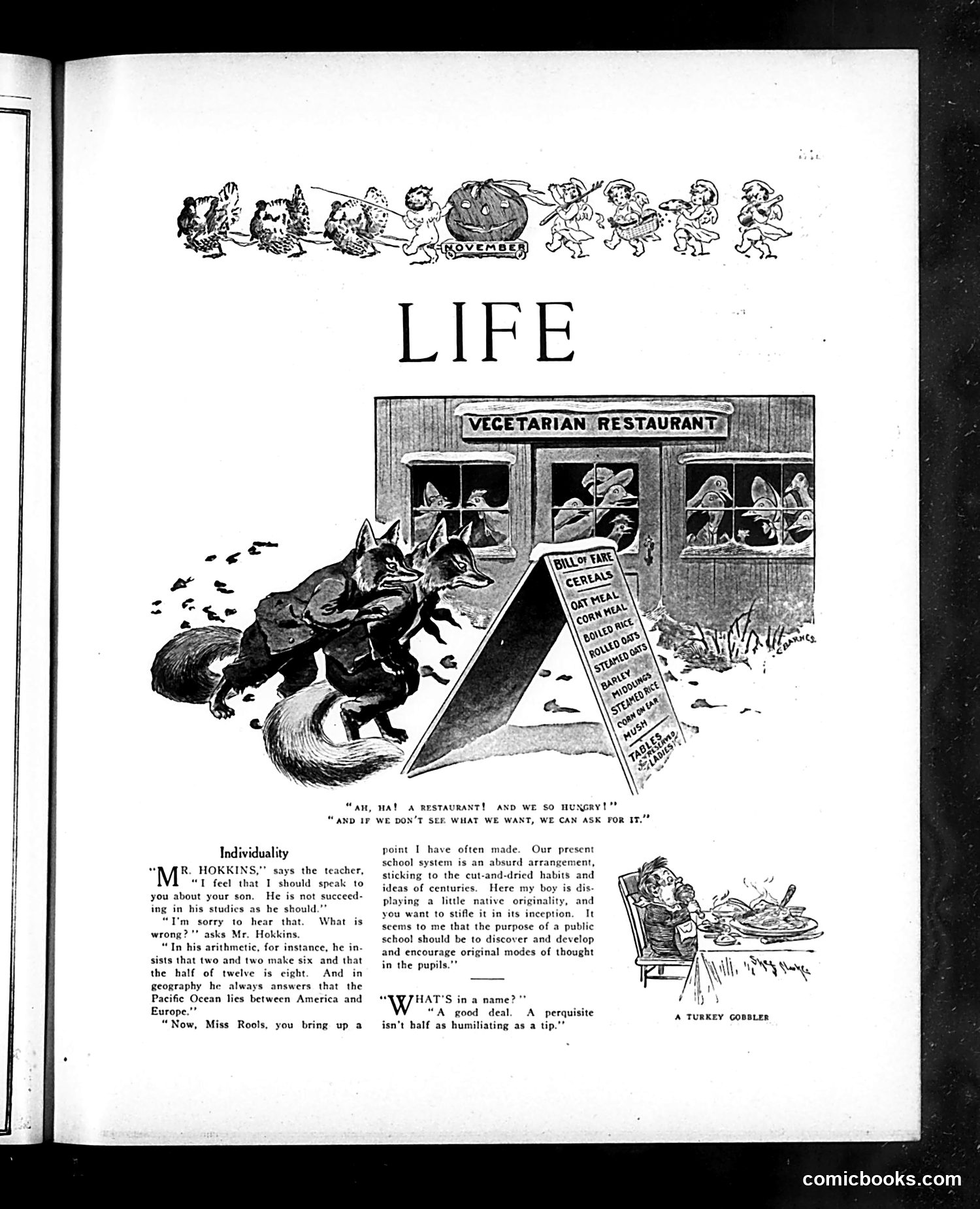
This satirical cartoon critiques **vegetarianism** through a humorous predator/prey inversion. Two foxes discover a "Vegetarian Restaurant" with birds visible through its windows—an ironic setup since foxes naturally hunt birds. The cartoon's caption states: "Ah, ha! A restaurant! And we so hungry! And if we don't see what we want, we can ask for it." The joke mocks vegetarian establishments as absurd or impractical, suggesting even carnivores would struggle with such limitations. The accompanying text discusses "Individuality" in education, featuring dialogue between Mr. Hokkins (a teacher) and Miss Rools about teaching methods and student originality—suggesting the page addresses broader themes of conformity versus individual thinking in early 20th-century American society.
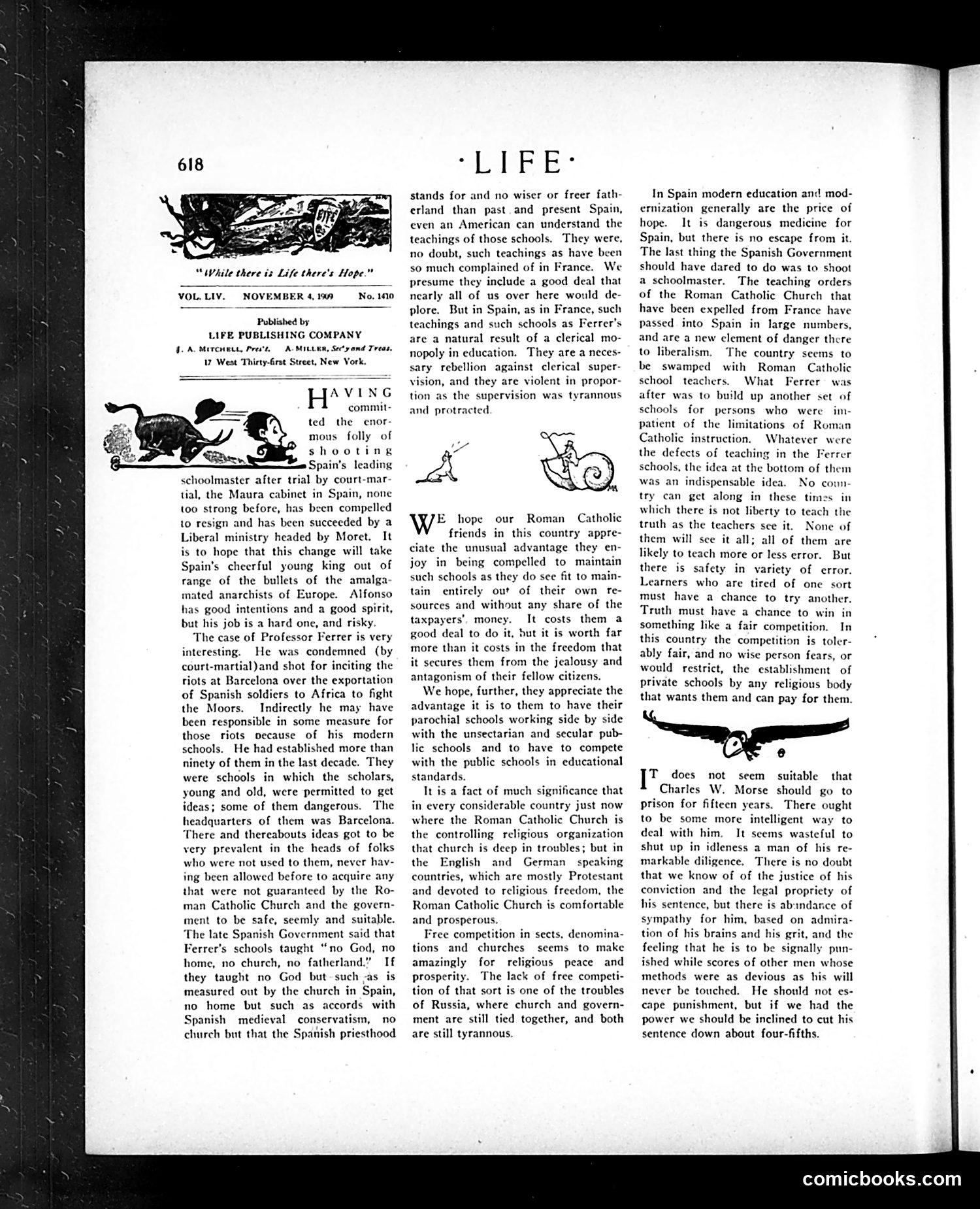
This page discusses the execution of Francisco Ferrer, a Spanish educator shot by the Maura government for allegedly inciting Barcelona riots (1909). The text argues Ferrer's "crime" was operating progressive schools that taught students to think independently—a radical act in Spain's clerical-dominated education system. **The satirical point:** Life uses Ferrer's case to critique Catholic Church monopoly on Spanish education. The magazine argues that such rigid control *creates* violent rebellion, and ironically praises American Catholics for having to fund their own schools without state support—which ironically gives them *freedom* from the antagonism Spain's enforced orthodoxy generates. The small decorative cartoons (rabbits/animals) lack clear political reference and appear purely ornamental. The real argument is textual: religious freedom through competition produces peace; monopolistic control breeds violence and unrest.
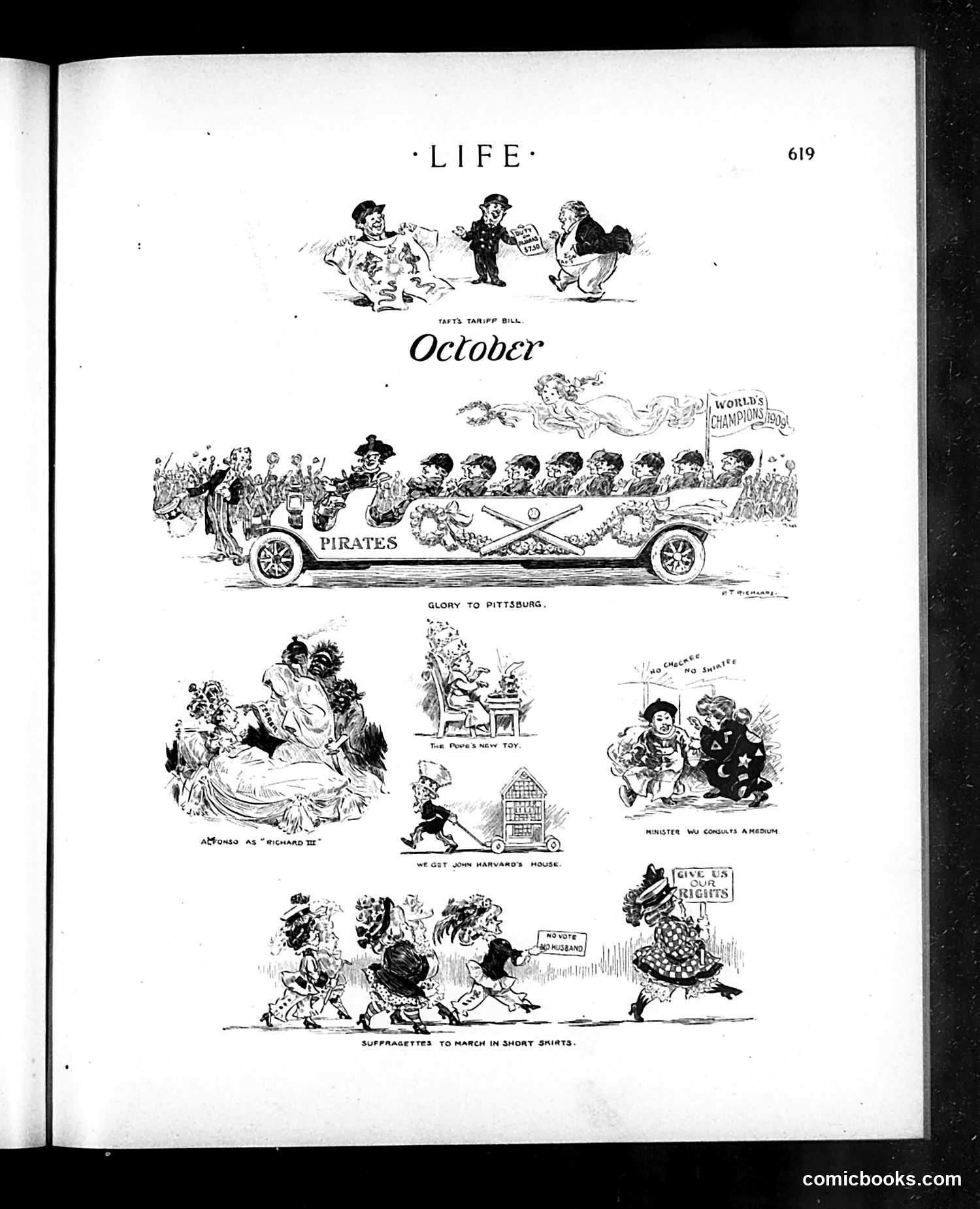
This page features satirical cartoons about October 1912 events. The top cartoon, "Taft's Tariff Bill," shows three figures debating trade policy under President Taft's administration. The large "Pirates" illustration depicts the Pittsburgh baseball team's World Series victory, labeled "Glory to Pittsburgh." Lower cartoons mock current events: "Arduous as 'Richard III'" appears to reference political maneuvering; "The Pope's New Toy" and "We Get John Harvard's House" remain unclear without more context; and "Minister Wu Conducts a Medium" likely references spiritualism fads or diplomatic matters. The bottom cartoon, "Suffragettes to March in Short Shirts," satirizes the women's suffrage movement, mocking activists' planned public demonstrations by suggesting their clothing choices were noteworthy or scandalous—reflecting anti-suffrage sentiment common in early 1910s satirical publications.
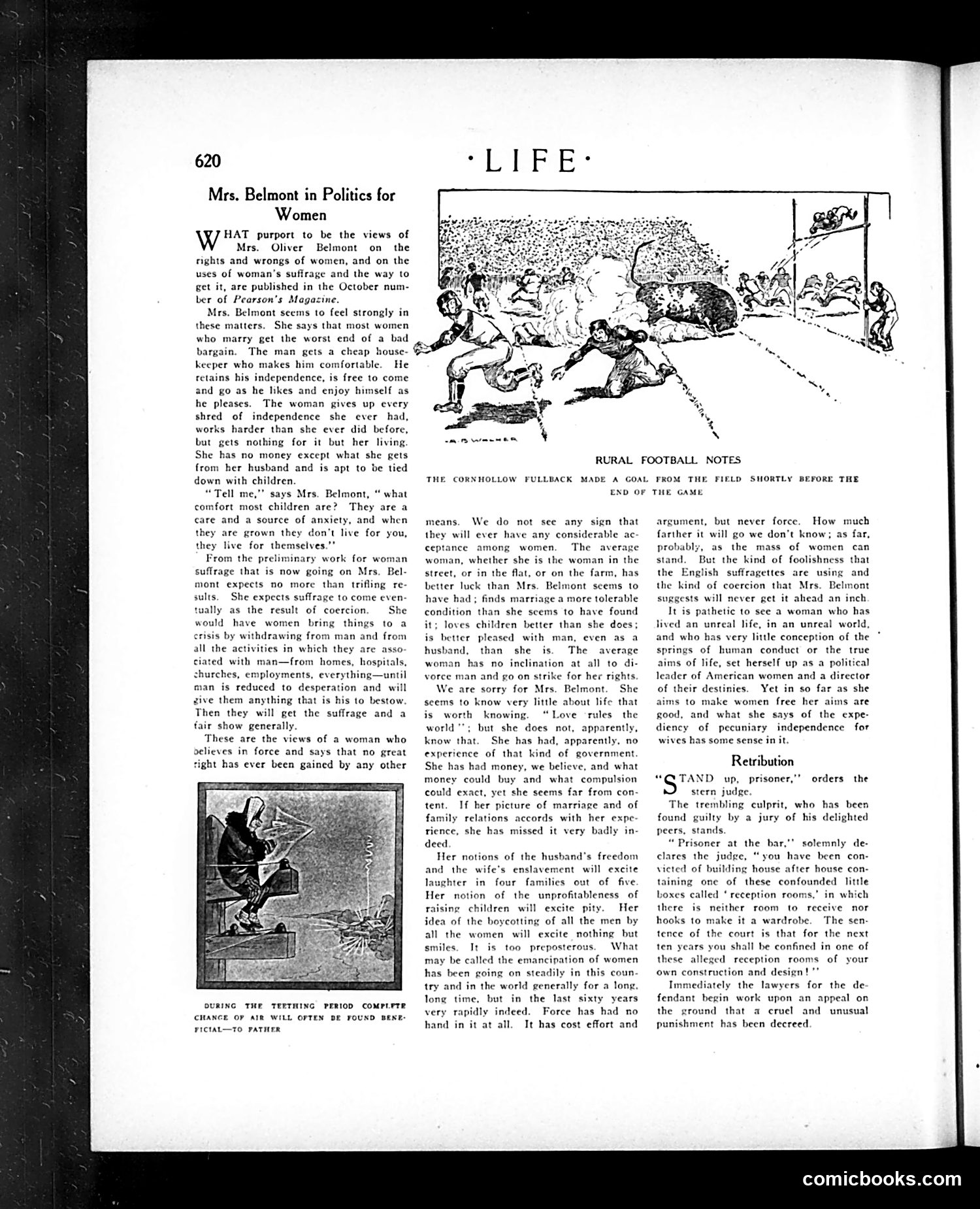
This page satirizes **Mrs. Oliver Belmont**, a wealthy advocate for women's suffrage, mocking her extreme views published in *Pearson's Magazine*. Belmont reportedly argued that marriage exploits women as unpaid housekeepers, that children are burdensome rather than blessings, and that women should **withdraw entirely from society**—abandoning homes, churches, and employment—to force men into granting suffrage through economic coercion. Life's editors ridicule these positions as dangerously out-of-touch. They argue the "average woman" finds marriage tolerable, loves children, and has no interest in Belmont's scorched-earth strategy. The magazine dismisses her as bitter and ignorant of "life worth knowing," having enjoyed wealth yet remained discontent. The editorial defends gradual women's emancipation achieved through "effort"—not force—while condemning both Belmont's extremism and the "foolishness" of English suffragettes. Two cartoons accompany the text: rural football scenes appearing unrelated to the political content.
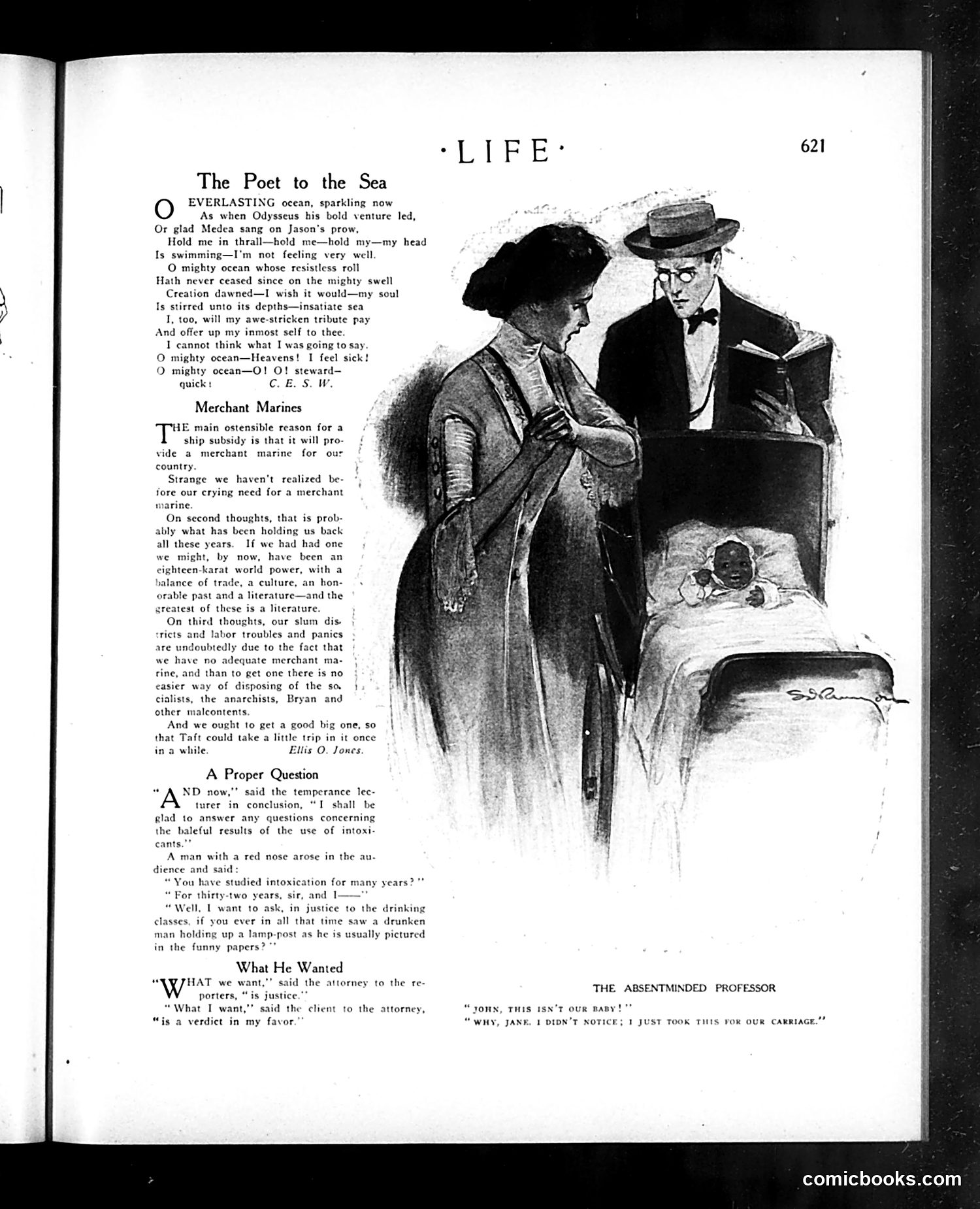
This page contains multiple satirical pieces mocking American society circa early 1900s: **"The Poet to the Sea"**: Parodies overly romantic poetry. A would-be poet addresses the ocean with grandiose classical references (Odysseus, Medea, Jason), but repeatedly loses his train of thought and becomes seasick—deflating pretentious literary aspirations with physical reality. **"Merchant Marines"**: Critiques the ship subsidy debate. The author sarcastically suggests America's social problems (slums, labor unrest, anarchism, Bryan's populism) stem from lacking a merchant marine—an absurd circular argument mocking both the subsidy advocates and those blaming various ills on maritime weakness. **"A Proper Question"**: A red-nosed man challenges a temperance lecturer, asking whether he's ever actually witnessed the stereotypical "drunken man holding up a lamppost" from newspaper cartoons—implying temperance propaganda relies on exaggerated imagery. **"The Absentminded Professor"**: A cartoon showing a befuddled professor absconding with someone else's baby, mistaking it for his carriage—physical comedy about absent-mindedness. All pieces mock social pretension, political rhetoric, and moral crusades through humor.
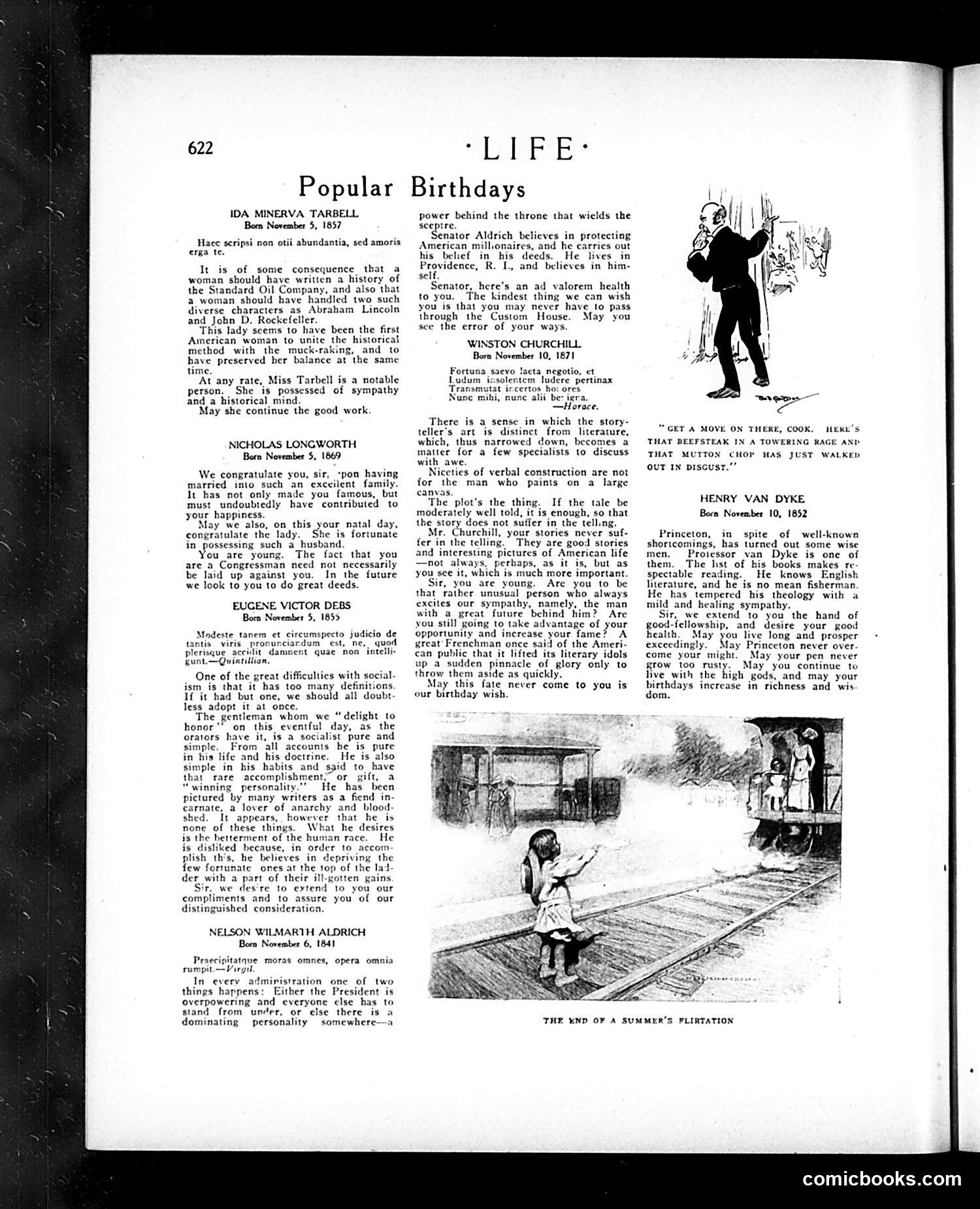
This satirical page celebrates five men's birthdays with mock-formal congratulations that reveal the magazine's social critique: **Ida Minerva Tarbell** (investigative journalist) — praised for pioneering "muck-raking" while maintaining historical rigor, particularly her exposé of Standard Oil. **Nicholas Longworth** (Congressman) — backhanded congratulations on marrying into wealth and prominence, with ironic hopes he'll eventually accomplish something. **Eugene Victor Debs** (socialist leader) — surprisingly respectful, acknowledging his genuine moral character and "winning personality" while noting socialists dislike him for wanting to redistribute millionaires' wealth. **Nelson Aldrich** (Senator) — sharp satire on his role as "power behind the throne," protecting wealthy industrialists; the customs house reference implies corruption. **Winston Churchill** (novelist/journalist) — praised for storytelling skill over literary refinement. The page uses Latin epigraphs and formal tone to undercut its subjects with irony—some genuine respect, some cutting criticism of political/industrial power brokers.
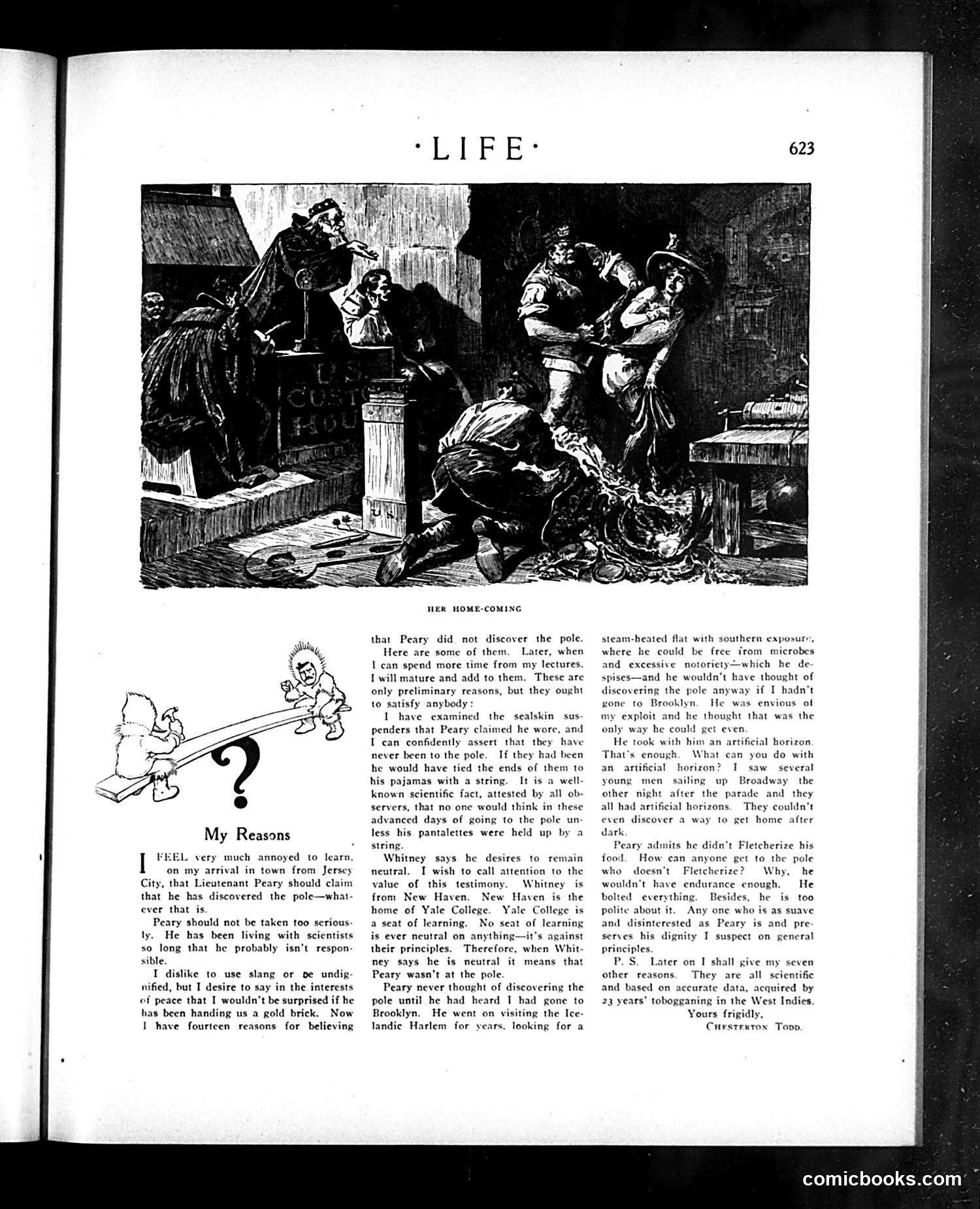
This is a humorous editorial piece mocking explorer Robert Peary's 1909 claim to have discovered the North Pole. The author—identified as "Currstertox Toop"—presents absurdly ridiculous "reasons" why Peary couldn't have reached the pole, including: - Peary's sealskin suspenders showed no signs of polar travel - Whitney's claim of neutrality is suspicious because Yale (Whitney's institution) is never neutral on anything - Peary only attempted the pole out of jealousy after the author went to Brooklyn - Peary used an artificial horizon (a navigation tool) but couldn't even help young men navigate Broadway - Peary didn't "Fletcherize" his food (chew thoroughly, per a fad diet) The satire mocks both Peary's credibility and contemporary enthusiasms like Fletcherism. The cartoon's "HER HOME-COMING" caption remains unclear without additional context, though it likely relates to the written content above it.
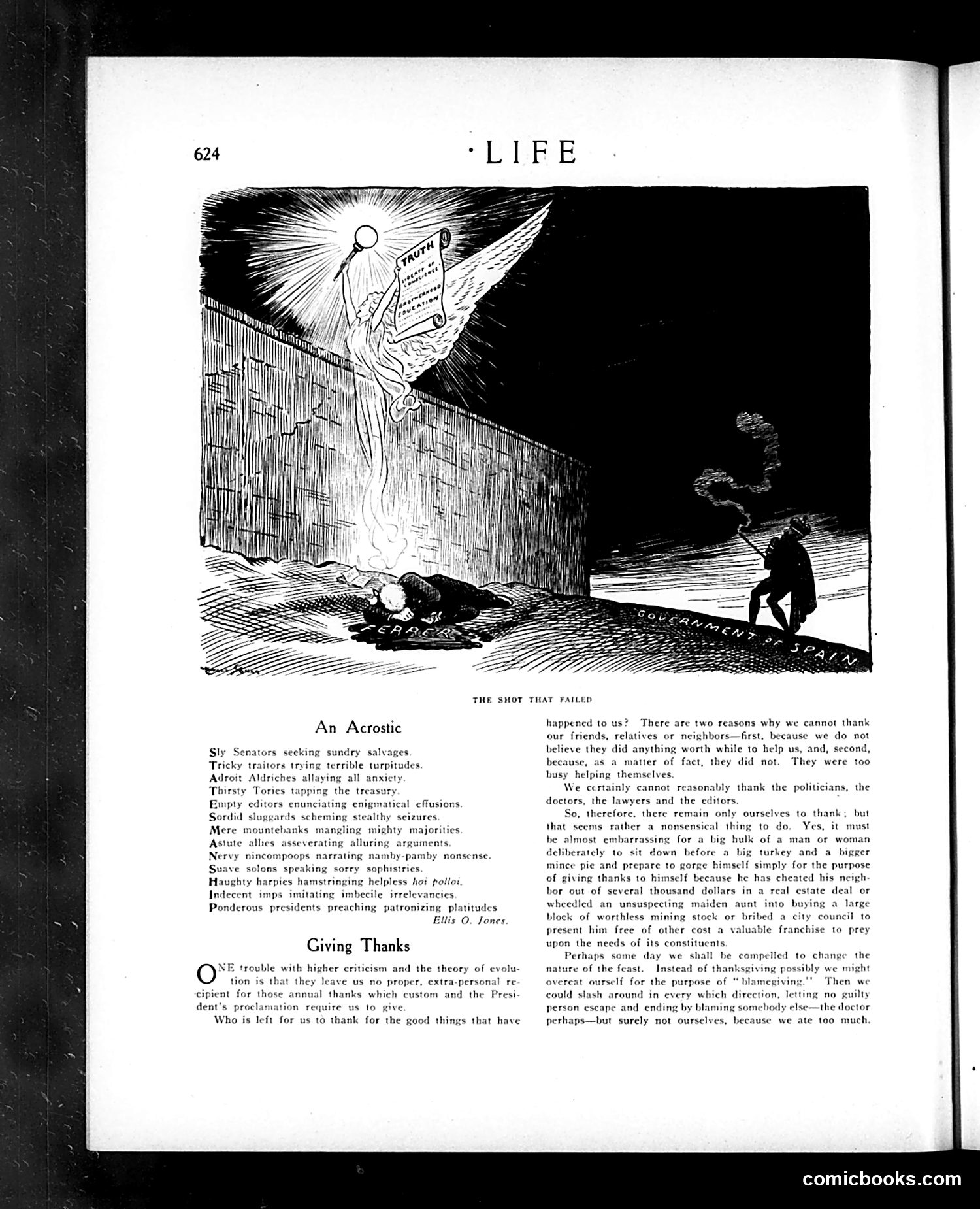
This page contains two satirical pieces from Life magazine attacking American political corruption and hypocrisy. **"The Shot That Failed"** is an acrostic poem (by Ellis O. Jones) that uses alliterative lines to mock corrupt politicians and officials. Each line begins with successive letters, attacking "Senators seeking salvages," "Tricky traitors," and "Aldriches" (likely referring to a specific political figure), among others—portraying them as self-serving, dishonest, and plundering the treasury. **"Giving Thanks"** is a satirical essay attacking the impossibility of sincere thanksgiving. It argues we cannot thank politicians, doctors, or lawyers for genuine help, nor friends and neighbors (they're too self-interested). The only remaining option—thanking ourselves—is absurd and hypocritical, given that success often comes from cheating neighbors, defrauding widows, bribing city councils, and other corrupt schemes. The essay sarcastically suggests replacing Thanksgiving with "blamegiving," where everyone admits their guilt. The accompanying illustration depicts an angel emerging from behind a wall labeled "Government of Spain," with a figure fleeing below—likely referencing Spanish political corruption or a failed Spanish government initiative.
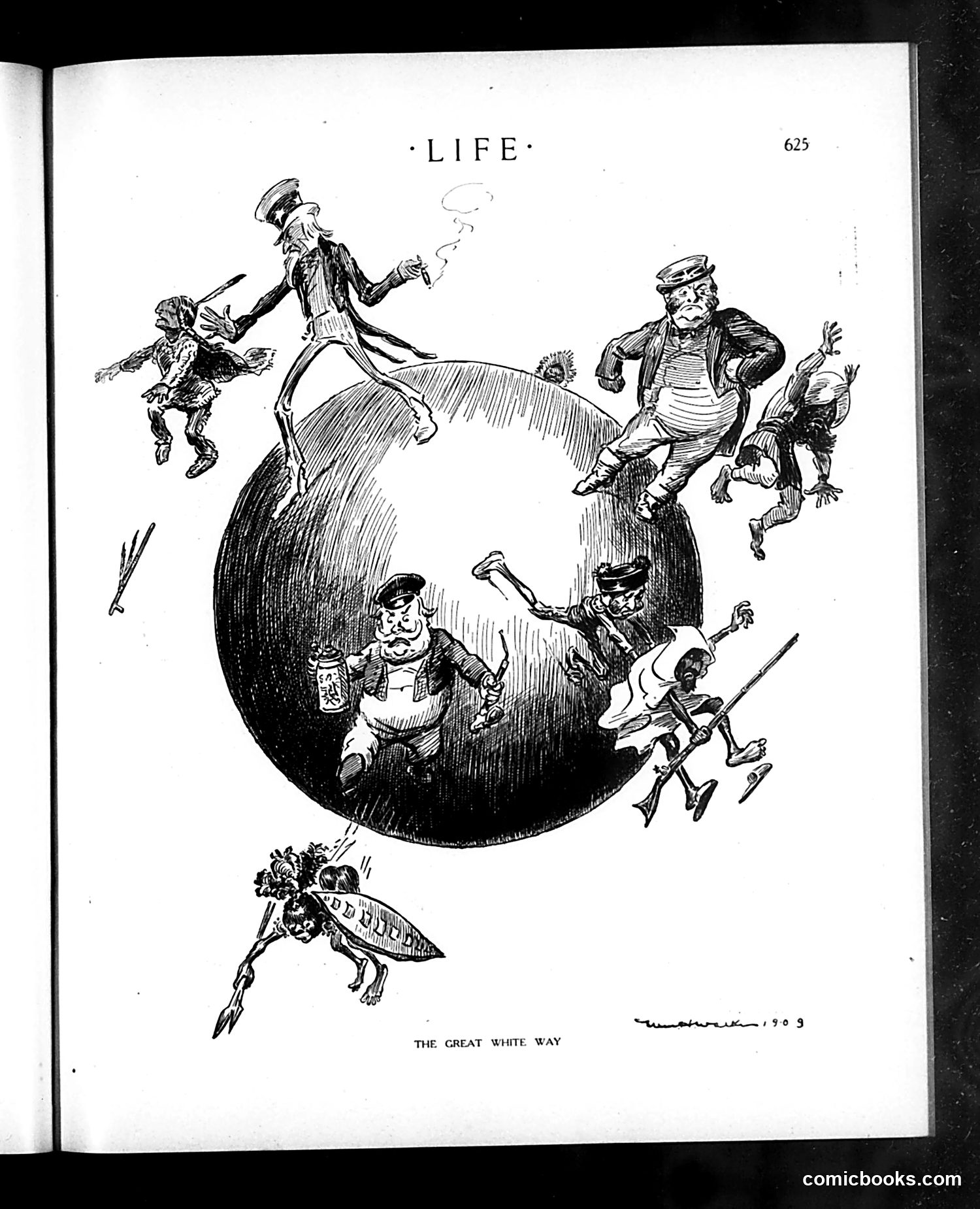
This satirical cartoon depicts "The Great White Way" (Broadway's theater district) as a large egg balanced precariously on a sword tip. Around it dance various caricatured figures in top hats and formal dress—appearing to be theatrical producers, performers, and related personalities. Small demonic or mischievous figures cavort around the unstable egg. The satire suggests Broadway's theatrical world is precarious and absurdly balanced on unstable foundations, with its various players engaged in frivolous antics. The egg likely symbolizes either the theater industry itself or a specific theatrical production. The "great white way" reference to Broadway's bright lights is inverted here into commentary on the industry's fragility and the foolishness of those involved in it. The 1903 date suggests this relates to early 20th-century theater culture.
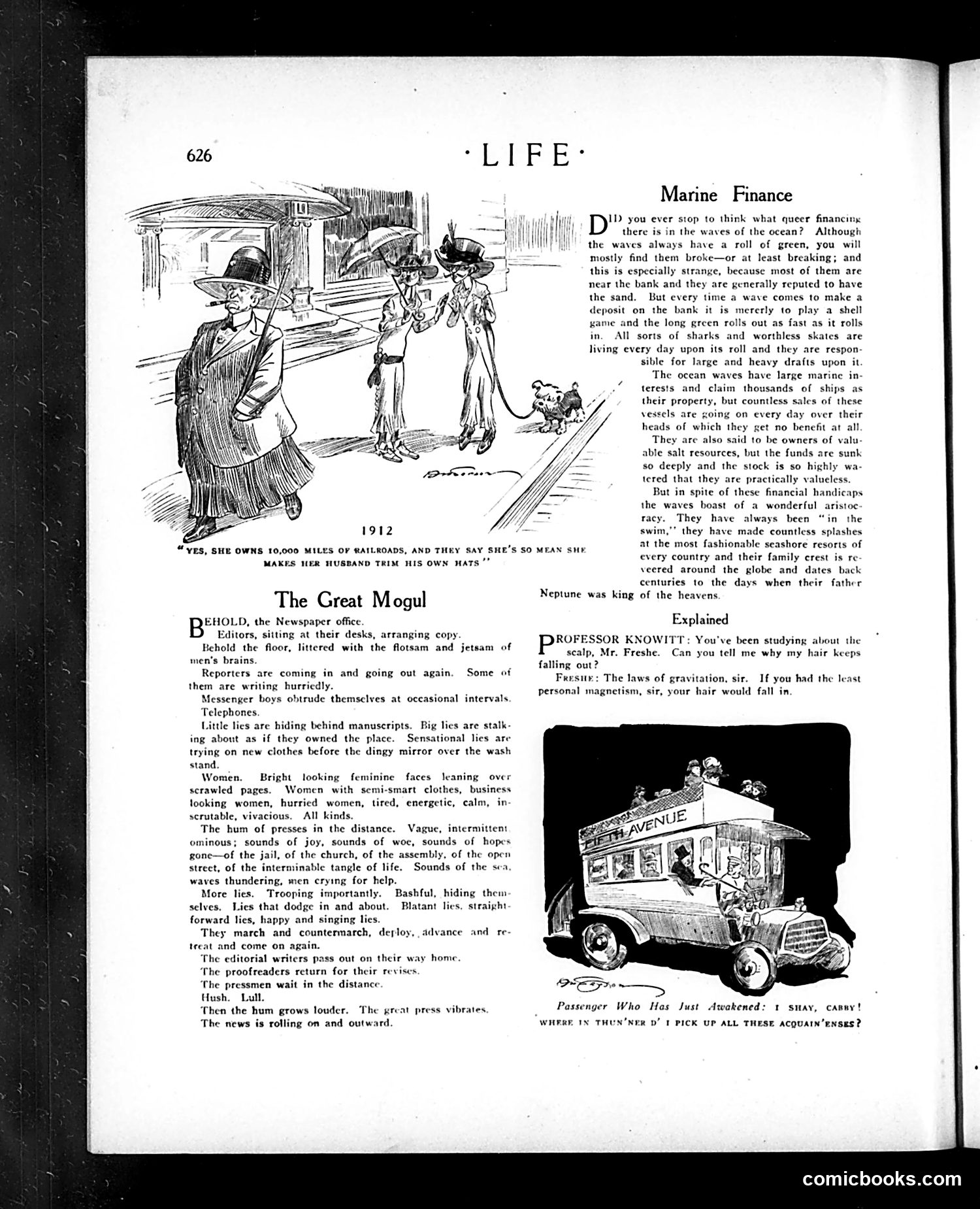
**Top Cartoon:** "Yes, she owns 10,000 miles of railroads, and they say she's so mean she makes her husband trim his own hats." This satirizes wealthy female railroad magnates of the Gilded Age—women who controlled vast industrial fortunes. The joke plays on the contrast between immense wealth and petty domestic frugality, mocking both the woman's miserliness and implying emasculation of her husband. **"The Great Mogul":** A prose-poem satirizing a newspaper office in chaotic operation—editors, reporters, messengers, and "lies" (both literal and metaphorical) proliferating. It mocks sensational journalism and the frenzy of news production, personifying falsehoods as active agents infesting the newsroom. **"Marine Finance":** A humorous analogy comparing ocean waves to financial entities—broke yet constantly "rolling in" money, owned by sharks and worthless speculators. It satirizes murky financial schemes and stock manipulation of the era. **"Explained":** A brief joke about gravity and hair loss, playing on "personal magnetism."
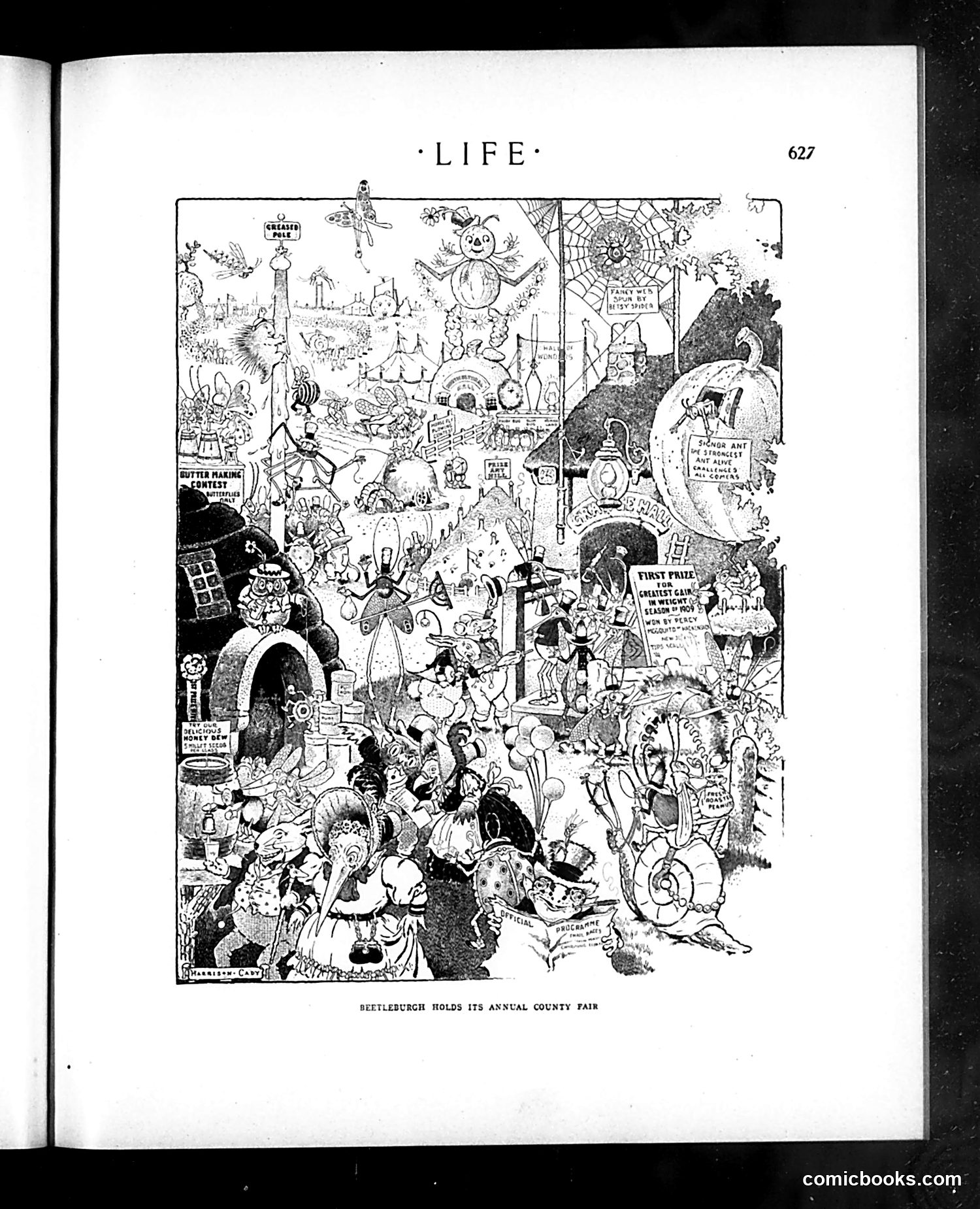
This is a densely packed satirical illustration titled "Beetleburgh Holds Its Annual County Fair." The cartoon depicts a chaotic county fair scene populated by exaggerated caricatures and absurd attractions. The image appears to be social satire mocking small-town American life and rural county fairs. Various signs advertising contests and prizes are visible throughout—referencing typical fair competitions. The crowded composition suggests satirizing the spectacle, commercialism, and entertainment-seeking behavior of fair attendees. The exaggerated character designs and surreal elements (like oversized mechanical devices and bizarre attractions) emphasize the ridiculous nature being lampooned. Without clearer text visibility, specific political targets are unclear, but the overall tone ridicules small-town Americana and the earnest, somewhat provincial culture of county fairs.
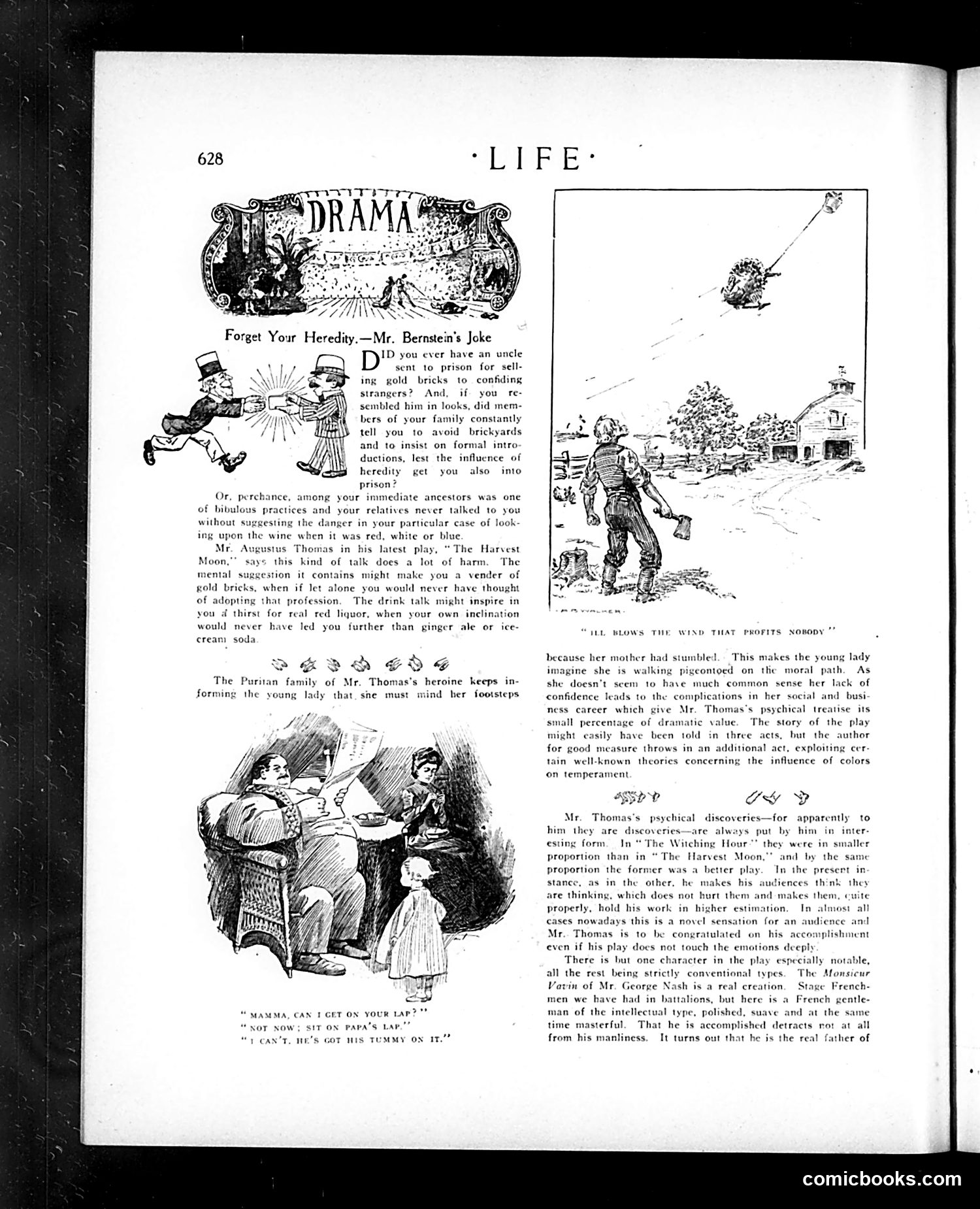
This drama review discusses Augustus Thomas's play "The Harvest Moon." The satire targets the *danger of hereditary suggestion*—the period's anxiety that merely *knowing* about a disreputable ancestor could psychologically destine you toward crime or vice. The review criticizes Thomas's thesis: that simply *telling* someone "your uncle was a con artist" or "your mother drank" might actually *cause* them to become one through mental suggestion. Thomas apparently argues in the play that such talk is harmful despite good intentions. The illustrated domestic scene (lower left, captioned with dialogue about a child's lap) exemplifies family interactions where hereditary warnings occur. The rural landscape scene (right) shows the play's pastoral setting. The review's tone is gently mocking—Thomas's "psychical discoveries" about color's influence on temperament and hereditary suggestion appear presented as pseudo-scientific. The only praised element is George Nash's performance as a sophisticated French gentleman character, offering an atypical, intelligent portrayal against conventional stereotypes.
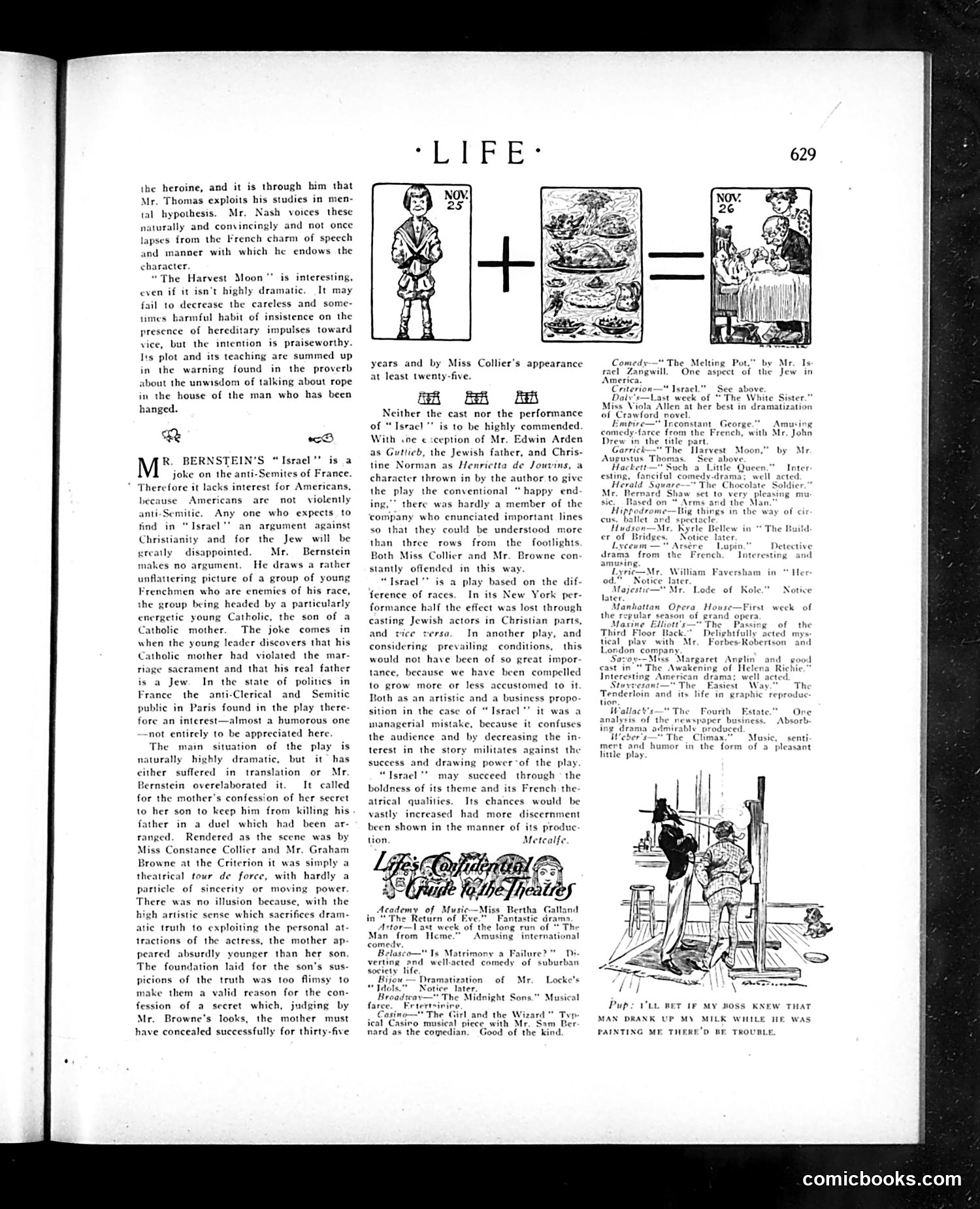
This page reviews Mr. Bernstein's play "Israel," a French satirical work targeting anti-Semitism. The critic explains the play's limited appeal to American audiences: it mocks young French Catholics who are anti-Semitic, with the central irony being that the most virulent anti-Semite discovers his own mother had a Jewish lover, making him half-Jewish. The reviewer notes this resonated in Paris's anti-Clerical political climate but lacks relevance for Americans, "because Americans are not violently anti-Semitic." The critic faults the production's casting—Jewish actors playing Christian roles and vice versa—calling it a "managerial mistake" that confuses the audience and undermines the play's impact. The review also critiques the performance quality and the implausible age difference between mother and son actors. The underlying assumption reflects early 20th-century attitudes about ethnic identity in theater and France's specific political divisions around religion and nationality.
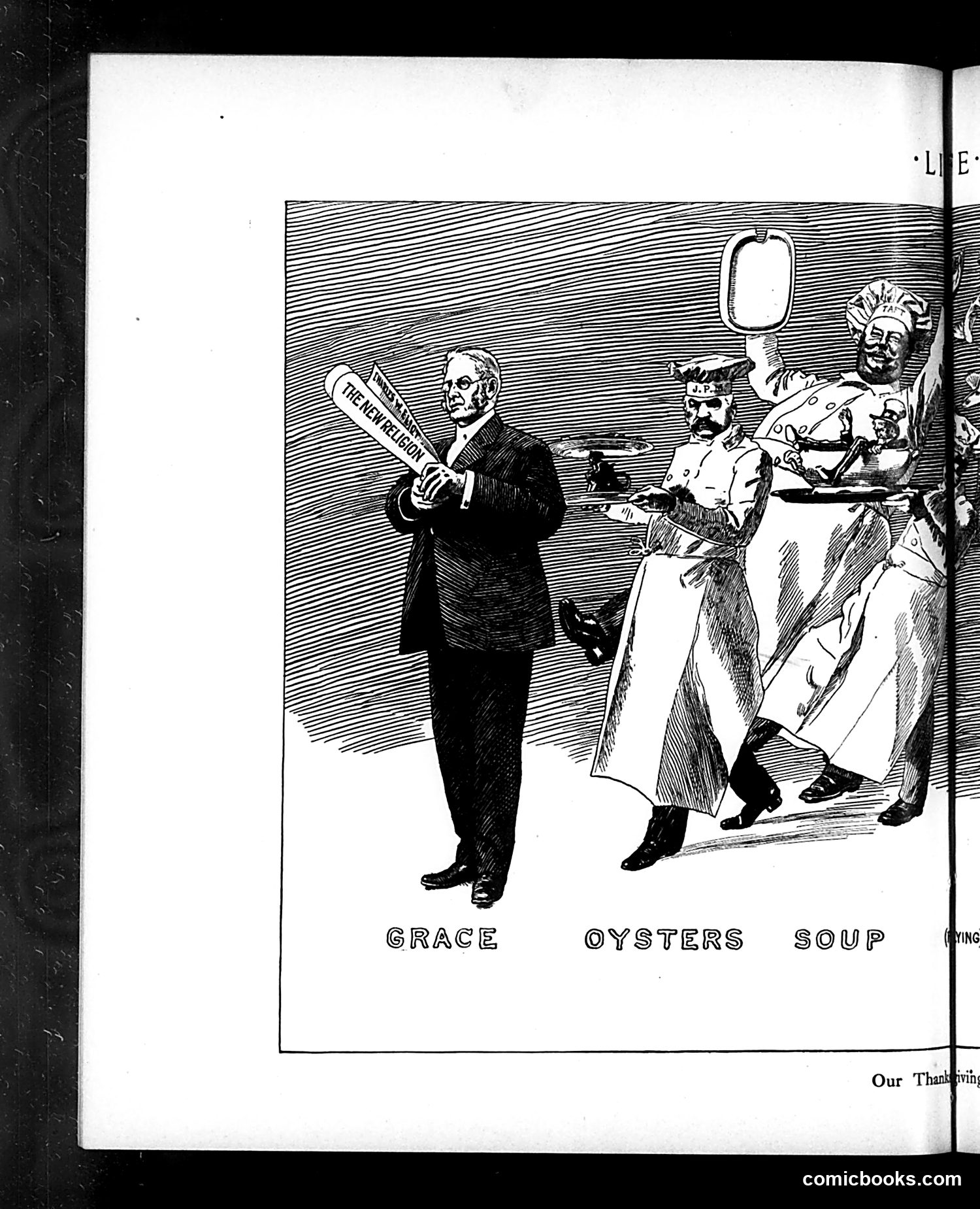
This cartoon depicts a formal dinner scene with a well-dressed man on the left holding what appears to be a newspaper or document labeled "THE INSPECTION" (partially visible). He stands apart from a group of formally-dressed figures on the right who appear to be seated at a dining table, with one holding up a mirror or reflective object. The title "Grace Oysters Soup" likely plays on the word "grace"—both a prayer before meals and a reference to inspection or official scrutiny. The cartoon appears to satirize either food safety inspection procedures or dining etiquette standards of the era, suggesting that formal inspection precedes or accompanies consumption. The specific political or social context remains unclear without additional historical information about contemporary food safety debates or dining-related controversies in Life magazine's publication period.
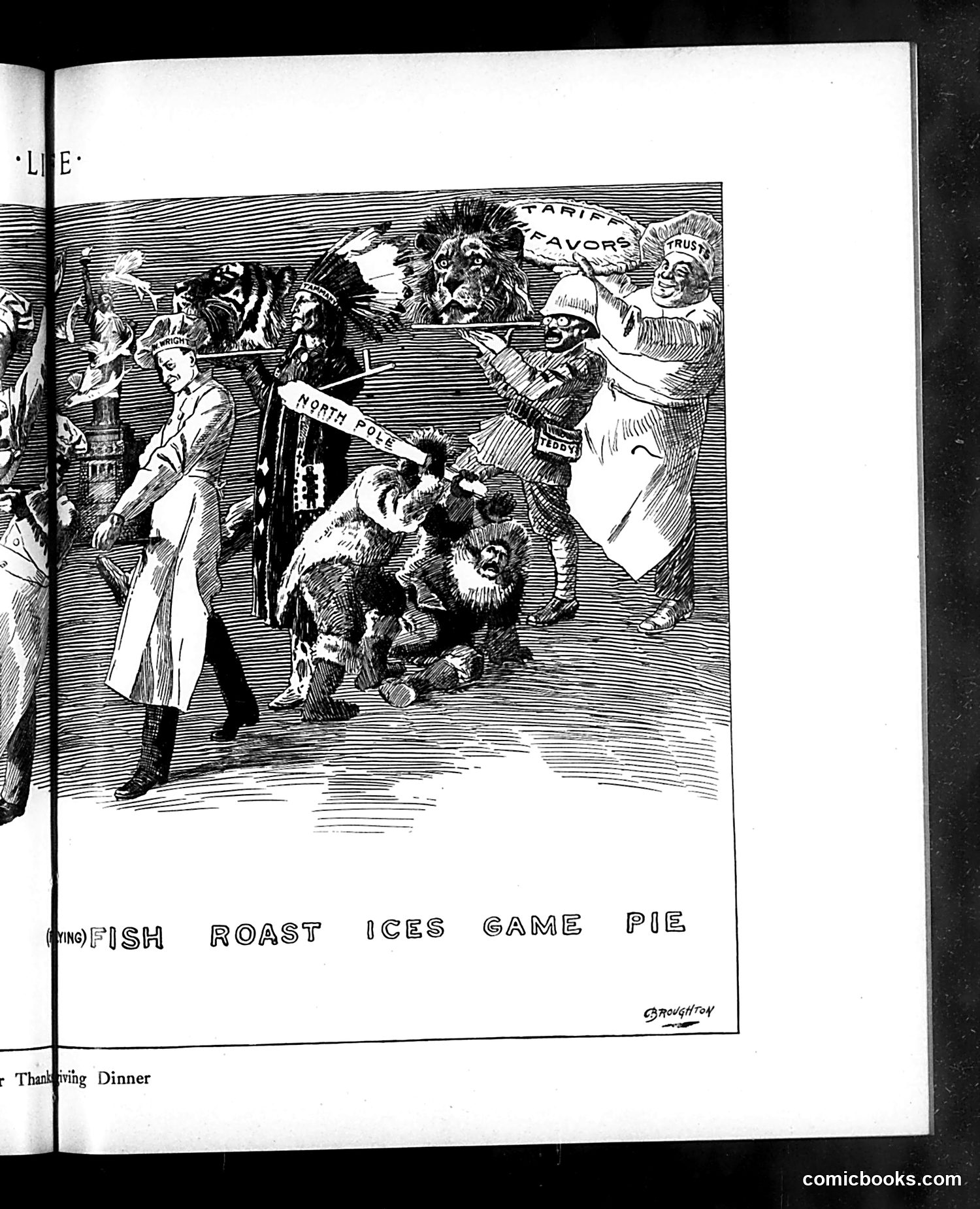
This engraved illustration depicts a holiday feast menu featuring exotic animals labeled "TARIFF FAVORS," "NORTH POLE," and "TRUST." A well-dressed man (likely a politician or industrialist) presides over the scene while various animal figures—appearing to represent different economic interests or political factions—gather around a table laden with dishes labeled "FISH ROAST ICES GAME PIE." The cartoon satirizes how political elites serve themselves by distributing economic benefits ("tariff favors," polar exploration opportunities, trust monopolies) like choice dinner courses to their preferred constituencies. The animals suggest these groups are treated as mere creatures at a feast controlled by powerful interests, mocking how Thanksgiving prosperity is unevenly distributed based on political connections rather than democratic fairness.
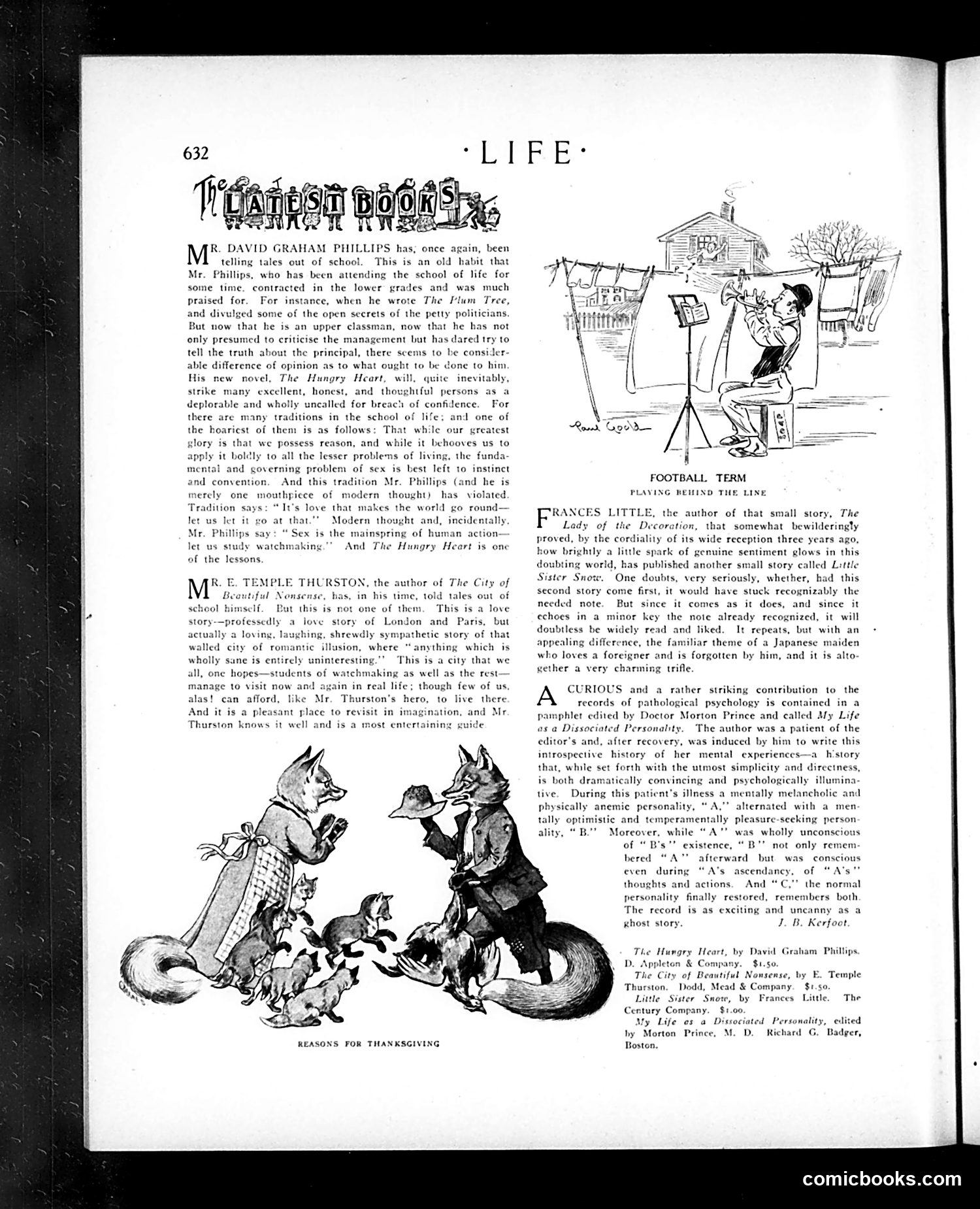
This page critiques **David Graham Phillips**, a muckraking novelist whose work *The Hungry Heart* violated social conventions by frankly addressing sexuality and human motivation. The satire's central point: Phillips dares to treat sex as a serious subject worthy of rational examination rather than leaving it to "instinct and convention"—the traditional approach Life sarcastically calls the "school of life." The text mocks both Phillips's critics and outdated moralism. When tradition says "it's love that makes the world go round," Phillips counters that sex is "the mainspring of human action"—modern thought challenging Victorian propriety. The page also reviews other literary works, including Frances Little's *Little Sister Snow* (repeating her successful Japanese romance theme) and a psychological case study about dissociated personality. The illustration labeled "Reasons for Thanksgiving" depicts anthropomorphic foxes in human clothing—likely satirizing deceptive social pretense, though the specific reference remains unclear.
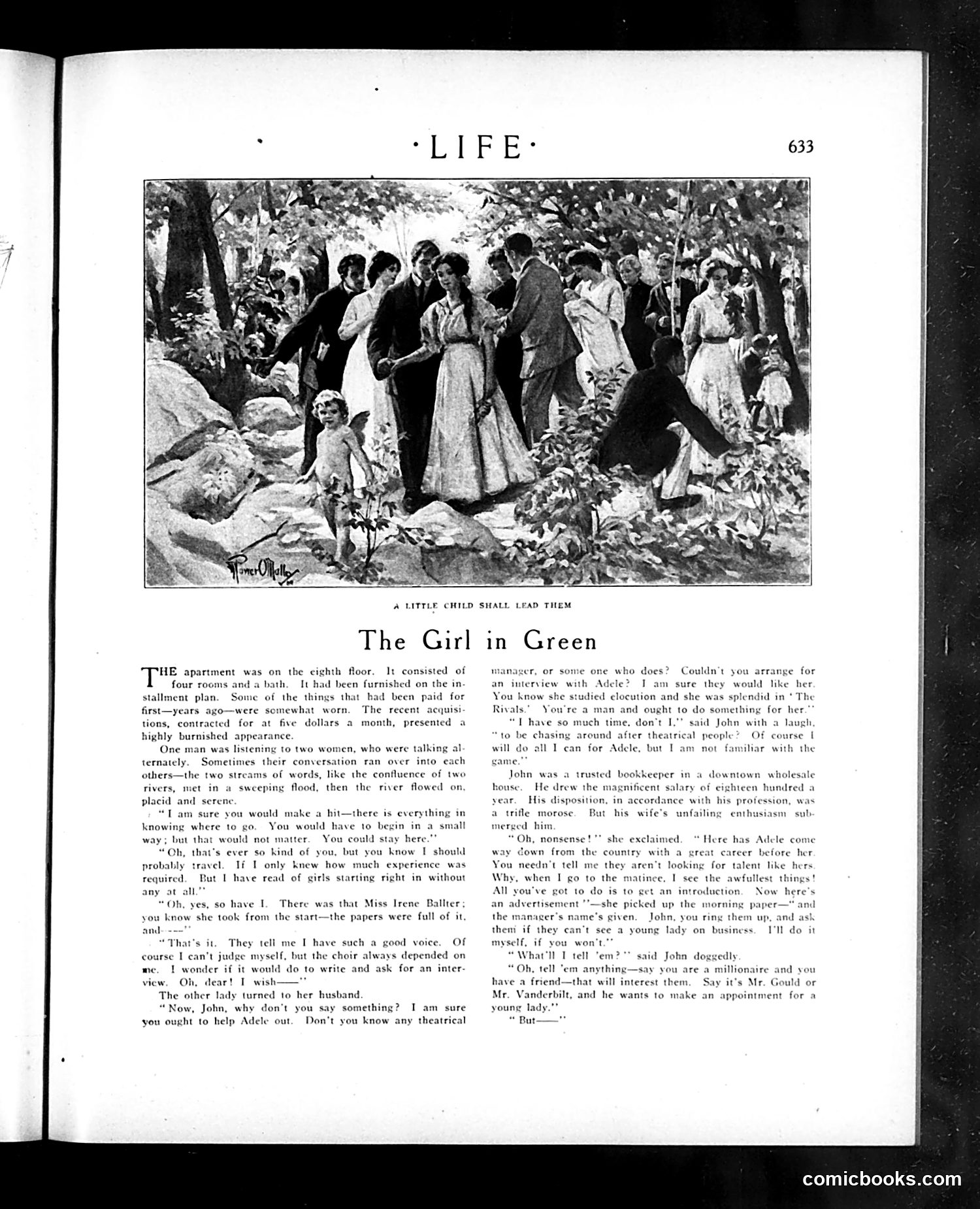
This is a prose fiction piece (not a cartoon), depicting social satire about theatrical ambition and class dynamics in early 20th-century America. The story satirizes the naïve dreams of a country girl named Adele who comes to the city seeking a theatrical career, armed only with elocution training and a good church choir voice. The humor targets both her unrealistic expectations and the well-meaning but ineffectual help of her friend's husband, John—a modest bookkeeper earning $1,800 yearly. The satire cuts multiple ways: it mocks Adele's assumption that talent alone guarantees success; ridicules the wife's breathless name-dropping (Vanderbilt, Gould) and her pressure on John to use nonexistent theatrical connections; and gently portrays John's resigned acceptance that he must now fabricate credentials to help. The title—"A Little Child Shall Lead Them"—suggests ironic innocence leading practical adults astray.
This page contains a serialized story (not a political cartoon) about theatrical ambition and deception in early 20th-century America. **The Plot:** Mrs. Murkle brings her friend Adele to a theater office, claiming to represent "Mr. Vanderbilt" who wants Adele on stage. Theater impresario Kogel interviews them but quickly recognizes the ruse—Adele is a small-town amateur ("Led the choir in Utica, or Rome, or Syracuse") with no real talent. Kogel instead identifies Mrs. Murkle herself as having potential, flattering her adaptability and stage presence while dismissing her friend as hopeless. **The Satire:** The piece mocks small-town theatrical aspirations and the phoniness of social pretense (name-dropping Vanderbilt to gain credibility). It also satirizes talent scouts' ability to spot genuine potential beneath conventional appearances—Kogel's shrewdness contrasts with the ladies' naive optimism. The story represents Life magazine's typical satirical treatment of American social climbing and theatrical ambition during the vaudeville era.
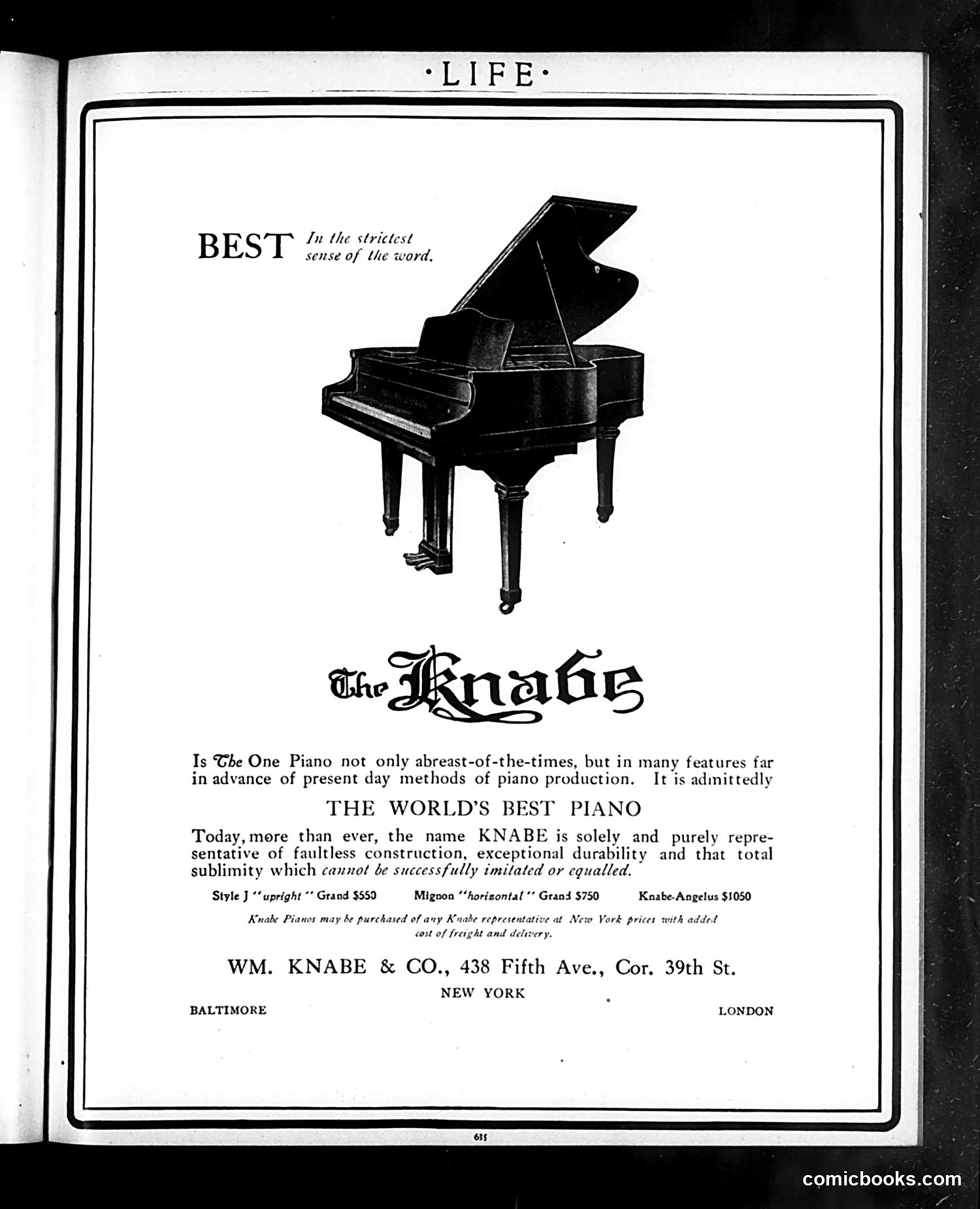
This is a **full-page advertisement**, not political satire or editorial cartooning. It appears in *Life* magazine promoting Knabe pianos as "the world's best piano." The image shows a grand piano rendered in black silhouette—a straightforward product illustration with no caricature or satirical intent. The text emphasizes quality and prestige, claiming the Knabe brand represents "faultless construction, exceptional durability and that total sublimity which cannot be successfully imitated or equalled." The ad lists three models with prices ranging from $550-$1050 and notes pianos can be purchased from Knabe representatives in New York with freight costs added. The company's address is given as 438 Fifth Avenue, New York, with offices in Baltimore and London. This represents typical early 20th-century luxury goods advertising—no hidden political meaning or social commentary present.
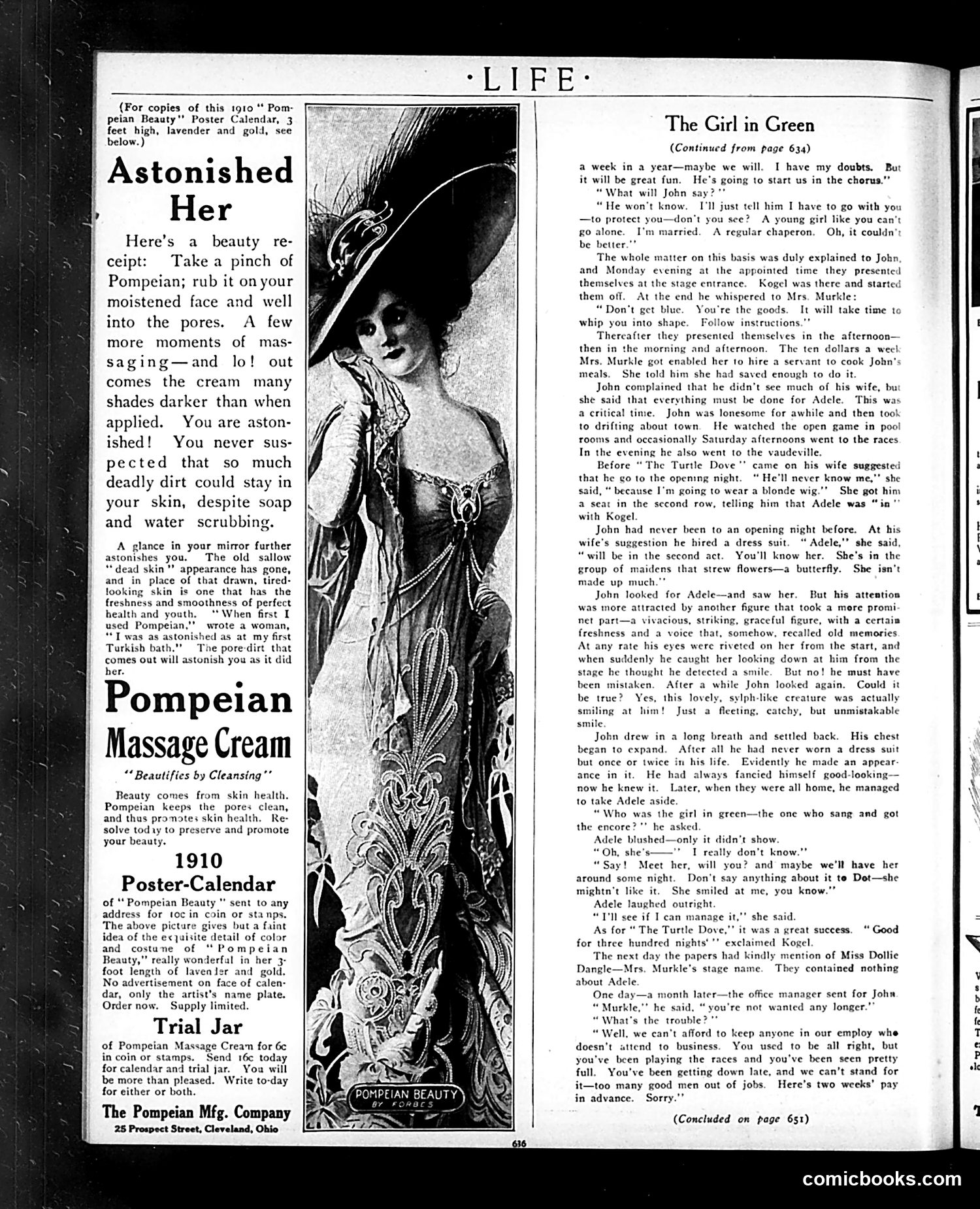
This page contains a **beauty product advertisement** (Pompeian Massage Cream) and the **continuation of a serialized short story** titled "The Girl in Green." **The Advertisement:** The left side promotes Pompeian Massage Cream, a cold cream promising to remove dirt and dead skin through massage, revealing fresher, younger-looking skin beneath. The accompanying illustration shows a glamorous woman in period dress. The ad emphasizes the "astonishment" of seeing visible dirt removed—appealing to early 1900s concerns about cleanliness and beauty. **The Story:** The right side continues a narrative about a woman named Adele who joins a theatrical chorus without her husband John's knowledge, claiming she needs a chaperone. John attends opening night and notices both Adele and another striking performer. The story explores themes of marital deception and theatrical ambition typical of early-20th-century serialized fiction in magazines like *Life*. The page reflects *Life* magazine's format: mixing advertisements with entertainment content to appeal to middle-class readers interested in beauty, theater, and domestic drama.
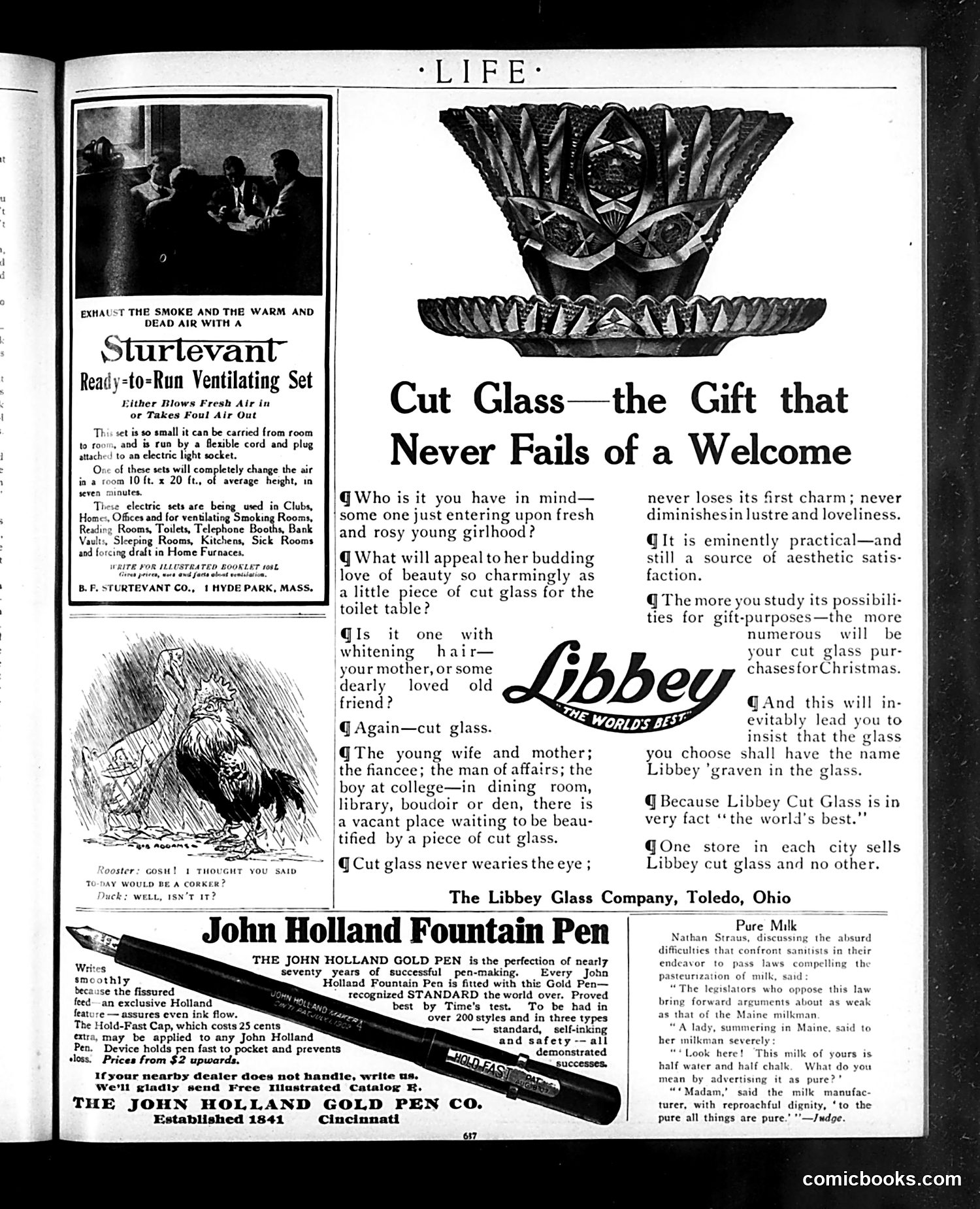
This is primarily an **advertising page** with minimal editorial content. The main elements are: **The Cartoon:** A small two-panel joke at bottom-left shows two men ("Rooster" and "Duck") discussing whether today will be a "corker" (excellent day). The punchline's humor is unclear without more context, though it appears to play on expectations versus reality. **Primary Advertisements:** - **Libbey Cut Glass**: The dominant ad promotes cut glass as an ideal gift for any occasion (young women, mothers, professionals), emphasizing it "never fails of a welcome" and maintains its aesthetic appeal. The branding emphasis on "Libbey" being "the world's best" reflects early 20th-century marketing strategy. - **John Holland Fountain Pen** and **Sturtevant Ventilating Set**: Standard product advertisements. **Editorial Content:** A brief piece on **milk purity** quotes Nathan Straus discussing pasteurization laws, with a humorous anecdote about a Maine milkman defending adulterated milk using philosophical wordplay ("to the pure all things are pure"). The page reflects commercial advertising priorities typical of *Life* magazine's era, with minimal satirical editorial content visible.
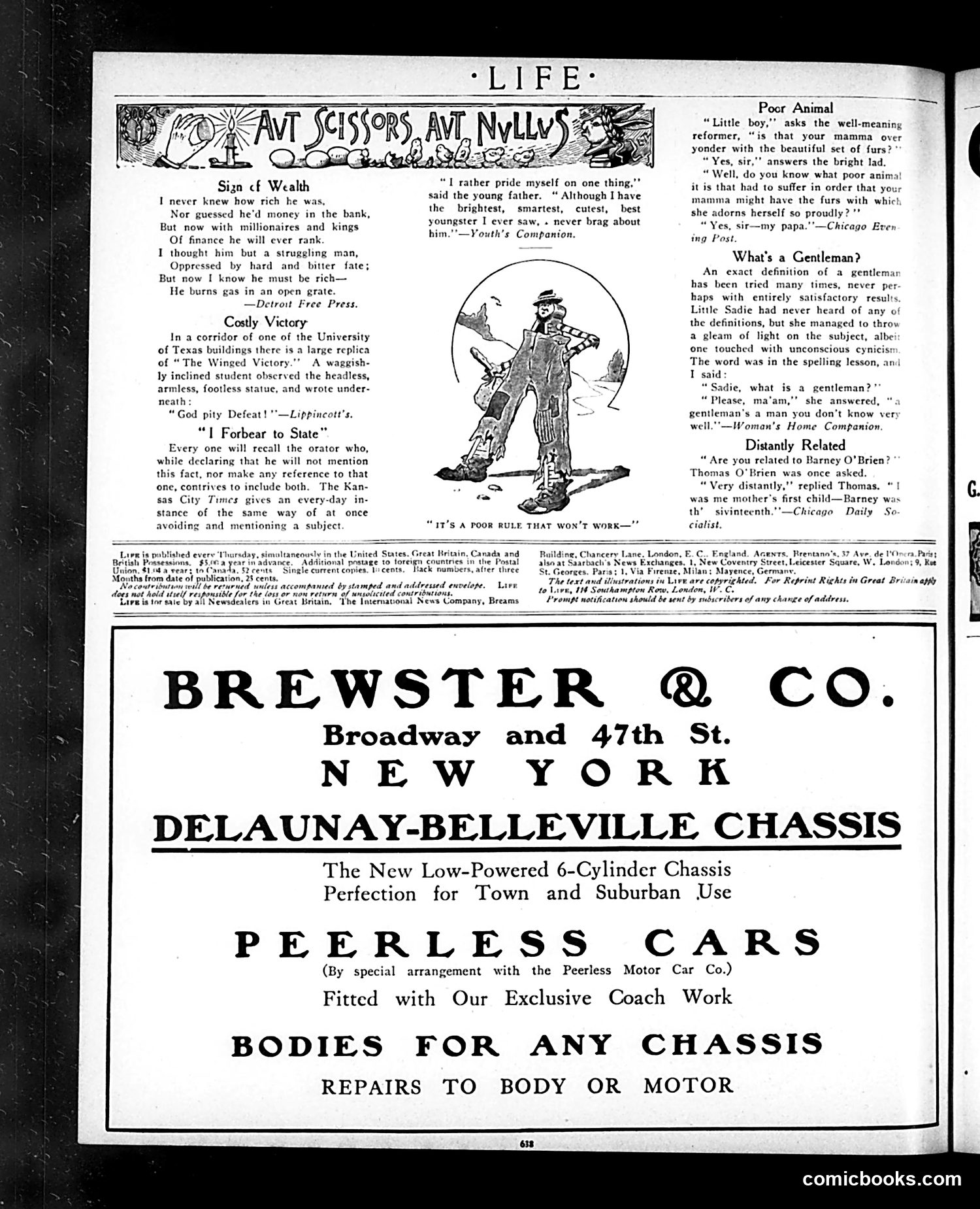
This page from *Life* magazine contains several brief humorous anecdotes rather than political cartoons. The jokes target middle-class social pretensions and hypocrisy: **"Sign of Wealth"** mocks newly wealthy people's conspicuous consumption—burning gas in an open fireplace signals sudden riches rather than actual financial security. **"Costly Victory"** references the University of Texas's replica of the classical "Winged Victory" statue; a student's sardonic caption suggests defeat is preferable to such a hollow, mutilated "victory." **"Poor Animal"** satirizes moral reformers who lecture children about animal suffering from fur coats, while the child innocently reveals the real "poor animal" is the father who must work to afford them. **"What's a Gentleman?"** and **"Distantly Related"** use children's innocent definitions to expose adult pretension and class consciousness. The large advertisement below promotes Brewster & Co.'s luxury automobile chassis and bodies. The juxtaposition of satirical content above with upscale advertising below is typical of *Life*'s targeting of affluent, educated readers.
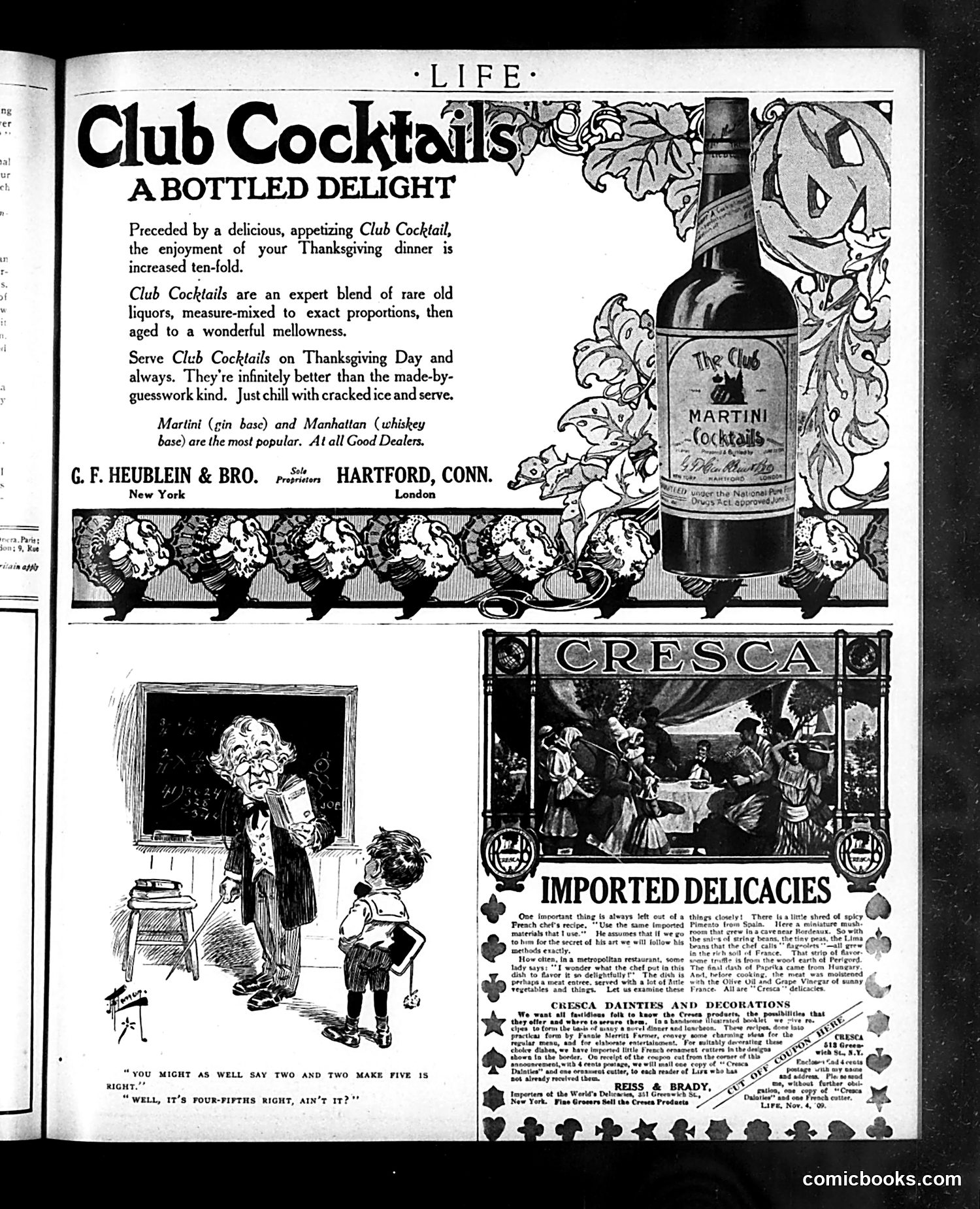
This is primarily **advertising**, not political satire. The top two-thirds feature Club Cocktails and Cresca imported foods advertisements from the Prohibition era (pre-1933, given the liquor promotion). The small cartoon at bottom-left is a **arithmetic joke** unrelated to politics: a child and adult debate whether "two and two make five," with the adult insisting it's "four-fifths right"—a nonsensical statement playing on imprecise language and faulty logic. The humor is simply absurdist wordplay about bad math reasoning. **Context for modern readers**: This page reflects early 20th-century Life magazine's mix of humor, advertising, and satirical content. The cocktail ad is notable as pre-Prohibition marketing (or Prohibition-era nostalgia, depending on dating). The child-adult dialogue represents common vintage humor tropes about innocent misunderstandings, not social commentary.
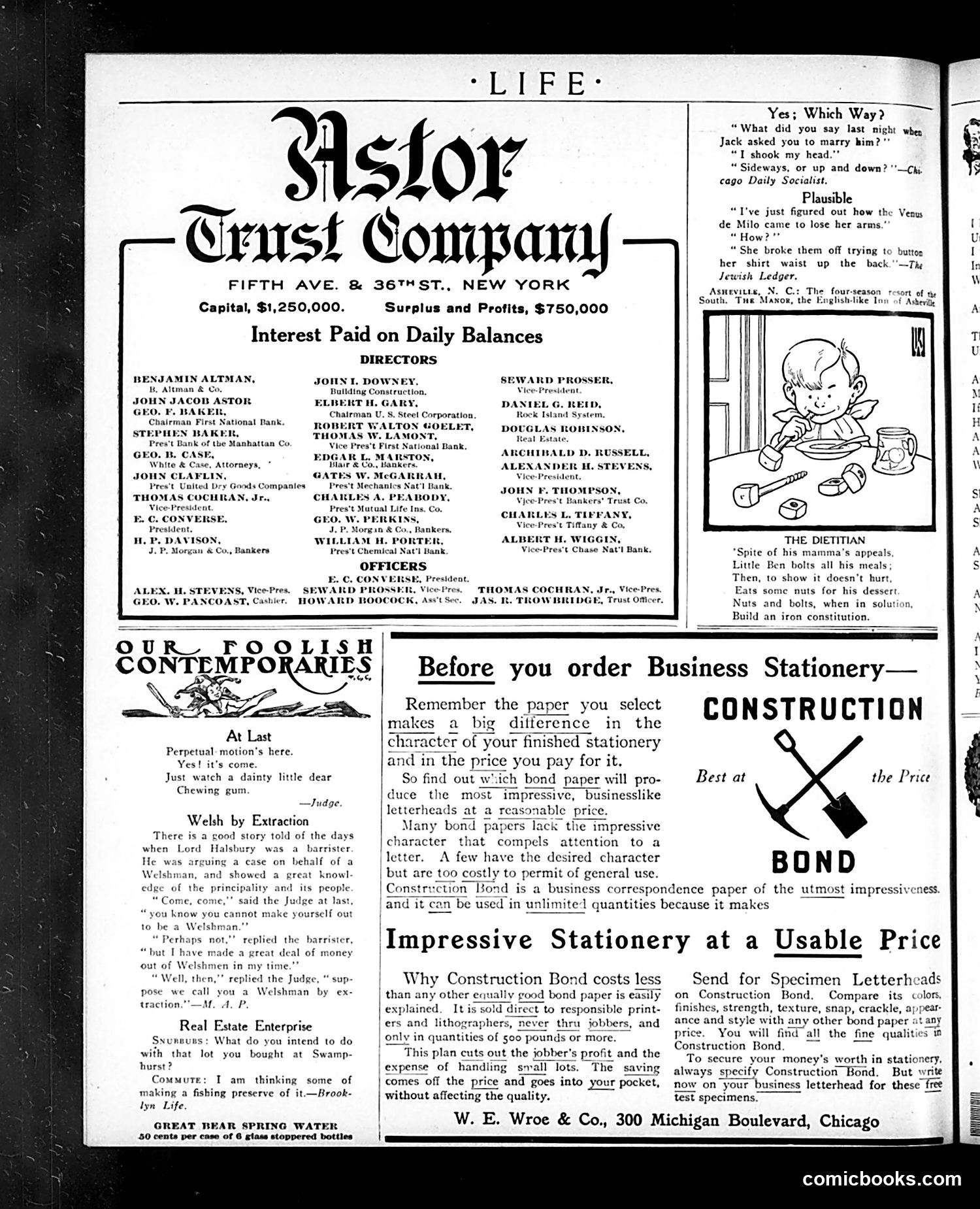
This page is primarily **advertisements and corporate notices** rather than political satire. The top half features the Astor Trust Company masthead with directors' names and several brief humor items. The small cartoons/jokes include: - **"Yes; Which Way?"**: A domestic humor piece about a woman's ambiguous head-shake response to a marriage proposal—unclear whether she nodded yes or shook no. - **"Welsh by Extraction"**: A legal anecdote about a barrister who made money from Welsh clients, playing on the double meaning of "extraction." - **"The Dietitian"**: A cartoon about a child named Ben who bolts his meals despite his mother's protests, then eats "nuts and bolts" to prove it doesn't hurt him—a pun on digestive fortitude. These are lightweight, apolitical humor pieces typical of Life's lighter content. The page is dominated by business advertisements for stationery and banking services, reflecting the magazine's mixed editorial-advertising format.
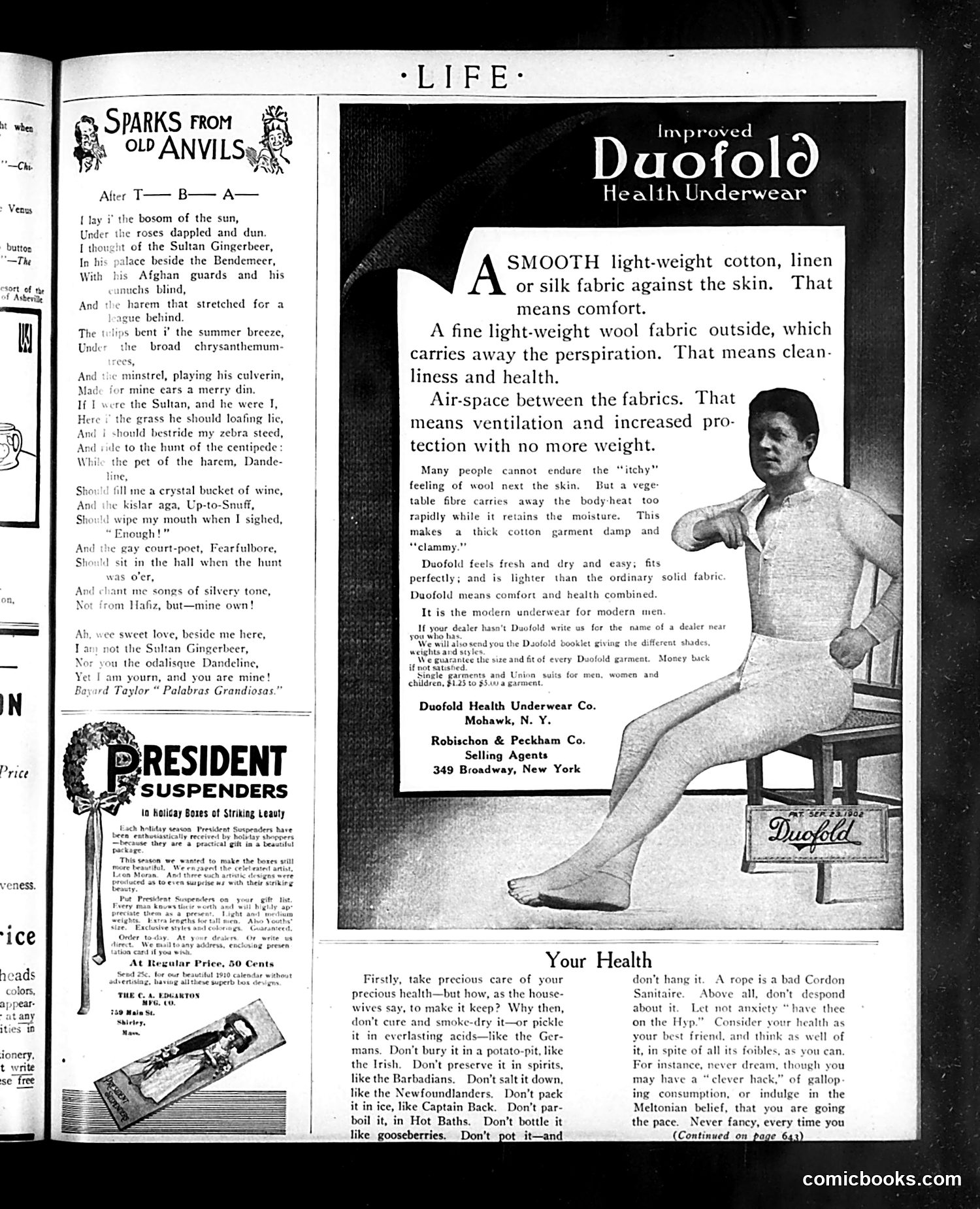
This page contains **three distinct elements**: **"Sparks from Old Anvils"** (left): A romantic poem by Bayard Taylor titled "Palabras Grandiosas," imagining trading places with an Oriental sultan. It's sentimental verse typical of 19th-century literature—no satire apparent. **"President Suspenders"** (lower left): A straightforward product advertisement emphasizing durability as a holiday gift, with no satirical content. **"Duofold Health Underwear"** (right): A product advertisement for innovative two-layer underwear combining cotton/silk (inner) with wool (outer) to provide comfort while wicking moisture—marketed as modern scientific clothing for health-conscious men. **"Your Health"** (bottom right): Humorous advice column satirizing old-fashioned health preservation methods (pickling, burying, salting, bottling—as if the body were food), contrasting them with modern sensible health practices. This appears to be primarily an **advertising page** rather than political satire. The humor is mild and product-focused rather than pointed social commentary.
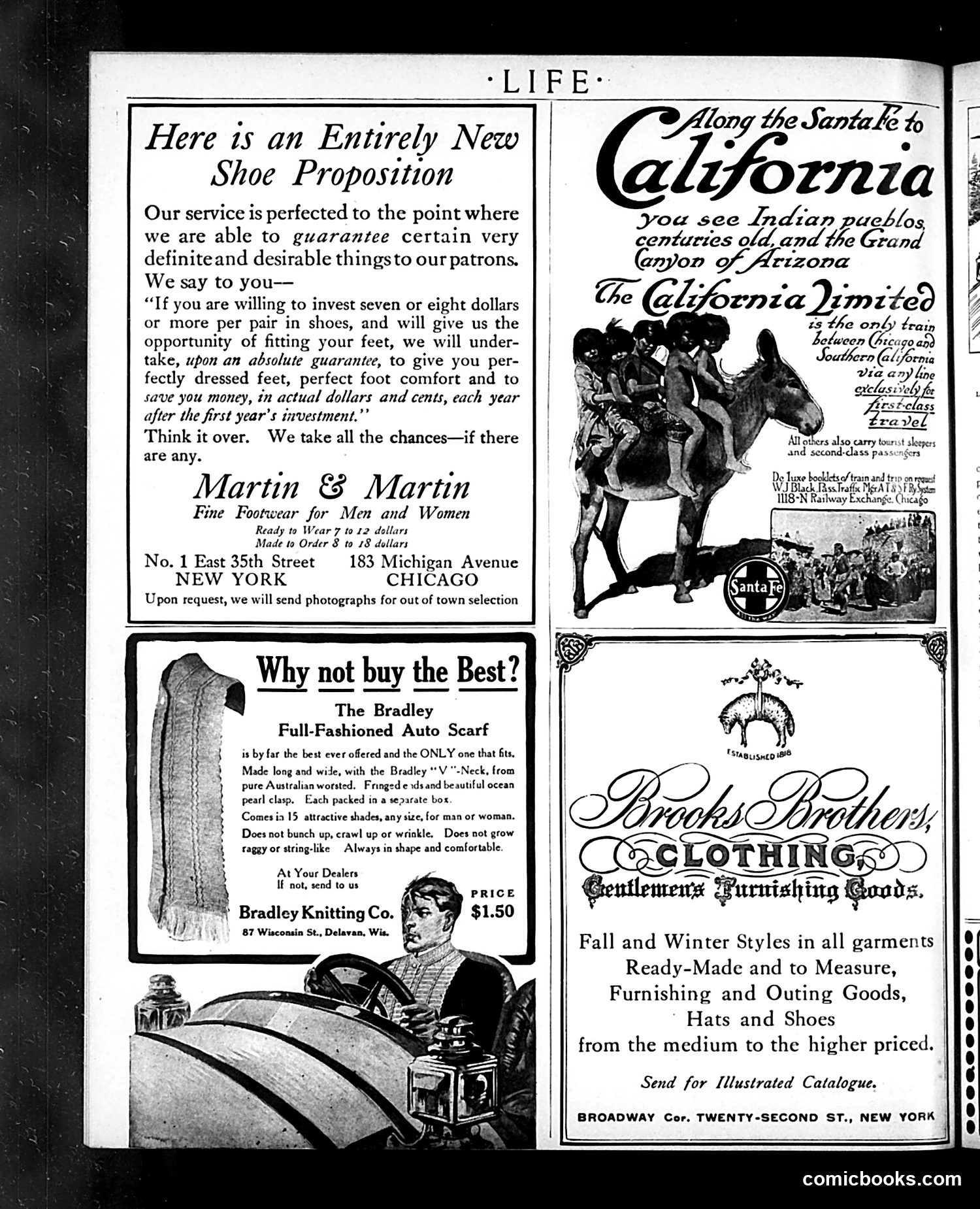
This is primarily a **commercial advertising page** with no political cartoons or satire. The page contains four advertisements from the early 20th century: 1. **Martin & Martin shoes** (New York/Chicago): Promises perfectly fitted feet and long-term savings with an unusual guarantee—customers invest $7-8+ initially but recoup costs annually through durability. 2. **Bradley auto scarf** (Wisconsin): Markets a specialized driving accessory in wool, positioned as superior because it won't bunch or wrinkle while driving. 3. **California Limited train** (Santa Fe Railway): Promotes luxury rail travel to Arizona and California, emphasizing scenic Indian pueblos and the Grand Canyon. 4. **Brooks Brothers clothing** (New York): Standard department store advertisement for ready-made and custom garments. The ads reflect consumer culture of the era—emphasizing quality, guarantees, and leisurely travel. No satire or political content is evident; this appears to be standard Life magazine revenue.
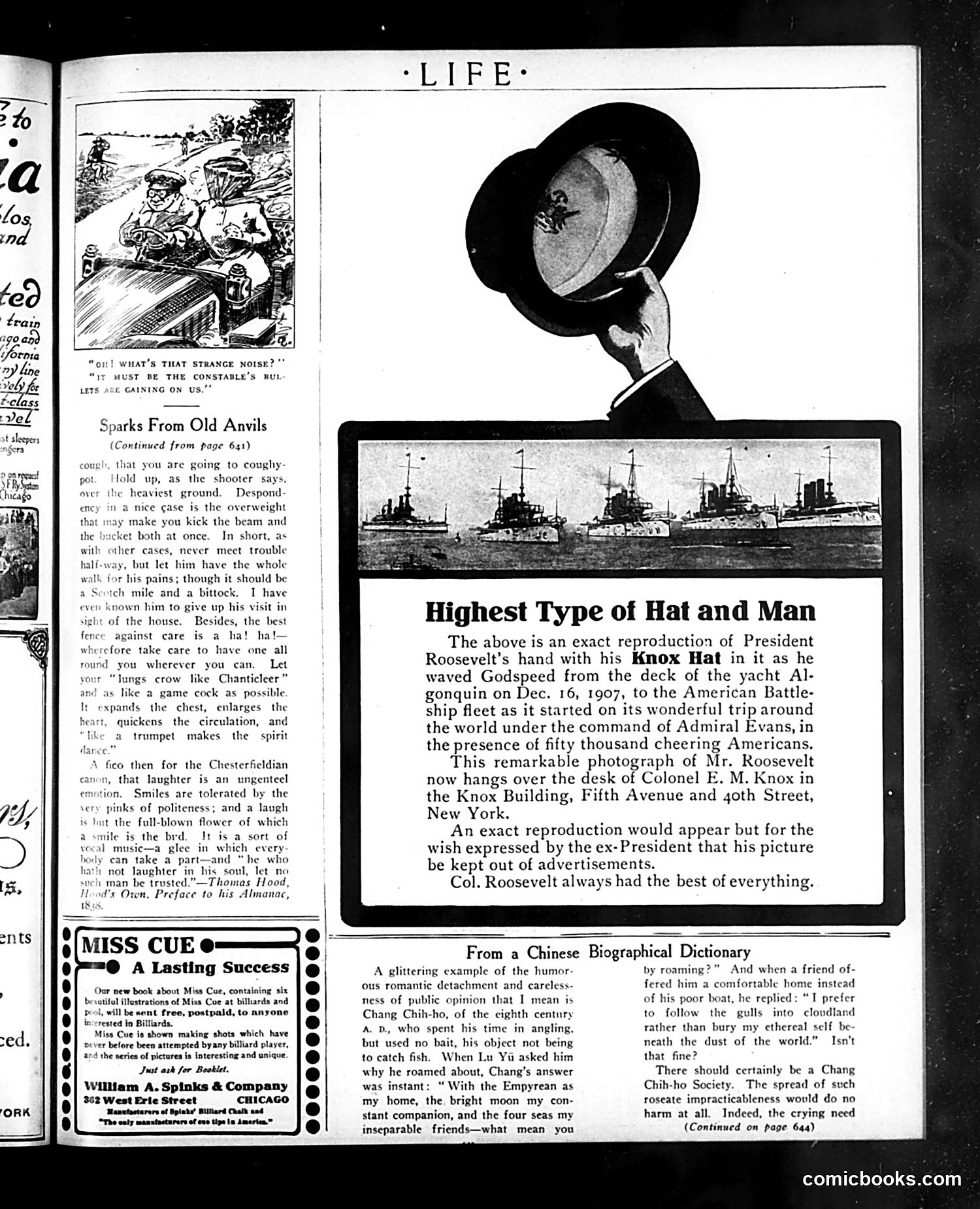
This page from *Life* magazine (circa 1907-1908) contains several distinct sections: **Top Left Comic**: A brief sketch satirizing noisy automobiles, showing two men in a speeding car alarming a constable—commentary on the newfangled technology's disruption of public peace. **Main Feature**: A photograph of President Theodore Roosevelt's hand holding a Knox Hat, taken as he waved goodbye to the American battleship fleet in December 1907. The caption celebrates Roosevelt's taste ("always had the best of everything") while noting the ex-President requested his image not appear in advertisements—a humorous acknowledgment of the advertisement's contradiction. **"Sparks from Old Anvils"**: Humorous life advice about maintaining optimism and avoiding despondency, with literary quotes praising laughter. **Advertisement**: William A. Spinks & Company promoting their "Miss Cue" billiards instruction book. **"Chinese Biographical Dictionary"**: An essay celebrating the philosophical detachment of an 8th-century Chinese angler, promoting carefree romanticism over material comfort. The page reflects *Life*'s characteristic blend of satire, celebrity culture, self-promotion, and genteel philosophizing aimed at educated readers.
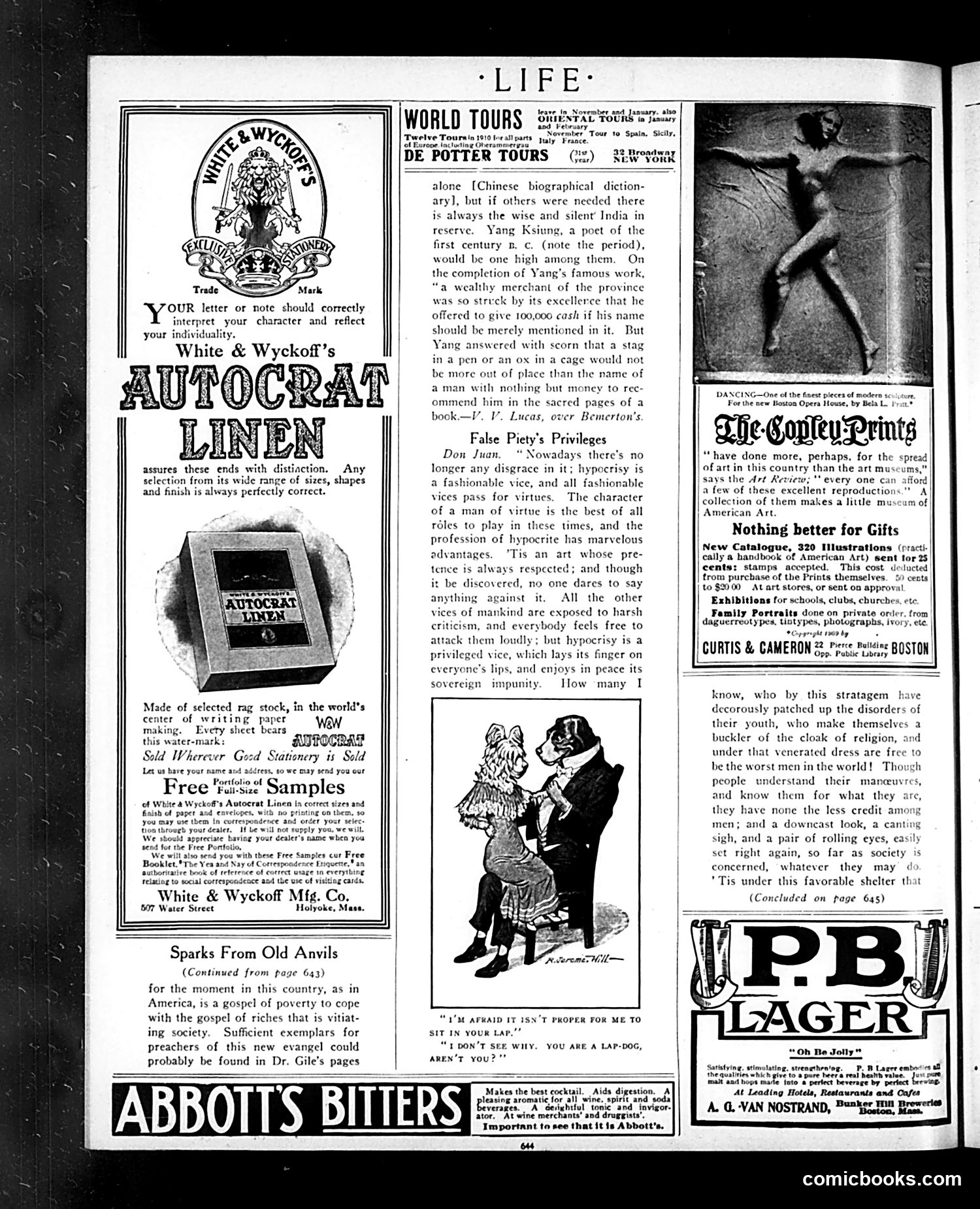
This page is primarily **advertising and literary content**, not political cartooning. The main visual element is a small cartoon showing a man and woman, with dialogue about a "lap-dog"—a mild social satire on propriety and euphemism. The substantive text includes excerpts from literary works: a passage on Chinese philosophy (Yang Ksiung's refusal of monetary reward for his writings) and a longer extract attributed to "Don Juan" criticizing hypocrisy as a socially-accepted vice. This latter piece argues that unlike other moral failings, hypocrisy enjoys "sovereign impunity" because people fear attacking it publicly. The page is dominated by **advertisements** for White & Wyckoff's stationery, Abbott's Bitters, P.B. Lager beer, and art print services—typical of Life's era as a magazine supported by luxury-goods advertising. **Context for modern readers**: This reflects early 20th-century *Life's* literary and satirical mission, mixing classical references with gentle social criticism about manners and morality.
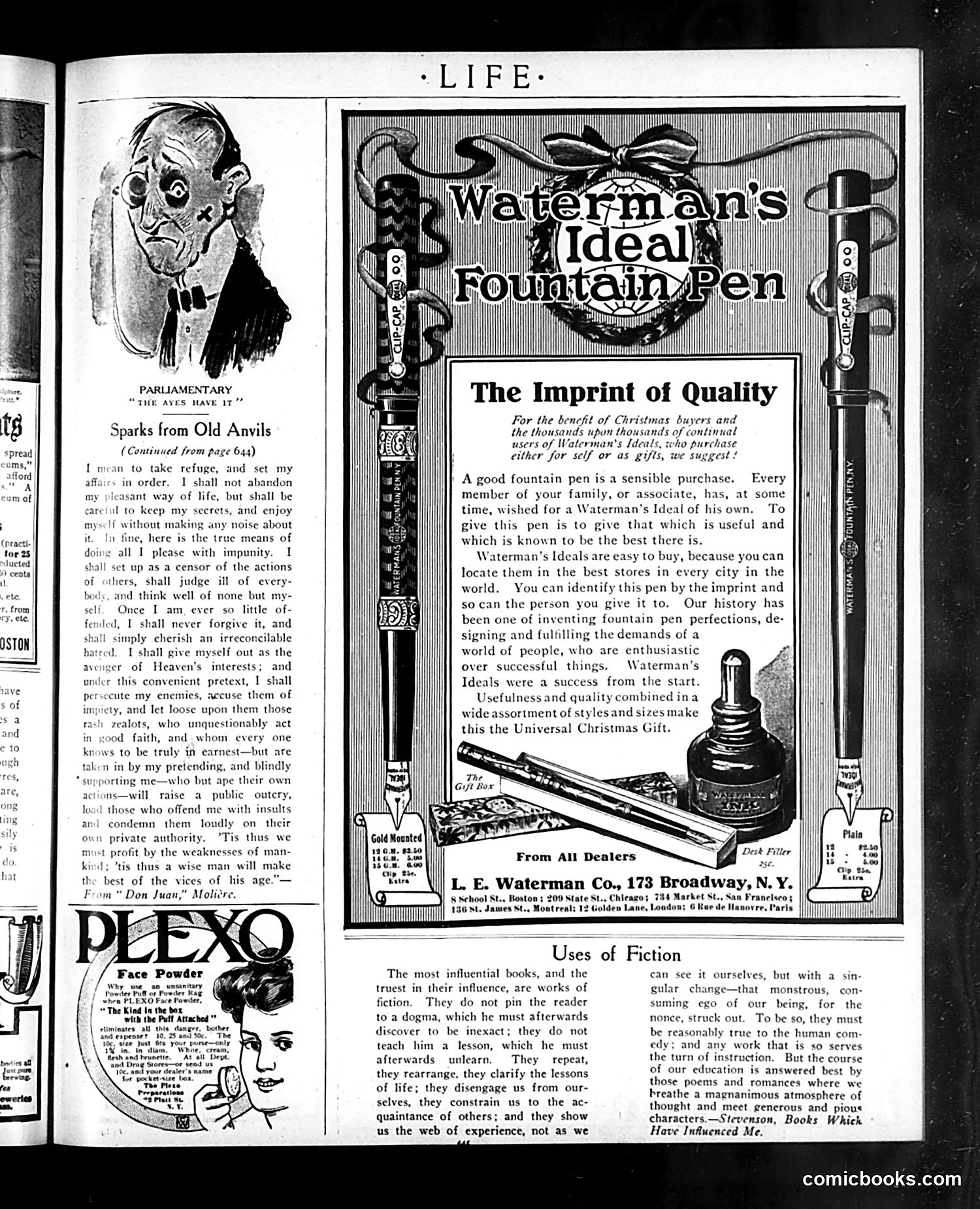
This page contains a political cartoon titled "Parliamentary 'The Ayes Have It'" depicting a sneering, scheming face—likely representing a corrupt or hypocritical politician or bureaucrat. The accompanying text "Sparks from Old Anvils" is a cynical monologue about exploiting weakness and manipulating the public through false piety and manufactured outrage, suggesting satire of self-serving political figures who weaponize public opinion for personal gain. The bulk of the page consists of advertisements (Waterman's fountain pens, Plexo face powder) and an essay on the literary merit of fiction—standard magazine content. The cartoon's point: critiquing politicians who cloak naked self-interest in moral authority while secretly manipulating their followers. The grotesque caricature emphasizes the ugliness beneath the political facade—a common satirical technique in early-20th-century American humor magazines.
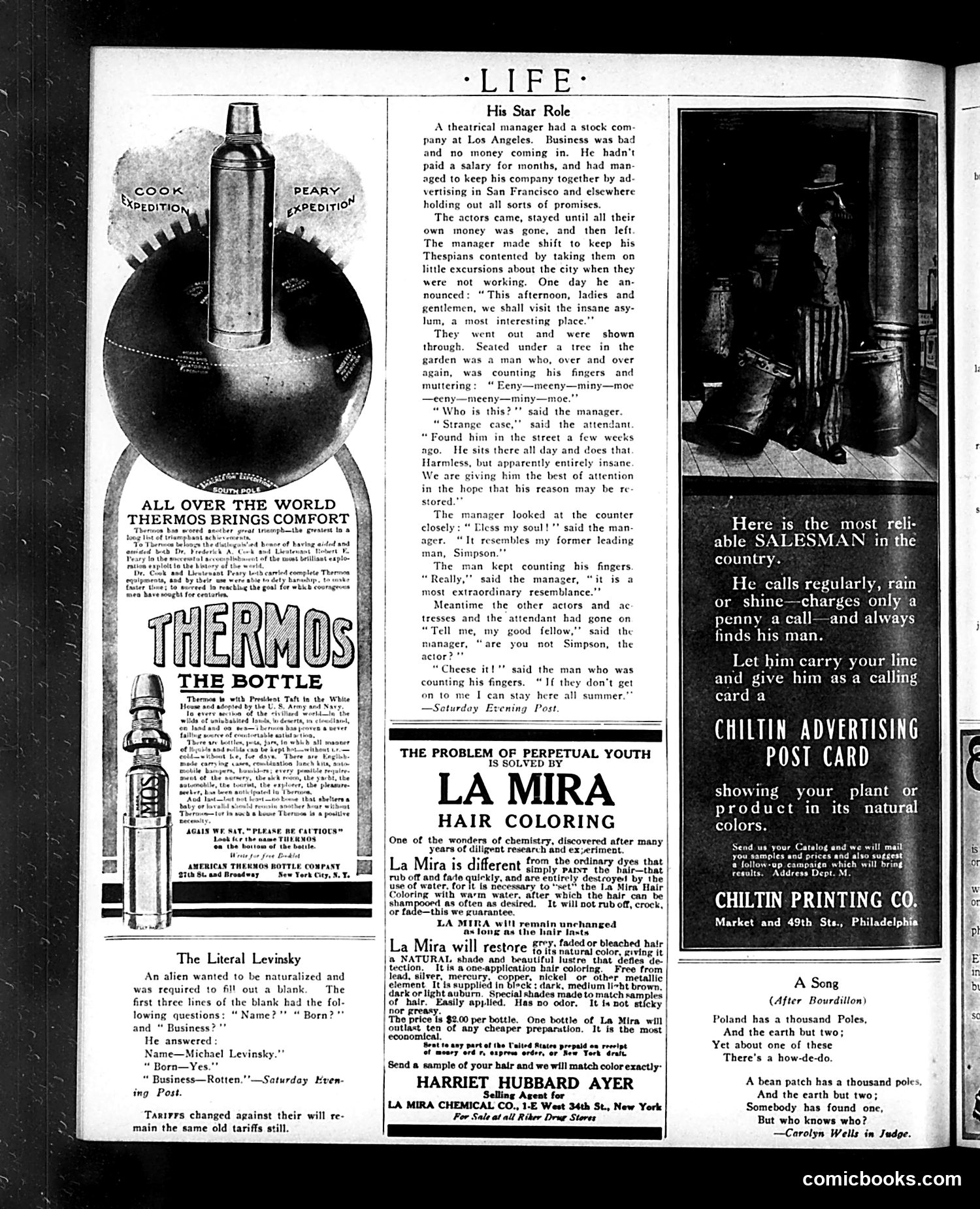
This page mixes advertisements with humor pieces typical of early 20th-century Life magazine. **Main Advertisement:** A Thermos bottle ad dominates the left side, showing the bottle has traveled on both Cook and Peary expeditions—referencing the famous polar explorers' competing claims to reaching the North Pole (a contentious issue of the era). **Humor Pieces:** "The Literal Levinsky" mocks an immigrant's misunderstanding of naturalization forms—a stereotypical joke about Eastern European Jewish immigrants struggling with English bureaucracy. "His Star Role" tells of a struggling theatrical manager who discovers his unpaid, money-desperate actor is now institutionalized, counting obsessively. When the manager recognizes him, the actor begs him not to reveal his identity, fearing he'll lose his "job" at the asylum—dark satire about unemployment and desperation during hard economic times. The remaining ads (La Mira Hair Coloring, Chiltin Advertising) are period beauty and printing services.
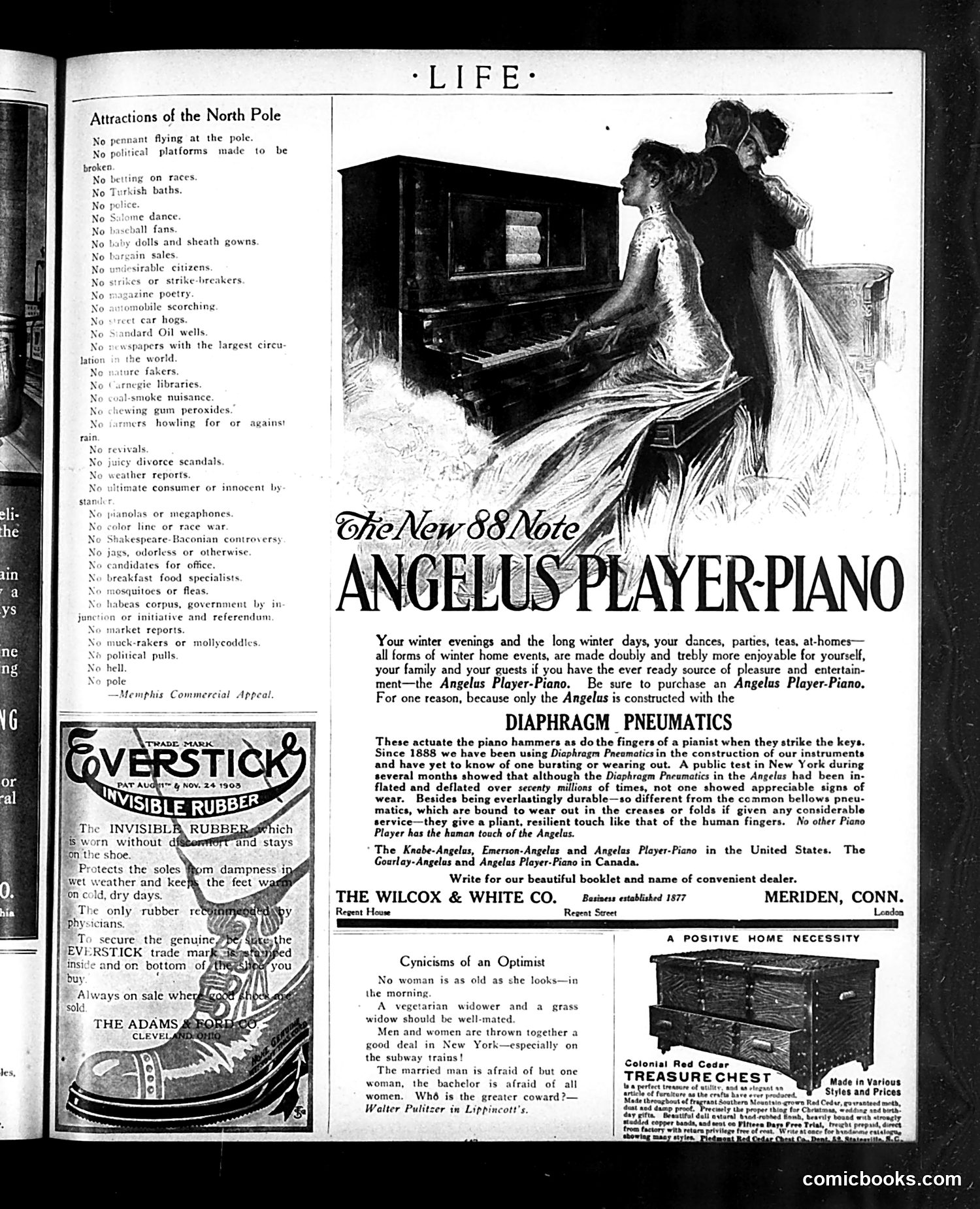
This page mixes satirical commentary with advertising. The main satirical piece, "Attractions of the North Pole," is a humorous list lamenting what one *won't* find there—essentially a critique of American society. It catalogs contemporary annoyances: political corruption ("political platforms made to be broken"), labor unrest ("strikes or strike-breakers"), yellow journalism ("newspapers with the largest circulation"), sensationalism ("juicy divorce scandals"), and industrial problems ("Standard Oil wells"). By listing what's absent at the North Pole, the satire condemns these as serious social ills afflicting modern America. The remaining content is commercial: advertisements for the Angelus Player-Piano, Everstick rubber shoe inserts, and a Colonial Red Cedar Treasure Chest. There's also a brief "Cynicisms of an Optimist" column offering wry observations about gender relations and urban life. The satire reflects Progressive Era concerns about monopolies, labor disputes, sensational media, and political corruption—issues Life magazine regularly lampooned.
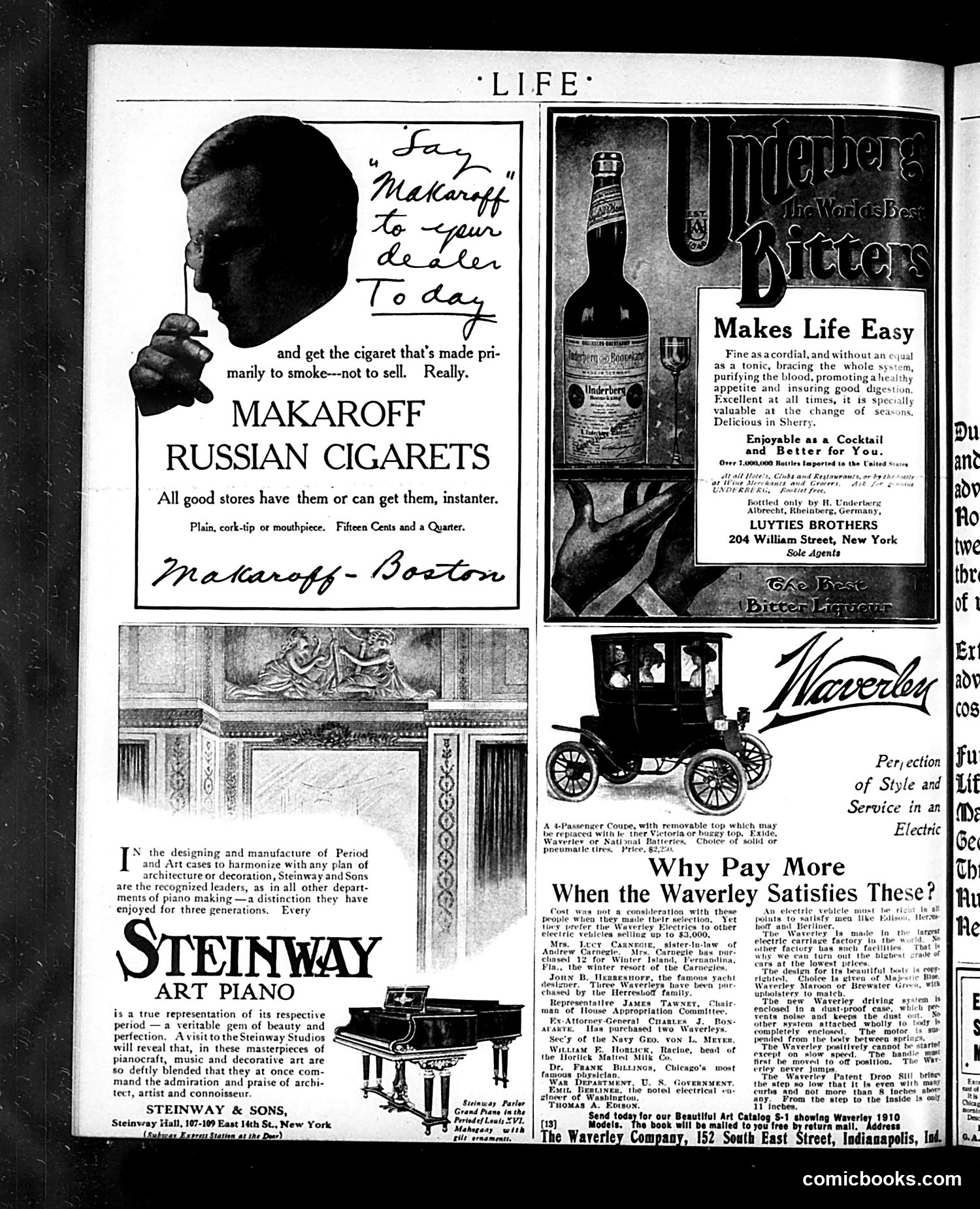
This page contains **primarily advertisements** rather than satirical cartoons. The main content includes: **Makaroff Russian Cigarettes**: An ad featuring a man's profile recommending the product "to your dealer today," emphasizing they're made "primarily to smoke—not to sell," suggesting authenticity over commercialism. **Underberg liqueur**: Marketed as a health tonic that "Makes Life Easy," claiming to brace the system and aid digestion—typical of early 20th-century patent medicine marketing. **Steinway Art Piano**: Positioning pianos as period-appropriate decorative art objects for the cultured home. **Waverley Electric Car**: Advertising an electric automobile emphasizing style, service, and practical features like low steps. The page reflects **early 1900s consumer culture** where products made health and lifestyle claims now considered dubious. The ads target middle/upper-class readers with aspirations toward refinement and modernity. No clear political satire is evident—this appears to be a standard magazine advertising section.
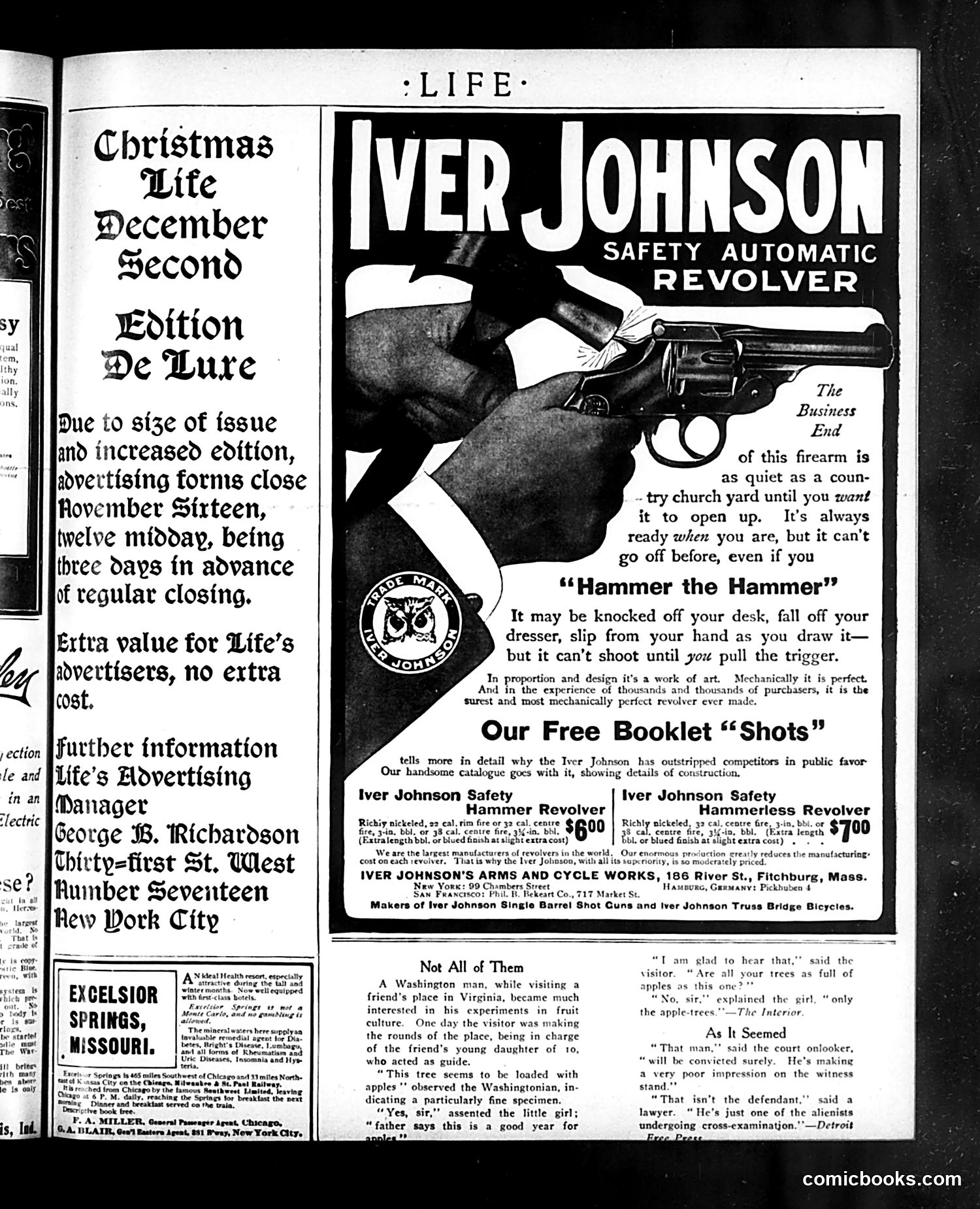
This page from Life contains primarily **advertisements and brief humor pieces**, not political cartoons. The dominant feature is a large **Iver Johnson Safety Automatic Revolver advertisement**, emphasizing the gun's safety features—it won't fire unless the trigger is deliberately pulled, even if dropped or struck. This targets middle-class concerns about household firearm safety. Below are three brief **humorous anecdotes**: 1. **"Not All of Them"**: A visiting Washingtonian asks a young girl if all her father's fruit trees are as full as one loaded with apples. She replies "only the apple-trees"—a joke about imprecise language. 2. **"As It Seemed"**: A courtroom observer mistakes one of several psychiatrists (called "alienists" in period terminology) testifying about a defendant's mental state for the defendant himself, commenting on his poor witness demeanor. The left side contains **publishing notices** for Life's Christmas issue and advertising deadlines. This is primarily a commercial/administrative page rather than satirical content.
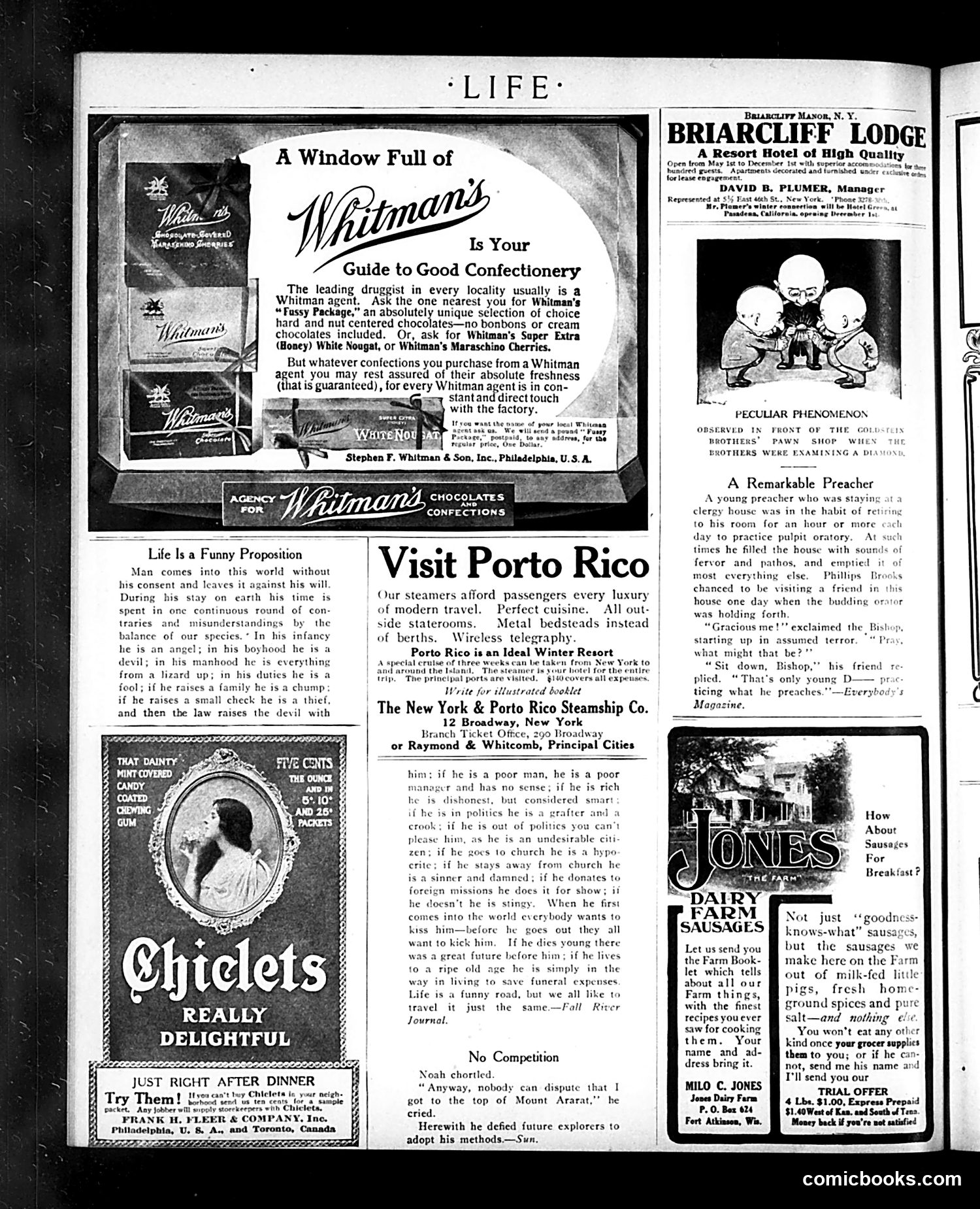
This page from *Life* magazine is primarily **advertising and light humor** rather than political satire. The main content includes: **"Life is a Funny Proposition"** — A cynical essay using the rhetorical device of listing how society judges people contradictorily at every life stage (poor/rich, religious/irreligious, etc.). It's satirical commentary on human hypocrisy and social judgment, concluding that life is absurd yet we all endure it anyway. **"No Competition"** — A brief joke about Noah claiming he reached Mount Ararat's peak unopposed, defying future explorers to match his achievement. It's wordplay on the biblical narrative. **Other content** consists of period advertisements for Whitman's chocolates, Chiclets candy, Jones Dairy Farm sausages, the Briarcliff Lodge hotel, and the New York & Porto Rico Steamship Company. The "Peculiar Phenomenon" illustration appears to be a sight-gag cartoon about pawnbrokers examining a diamond, but lacks sufficient context here to explain fully.
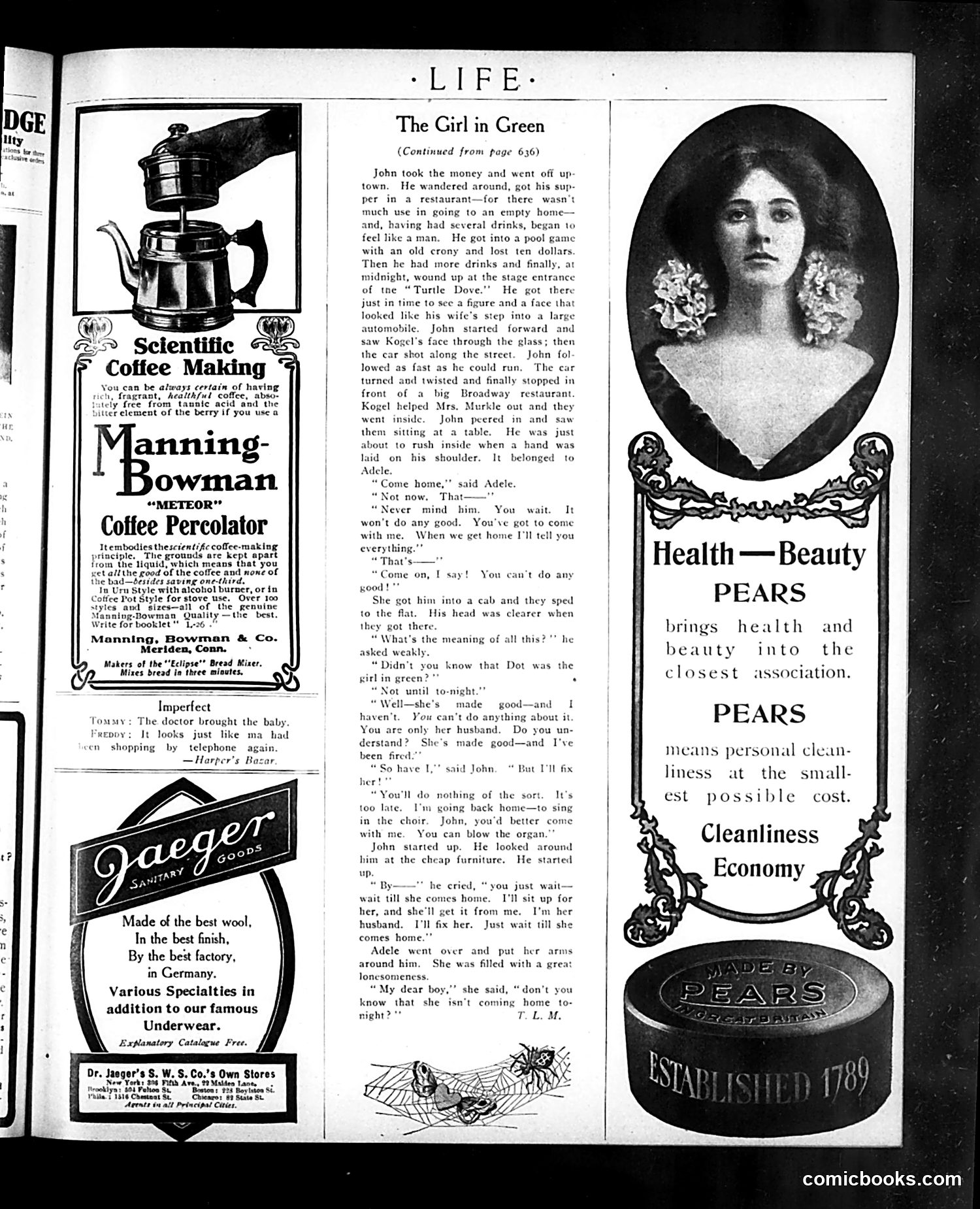
This page continues a serialized short story about marital drama and infidelity. John discovers his wife "Dot" (the "girl in green") has become successful—apparently as a performer at the "Turtle Dove" theater—while accompanying a man named Kogel in an automobile. When John attempts to confront them at a restaurant, Adele (presumably his sister or close friend) intervenes, revealing that Dot has "made good" professionally. She persuades John to abandon his angry plans, suggesting he return home to sing in the church choir instead. The story explores early 20th-century anxieties about women's independence, theater work (often associated with moral danger), and marital fidelity. The narrative suggests Dot's success has shifted power dynamics in the marriage. The page is otherwise filled with period advertisements for coffee percolators, sanitary goods, and pear soap—typical LIFE magazine content of the era.
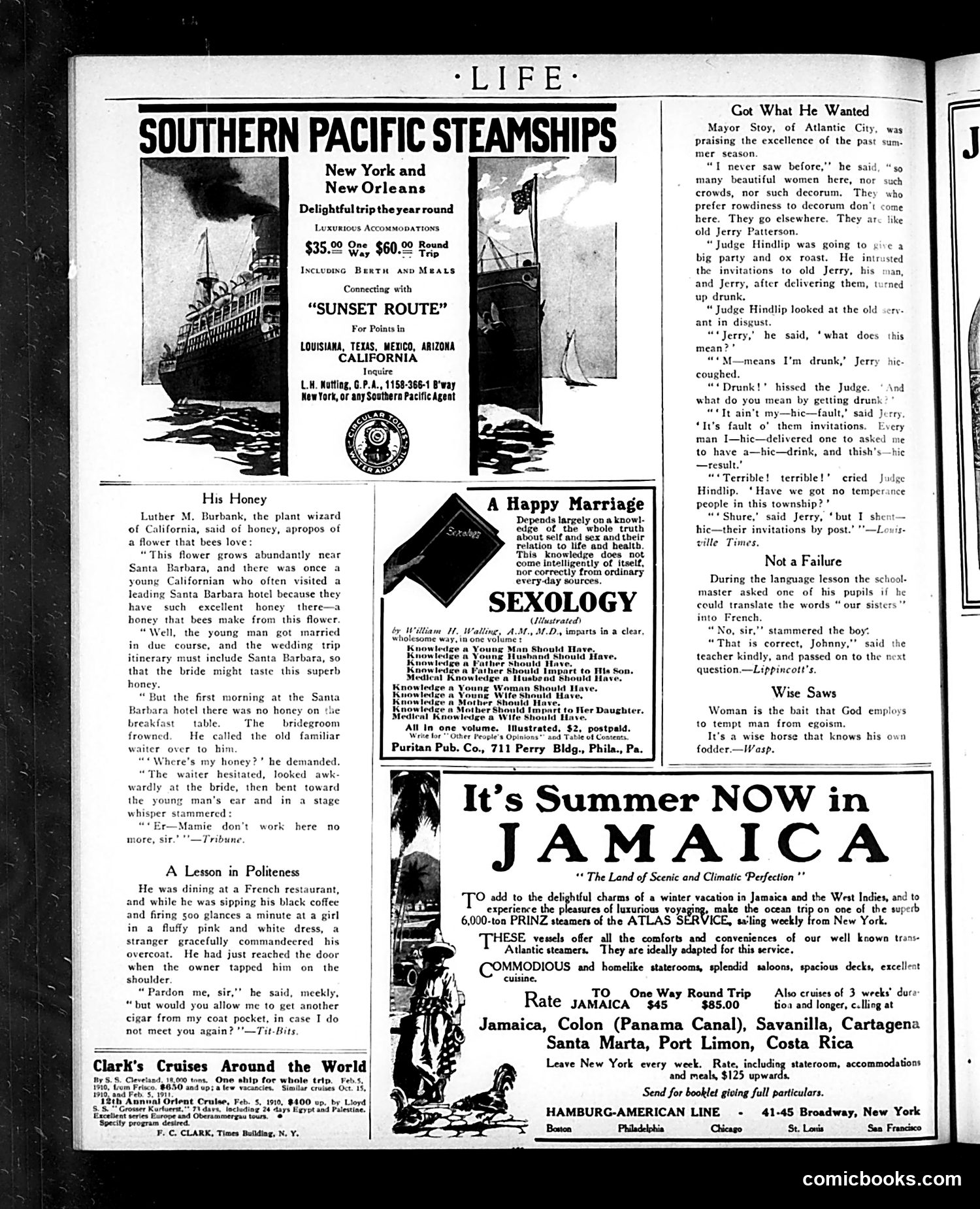
This page is primarily **advertising and humorous anecdotes** rather than political cartoons. The content includes: **"His Honey"** and **"A Lesson in Politeness"** are light satirical sketches mocking social pretension. The first ridicules a young man's honeymoon plans; the second gently mocks overly formal dining etiquette at French restaurants. **"Got What He Wanted"** and **"Not a Failure"** are brief comedic stories about drunkenness and schoolroom mishaps—common humor topics of the era. The bulk of the page features **genuine advertisements**: Southern Pacific Steamships cruises, a book on sexology (presented matter-of-factly), and Jamaica tourism promoting ocean travel from New York. **No specific political figures or events** are referenced. This appears to be a typical 1920s Life magazine page mixing light humor with commercial advertisements aimed at middle-class leisure and travel.
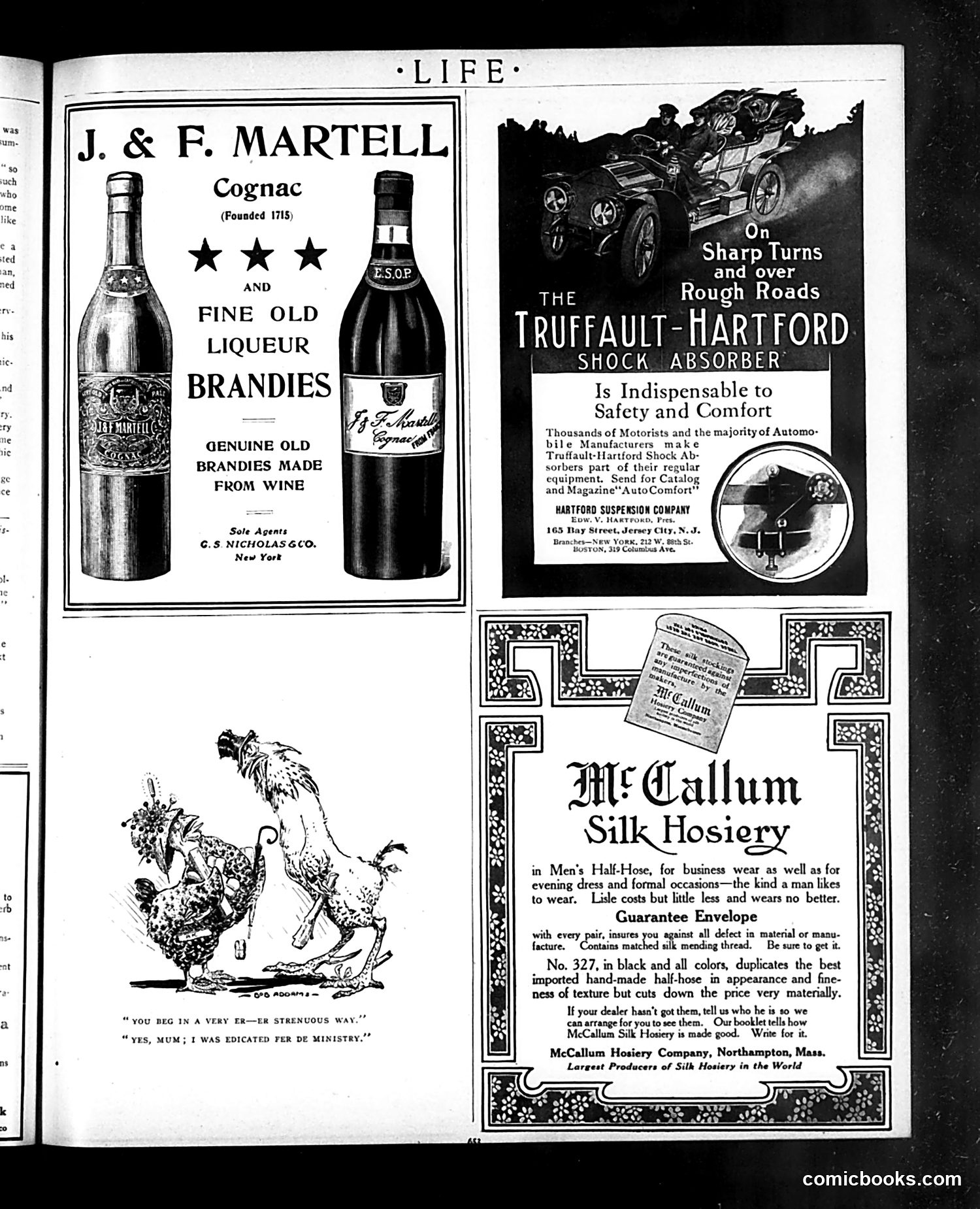
This page is primarily **advertisements** with one small cartoon. The ads promote luxury goods (Martell Cognac, automobile shock absorbers, silk hosiery) typical of early 20th-century Life magazine. The only satirical content is the bottom-left cartoon showing two roosters in conversation. One says he was "educated for the ministry" but now leads "a very strenuous way." This appears to be gentle humor about roosters' mating behavior—a euphemistic joke about the contrast between religious education and natural instinct. The rooster's dialect speech ("ER—ER," "FER DE") suggests working-class or rural characterization. The cartoon's humor relies on the reader's understanding that roosters are famously prolific breeders, making the "strenuous" lifestyle ironic for someone trained for ministry (implying celibacy or restraint). It's mild satire of hypocrisy or life's contradictions rather than political commentary.
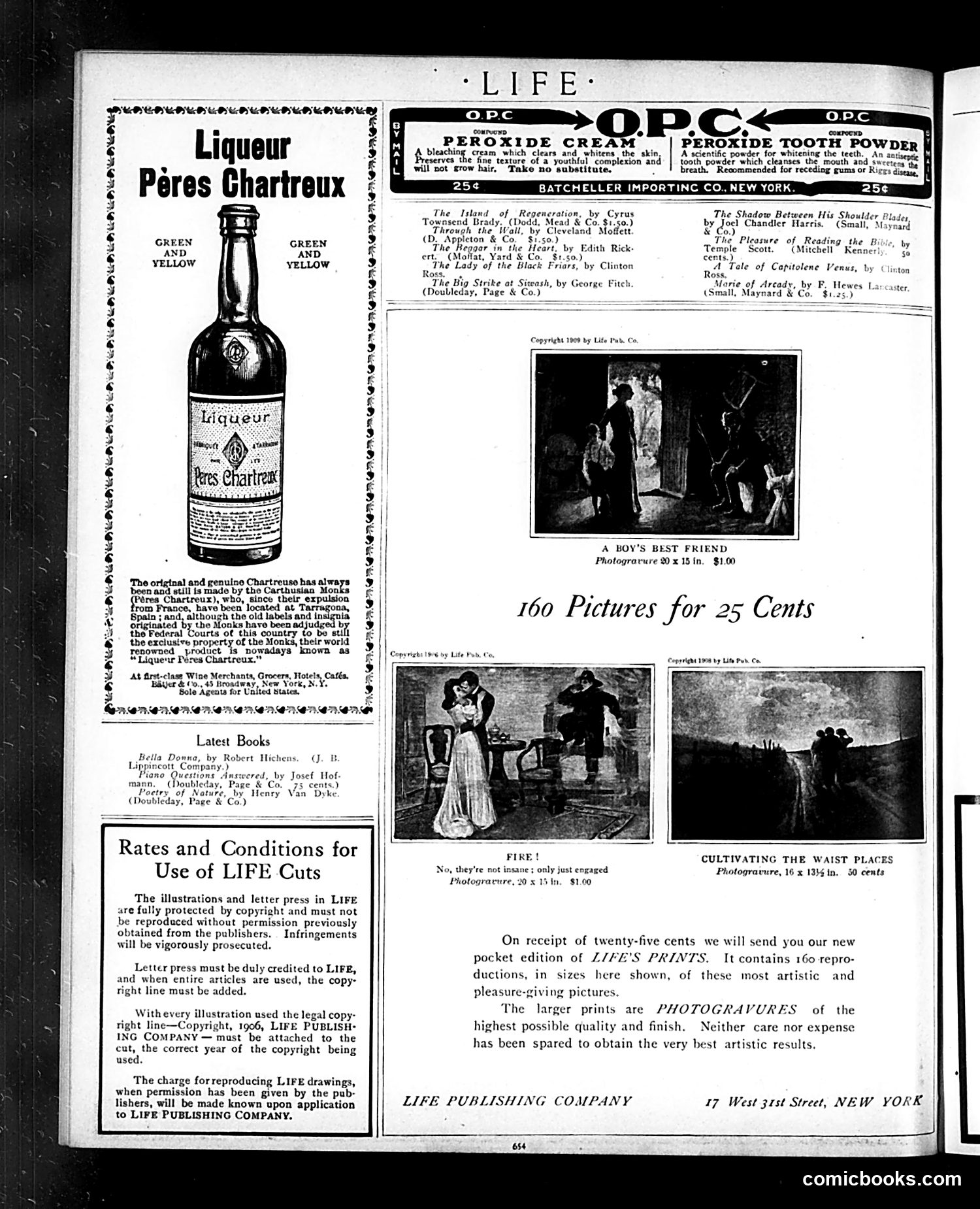
This page is primarily **advertising and publishing notices** rather than satirical content. The main elements are: **Advertisements:** - A liqueur ad for "Pères Chartreux," emphasizing its authenticity despite the monks' expulsion from France - OPC brand beauty products (peroxide cream and tooth powder) claiming whitening properties **Publishing Content:** - A "Latest Books" section listing contemporary titles - "Rates and Conditions for LIFE Cuts" — legal notice protecting the magazine's illustrations and photographs from unauthorized reproduction - An offer for "160 Pictures for 25 Cents" — a mail-order collection of photogravures, including images titled "A Boy's Best Friend" and "Cultivating the Waist Places" **Historical Note:** The "waist places" reference likely relates to early 1900s corset culture and body modification trends of the era. This appears to be a standard back-of-magazine section mixing commercial advertising with publishing business matters rather than editorial satire.

This is a **full-page advertisement**, not political satire. It promotes Pond's Extract, a commercial aftershave product marketed to men. The headline "After Shaving" and tagline "The best part of the shave is when you come to Pond's Extract" frame the product as a post-shave treatment that relieves irritation and prevents inflammation. The ad emphasizes exclusivity ("used by men of discrimination") and quality control ("sold only in sealed bottles—never in bulk"), standard marketing appeals of the era. A bottle is shown alongside traditional shaving implements. There is no political cartoon or satirical commentary visible—this is straightforward commercial advertising typical of *Life* magazine's revenue model.
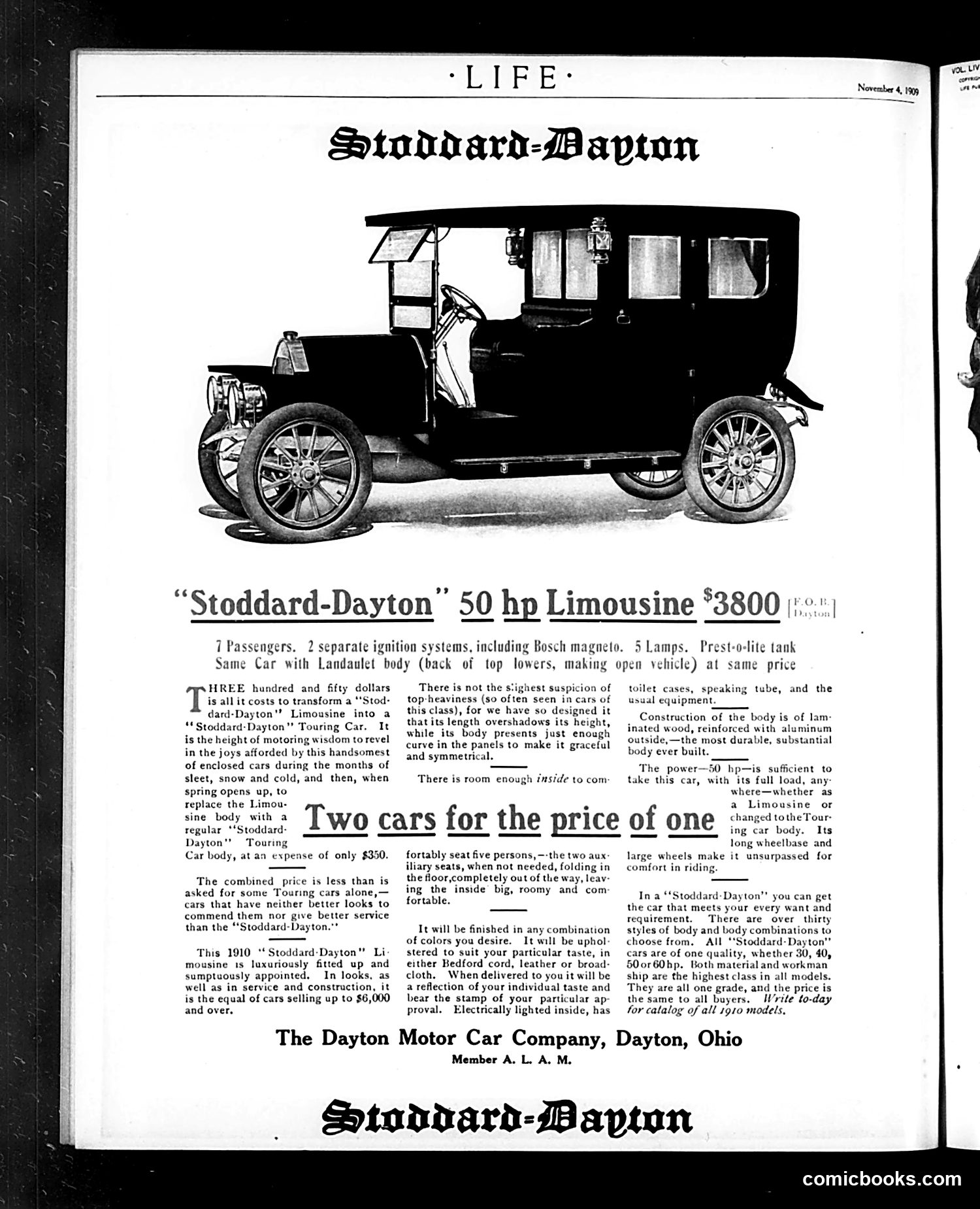
This is **not a cartoon or satire**—it's a straightforward automobile advertisement from Life magazine's November 4, 1909 issue. The ad promotes the Stoddard-Dayton 50 hp Limousine, priced at $3,800. The key sales pitch is "Two cars for the price of one": for only $350 extra, buyers could convert the enclosed winter limousine into an open touring car by swapping bodies. This flexibility appealed to wealthy early-automobile owners who wanted seasonal versatility without purchasing separate vehicles. The advertisement emphasizes luxury features (leather upholstery, electrical lighting, auxiliary folding seats), engineering quality (reinforced aluminum body construction), and customization options (thirty body styles available). The copy positions the Stoddard-Dayton as comparable to cars costing up to $6,000—a significant marketing claim for a $3,800 vehicle in 1910. The Dayton Motor Car Company was based in Dayton, Ohio.