
Life, 1909-11-04 · page 16 of 52
Life — November 4, 1909 — page 16: what you’re looking at
What you’re looking at
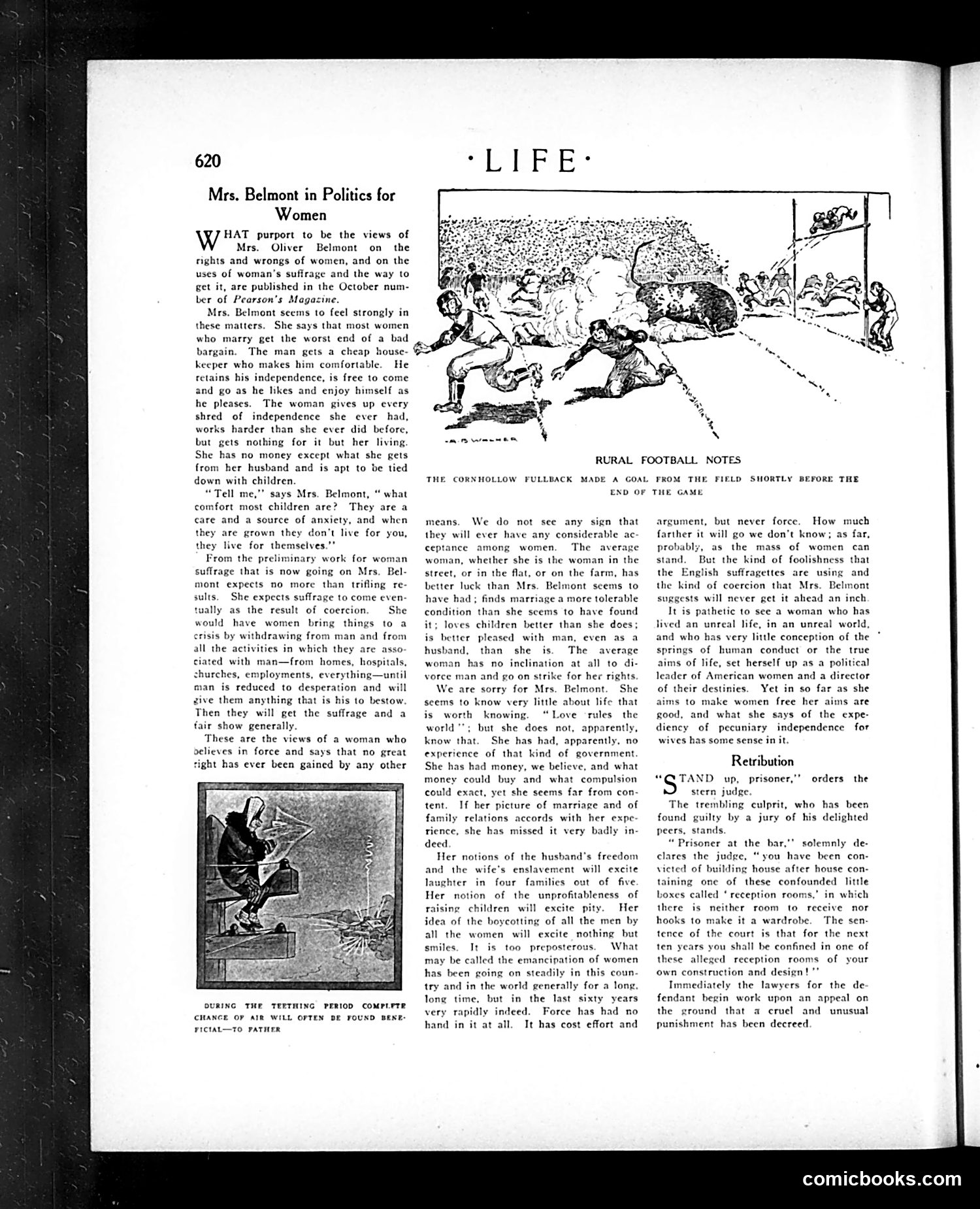
This page satirizes **Mrs. Oliver Belmont**, a wealthy advocate for women's suffrage, mocking her extreme views published in *Pearson's Magazine*. Belmont reportedly argued that marriage exploits women as unpaid housekeepers, that children are burdensome rather than blessings, and that women should **withdraw entirely from society**—abandoning homes, churches, and employment—to force men into granting suffrage through economic coercion. Life's editors ridicule these positions as dangerously out-of-touch. They argue the "average woman" finds marriage tolerable, loves children, and has no interest in Belmont's scorched-earth strategy. The magazine dismisses her as bitter and ignorant of "life worth knowing," having enjoyed wealth yet remained discontent. The editorial defends gradual women's emancipation achieved through "effort"—not force—while condemning both Belmont's extremism and the "foolishness" of English suffragettes. Two cartoons accompany the text: rural football scenes appearing unrelated to the political content.
📄 Transcribed text from this page (OCR, searchable)
Machine-transcribed from the original scan — historical spelling and the odd misread are preserved.
620 Mrs. Belmont in Politics for Women HAT purport to be the views of Mrs. Oliver Belmont on the rights and wrongs of women, and on the uses of woman's suffrage and the way to get it, are published in the October num- ber of Pearson's Magazine. Mrs. Belmont seems to feel strongly in these matters. She says that most women who marry get the worst end of a bad bargain. The man gets a cheap house- keeper who makes him comfortable. He retains his independence, is free to come and go as he likes and enjoy himself as he pleases. The woman gives up every shred of independence she ever had, works harder than she ever did before, bat gets nothing for it but her living She has no money except what she gets from her husband and is apt to be tied down with children. “Tell me,” says Mrs. Belmont, “ wha comfort most children are? They are a care and a source of anxiety, and when they are grown they don't live for you, they live for themselves From the preliminary work for woman suffrage that is now going on Mrs. Bel- mont expects no more than trifling re- sults, She expects suffrage to come even- tually as the result of coercion. She would have women bring things to a crisis by withdrawing from man and fron all the activities in which they asso: ciated with man—from homes, hospitals, churches, employments, everything—until man is reduced to desperation and will give them anything that is his to bestow. Then they will get the suffrage and a fair show generally. hese are the views of a woman who oelieves in force and says that no great ght has ever been gained by any other DURING THE TEETHING PERIOD COMPLETE CHANCE OF AIR WILL OFTEN DE FOUND BENE: FICIAL—TO FATHER RURAL FOOTBALL NOTES THE FULLBACK MADE A GOAL END OF CORN HOLLOW means. We do not see any sign that they will ever have any considerable ac ceptance among women. The average woman, whether she is the woman in the street, or in the flat, or on the farm, has better luck than Mrs. Belmont seems to have had; finds marriage a more tolerable condition than she scems to have found it; loves children better than she does; is better pleased with man, even as a husband, than she is. The average woman has no inclination at all to di- vorce man and go on strike for her rights We are sorry for Mrs. Belmont, She seems to know very little about life that is worth knowing. “Love ‘rules the world; but she does not, apparently, know that. She has had, apparently, no experience of that kind of government She has had money, we believe, and what money could buy and what compulsion could exact, yet she seems far from con- tent. If her picture of marriage and of family relations accords with her expe rience, she has missed it very badly in- deed Her notions of the husband's freedom and the wife's enslavement will excite laughter in four families out of five Her notion of the unprofitableness of raising children will excite pity. Her idea of the boycotting of all the men by all the women will excite nothing but smiles, It is preposterous. What may be called the emancipation of women has been going on steadily in this coun- try and in the world generally for a long, long time, but in the last sixty years pidly indeed. Force has had no at all. It has cost effort and too very hand in i FROM THE FIELD SHORTLY BEFORE THE THE GAME argument, but never force. How much farther it will go we don’t know; as far, probably, as the mass of women can stand, But the kind of foolishness that the English suffragettes are using and the kind of coercion that Mrs. Belmont suggests will never get it ahead an inch It is pathetic to see a woman who has lived an unreal life, in an unreal world, and who has very little conception of the springs of human conduct or the true aims of life, set herself up as a political leader of American women and a director of their destinies. Yet in so far as she aims to make women free her aims are good, and what she says of the expe- diency of pecuniary independence for wives has some sense in it. Retribution * TAND up, stern judge The trembling culprit, who has been found guilty by a jury of his delighted prisoner,"’ orders the peers, stands “Prisoner at the bar,'’ solemnly de- clares the judge, “you have been con- vieted of building house after house con- taining one of these confounded little boxes called ‘reception rooms,’ in which re is neither room to receive nor hooks to make it a wardrobe. The sen- tence of the court is that for the next ten years you shall be confined in one of 1 reception rooms of your own construction and design!" Immediately the lawyers for the de. fendant begin work upon an appeal on the ground that a cruel and unusual punishment has been decreed comicbooks.com