
Life, 1909-11-04 · page 25 of 52
Life — November 4, 1909 — page 25: what you’re looking at
What you’re looking at
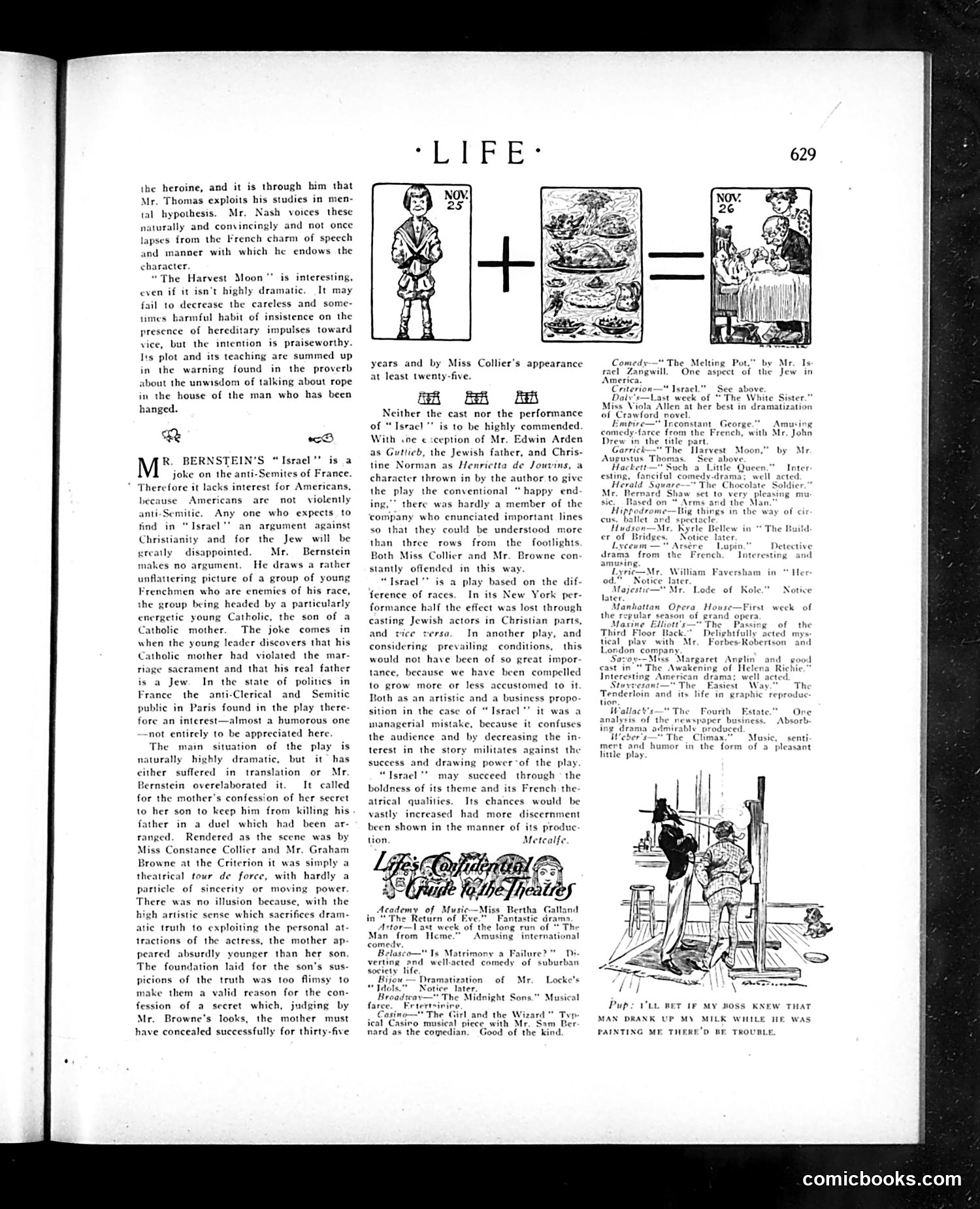
This page reviews Mr. Bernstein's play "Israel," a French satirical work targeting anti-Semitism. The critic explains the play's limited appeal to American audiences: it mocks young French Catholics who are anti-Semitic, with the central irony being that the most virulent anti-Semite discovers his own mother had a Jewish lover, making him half-Jewish. The reviewer notes this resonated in Paris's anti-Clerical political climate but lacks relevance for Americans, "because Americans are not violently anti-Semitic." The critic faults the production's casting—Jewish actors playing Christian roles and vice versa—calling it a "managerial mistake" that confuses the audience and undermines the play's impact. The review also critiques the performance quality and the implausible age difference between mother and son actors. The underlying assumption reflects early 20th-century attitudes about ethnic identity in theater and France's specific political divisions around religion and nationality.
📄 Transcribed text from this page (OCR, searchable)
Machine-transcribed from the original scan — historical spelling and the odd misread are preserved.
the heroine, and it is through him that Mr. Thomas exploits his studies in men- tal hypothesis. Mr. Nash voices these naturally and convincingly and not once lapses from the French charm of speech and manner with which he endows the character. “The Harvest Moon” even if it isn't highly dramatic fail to decrease the careless and some- times harmful habit of insistence on the presence of hereditary impulses toward vice, but the intention is praiseworthy. lis plot and its teaching are summed up in the warning found in the proverb about the unwisdom of talking about rope in the house of the man who has been hanged. eed R. BERNSTEIN’S “Israel "* joke on the anti-Semites of France. Therefore it lacks interest for Americans, because Americans are not violently anti-Semitic. Any one who expects to find in “Israel’” an argument against Christianity and for the Jew will be greatly disappointed. Mr. Bernstein makes no argument. He draws a rather unflattering picture of a group of young Frenchmen who are enemies of his race, the group being headed by a particularly energetic young Catholic, the son of a Catholic mother. The joke comes in when the young leader discovers that his Catholic mother had violated the mar- riage sacrament and that his real father is a Jew. In the state of polities in France the anti-Clerical and Semitic public in Paris found in the play there fore an interest—almost a humorous one not entirely to be appreciated here. The main situation of the play is naturally highly dramatic, but it~ has cither suffered in translation or Mr. Bernstein overelaborated it. It called for the mother’s confession of her secret to her son to keep him from killing his father in a duel which had been ar- ranged. Rendered as the scene was by Miss Constance Collier and Mr. Graham Browne at the Criterion it was simply a theatrical tour de force, with hardly a is interesting, It may <S is a particle of sincerity or moving power. with the dram- There was no illusion because, high artistic sense which saer atic truth to exploiting the personal at- tractions of the actress, the mother ap peared absurdly younger than her son The foundation laid for the son's sus- picions of the truth was too flimsy to make them a valid reason for the con- fession of a secret which, judging by Mr. Browne's looks, the mother must have concealed successfully for thirty-five years and by Miss Collier's appearance at least twenty-five. i A BA ther the cast nor the performance of “Israel” is to be highly commended With sre « cception of Mr. Edwin Arden as Gutlieb, the Jewish father, and Chris- tine Norman as Henrietta de Jouvins, a character thrown in by the author to give the play the conventional “happy end ing.” there was hardly a member of the company who cnunciated important lines so that they could be understood more than three rows from the footlight Both Miss Collier and Mr. Browne con stantly offended in this way “Israel ’’ is a play based on the dif- ference of races. In its New York per- formance half the effect was lost through casting Jewish actors in Christian parts, In another play, and conditions, this and vice versa considering prevailing would not have been of so great impor- tance, because we have been compelled to grow more or less accustomed to it Both as an artistic and a business propo: sition in the case of “ Israel"? it was a managerial mistake, because it confuses the audience and by decreasing the in terest in the story militates against the success and drawing power ‘of the play “Israel? may succeed through ° the boldness of its theme and its French the Its chances would be creased had more discernment been shown in the manner of its produc Metcalfe. Academy of Music—Miss Bertha Galland in" The Return of Eve.” Fantastic drama. $+tor—Last week of the long run of “ The Man from Heme.” Amusing internat} comedy Belasco—" Is Matrimony a verting and well-acted comedy society life Bijow tion. of suburban Dramatization of Mr. Locke’ “Idols.” Notice later. Hroadteax—" The Midnight Sons.” Casino—" The Girl and the Wizard" Typ- ical Casino musical piece with Mr. Sam T nard as the comedian, Good of the ki Musical fa “The Melting Pot.” by Mr. Is ‘One aspect of the Jew in Comedy rael Zangwill. Criterion— Israel.” See above Daly's—Last week of The White Sister.” Miss Viola Allen at her best in dramatization of Crawford novel Empire—" Inconstant_ George.” Amusing edy-farce from the French, with Mr. John in the, title part Garrick" The Harvest Moon,” by Mr Augustus Thomas. See above Hackett—" Such a Little Queen.” Inter esting, {9 acted Herald Square" T © Soldier Mr. Bernard Shaw set to very sic. Tased on “Arms and the spectacle Kyrle Bellew in T Notice later Tupi French er of Bridges Lxceum —* Arsere drama Lyrie—Mr. Notic Detective from the Interesting William Faversham in “Mer later Mr. Lode of Kole.” Notice od.” Opera Howse—First week of the repular season of grand oper farine Elliott's—" The Passing of the Third Floor Back.” Delightfully acted mys tical play with Mr. Forbes-Robertson and London company Sazoy-—Miss Margaret Anglin and ood cast in’ The Awakening of Helena Richie Interesting American drama; well f Stuvresant—" Easiest’ Way Th Te ife in graphic reproduc tion Wallack's Estate analysis of the newspaper business mirably. produced. Frente Clima.” Music, senti mert and humor in the form of a pleasan little play ' ‘ Ove Absorb. RET IP MY BOSS KNEW MILK WHILE HE PAINTING ME THERE'D BE TROUBLE Pups vu THAT MAN DRANK UP aty was comicbooks.com