
Life, 1909-11-04 · page 30 of 52
Life — November 4, 1909 — page 30: what you’re looking at
What you’re looking at
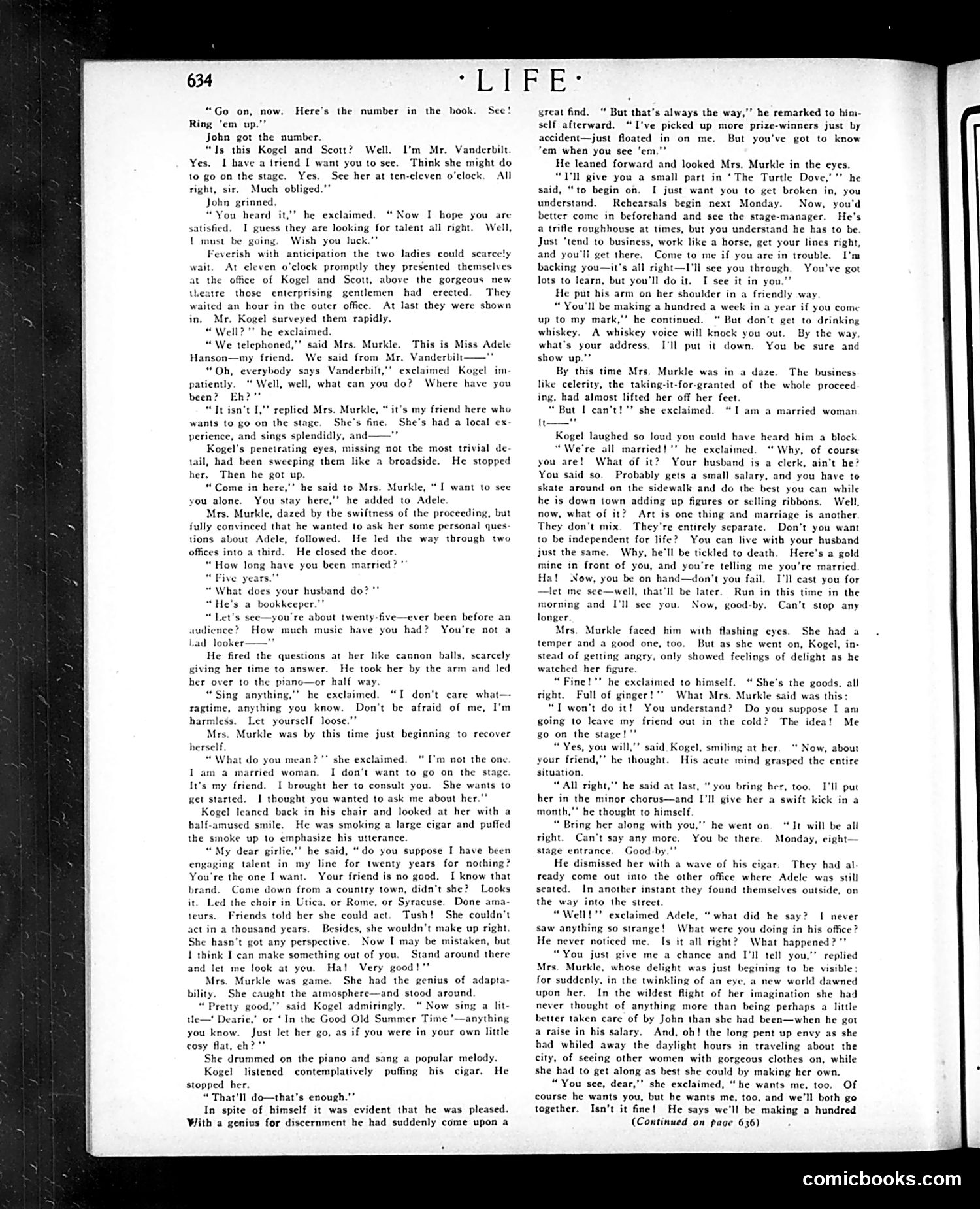
This page contains a serialized story (not a political cartoon) about theatrical ambition and deception in early 20th-century America. **The Plot:** Mrs. Murkle brings her friend Adele to a theater office, claiming to represent "Mr. Vanderbilt" who wants Adele on stage. Theater impresario Kogel interviews them but quickly recognizes the ruse—Adele is a small-town amateur ("Led the choir in Utica, or Rome, or Syracuse") with no real talent. Kogel instead identifies Mrs. Murkle herself as having potential, flattering her adaptability and stage presence while dismissing her friend as hopeless. **The Satire:** The piece mocks small-town theatrical aspirations and the phoniness of social pretense (name-dropping Vanderbilt to gain credibility). It also satirizes talent scouts' ability to spot genuine potential beneath conventional appearances—Kogel's shrewdness contrasts with the ladies' naive optimism. The story represents Life magazine's typical satirical treatment of American social climbing and theatrical ambition during the vaudeville era.
📄 Transcribed text from this page (OCR, searchable)
Machine-transcribed from the original scan — historical spelling and the odd misread are preserved.
634 lel “Go on, now. Here's the number in the book. Sec! Ring ‘em up.” John got the number. “Is this Kogel and Scott? Well. I'm Mr. Vanderbilt Yes. I have a iriend I want you to see. to go on the stage. Yes. right, sir. Much obliged." John grinned. “You heard it,’ he exclaimed. satisfied. Ln Think she might do See her at ten-eleven o'clock. All “Now I hope you are I guess they are looking for talent all right. Well, ast be going. Wish you luck.” Feyerish with anticipation the two ladies could scarce!y wait. At eleven o'clock promptly they presented themselves at the office of Kogel and Scott, above the gorgeous new theatre those enterprising gentlemen had erected. They waited an hour in the outer office. At last they were shown in. Mr. Kogel surveyed them rapidly. “ Well?" he exclaimed. “We telephoned,” said Mrs. Murkle. This is Miss Adele Hanson—my friend. We said from Mr. Vanderbilt “Ob, everybody says Vanderbilt,” exclaimed patiently.“ Well, well, what can you do? been? Eh? “It isn't I," replied Mrs. Murkle, “it’s my friend here who wants to go on the stage. She's fine. She's had a local ex perience, and sings splendidly, and. Kogel’s penetrating eyes, missing not the most trivial de tail, had been sweeping them like a broadside. He stopped her. Then he got up. “Come in here,” he said to Mrs. Murkle, “I want to see you alone. You stay here,’’ he added to Adele. Mrs. Murkle, dazed by the swiftness of the proceeding, but fully convinced that he wanted to ask her some personal ques ons about Adele, followed. He led the way through two offices into a third. He closed the door. “How long have you been married?” “ive years.” “What does your husband do?" “He's a bookkeeper.” “ Let's see—you're about twenty-five—ever been before an audience? How much music have you had? You're not a Kogel im- Where have you Lad looker. He fired the questions at her like cannon balls, scarcely giving her time to answer. He took her by the arm and led her over to the piano—or half way. “Sing anything,” he exclaimed. ragtime, anything you know. harmless. Let yourself loose. Mrs. Murkle was by this time just beginning to recover herself, “What do you me I am a married wo It's my friend. “T don't care what—- Don't be afraid of me, I'm in?" she exclaimed. “I’m not the one an, I don’t want to go on the stage. I brought her to consult you. She wants to get started. I thought you wanted to ask me about her.”’ Kogel leaned back in his chair and looked at her with a mused smile. He was smoking a large cigar and puffed the smoke up to emphasize his utterance. “My dear girlie,”” he said, “do you suppose I have been engaging talent in my line for twenty years for nothing? You're the one I want. Your friend is no good. I know that brand. Come down from a country town, didn't she? Looks it. Led the choir in Utica, or Rome, or Syracuse. Done ama- teurs. Friends told her she could act. Tush! She couldn't act in a thousand years. Besides, she wouldn't make up right. She hasn’t got any perspective. Now I may be mistaken, but I think I can make something out of you. Stand around there and let me look at yeu. Ha! Very good Mrs. Murkle was game. She had the genius of adapta- bility. She caught the atmosphere—and stood around. “Pretty good,’’ said Kogel admiringly. “Now sing a lit- tle—' Dearie,’ or ‘In the Good Old Summer Time *. ything you know. Just let her go, as if you were in your own little cosy flat, eh?" She drummed on the piano and sang a popular melody. Kogel listened contemplatively puffing his cigar. He stopped her. “That'll do—that’s enough."” In spite of himself it was evident that he was pleased. With a genius for discernment he had suddenly come upon a ReE® great find, “ But that’s always the way,” he remarked to him- self afterward. “I've picked up more prize-winners just by accident—just floated in on me. But you've got to know "em when you see ’em."* He leaned forward and looked Mrs, Murkle in the eyes. “I'll give you a small part in ‘The Turtle Dove,’ he said, “to begin of. I just want you to get broken in, you understand. Rehearsals begin next Monday ow, you'd better come in beforehand and sce the stage-manager. He's a trifle roughhouse at times, but you understand he has to be Just ‘tend to business, work like a horse, get your lines right, and you'll get there. Come to me if you are in trouble. backing you—it's all right—I'll sce you through lots to learn, but you'll do it. I see it in you.” He put his arm on her shoulder in a friendly way “ You'll be making a hundred a week in a year if you come up to my mark,’’ he continued. “But don’t get to drinking Im You've got whiskey. A whiskey voice will knock you out. By the way, what's your address. I'll put it down. You be sure and show up."” By this time Mrs. Murkle was in a daze. The business like celerity, the taking-it-for-granted of the whole proceed ing, had almost lifted her off her feet. “But I can't!’? she exclaimed. “I am a married womar Kogel laughed so loud you could ha “We're all married! "” ¢ heard him a block he exclaimed. “Why, of course you are! What of it? Your husband is a clerk, ain't he? You said so. Probably gets a small salary, and you have to skate around on the sidewalk and do the best you can while he is down town adding up figures or selling ribbons. Well, now, what of it? Art is one thing and marriage is another. They don't mix. They're entirely separate. Don’t you want to be independent for life? You can live with your husband just the same. Why, he'll be tickled to death. Here’s a gold mine in front of you, and you're telling me you're married. Ha! Now, you be on hand—don't you fail. I'll cast you for —let me see—well, that'll be later. Run in this time in the and I'll see morning you. Now, good-by. Can't stop any longer. Mrs. Murkle faced him with flashing eyes. She had a temper and a good one, too. But as she went on, Kogel, in- stead of getting angry, only showed feelings of delight as he watched her figure. “ Fine!" he exclaimed to himself, right. Full of ginger!"" What Mrs. Murkle said was this “LT won't do it! You understand? Do you suppose I am going to leave my friend out in the cold? The idea! Me go on the stage!" “Yes, you will,’’ said Kogel, your friend,’* he thought. His situation. “She's the goods, all smiling at her. “ Now, about ute mind grasped the entire “ All right,"’ he said at last, “you bring her, too. I'll put her in the minor chorus—and I'll give her a swift kick in a month,"" he thought to himself “ Bring her along with you,"” he went on right. Can't say any more. You be there Stage entrance. Good-by.’" He dismissed her with a wave of his cigar. They had al ready come out into the other office where Adele was still seated. In another instant they found themselves outside, on the way into the street “Well!” exclaimed Adele, “what did he say? saw anything so strange! What were you doing in his office? He never noticed me. Is it all right? What happened?" “You just give me a chance and I'll tell you," replied Mrs. Murkle, whose delight was just begining to be visible for suddenly, in the twinkling of an eye, a new world dawned upon her. In the wildest flight of her imagination she had never thought of anything more than being perhaps a little better taken care of by John than she had been—when he got a raise in his salary. And, oh! the long pent up envy as she had whiled away the daylight hours in traveling about the city, of seeing other women with gorgeous clothes on, while she had to get along as best she could by making her own. “You see, dear,”’ she exclaimed, “he wants me, too. Of course he wants you, but he wants me, too, and we'll both go together. Isn't it fine! He says we'll be making a hundred (Continued on poge 636) “Tt will be all Monday, eight- I never comicbooks.com