
Life, 1909-11-04 · page 28 of 52
Life — November 4, 1909 — page 28: what you’re looking at
What you’re looking at
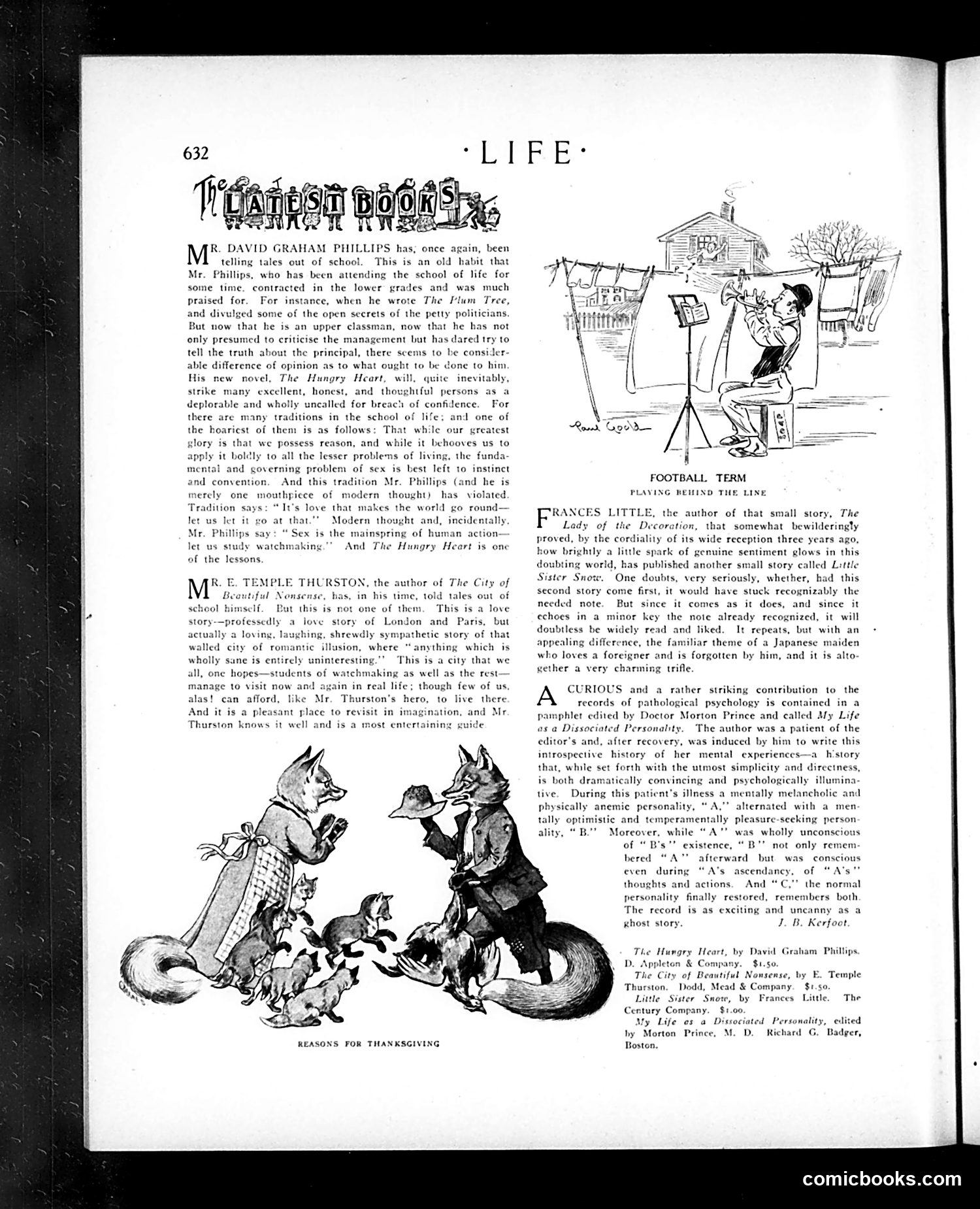
This page critiques **David Graham Phillips**, a muckraking novelist whose work *The Hungry Heart* violated social conventions by frankly addressing sexuality and human motivation. The satire's central point: Phillips dares to treat sex as a serious subject worthy of rational examination rather than leaving it to "instinct and convention"—the traditional approach Life sarcastically calls the "school of life." The text mocks both Phillips's critics and outdated moralism. When tradition says "it's love that makes the world go round," Phillips counters that sex is "the mainspring of human action"—modern thought challenging Victorian propriety. The page also reviews other literary works, including Frances Little's *Little Sister Snow* (repeating her successful Japanese romance theme) and a psychological case study about dissociated personality. The illustration labeled "Reasons for Thanksgiving" depicts anthropomorphic foxes in human clothing—likely satirizing deceptive social pretense, though the specific reference remains unclear.
📄 Transcribed text from this page (OCR, searchable)
Machine-transcribed from the original scan — historical spelling and the odd misread are preserved.
R. DAVID GRAHAM PHILLIPS has; once again, been telling tales out of school. This is an old habit that Mr. Phillips, who has been attending the school of life for some time, contracted in the lower grades and was much praised for. For instance, when he wrote The Mum Tree, and divulged some of the open secrets of the petty politicians But now that he is an upper classman, now that he has not only presumed to criticise the management but has dared try to tell the truth about the principal, there scems to be consier- able difference of opinion as to what ought to be done to him His new novel, The Hungry Heart, will, quite inevitably, strike many excellent, honest, and thoughtful persons as 4 deplorable and wholly uncalled for breach of confi For there are many traditions in the school of life; and one of the hoariest of them is as follows: That while our greatest glory is that we possess reason, and while it behooves us to it boldly to all the lesser problems of living, the funda. mental and governing problem of sex is best left to instinct and convention. And this tradition Mr. Phillips (and he is merely one mouthpicce of modern thought) has violated radition says: “It’s love that makes the world go round— Jet us let it go at that.” Mr. Phillips say let_us study watchmaking of the lessons Modern thought and, incidentally, “Sex is the mainspring of human action And The Hungry Heart is one in his time, told tales out of t this is not one of them. This is a love story-—professedly a love story of London and Paris, but . shrewdly sympathetic story of that walled city of romantic illusion, where actually a loving, laughin anything which is wholly sane is entirely uninterestin This is a city that we all, one hopes—students of watchmaking as well as the rest manage to visit now and again in real life; though few of us. alas! can afford, like Mr. Thurston's hero, to live there. And it is a pl t place to revisit in imagination, and Mr Thurston knows it well and is a most entertaining guide REASONS FOR THANKSGIVING FOOTBALL TERM PLAYING REWIND THE LINE RANCES LITTLE, the author of that small story, The Lady of the Decoration, that somewhat bewilderingly proved, by the cordiality of its wide reception three years ago, how brightly a little spark of genuine sentiment glows in this doubting world, has published another small story called Little Sister Snow. One doubts, very seriously, whether, had this second story come first, it would have stuck recognizably the needed note. But since it comes as it does, and since it echoes in a minor key the note already recognized, it will doubtless be widely read and liked. It repeats, but with an appealing difference, the familiar theme of a Japanese maiden who loves a foreigner and is forgotten by him, and it is alto- gether a very charming trifle. CURIOUS and a rather striking contribution to the records of pathological psychology is contained in a pamphlet edited by Doctor Morton Prince and called My Life as a Dissociated Personality. The author was a patient of the editor's and, after recovery, was induced by him to write this introspective history of her mental experiences—a_ history that, while set forth with the utmost simplicity and directness, is both dramatically convincing and psychologically illumina- tive. During this patient's illness a mentally melancholic and physically anemic personality, “ A," alternated with a men. tally optimistic and temperamentally pleasure-seeking person ality, “ B."" Moreover, of “ B's’? existence, “B’’ not only remem bered “ A‘ afterward but was conse even during “A's ascendancy, of “A's And “C,"" the normal personality finally restored, remembers both A" was wholly unconscious thoughts and actions. The record is as exciting and uncanny as a ghost story J. B. Kerfoot. The Hungry Heart, by David Graham Phillips D. Appleton & Company. $1. The City of Beautiful Nonsens ple Thurston, Dodd, Mead & Company. $1.0 Little Sister Snow, by Frances Little. The Century Company. $1.00 My Life es a Dissociated Personality, edited hy Morton Prince, M. D. Richard G. Badger, Boston. comicbooks.com