
Life, 1909-11-04 · page 14 of 52
Life — November 4, 1909 — page 14: what you’re looking at
What you’re looking at
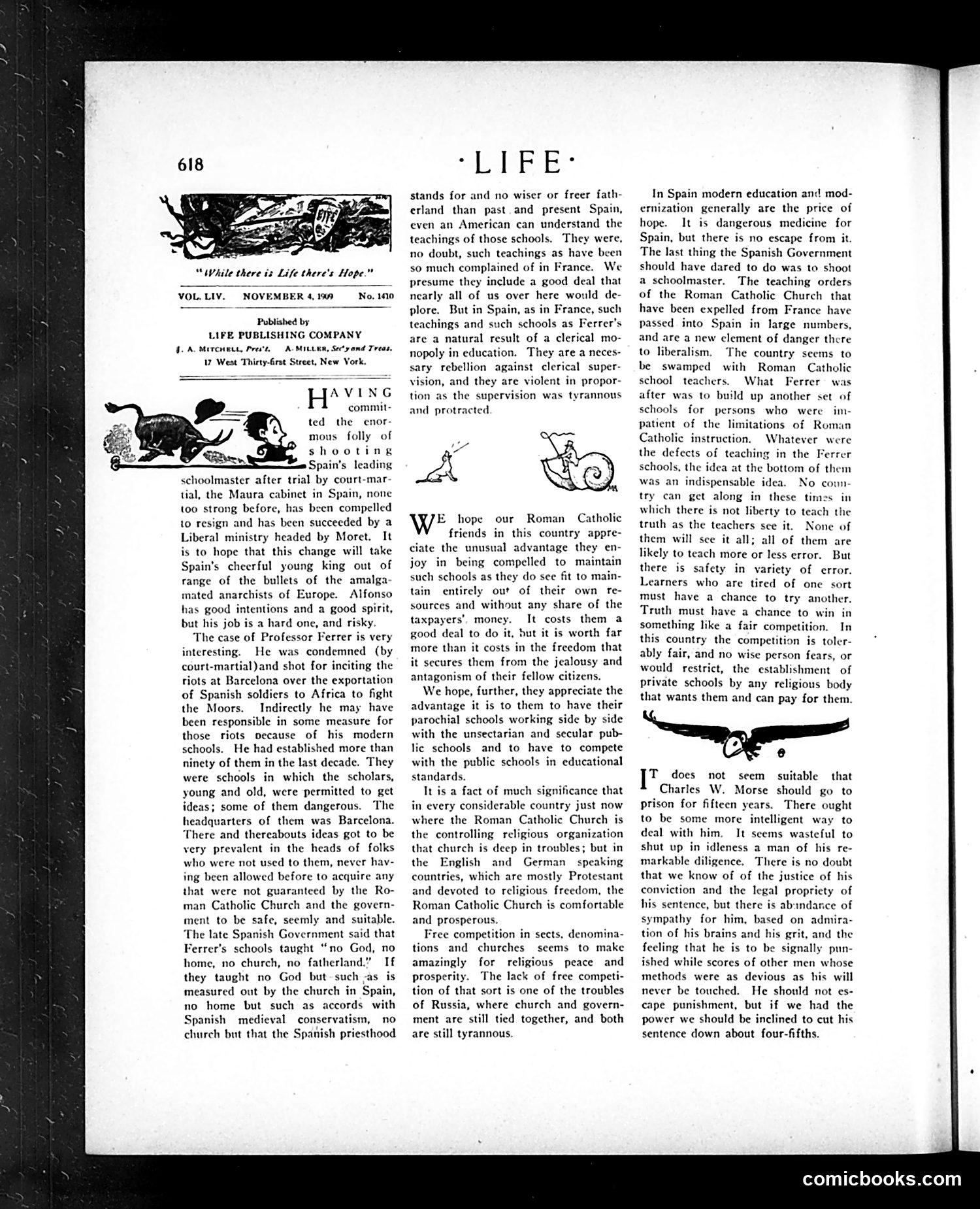
This page discusses the execution of Francisco Ferrer, a Spanish educator shot by the Maura government for allegedly inciting Barcelona riots (1909). The text argues Ferrer's "crime" was operating progressive schools that taught students to think independently—a radical act in Spain's clerical-dominated education system. **The satirical point:** Life uses Ferrer's case to critique Catholic Church monopoly on Spanish education. The magazine argues that such rigid control *creates* violent rebellion, and ironically praises American Catholics for having to fund their own schools without state support—which ironically gives them *freedom* from the antagonism Spain's enforced orthodoxy generates. The small decorative cartoons (rabbits/animals) lack clear political reference and appear purely ornamental. The real argument is textual: religious freedom through competition produces peace; monopolistic control breeds violence and unrest.
📄 Transcribed text from this page (OCR, searchable)
Machine-transcribed from the original scan — historical spelling and the odd misread are preserved.
“While there is Life there's Hope.” VOL. LIV. NOVEMBER 4,199 —-No.190 Published by LIFE PUBLISHING COMPANY BA MUTCHELE, Pres A MILLER, Setyand Treas, 1 West Thirty-Girst Street, New Vork. H* VING commit- ted the mous folly of shooting Spain's leading schoolmaster after trial by court-mar- tial, the Maura cabinet in Spain, none too strong before, has been compelled to resign and has been succeeded by a Liberal ministry headed by Moret. It is to hope that this change will take Spain’s cheerful young king out of range of the bullets of the amalga- mated anarchists of Europe. Alfonso has good intentions and a good spirit, but his job is a hard one, and risky. The case of Professor Ferrer is very interesting. He was condemned (by court-martial)and shot for inciting the riots at Barcelona over the exportation of Spanish soldiers to Africa to fight the Moors. Indirectly he may have been responsible in some measure for those riots pecause of his modern schools. He had established more than ninety of them in the last decade. They were schools in which the scholars, young and old, were permitted to get ideas; some of them dangerous. The headquarters of them was Barcelona. There and thereabouts ideas got to be very prevalent in the heads of folks who were not used to them, never hav- ing been allowed before to acquire any that were not guaranteed by the Ro- man Catholic Church and the govern- ment to be safe, seemly and suitable. ‘The late Spanish Government said that Ferrer’s schools taught “no God, no home, no church, no fatherland.” If they taught no God but such -as is measured out by the church in Spain, no home but such as accords with Spanish medieval conservatism, no church but that the Spanish priesthood enor- go) Ld a stands for and no wiser or freer fath- erland than past. and present Spain, even an American can understand the teachings of those schools. They were, no doubt, such teachings as have been so much complained of in France. We presume they include a good deal that nearly all of us over here would de- plore. But in Spain, as in France, such teachings and such schools as Ferrer’s are a natural result of a clerical mo- nopoly in education. They are a neces- sary rebellion against clerical super- vision, and they are violent in propor- tion as the supervisi and protracted. W* hope our Roman Catholic friends in this country appre- ciate the unusual advantage they en- joy in being compelled to maintain such schools as they do see fit to main- tain entirely out of their own. re- sources and without any share of the taxpayers’. money. It costs them a good deal to do it, but it is worth far more than it costs in the freedom that it secures them from the jealousy and antagonism of their fellow citizens. We hope, further, they appreciate the advantage it is to them to have their parochial schools working side by side with the unsectarian and secular pub- lic schools and to have to compete with the public schools in educational standards. It is a fact of much significance that in every considerable country just now where the Roman Catholic Church is the controlling religious organization that church is deep in troubles; but in the English and German speaking countries, which are mostly Protestant and devoted to religious freedom, the Roman Catholic Church is comfortable and prosperous. Free competition in sects, denomina- tions and churches seems to make amazingly for religious peace and prosperity. The lack of free competi- tion of that sort is one of the troubles of Russia, where church and govern- ment are still tied together, and both are still tyrannous. In Spain modern education and mod- emnization generally are the price of hope. It is dangerous medicine for Spain, but there is no escape from it. The last thing the Spanish Government should have dared to do was to shoot a schoolmaster. The teaching orders of the Roman Catholic Church that have been expelled from France have passed into Spain in large numbers, and are a new clement of danger there to liberalism. The country seems to be swamped with Roman Catholic school teachers. What Ferrer was after was to build up another set of schools for persons who were im- patient of the limitations of Roman Catholic instruction. Whatever were the defects of teaching in the Ferrer schools, the idea at the bottom of them was an indispensable idea. No covn- try can get along in these times in which there is not liberty to teach the truth as the teachers sce it. None of them will sce it all; all of them are likely to teach more or less error. But there is safety in variety of error. Learners who are tired of one sort must have a chance to try another. Truth must have a chance to win in something like a fair competition. In this country the competition is toler- ably fair, and no wise person fears, or would restrict, the establishment of private schools by any religious body that wants them and can pay for them. e T does not seem suitable that Charles W. Morse should go to prison for fifteen years. There ought to be some more intelligent way to deal with him. It seems wasteful to shut up in idleness a man of his re- markable diligence. There is no doubt that we know of of the justice of his conviction and the legal propriety of his sentence, but there is abundance of sympathy for him, based on admira- tion of his brains and his grit, and the feeling that he is to be signally pun- ished while scores of other men whose methods were as devious as his will never be touched. He should not es- cape punishment, but if we had the power we should be inclined to cut his sentence down about four-fifths. comicbooks.com