
A complete issue · 48 pages · 1908
Life — November 5, 1908
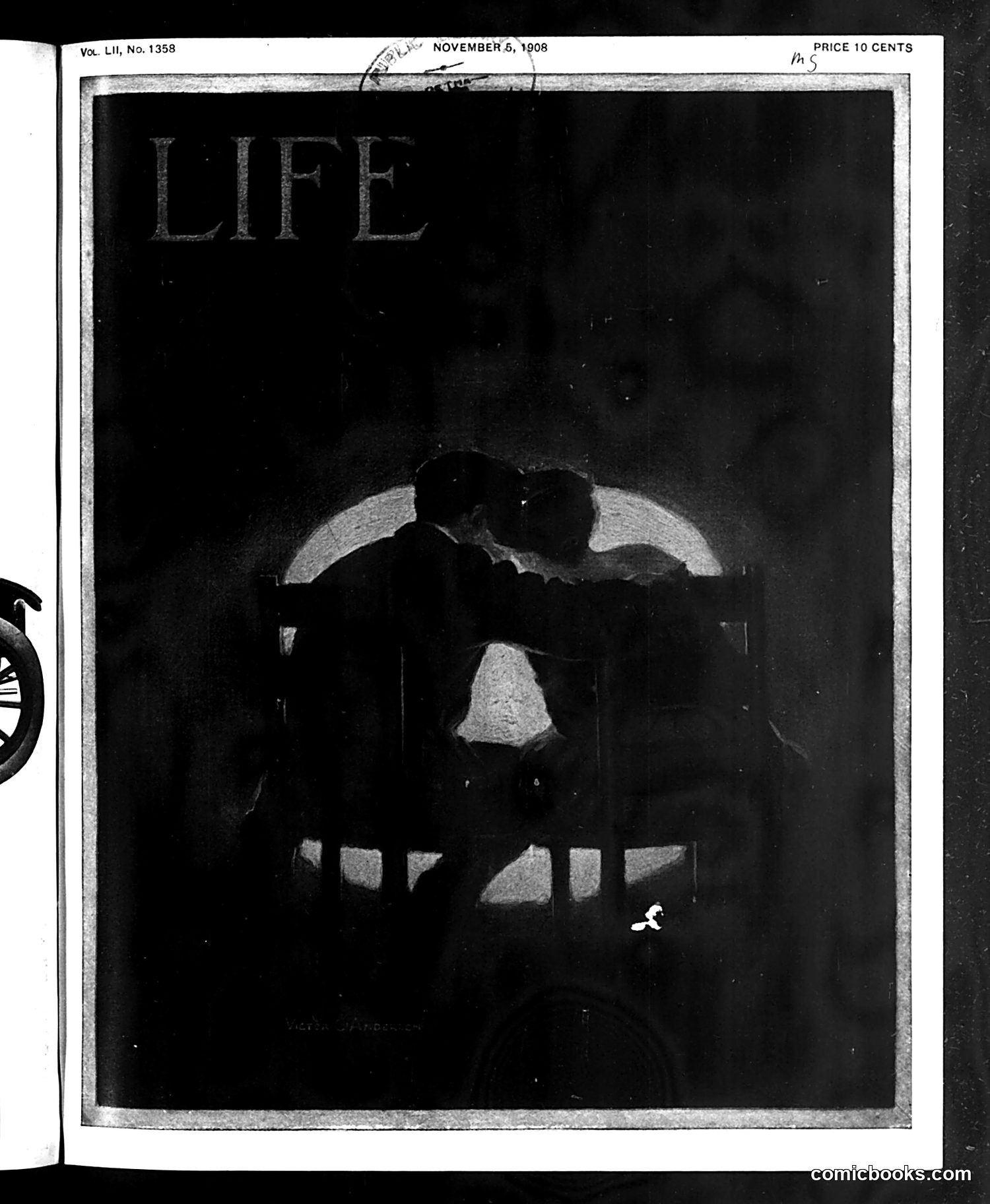
This appears to be a **Life magazine cover from the 1908 U.S. presidential election period**. The silhouetted image shows two figures in formal attire in an intimate moment, framed by a glowing window or doorway against a dark background. Given the timing (November 1908) and the romantic/domestic imagery, this likely satirizes **the personal or political relationship between prominent figures of that era**—possibly relating to Theodore Roosevelt and his chosen successor William Howard Taft, or another high-profile political pair. The "LIFE" masthead suggests social or political commentary typical of the magazine's satirical approach. Without clearer identification of the figures, the exact satirical target remains uncertain, though the intimate framing suggests commentary on political alliances or personal relationships among the powerful.
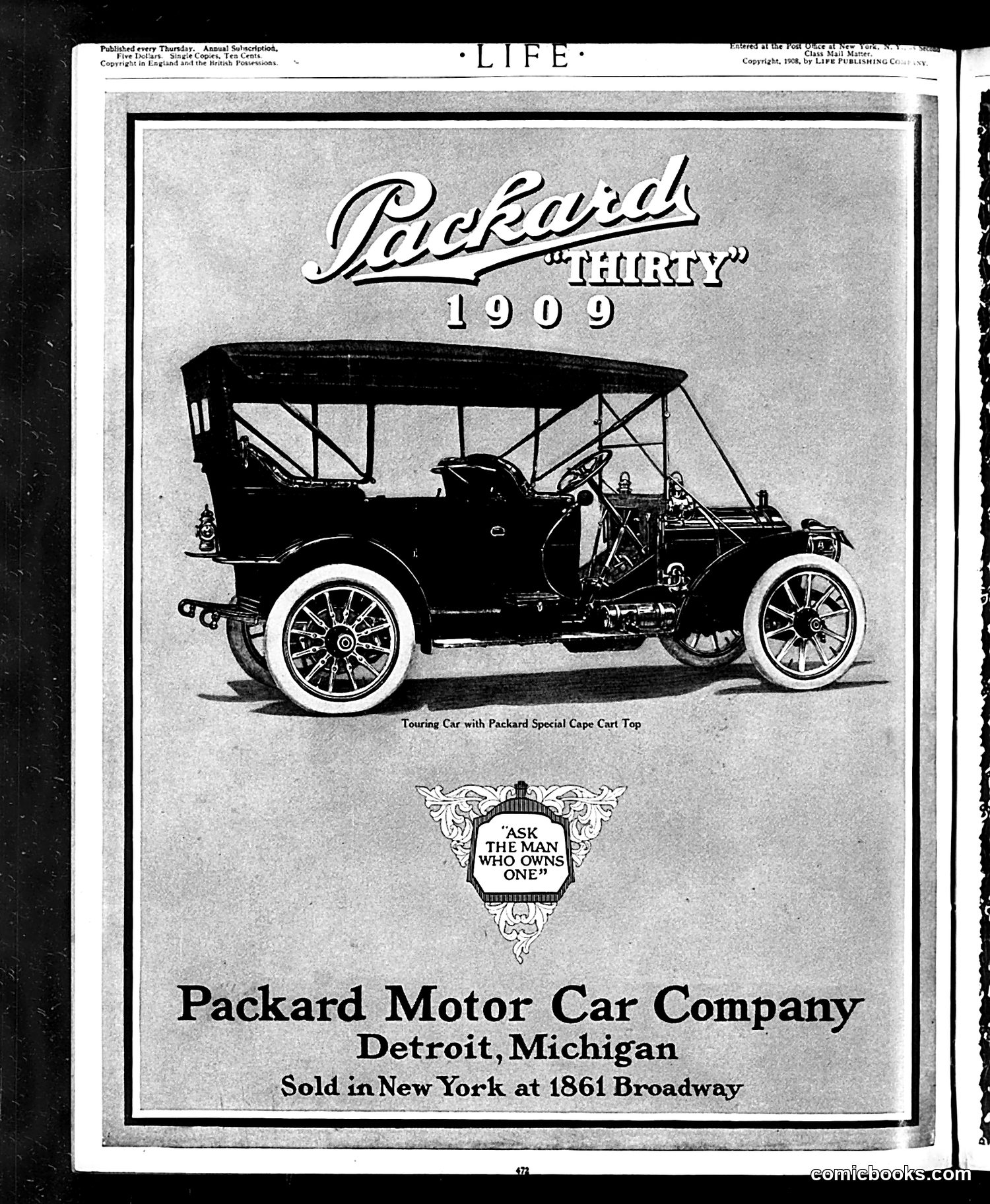
This is primarily an **advertisement, not political satire**. It's a full-page Packard Motor Car Company ad from 1909 appearing in *Life* magazine. The image shows a Packard "Thirty" touring car with a convertible cape cart top—a practical feature for early automobiles. The ad emphasizes the vehicle's open-air design and mechanical visibility. The tagline "ASK THE MAN WHO OWNS ONE" was Packard's famous marketing slogan, implying satisfied customer testimonials vouched for quality. The notation that the car is "Sold in New York at 1861 Broadway" indicates Packard's retail presence. This represents early automotive advertising targeting affluent readers of *Life*—a luxury product marketed to an educated, wealthy audience during the automobile industry's rapid expansion.
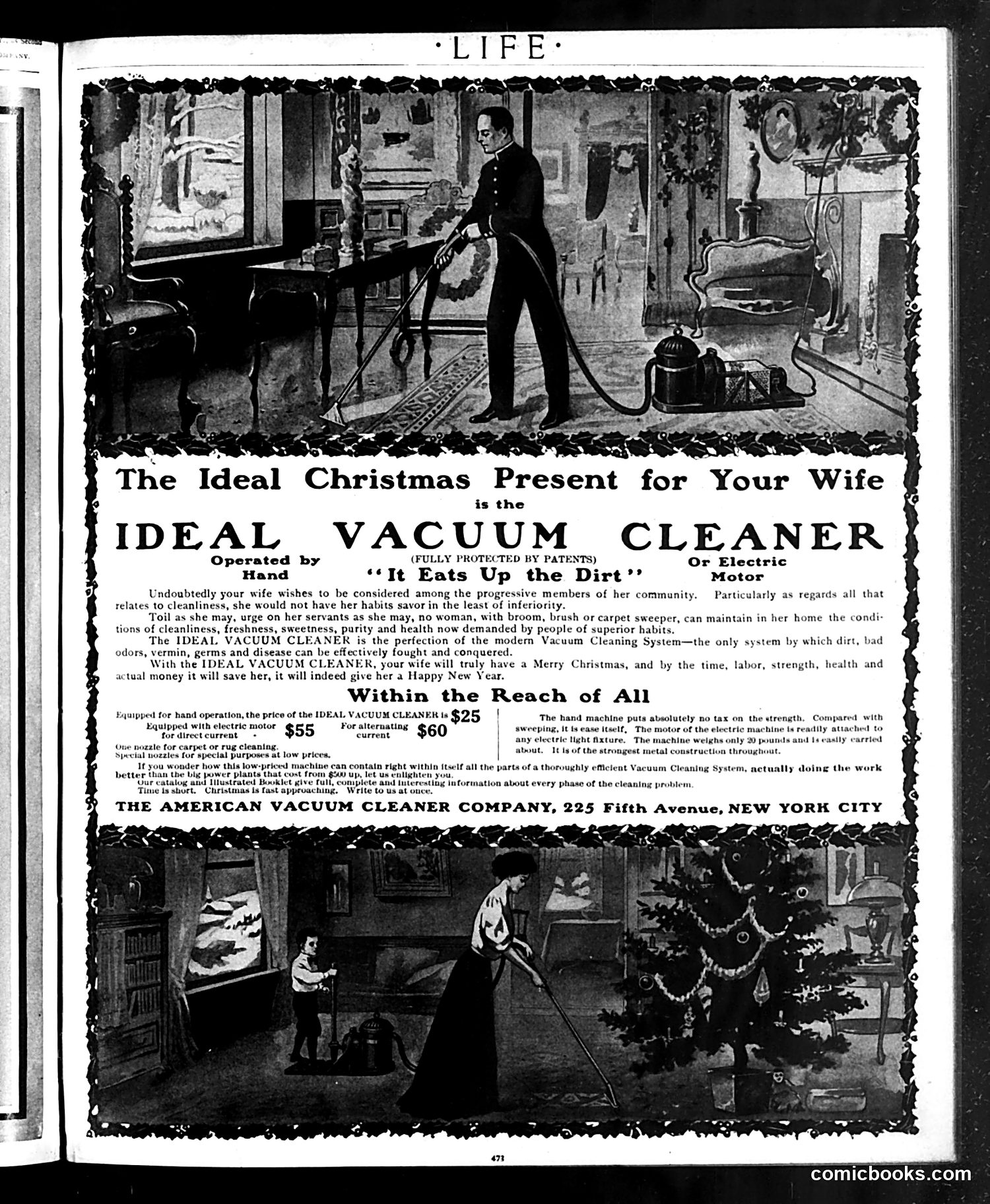
This is primarily a **product advertisement**, not satire or political commentary. The American Vacuum Cleaner Company advertises their "Ideal Vacuum Cleaner" as "The Ideal Christmas Present for Your Wife." The advertisement uses two illustrated scenes showing women using the vacuum cleaner in domestic settings. The text appeals to wives' desires to be viewed as "progressive members of her community" while promoting the machine's ability to eliminate dirt, germs, and disease. **The social message** (not satirical, but revealing of the era) assumes wives do household cleaning and frames a vacuum cleaner as an aspirational gift that grants women status and health benefits—reflecting early 20th-century gender roles and marketing strategies that sold labor-saving devices by emphasizing domestic duty rather than leisure.
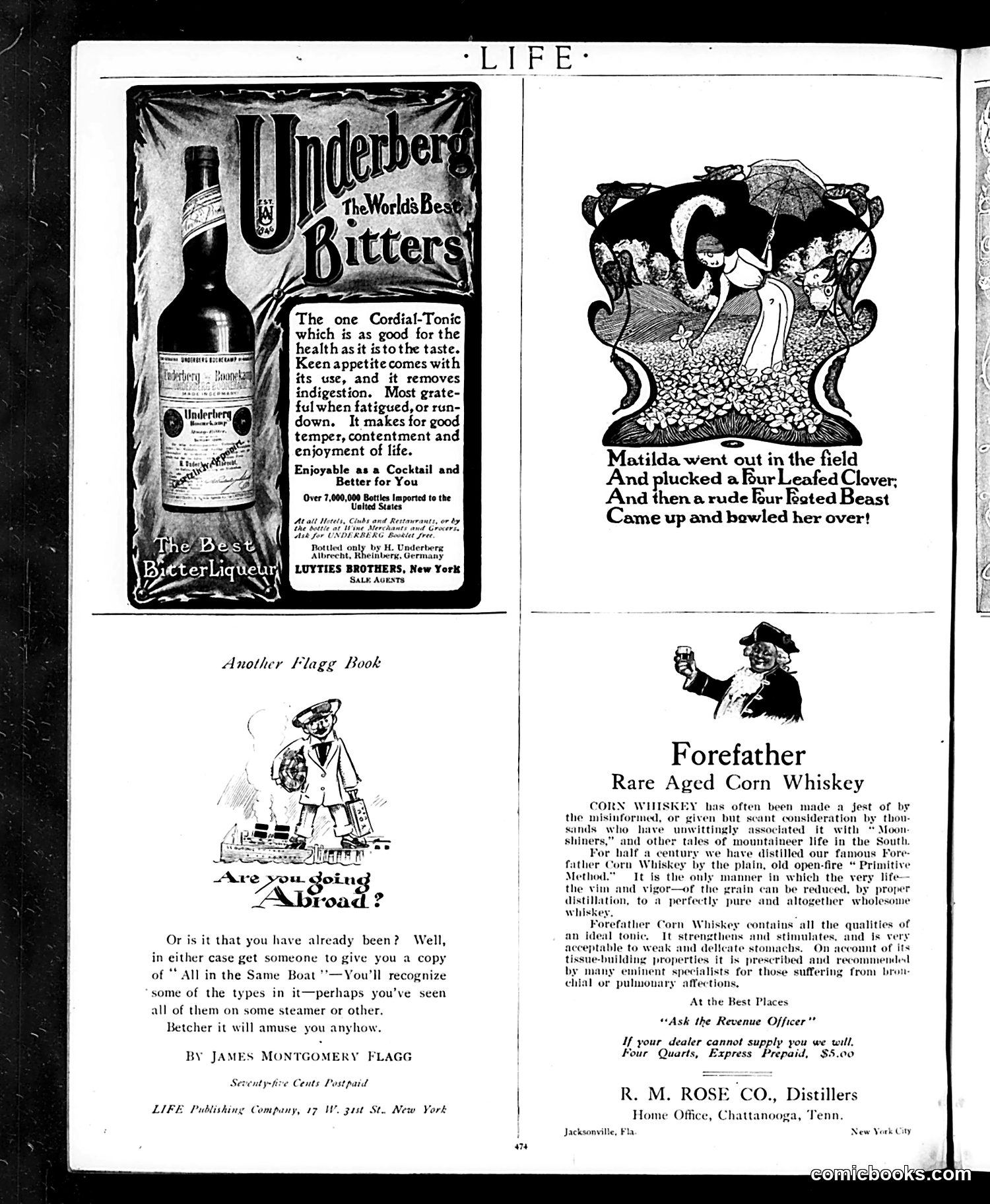
This Life magazine page is primarily **advertising**, not satire or political commentary. The left side advertises **Underberg Bitters**, a cordial-tonic marketed as beneficial for health and digestion. Below is a Flagg Book advertisement for "Are you going Abroad?" by James Montgomery Flagg. The right side features two advertisements: a whimsical illustrated narrative about "Matilda" and a four-leaf clover (text unclear in purpose), and below that, **Forefather Rare Aged Corn Whiskey** marketed as a pure grain liquor with medicinal properties, sold by R.M. Rose Co. of Chattanooga. The content reflects early 20th-century patent medicine advertising, when alcohol-based tonics were marketed with health claims now recognized as false. No political cartoons or satire appear on this page.
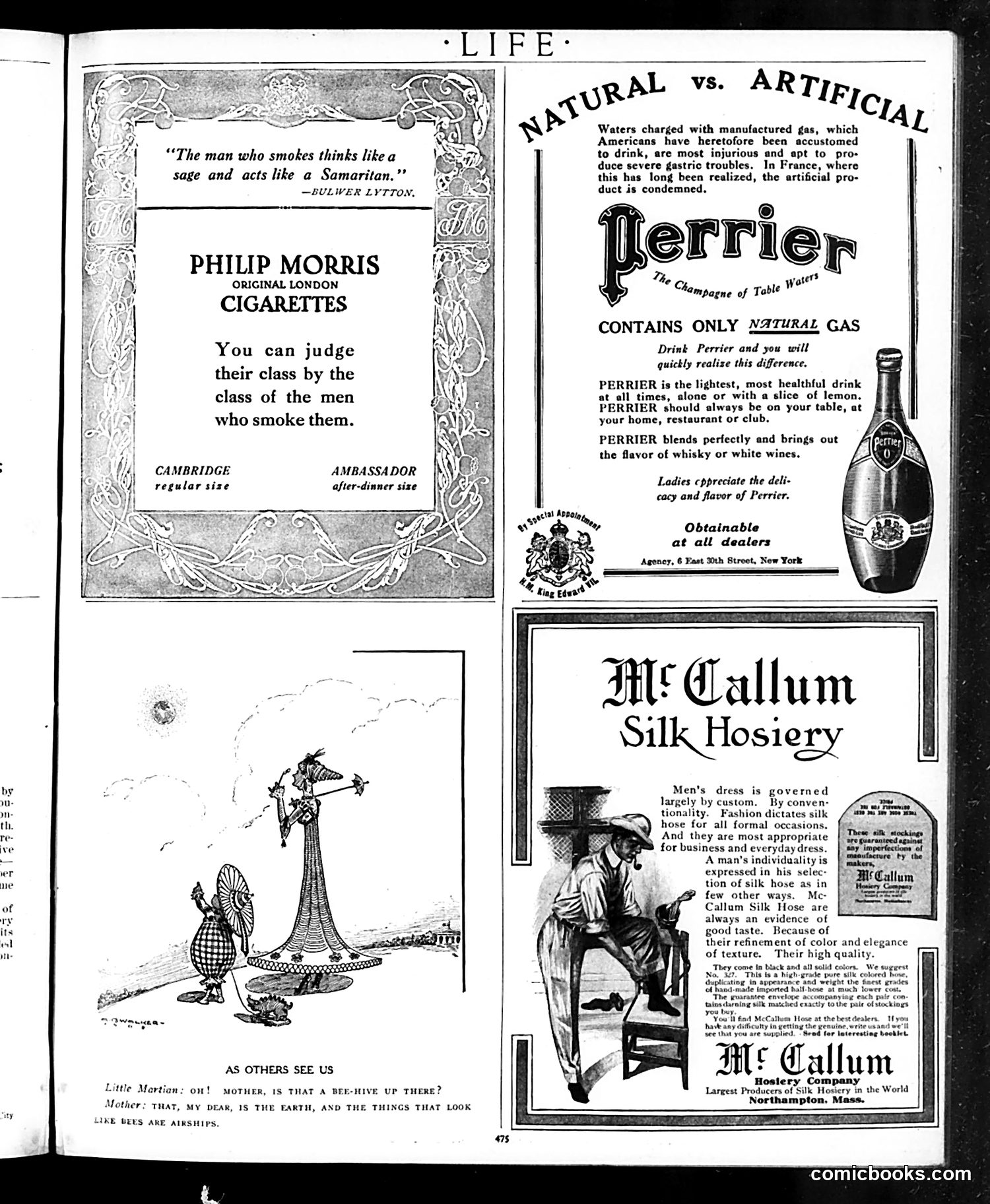
This page is primarily **advertisements** with one cartoon. The ads promote Philip Morris cigarettes, Perrier water, and McCallum Silk Hosiery. The cartoon ("As Others See Us") depicts a mother pointing at a bee-hive structure, telling her child that bees are airships. The joke satirizes how mothers provide fanciful or misleading explanations to children rather than truthful ones—a gentle jab at parental dishonesty or oversimplification for young audiences. The page reflects early 20th-century advertising practices and social attitudes. Notable is the Perrier ad's claim about "natural gas" being healthier than manufactured alternatives, and the hosiery ad's discussion of masculine dress conventions—details revealing period-specific consumer concerns now largely obsolete.
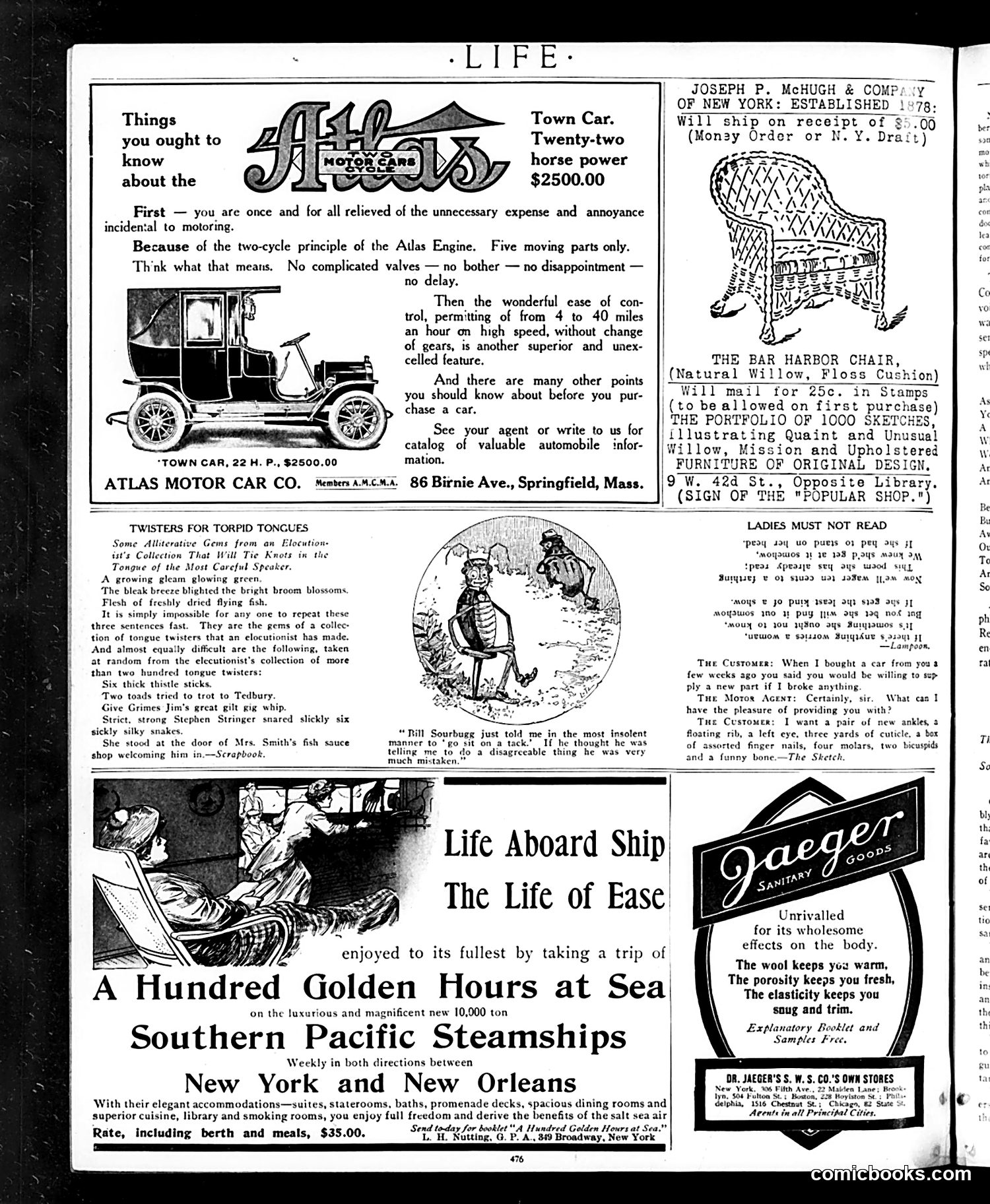
This page is **primarily advertising** with one small satirical cartoon. The main advertisements promote: - Atlas Motor Cars (a town car for $2,500) - Bar Harbor Chair (wicker furniture) - Southern Pacific Steamships cruises - Jaeger Sanitary Goods (wool clothing) The only cartoon appears under the heading **"LADIES MUST NOT READ"** and shows a man in what seems to be a domestic scene. The accompanying text discusses a car purchase and mentions "Bill Sourburg" telling someone about "the most insolent manner to go up in a trick." The joke appears to reference automotive reliability or a husband's questionable driving, but the satirical point is **unclear** without fuller context. The "ladies must not read" framing suggests it was considered mildly risqué humor for 1910s audiences.
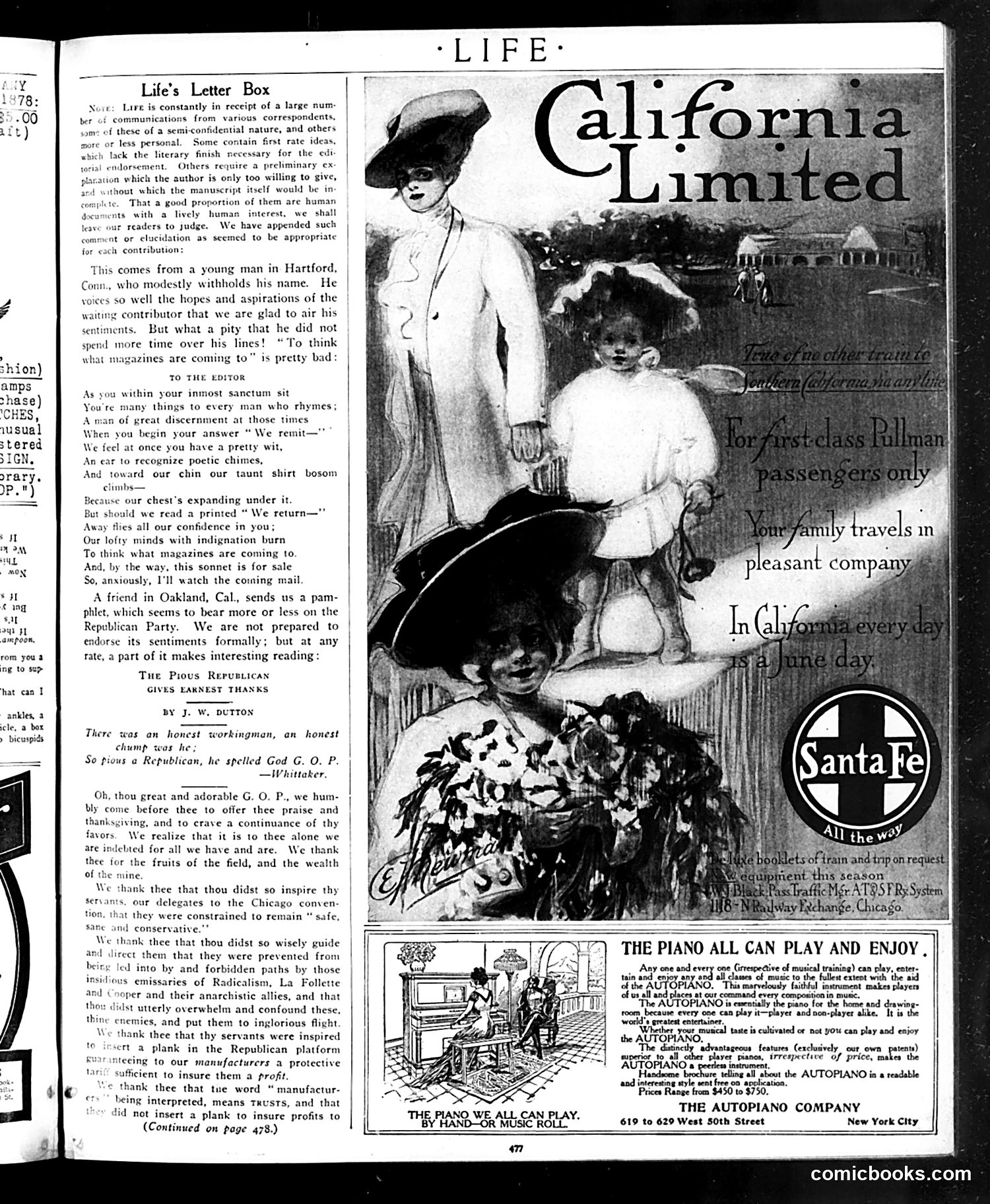
This page is primarily **advertising** rather than political satire. The dominant image is a Santa Fe Railroad advertisement for California travel, featuring a stylized illustration of a well-dressed woman and children with text promoting first-class Pullman travel and California's pleasant climate. The left side contains **"Life's Letter Box,"** a readers' letters section. One letter from Hartford, Connecticut presents a poem addressed "to the editor" that appears to be gentle literary satire about magazine writing. Below that is content titled **"The Pious Republican"** by J.W. Dutton, which satirizes Republican Party politics and mentions conventions and conservative positions, though the full satirical point requires seeing the continued text. The bottom features an **Autopiano advertisement** about a self-playing piano. This is a typical early 20th-century magazine page mixing editorial content with commercial advertising.
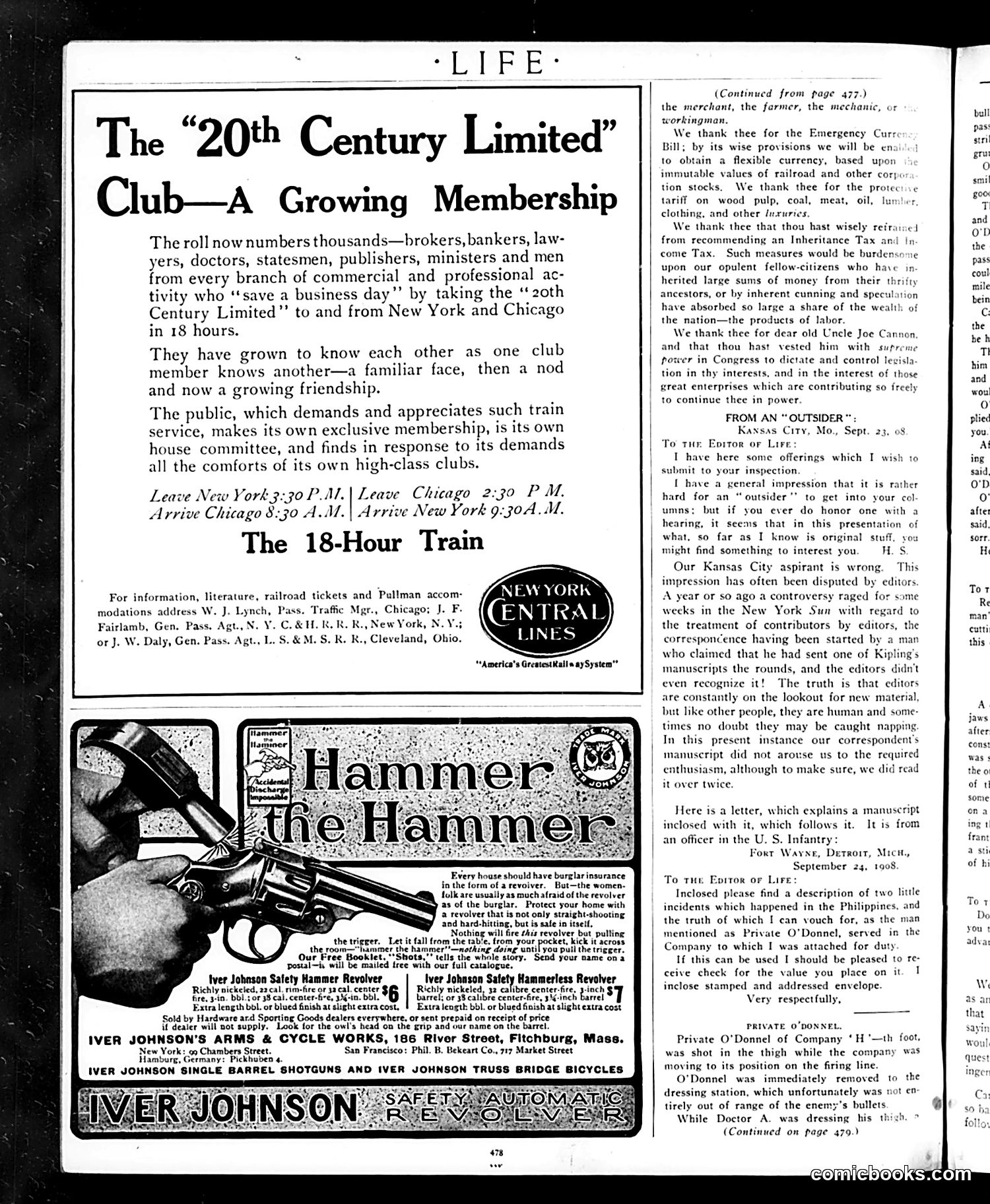
This page is primarily advertising and letters to the editor rather than satirical content. The main advertisement promotes the New York Central Railroad's "20th Century Limited" luxury train service, appealing to professional classes (brokers, bankers, lawyers, doctors). Below that is a "Hammer the Hammer" revolver advertisement from Iver Johnson, emphasizing home security against burglars. The right column contains readers' letters, including one from a Kansas City resident complaining about negative newspaper treatment of contributors, and another from a soldier named Private O'Donnel describing an incident in the Philippines. This appears to be a standard magazine page mixing commercial advertisements with reader correspondence rather than satirical editorial cartooning.
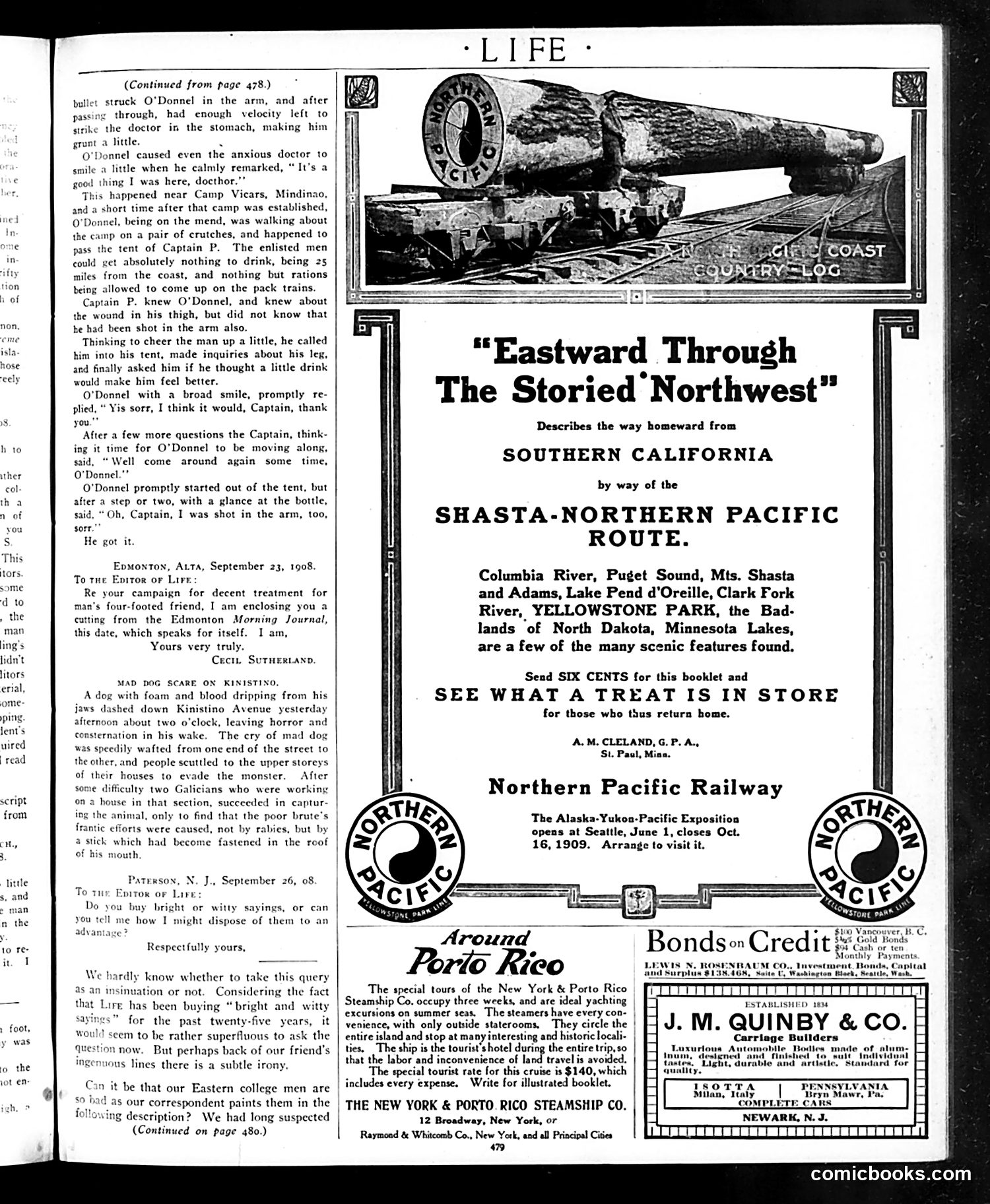
This page is primarily **advertising content** rather than political satire or editorial cartoons. The main visual element is a photograph of a large cannon labeled "ARTILLERY COAST DEFENSE," promoting a travel booklet about the "Shasta-Northern Pacific Route" from Southern California northward through scenic areas (Columbia River, Puget Sound, Yellowstone Park, etc.). The page contains several advertisements: - A Northern Pacific Railway travel promotion - A Porto Rico steamship tour ad - Carriage builder and investment company advertisements The left column includes reader letters about mundane topics (a dog scare in Kinistino, Saskatchewan; a medical anecdote from Edmonton). There is no political cartoon or satirical content visible. This appears to be a typical early-1900s magazine page mixing editorial correspondence with commercial advertising.
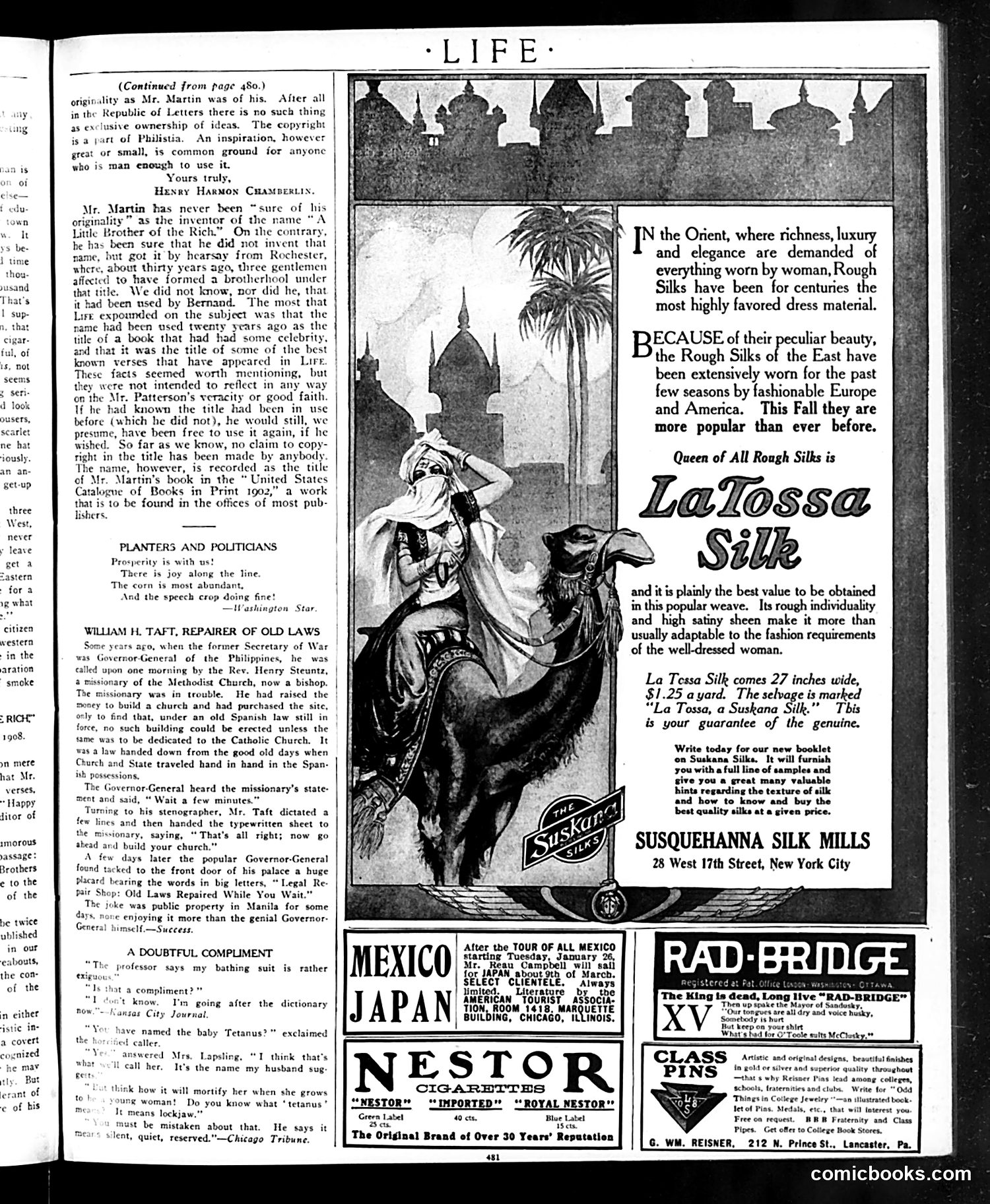
This page is primarily **advertising**, not satire or political cartoons. The dominant feature is a large advertisement for "La Tossa Silk" by Susquehanna Silk Mills, featuring an illustration of a woman in Oriental dress on a camel. The ad emphasizes that rough silks from the East have become fashionable in Europe and America. Below the silk advertisement are smaller ads for Mexico travel tours, Nestor brand products, Rad-Bridge automobiles, and Class Pins. The left column contains text articles (partially visible), including one titled "Planters and Politicians" and another about "William H. Taft, Repairer of Old Laws," but these are obscured and incomplete in the image provided.
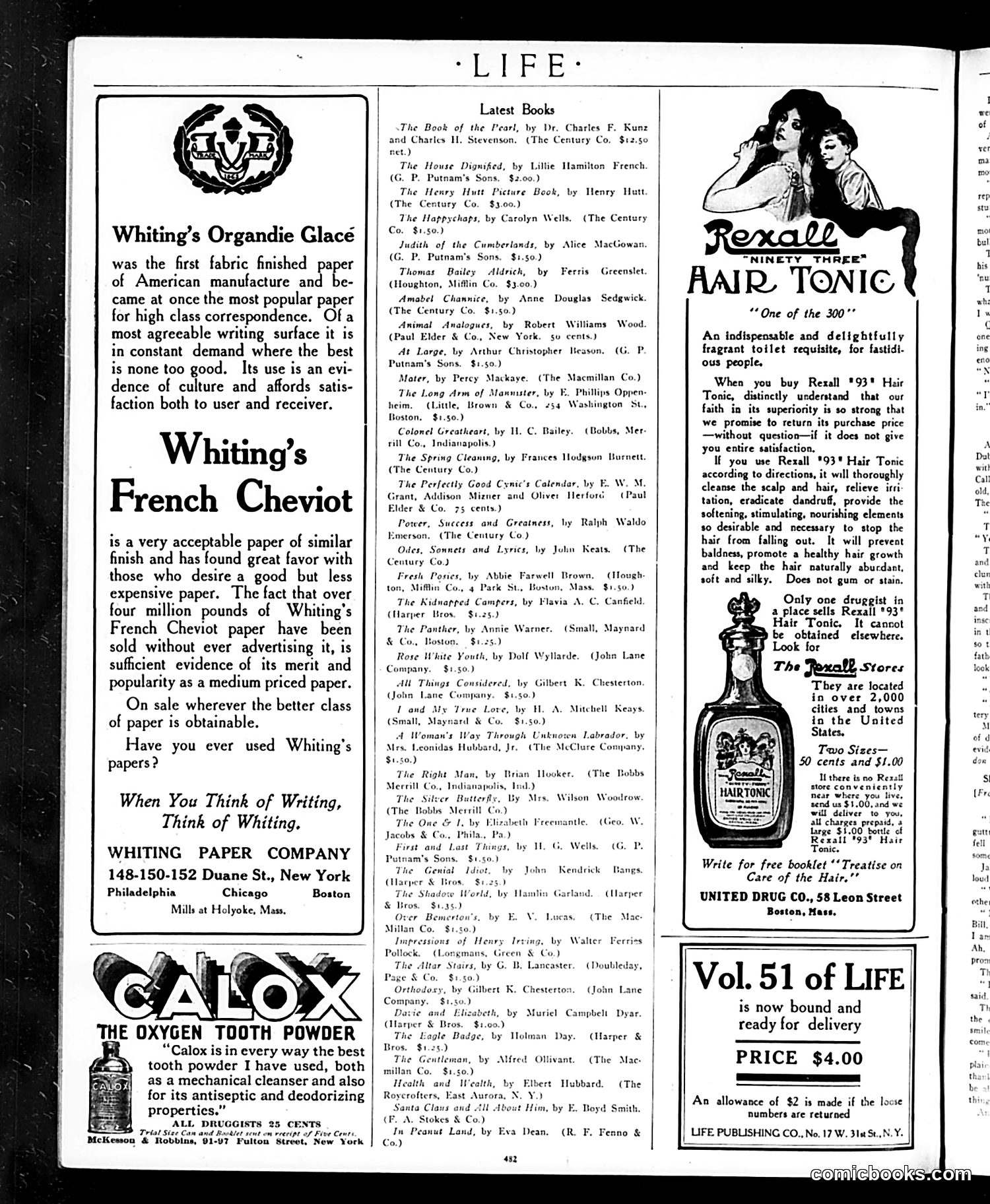
This page is primarily **advertising content**, not political satire. It contains three distinct ads: 1. **Whiting's Paper Company** — promoting high-quality writing papers (Organdie Glacé and French Cheviot), emphasizing their superiority for correspondence. 2. **Rexall "Ninety Three" Hair Tonic** — featuring an illustration of a woman with dark hair and a child, advertising a hair product with a money-back guarantee. The ad emphasizes hair health and growth. 3. **Calox Tooth Powder** — a brief endorsement claiming superiority as a tooth powder for cleaning and deodorizing. There is **no political cartoon or social satire** on this page. The content reflects early 20th-century consumer goods marketed through lifestyle and quality claims typical of period magazine advertising.
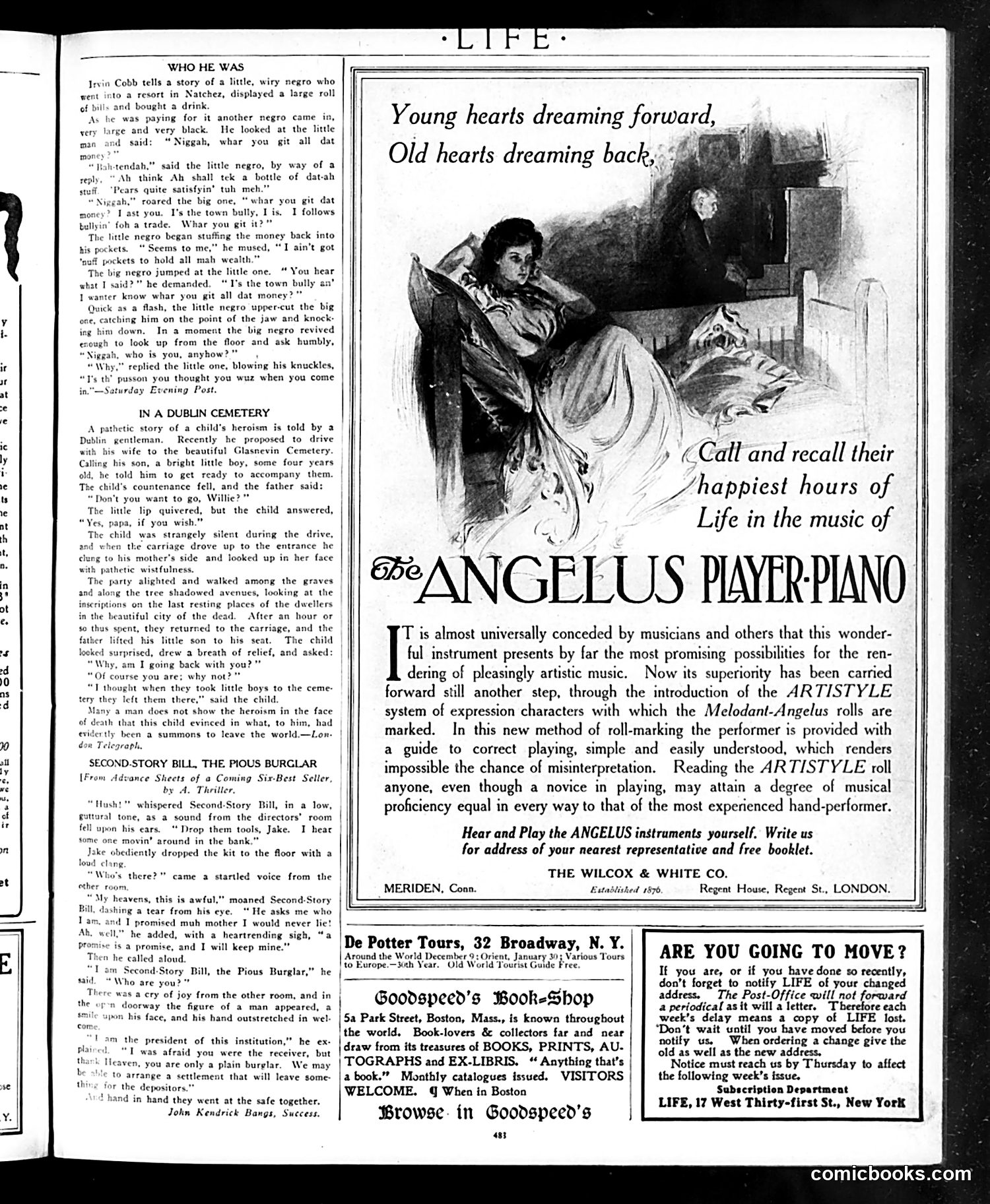
This page is primarily a **full-page advertisement** for the Angelus Player-Piano, not political satire. The illustrated image shows an elderly couple in domestic contentment, with the tagline "Young hearts dreaming forward, / Old hearts dreaming back." The ad's central claim is that this player-piano allows untrained people to perform artistic music. It emphasizes the "ARTISTYLE" system of roll-marking, which supposedly enables even novices to achieve musical proficiency "equal in every way to that of the most experienced professional." The advertisement positions the piano as a means for families to access culture and refinement. The surrounding page includes unrelated story excerpts and other advertisements typical of Life magazine's commercial content from this era.
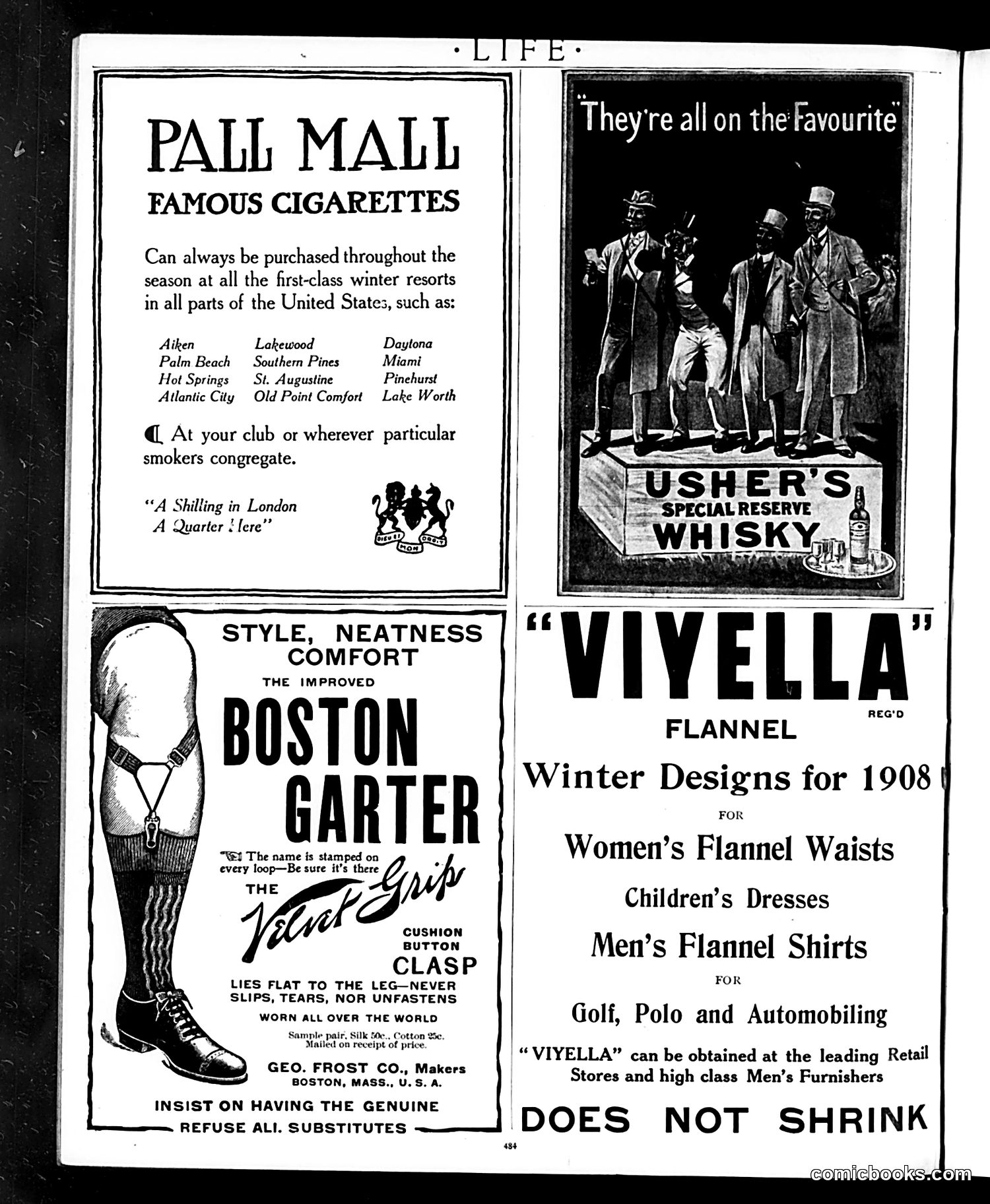
This is primarily a **commercial advertising page** from early 1908, not political satire. It contains four product advertisements: 1. **Pall Mall Cigarettes**: Emphasizes luxury positioning by listing prestigious American winter resort destinations where the brand is sold, suggesting cigarettes for the wealthy leisure class. 2. **Boston Garter**: A men's sock garter with an illustration of a leg/foot. The ad stresses reliability ("never slips, tears, nor unfastens") and authenticity ("insist on having the genuine"). 3. **Usher's Whisky**: Features well-dressed men in top hats with the tagline "They're all on the Favourite," marketing to affluent drinkers. 4. **Vivella Flannel**: Winter clothing for "Golf, Polo and Automobiling"—sports associated with the wealthy. The "does not shrink" claim addresses a practical consumer concern. The page targets **upper-class consumers** across multiple product categories, reflecting early-20th-century consumer capitalism and the aspirational lifestyle marketed through magazines.
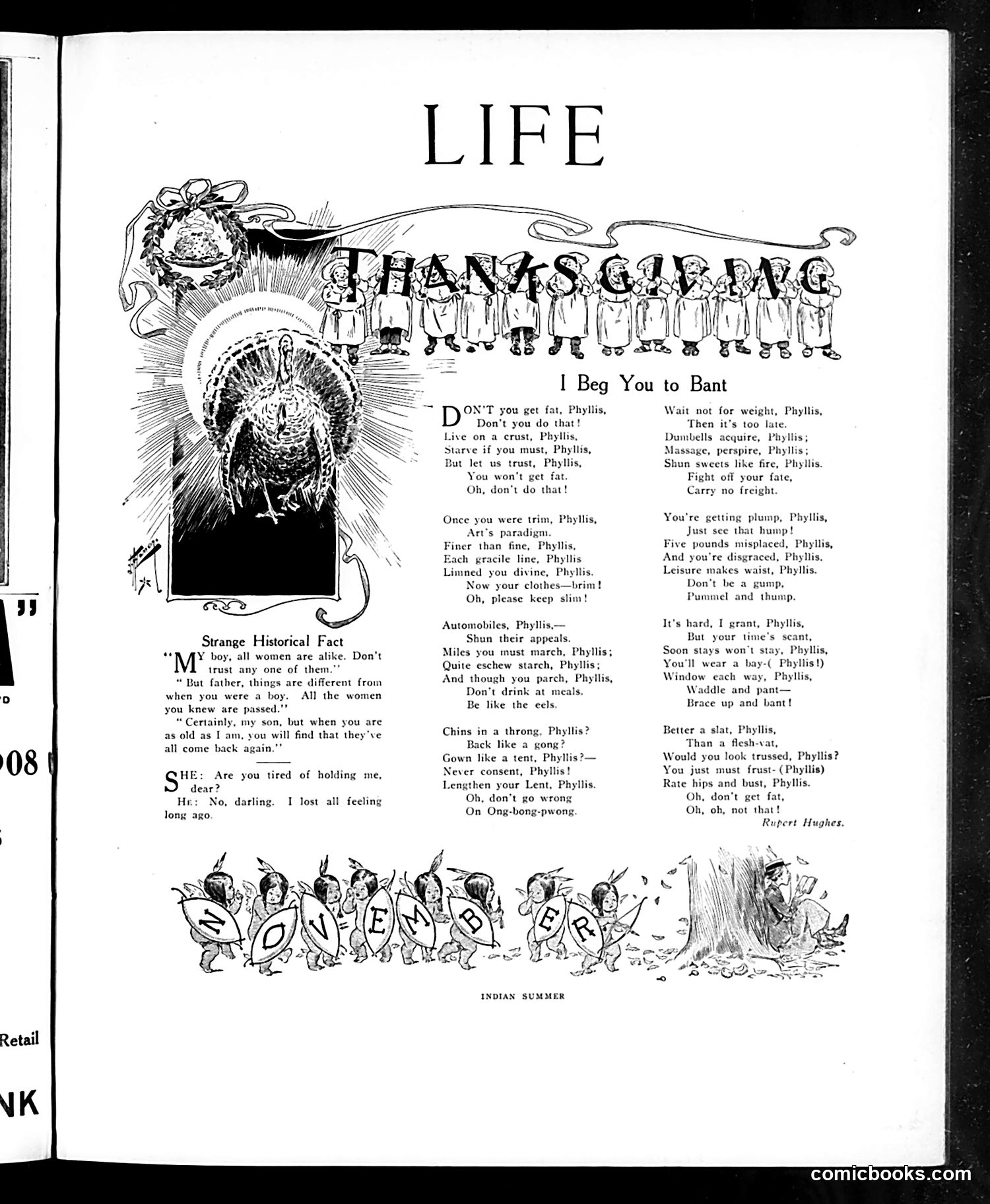
This page combines two distinct satirical pieces from an early 20th-century American humor magazine. **"Strange Historical Fact"** mocks male cynicism about women through a generational dialogue: an older man insists all women are alike and untrustworthy, claiming the specific women change but the type remains constant—a dig at misogynistic attitudes. **"I Beg You to Bant"** (by Rupert Hughes) is extended satire on the obsessive dieting culture and body-shaming of the era. "Banting" was a popular weight-loss method. The poem relentlessly mocks a woman named Phyllis, pressuring her not to gain weight through increasingly absurd demands—no automobiles, no starches, constant exercise. The satire targets how society (and men especially) police women's bodies, with the humor pointing at the *ridiculousness of these expectations* rather than at Phyllis herself. The accompanying turkey and Native American illustrations likely reference Thanksgiving, connecting the food-focused satire to seasonal context.
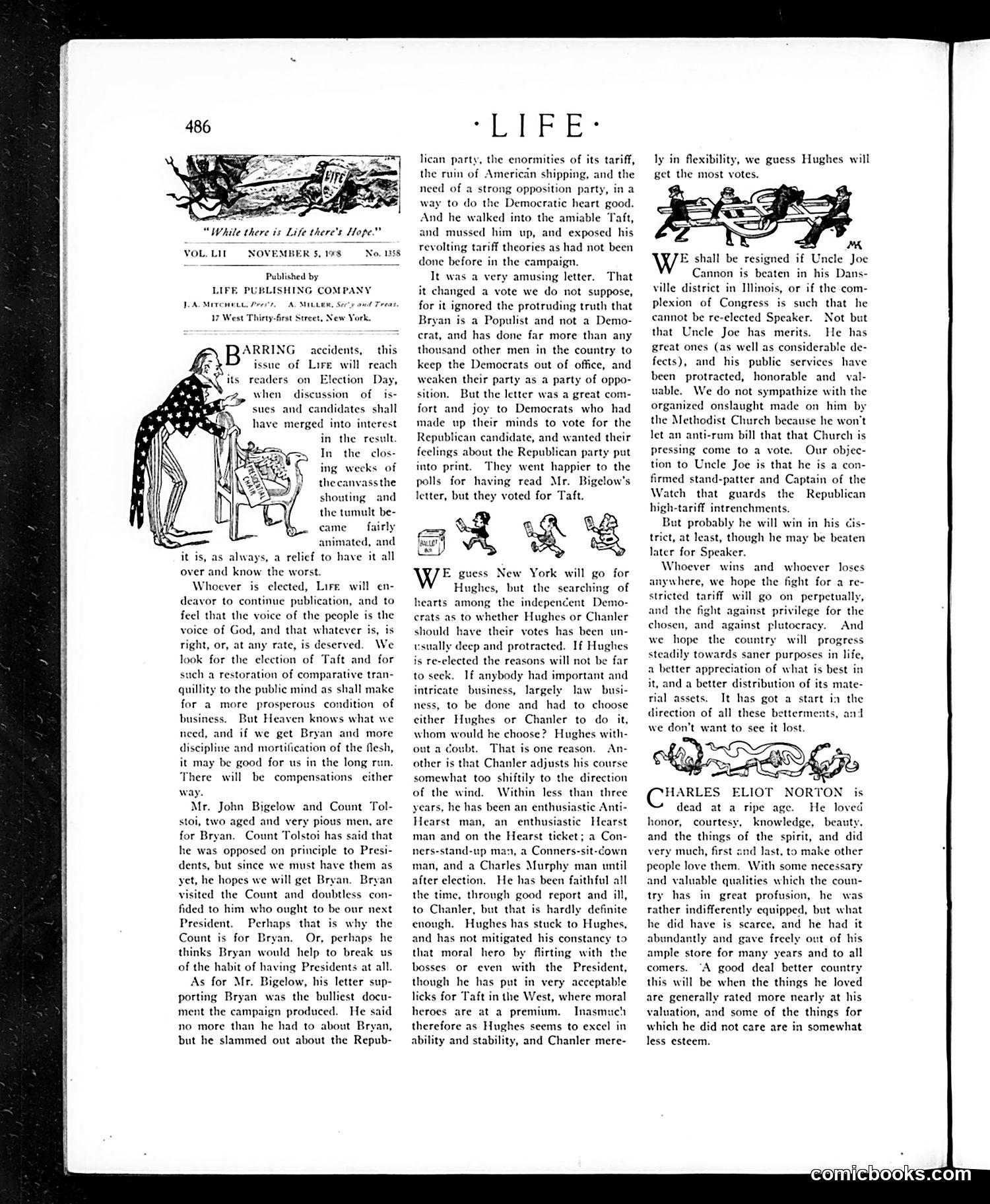
This is **Election Day commentary** for the 1908 U.S. presidential election. The main editorial discusses the campaign between Republican **William Howard Taft** and Democrat **William Jennings Bryan**. The text references: - **John Bigelow** and **Count Tolstoy** (Russian author), both supporting Bryan, criticized for their idealism - **Bigelow's letter** attacking Republican tariff policies, though it didn't change votes - Bryan's weakness as a candidate despite Democratic enthusiasm - Comparison between **Hughes** and **Chanler** (likely Democratic candidates for New York office), with Hughes favored for stability The editorial's tone is satirical and weary—expressing relief the campaign is ending while maintaining cynical detachment about the outcome. Life promises to "continue publication" regardless of results, treating the election as inevitable theater rather than consequential choice. The illustrations appear to show period political caricatures, though specific identities are difficult to confirm from this reproduction.
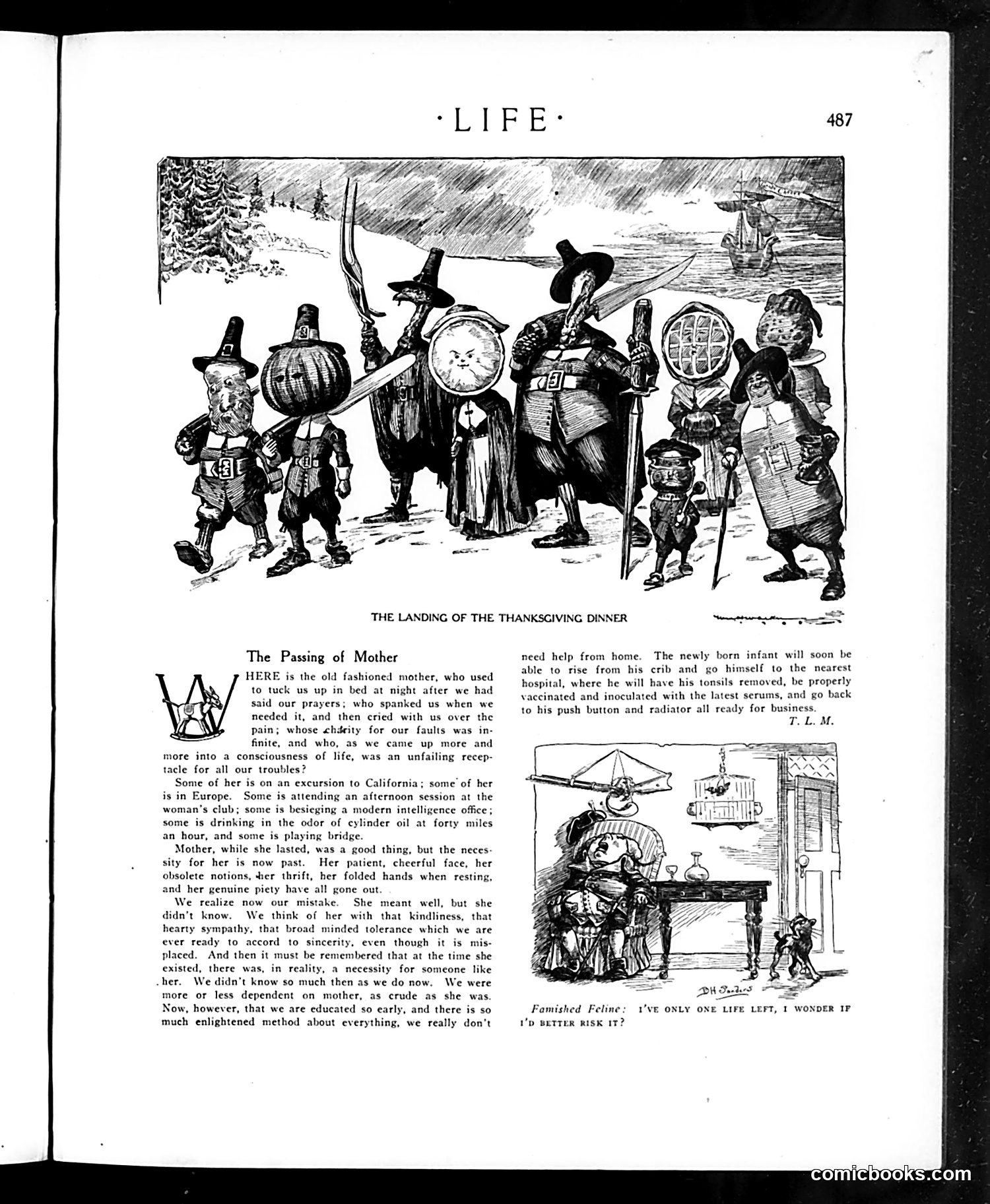
**Top Cartoon ("The Landing of the Thanksgiving Dinner"):** A satirical woodcut showing anthropomorphic animals in colonial/pilgrim dress presenting a turkey to a mother figure. The joke appears to reference historical Thanksgiving imagery, likely mocking either the idealization of traditional holiday celebrations or contemporary debates about tradition versus modernity. **Main Article ("The Passing of Mother"):** This is social satire lamenting the decline of traditional motherhood. The author criticizes modern educated society for abandoning the "old fashioned mother" who provided unconditional care, patience, and moral guidance. The text lists where contemporary mothers are instead: California excursions, women's clubs, driving fast cars, playing bridge—activities representing 1920s modernity. The satire's target: educated society's assumption that modern efficiency and early scientific education have replaced the need for maternal care and traditional family values. The final paragraph's ironic tone (infants going to hospitals alone via "push button") emphasizes the absurdity of this belief. **Bottom Cartoon ("Famished Feline"):** A starving cat questions risking its last life, likely commenting on economic hardship or precarious living conditions of the era.
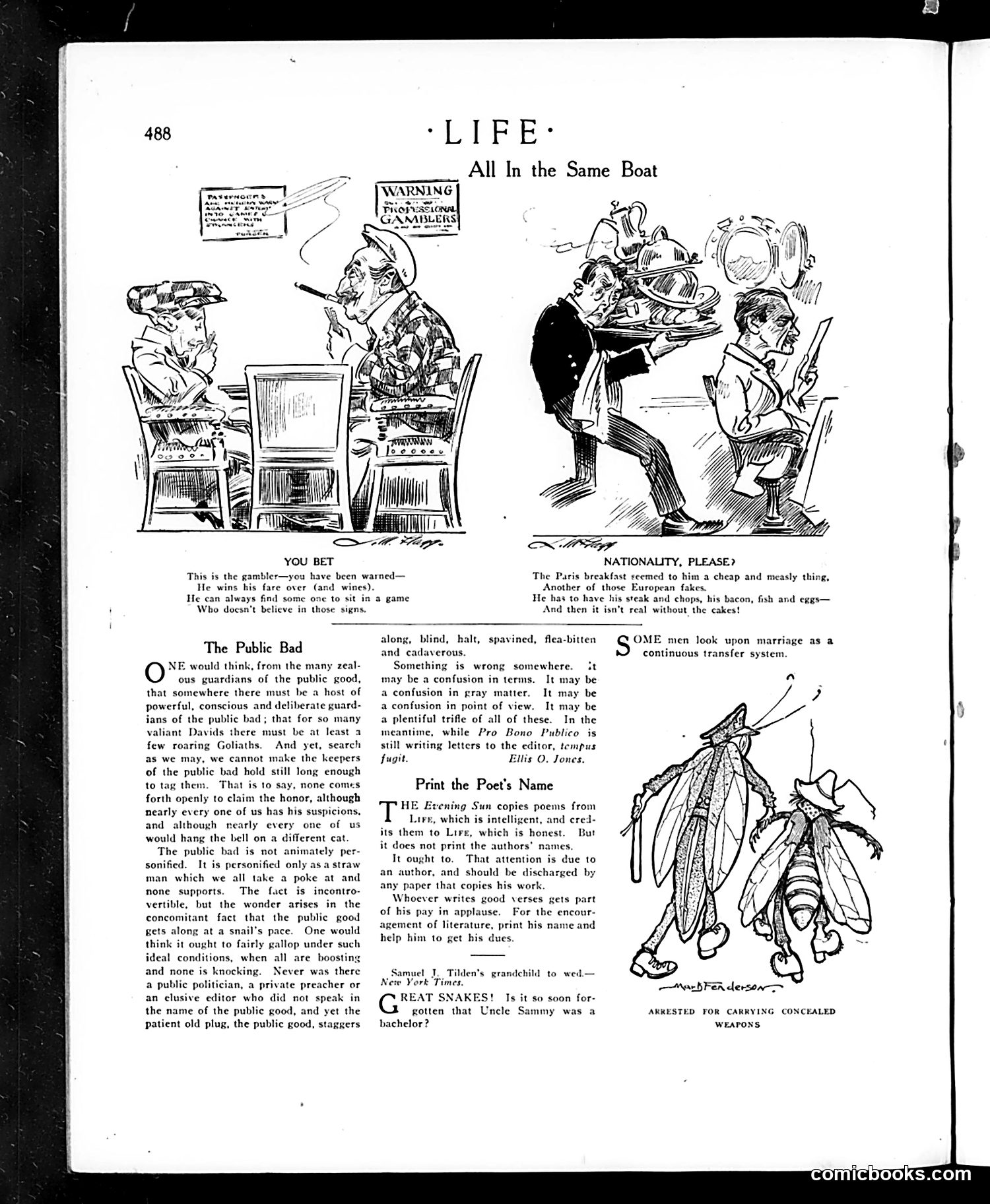
This early 20th-century satirical page contains three distinct pieces: **"All In the Same Boat"** (top cartoons): Two scenes mocking American travelers abroad. Left: a professional gambler confident he can fleece anyone. Right: an American tourist dismissing Paris's "cheap" breakfast, insisting on familiar American fare (steak, bacon, eggs). The satire targets American arrogance and materialism abroad. **"The Public Bad"** (essay): A philosophical complaint that while everyone claims to champion "the public good," no one openly defends "the public bad"—yet society progresses slowly anyway. The author suggests confusion about values prevents actual progress. **"Print the Poet's Name"**: Criticizes the *Evening Sun* newspaper for republishing *Life* magazine's poems without crediting original authors, arguing writers deserve attribution and recognition. **Lower items**: Brief jokes about marriage as financial transaction and a cartoon about concealed weapons arrests. The page reflects *Life*'s focus on social criticism and literary matters rather than hard politics.
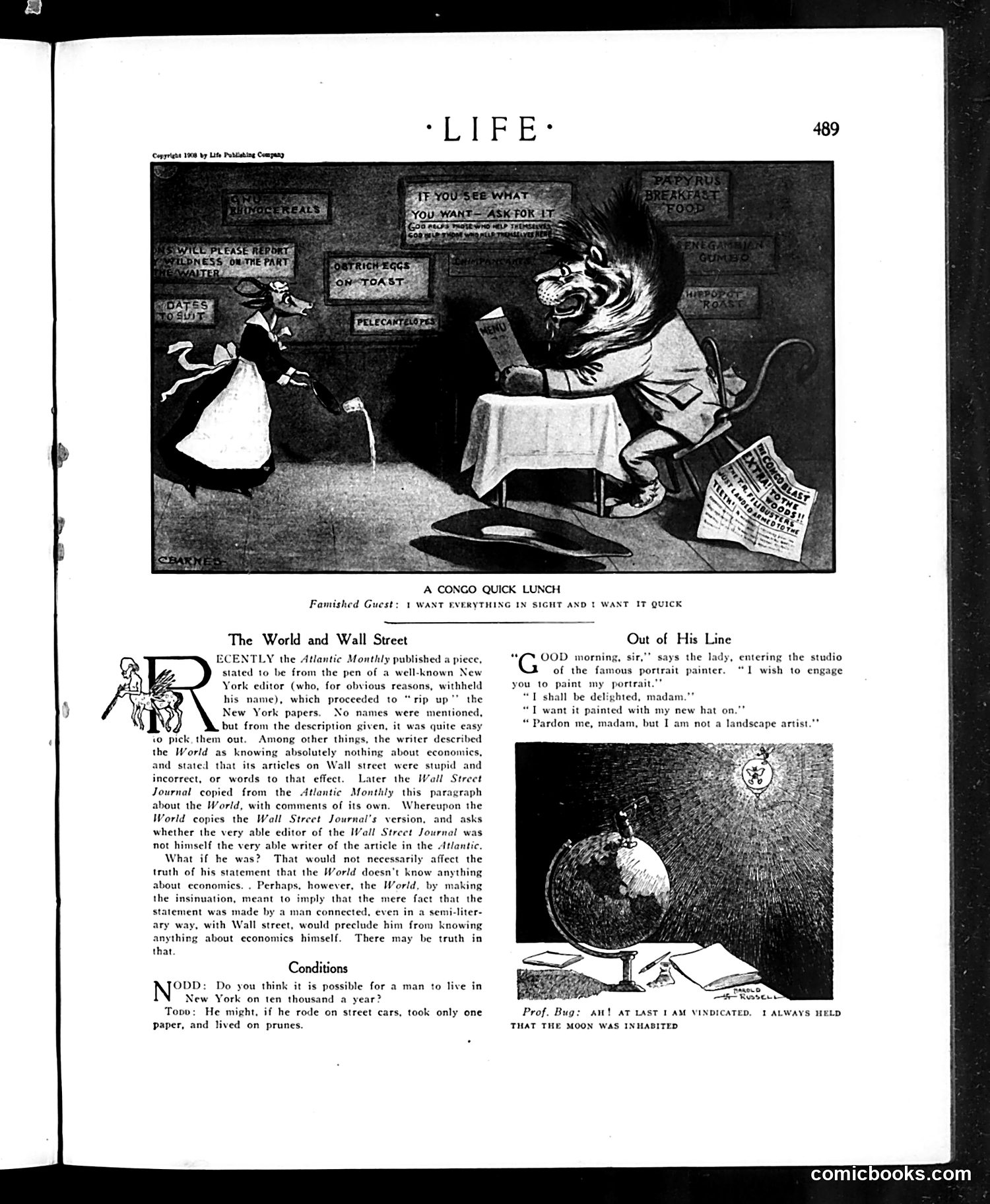
**Top Cartoon ("A Congo Quick Lunch"):** A caricatured Black figure (drawn in the deeply racist style typical of early 1900s American magazines) sits at a table demanding quick service, while a frightened waiter flees. The title references "Congo," playing on contemporary stereotypes about African people as "savage" or "primitive." The joke relies on dehumanizing racial caricature—a standard form of casual racism in this era's popular media. **"The World and Wall Street" Section:** Satirizes newspaper rivalry and defensive journalism. The *Atlantic Monthly* published an anonymous critique of the *New York World's* economic coverage as ignorant. The *Wall Street Journal* republished this, and the *World* responded by insinuating the *Journal's* editor wrote it—attempting to discredit the criticism by suggesting bias. The satire questions whether origin matters if the criticism is factually true. **Right cartoon ("Out of His Line"):** A portrait painter refuses to include a woman's new hat, claiming landscape painting isn't his specialty—a joke about the hat's presumably outlandish size or appearance.
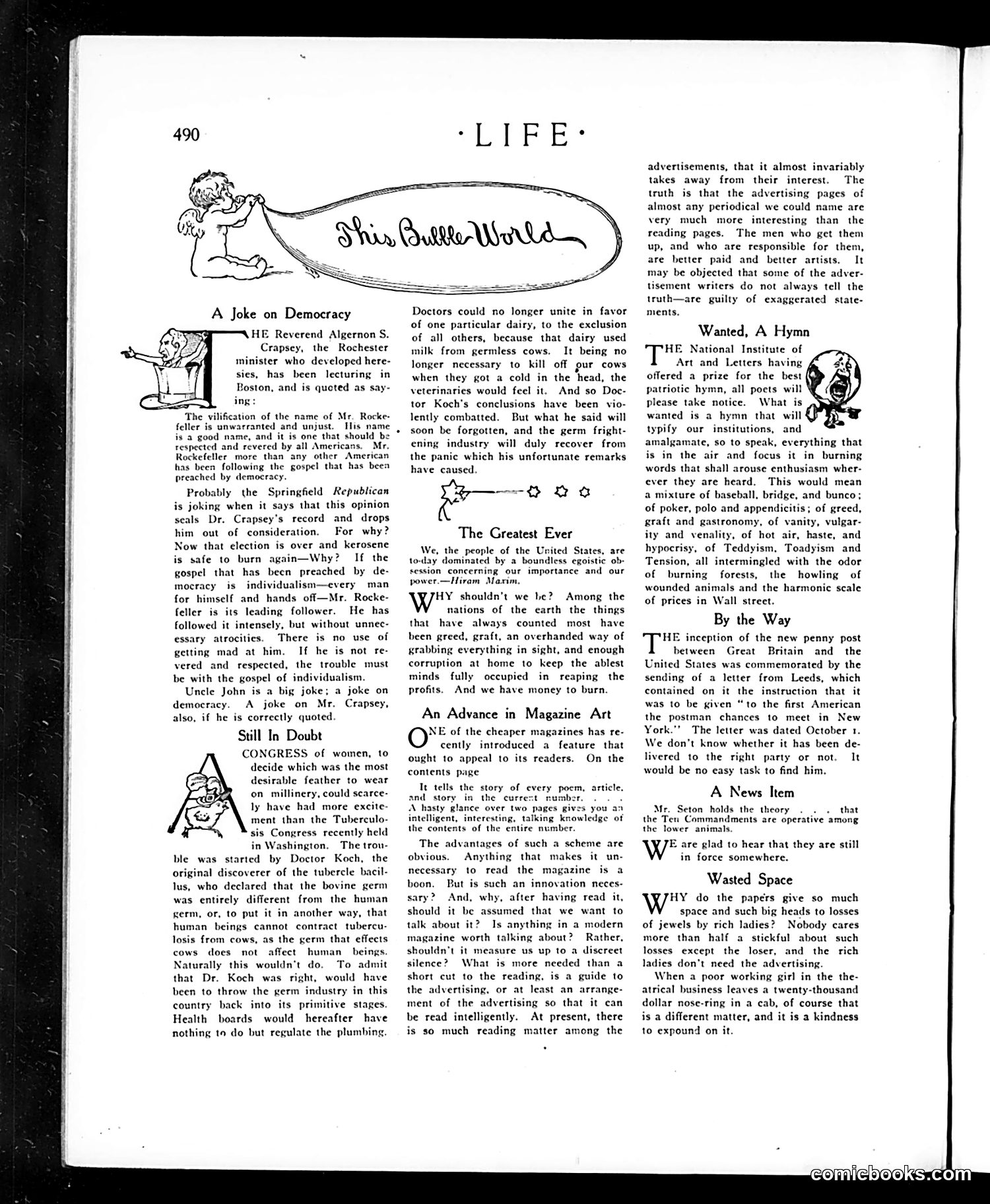
This page contains three satirical pieces attacking American institutions: **"A Joke on Democracy"** mocks Reverend Crapsey for praising Rockefeller as embodying democratic ideals of individualism ("every man for himself"). The satire is bitter: if democracy truly means selfish individualism without restraint, then Rockefeller—who pursued ruthless business practices—is its perfect exemplar. The joke exposes the hypocrisy of celebrating both democracy and unchecked capitalist greed. **"Still in Doubt"** ridicules the medical and public health establishment. It sarcastically notes that Doctor Koch's discovery that bovine tuberculosis differs from human tuberculosis threatens entire industries—veterinarians, dairy inspectors, and health boards profit from disease panic. The satire suggests these professionals suppress scientific truth to maintain their lucrative "germ frightening industry." **"The Greatest Ever"** quotes inventor Hiram Maxim criticizing American egotism, greed, and corruption, while noting Americans have "money to burn"—validating his critique through material success itself. All three pieces attack institutional corruption and self-interest masquerading as public good.
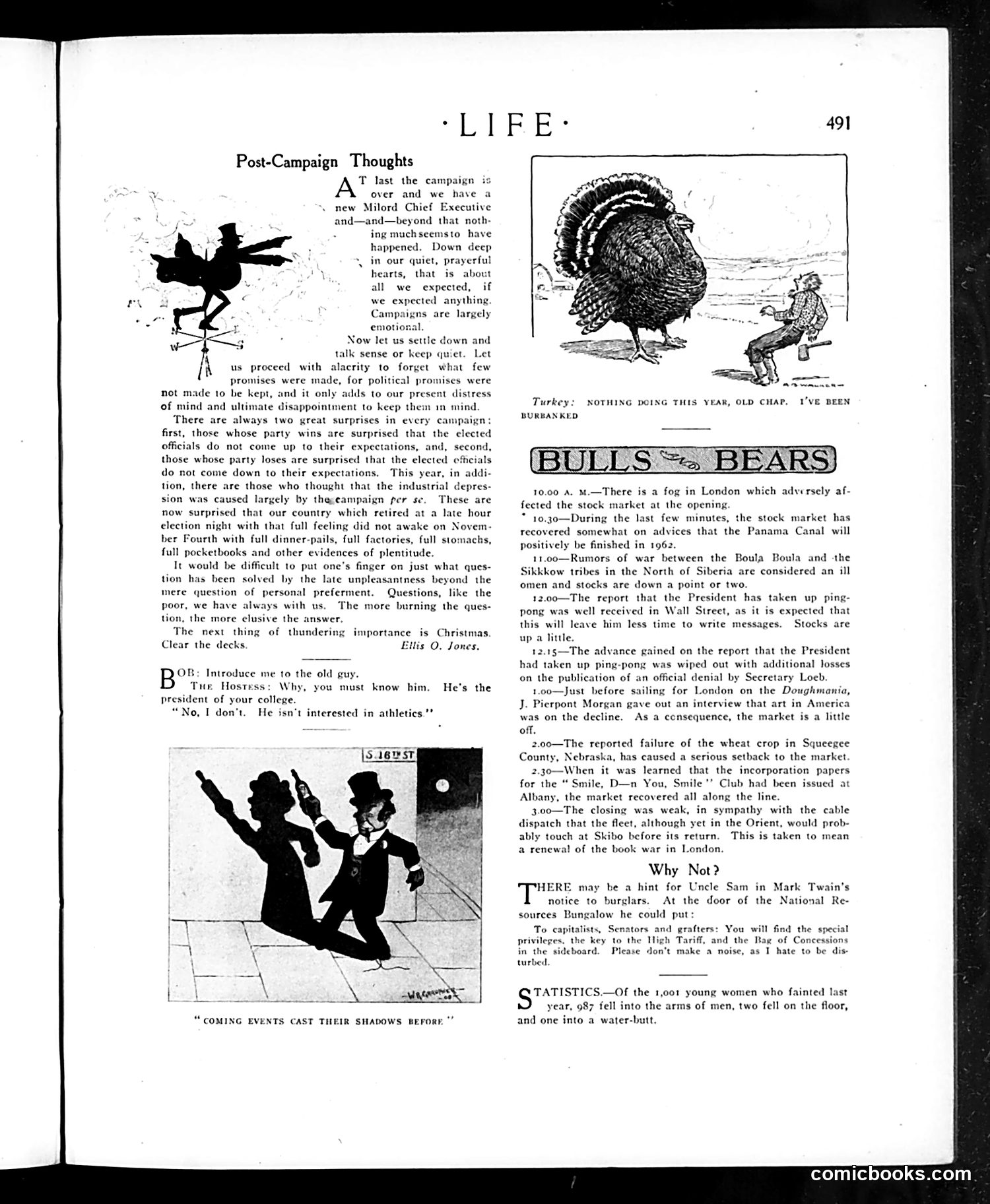
This page mocks the American public's post-election disappointment (appears to be after the 1912 election based on context clues like "new Milord Chief Executive"). **Main Cartoon (center):** Shows a turkey being told "Nothing doing this year, old chap. I've been Burbanked"—a reference to Luther Burbank, the famous plant breeder. The joke suggests the nation's prospects have been selectively bred into nonexistence. **Other elements:** - Upper left silhouette: A caricatured political figure - Lower cartoon: Two figures labeled "Coming Events Cast Their Shadows Before"—suggesting warning signs ahead **"Bulls & Bears" Stock Market column:** Satirizes how petty news (ping-pong, club charters, rumors) moves markets, mocking both Wall Street sensitivity and presidential triviality. **Main theme:** Political campaigning promises much but delivers nothing; voters expect improvement but get disappointment regardless of which party wins.
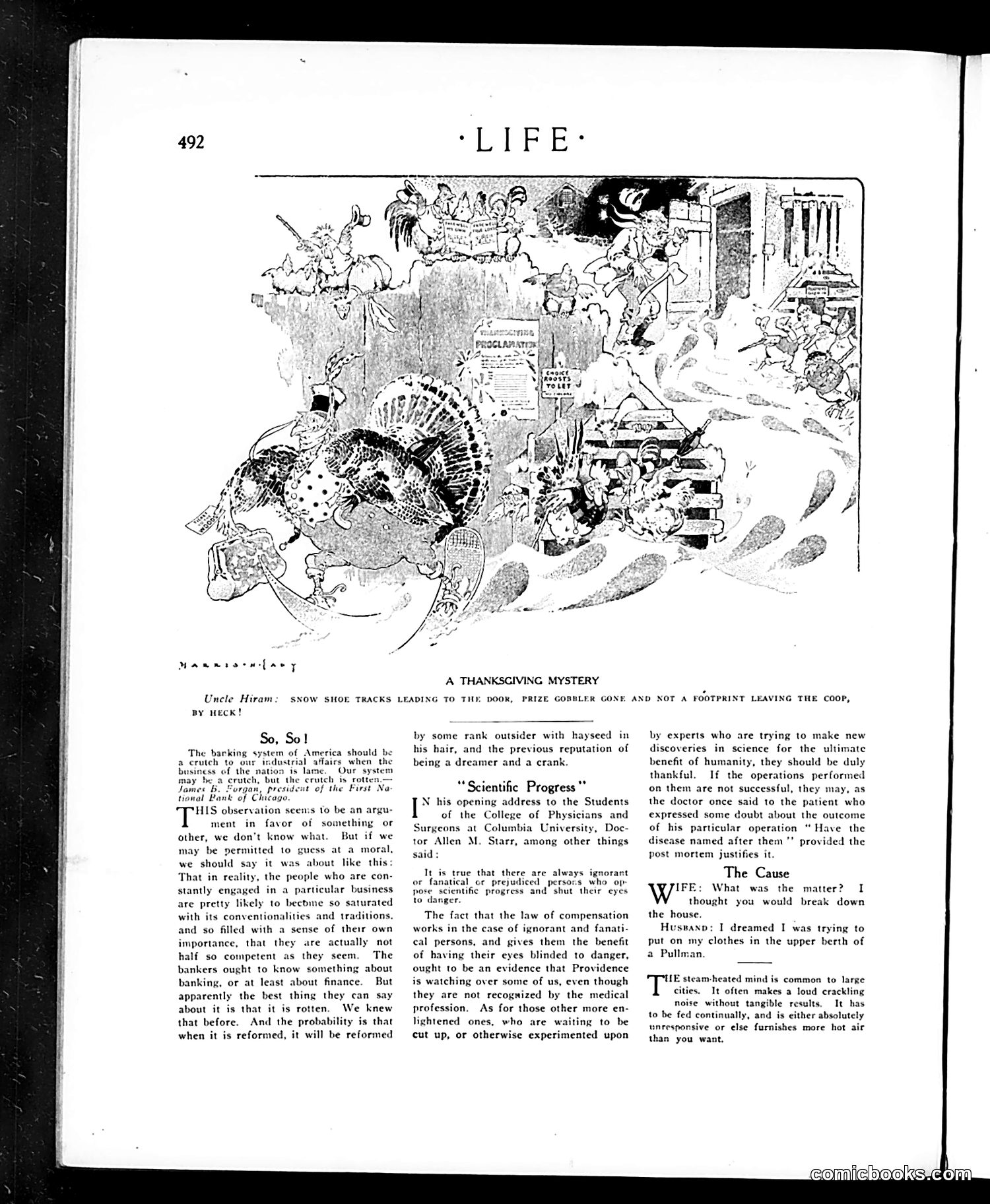
This page contains two satirical pieces targeting institutional incompetence and medical ethics. **"Uncle Hiram" cartoon** (top): A humorous mystery illustration featuring snow shoe tracks—a visual pun on institutional bumbling. The accompanying text mocks bankers and financial leaders, arguing that people saturated in their profession's "conventionalities and traditions" become incompetent despite appearances. The author suggests banking reform will only come from outside "dreamers and cranks," not insiders. **"Scientific Progress" section**: Quotes Doctor Allen M. Starr's address to Columbia medical students, then satirizes it. The satire targets medical experimentation on patients—suggesting Providence "blinds" the ignorant to danger while enlightened patients should be "duly thankful" even if operations fail, since failed procedures can at least be "named after them" in post-mortem analysis. This bitterly mocks cavalier attitudes toward experimental medicine and patient welfare. Both pieces critique institutional self-interest masquerading as expertise.
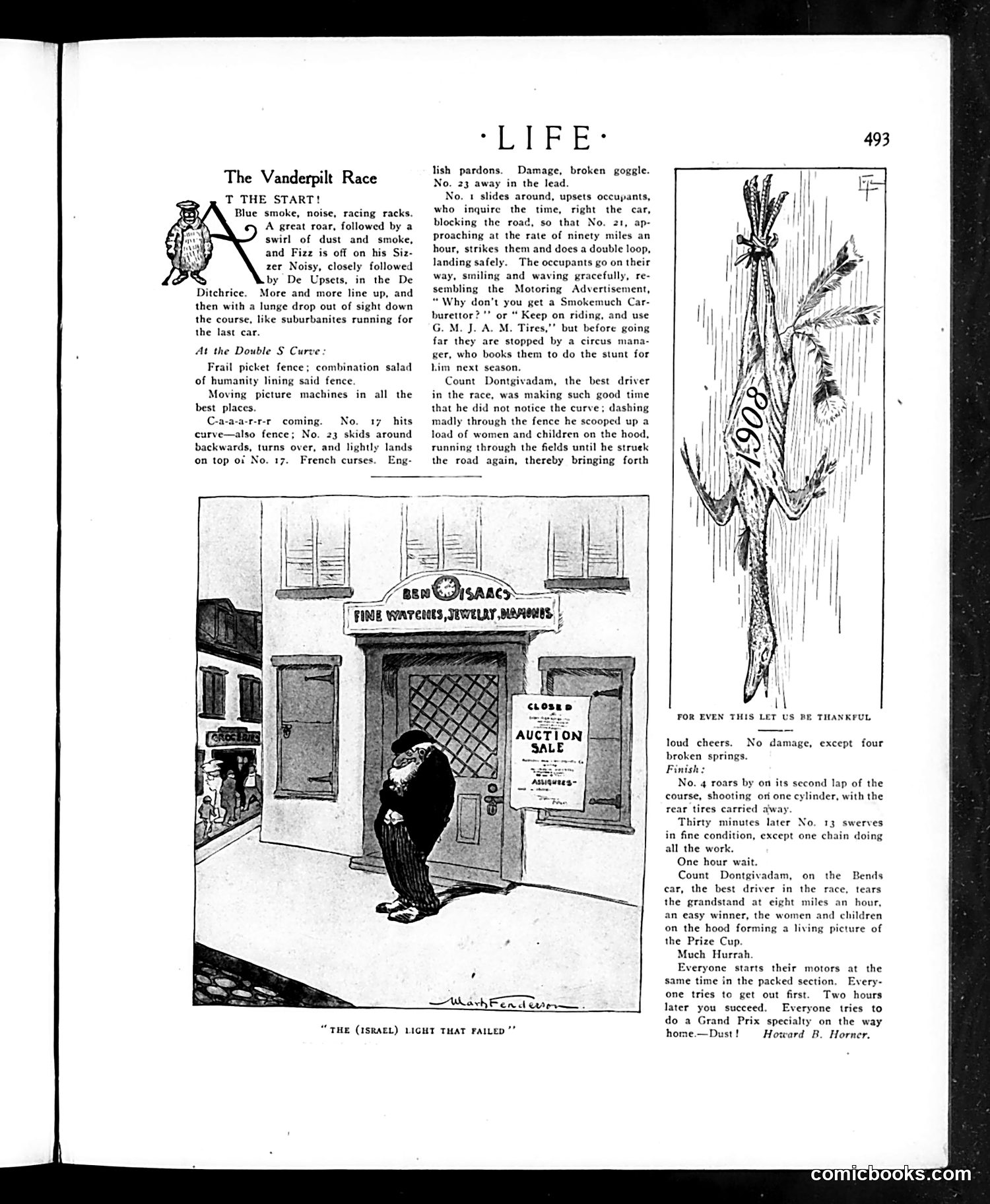
This is a humorous narrative account of a motor race (likely the Vanderbilt Cup, a real early 1900s American racing event). The satire mocks both reckless drivers and the chaos of early automobile racing spectacles. The cartoon depicts a jewelry store ("Ben Isaac, Time Watches, Jewelry") with an "Auction Sale" sign—appearing to reference a business failure, though the connection to racing remains unclear. The story ridicules dangerous driving: cars crash through fences, spectators are scooped onto hoods, vehicles flip and land on each other. Yet drivers emerge unharmed, behaving like they're in advertisements ("smiling and waving gracefully"). Count Dontgivadam wins despite mechanical failure, carrying women and children on his hood as a "living picture of the Prize Cup." The satire targets automobile racing's recklessness and the absurd advertising culture surrounding early motoring. The ending emphasizes post-race traffic chaos—everyone leaving simultaneously creates another "race." The cartoonist is Howard B. Horner.
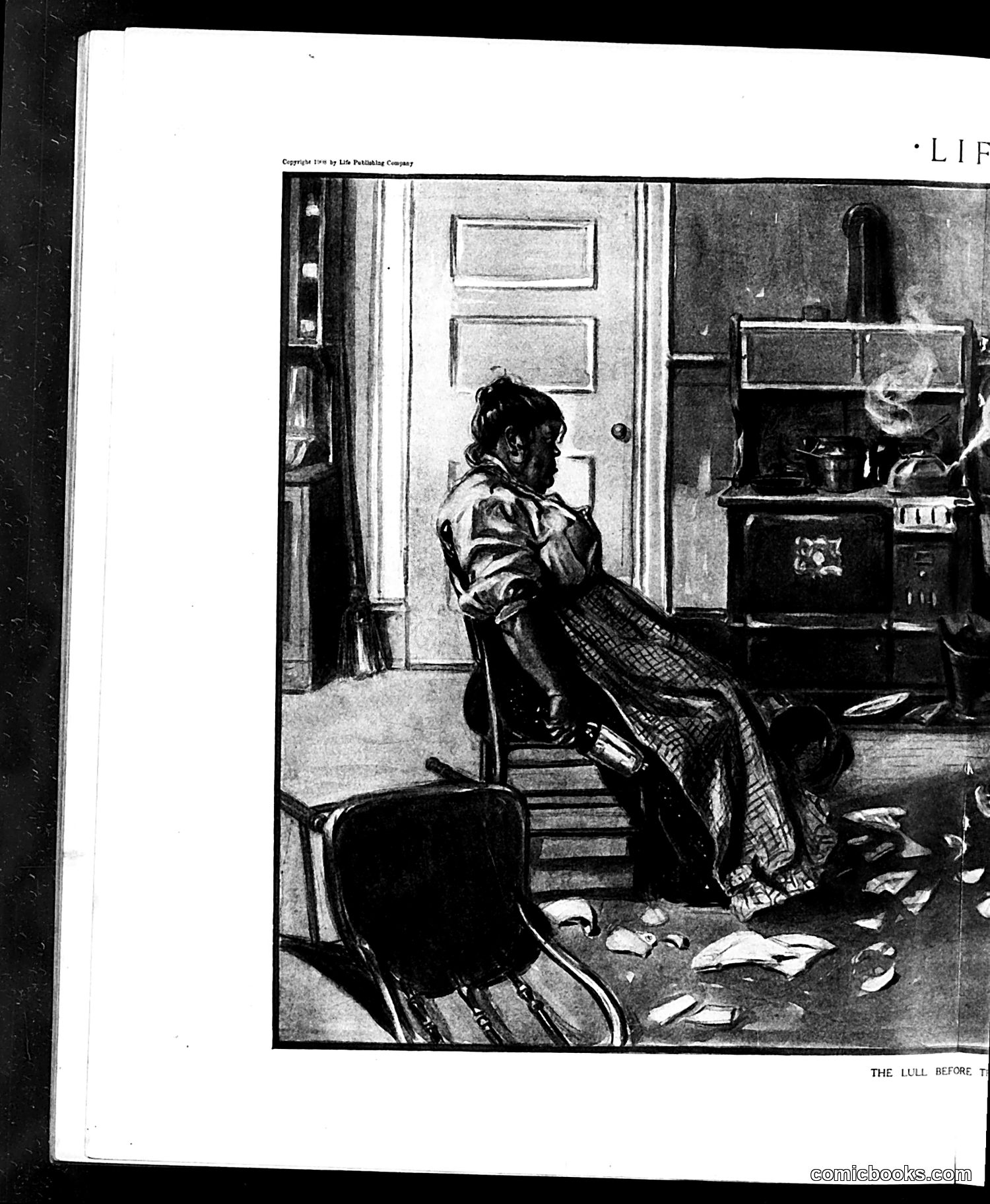
This illustration depicts a domestic kitchen scene from what appears to be the early 20th century. A woman sits alone by a stove in a messy kitchen, surrounded by scattered papers or items on the floor. The caption reads "THE LULL BEFORE T[HE STORM]" (text cut off). The cartoon appears to satirize domestic life—specifically the calm moment before chaos erupts, likely referencing the contrast between household order and disorder, or perhaps the quiet before conflict. The woman's posture suggests resignation or exhaustion rather than contentment. Without seeing the full caption and surrounding context, the specific social or political target remains unclear, though it likely comments on domestic drudgery or family tensions common to Life magazine's satirical commentary on American life.
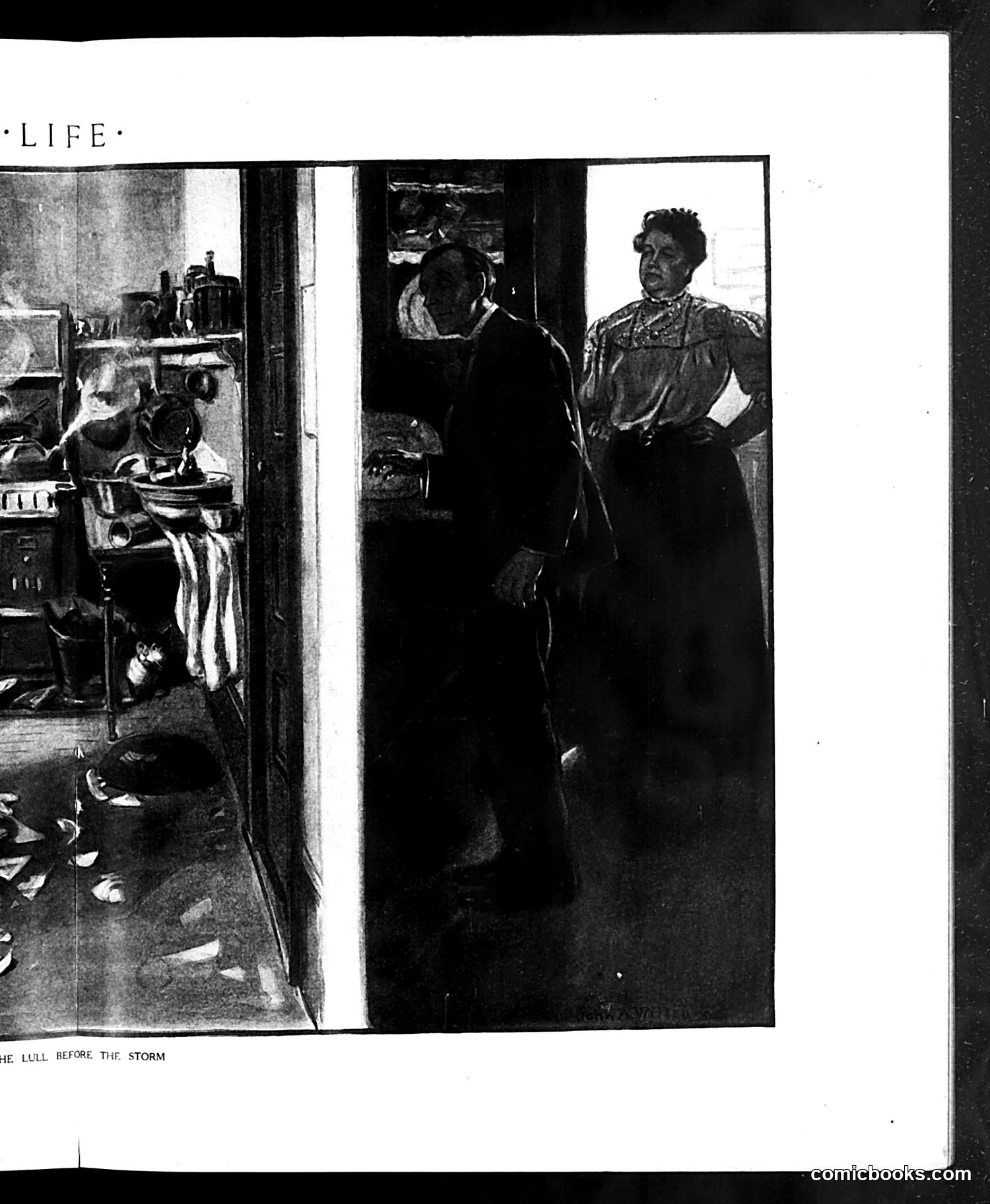
This appears to be a domestic scene from an early 20th-century Life magazine. The image shows two figures in what looks like a kitchen or domestic space—one person seated on the left near cooking equipment, another standing on the right in period dress. The caption "The Lull Before the Storm" suggests satirical commentary on domestic life, likely playing on the contrast between peaceful household moments and impending domestic conflict or chaos. Without additional context or visible artist attribution, the specific social commentary is unclear, though the title implies ironic commentary about relationships or household management—a common theme in Life's domestic humor during this era. The photograph's quality and styling suggest this dates to the early 1900s.
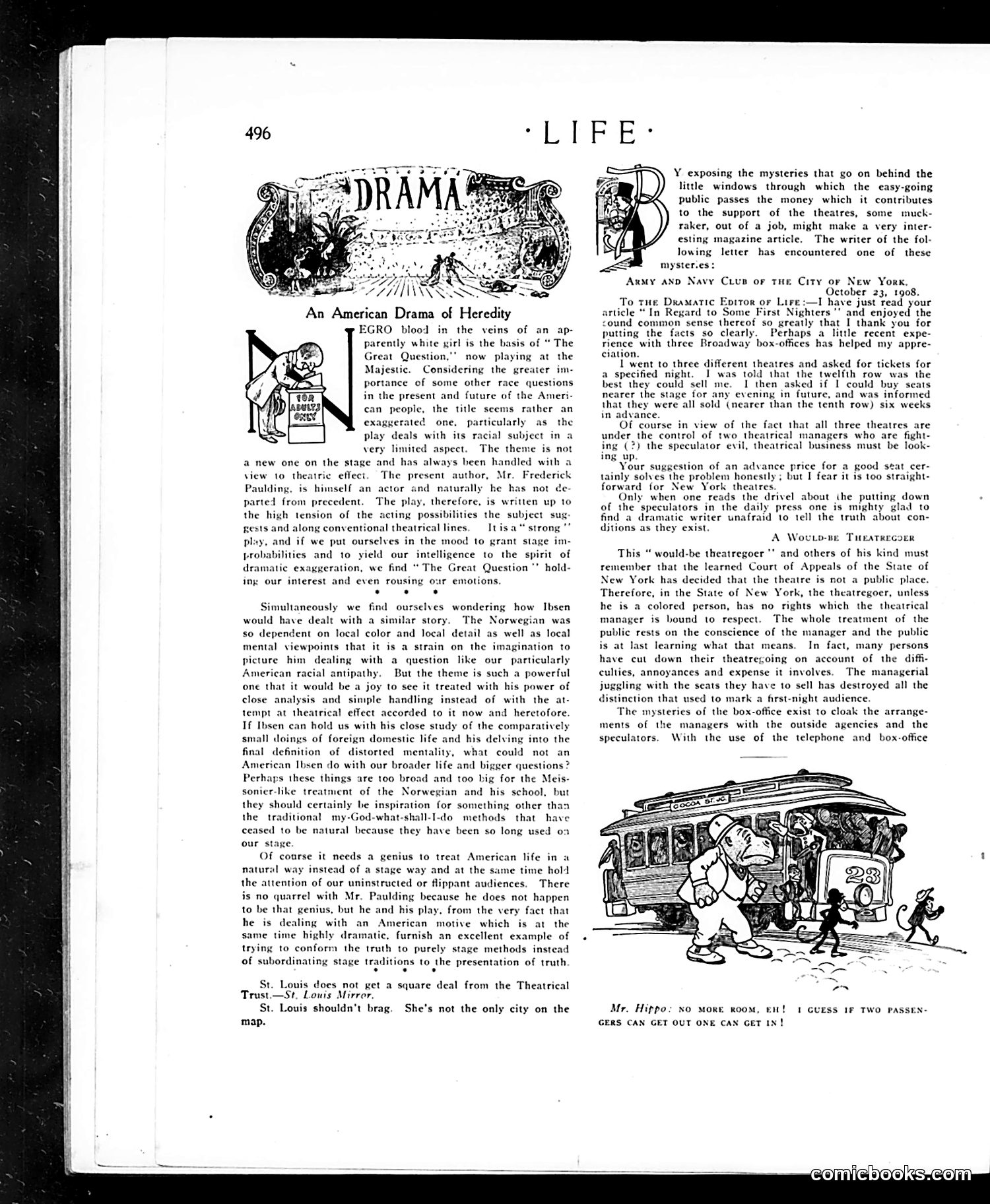
This page critiques theatrical practices and racial representation in early 1900s American drama. The main article reviews "The Great Question," a play about mixed-race identity at the Majestic Theatre. The critic argues the play sensationalizes race as melodrama rather than treating it with serious social inquiry—lamenting it lacks the psychological depth Henrik Ibsen would bring to such themes. The cartoon at bottom depicts theatrical box-office congestion, with the caption "Mr. Hippo: No more room, eh? I guess if two passengers can get out one can get in!" This satirizes overcrowded Broadway theaters and their chaotic management. A letter criticizes the "Theatrical Trust"—referring to the monopolistic control of theaters and booking practices that restricted independent venues, particularly affecting St. Louis. The satire suggests theatrical gatekeeping limited fair access to entertainment venues across America. Together, these items critique both how Broadway handled controversial social subjects superficially and the industry's corporate consolidation problems.
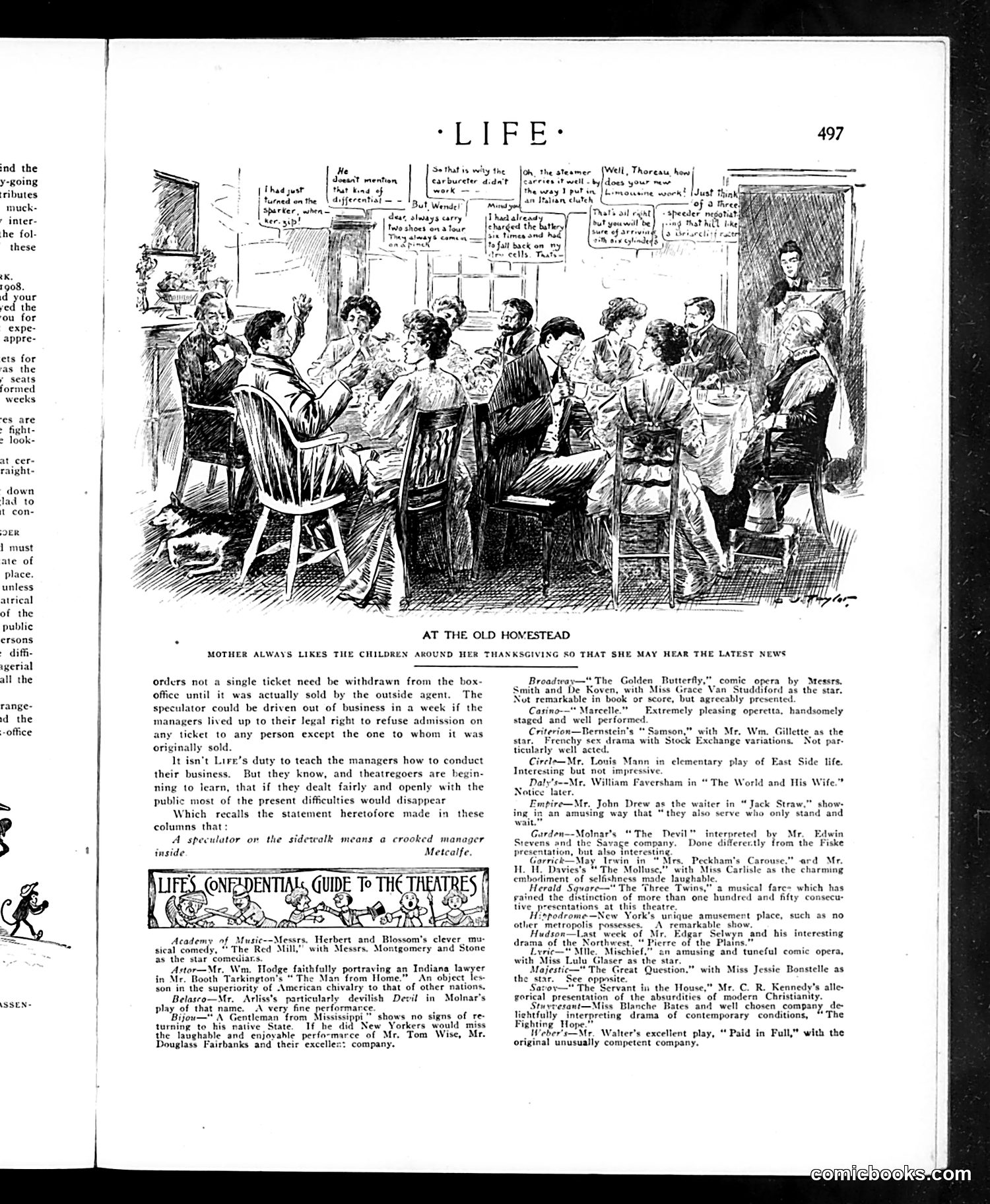
This is a *Life* magazine page featuring a satirical cartoon titled "At the Old Homestead" about Thanksgiving dinner conversation. The sketch shows a family gathered around a table while one person speaks animatedly—the caption explains "Mother always likes the children around her Thanksgiving so that she may hear the latest news." The joke appears to be that family members use holiday gatherings as opportunities to share gossip and updates, turning the occasion into an informal news exchange rather than a purely sentimental family moment. Below the cartoon, the page contains theater reviews and a column about ticket speculation. The text argues that theater managers who allow ticket speculators to resell seats at inflated prices are themselves complicit in the fraud—"a speculator on the sidewalk means a crooked manager inside." The reviews list popular Broadway productions of the era with brief critiques of performances and productions.
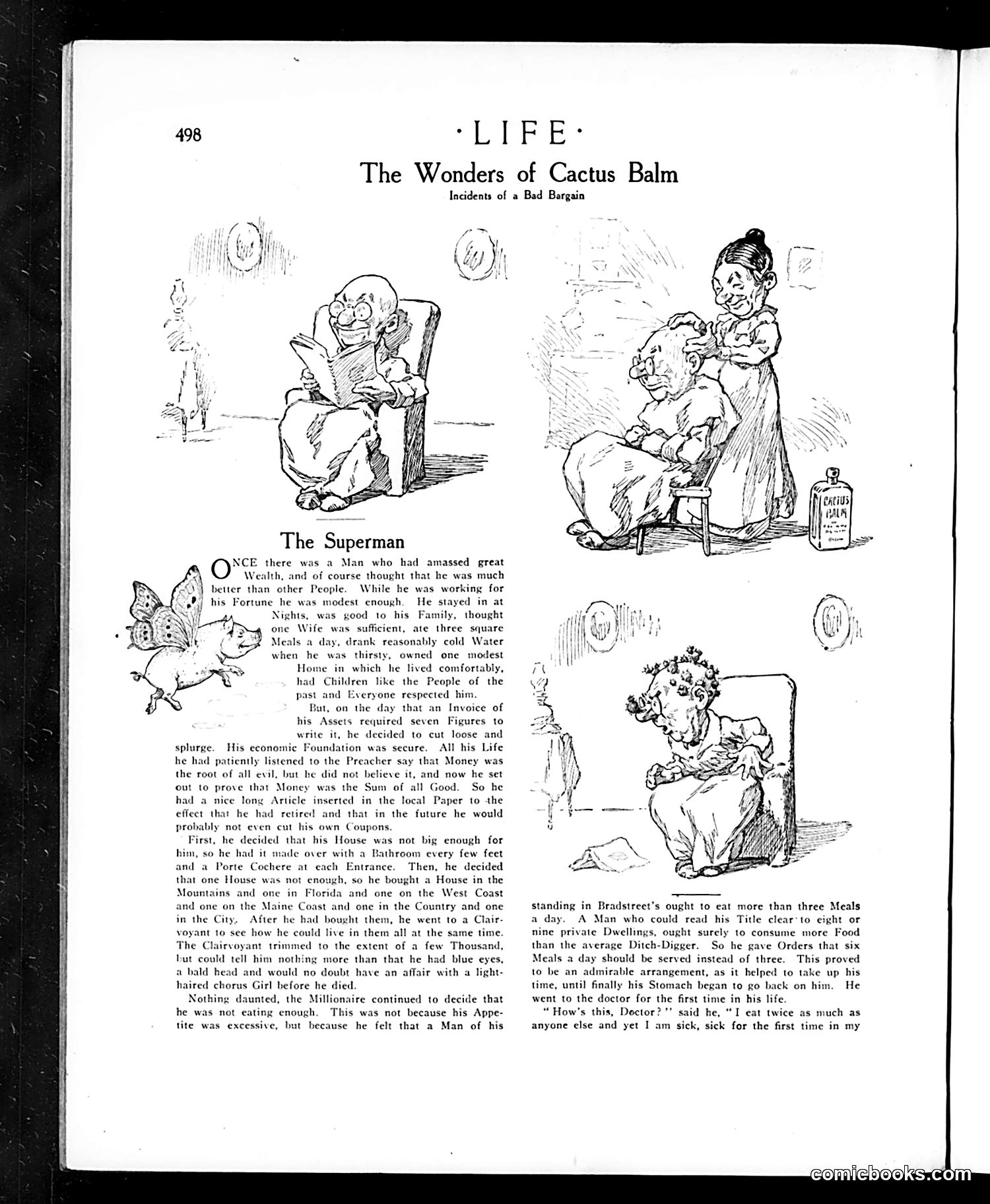
This satirical story mocks the moral decay that accompanies sudden extreme wealth. A formerly modest, virtuous man becomes a millionaire and immediately abandons restraint—building multiple mansions, consulting a clairvoyant, and absurdly increasing his meals from three to six daily to match his inflated social status. The central joke: his body rebels. Despite eating twice what ordinary laborers consume, he becomes ill—suggesting that excess and pretension cannot create genuine superiority or health. The title "Cactus Balm" (a dubious cure-all) hints that no remedy exists for his self-inflicted condition. The cartoon illustrates Life magazine's critique of the Gilded Age wealthy, who believed money entitled them to transcend normal human limits. The satire suggests their status-obsessed extravagance ultimately proves hollow and unhealthy, a "bad bargain" indeed.
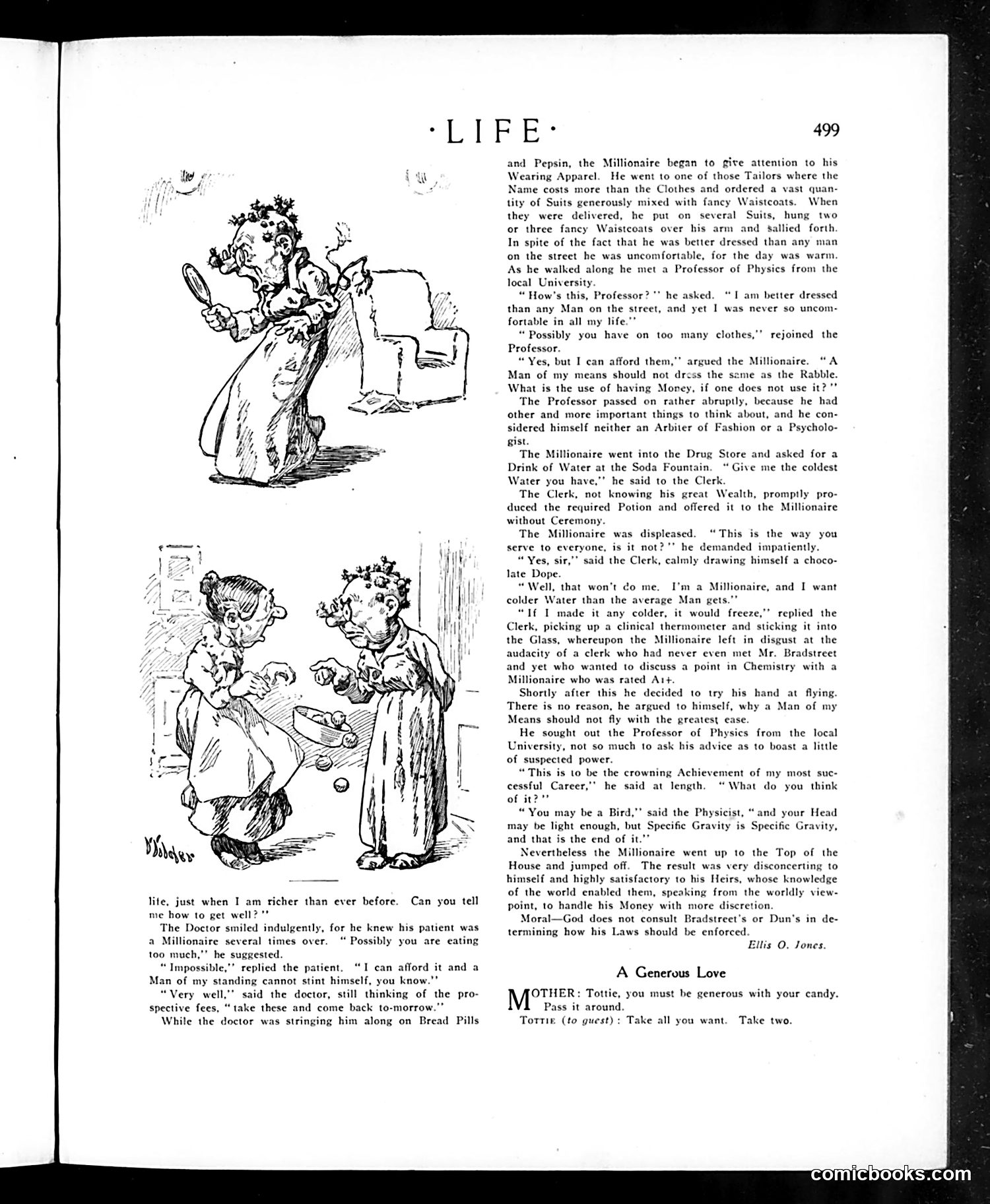
This page satirizes the absurd entitlement of a wealthy American millionaire who believes money exempts him from natural laws and common sense. The story follows a rich man consulting a doctor about his health troubles, then a professor about discomfort in expensive clothes—in both cases insisting his wealth should allow him to transcend ordinary constraints. He demands specially-cold water at a soda fountain, then attempts to fly off a rooftop because "a Man of my Means should not fly with the greatest ease." The joke: money cannot buy exemption from physics, biology, or basic reality. The doctor, professor, and clerk all respond with mild bewilderment at his delusions. The moral explicitly states that "God does not consult Bradstreet's or Dun's"—financial rating agencies—when enforcing natural laws. The cartoons show the millionaire's comical self-importance. This reflects Progressive-era American skepticism toward unchecked wealth and the belief that the rich absurdly overestimated their power.
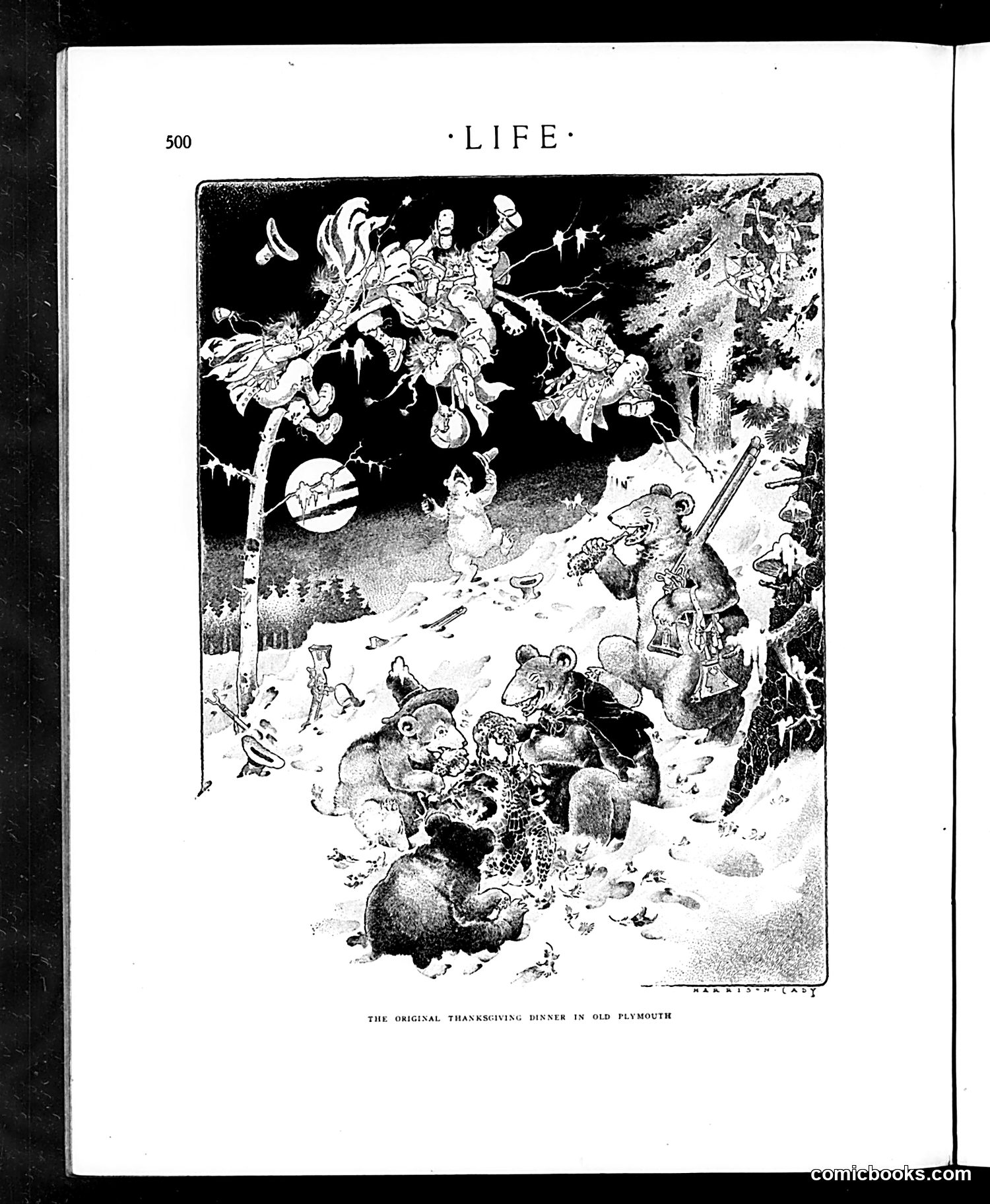
This satirical cartoon depicts a whimsical, fantastical version of the first Thanksgiving. Rather than depicting the historical Pilgrims and Native Americans sharing a meal, the image shows anthropomorphic animals—bears, mice, and other creatures—feasting together in a woodland setting, with what appear to be fairies or supernatural beings flying overhead. The satire likely mocks the romanticized, sanitized American mythology of Thanksgiving by presenting an absurdist alternative history. By replacing the actual historical figures with animals and magical creatures, the cartoonist suggests the "original Thanksgiving" story itself is largely fictional or fantastical—a children's tale rather than serious history. This reflects early 20th-century satirical magazine conventions of using surreal humor to critique popular myths and historical narratives.
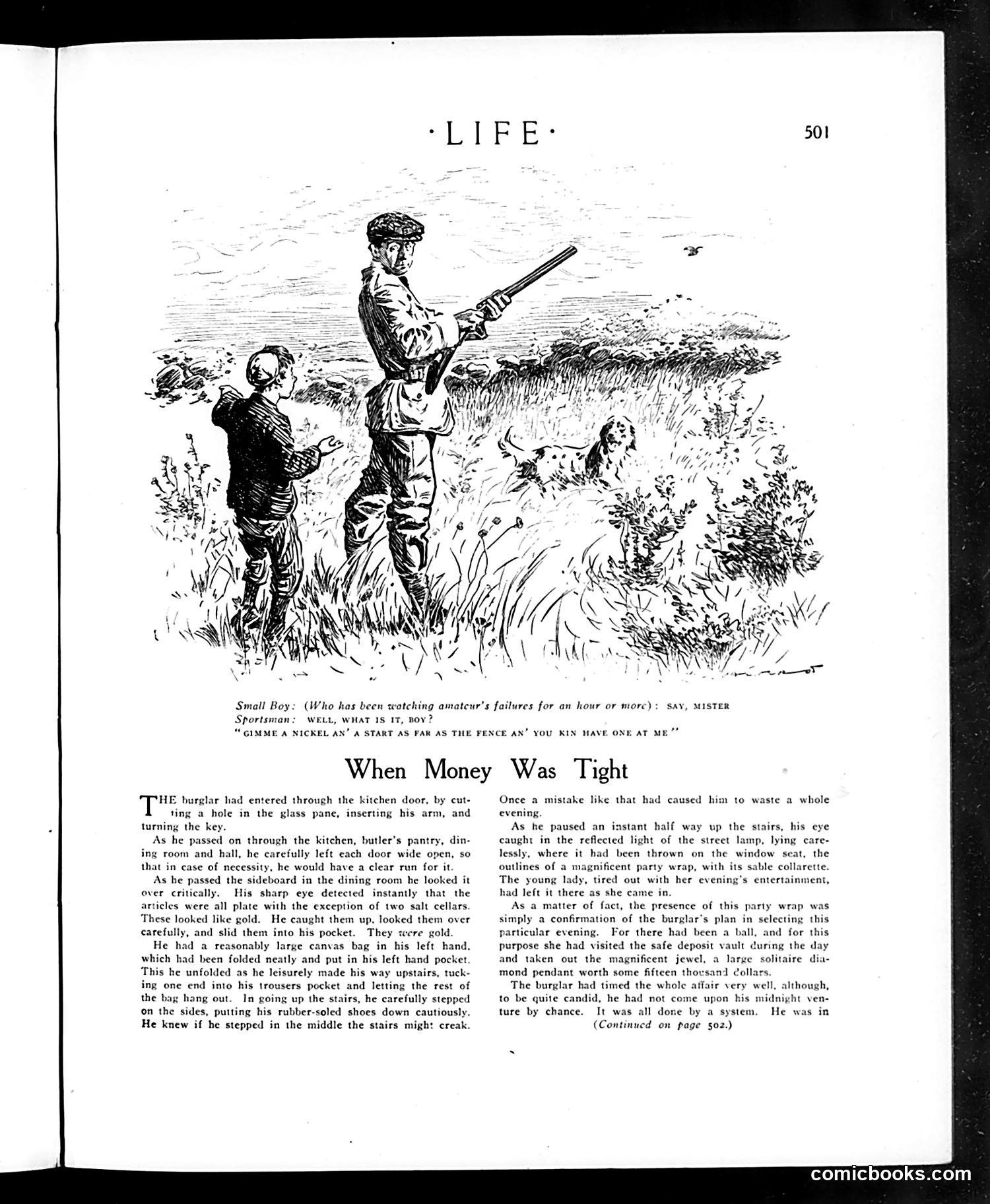
**The Cartoon (top):** A small boy watches an adult amateur hunter repeatedly miss shots. The child offers the sportsman a nickel and a running head start to let him shoot at him—a cheeky insult suggesting the man is such a poor marksman that even a child could hit him. **The Story "When Money Was Tight":** This appears to be a serialized crime fiction piece about a professional burglar methodically robbing a wealthy household. The narrative emphasizes his careful planning and technique—he timed the burglary knowing the lady of the house had withdrawn her jewels for a ball that evening. The burglar operates with precision and inside knowledge, suggesting premeditation rather than random opportunism. **Historical Context:** The title "When Money Was Tight" likely references economic hardship (possibly the early 1900s recession). The story romanticizes the burglar as intelligent and calculating rather than villainous—a common literary trope of the era. The overall page mixes light humor with sophisticated crime fiction, reflecting Life magazine's satirical approach to American society.
This page contains no cartoon or caricature—it's a serialized short story about a skilled burglar conducting a nighttime theft. The narrative focuses on the burglar's methodical, almost artistic approach to robbery. The key plot point involves the burglar discovering a letter from jewelers "Spottiswood, Trench & Smythe" regarding a yellow diamond necklace. The letter reveals the jewelers have agreed to repurchase the necklace for $12,000 (less than its $14,000 sale price) within one year, though they're requesting a six-month extension due to economic hardship—likely referencing a contemporary financial downturn. The burglar cleverly substitutes a similar letter in place of the original, then finds his target: the necklace worn by the sleeping female occupant. This appears to be serialized fiction rather than satirical content—there's no political commentary or cartoon humor visible on this page.
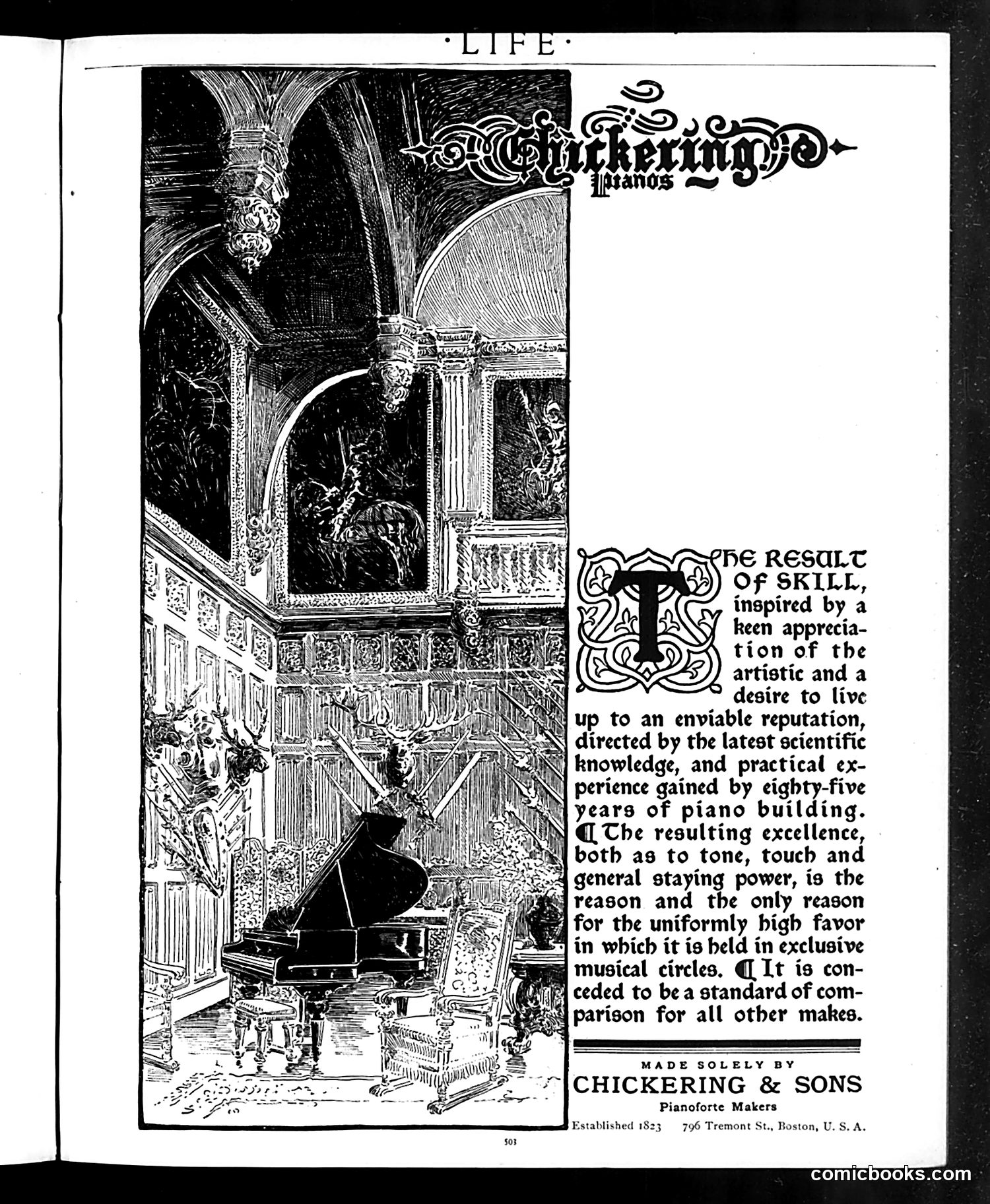
This is a **Chickering & Sons piano advertisement**, not political satire. The page features an ornate illustration of a grand piano in an elaborate, wealthy interior setting—a palatial room with decorated columns, arches, and classical architectural details. The ad claims Chickering pianos represent "skill" and "artistic" excellence, backed by "eighty-five years of piano building" (the company was established 1823). The text argues their superiority in "tone, touch and general staying power" makes them the standard by which other pianos are judged in "exclusive musical circles." This is **luxury brand positioning**—appealing to wealthy, cultured consumers by associating the product with refined taste, tradition, and social status. The grandiose setting emphasizes that owning a Chickering piano signals membership in elite society. For modern readers: this represents early 20th-century advertising that sold aspirational lifestyle rather than functional product details.
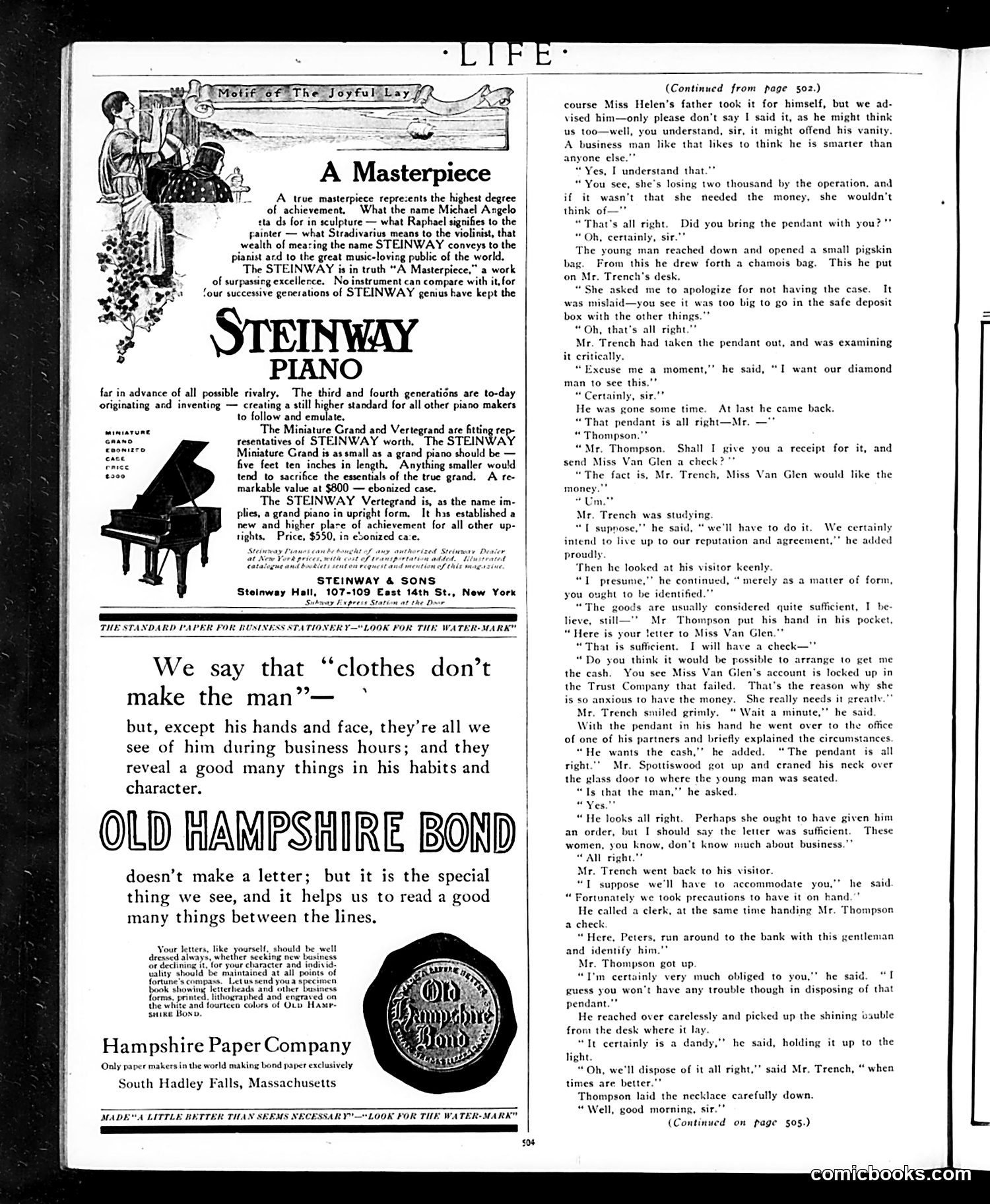
This page contains two distinct elements: **Advertisements** (top two-thirds): Full-page ads for Steinway pianos and Hampshire Bond paper. These use aspirational messaging—comparing Steinway to Renaissance masters (Michelangelo, Raphael), and arguing that quality stationery reflects one's character and business credibility. The appeals are to middle-class professionalism and cultural refinement typical of early 20th-century advertising. **Fiction** (bottom third): A serialized story ("Continued from page 502") involving a business transaction. A young man named Thompson appears to be selling a diamond pendant on behalf of "Miss Van Glen" to a jeweler named Mr. Trench. The dialogue suggests financial desperation on Van Glen's part and some concern about proper identification/legitimacy of the transaction—hints at potential fraud or social scandal. The juxtaposition is characteristic of *Life* magazine's format: aspirational ads alongside satirical or dramatic fiction reflecting real commercial and social anxieties of the era.
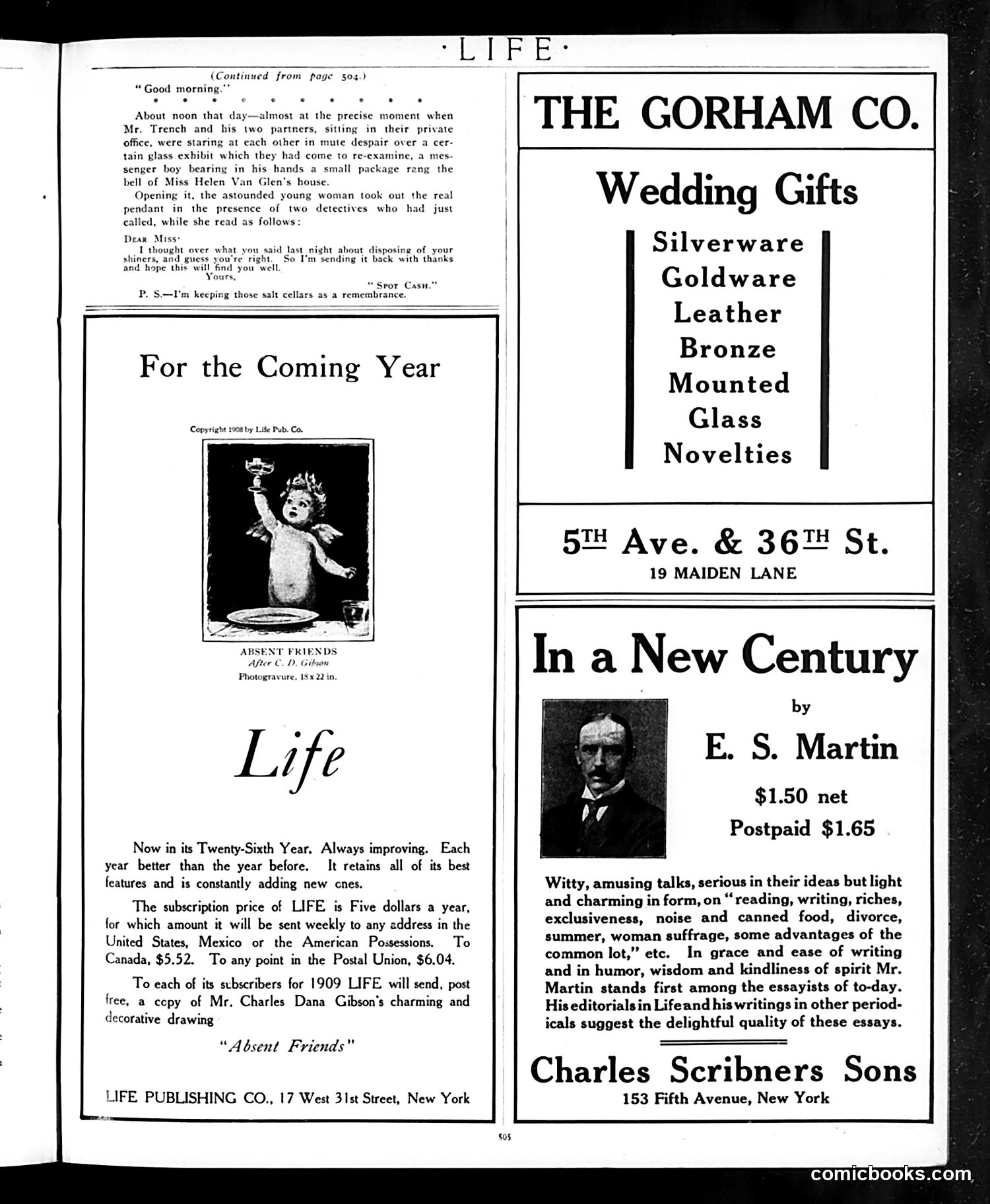
This page from *Life* magazine (circa 1908-1909) contains two main elements: **Left side**: A serialized story continuation involving a theft plot. A character named "Scot Cash" has stolen a pendant from Miss Helen Van Glen but returns it with an apologetic note, keeping only salt cellars as a "remembrance." The narrative suggests a theft that was resolved through the detective's intervention. **Right side**: Primarily advertisements and subscription information: - *The Gorham Co.* advertises luxury wedding gifts - *Life* promotes its subscription ($5/year) and offers a complimentary Charles Dana Gibson drawing titled "Absent Friends" to new subscribers - *Charles Scribners Sons* advertises E.S. Martin's essay collection "In a New Century" ($1.50) **No political cartoon appears on this page.** The content is mostly commercial/promotional material supporting the magazine's business model, with a fictional narrative snippet. The "Absent Friends" Gibson drawing mentioned isn't visible here.
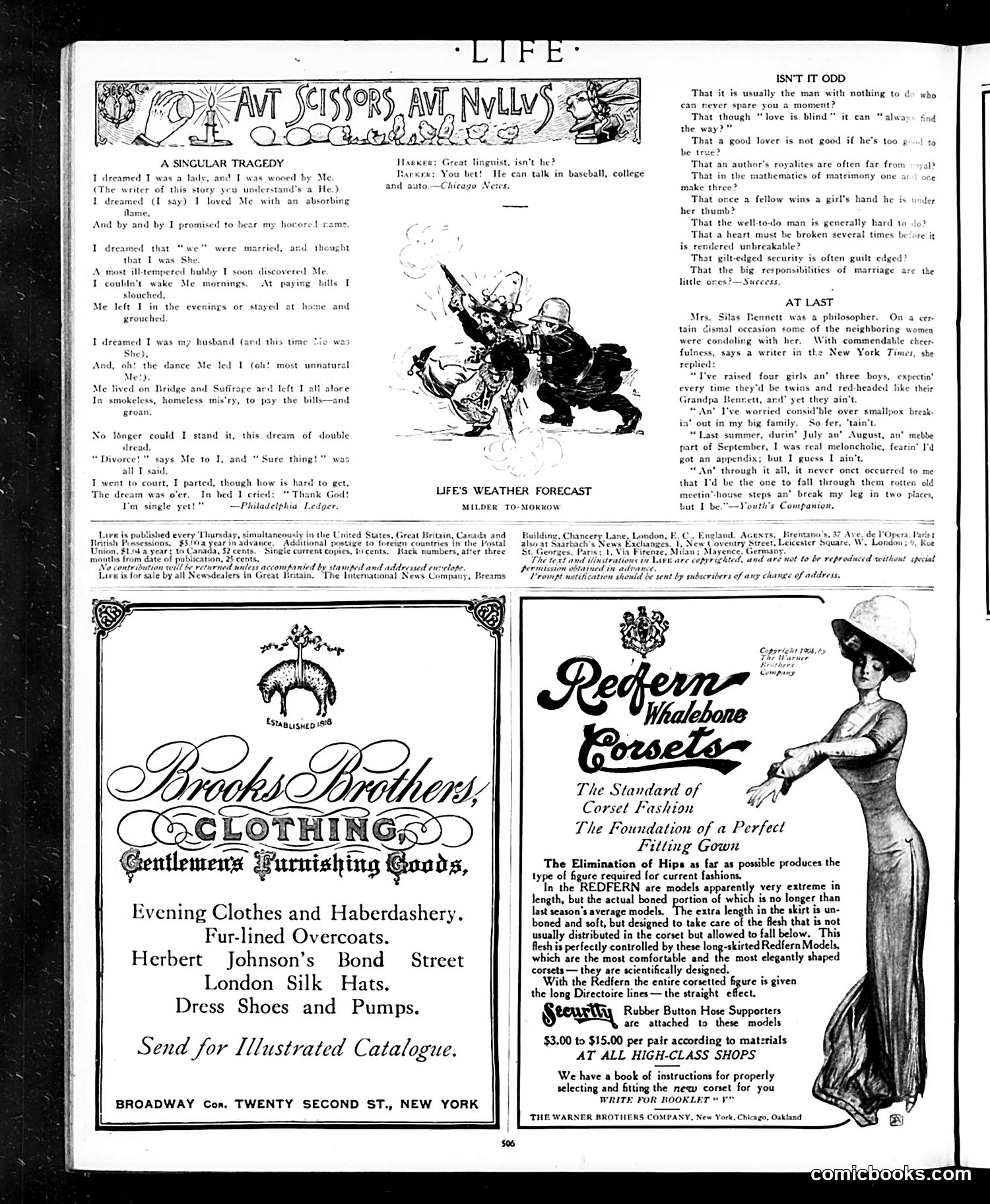
This page contains two main elements: **"A Singular Tragedy" (verse/comic poem):** A humorous account of a marriage told through dreams and role reversals. The narrator dreams of marrying a woman ("Me"), but discovers she's lazy and won't wake for household duties. Later, the genders reverse—"Me" becomes the husband who abandons "I" for dancing and leaves bills unpaid. The narrator seeks divorce, waking relieved to be single. The satire mocks both lazy spouses and the frustrations of married life, using gender-role confusion for comedic effect typical of early 20th-century humor about marriage dynamics. **"Isn't It Odd" (aphorisms):** A series of witty observations about love and marriage—blind love, financial paradoxes in relationships, broken hearts becoming unbreakable, and responsibilities. These are lighthearted relationship commentary. **"At Last" (anecdote):** Mrs. Silas Bennett philosophically recounts surviving various health scares (appendicitis fears, smallpox concerns), only to ironically fall through rotting porch steps—the expected crisis never arrives, but an absurd accident does. It's humorous irony about life's unpredictability. The page is primarily **entertainment and advertising**, not political satire.
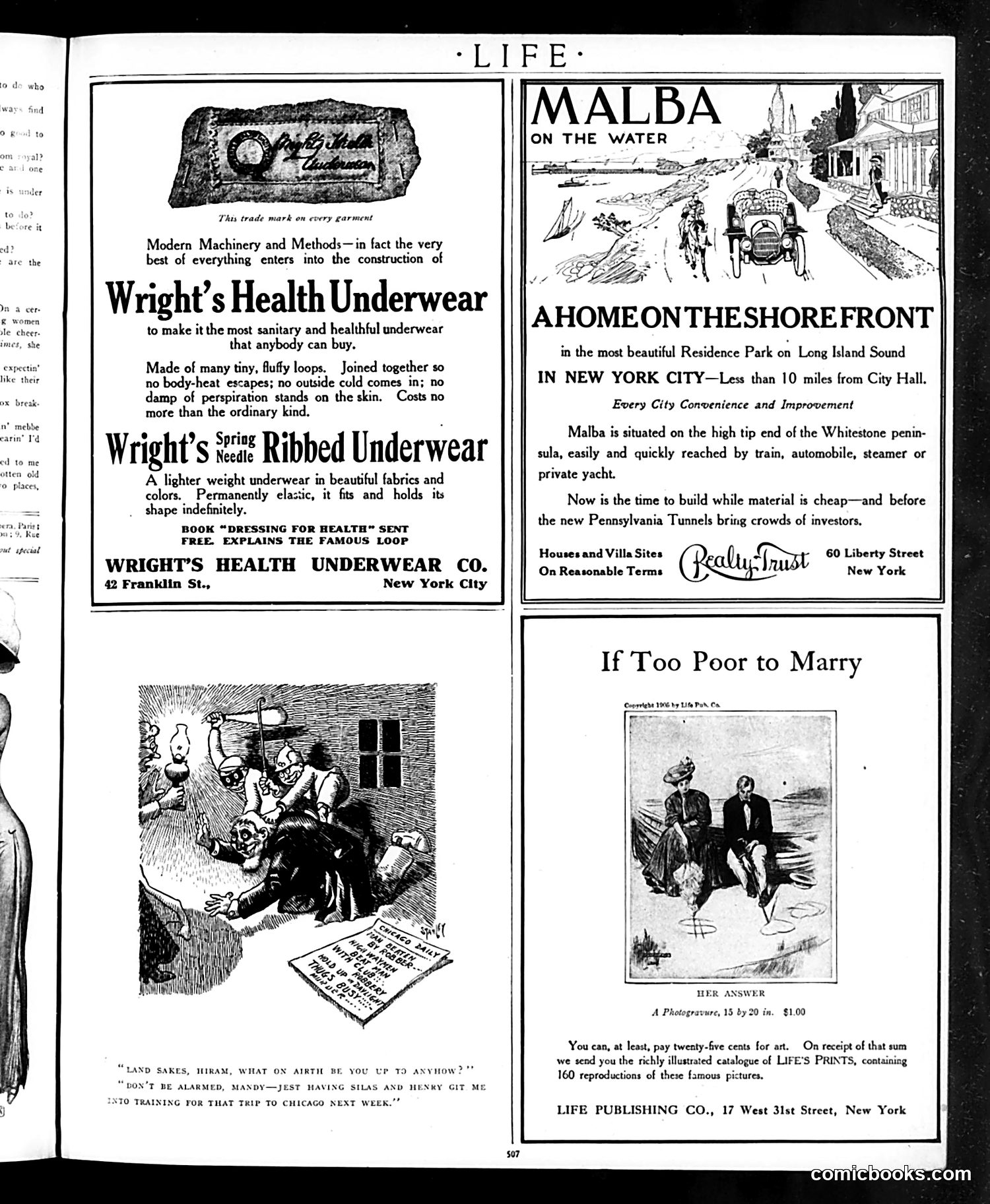
This page is primarily **advertising** with one cartoon feature. The main cartoon, titled "If Too Poor to Marry," shows a couple sitting by water. The caption "HER ANSWER" suggests this illustrates a romantic or marital dilemma. The accompanying text offers to sell a photogravure print for $1.00, or a catalog of 160 reproductions for 25 cents. The other content includes advertisements for **Wright's Health Underwear** (emphasizing sanitary construction with "fluffy loops" to manage perspiration), **Malba residential real estate** on Long Island Sound near New York City, and a lower cartoon about rural figures ("Hiram," "Mandy," "Silas," "Henry") training for a Chicago trip—likely humorous Americana content typical of Life's satirical style. The page reflects early 20th-century consumer culture: health-conscious undergarment marketing, suburban development pitches, and sentimental romantic imagery sold as affordable art prints.
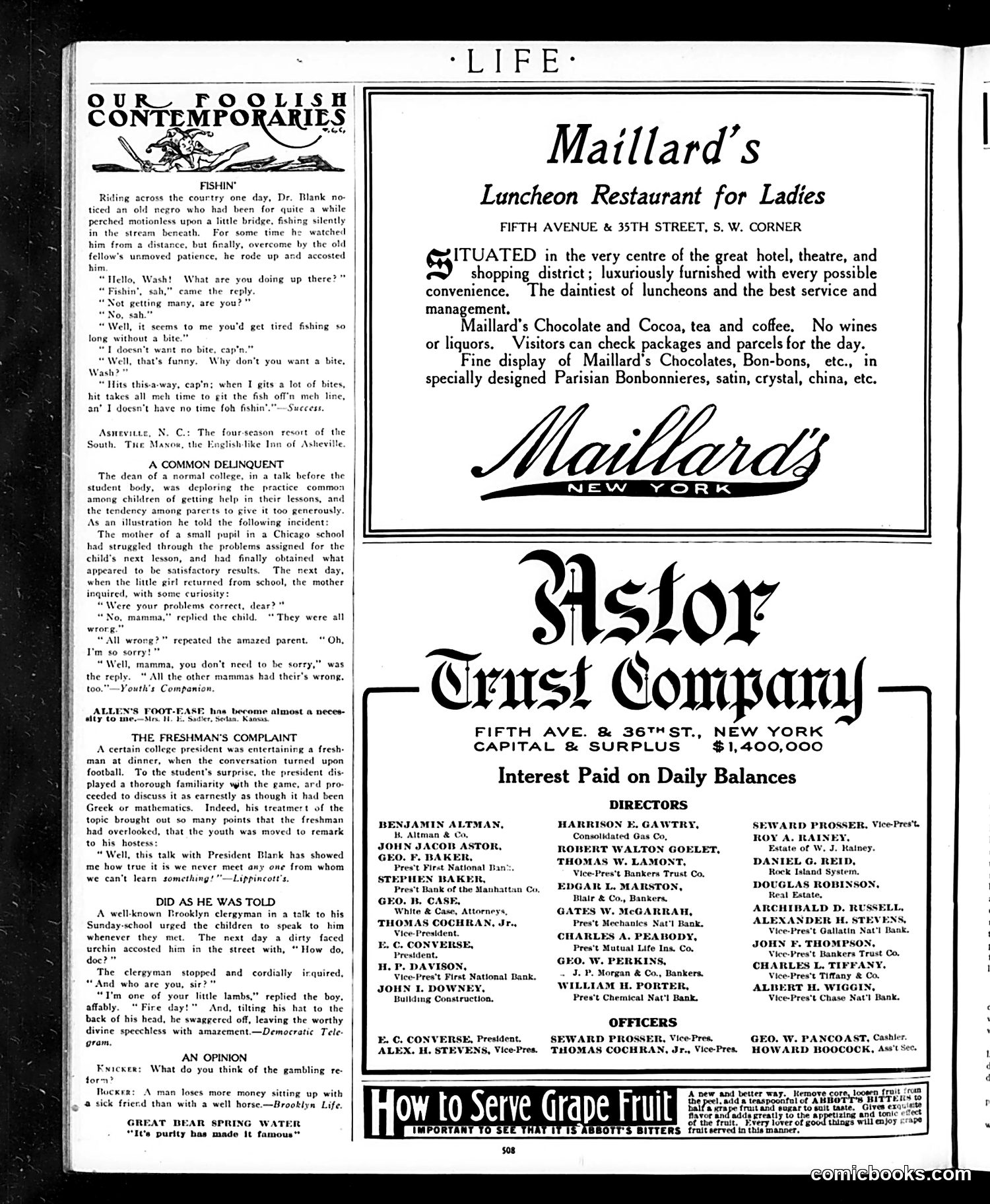
This is primarily an **advertising and humor page** from *Life* magazine, circa 1900s. The left column contains humorous anecdotes rather than political cartoons. ## Key Content: **Humor Pieces:** - "Fishin'" mocks African American dialect and rural southern ignorance - "A Common Delinquent" satirizes parental enabling of children's homework cheating - "The Freshman's Complaint" and other pieces humorously critique social pretension among the educated classes **Advertisements:** The page is dominated by **luxury consumer ads**—Maillard's (a high-end chocolatier/restaurant), Astor Trust Company, and other premium services targeting wealthy New Yorkers. These reflect *Life*'s affluent readership. **Social Context:** The dialect humor reveals period racism normalized in mainstream publications. The anecdotes target universal human folly (laziness, pride) rather than specific political figures. The advertisements emphasize that *Life*, despite its satirical edge, was fundamentally a magazine *for* the wealthy elite, not against them. This is **not** political cartooning in the traditional sense.
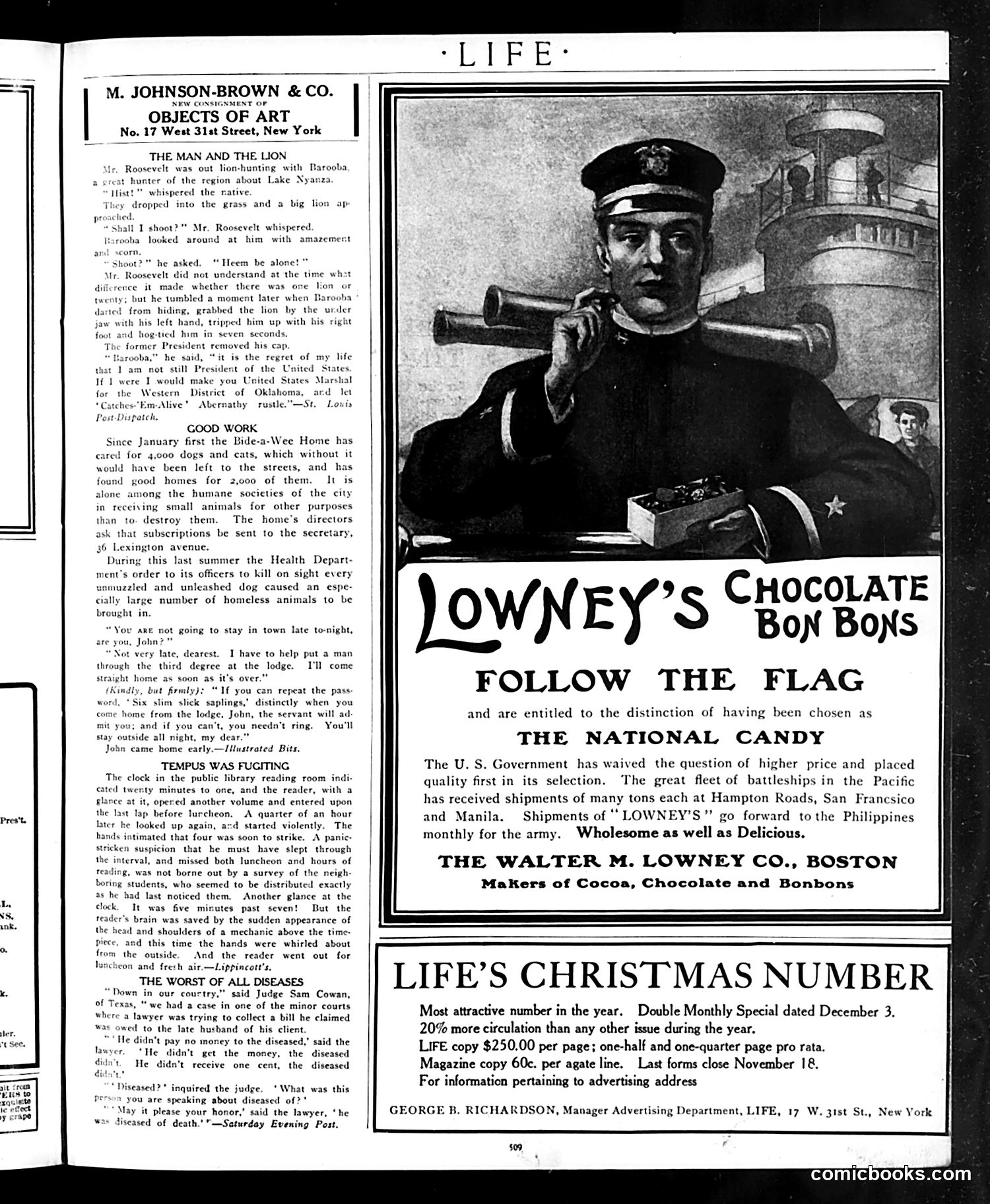
This page is primarily **advertising and humor columns**, not political satire. The main content includes: **"The Man and the Lion"**: A humorous anecdote about **Theodore Roosevelt** (identified as "former President") on a hunting expedition in Africa. The joke contrasts Roosevelt's famous big-game hunting prowess with a native guide who casually captures a lion barehanded—implying Roosevelt's celebrated hunting achievements are less impressive than popularly believed. Roosevelt's response (expressing regret he's no longer president so he could appoint the guide as U.S. Marshal) is self-deprecating humor about his lost authority. **Remaining content**: The page contains miscellaneous humor pieces about library clocks, lodge passwords, and a pun about "diseased" (diseased of death), plus advertisements for chocolate bonbons and art objects. These are light, domestic humor with no political significance. The Roosevelt piece gently mocks the former president's ego and hunting legend through unexpected competence from an "ordinary" guide.
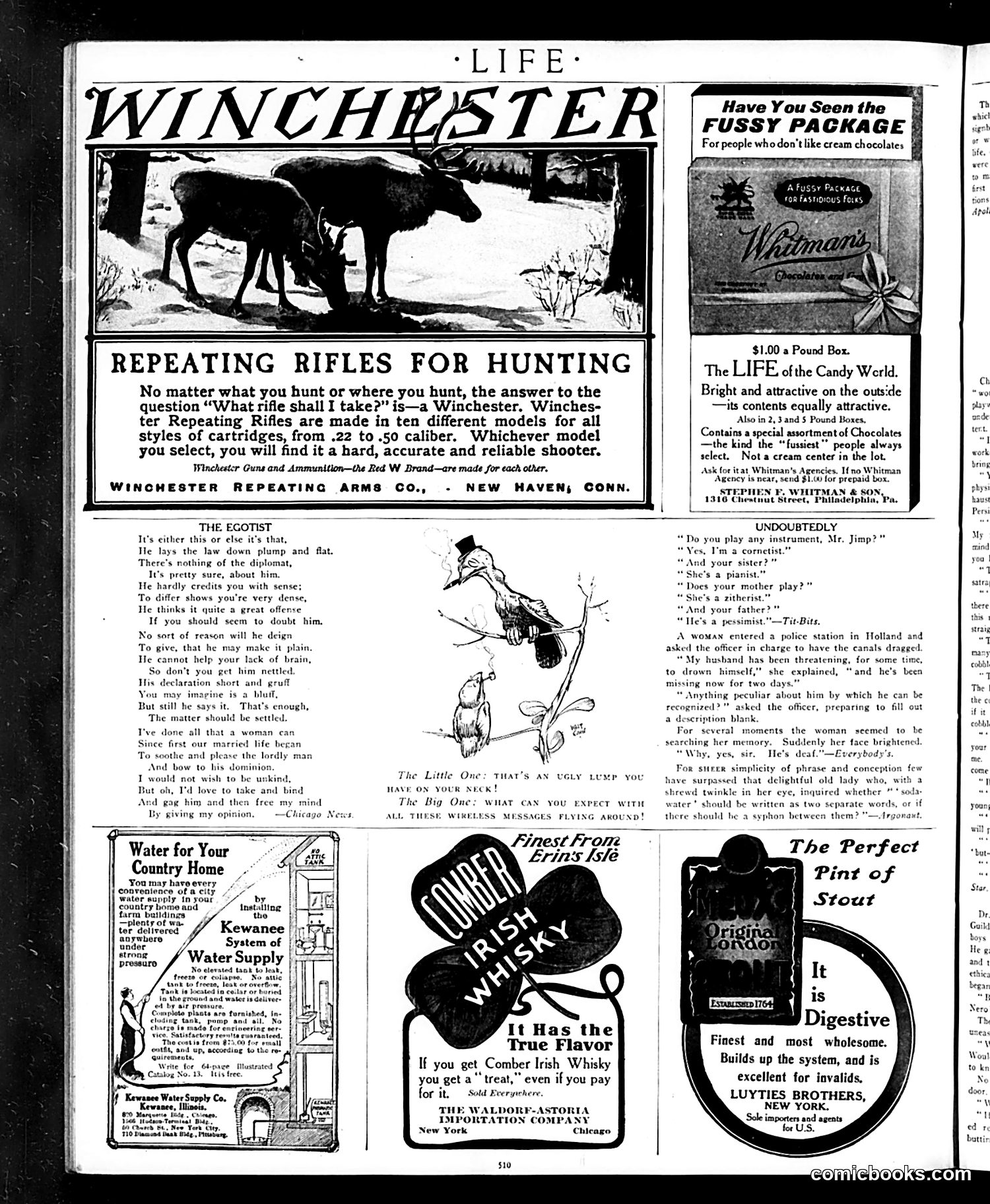
This page is primarily **advertisements and light humor** rather than political satire. The main content includes: **"The Egotist" poem**: A satirical verse about an overbearing, opinionated man who dismisses others' views and cannot accept disagreement. The humor relies on the speaker's frustrated resignation to his domineering nature—a domestic/social commentary on masculine arrogance rather than political critique. **"Undoubtedly" section**: Comic anecdotes illustrating human absurdity, including a Dutch woman asking police to dredge canals for her suicidal husband, played for absurdist humor. **Advertisements**: Winchester rifles, Whitman chocolates, water systems, Irish whisky, and stout dominate the page—typical early 20th-century product marketing. The cartoons are generic social humor about personality types and domestic situations, not commentary on specific political events or figures. This represents Life magazine's lighter content rather than its more famous satirical political work.
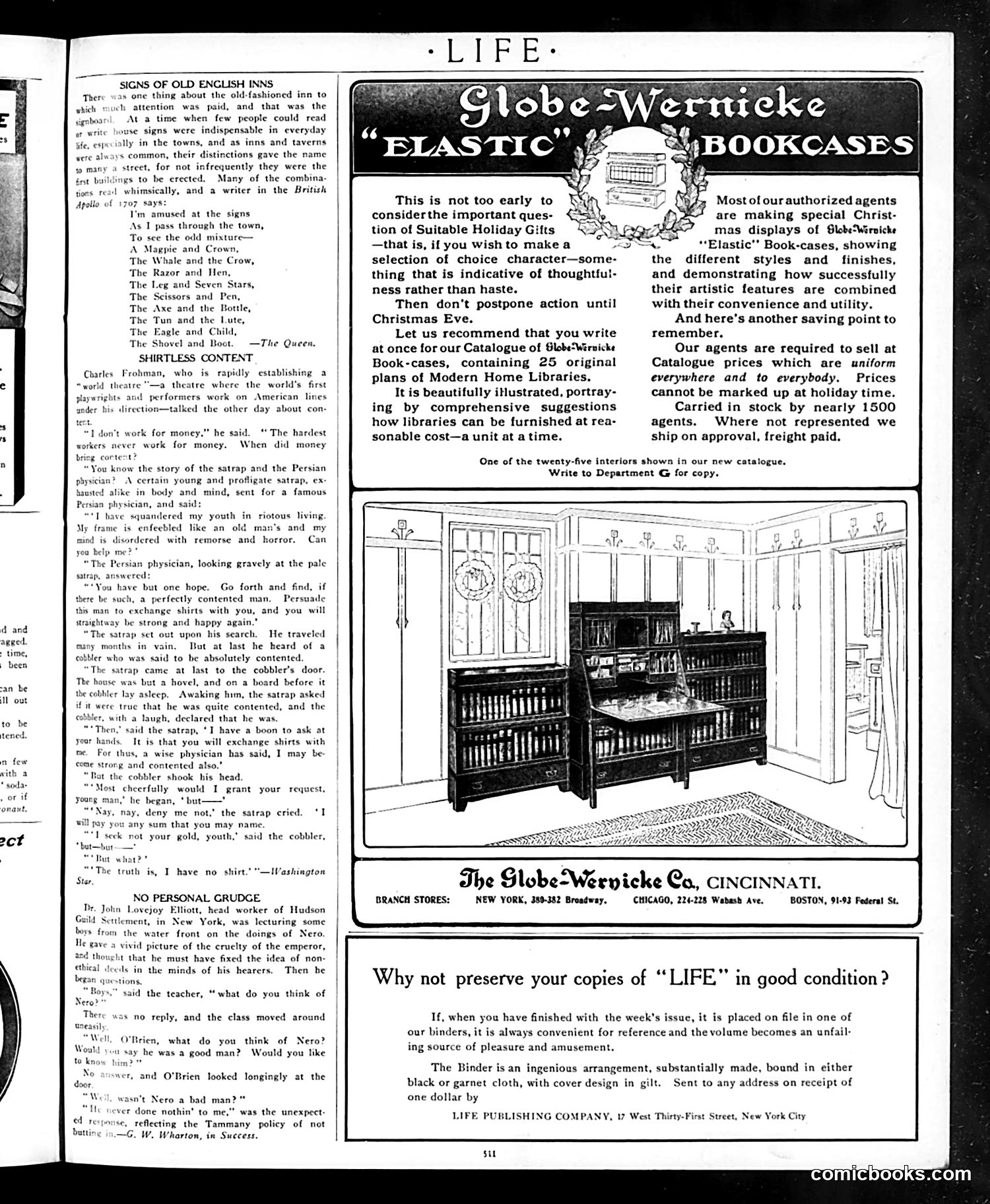
This page contains three unrelated pieces: a historical essay on old English inn signs, a brief anecdote about playwright Charles Frohman discussing work motivation, and two short humorous teaching anecdotes. The main content is **advertising** for Globe-Wernicke "Elastic" bookcases, featuring an illustration of an elegant library interior with ornate wooden shelving. The two brief stories use old moral tales to make points: one Persian parable shows that contentment cannot be bought (a poor cobbler refuses money); the second depicts an ironic lesson when a settlement house teacher lecturing waterfront boys about Emperor Nero's cruelty finds one student responds he bears Nero no grudge since "he never done nothin' to me"—a joke about Tammany Hall political corruption, implying the boy judges people only by personal favors received, not moral principles. Neither requires extensive historical knowledge to understand; both are simple moral/satirical observations on human nature and urban politics.
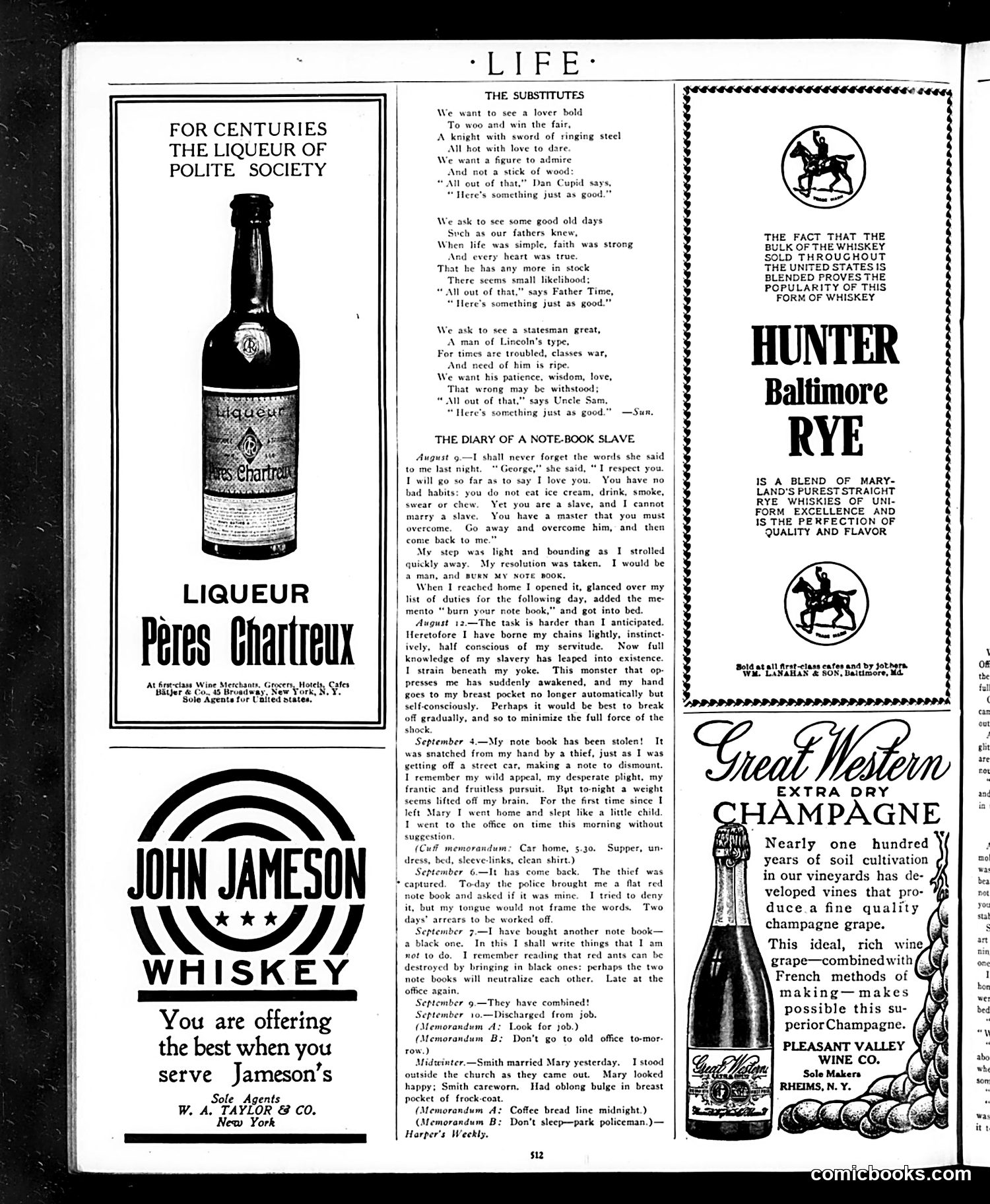
This page contains two satirical pieces reflecting early-20th-century anxieties about modern life's compromises. **"The Substitutes"** is a poem lamenting societal decline. It expresses nostalgia for idealized predecessors—romantic lovers, simpler times with strong faith, and great statesmen like Lincoln—while suggesting contemporary replacements are inadequate. The refrain "Here's something just as good" from Dan Cupid, Father Time, and Uncle Sam is ironic: clearly, they're *not* good substitutes. **"The Diary of a Note-Book Slave"** satirizes modern dependence on organization systems. A man keeps an obsessive pocket notebook tracking duties. His girlfriend demands he abandon this "slavery" to prove manhood. After a thief steals it, he briefly feels liberated—then obtains a replacement. The darkly comic ending: his attempted self-improvement fails; he loses his job, the girl marries someone else, and he ends up homeless. The joke: breaking free from modern systems of self-management proves impossible. Both pieces mock contemporary American culture's contradictions between tradition and modernity, and between aspirations for freedom and actual dependence on new social structures.
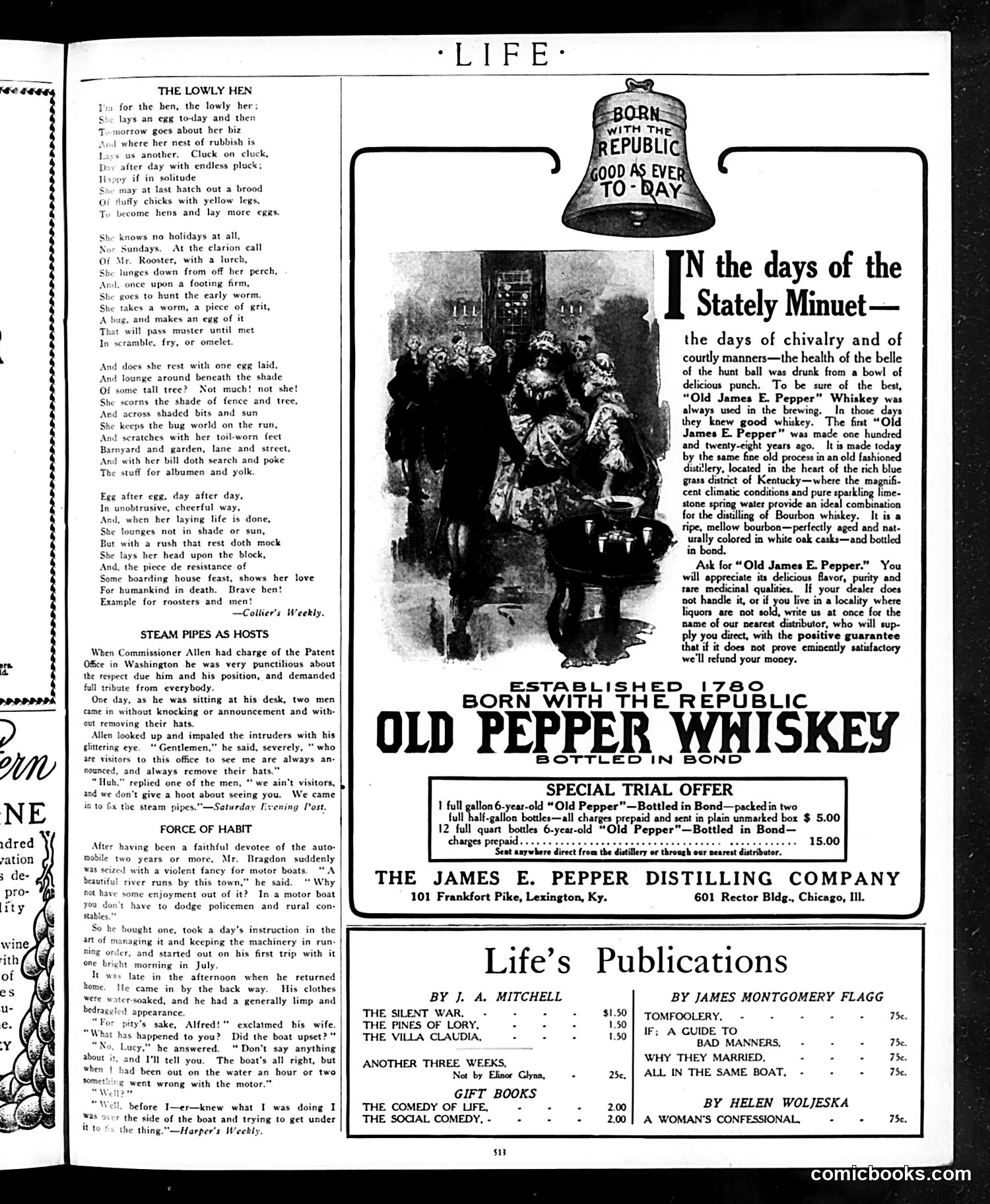
This page combines humorous short pieces with advertising. **"The Lowly Hen"** (left column) is a mock-heroic poem celebrating the hen's tireless productivity and sacrifice—laying eggs daily, hunting bugs, and ultimately dying to feed humanity. The satire gently mocks romanticized notions of noble suffering, using the hen as an ironic "example for roosters and men." It's sentimental but tongue-in-cheek. **"Steam Pipes as Hosts"** and **"Force of Habit"** are brief anecdotal jokes about social awkwardness and absent-mindedness—typical Light humor for the era. The dominant content is a **full-page advertisement for Old Pepper Whiskey**, depicting a historical scene of well-dressed people at a formal gathering. The ad invokes nostalgia for "the days of the Stately Minuet"—antebellum gentility—claiming the whiskey has been made the same way for 128 years in Kentucky. It offers a "trial offer" of bottles. This represents typical early 20th-century advertising mixing historical romance with product promotion.
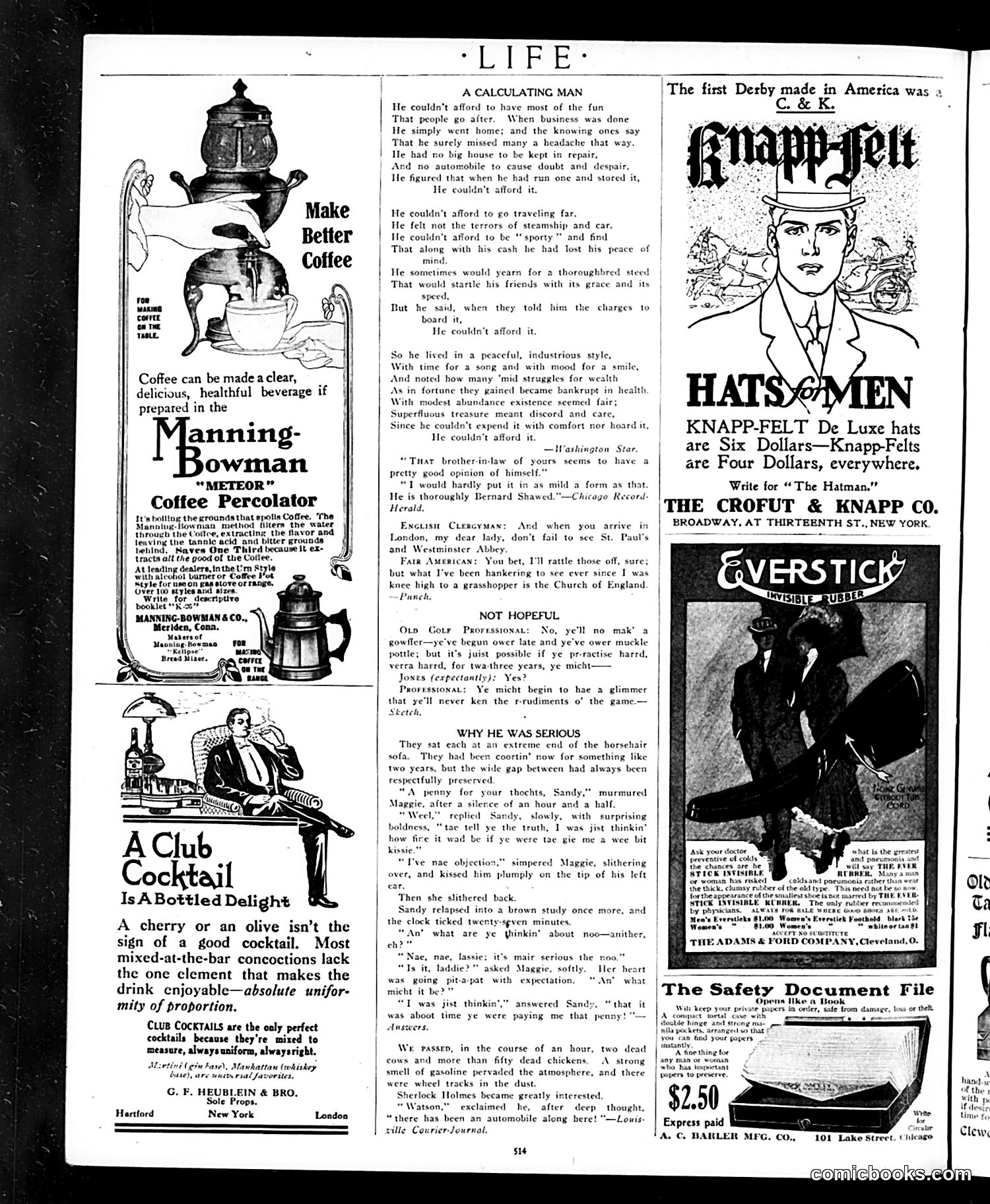
This page is primarily **advertising with brief satirical content**. The main elements include: **Advertisements:** - Manning-Bowman coffee percolators (left) - Club Cocktails by Heublein & Bro (center-left) - Knapp-Felt hats (right) - Overstick rubber and safety document files (right) **Satirical Content:** The center features "A Calculating Man"—a poem mocking excessive consumer culture. It satirizes the wealthy who pursue status symbols (large houses, automobiles, travel) only to lose peace of mind, contrasting this with a modest man who lives contentedly within his means. The humor targets Gilded Age materialism and the anxiety it produces. **Comic Sections:** Multiple short humor pieces ("Not Hopeful," "Why He Was Serious") appear to be reprinted jokes from other publications, featuring Scottish dialect humor about golf and courtship—typical early-20th-century magazine filler. The page reflects pre-1920s attitudes toward consumption, class, and domestic life, with advertising placed ironically alongside critique of consumerism.
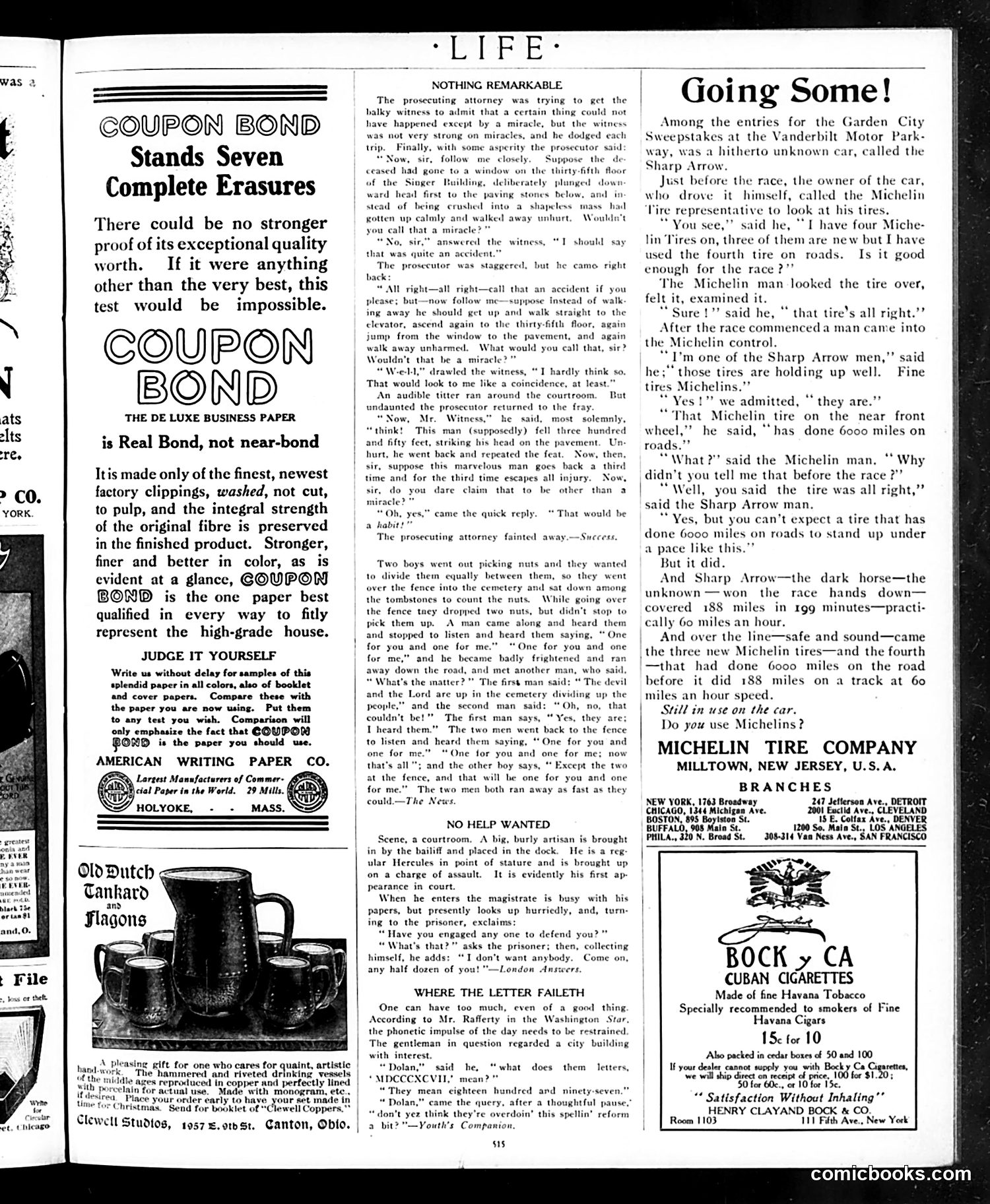
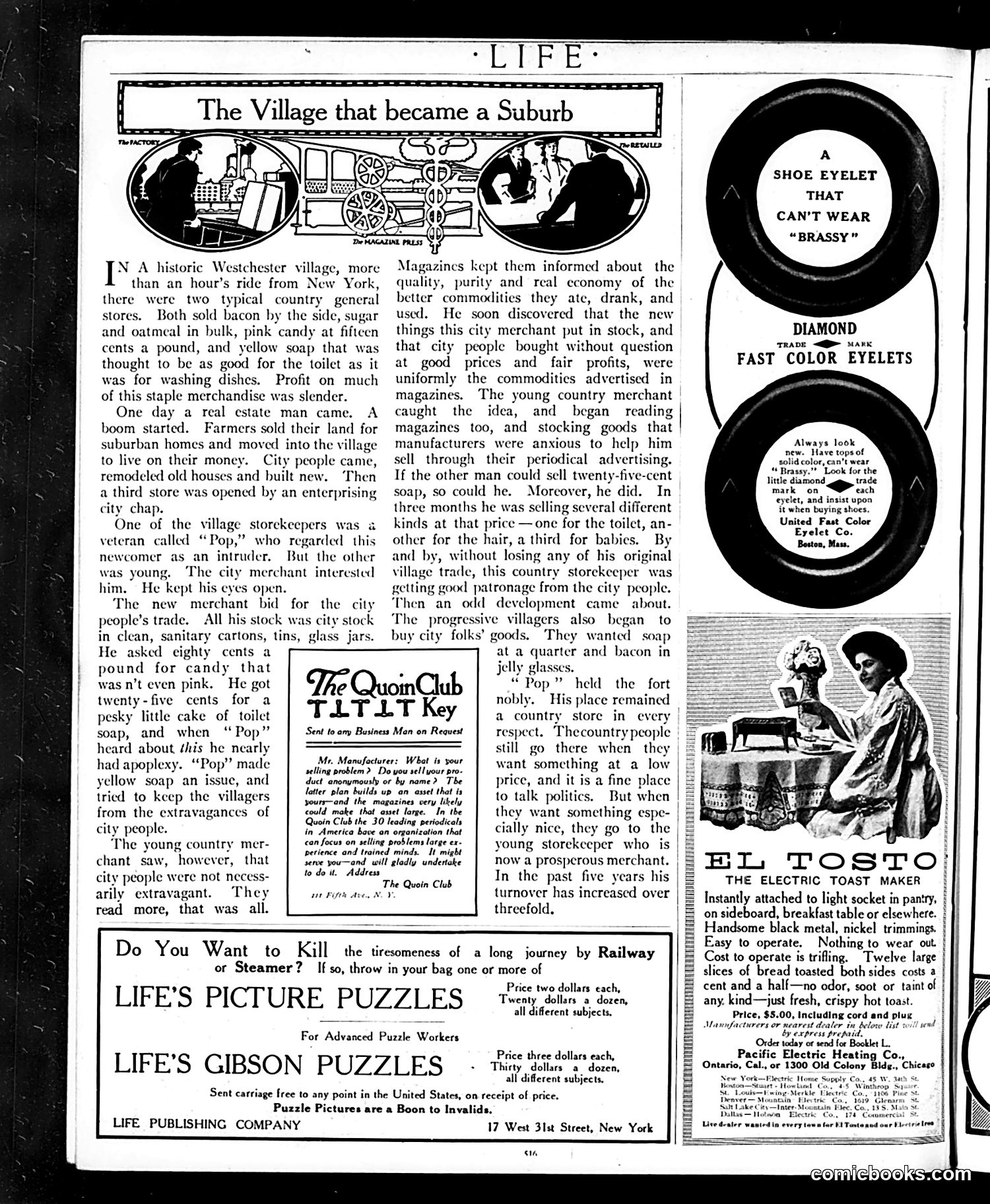
This is primarily a **business/economics parable** dressed as a short story, titled "The Village that Became a Suburb." **The Story's Point:** An old-guard country storekeeper ("Pop") resists modernization when suburban development brings city people and a younger, enterprising merchant to his village. Pop clings to traditional merchandise (basic bulk goods, cheap pink candy, yellow soap) and views city tastes as wasteful extravagance. **The Twist:** The young merchant succeeds not through fancy goods, but by reading **magazines**—which advertise quality products to city consumers. He stocks advertised brands and learns that city people aren't extravagant; they're simply informed by advertising. He thrives. Eventually, even village residents adopt city goods. **The Satire:** This is *pro-advertising propaganda*. Life magazine uses the story to argue that magazine advertising educates consumers and drives economic progress. Pop represents outdated thinking; the young merchant represents progress through brand awareness and modern commerce. **The Irony for Modern Readers:** The page is surrounded by advertisements (shoe eyelets, toast makers, puzzles), making the entire magazine itself an example of the "informative advertising" it celebrates.
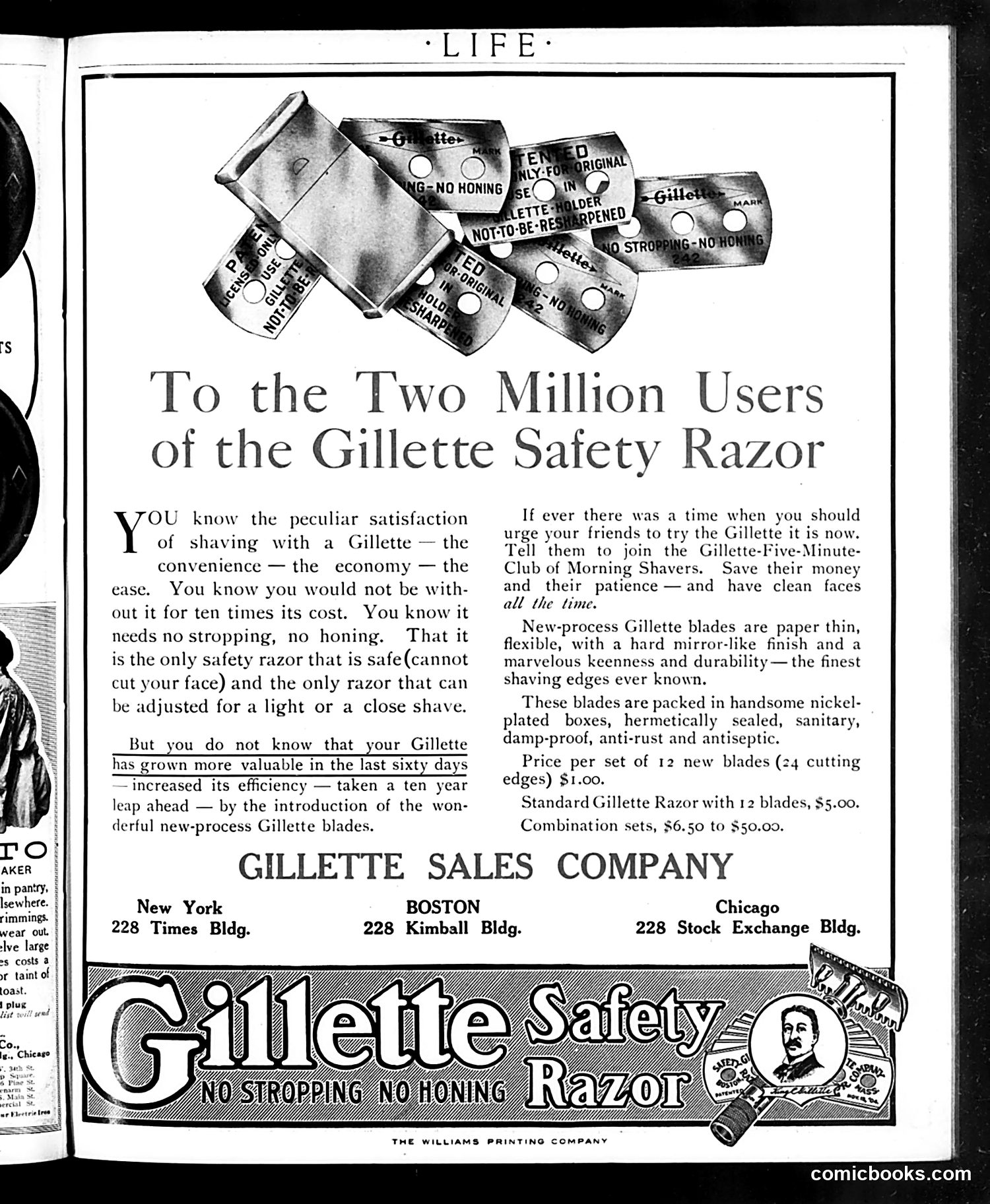
This is a **full-page advertisement**, not satire or editorial content. It promotes Gillette Safety Razors to an existing customer base of "two million users." The ad emphasizes the product's recent innovation: new "new-process" blades introduced within the preceding sixty days. It positions these as a major advancement ("taken a ten year leap ahead"), claiming superior sharpness and durability compared to previous versions. The appeal is practical rather than humorous—targeting efficiency-minded shavers by promoting a "Gillette-Five-Minute-Club of Morning Shavers" that will "save their money and their patience." Pricing is listed ($1.00 per blade set, $5.00-$50.00 for complete razors). The tagline "NO STROPPING NO HONING" emphasizes convenience—unlike straight razors requiring maintenance, Gillette's safety razor needs neither sharpening nor stropping. **No political satire or cartoon content appears on this page.** It is straightforward commercial advertising typical of early 20th-century Life magazine.
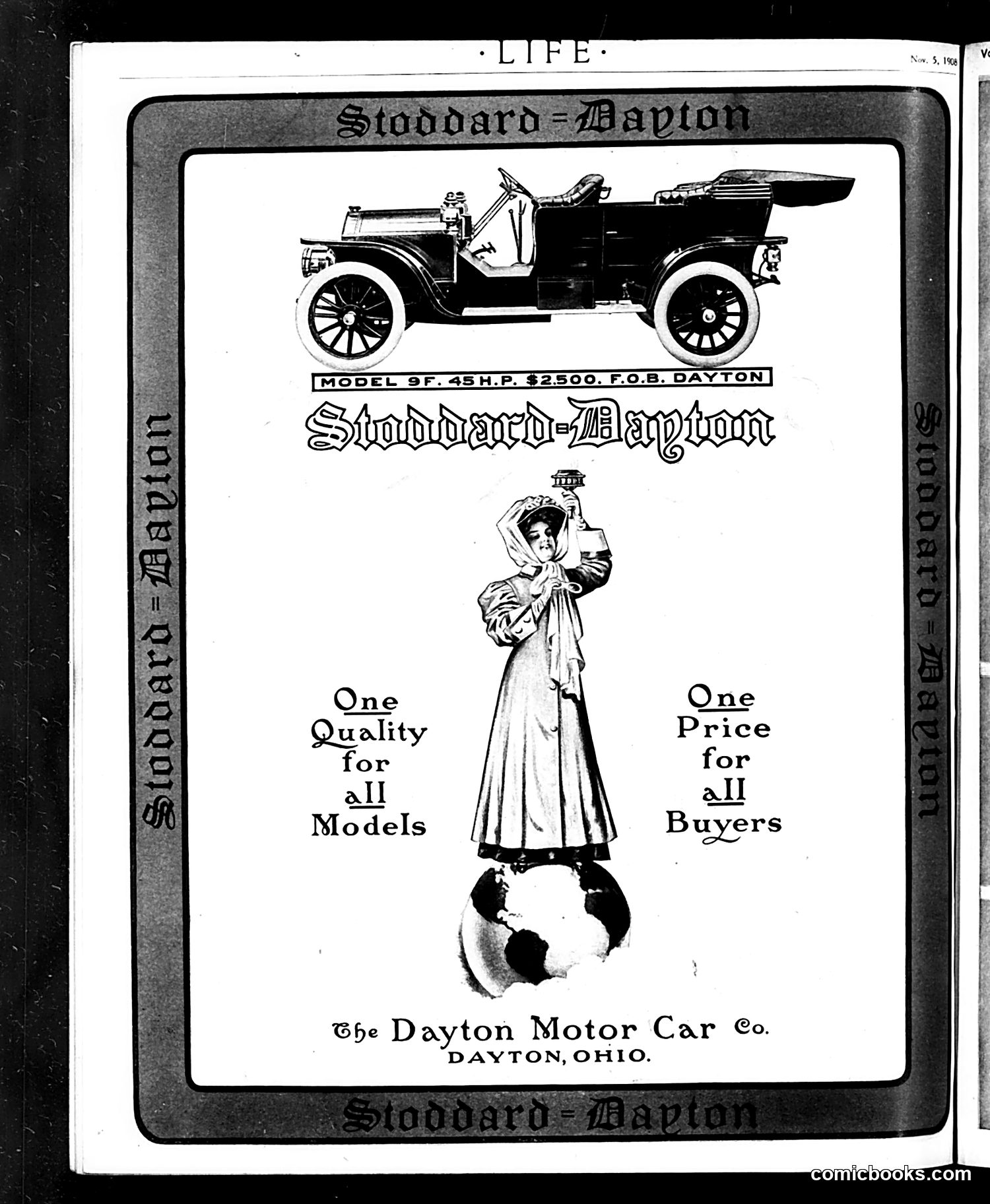
This is a **Stoddard-Dayton automobile advertisement**, not a political cartoon. The page promotes the Model 9F, a 45-horsepower car priced at $2,500, manufactured by the Dayton Motor Car Company in Dayton, Ohio. The advertisement uses an allegorical female figure (likely representing Liberty or Lady Commerce) standing on a globe, holding a car lamp. The accompanying text—"One Quality for all Models" and "One Price for all Buyers"—emphasizes the manufacturer's commitment to standardized, democratic pricing and quality across their product line. This marketing approach was notable in early automotive history, when standardization and accessible pricing were competitive selling points. The classical female iconography was typical early-1900s advertising imagery.