
Life, 1908-11-05 · page 46 of 48
Life — November 5, 1908 — page 46: what you’re looking at
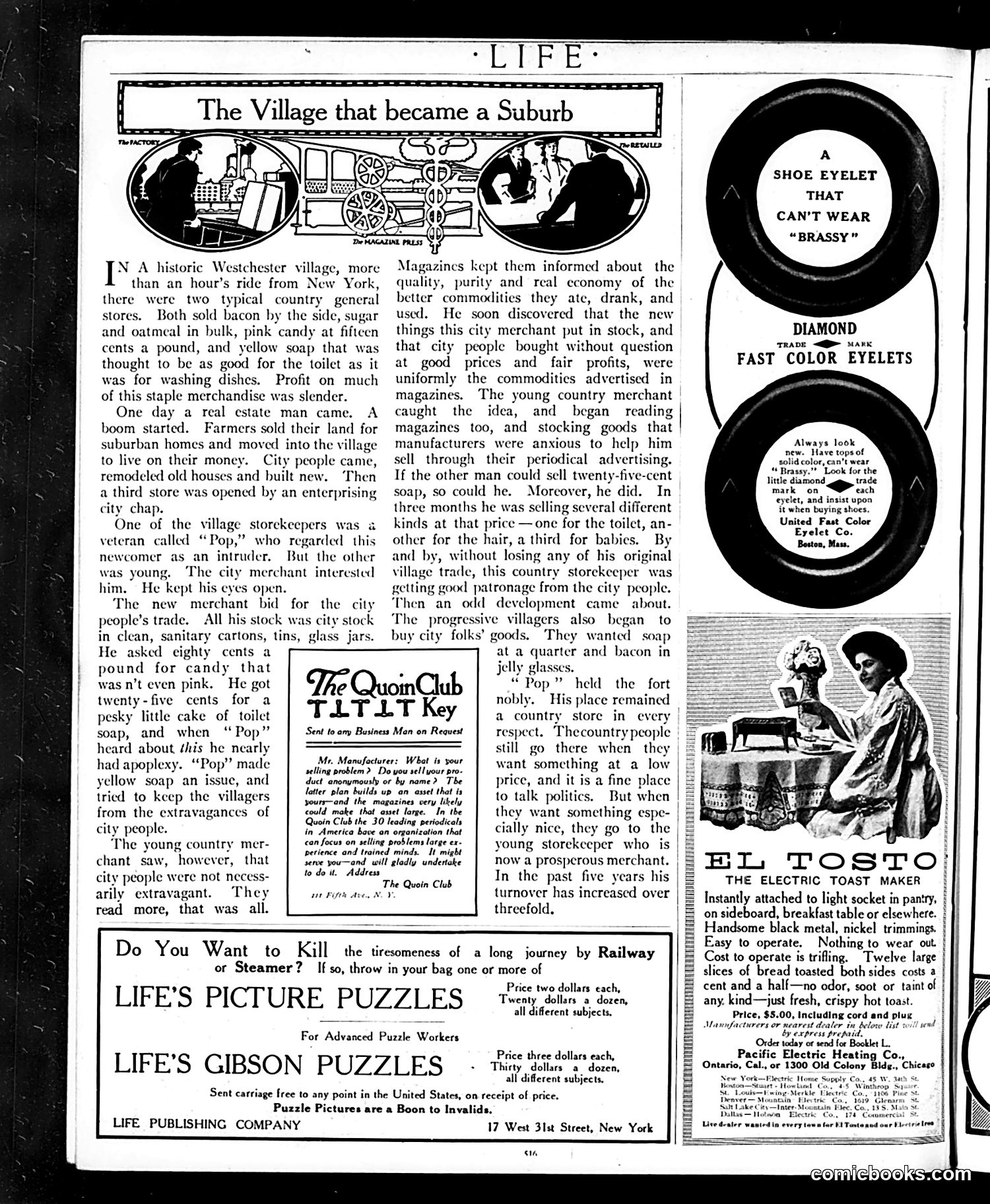
What you’re looking at
This is primarily a **business/economics parable** dressed as a short story, titled "The Village that Became a Suburb." **The Story's Point:** An old-guard country storekeeper ("Pop") resists modernization when suburban development brings city people and a younger, enterprising merchant to his village. Pop clings to traditional merchandise (basic bulk goods, cheap pink candy, yellow soap) and views city tastes as wasteful extravagance. **The Twist:** The young merchant succeeds not through fancy goods, but by reading **magazines**—which advertise quality products to city consumers. He stocks advertised brands and learns that city people aren't extravagant; they're simply informed by advertising. He thrives. Eventually, even village residents adopt city goods. **The Satire:** This is *pro-advertising propaganda*. Life magazine uses the story to argue that magazine advertising educates consumers and drives economic progress. Pop represents outdated thinking; the young merchant represents progress through brand awareness and modern commerce. **The Irony for Modern Readers:** The page is surrounded by advertisements (shoe eyelets, toast makers, puzzles), making the entire magazine itself an example of the "informative advertising" it celebrates.
📄 Transcribed text from this page (OCR, searchable)
Machine-transcribed from the original scan — historical spelling and the odd misread are preserved.
I* A historic Westchester village, more than an hour’s ride from New York, there were two typical country gencral stores. Both sold bacon by the side, sugar and oatmeal in bulk, pink candy at fifteen cents a pound, and yellow soap that was thought to be as good for the toilet as it was for washing dishes. Profit on much of this staple merchandise was slender. One day a real estate man came. A boom started. Farmers sold their land for suburban homes and moved into the village to live on their money. City people came, remodeled old houses and built new. Then a third store was opened by an enterprising city chap. One of the village storckeepers was a veteran called “Pop,” who regarded this newcomer an intruder. But the other young. The city merchant interested him. He kept his eyes open. The new merchant bid for the city people’s trade. All his stock w ity stock in clean, sanitary cartons, tins, glass jars. He asked eighty cents a pound for candy that wasn’t even pink. He got twenty-five cents for a pesky little cake of toilet soap, and when ‘ Pop” heard about ¢his he nearly had apoplexy. ‘Pop’? made yellow soap an issue, and tried to keep the villagers from the extravagances of city people. ‘The young country mer- chant saw, however, that city people were not necess- arily extravagant. They read more, that was all. Do You Want to Kill or Steamer? to do ut. LIFE’S PICTURE PUZZLES Te Quin Qub Sent to any Business Man on Request Mr. Manufacto selling problem > Do you sell your pro- duct anonymously or by name? The latter plan builds up an osset that is your—and the magazines very likely could make thot asset large. Quoin Club the 30 leading periodicals In America bave an organization that can focus on selling problems large ex- perience and trained minds. It might serve you-and will gladly undertake Address The Quoin Club Bt Fifth Aves NY Magazines kept them informed about the quality, purity and real economy of the better commodities they ate, drank, and used. He soon discovered that the new things this city merchant put in stock, and that city people bought without question at good prices and fair profits, were uniformly the commoditics advertised in magazines. The young country merchant caught the idea, and began _ reading magazines too, and stocking goods that manufacturers were anxious to help him sell through their periodical advertising. If the other man could sell twenty-five-cent soap, so could he. Morcover, he did. In three months he was selling several different kinds at that price —one for the toilet, an- other for the hair, a third for babies. By and by, without losing any of his original village trade, this country storekeeper was getting good patronage from the city people. Then an odd development came about. The progressive villagers also began to buy city folks’ goods. They wanted soap at a quarter and bacon in jelly gl " “Pop” held the fort nobly. His place remained a country store in every respect. Thecountry people still go there when they : What ts your price, and it is a fine place to talk politics. they want something espe- cially nice, they go to the young storekeeper who is now a prosperous merchant. In the past five years his turnover has increased over threefold, In the the tiresomeness of a long journey by Railway If so, throw in your bag one or more of Price two dollars each, Twenty dollars a dozen, all different subjects, For Advanced Puzzle Workers LIFE’S GIBSON PUZZLES Price three dollars each, Thirty dollars a dozen, all different subjects. Sent carriage free to any point in the United States, on receipt of price. Puzzle Pictures are a Boon to Invalids. LIFE PUBLISHING COMPANY 17 West 31st Street, New York want something at a low | But when | SHOE EYELET THAT CAN'T WEAR “BRASSY” DIAMOND TRADE <BR Mane FAST COLOR EYELETS Always look new. Have tops of solid color, can’t wear “ Brassy.”” ‘Look for the little diamond, trade mark on ‘each eyelet, and insist upon it when buying shoes. United Fast Color Eyelet Co. Boston, Mass. THE ELECTRIC TOAST MAKER Instantly attached to light socket in pantry, on sideboard, breakfast table or elsewhere. Handsome black metal, nickel trimmings. Easy to operate. Nothing to wear out } Cost to operate is trifling. Twelve large | = slices of bread toasted both sides costs a DCE cent and a half—no odor, soot or taint of any. kind—just fresh, crispy hot toast. Price, $5.00, Including cord and plug Manufacturers or nearest dealer in be ist by express prepaid. Order today or send for Booklet L. Pacific Electric Heating Co. Ontario, Cal., or 1300 Old Colony Bld