
Life, 1908-11-05 · page 16 of 48
Life — November 5, 1908 — page 16: what you’re looking at
What you’re looking at
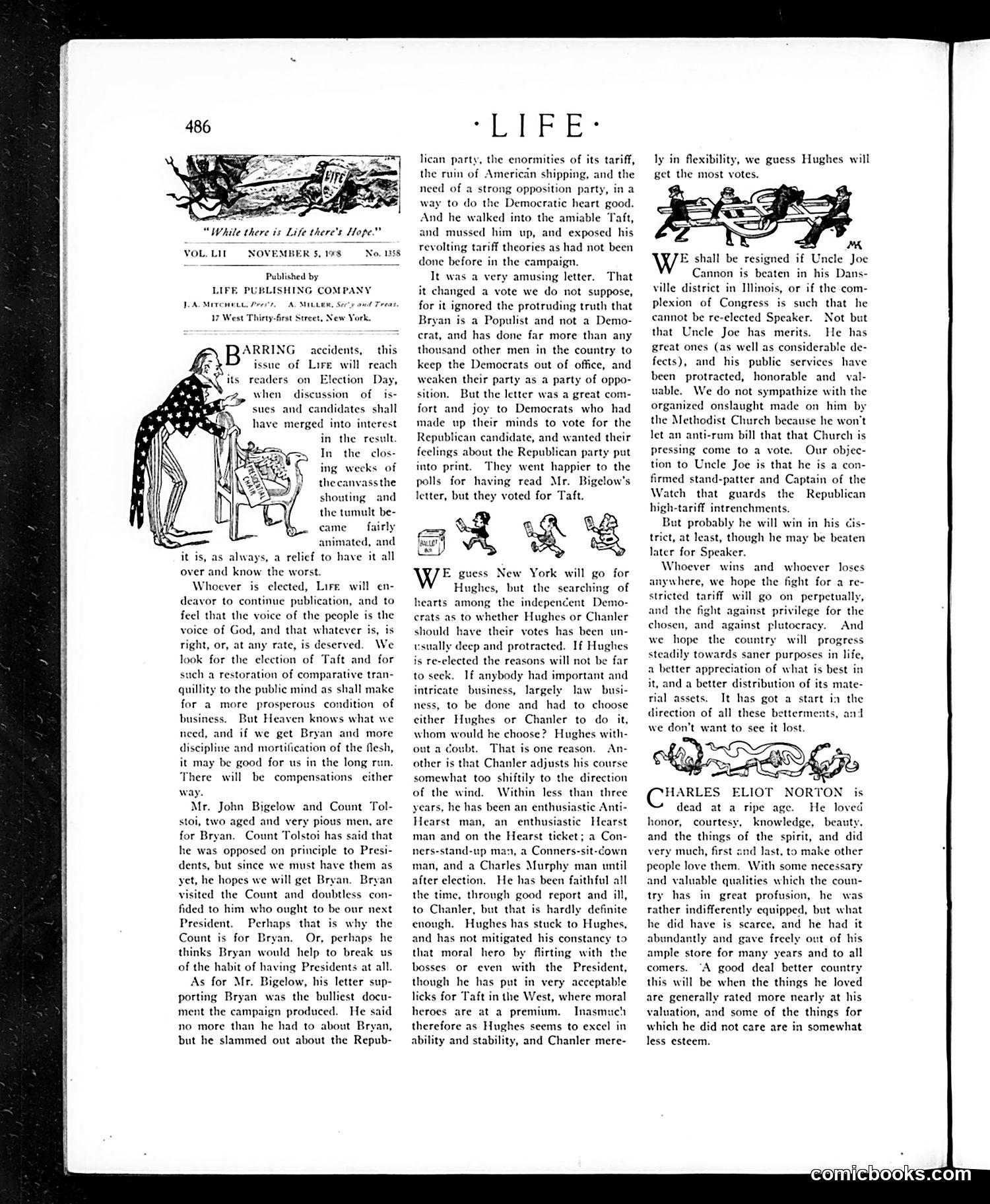
This is **Election Day commentary** for the 1908 U.S. presidential election. The main editorial discusses the campaign between Republican **William Howard Taft** and Democrat **William Jennings Bryan**. The text references: - **John Bigelow** and **Count Tolstoy** (Russian author), both supporting Bryan, criticized for their idealism - **Bigelow's letter** attacking Republican tariff policies, though it didn't change votes - Bryan's weakness as a candidate despite Democratic enthusiasm - Comparison between **Hughes** and **Chanler** (likely Democratic candidates for New York office), with Hughes favored for stability The editorial's tone is satirical and weary—expressing relief the campaign is ending while maintaining cynical detachment about the outcome. Life promises to "continue publication" regardless of results, treating the election as inevitable theater rather than consequential choice. The illustrations appear to show period political caricatures, though specific identities are difficult to confirm from this reproduction.
📄 Transcribed text from this page (OCR, searchable)
Machine-transcribed from the original scan — historical spelling and the odd misread are preserved.
“While there is Life there's Hop VOL. LIL NOVEMBER $,198 No. 1358 Published by LIFE PUBLISHING COMPANY A. MILLER, See“y and Treat JA. Mirenene, Pres 17 West Thirty-first Street, New York. ARRING issue of accidents, — this Lire will reach its readers on Election Day, when discussion of —is- sues and candidates shall have merged into interest in the result. In the ing weeks of thecanvyass the shouting and the tumult be- came fairly animated, and always, a relief to have it all over and know the worst. Whoever is elected, Lire will en- deavor to continue publication, and to feel that the voice of the people is the voice of God, and that whatever is, is right, or, at any rate, is deserved. We look for the election of Taft and for such a restoration of comparative tran- quillity to the public mind as shall make for a more prosperous condition of business. But Heaven knows what we need, and if we get Bryan and more discipline and mortification of the flesh, it may be good for us in the long run. There will be compensations either way. Mr. John Bigelow and Count Tol- stoi, two aged and very pious men, are for Bryan. Count Tolstoi has said that he was opposed on principle to Presi- dents, but since we must have them as yet, he hopes we will get Bryan. Bryan visited the Count and doubtless con- fided to him who ought to be our next President. Perhaps that is why the Count is for Bryan. Or, perhaps he thinks Bryan would help to break us of the habit of having Presidents at all. As for Mr. Bigelow, his letter sup- porting Bryan was the bulliest docu- ment the campaign produced. He said no more than he had to about Bryan, but he slammed out about the Repub- clos- “LIP E- lican party, the cnormities of its tariff, the ruin of American shipping, and the need of a strong opposition party, in a way to do the Democratic heart good. And he walked into the amiable Taft, and mussed him up, and exposed his revolting tariff theories as had not been done before in the campaign. It was a very amusing letter. That it changed a vote we do not suppose, for it ignored the protruding truth that Bryan is a Populist and not a Demo- crat, and has done far more than any thousand other men in the country to keep the Democrats out of office, and weaken their party as a party of oppo- sition. But the letter was a great com- fort and joy to Democrats who had made up their minds to vote for the Republican candidate, and wanted their feelings about the Republican party put into print. They went happier to the polls for having read Mr. Bigelow’s letter, but they voted for Taft. E guess New York will go for Hughes, but the searching of hearts among the indepencent Demo- crats as to whether Hughes or Chanler should have their votes has been un- usttally deep and protracted. If Hughes is re-elected the reasons will not be far to seek. If anybody had important and intricate business, largely law busi- ness, to be done and had to choose either Hughes or Chanler to do it, whom would he choose? Hughes with- out a Coubt. That is one reason. An- other is that Chanler adjusts his course somewhat too shiftily to the direction of the wind. Within less than three years, he has been an enthusiastic Anti- Hearst man, an enthusiastic Hearst man and on the Hearst ticket; a Con- ners-stand-up man, a Conners-sit-cown man, and a Charles Murphy man until after election. He has been faithful all the time, through good report and ill, to Chanler, but that is hardly definite enough. Hughes has stuck to Hughes, and has not mitigated his constancy to that moral hero by flirting with the bosses or even with the President, though he has put in very acceptable licks for Taft in the West, where moral heroes are at a premium. Inasmuch therefore as Hughes seems to excel in ability and stability, and Chanler mere- wy) ly in flexibility, we guess Hughes will get the most votes. = shall be resigned if Uncle Joc Cannon is beaten in his Dans- ville district in Hlinois, or if the com- plexion of Congress is such that he cannot be re-elected Speaker. Not but that Uncle Joe has meri He has great ones (as well as considerable de- fects), and his public services hav been protracted, honorable and val- uable. We do not sympathize with the organized onslaught made on him by the Methodist Church because he won't let an anti-rum bill that that Church is pressing come to a vote. Our objec- tion to Uncle Joe is that he is a con- firmed stand-patter and Captain of the Watch that guards the Republican high-tariff intrenchments. But probably he will win in his cis- trict, at least, though he may be beaten later for Speaker. Whoever wins and whoever anywhere, we hope the fight for a re- stricted tariff will go on perpetually, and the fight against privilege for the chosen, and against plutocracy. And we hope the country will progr steadily towards saner purposes in life, a better appreciation of what is best in it, and a better distribution of its mate- rial assets. It has got a start in the direction of all these betterments, and we don't want to see it lost. loses NORTON is loved HARLES ELIOT dead at a ripe age. He honor, courtesy, knowledge, beauty, and the things of the spirit, and did very much, first and last, to make other people love them. With some necessary and valuable qualities which the coun- try has in great profusion, he was rather indifferently equipped, but what he did have is scarce, and he had it abundantly and gave freely out of his ample store for many years and to all comers. “A good deal better countr: this will be when the things he loved are generally rated more nearly at his valuation, and some of the things for which he did not care are in somewhat less esteem.