
Life, 1908-11-05 · page 27 of 48
Life — November 5, 1908 — page 27: what you’re looking at
What you’re looking at
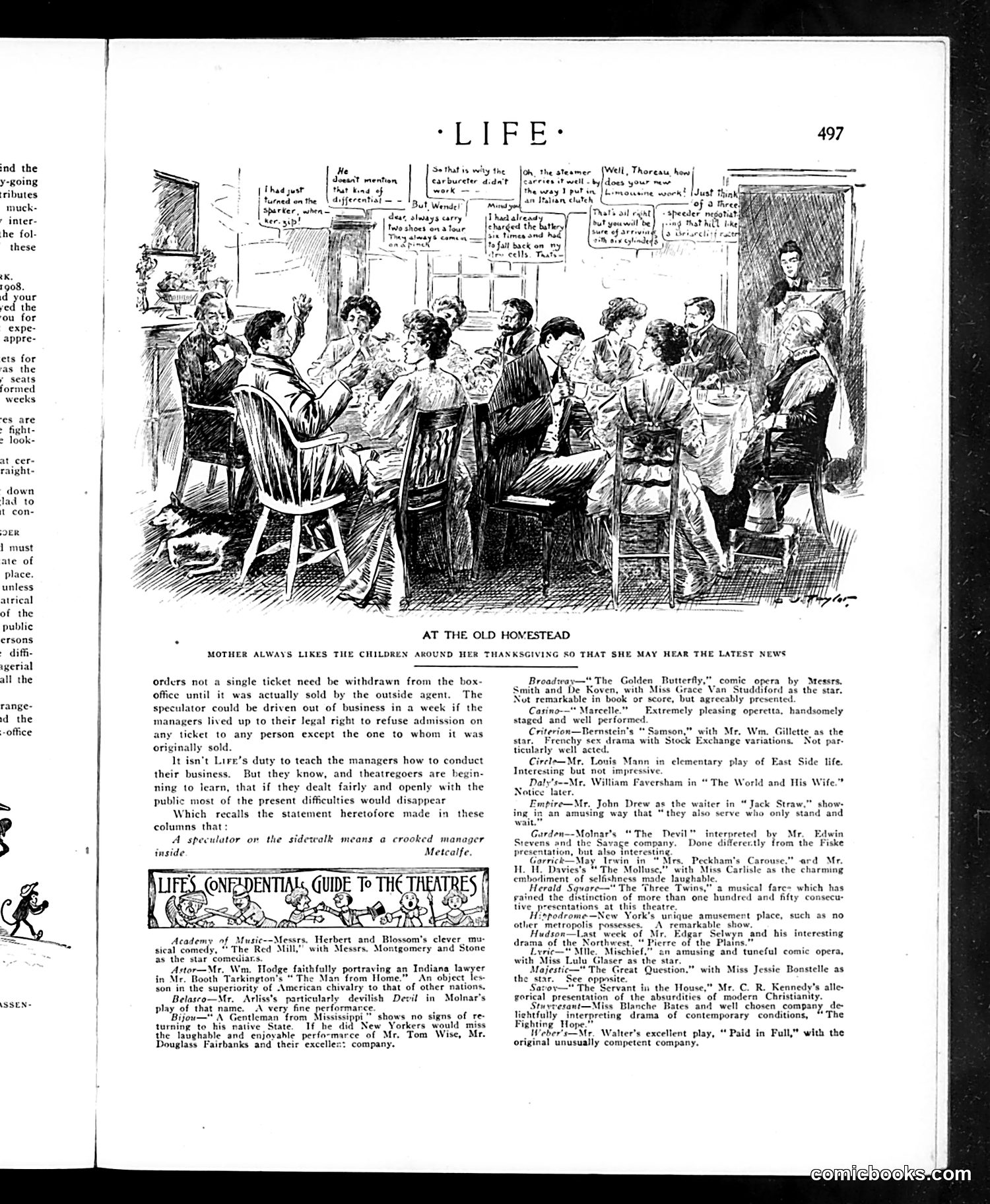
This is a *Life* magazine page featuring a satirical cartoon titled "At the Old Homestead" about Thanksgiving dinner conversation. The sketch shows a family gathered around a table while one person speaks animatedly—the caption explains "Mother always likes the children around her Thanksgiving so that she may hear the latest news." The joke appears to be that family members use holiday gatherings as opportunities to share gossip and updates, turning the occasion into an informal news exchange rather than a purely sentimental family moment. Below the cartoon, the page contains theater reviews and a column about ticket speculation. The text argues that theater managers who allow ticket speculators to resell seats at inflated prices are themselves complicit in the fraud—"a speculator on the sidewalk means a crooked manager inside." The reviews list popular Broadway productions of the era with brief critiques of performances and productions.
📄 Transcribed text from this page (OCR, searchable)
Machine-transcribed from the original scan — historical spelling and the odd misread are preserved.
ind the y-going ributes muck- ; inter- he fol- these cK, 1908. d your yed the ou for expe- appre- ets for ‘as the y seats formed weeks es are fight- look- at cer= raight- down lad to 1 con- place. unless atrical of the public ersons diffi- igerial all the range- id the office \SSEN> “LIFE: 497 dosent mention carbureter didn't that kond of work differential — = He (2% is why the | Thad jest | turned on the | shitter, ate NG ae But Wendel two shoes ona tour deat, always carr Thaed alread Je ateoe — [ehurged the batten [Well Thoreau how | well = by/does your new ay T putin |Limowsne work! [Just th [Prats ail gad buf youwill be fH ary cyhinde AT THE OLD HOMESTEAD MOTHER ALWAYS LIKES THE CHILDREN AROUND HER THANKSGIVING SO THAT SHE MAY HEAR THE LATEST NEWS orders not a single ticket need be withdrawn from the box- office until it was actually sold by the outside agent. The speculator could be driven out of business in a week if the managers lived up to their legal right to refuse admission on any ticket to any person except the one to whom it was originally sold. It isn’t Lire’s duty to teach the managers how to conduct their business. But they know, and theatregoers are begin- ning to learn, that if they dealt fairly and openly with the public most of the present difficulties would disappear Which recalls the statement heretofore made in these columns that: A speculator on the sid walk means a crooked manager inside Metcalfe. Academy of Music--Messrs, Herbert and Blossom’s clever, mu- sical comedy, “ The Red Mill,” with Messrs, Montgomery and Stone as the star comedians. Astor—Mr, Wm. Hodge faithfully portraving an Indiana lawyer in Mr. Booth Tarkington's “The Man from Home.” An object les son in the superiority of American chivalry to that of other nations. Belasco—Mr. Arliss's particularly devilish Devil in Molnar's play of that name. A very fine performance. . Bijow—" \ Gentleman from Mississippi " shows, no. signs of re turning to his native State. If he did New Yorkers would miss the laughable and enjoyable perfo-marce of Mr. Tom Wise, Mr. Douglass Fairbanks and their excellen: company. Broadiway—" The Golden Tutterfly,” comic opera by Messrs. jith and De Koven, with Miss Grace Van Studdiford as the star. Not remarkable in book or score, but agrecably presented. Casino-—" Marcelle.” Extremely pleasing operetta, handsomely staged and well performed Criterion—Dernstein’s Somson,” with Mr. Wm. star, Frenchy sex drama with Stock hange variat ticularly well acted. Cirela—Mr. Lonis Mann in elementary play of East Sid Interesting but not impressive. no Qalrsc=Me William Faversham in “The World and His Wife” Notice later. mpire—Mr, John Drew as the waiter in “Jack Straw,” show: ing in an amusing way that “they also serve who only stand and Mette as the s. Not par- “The Devil” interpreted by Mr. Edwin favage company. Done differently from the Fiske also interesting. Irwin in Mrs. Peckham's Co ard Mr. H. MH. Davies's * The Mollusc,” with Carlisle a charming emboriment_of selfishness made lau Herald Square—" The ‘three Twins,” a musical fare> which has gained the distinction of more than one hundred and fifty consecu- tive presentations at this theatre. H:tpodrome—New York's unique amuseme other metropolis possesses. A remarkable sho Hudson—| dgar Selwyn drama of the of the Plains.” Lyrie—"* Mlle, Mischief, amusing and tuneful comic opera, Miss Lulu Glaser as the star Majestic—" The Great Question.” with Miss Jessie Bonstelle as star. See opposite. ‘ov—" The Servant in the House,” Mr. C. R. Kennedy's alle- gorical presentation of the absurdities ‘of modern Christianity. | Stuvresant—Miss Blanche Bates and well chosen company de lightfully interpreting drama of contemporary conditions, “The ighting Hope.” Weber’s—Mr. Walter’s excellent play, Paid in Full,” with the original unusually competent company. place, such as no ind his interesting