
Life, 1908-11-05 · page 41 of 48
Life — November 5, 1908 — page 41: what you’re looking at
What you’re looking at
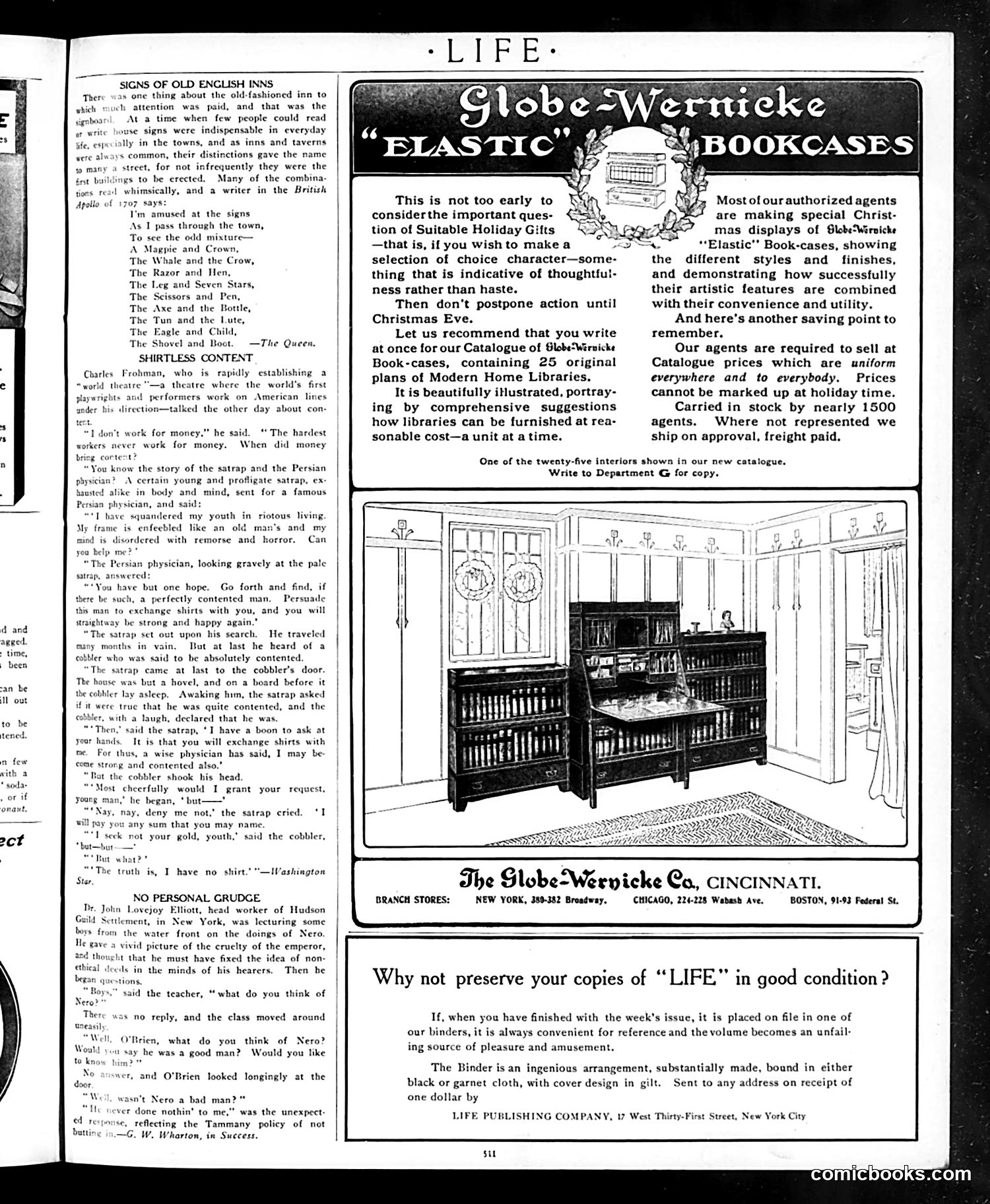
This page contains three unrelated pieces: a historical essay on old English inn signs, a brief anecdote about playwright Charles Frohman discussing work motivation, and two short humorous teaching anecdotes. The main content is **advertising** for Globe-Wernicke "Elastic" bookcases, featuring an illustration of an elegant library interior with ornate wooden shelving. The two brief stories use old moral tales to make points: one Persian parable shows that contentment cannot be bought (a poor cobbler refuses money); the second depicts an ironic lesson when a settlement house teacher lecturing waterfront boys about Emperor Nero's cruelty finds one student responds he bears Nero no grudge since "he never done nothin' to me"—a joke about Tammany Hall political corruption, implying the boy judges people only by personal favors received, not moral principles. Neither requires extensive historical knowledge to understand; both are simple moral/satirical observations on human nature and urban politics.
📄 Transcribed text from this page (OCR, searchable)
Machine-transcribed from the original scan — historical spelling and the odd misread are preserved.
d and ageed ; time, been “an be Mout SIGNS OF OLD ENGLISH INNS There was one thing about the old-fashioned inn to hich such attention was paid, and that was the Ata time when few people could read se signs were indispensable in everyday lly in the towns, and as inns and taverns eere always common, their distinctions gave the name many a street, for not infrequently they were the st buildings to be erected. Many of the combina- whimsically, and a writer in the British rnboa os 707 says: amused at the signs AAs I pass through the town, To see the odd mixture— A Magpie and Crown, The Whale and the Crow, The Razor and Hen, The Leg and Seven St The Scissors and Pe The Axe and the Mottle, The Tun and the Lute, The Eagle and Child, The Shovel and Boot. —The Queen, SHIRTLESS CONTENT Charles. Frohman, who is rapidly esta * world theatre "—a theatre where the world’s first playwrights performers work on American lines ander his direction—talked the other day about con- I don’t work for money,” he said. “The hardest workers never work for money. When did money bring content? “You know the story of the satrap and the Persian physician? A certain young and proftigate satrap, ex tausted alike in body and mind, sent for a famous Persian physician, and said: “T have squandered my youth in riotous living My frame is enfecbled like an old man’s and my ind is disordered with remorse and horror. C: yoa be “The Persian physician, looking gravely at the pale p, answered: have but one hope. Go forth and find, if , a perfectly contented man. Persuade this man to exchange shirts with you, and you will tway be strong and happy again.” ¢ satrap set out upon his search. He traveled any months in But at last he heard of a cobtler who was said to be absolutely contented. “The satrap came at last to the cobbler’s door. The house wa a hovel, and on a board before it tbe cobbler lay asleep. Awaking him, the satrap asked were true that he was quite contented, and the . with a laugh, declared that he was. Then,’ said the satrap, ‘I have a boon to ask at hands. It is that you will exchange shirts with For thus, a wise physician has said, I may be come strong and contented also.” the cobbler shook his head Most cheerfully would I grant your request, young man,’ he began, ‘but— ay, nay, deny me not,’ the satrap cried. *T will poy y yy sum that you may name. t your gold, youth,’ said the cobbler, The truth is, T have no shirt.’ "—Washington NO PERSONAL GRUDGE Lovejoy Elliott, head worker of Hudson Gsild Settlement, in New York, was lecturing some bors from the water front on the doings of Nero. He gave a vivid picture of the cruelty of the emperor, sed thousht that he must have fixed the idea of non- ethical deeds in the minds of his hearers. Then he began question yc been” ssid the teacher, “what do you think of Neto? There uss no reply, and the class moved around seas Welt Woah door. ow “i O'Brien, what do you think of Nero? he was a good man? Would you like and O'Rrien looked longingly at the wasn't Nero a bad man?" ver done nothin’ to me,” was the unexpect ed response, reflecting the Tammany policy of not Dutting in.—G. W. Wharton, in Success. pce e am 30 eke This is not too early to ih * consider the important ques- ese tion of Suitable Holiday Gifts Ste —that is, if you wish to make a selection of choice character—some- thing that is indicative of thoughtful ness rather than haste. Then don't postpone action until Christmas Eve. Let us recommend that you write at once for our Catalogue of SlobeWirnicke Book-cases, containing 25 original plans of Modern Home Libraries, It is beautifully iNustrated, portray- ing by comprehensive suggestions how libraries can be furnished at rea- sonable cost—a unit at atime. Most of ourauthorized agents are making special Christ- mas displays of Globe"Wirvicke ‘Elastic’ Book-cases, showing the different styles and finishes, and demonstrating how successfully their artistic features are combined with their convenience and utility. And here's another saving point to remember. Our agents are required to sell at Catalogue prices which are uniform everywhere and to everybody. Prices cannot be marked up at holiday time. Carried in stock by nearly 1500 agents. Where not represented we ship on approval, freight paid. One of the twenty-five interiors shown in our new catalogue. ‘Write to Department G for copy. The Globe“Wervicke Co, CINCINNATI. BRANCH STORES: NEW YORK, 380-382 Broadway, CHICAGO, 224-228 Wabash Ave. BOSTON, 91-93 Federal St. Why not preserve your copies of “LIFE” in good condition > If, when you have finished with the week's issue, it is placed on file in one of our binders, it is always convenient for reference and the volume becomes an unfail- ing source of pleasure and amusement. The Binder is an ingenious arrangement, substantially made, bound in either black or garnet cloth, with cover design in gilt. Sent to any address on receipt of one dollar by LIFE PUBLISHING COMPANY, 17 West Thirty-First Street, New York City