
Life, 1908-11-05 · page 18 of 48
Life — November 5, 1908 — page 18: what you’re looking at
What you’re looking at
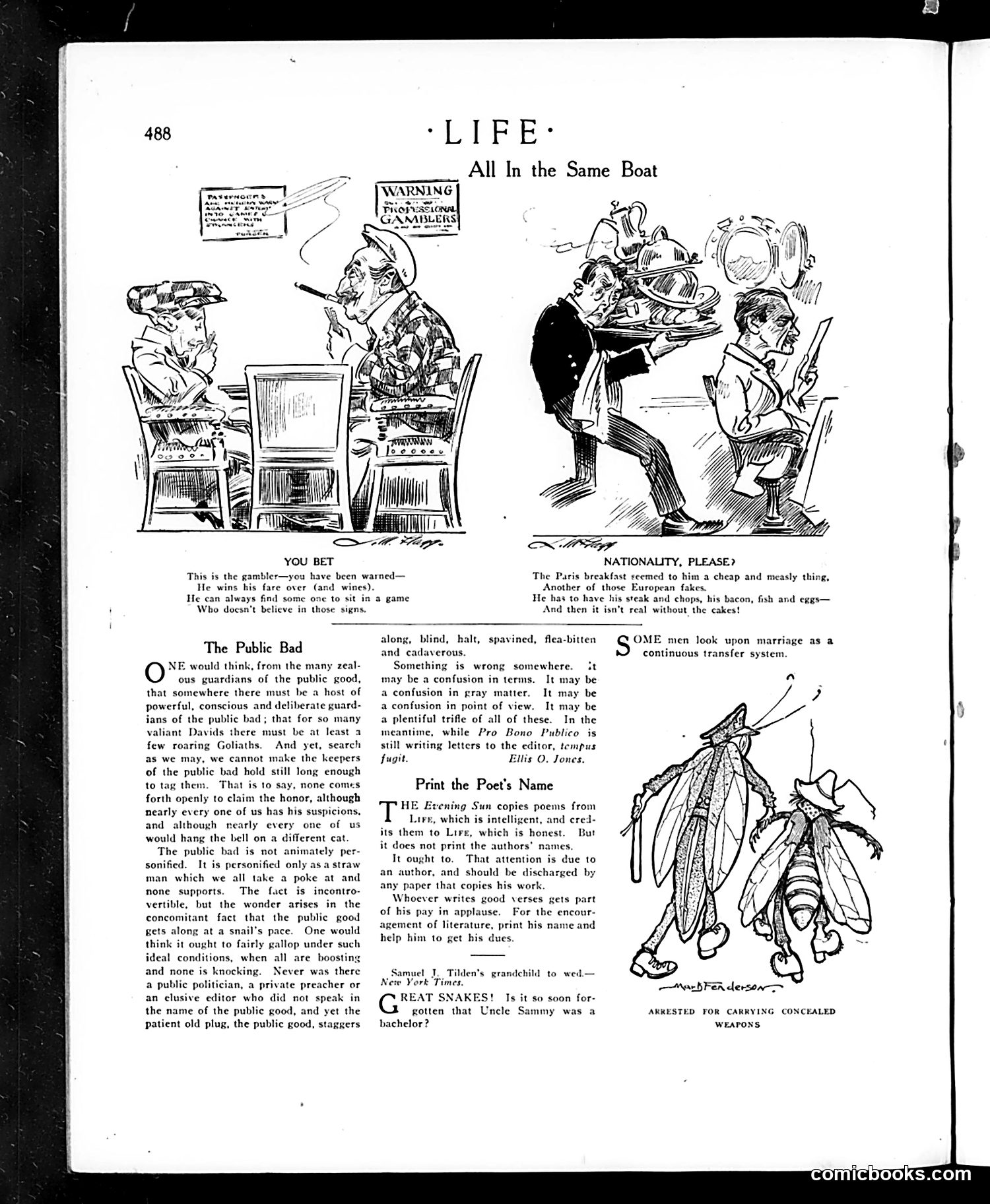
This early 20th-century satirical page contains three distinct pieces: **"All In the Same Boat"** (top cartoons): Two scenes mocking American travelers abroad. Left: a professional gambler confident he can fleece anyone. Right: an American tourist dismissing Paris's "cheap" breakfast, insisting on familiar American fare (steak, bacon, eggs). The satire targets American arrogance and materialism abroad. **"The Public Bad"** (essay): A philosophical complaint that while everyone claims to champion "the public good," no one openly defends "the public bad"—yet society progresses slowly anyway. The author suggests confusion about values prevents actual progress. **"Print the Poet's Name"**: Criticizes the *Evening Sun* newspaper for republishing *Life* magazine's poems without crediting original authors, arguing writers deserve attribution and recognition. **Lower items**: Brief jokes about marriage as financial transaction and a cartoon about concealed weapons arrests. The page reflects *Life*'s focus on social criticism and literary matters rather than hard politics.
📄 Transcribed text from this page (OCR, searchable)
Machine-transcribed from the original scan — historical spelling and the odd misread are preserved.
‘LIFE: All In the Same Boat oy YOU BET This is the gambler—you have been warned— NATIONALITY, PLEASE? The Paris breakfast reemed to him a cheap and measly thing, Another of those European fakes. He has to have his steak and chops, his bacon, fish and eggs— He wins his fare over (and wines). He can always find some one to sit in a game Who doesn't believe in those signs. And then it isn't real without the cakes! The Public Bad NE would think, from the many zeal- ous guardians of the public good, that somewhere there must be a host of powerful, conscious and deliberate guard- ians of the public bad; that for so many valiant Davids there must be at least a few roaring Goliaths. And yet, search as we may, we cannot make the keepers of the public bad hold still long enough to tag them, That is to say, none comes forth openly to claim the honor, although nearly every one of us has his suspicions, and although nearly every one of us would hang the bell on a different cat. The public bad is not animately per- sonified. It is personified only asa straw man which we all take a poke at and none supports. The fact is incontro- vertible, but the wonder arises in the concomitant fact that the public good gets along at a snail’s pace. One would it ought to fairly gallop under such 1 conditions, when all are boosti and none is knocking. Never was there a public politician, a private preacher or an elusive editor who did not speak in the name of the public good, and yet the patient old plug, the public good, staggers along, blind, halt, spavined, flea-bitten and cadaverou: Something is wrong somewhere. it may be a confusion in terms. It may be a confusion in gray matter. It may be a confusion in point of view. It may be a plentiful trifle of all of these. In the meantime, while Pro Bono Publico is still writing letters to the editor, tempus fugit. Ellis O. Jones. Print the Poet's Name T' E Evening Sun copies poems from Lire, which is intelligent, and cred- its them to Lire, which is honest. But it does not print the authors’ names. It ought to. That attention is due to an author, and should be discharged by any paper that copies his work. Whoever writes good verses gets part of his pay in applause. For the encour- agement of literature, print his name and help him to get his dues. Samuel J. Tilden's grandchild to wed.— New York Times. REAT SNAKES! Is it so soon for- gotten that Uncle Sammy was a bachelor? OME men look upon marriage as a continuous transfer system. —*arbFen dersoan ARRESTED FOR CARRY WEAPONS, G CONCEALED icbooks.com