
Life, 1908-11-05 · page 26 of 48
Life — November 5, 1908 — page 26: what you’re looking at
What you’re looking at
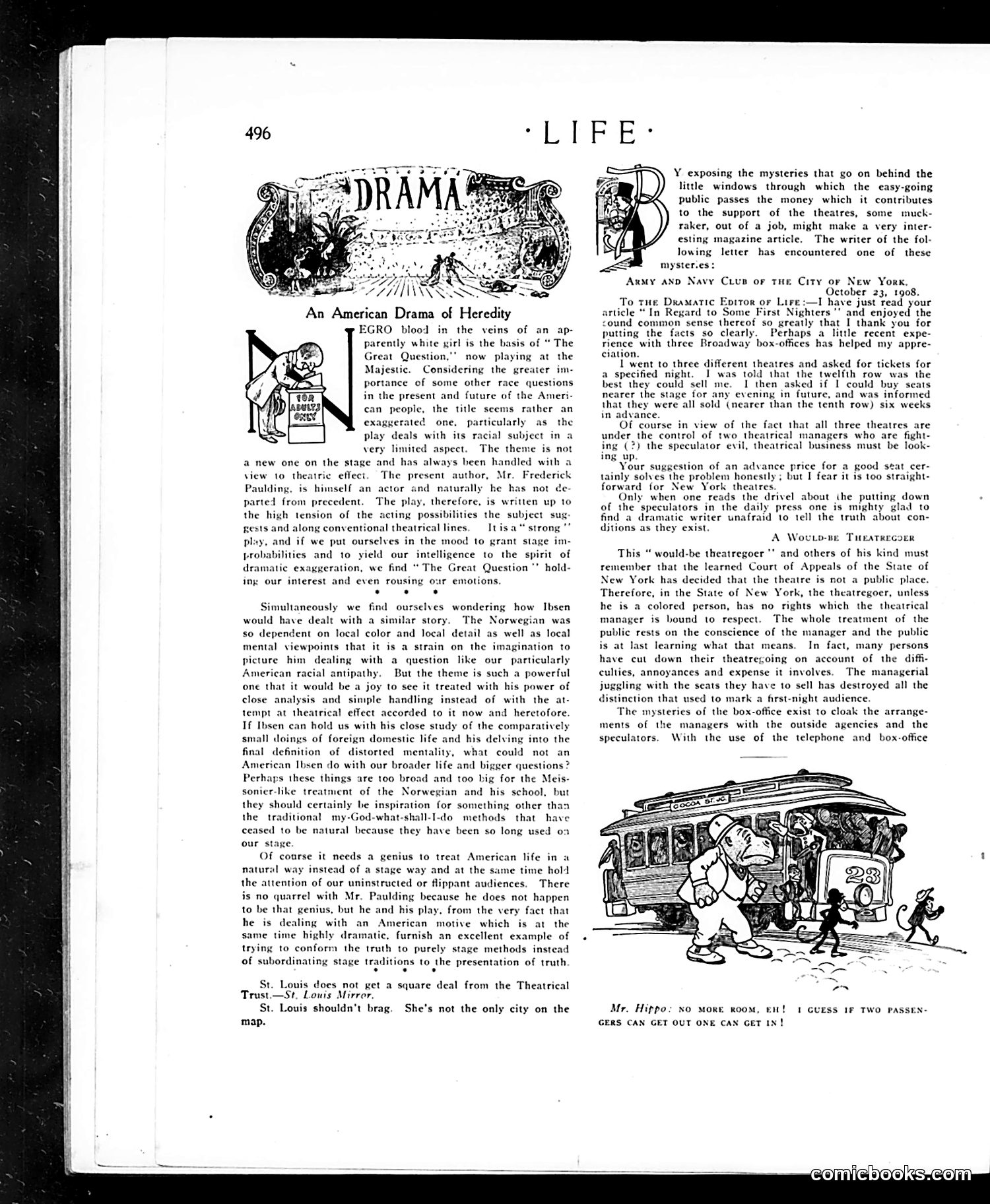
This page critiques theatrical practices and racial representation in early 1900s American drama. The main article reviews "The Great Question," a play about mixed-race identity at the Majestic Theatre. The critic argues the play sensationalizes race as melodrama rather than treating it with serious social inquiry—lamenting it lacks the psychological depth Henrik Ibsen would bring to such themes. The cartoon at bottom depicts theatrical box-office congestion, with the caption "Mr. Hippo: No more room, eh? I guess if two passengers can get out one can get in!" This satirizes overcrowded Broadway theaters and their chaotic management. A letter criticizes the "Theatrical Trust"—referring to the monopolistic control of theaters and booking practices that restricted independent venues, particularly affecting St. Louis. The satire suggests theatrical gatekeeping limited fair access to entertainment venues across America. Together, these items critique both how Broadway handled controversial social subjects superficially and the industry's corporate consolidation problems.
📄 Transcribed text from this page (OCR, searchable)
Machine-transcribed from the original scan — historical spelling and the odd misread are preserved.
An American Drama of Heredity 3RO blood in the veins of an ap- parently white girl is the basis of “ The Great Question,’ now playing at the Majestic. Considering the greater im- portance of some other race questions in the present and future of the Ameri- can people, the title seems rather an exaggerated one, particularly as the play deals with its racial subject in a very limited aspect. The theme is not a new one on the stage and has always been handled with a view to theatric effect. The present author, Mr. Frederick Paulding, is himself an or and naturally he has not de. parted from precedent. The play, therefore, is written up to the high tension of the acting possibilities the subject sug- “ strong "" gests and along conventional theatrical lines, —Itis play. and if we put ourselves in the mood to grant stage im- probabilities and to yield our intelligence to the spirit of dramatic exaggeration, we find “ The Great Question "' hold- J even rousing our emotions. ing our interest multancously we find ourselves wondering how Ibsen would have dealt with a similar story. The Norwegian was so dependent on local color and local detail as well as local mental viewpoints that it is a strain on the imagination to picture him dealing with a question like our particularly American racial antipathy. But the theme is such a powerful one that it would be a joy to see it treated with his power of close analysis and simple handling instead of with the at- tempt at theatrical effect accorded to it now and heretofore If Ibsen can hold us with his close study of the comparatively small doings of foreign domestic life and his delving into the final definition of distorted mentality, what could not an American Ibsen do with our broader life and bigger questions? Perhaps these things are too broad and too big for the Meis- sonier-like treatment of the Norwegian and his school, but they should certainly be inspiration for something other than the traditional my-God-what-shall-I-do methods that have ceased to be natural because they have been so long used 03 our stage Of course it needs a genius to treat American life in a natural way instead of a stage way and at the same time hold the attention of our uninstructed or fippant audiences. There is no quarrel with Mr. Paulding because he does not happen to be that genius, but he and his play, from the very fact that he is dealing with an American motive which is at the same time highly dramatic, furnish an excellent example of trying to conform the truth to purely stage methods instead of subordinating stage traditions to the presentation of truth St. Louis does not get a square deal from the Theatrical Trust.—St. Louis Mirror, St. Louis shouldn't brag. She's not the only city on the map. Y exposing the mysteries that go on behind the little windows through which the easy-going public passes the money which it contributes to the support of the theatres, some muck- raker, out of a job, might make a very inter- esting magazine article. The writer of the fol- lowing letter has encountered one of these mysteries: Arty AND Navy Cun of tHe City or New York. October 23, 1908. To tHe Dramatic Epttor or Lire :—I have just read your article “In Regard to Some First Nighters "’ and enjoyed the cound common sense thereof so greatly that I thank you for putting the facts so clearly. Perhaps a little recent expe- rience with three Broadway box-offices has helped my appre- ciation. I went to three different theatres and asked for tickets for a specified night. J was told that the twelfth row was the best they could sell me. 1 then asked if | could buy seats nearer the stage for any evening in future, and was informed that they were all sold (nearer than the tenth row) six weeks in advance. Of course in view of the fact that all three theatres are under the control of two theatrical managers who are fight ing (?) the speculator evil, theatrical business must be look- ing up Your suggestion of an advance price for a good stat cer- tainly solves the problem honestly; but I fear it is too straight- forward for New York theatres. Only when one reads the drivel about the putting down of the speculators in the daily press one is mighty glad to find a dramatic writer unafraid to tell the truth about con- ditions as they exist. A Wovtp-ne Titeatrecorr This “ would-be theatregoer "’ and others of his kind must remember that the learned Court of Appeals of the State of New York has decided that the theatre is not a public place. Therefore, in the State of New York, the theatregoer, unless he is a colored person, no rights which the theatrical manager is bound to respect. The whole treatment of the public rests on the conscience of the manager and the public is at last learning what that means. In fact, many persons have cut down their theatrecoing on account of the diffi- culties, annoyances and expense it involves. The managerial juggling with the seats they have to sell has destroyed all the distinction that used to mark a first-night audience. The mysteries of the box-office exist to cloak the arrange- ments of the managers with the outside agencies and the speculators. With the use of the telephone and box-office Mr. Hippo: so More room, en! 1 GUESS IF TWO PASSEN- GERS CAN GET OUT ONE CAN GET IN!