
Life, 1908-11-05 · page 20 of 48
Life — November 5, 1908 — page 20: what you’re looking at
What you’re looking at
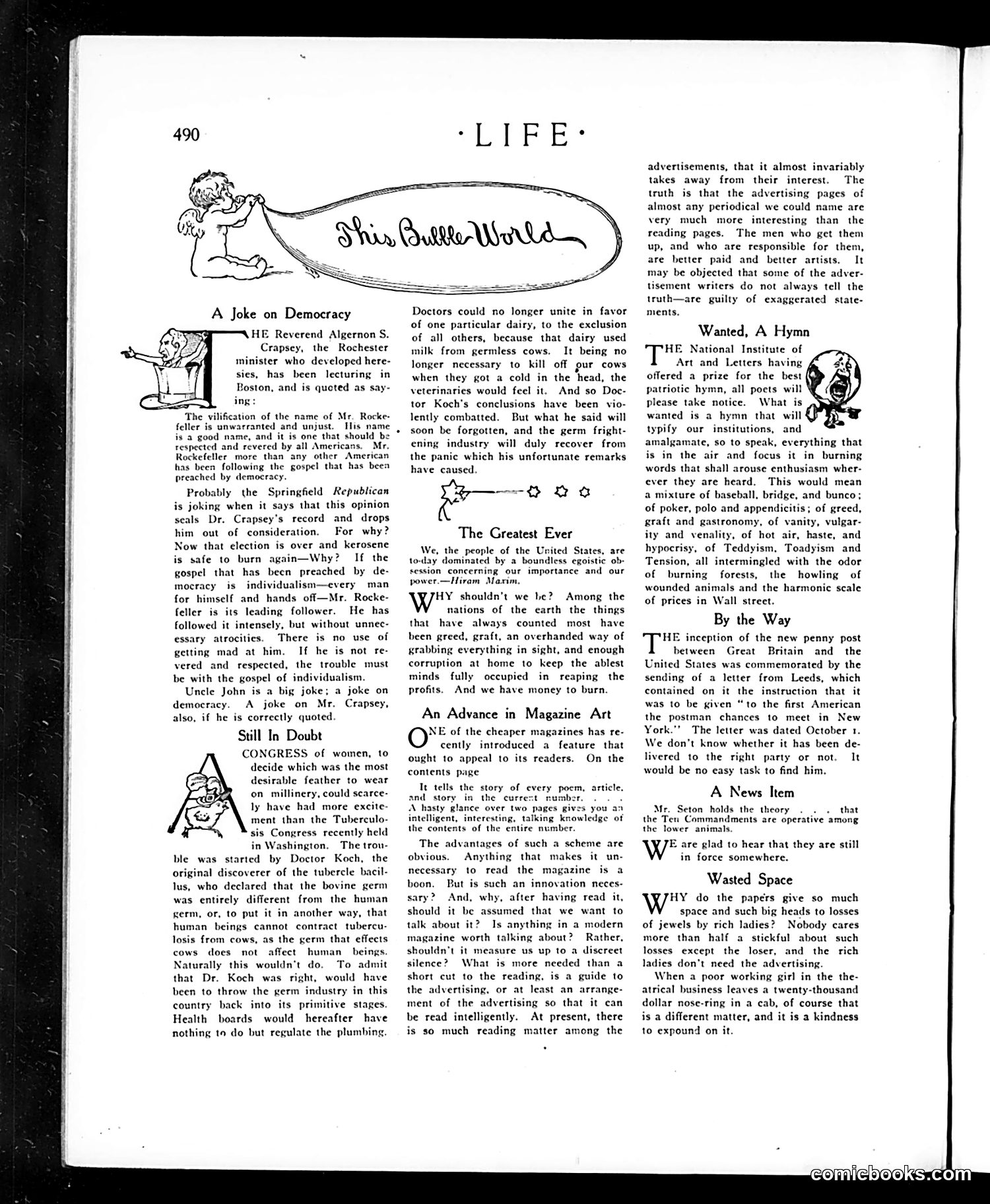
This page contains three satirical pieces attacking American institutions: **"A Joke on Democracy"** mocks Reverend Crapsey for praising Rockefeller as embodying democratic ideals of individualism ("every man for himself"). The satire is bitter: if democracy truly means selfish individualism without restraint, then Rockefeller—who pursued ruthless business practices—is its perfect exemplar. The joke exposes the hypocrisy of celebrating both democracy and unchecked capitalist greed. **"Still in Doubt"** ridicules the medical and public health establishment. It sarcastically notes that Doctor Koch's discovery that bovine tuberculosis differs from human tuberculosis threatens entire industries—veterinarians, dairy inspectors, and health boards profit from disease panic. The satire suggests these professionals suppress scientific truth to maintain their lucrative "germ frightening industry." **"The Greatest Ever"** quotes inventor Hiram Maxim criticizing American egotism, greed, and corruption, while noting Americans have "money to burn"—validating his critique through material success itself. All three pieces attack institutional corruption and self-interest masquerading as public good.
📄 Transcribed text from this page (OCR, searchable)
Machine-transcribed from the original scan — historical spelling and the odd misread are preserved.
A Joke on Democracy HE Reverend Algernon S. Crapsey, the Rochester minister who developed here- sies, has been lecturing in Boston, and is quoted as say- ing: The vilification of the name of Mr. Rocke- feller is unwarranted and unjust. Ilis name is a good name, and it is one that should be respected and revered by all Americans. Mr. Rockefeller more than any other American has been following the gospel that has been preached by democracy. Probably the Springfield Republican is joking when it says that this opinion seals Dr. Crapsey’s record and drops him out of consideration. For why? Now that election is over and kerosene is safe to burn again—Why? If the gospel that has becn preached by de- mocracy is individualism—every man for himself and hands off—Mr. Rocke- feller is its leading follower. He has followed it intensely, but without unnec- essary atrocities. There is no use of getting mad at him. If he is not re- vered and respected, the trouble must be with the gospel of individualism. Uncle John is a big joke; a joke on democracy. A joke on Mr. Crapsey, also, if he is correctly quoted. Still In Doubt CONGRESS of women, to decide which was the most desirable feather to wear on millinery, could scarce- ly have had more excite- ment than the Tuberculo- sis Congress recently held in Washington. The trou- ble was started by Doctor Koch, the original discoverer of the tubercle bacil- lus, who declared that the bovine germ was entirely different from the human germ, or, to put it in another way, that human beings cannot contract tubercu- losis from cows, as the germ that effects cows does not affect human beings. Naturally this wouldn't do. To admit that Dr. Koch was right, would have been to throw the germ industry in this country back into its primitive stages. Health boards would hereafter have nothing ta do but regulate the plumbing Doctors could no longer unite in favor of one particular dairy, to the exclusion of all others, because that dairy used milk from germless cows. It being no longer necessary to kill off pur cows when they got a cold in the head, the veterinaries would feel it. And so Doc- tor Koch's conclusions have been vio- lently combatted. But what he said will soon be forgotten, and the germ fright- ening industry will duly recover from the panic which his unfortunate remarks have caused ——-O 26 The Greatest Ever We, the people of the United States, are towlay dominated by a boundless egoistic ob- session concerning our importance and our power.—Hiram Maxim, HY shouldn't we be? nations of the earth the things that have always counted most have been greed, graft, an overhanded way of grabbing everything in sight, and enough corruption at home to keep the ablest minds fully occupied in reaping the profits. And we have money to burn. Among the An Advance in Magazine Art NE of the cheaper magazines has re- cently introduced a feature that ought to appeal to its readers. On the contents page It tells the story of every poem, article. and story in the currext num sone A hasty glance over two pages gives you an intelligent, interesting, talking knowledge of the contents of the entire number. The advantages of such a scheme are obvious. Anything that makes it un- necessary to read the magazine is a boon. But is such an innovation neces- sary? And, why, after having read it, should it be assumed that we want to talk about it? Is anything in a modern magazine worth talking about? Rather, shouldn't it measure us up to a discreet silence? What is more needed than a short cut to the reading, is a guide to the advertising, or at least an arrange- ment of the advertising so that it can be read intelligently. At present, there is so much reading matter among the advertisements, that it almost invariably takes away from their interest. The truth is that the advertising pages of almost any periodical we could name are very much more interesting than the reading pages. The men who get them up, and who are responsible for them, are better paid and better artists. It may be objected that some of the adver- tisement writers do not always tell the truth—are guilty of exaggerated state- ments. Wanted, A Hymn HE National Institute of Art and Letters having offered a prize for the best ® patriotic hymn, all poets will please take notice. What is wanted is a hymn that will & typify our institutions, and amalgamate, so to speak, everything that is in the air and focus it in burning words that shall arouse enthusiasm wher- ever they are heard. This would mean a mixture of baseball, bridge, and bunco; of poker, polo and appendicitis; of greed, graft and gastronomy, of vanity, vulgar- ity and venality, of hot air, haste, and hypocrisy, of Teddyism, Toadyism and Tension, all intermingled with the odor of burning forests, the howling of wounded animals and the harmonic scale of prices in Wall street. By the Way HE inception of the new penny post between Great Britain and the United States was commemorated by the sending of a letter from Leeds, which contained on it the instruction that it was to be given “to the first American the postman chances to meet in New York.’ The letter was dated October 1. We don’t know whether it has been de- livered to the right party or not. It would be no easy task to find him. A News Item Mr. Seton holds the theory . . . that the Ten Commandments are operative among the lower animals. E are glad to hear that they are still in force somewhere. Wasted Space HY do the papers give so much space and such big heads to losses of jewels by rich ladies? Nobody cares more than half a stickful about such losses except the loser, and the rich ladies don't need the advertising. When a poor working gitl in the the- atrical business leaves a twenty-thousand dollar nose-ring in a cab, of course that is a different matter, and it is a kindness to expound on it.