
Life, 1908-11-05 · page 23 of 48
Life — November 5, 1908 — page 23: what you’re looking at
What you’re looking at
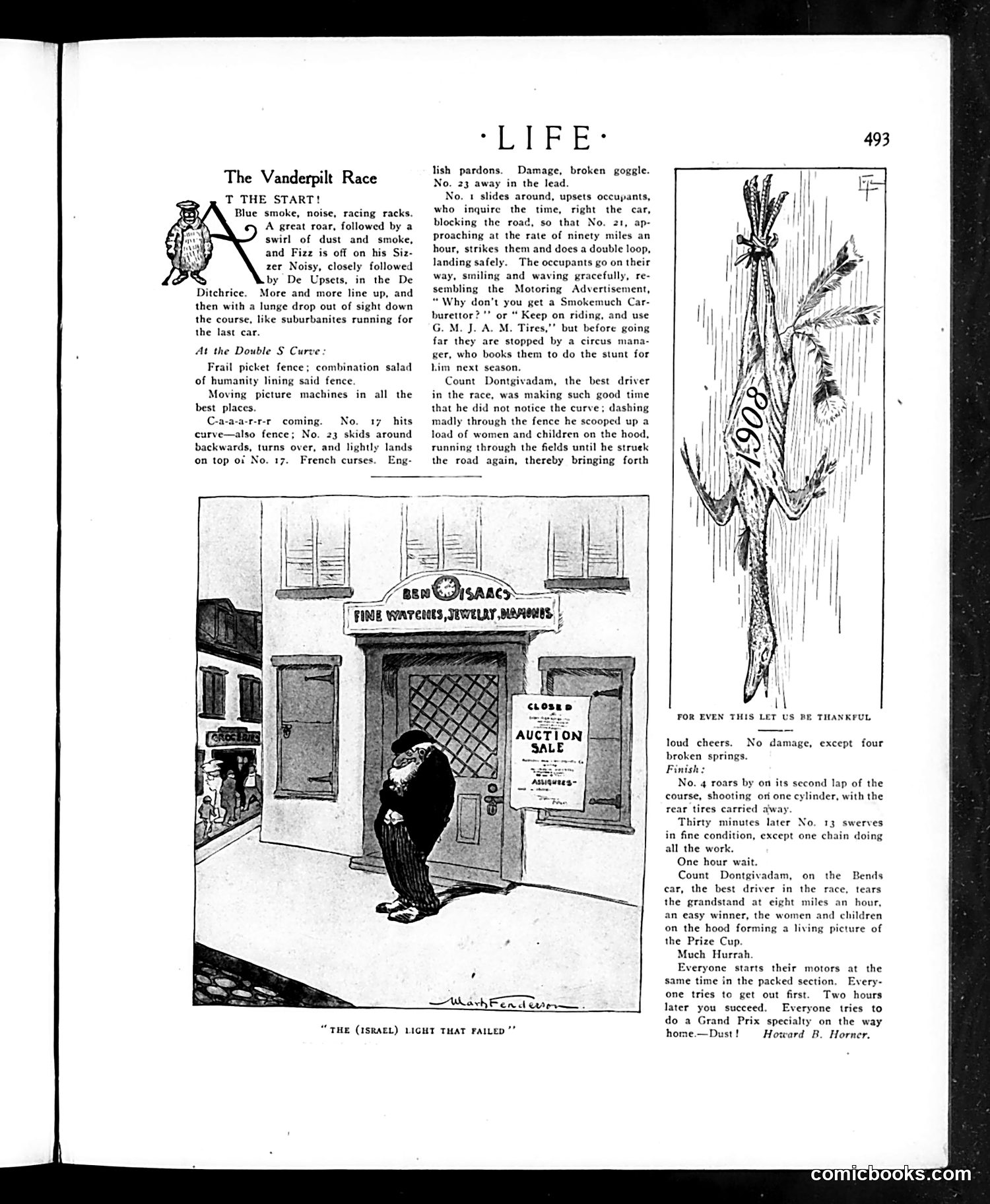
This is a humorous narrative account of a motor race (likely the Vanderbilt Cup, a real early 1900s American racing event). The satire mocks both reckless drivers and the chaos of early automobile racing spectacles. The cartoon depicts a jewelry store ("Ben Isaac, Time Watches, Jewelry") with an "Auction Sale" sign—appearing to reference a business failure, though the connection to racing remains unclear. The story ridicules dangerous driving: cars crash through fences, spectators are scooped onto hoods, vehicles flip and land on each other. Yet drivers emerge unharmed, behaving like they're in advertisements ("smiling and waving gracefully"). Count Dontgivadam wins despite mechanical failure, carrying women and children on his hood as a "living picture of the Prize Cup." The satire targets automobile racing's recklessness and the absurd advertising culture surrounding early motoring. The ending emphasizes post-race traffic chaos—everyone leaving simultaneously creates another "race." The cartoonist is Howard B. Horner.
📄 Transcribed text from this page (OCR, searchable)
Machine-transcribed from the original scan — historical spelling and the odd misread are preserved.
The Vanderpilt Race T THE START! Blue smoke, noise, racing racks. A great roar, followed by a swirl of dust and smoke, and Fizz is off on his Siz- zer Noisy, closely followed by De Upsets, in the De Ditchrice. More and more line up, and then with a lunge drop out of sight down the course, like suburbanites running for the last car. At the Double S Curve: Frail picket fence; combination salad of humanity lining said fence. Moving picture machines in all the best places. : r-r coming. No. 17 hits curve—also fence; No. 23 skids around backwards, turns over, and lightly lands on top of No. 17. French curses. Eng- ‘LIFE: lish pardons. Damage, broken goggle. No. 23 away in the lead. No. 1 slides around, upsets occupants, who inquire the time, right the car, blocking the road, so that No. 21, ap- proaching at the rate of ninety miles an hour, strikes them and does a double loop, landing safely. The occupants go on their way, smiling and waving gracefully, re- sembling the Motoring Advertisement, “Why don’t you get a Smokemuch Car- burettor?"’ or “ Keep on riding, and use G. M. J. A. M. Tires,”” but before going far they are stopped by a circus mana- ger, who books them to do the stunt for Lim next season. Count Dontgivadam, the best driver in the race, was making such good time that he did not notice the curve; dashing madly through the fence he scooped up a load of women and children on the hood, running through the fields until he struek the road again, thereby bringing forth ’ —WhFen de. | “THE (ISRAEL) LIGHT THAT FAILED ’* FOR EVEN THIS LET US RE THANKFUL loud cheers. No damage, except four broken springs. Finish No. 4 roars by on its second lap of the course, shooting ox one cylinder, with the rear tires carried away. Thirty minutes later No. 13 swerves in fine condition, except one chain doing all the work. One hour wait. Count Dontgivadam, on the Bends car, the best driver in the race, tears the grandstand at eight miles an hour, an easy winner, the women and children on the hood forming a living picture of the Prize Cup. Much Hurrah Everyone starts their motors at the same time in the packed section. Every- one tries to get out first. Two hours later you succeed. Everyone tries to do a Grand Prix specialty on the way home—Dust! Howard B. Horner.