
A complete issue · 44 pages · 1908
Life — April 2, 1908
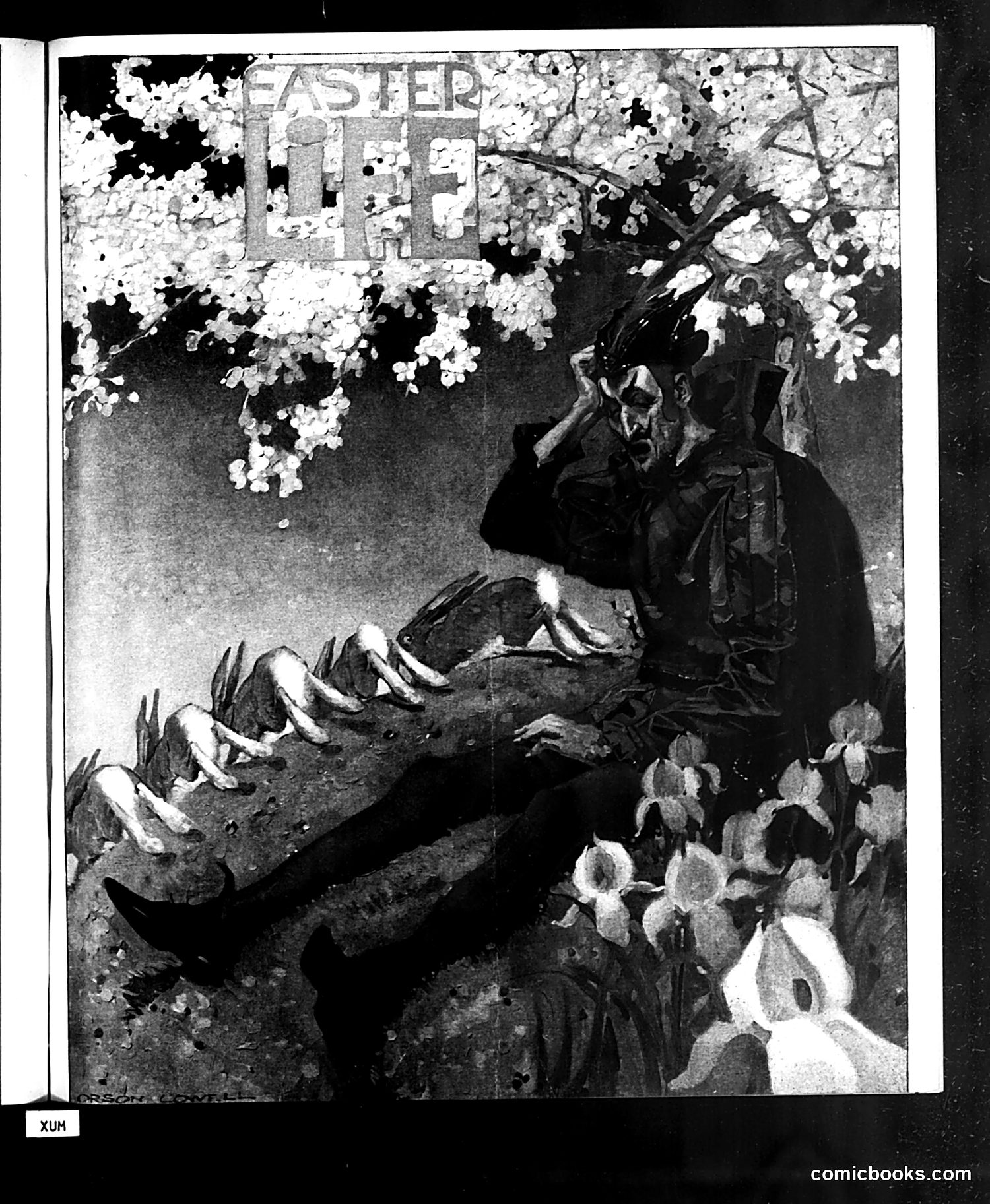
This appears to be an Easter-themed satirical illustration from Life magazine. The image shows a darkly-dressed figure (possibly representing Death or a grim personification) reclining among spring flowers—irises and what appear to be Easter lilies—creating a stark visual contrast between the symbols of renewal and mortality. The "EASTER LIFE" text at the top suggests the cartoon comments on Easter's themes of resurrection and rebirth, but the juxtaposition implies darker commentary: perhaps critiquing materialism obscuring spiritual meaning, or commenting on death's persistence despite seasonal renewal symbolism. The specific historical or political references remain unclear without additional context from the magazine's date and surrounding content.
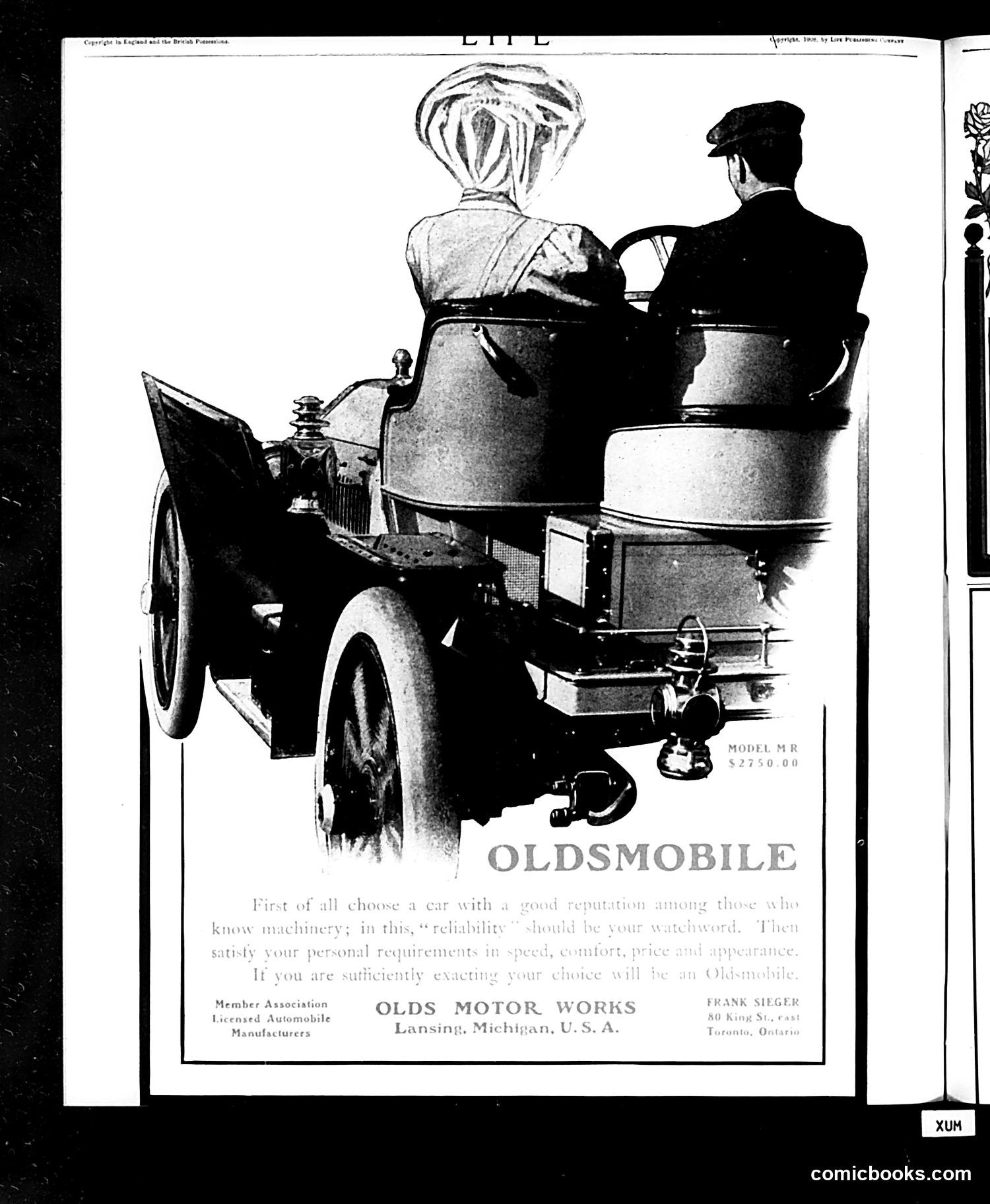
This page is **primarily an advertisement**, not political satire. It promotes the Oldsmobile Model M R, priced at $2,750, manufactured by Olds Motor Works in Lansing, Michigan. The ad features an illustration of an elegantly dressed couple in an early automobile. The accompanying text advises potential buyers to prioritize a car's reputation and reliability ("reliability should be your watchword"), then consider personal preferences regarding speed, comfort, price, and appearance. The ad includes contact information for Frank Sieger, a dealer at 80 King Street East, Toronto, Ontario. There is no political cartoon or satire present on this page—it is a straightforward commercial advertisement typical of early 20th-century automotive marketing in a general-interest magazine.
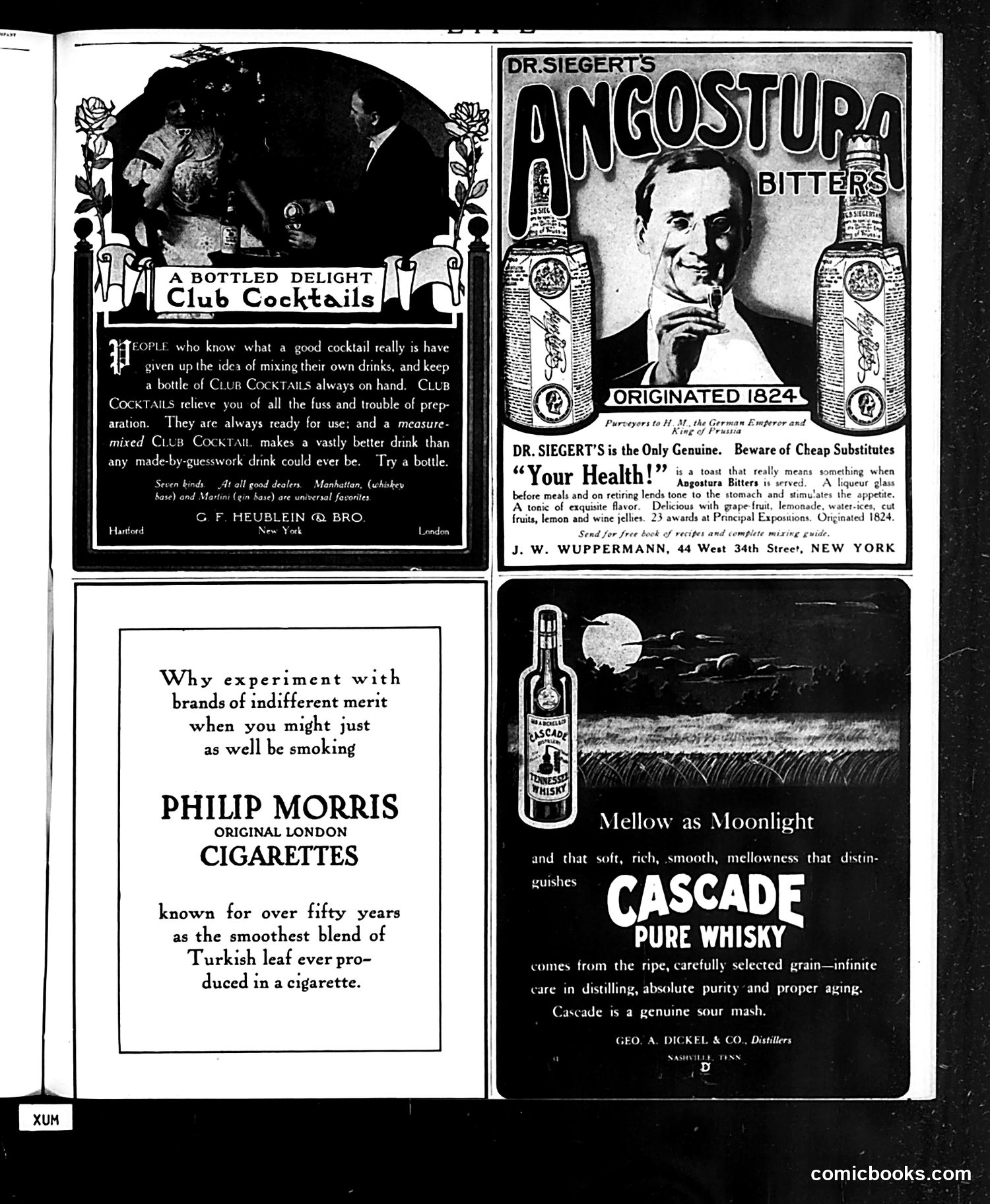
This page contains **four advertisements**, not political cartoons or satire. The ads promote: 1. **Club Cocktails** (G.F. Heublein & Bro.) - pre-mixed cocktails for convenience 2. **Angostura Bitters** - a digestive tonic, emphasizing its 1824 origin and warning against cheap substitutes 3. **Philip Morris Cigarettes** - highlighting Turkish tobacco blend 4. **Cascade Pure Whisky** - describing its smoothness and quality These are vintage print advertisements from an era (likely early-to-mid 20th century) when alcohol and tobacco were marketed without health warnings. The ads reflect period attitudes toward these products as lifestyle choices and health tonics rather than health risks. There is no political satire or cartooning present on this page.
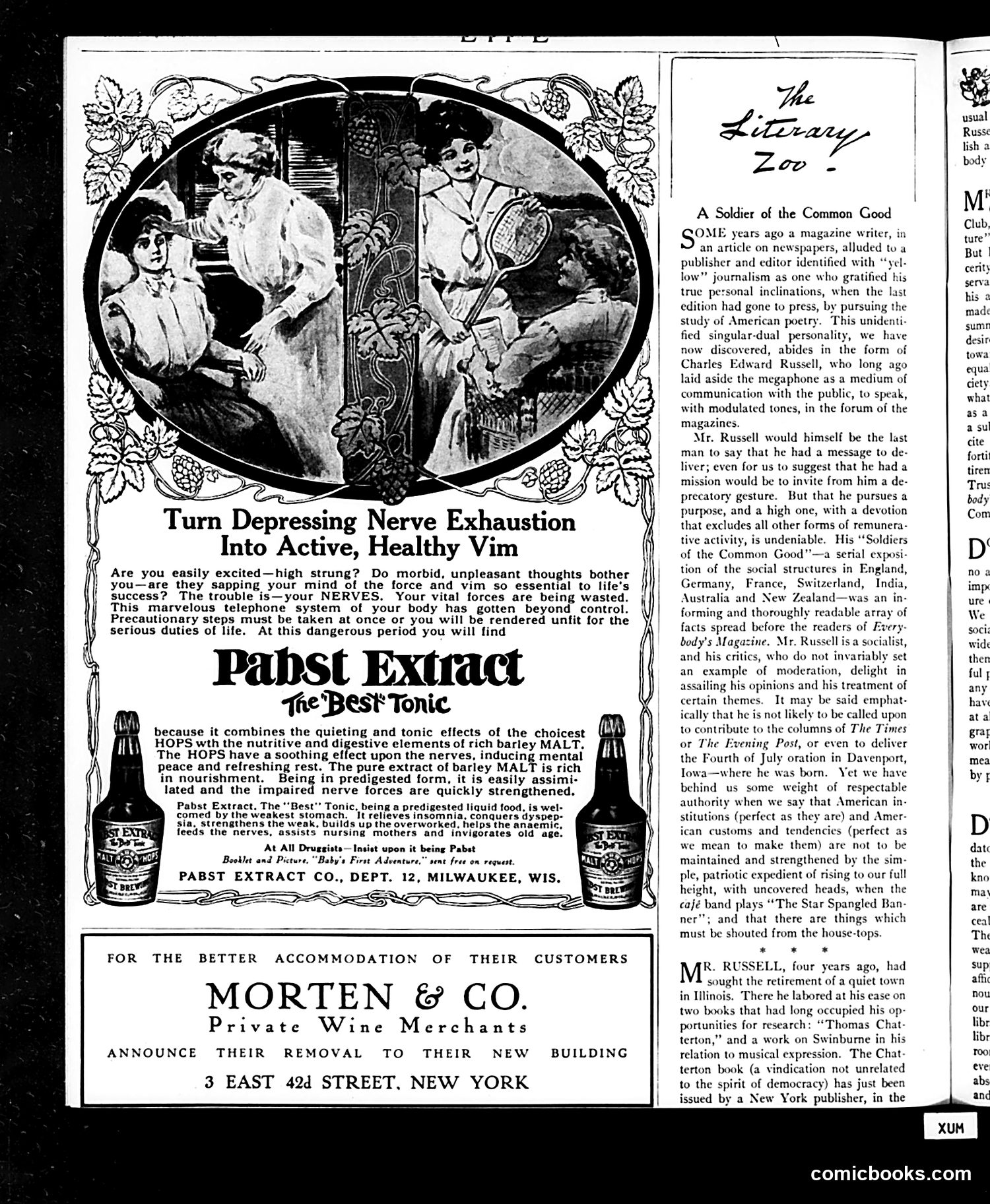
This page is primarily **advertising**, not political satire. The dominant content is a Pabst Extract tonic advertisement featuring an illustration of fashionably dressed people in an interior scene, framed by decorative hops. The ad addresses "nerve exhaustion"—a common early-20th-century diagnosis—promising the product will convert "depressing nerve exhaustion" into "active, healthy vim." This reflects period anxieties about modern urban life depleting vitality. The right column contains "The Literary Zoo," a book review of Charles Edward Russell's *Soldiers of the Common Good*, discussing his social criticism of institutional structures in England, Germany, and other nations. Below is a notice for **Morten & Co.**, wine merchants announcing a location move to East 42nd Street, New York. The page reflects Prohibition-era commerce and contemporary wellness marketing.
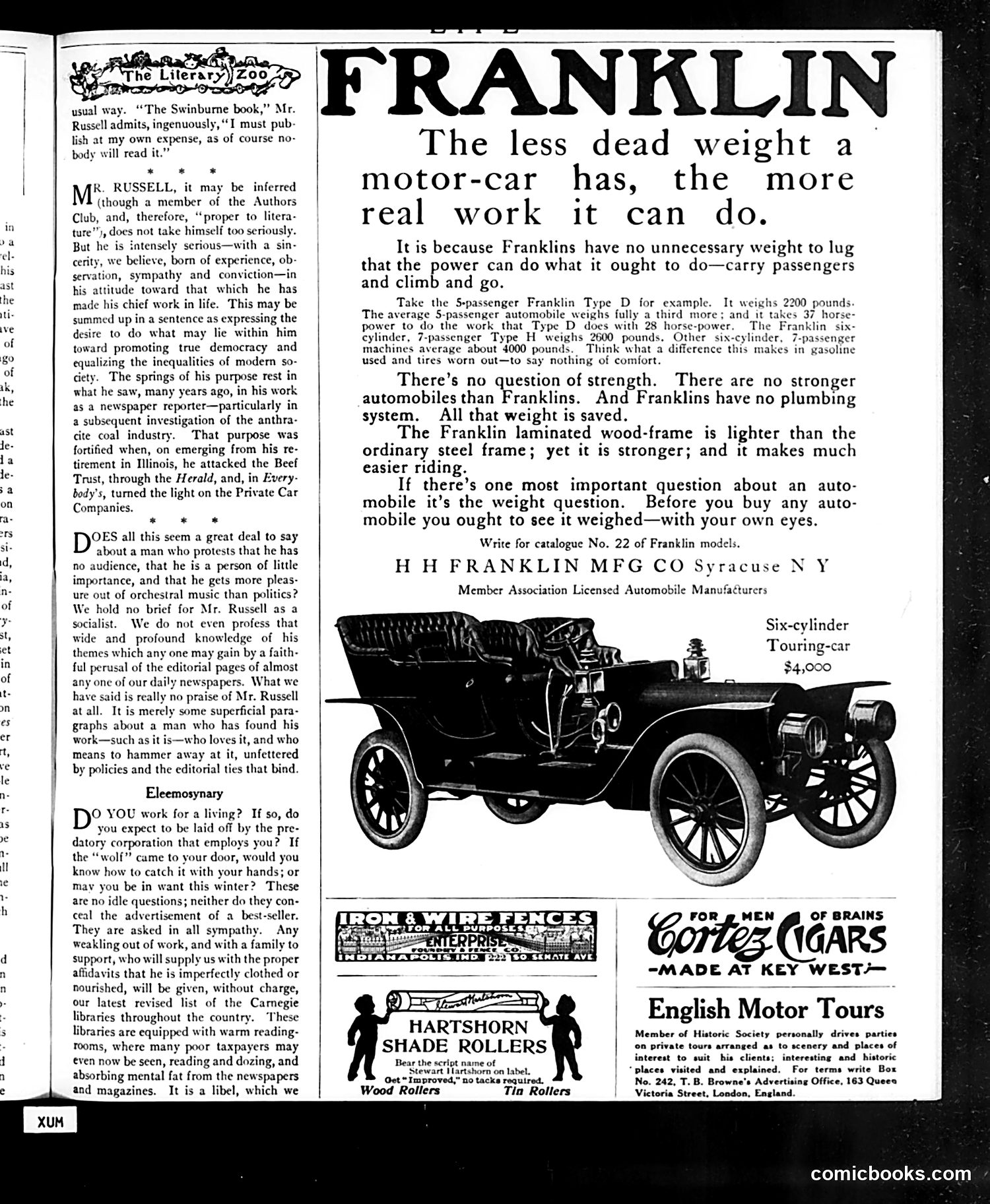
This page is primarily **advertising content**, not political satire. The main feature is a Franklin automobile advertisement emphasizing the car's lightweight construction and efficiency—the "less dead weight a motor-car has, the more real work it can do." The left column contains editorial commentary about **Mr. Russell** (apparently a member of the Authors Club), defending his serious approach to literature against dismissals as "improper." The piece argues Russell deserves respect for his experiential observations about social inequality, and defends intellectual work generally against those who undervalue it. Below that is an "Elementary" section addressing unemployment and social support during hardship—advocating for libraries and public assistance programs. The advertisements (Cortez Cigars, Hartshorn Shade Rollers, English Motor Tours) fill the remaining space. No political cartoons appear on this page.
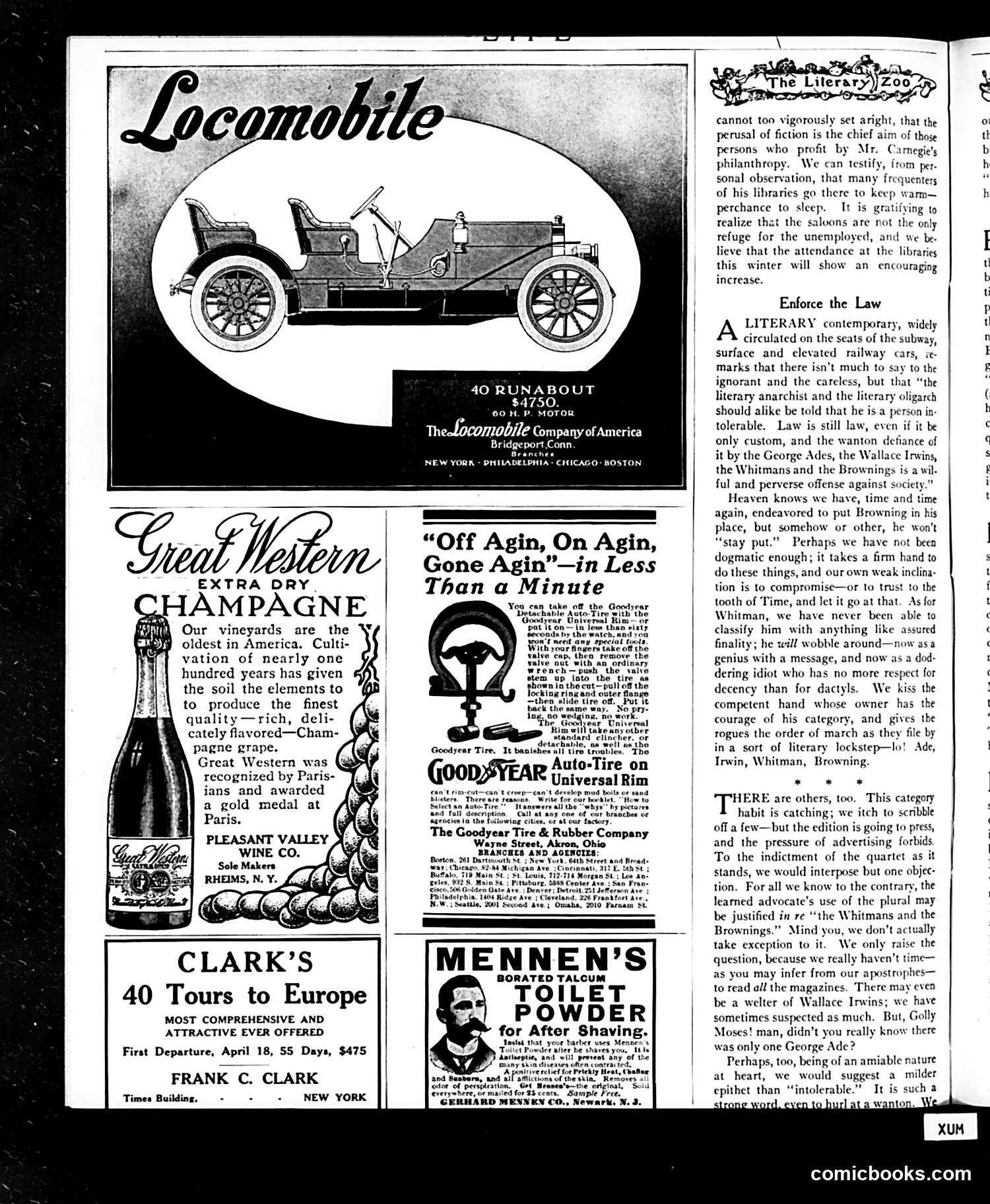
This page is primarily **advertisements** interspersed with editorial content from *Life* magazine's "Literary Zoo" section. The main article discusses **literary anarchists and oligarchs** who defy social conventions—specifically naming George Ade, Wallace Irwin, the Whitmans, and the Brownings as figures who challenge respectability. The piece argues that while such defiance may seem bold, compromise with society's rules remains necessary. The ads feature a Locomobile automobile, Great Western Champagne, Goodyear tires, Clark's European tours, and Mennen's shaving powder—typical luxury consumer goods of the era. The editorial content critiques those who flaunt literary or social conventions as self-destructive rebels, suggesting even artistic geniuses must ultimately respect societal order.
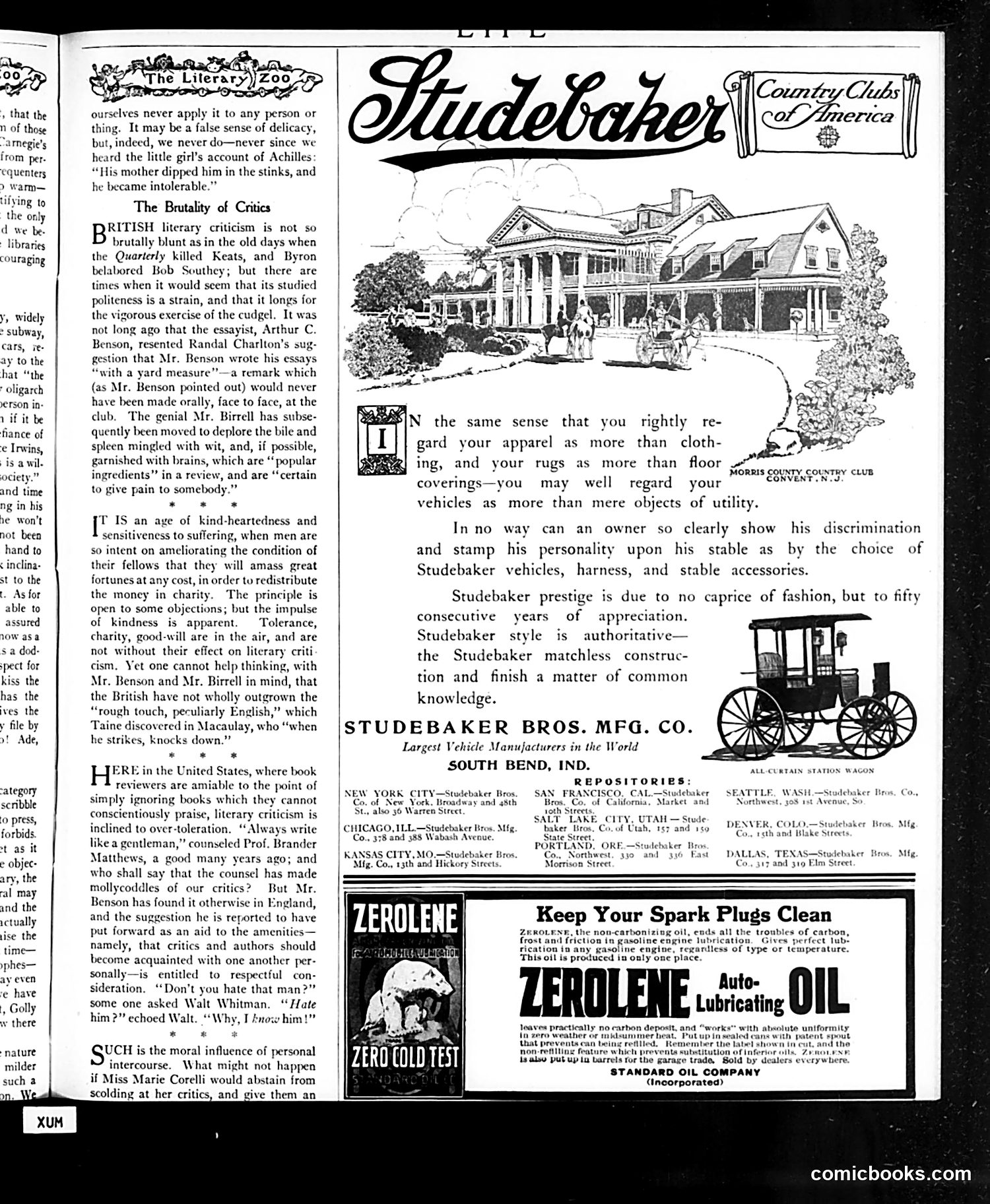
This page is **primarily advertising**, not satire or political commentary. The main feature is a full-page advertisement for **Studebaker vehicles** (a major American automaker), featuring an illustration of an elegant country club estate and promoting Studebaker's quality and prestige. The left column contains a literary article titled "The Brutality of Critics," discussing British literary criticism and figures like Keats, Byron, and Randall Charlton—unrelated to the ads. Below the Studebaker ad is an advertisement for **Zerolene Auto-Lubricating Oil** by Standard Oil Company, emphasizing its non-carbonizing properties. No political cartoons or satire appear on this page. It represents typical **Life magazine advertising and editorial content** from the early 20th century.
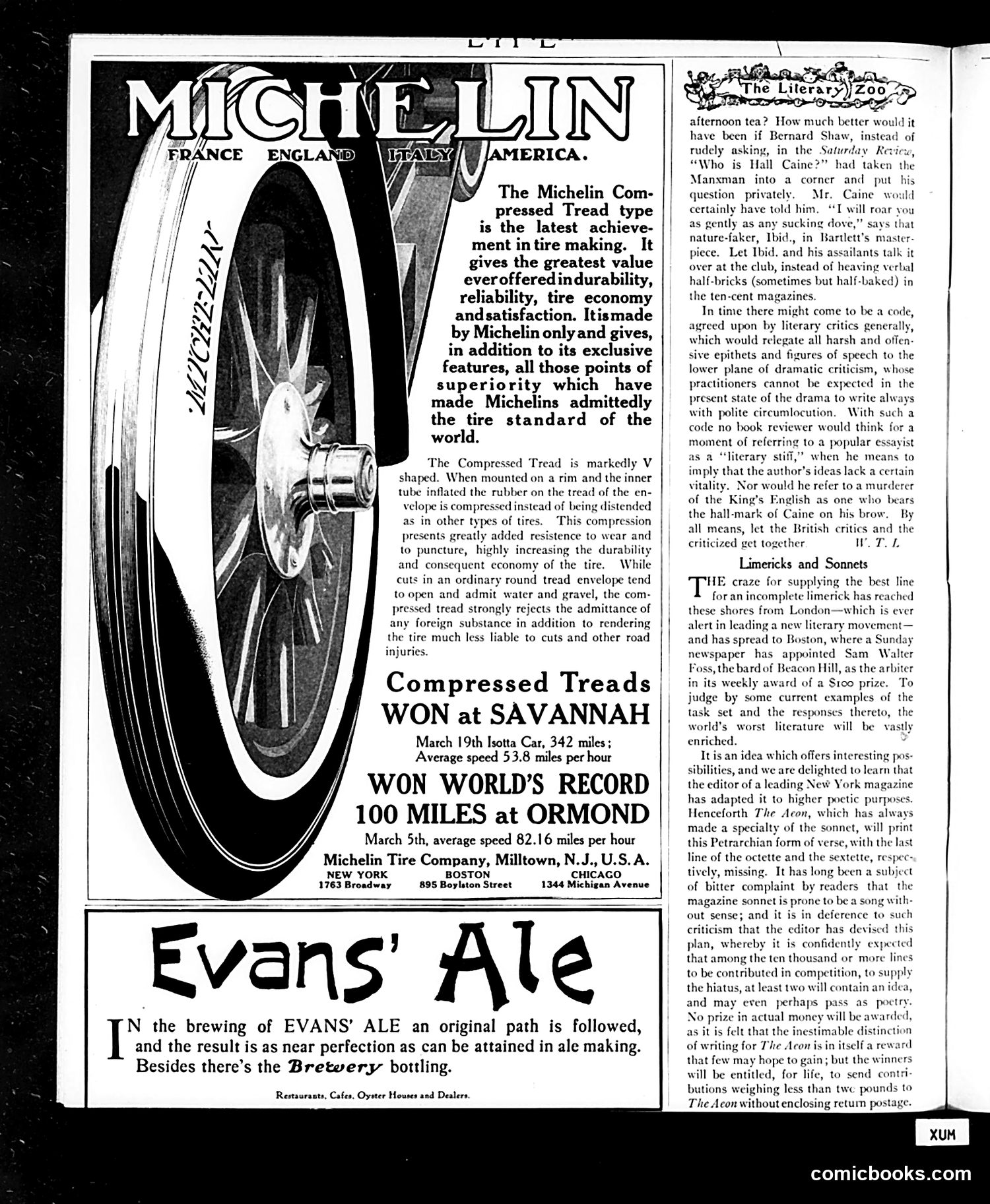
This page contains two advertisements rather than political cartoons: 1. **Michelin Tires**: A full-page ad showcasing their "Compressed Tread" tire technology, emphasizing durability and economy. It highlights racing records (100 miles at Ormond, March 5th at 82.16 mph average) to demonstrate superiority. The visual is a detailed technical illustration of the tire's V-shaped tread design. 2. **Evans' Ale**: A smaller advertisement claiming their brewing follows "an original path" achieving "near perfection in ale making," with mention of "Brewery bottling." There is no political satire or caricature present. The right column contains an unrelated literary article about limericks and sonnets. This appears to be a standard advertisement page from *Life* magazine's commercial section.
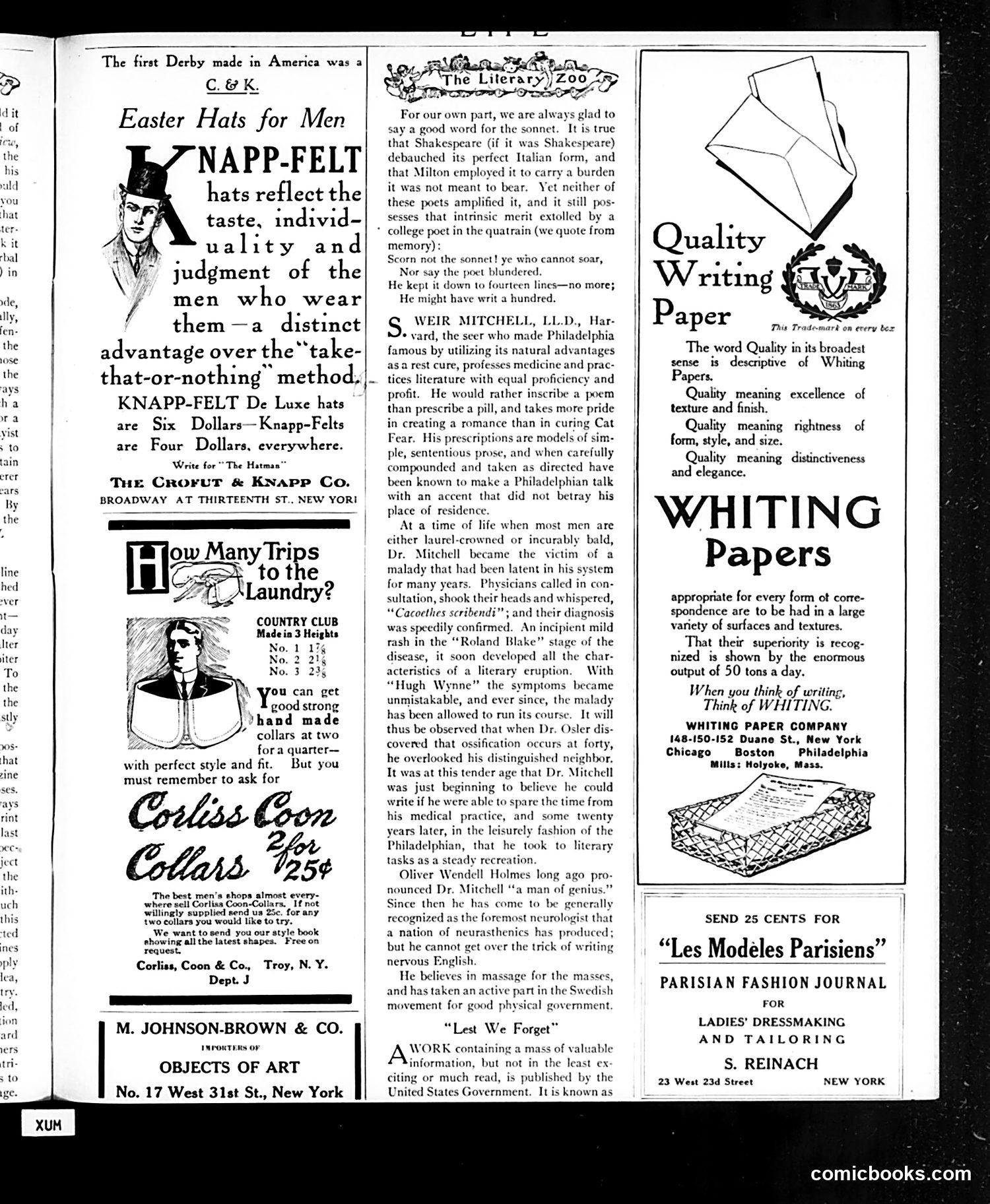
This page is primarily **advertising**, not satire or political content. The advertisements include: - **Knapp-Felt hats** for men, emphasizing quality and individual taste - **Corliss Coon Collars** (25¢), promoting durability for laundry - **Whiting Papers**, quality writing paper for correspondence - **M. Johnson-Brown & Co.**, art importers - **Les Modèles Parisiens**, a Parisian fashion journal The central text discusses **Sewell Mitchell**, a Philadelphia physician and literary figure, referencing his medical practice and literary interests—this appears to be editorial content rather than satire. There are **no political cartoons** on this page. The single illustration is a portrait of a man wearing a Knapp-Felt hat, used for the hat advertisement.
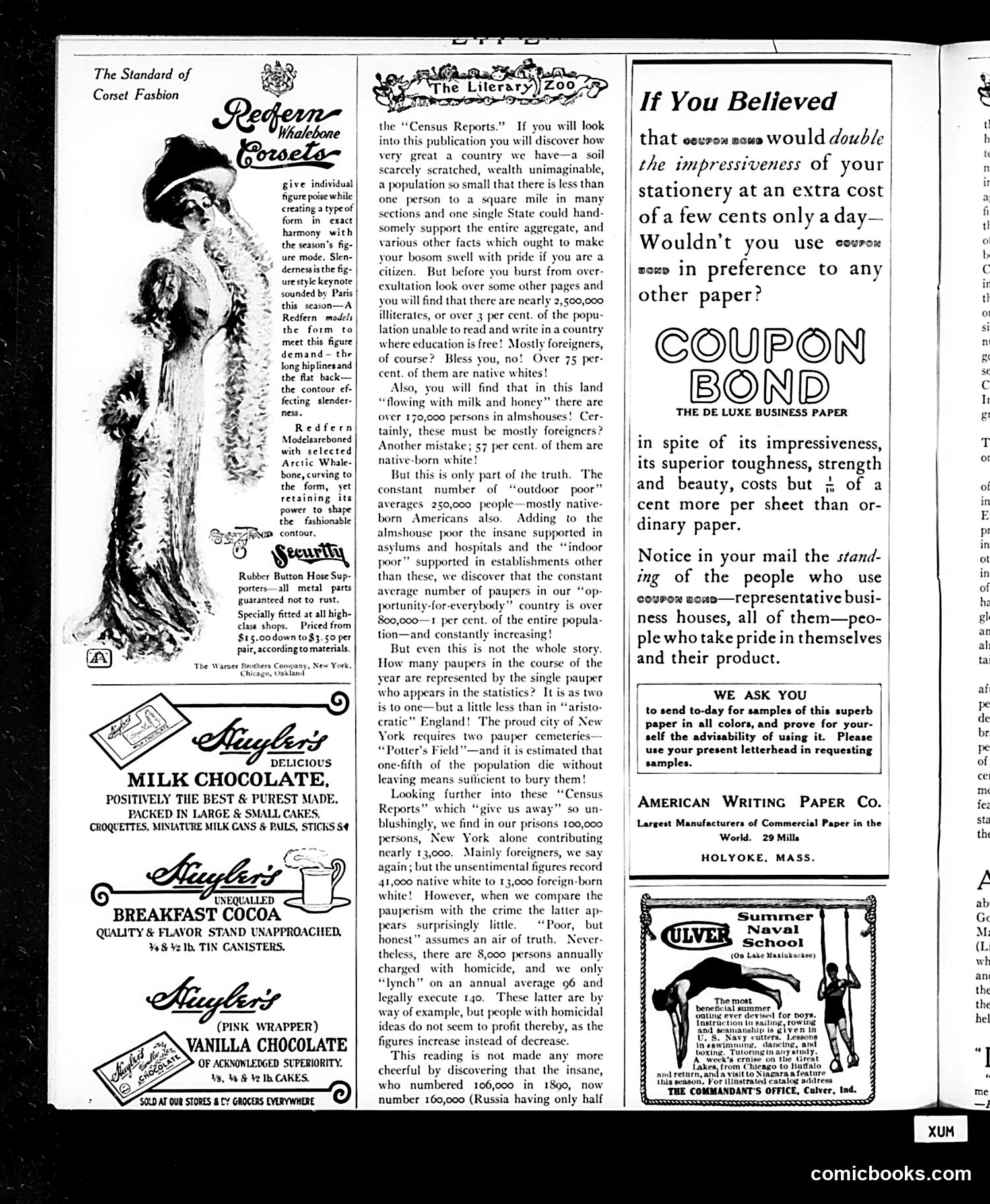
This page is primarily **advertising**, not political satire. The main content includes: 1. **Redfern Corsets ad** (left): Features an elegant woman in fashionable dress, emphasizing how corsets create an idealized silhouette—standard fashion advertising of the era. 2. **Stuyler's Chocolate ads** (left): Multiple product advertisements for milk chocolate, cocoa, and vanilla chocolate. 3. **Coupon Bond Paper ad** (right): The primary feature argues that using quality business paper demonstrates professionalism and impressiveness, even at minimal extra cost. It appeals to business pride and competitive advantage. 4. **Ulver Naval Summer ad** (bottom right): Appears to be maritime/nautical product advertising. The page reflects early 20th-century consumer culture and class aspiration rather than political commentary.
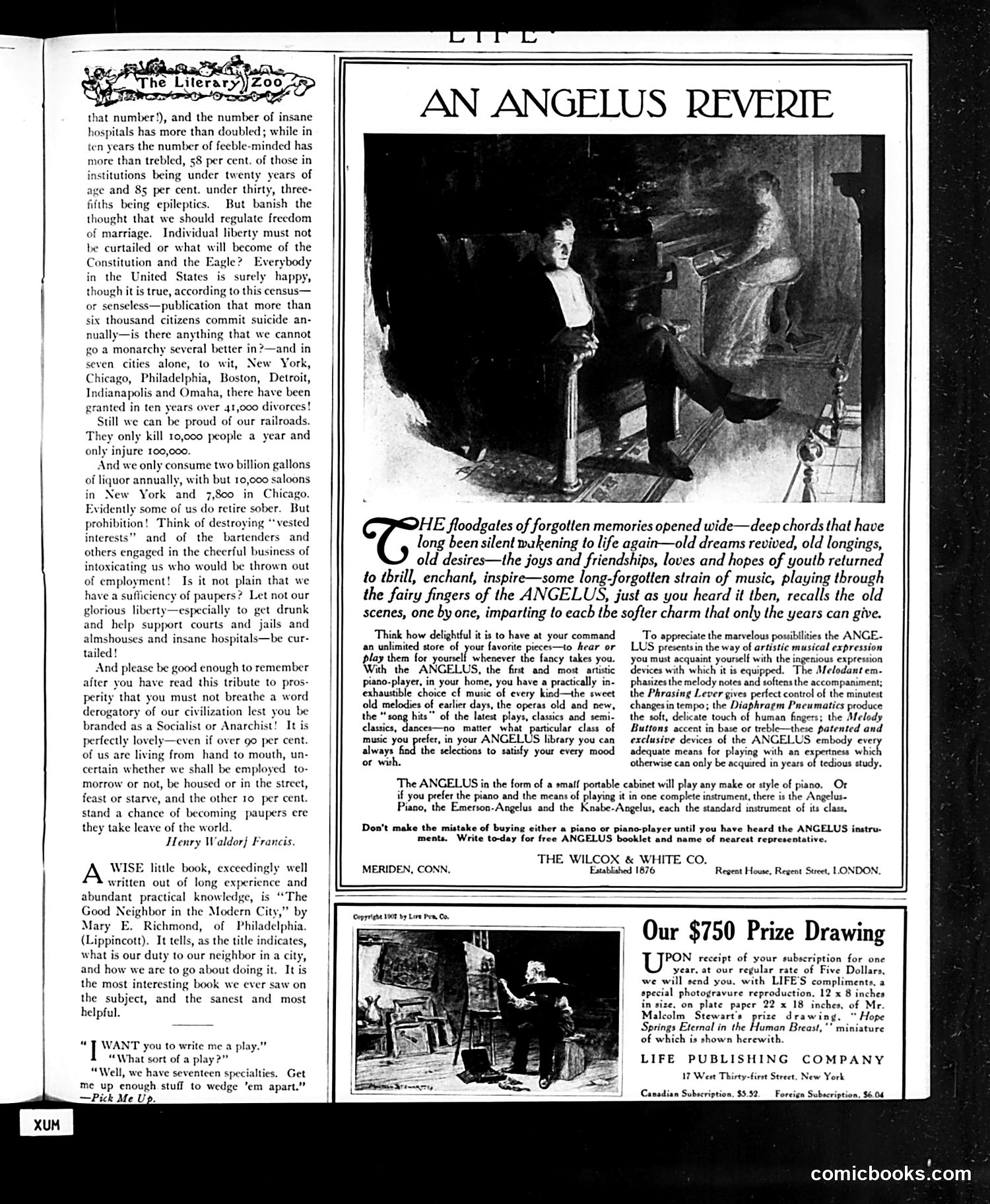
This page is primarily an **advertisement for the Angelus piano** (Wilcox & White Co., Meriden, Connecticut). The main image shows a woman at a piano with an ethereal, ghostly figure appearing above it—a visual reference to Millet's famous painting "The Angelus." The ad's text uses romantic, nostalgic language about music awakening "forgotten memories" and "old dreams revived." It positions the Angelus piano as a luxury item offering "unlimited store of your favorite pieces." Below is a separate advertisement for **Life Publishing Company's $750 Prize Drawing**, offering subscriptions and photographic reproductions. This represents typical early 20th-century magazine advertising: emotional appeals to middle-class aspirations, combining cultural refinement (classical music, fine art references) with consumer products.
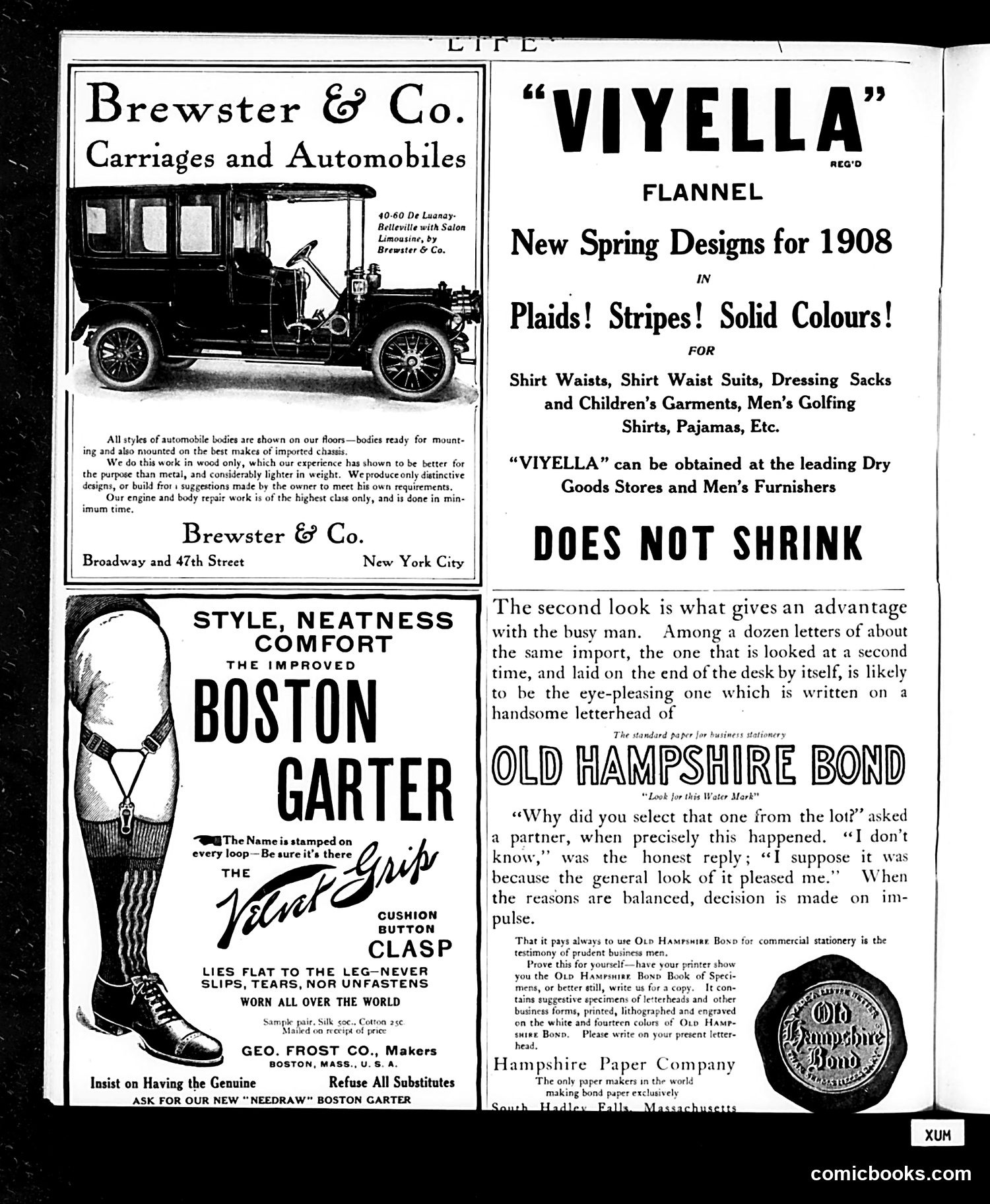
This page contains **no political cartoons or satire**—it is primarily **advertisements** from circa 1908. The content includes: - **Brewster & Co.**: An automobile manufacturer advertising custom carriage bodies and repairs in New York City - **Viyella Flannel**: A fabric company promoting spring 1908 textile designs (plaids, stripes, solid colors) for clothing, emphasizing the product "does not shrink" - **Boston Garter**: A men's garter advertised with an illustration of a leg/foot, highlighting features like the "Velvet Grip" cushion button and claiming it "lies flat to the leg—never slips, tears, nor unfastens" - **Old Hampshire Bond**: Business stationery paper, featuring text about making good first impressions in business correspondence The page reflects early 1900s consumer advertising and product innovation, with no satirical or political commentary visible.
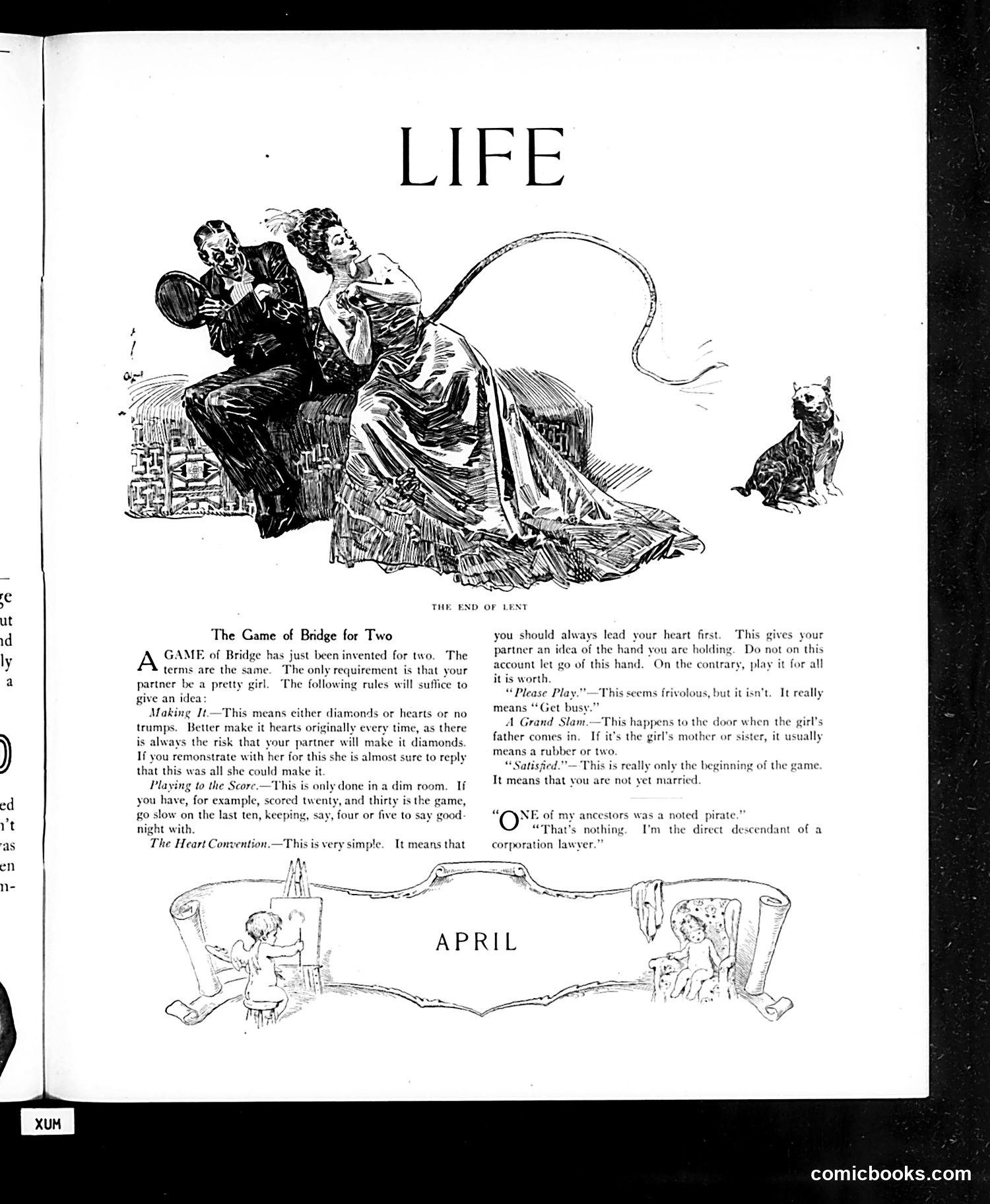
This page from *Life* magazine presents satirical humor about the card game Bridge adapted for couples. The main illustration shows a man and woman playing cards together, with accompanying text offering humorous "rules" for two-player Bridge. The satire targets domestic relationships: terms like "Making It," "Playing to the Score," and "A Grand Slam" are card-game terminology repurposed with romantic double meanings. Phrases like "Please Play" (meaning "Get busy") and "Satisfied" (the beginning of engagement) mock how couples navigate intimacy and commitment. The page includes a separate anecdote joke about ancestry—a woman's claim that her ancestor was a pirate versus a man's counter that his was a corporate lawyer, satirizing competitive boasting about family lineage.
This editorial discusses the dangers of studying currency and finance—arguing that prolonged engagement with monetary policy drives people to insanity, citing Gladstone's observation. The piece then applies this sardonically to contemporary figures. The main target is **Senator Robert La Follette**, apparently a candidate for the Hearst party's presidential nomination. The satire mocks La Follette's Senate speech (March 17, 1908) explaining the recent financial panic, where he claimed it was deliberately orchestrated by **J.P. Morgan and Standard Oil** through "speculative, legislative and political reasons"—not commercial ones. Life's point: La Follette's conspiracy theory proves the magazine's thesis that studying finance makes people crazy. By attributing the panic to a secret plot by two powerful figures, La Follette has apparently "unsettled his judgment." The cartoon's caption "While there is Life there's Hope" suggests satirical optimism despite widespread financial delusion among political figures.
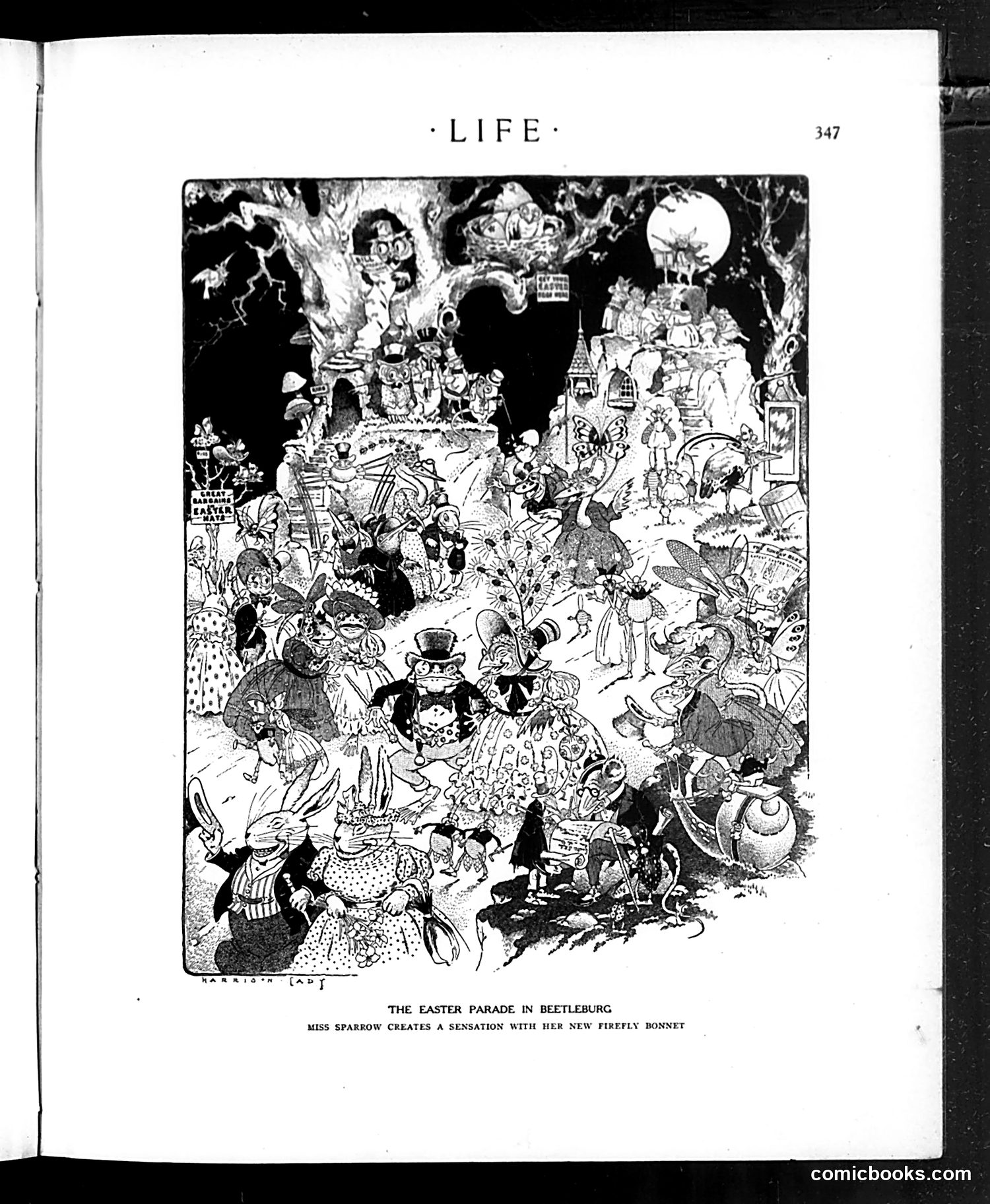
This is a whimsical illustration satirizing Easter fashion, particularly women's elaborate bonnets. The caption indicates "Miss Sparrow" has created a "sensation" with a "firefly bonnet"—suggesting an absurdly extravagant hat accessory. The cartoon depicts an imaginary insect town ("Beetleburg") celebrating Easter with anthropomorphic insects in fancy dress. The humor derives from treating insects as fashionable society attending a parade, with exaggerated clothing and accessories. The "firefly bonnet" is likely a visual pun, playing on period fashion trends where women wore increasingly elaborate, ornamental headwear—sometimes incorporating feathers and decorative elements. This parodies contemporary upper-class fashion obsessions and the competitive display of wealth through Easter parade attire, a real cultural event where fashionable women showcased new clothing.
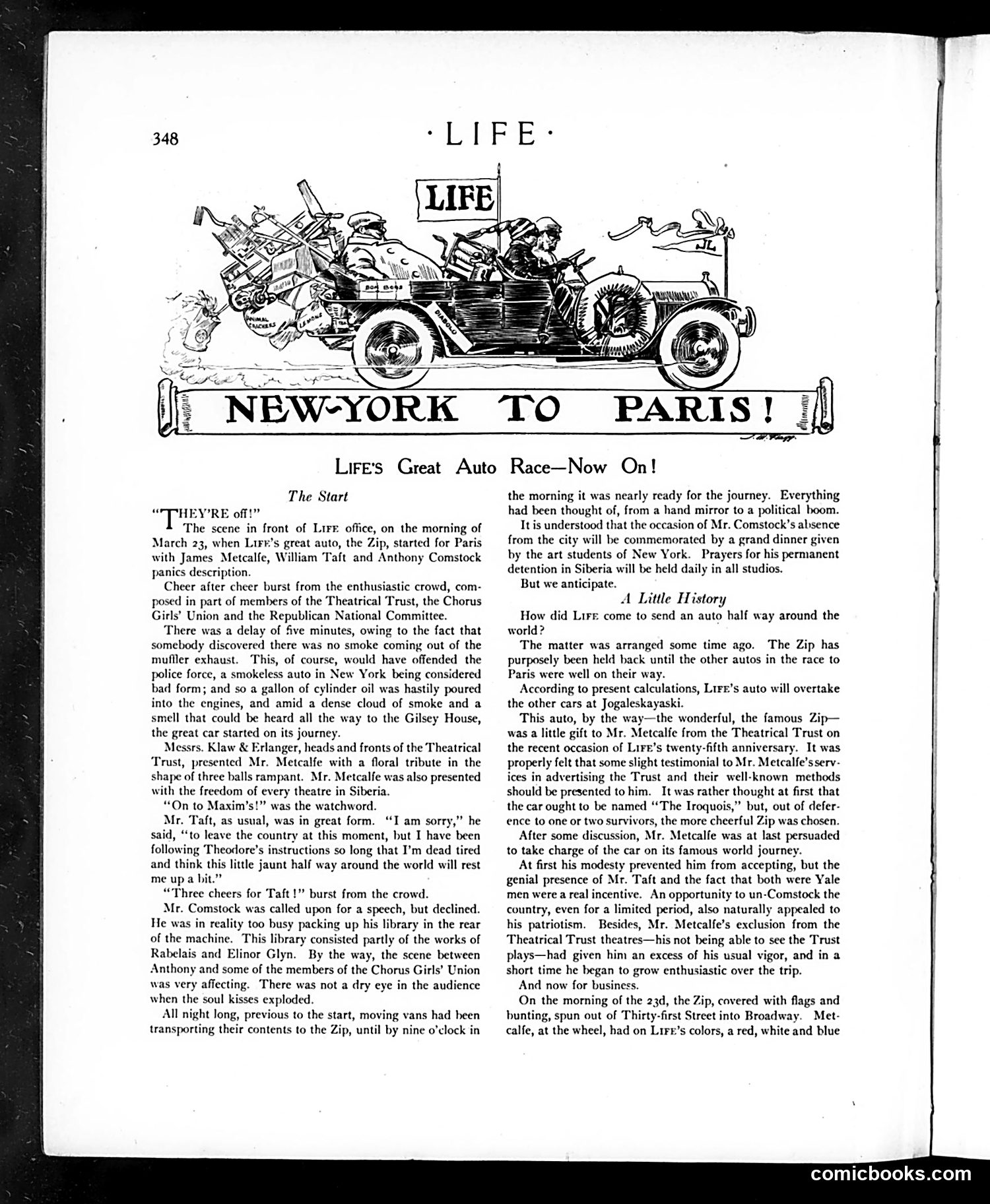
This 1908 *Life* article mocks a publicity stunt where the magazine's auto, "the Zip," embarks on a Paris race with three prominent passengers: James Metcalfe (editor), William Taft (President), and Anthony Comstock (anti-obscenity crusader). The satire targets: **Taft**: Portrayed as exhausted, following Theodore Roosevelt's orders so long he needs vacation—a dig at Taft's perceived weakness compared to his predecessor. **Comstock**: Depicted packing "works of Rabelais and Elinor Glyn" (scandalous literature he'd normally censor) and receiving zero farewell attention—the art students will pray for his permanent detention in Siberia, suggesting his prudish censorship is unwelcome. **The Theatrical Trust**: Satirized as corrupt, gifting the car as a bribe for advertising their "well-known methods." The humor relies on readers recognizing these figures and understanding contemporary anxieties about political power, censorship, and theatrical industry corruption.
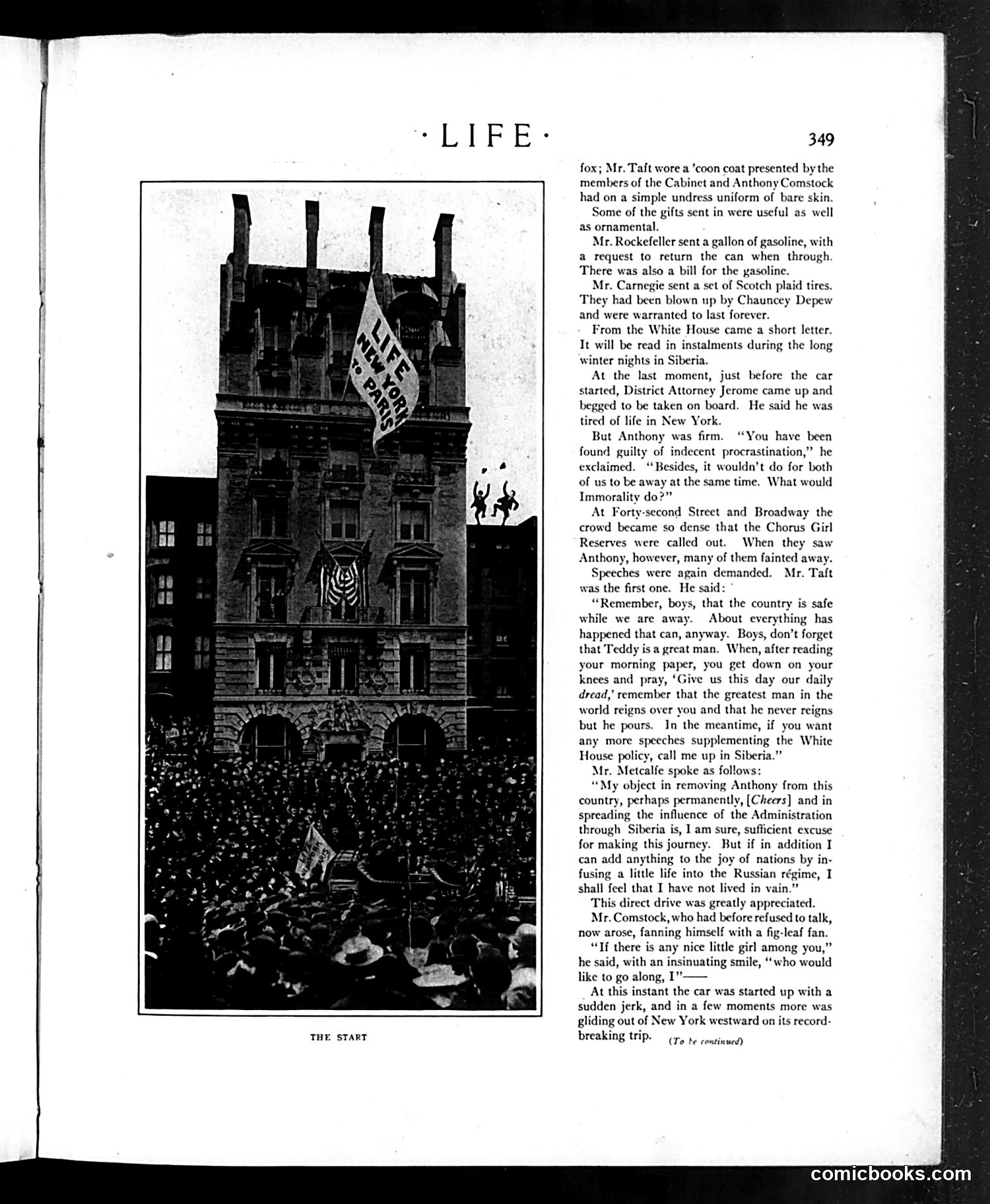
This is satirical fiction about sending prominent figures on a Siberia-bound journey. The main target is **Anthony Comstock**, the famous moral crusader and censor, depicted as a puritanical nuisance being exiled. The satire mocks: - **Taft** (President William Howard Taft, identifiable from "coon coat" reference), presented as an ineffectual successor to Theodore Roosevelt - **Comstock** as an insufferable moralist whose removal benefits the nation - **Wealthy industrialists** (Rockefeller, Carnegie) contributing absurd gifts - The Roosevelt administration's influence persisting even after he left office The humor relies on Comstock's reputation for suppressing anything he deemed immoral—the joke being that even he is uncomfortable around "Chorus Girl Reserves" (dancers/performers he'd typically condemn). His final leering comment about "nice little girls" is cut off by the car's sudden departure, suggesting divine intervention spares the nation further moral hectoring. The satire celebrates removing Comstock from American public life as beneficial to society.
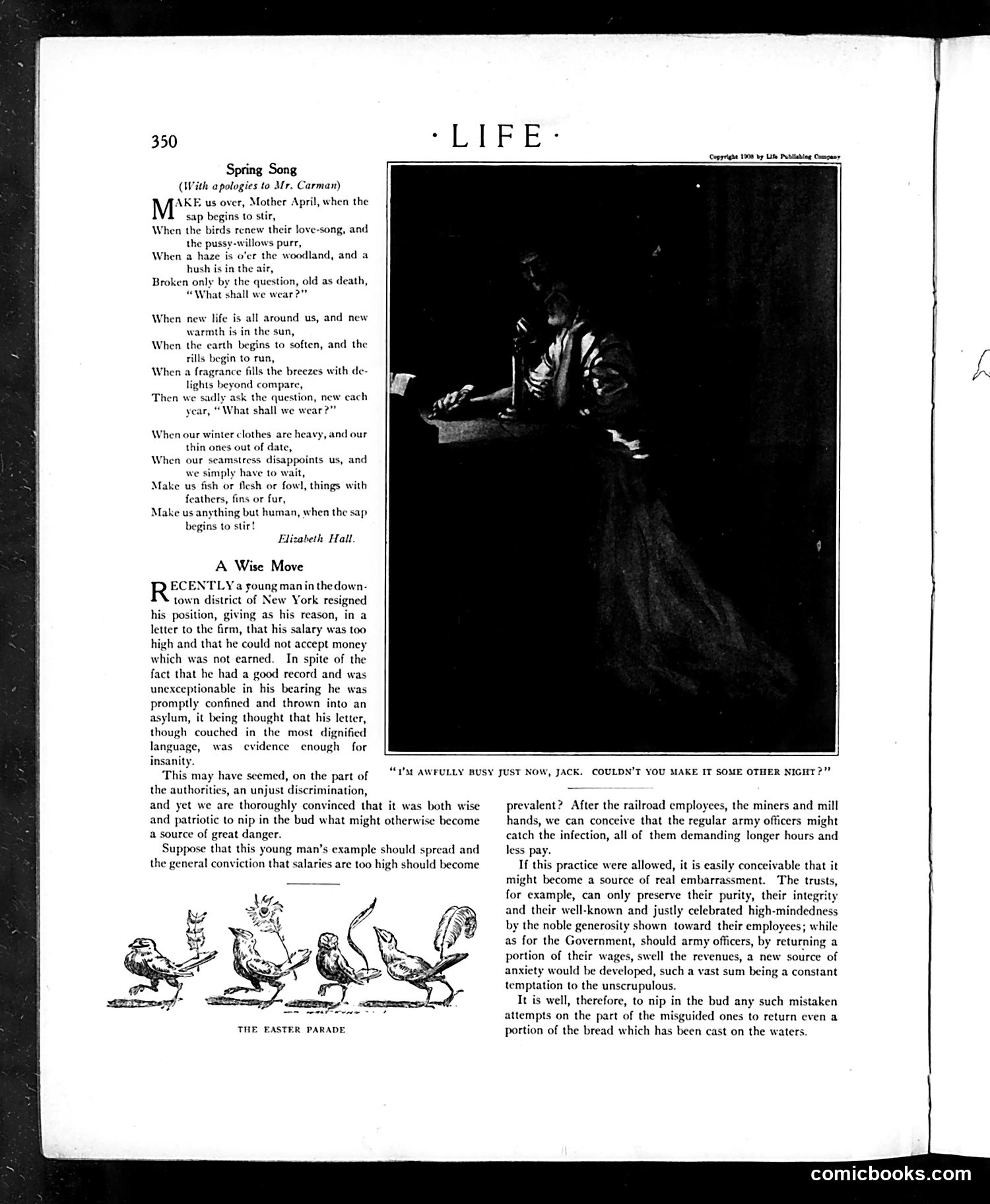
This page contains two satirical pieces: **"Spring Song"** is a parody of spring poetry that subverts romantic nature imagery. Rather than celebrating renewal, the speaker repeatedly asks the urgent question "What shall we wear?"—mocking women's fashion anxiety during spring wardrobe transitions. The satire targets the disconnect between poetic idealization of spring and the mundane, genuinely stressful reality of seasonal clothing changes. **"A Wise Move"** is heavy irony criticizing the authorities' response to a young New York businessman who resigned, claiming his salary was unearned. Rather than praise his integrity, they committed him to an asylum as "insane." The article sarcastically defends this decision, warning that if workers questioned whether their pay matched their labor, it could spread dangerously—threatening that soldiers or miners might demand fair wages. The joke exposes how threatening the status quo finds any worker questioning economic fairness. **"The Easter Parade"** illustration (bottom) appears unrelated editorial cartoon content. The copyright date is 1908.
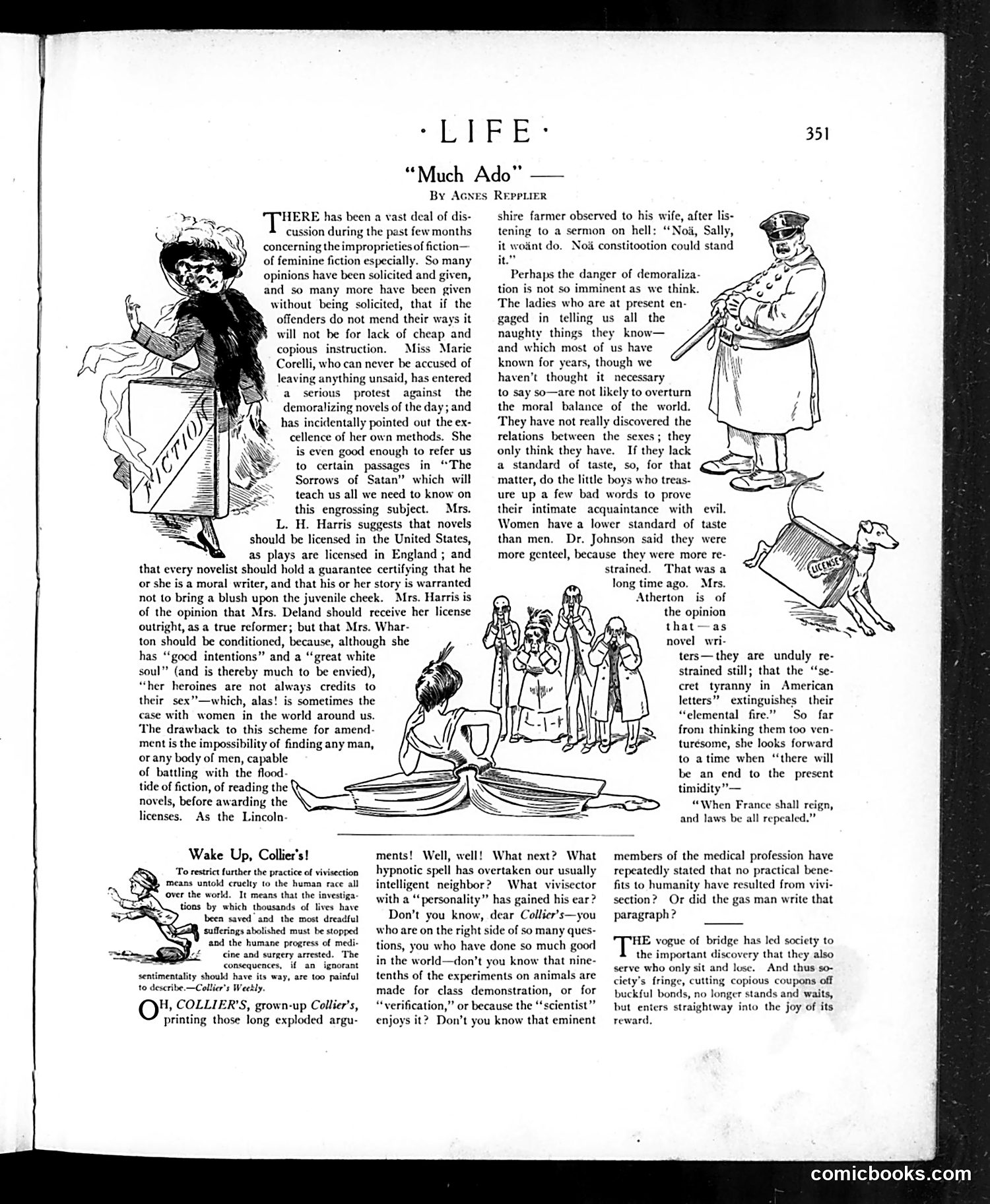
This page contains two distinct satirical commentaries on contemporary debates: **"Much Ado"** (top): Agnes Repplier critiques the moral panic over "immoral" fiction by women writers. She mocks the proposal to license novelists and morally vet their work before publication—suggesting it's impossible to find qualified censors. The satire targets those like Mrs. Harris who want government oversight of novels they deem scandalous (like works by Marie Corelli or Edith Wharton). Repplier argues women readers aren't actually corrupted by such fiction and that society's concern is overblown. **"Wake Up, Collier's!"** (bottom): This attacks *Collier's* magazine for apparently defending animal vivisection in medical research. Life's editors sarcastically chide their rival publication, questioning whether some charismatic scientist has influenced them. They challenge the claim that most animal experiments serve genuine medical purposes, suggesting many are merely for classroom demonstration or professional verification—not humanitarian advancement. Both pieces exemplify Life's muckraking, anti-censorship stance and skepticism toward institutional authority.
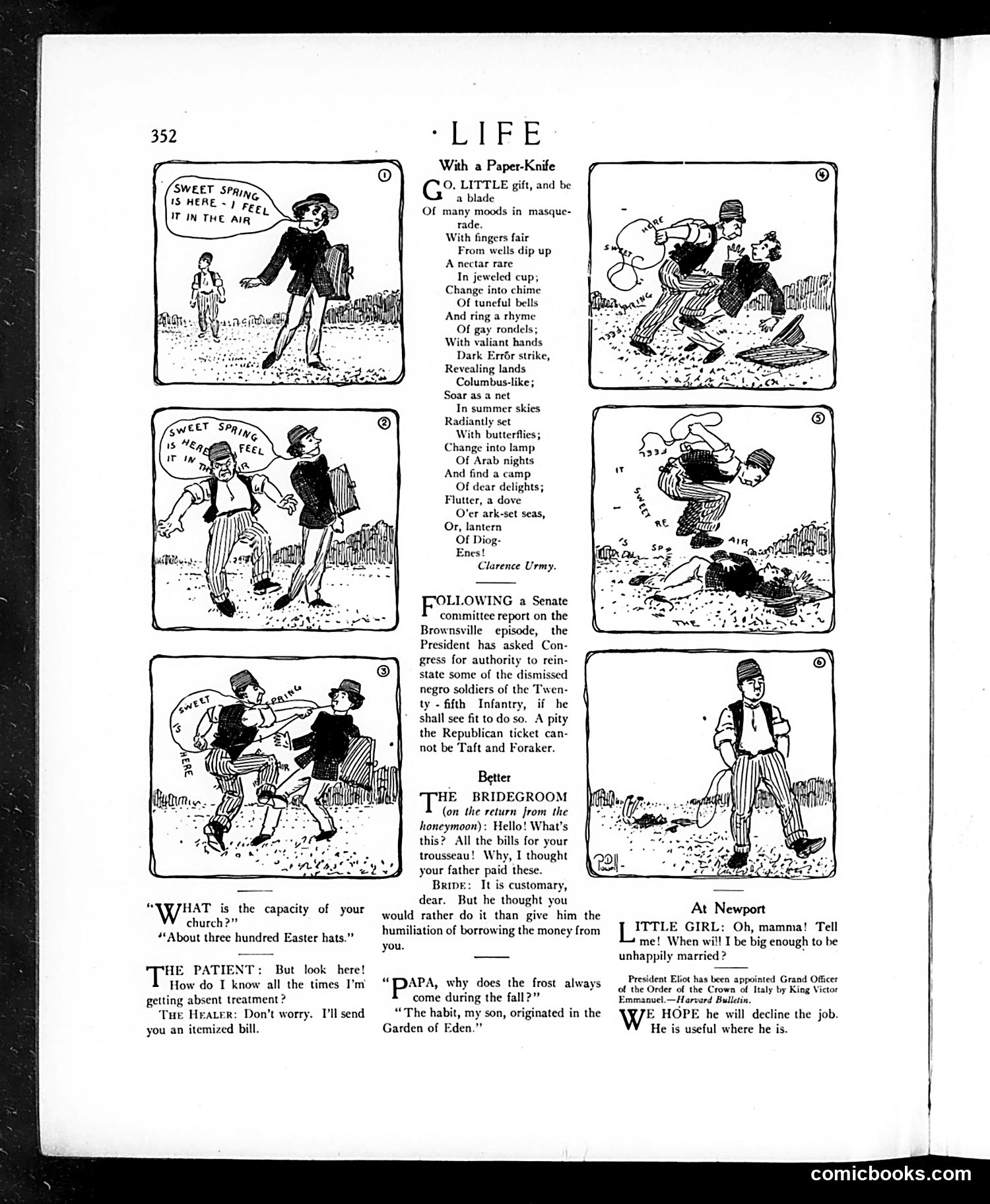
This page contains multiple satirical pieces typical of *Life* magazine's early 20th-century format: **Main Political Cartoon (top)**: References the "Brownsville episode"—a 1906 incident where President Theodore Roosevelt dismissed Black soldiers from the 25th Infantry without due process, allegedly for a shooting incident. The text sarcastically notes that Republican vice-presidential candidate James Sherman and Senator Joseph Foraker cannot run together because Foraker opposed Roosevelt's handling of the dismissals, creating party tension. **Other Humor Pieces**: Include marital humor (a bridegroom shocked at wedding expenses), medical comedy, and a Newport socialite joke about early marriage. The page also notes Harvard President Charles Eliot's appointment as an Italian honor, with *Life* sarcastically suggesting he decline because "he is useful where he is." The cartoons throughout use simple line drawings depicting everyday domestic and social situations as humorous commentary on American life and politics.
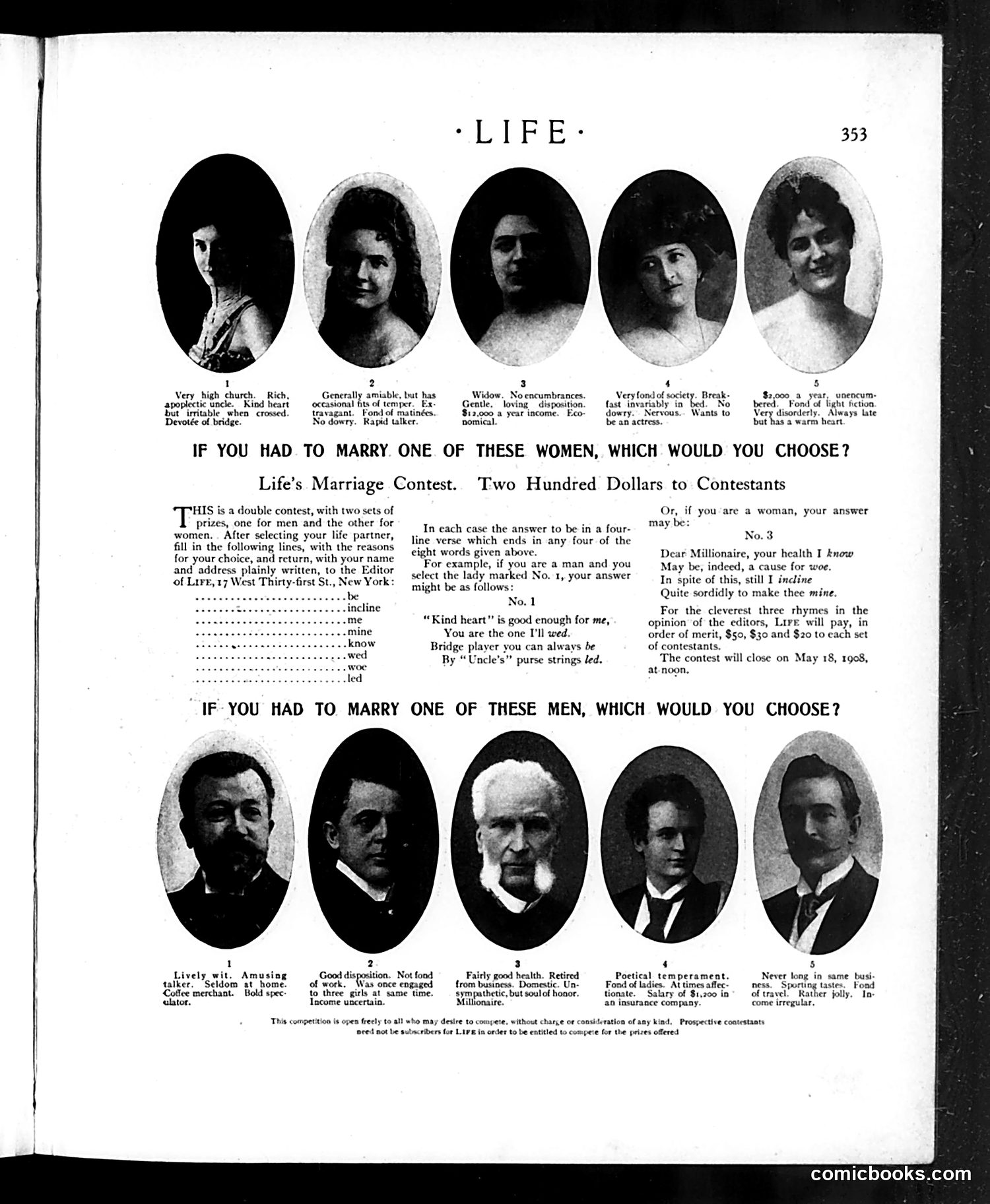
This is a satirical matchmaking game where readers select hypothetical spouses from five women and five men, then write humorous four-line verses explaining their choice. The humor lies in the brutally honest character descriptions that expose what people *actually* consider in marriage. The women's descriptions highlight dowries, temperament, and domestic qualities ("Very fond of society. Breakfast invariably in bed"). The men's descriptions emphasize income, stability, and personality flaws ("Good disposition. Not fond of work"). The satire targets both genders: women are evaluated primarily for wealth and appearance; men for earning potential and reliability. The contest mocks the mercenary calculations underlying "respectable" marriages of the Edwardian era, while the crude character summaries suggest that genuine compatibility matters far less than financial security and avoiding obvious character defects. The $200 prize suggests this was a popular, participatory feature—readers could win money by crafting the cleverest satirical verses about matrimonial compromise.
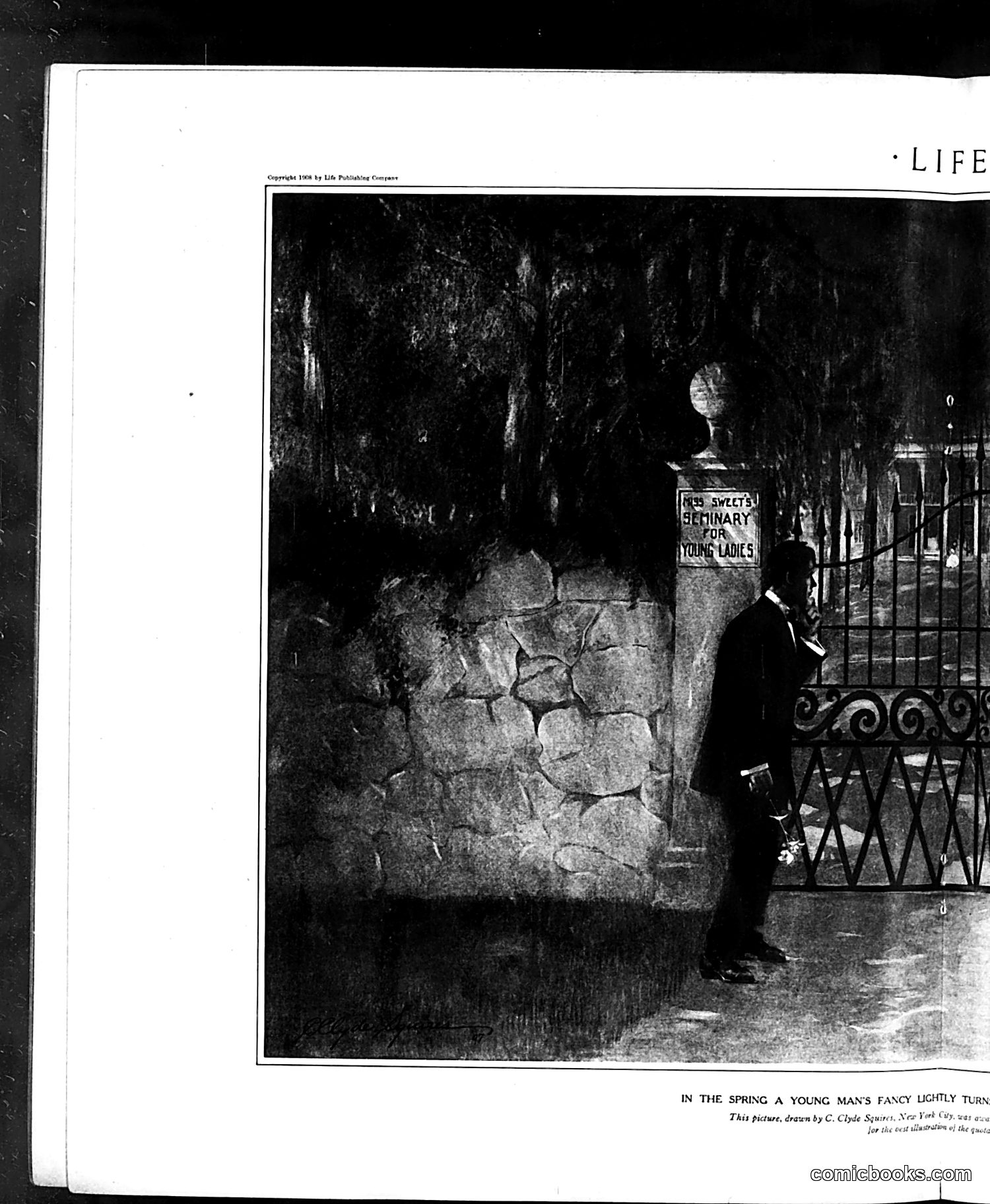
This appears to be a satirical illustration from *Life* magazine showing a well-dressed man in formal attire standing at an ornate gate. A sign reading "SWEET'S ETINARY FOR YOUNG LADIES" is visible above. The caption "IN THE SPRING A YOUNG MAN'S FANCY LIGHTLY TURN[S]" references the famous Tennyson poem line about springtime romance. The joke appears to be visual satire on courtship and romantic pursuits—the gentleman caller presenting himself at what seems to be a finishing school or academy for young women. The cartoon illustrates the social conventions of the era regarding how young men would formally court young ladies, likely mocking either the formality of these rituals or the predictability of spring romance. The specific etinary (veterinary) reference remains unclear from the visible text.
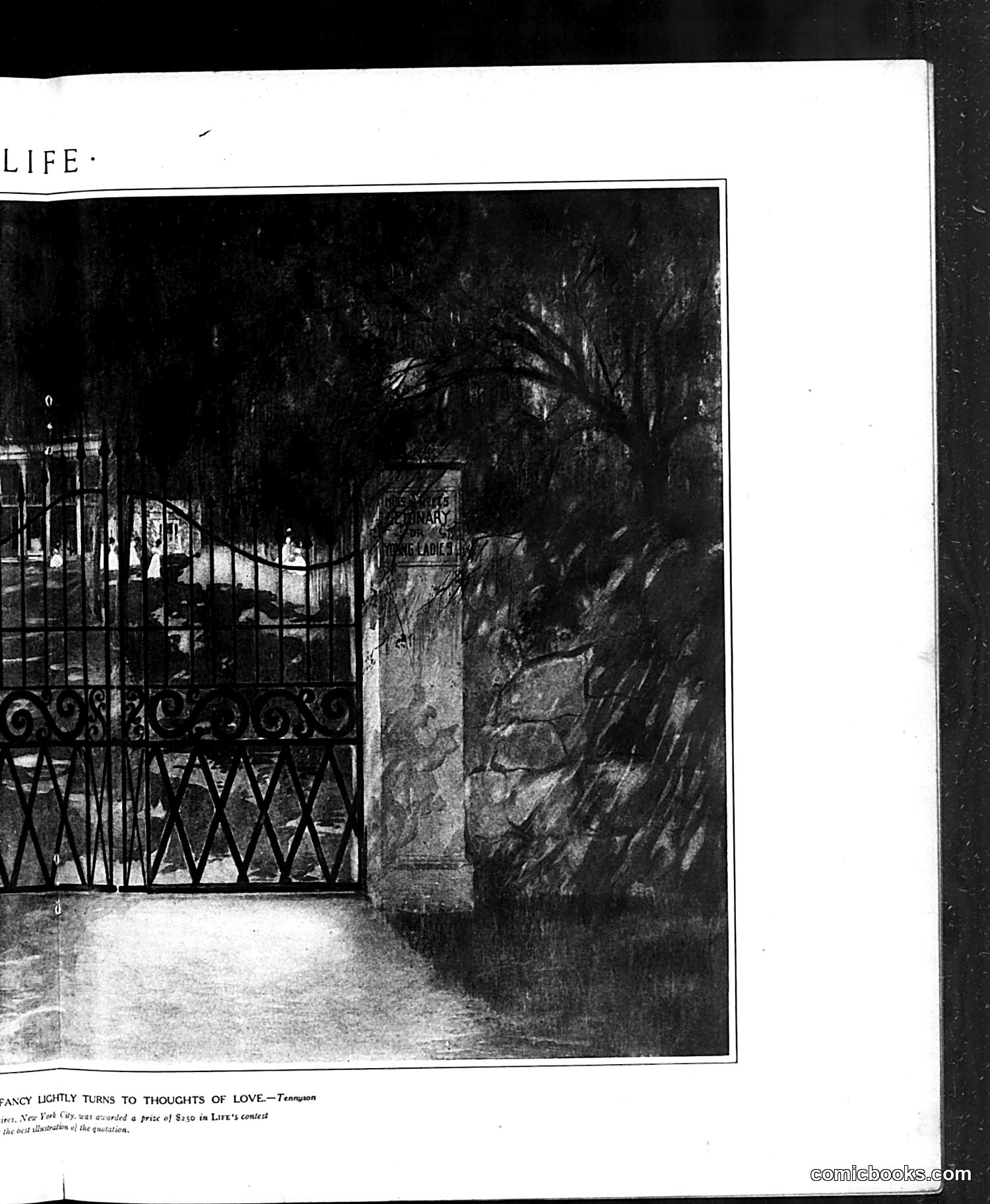
This page from *Life* magazine features a romantic scene with the caption "FANCY LIGHTLY TURNS TO THOUGHTS OF LOVE—Tennyson." The image shows an ornate iron gate opening onto a garden path lined with weeping willow or similar drooping trees, creating an atmospheric, romantic setting. The caption references Tennyson's famous line about spring inspiring love, suggesting the page is making a lighthearted commentary on romance and sentimentality. The atmospheric photograph illustrates this literary allusion visually—the romantic gateway and natural setting embody the poetic mood Tennyson described. Without additional visible text or context on this page, it appears to be a straightforward romantic illustration paired with a classical literary reference, likely part of *Life*'s regular feature content mixing humor, culture, and sentiment.
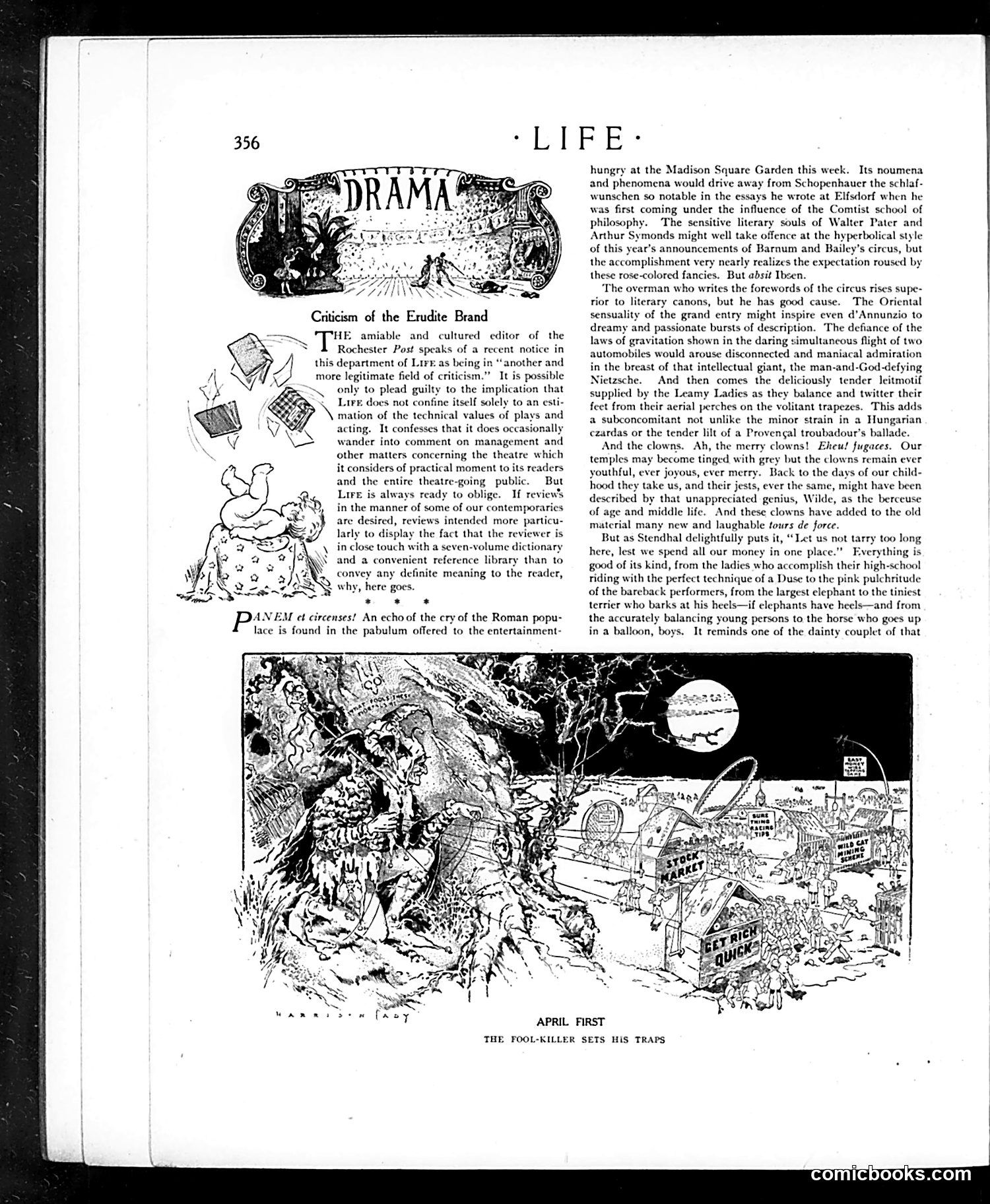
This is a **drama criticism column** from *Life* magazine's April 1st issue, using deliberately pretentious language to mock both overly erudite literary critics and the Barnum & Bailey Circus. ## The Satire The editor of the Rochester Post had criticized *Life*'s theater coverage as "another and more legitimate field of criticism." The *Life* writer responds sarcastically by praising the circus in absurdly flowery, name-dropping language—referencing Schopenhauer, Pater, Nietzsche, d'Annunzio, and Wilde—treating circus acts (acrobats, clowns, elephants) with the same overwrought reverence critics apply to serious theater. ## The Point The joke is twofold: (1) mocking self-important critics who use obscure references to sound intelligent rather than communicate clearly, and (2) suggesting the circus is actually worthy of serious aesthetic consideration. The title "The Fool-Killer Sets His Traps" indicates the author is catching pretentious fools in their own verbose nonsense. The large illustration below shows a typical circus scene, reinforcing the absurdity of applying haute-culture discourse to popular entertainment.
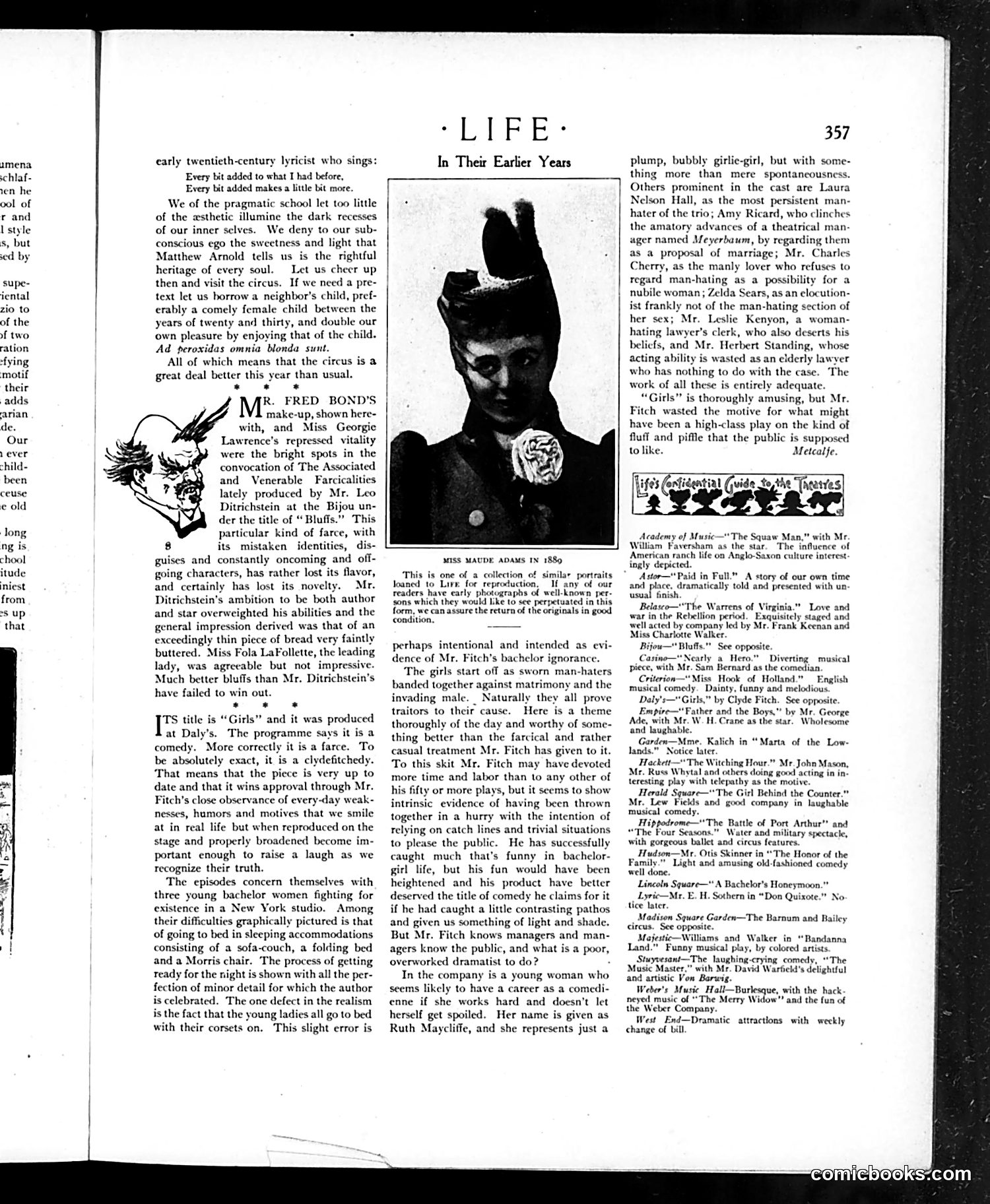
This page reviews theatrical productions from early 1900s New York. The main content discusses three plays: "Bluffs," "Girls," and includes a historical photograph of actress Maude Adams from 1889. The cartoon/caricature shows **Fred Bond** (identified in text), an actor in "Bluffs." The review criticizes the play as thin farce with tired conventions of mistaken identities and disguises. It praises Bond's makeup and performance but faults author-star Leo Ditrichstein's overreach. The "Girls" review discusses a Clyde Fitch comedy about three unmarried women sharing studio housing in New York—a modern social scenario for the era. The satire mocks their sleeping arrangements (sofa, folding bed, Morris chair) and their hypocrisy: they swear off men but all eventually betray that pledge through romance. The historical photograph of Maude Adams represents Life's practice of publishing early images of famous performers, inviting readers to contribute similar archival photographs for publication.
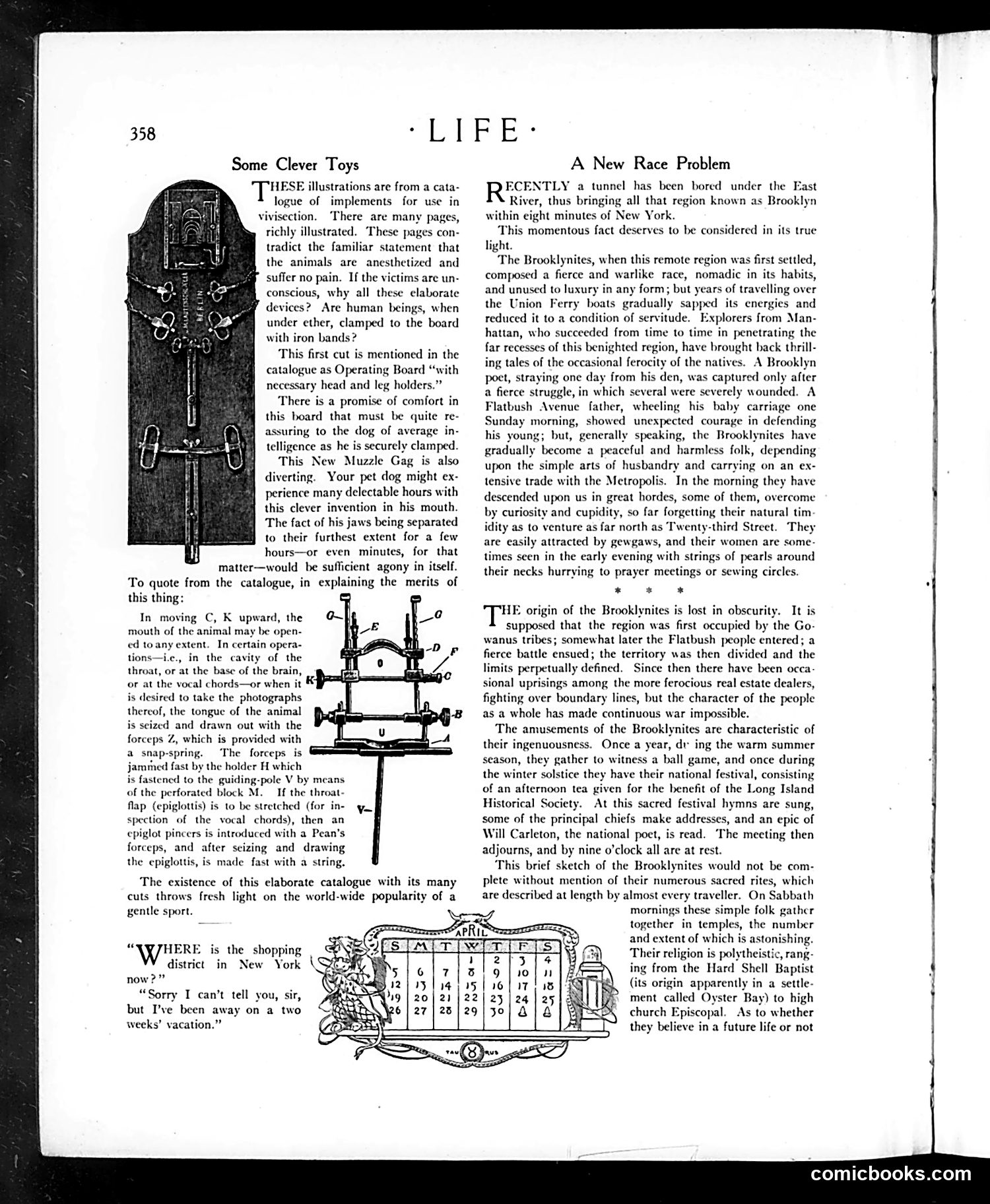
**Left section ("Some Clever Toys"):** Life satirizes vivisection—animal experimentation—by showing surgical implements from a catalogue. The magazine mocks the claim that animals are anesthetized and feel no pain, asking sarcastically whether humans under ether are also clamped to boards. The detailed descriptions of restraints and mouth gags reveal the brutal reality behind scientific experiments. **Right section ("A New Race Problem"):** This is a mock-anthropological piece satirizing Brooklyn residents after a tunnel opened connecting Brooklyn to Manhattan. Life playfully depicts Brooklynites as a "fierce and warlike" primitive people gradually "civilized" by ferry travel, now docile and dependent on Manhattan commerce. The humor mocks both Brooklyn's status as an outer borough and contemporary attitudes treating social groups as specimens for study. The small calendar cartoon about vacation time appears unrelated to the main content.
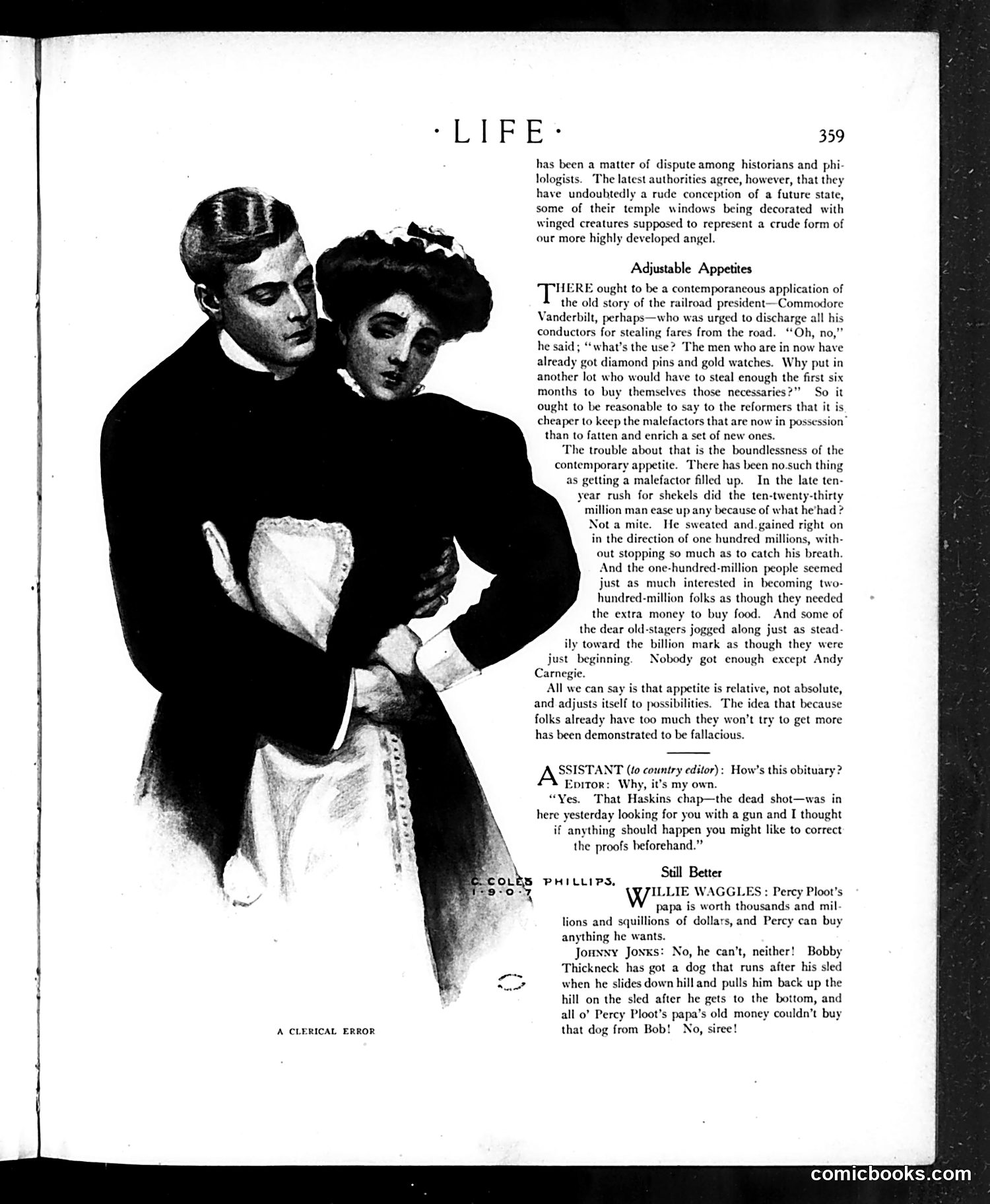
This page contains two satirical pieces from *Life* magazine: **"Adjustable Appetites"** is a commentary on gilded-age wealth inequality. The text references Commodore Vanderbilt (a real railroad magnate) and argues that wealthy people's appetites for money are insatiable—they don't stop accumulating once rich. The piece mocks reform efforts as pointless, since corrupt officials won't be satisfied anyway. It critiques both wealthy industrialists (who keep pursuing billions) and the general population (equally greedy). Andy Carnegie is mentioned as someone who finally "got enough." **The cartoon labeled "A Clerical Error"** (illustrated by Coles Phillips) shows a priest or clergyman with a woman holding what appears to be a baby—likely depicting an illegitimate child, playing on the ironic title about clerical (religious) "error." **The brief dialogue pieces** at bottom are unrelated humor about journalism and childhood values—a country editor's dark joke about printing his own obituary, and children's banter about what money can't buy. The overall page satirizes American capitalism's endless pursuit of wealth accumulation.
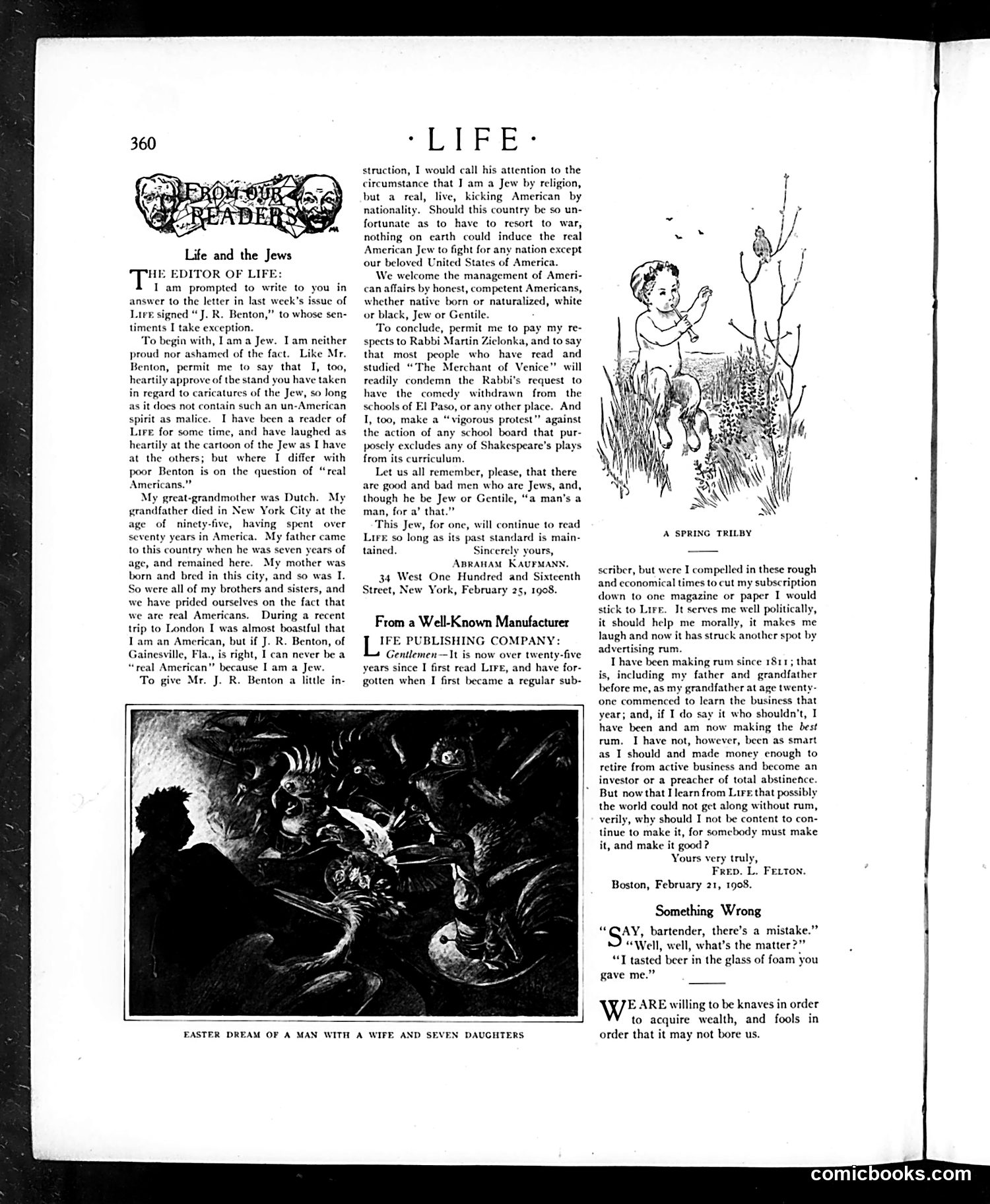
This page presents reader letters debating Jewish representation in American media and society. **Main Content:** Abraham Kaufmann responds to a previous letter by J.R. Benton, defending Jews as genuine Americans. Kaufmann details his family's multi-generational American residency, arguing that being Jewish by religion doesn't negate American nationality. He challenges Benton's implied definition of "real Americans" as excluding Jews and defends *The Merchant of Venice* against Rabbi Ziclonka's attempt to remove it from El Paso schools, citing Shakespeare's literary value. **The Dark Cartoon:** The illustration labeled "Easter Dream of a Man with a Wife and Seven Daughters" appears grotesque and nightmarish, likely satirizing economic burden or anxiety—common themes in early 20th-century American humor about family size and expense. **Significance:** The page reflects 1908 debates about Jewish integration and assimilation in America, including tensions over anti-Semitic stereotypes in media versus free speech regarding classic literature.
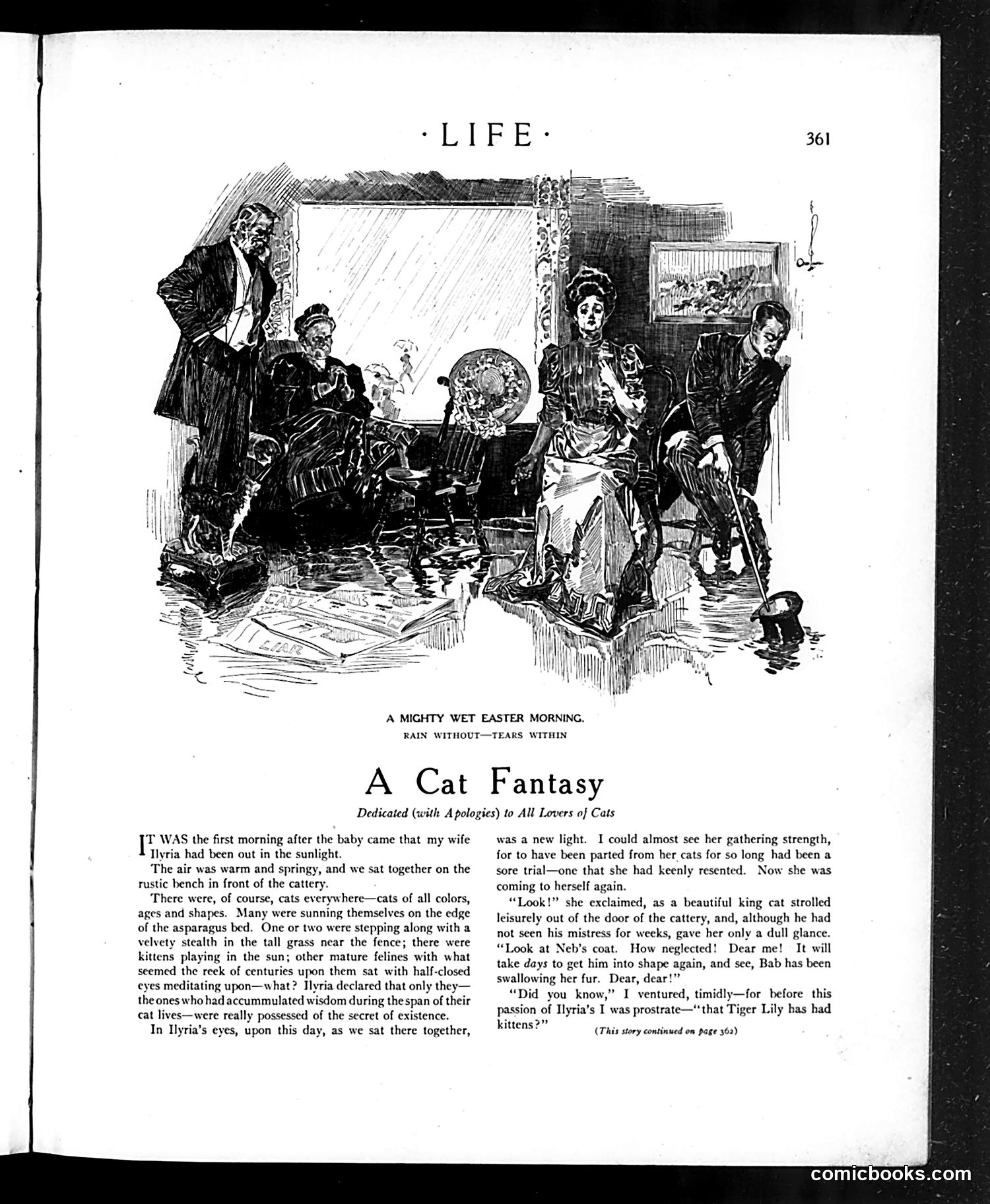
This is a humorous short story illustrated with a sketch showing a domestic scene. The narrative depicts a wife named Ilyria returning home after childbirth to find her beloved cats. The joke centers on her priorities: she's far more concerned with her cats' welfare than her newborn baby. The satire mocks obsessive cat-lovers—particularly women of means with leisure to maintain a "cattery" (cat breeding establishment). The subtitle "Rain Without—Tears Within" suggests emotional drama over trivial matters. The husband's nervous tone ("ventured, timidly") when discussing cat pregnancies humorously emphasizes how his wife's cat-passion dominates household dynamics. This reflects early 20th-century satirical attitudes toward eccentric pet devotion, portraying it as an amusing character flaw. The illustration shows the wife surrounded by attentive family members, yet preoccupied with feline concerns rather than her infant.
This page appears to be a serialized short story rather than political satire or comics. The narrative follows a man attempting to understand his wife Ilyria's unusual devotion to her cats over their human infant. The story satirizes **late 19th/early 20th-century feminist and "New Woman" ideology**. Ilyria represents an exaggerated version of women seeking emancipation from traditional motherhood—she explicitly states her love for her baby is a "weakness" she'll "conquer eventually" and prioritizes her cats' emotional needs over her child's care. The satire mocks this movement by presenting Ilyria as almost mystically devoted to cats, speaking cryptically about their superiority to humans and suggesting maternal instinct is merely "custom" and "society" rather than natural. The narrator, a conventional man, struggles helplessly to comprehend her worldview. This reflects anxieties of the era about women rejecting traditional domestic roles.
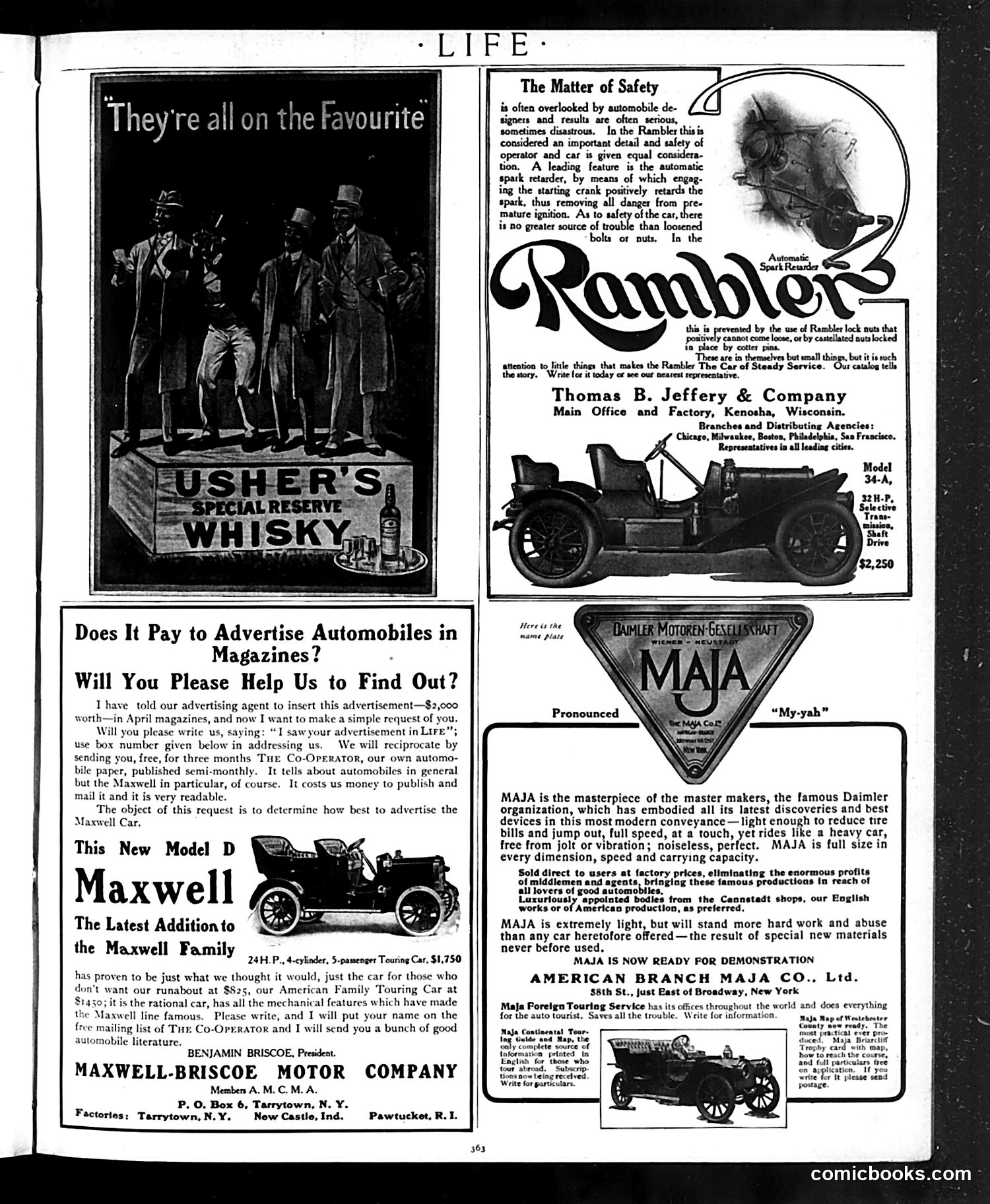
This page consists primarily of automobile advertisements rather than editorial content or political cartoons. The ads promote early automobiles—the Rambler, Maxwell, and Maja—emphasizing emerging safety features and affordability. The Rambler advertisement highlights "automatic spark retarders" and "lock nuts" as safety innovations. Maxwell's ad includes an interactive element: readers who write mentioning seeing the ad receive free copies of *The Co-Operator*, a semi-monthly automobile publication, allowing the manufacturer to measure advertising effectiveness. The Maja advertisement appeals to luxury buyers, claiming it's a "masterpiece" from the famous Daimler organization, sold "direct to users at factory prices" to eliminate middlemen profits. The writing reflects pre-WWI automobile marketing conventions: emphasizing mechanical reliability, ride quality, and cost-consciousness. There is no political satire or caricature visible on this page—it is straightforward commercial advertising typical of early 20th-century magazines.
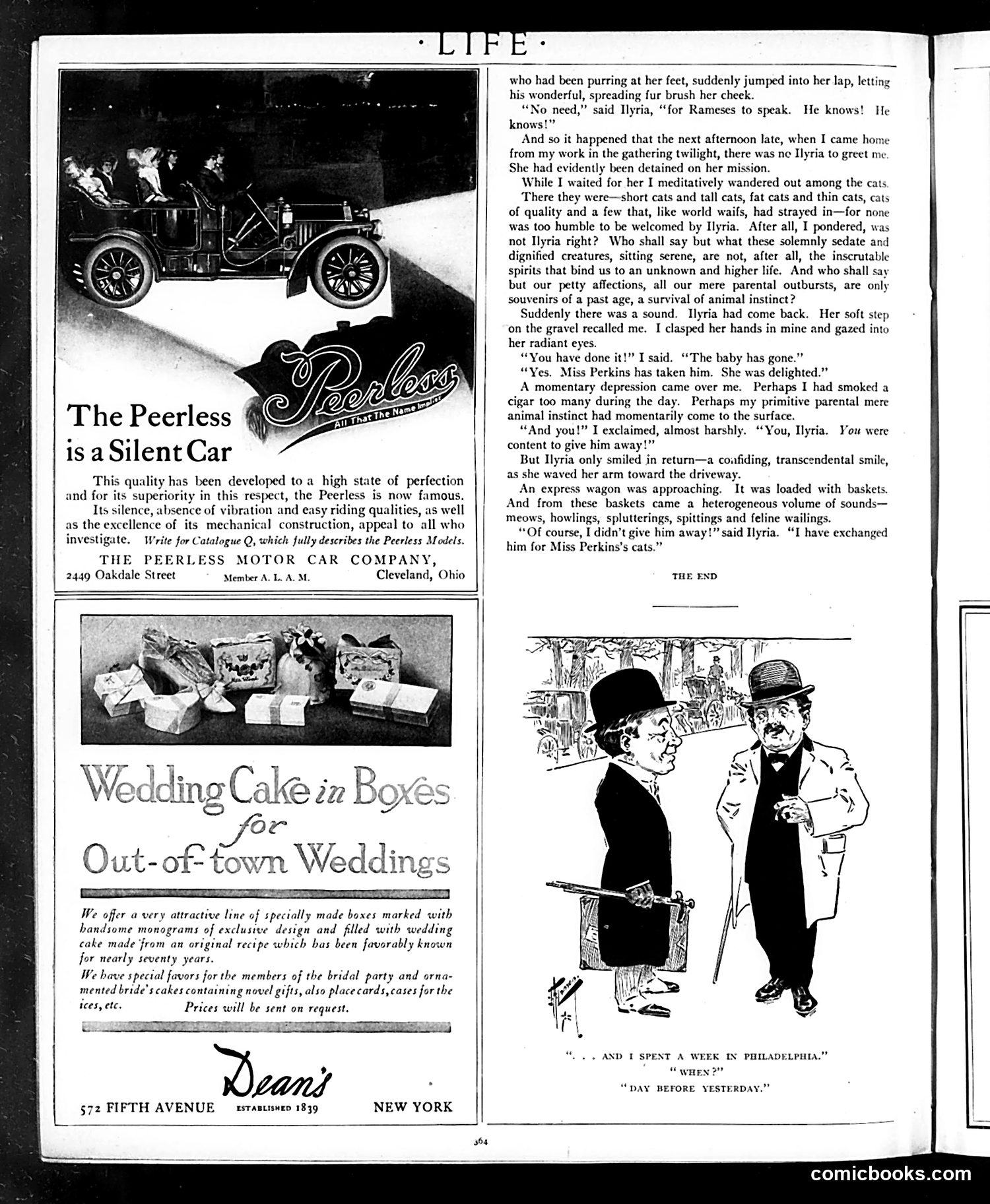
This page contains a **completed short story** (marked "THE END") about a woman named Ilyria who adopts her neighbor's unwanted baby by trading it to Miss Perkins in exchange for Miss Perkins's cats. The satire targets **early 20th-century sentimentality about animals and pseudo-philosophical attitudes toward pets**. The joke's sting: Ilyria treats the human infant as casually as a possession to be swapped, valuing the cats—which she romanticizes as "inscrutable spirits"—over human responsibility. The narrator's moment of harsh judgment ("You were content to give him away!") is undercut by Ilyria's serene satisfaction, suggesting the story mocks people who elevate animal companionship above human duty. The surrounding **advertisements** (Peerless automobiles, Dean's wedding cakes) are unrelated commercial content typical of Life's format. The bottom **cartoon** shows two men in conversation; the caption's incomplete exchange ("spent a week in Philadelphia"/"When?") appears to be a separate, unrelated joke whose punchline isn't visible.
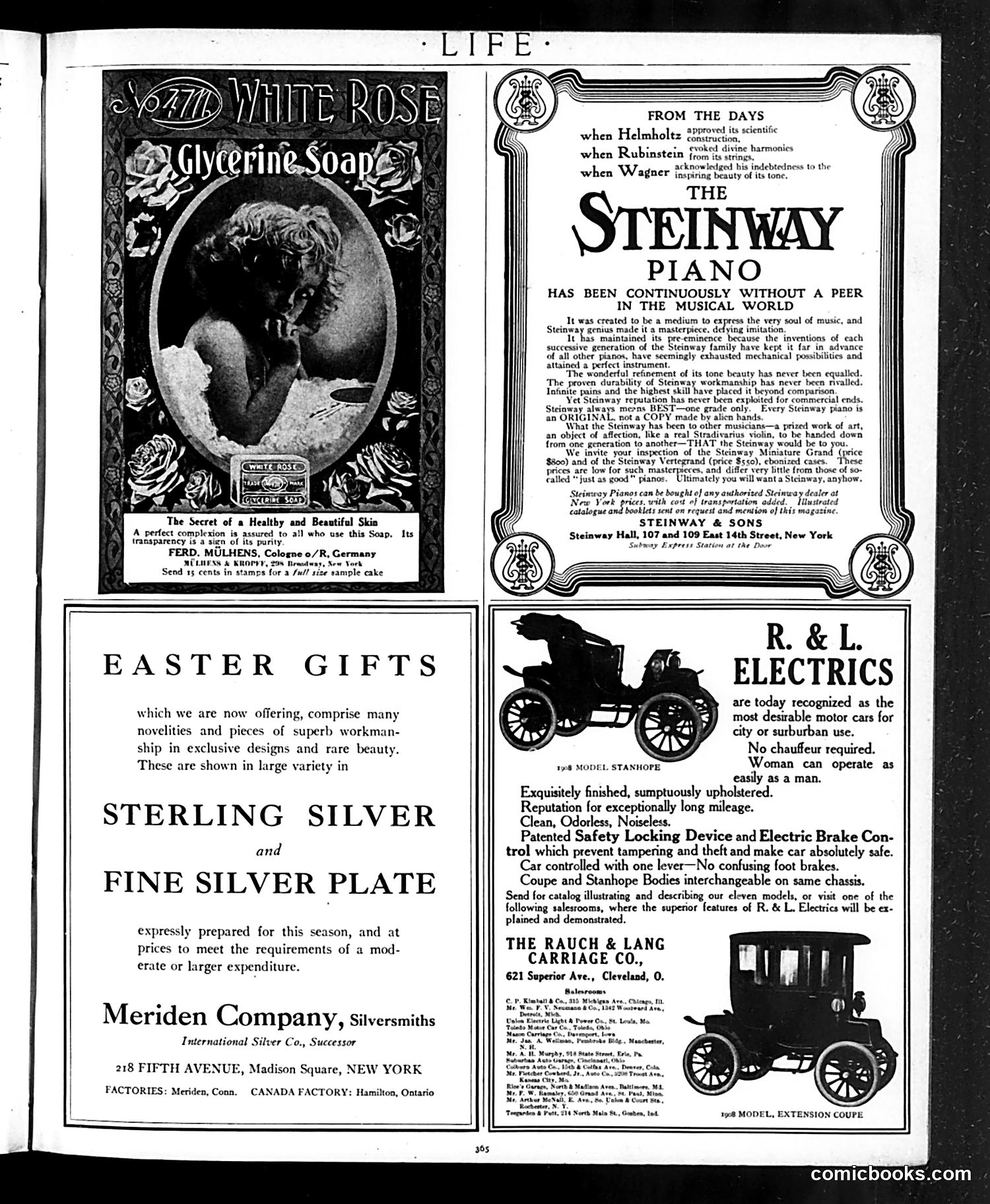
This is primarily a **advertising page**, not satire or political commentary. It contains four luxury product advertisements from the early 1900s: 1. **White Rose Glycerine Soap** — appeals to vanity with promises of perfect complexion 2. **Steinway Piano** — emphasizes prestige by name-dropping famous composers (Helmholtz, Rubinstein, Wagner) to position the instrument as the choice of genius musicians 3. **Meriden Company Silver** — targets Easter gift-givers with sterling and silver plate 4. **R. & L. Electric Cars** — markets electric automobiles as modern, safe, and notably operated by women "as easily as a man" (suggesting this was novel/noteworthy) The Rauch & Lang carriage ad shows competing horse-drawn technology. These ads reflect **Gilded Age consumer culture**: luxury goods marketed to wealthy audiences through appeals to cultural refinement, safety innovation, and social status. No cartoon or satirical content is present—this is straightforward period advertising.
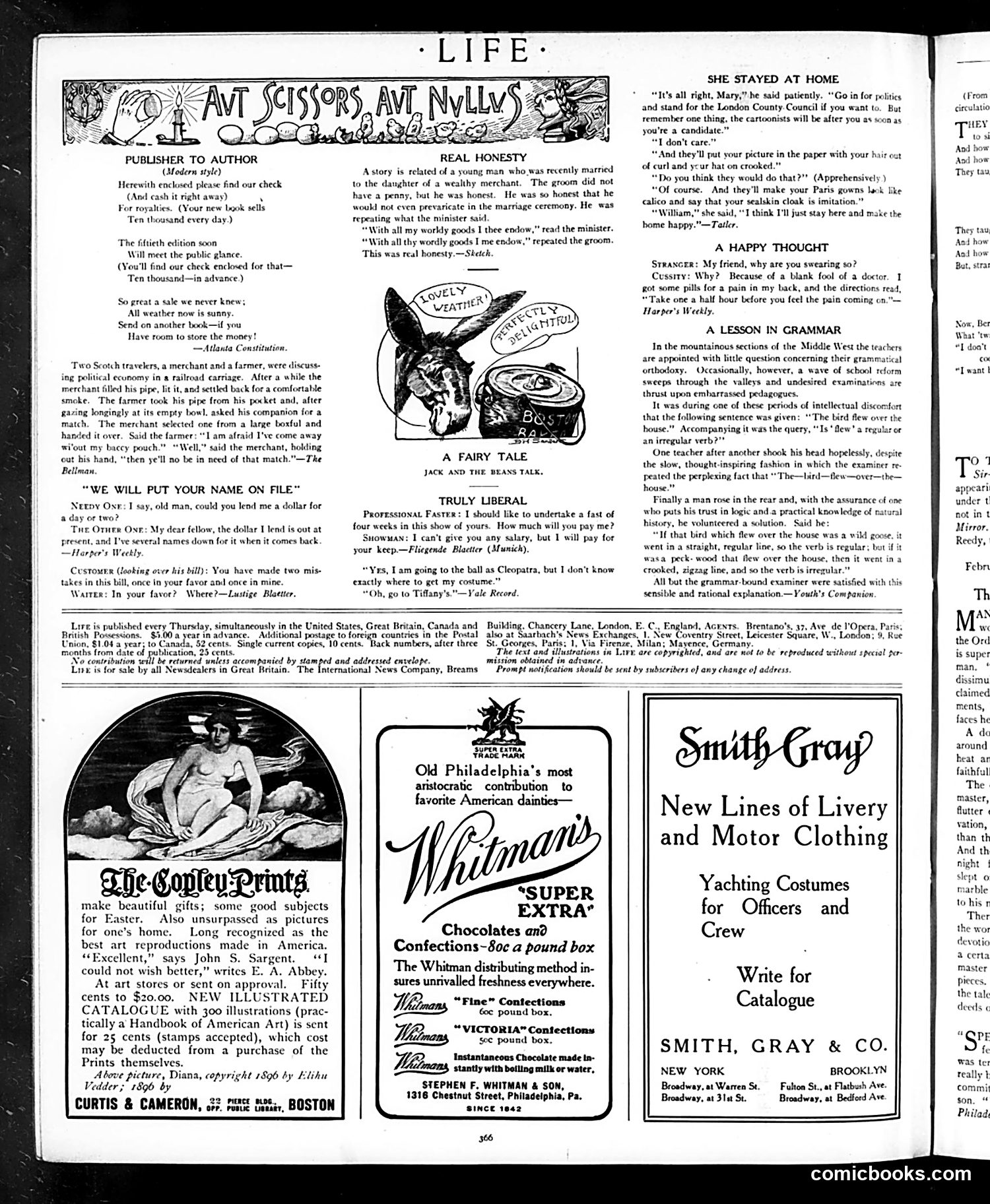
This is primarily a **humor and satire page** from Life magazine, featuring various short jokes and anecdotes rather than political cartoons. The main pieces satirize: 1. **"Publisher to Author"** — Mocks the modern publishing industry's obsession with commercial success over literary merit, portraying a publisher offering absurdly large advances for popular but lightweight books. 2. **"Real Honesty"** — A brief anecdote about a groom so scrupulously honest he repeats the minister's vows verbatim, even when they're factually incorrect about his assets. 3. **"She Stayed at Home"** — Satirizes both political ambition and press treatment of women in politics. A husband warns his wife that if she stands for London County Council, cartoonists will caricature her unflattering, mocking her appearance and clothing—discouraging her political participation. 4. Other brief jokes about lending money, restaurant bills, and costume acquisition. The page reflects early 20th-century attitudes: skepticism of commercialism, gender politics, and the power of media representation to influence behavior.
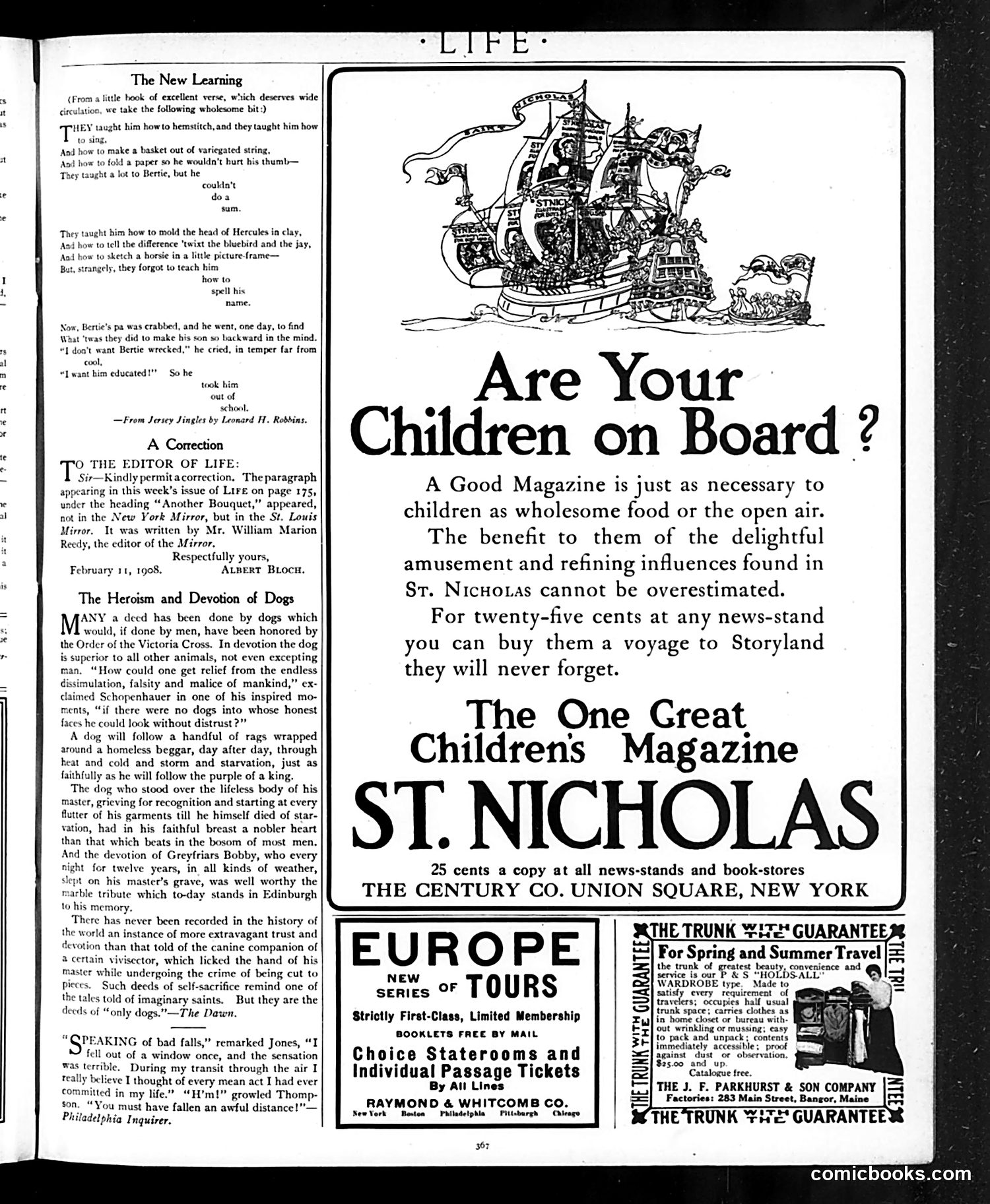
This page from *Life* magazine (dated February 11, 1908) contains primarily **advertisements and reader corrections**, not political satire. The main content includes: 1. **"The New Learning"** - A humorous poem satirizing progressive education. It mocks schools that teach children elaborate skills (hemstitching, clay sculpture, ornithology, sketching) while failing to teach fundamentals like spelling. The punchline: a frustrated father withdraws his son "Bertie" from school because he wants him actually *educated*. 2. **"The Heroism and Devotion of Dogs"** - A sentimental essay praising dogs' loyalty, citing examples like Greyfriars Bobby (a real historical dog). No satire intended; it's earnest praise. 3. **Advertisements** dominate the lower half, including St. Nicholas children's magazine, travel tours, and trunks. The satire targets **contemporary educational fads** — the implication being that 1908 schools prioritized trendy accomplishments over basic literacy. This reflects early-20th-century anxieties about "modern" versus "traditional" education.
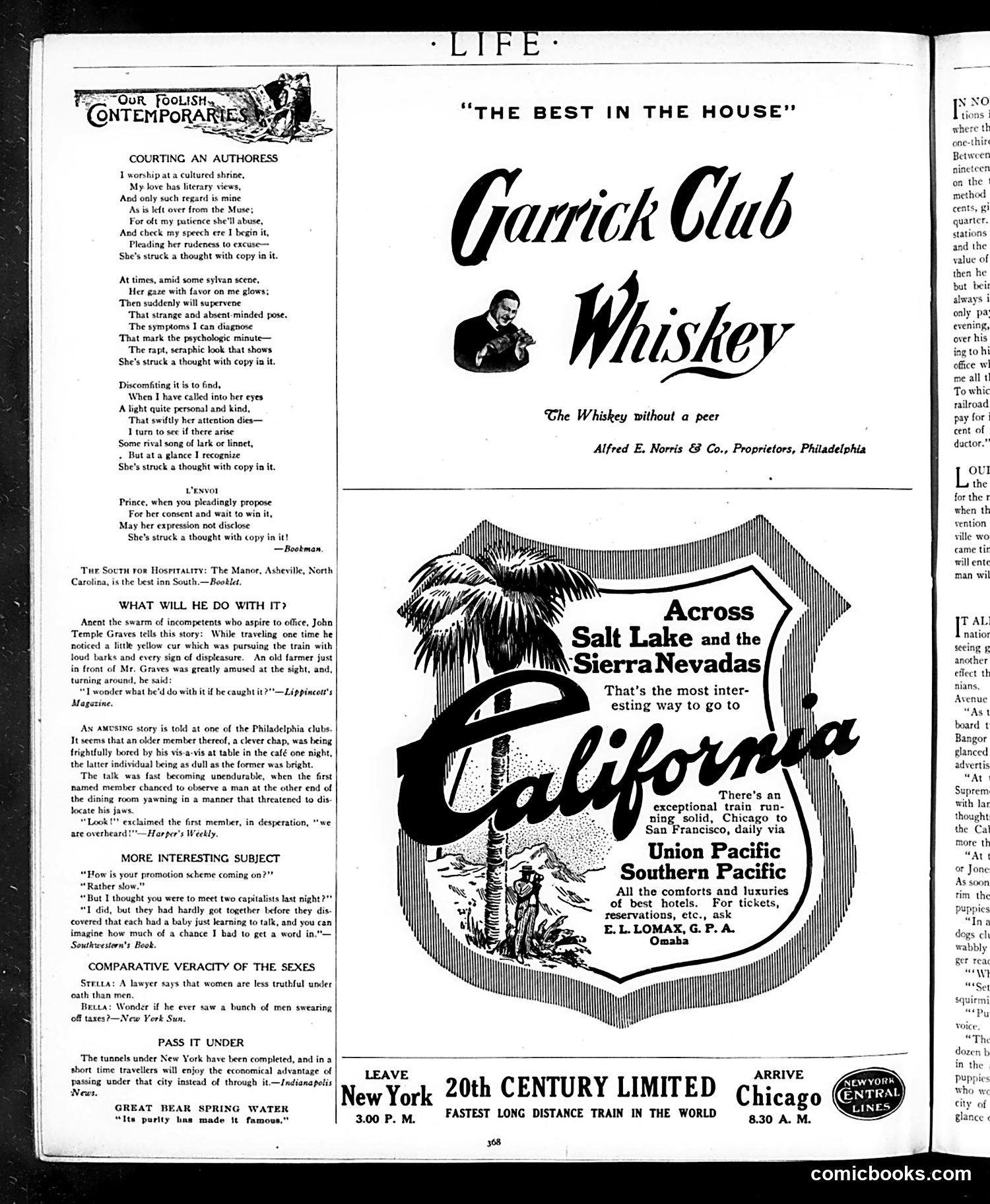
This page combines satirical poetry and humorous anecdotes with period advertising. **"Courting an Authoress"** satirizes romantic pursuit of female writers. The poem's joke: a suitor repeatedly loses his beloved's romantic attention when she becomes distracted by literary inspiration ("struck a thought with copy in it"). The satire targets both the absent-minded artistic temperament and the notion that creative ambition supersedes romantic engagement—a pointed commentary on women's intellectual pursuits in an era when such priorities were considered eccentric. **The anecdotes** mock human behavior: incompetent office-seekers, tedious dinner companions, and tax evasion claims—generic social satire about professional mediocrity and dishonesty. **The advertisements** promote luxury rail travel (20th Century Limited, Union Pacific) and whiskey, reflecting early-20th-century consumer culture aimed at affluent readers. The page reflects *Life* magazine's dual purpose: sophisticated satire for educated audiences combined with upscale commercial messaging.
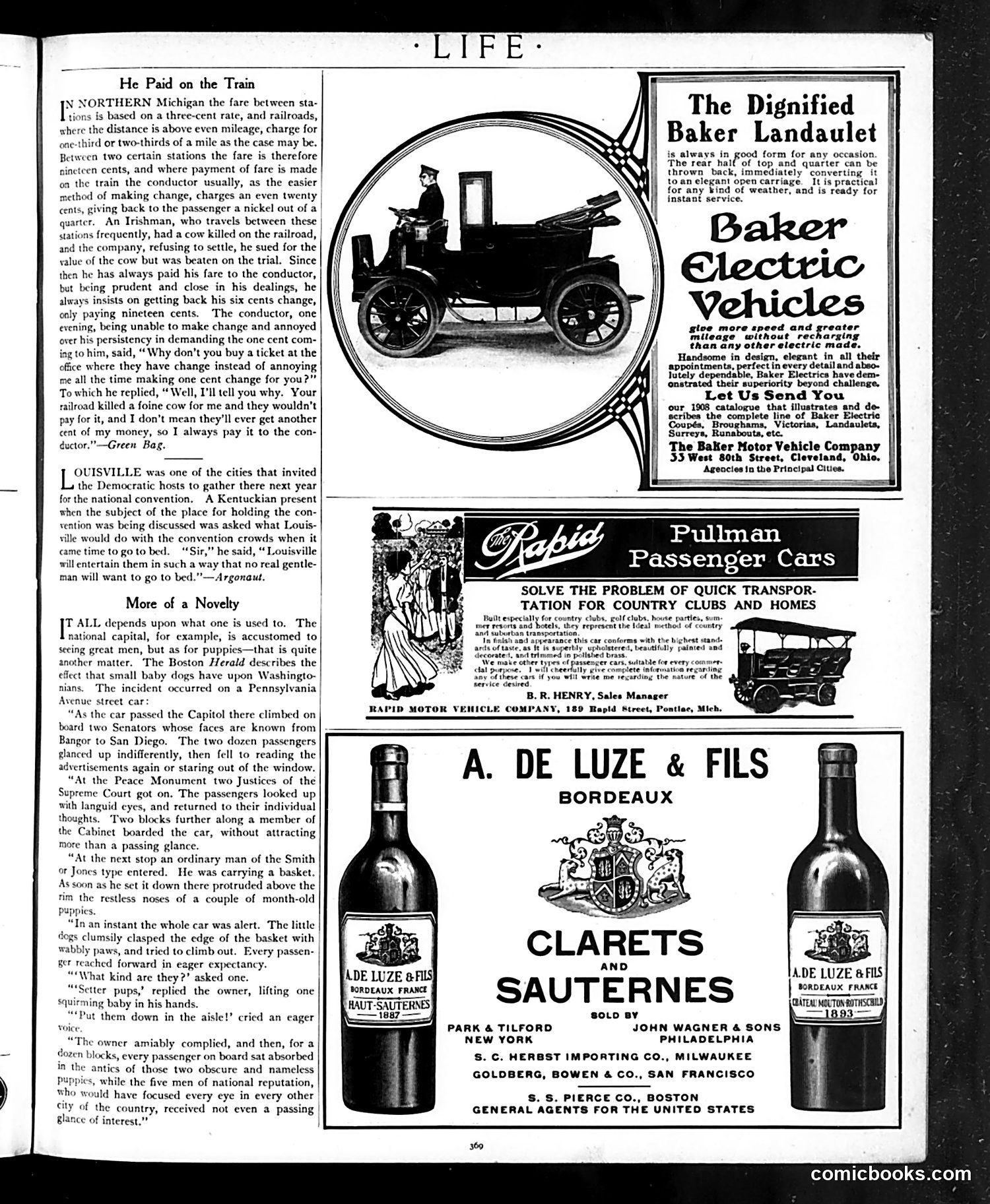
This page contains three distinct humor pieces typical of Life's satirical content: **"He Paid on the Train"** mocks a stubborn Irish railroad passenger who, after the company refused to compensate him for a cow they killed, retaliates by insisting on exact change (nineteen cents, not twenty) on every trip. His penny-pinching revenge is his way of "getting back" at the railroad—petty but persistent. **"Louisville for the Convention"** is a risqué joke about the Democratic National Convention. A Kentucky gentleman suggests Louisville will entertain convention delegates so thoroughly "that no real gentleman will want to go to bed"—implying the city offers illicit nighttime pleasures. **"More of a Novelty"** satirizes Washington, D.C. society's indifference to famous politicians. A Capitol streetcar full of senators, Supreme Court justices, and a Cabinet member draws no attention, but when an ordinary man boards carrying puppies, all passengers become instantly animated. The joke: common puppies fascinate jaded Washington elites more than actual power. These pieces mock human nature and social pretension through everyday situations.
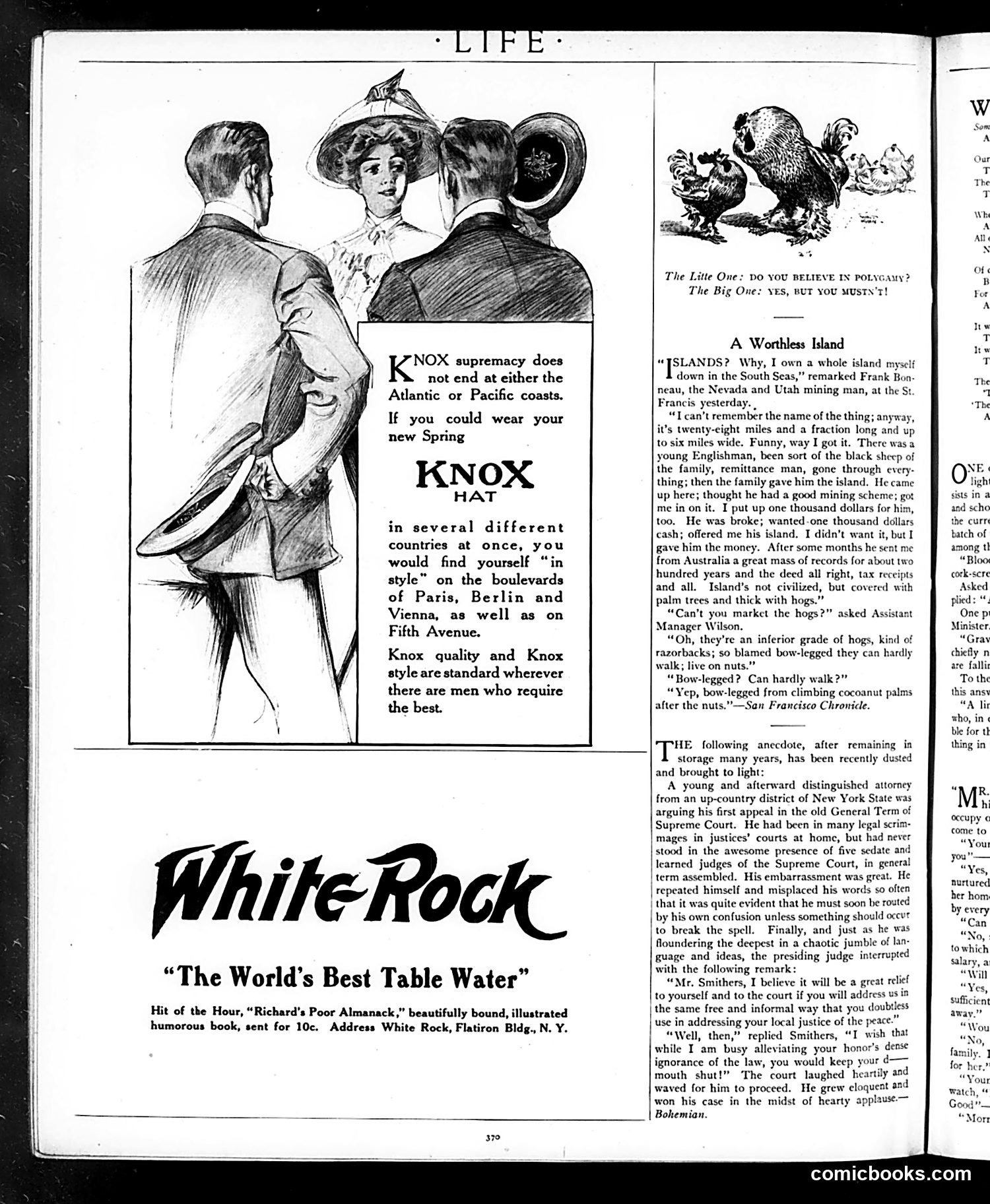
This page contains two main items: **Left: Knox Hat Advertisement** A fashion ad showing well-dressed men, claiming Knox hats are fashionable across Paris, Berlin, Vienna, and Fifth Avenue—emphasizing American sophistication equals European style. **Right: Two Humorous Anecdotes** 1. **"A Worthless Island"**: A tall tale about a Nevada mining man who acquired a South Seas island as payment for a loan. The joke builds on absurdity—the island is covered only with "inferior" bow-legged hogs that can barely walk because they've climbed coconut palms so much. It's nonsensical humor mocking get-rich-quick schemes and worthless colonial acquisitions. 2. **Court Anecdote**: A young upstate New York lawyer, terrified before the state Supreme Court, is told to speak informally. He responds by telling the judge to "keep your d— mouth shut" while he argues. The court laughs and he wins—satirizing pompous legal formality and suggesting blunt directness works better than intimidated deference. Both pieces use humor to mock pretension and social anxiety.
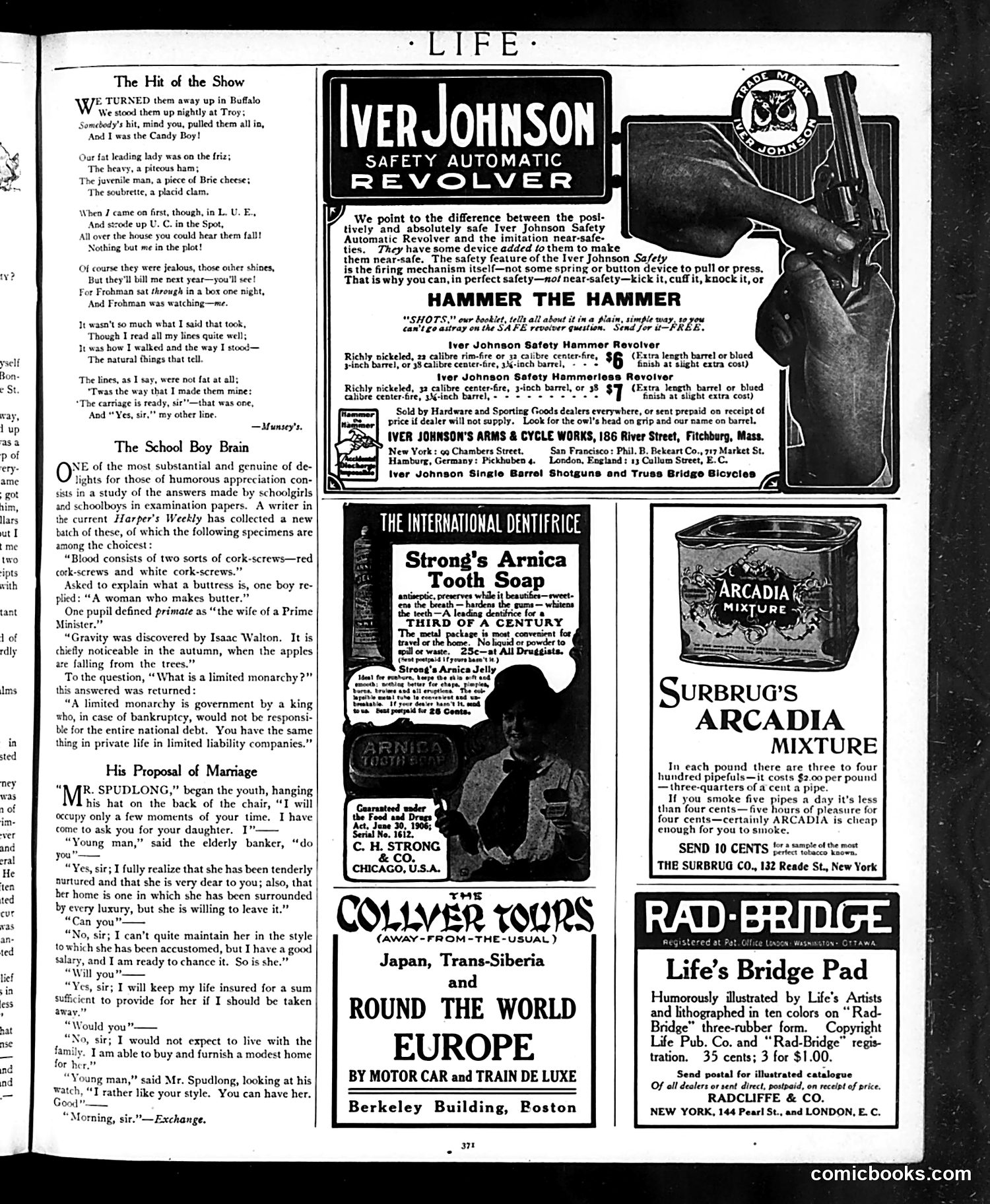
This page contains three distinct pieces of humor content typical of early 20th-century Life magazine: **"The Hit of the Show"** — A comedic poem from *Munsey's* about a vain theater actor who claims he alone drew audiences, despite being mediocre ("The heavy, a piteous ham"). The joke satirizes theatrical ego and self-delusion; the actor credits his success to physical presence and delivery of two forgettable lines, completely overlooking his colleagues' contributions. **"The School Boy Brain"** — A collection of humorous student exam answers highlighting childish logic and misunderstandings (gravity discovered by Isaac Walton; buttress defined as a woman who makes butter). This gentle satire mocks the gaps between adult knowledge and juvenile reasoning. **"His Proposal of Marriage"** — A comedic dialogue where a young suitor preemptively answers every objection a banker-father might raise about supporting his daughter. The humor lies in the suitor's strategic, almost absurd thoroughness—he renders the father speechless by anticipating and defusing all arguments. The page is otherwise dominated by product advertisements (Iver Johnson revolvers, tooth soap, etc.), typical of Life's magazine format.
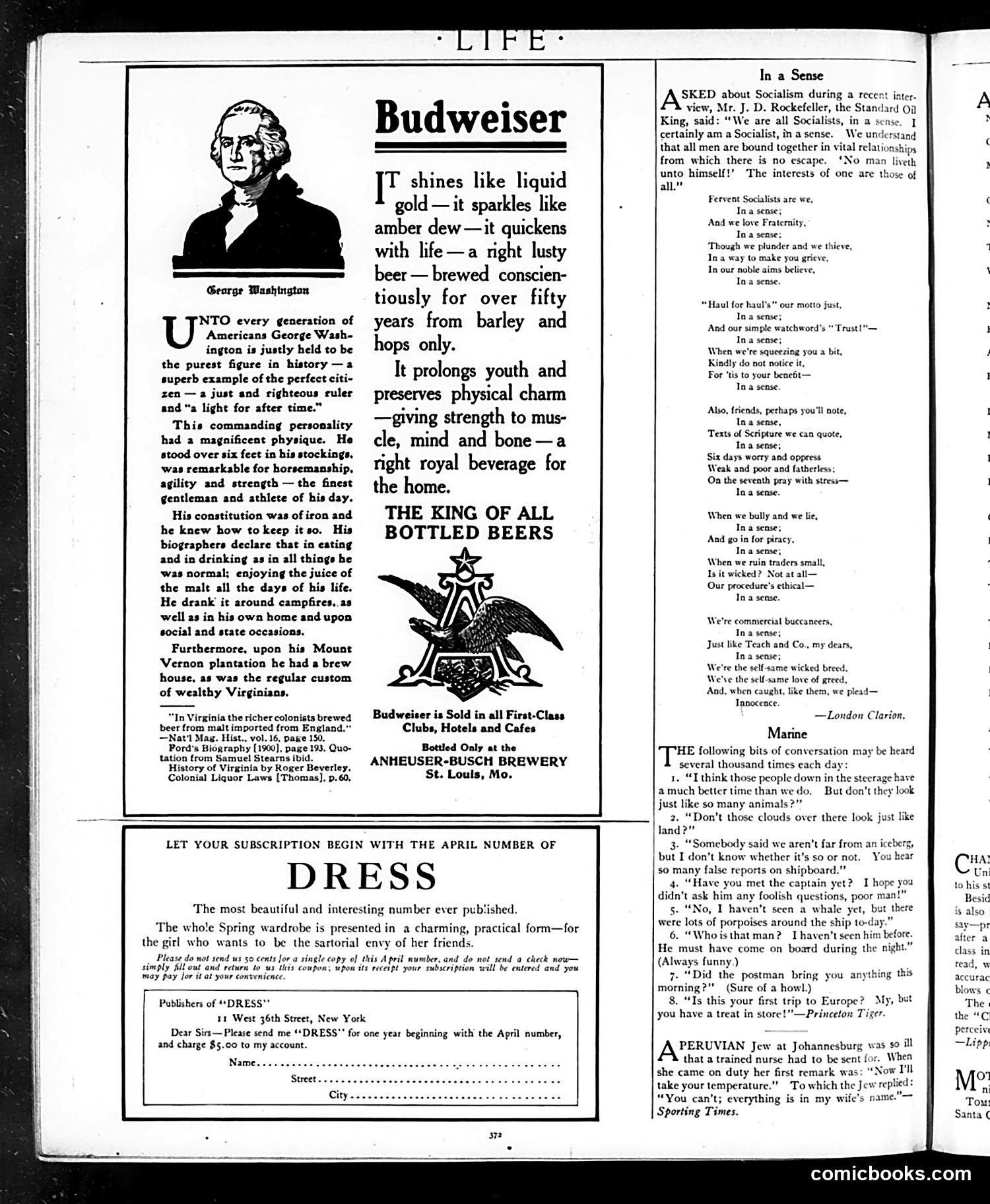
This page contains a **Budweiser beer advertisement** masquerading as historical content, alongside satirical poetry mocking wealthy industrialists' claims of socialism. **The Budweiser Ad:** Uses George Washington as endorsement, claiming he was a beer-drinker who maintained a brewhouse at Mount Vernon. The ad invokes patriotic authority and physical vigor to sell beer as a wholesome, characterbuilding beverage. **The Satire ("In a Sense"):** Directly attacks J.D. Rockefeller (the Standard Oil magnate), who recently claimed industrialists were "Socialists in a sense." The poem ridicules this by cataloging hypocrisy: the wealthy claim fraternity while "plundering," invoke Scripture while exploiting workers, call themselves "ethical" while engaging in piracy. The repeated refrain "In a sense" savagely undercuts their moral pretenses—suggesting their socialism is purely rhetorical cover for ruthless capitalism. The juxtaposition is pointed: an advertisement selling American heritage sits opposite poetry exposing how the powerful corrupt American ideals.
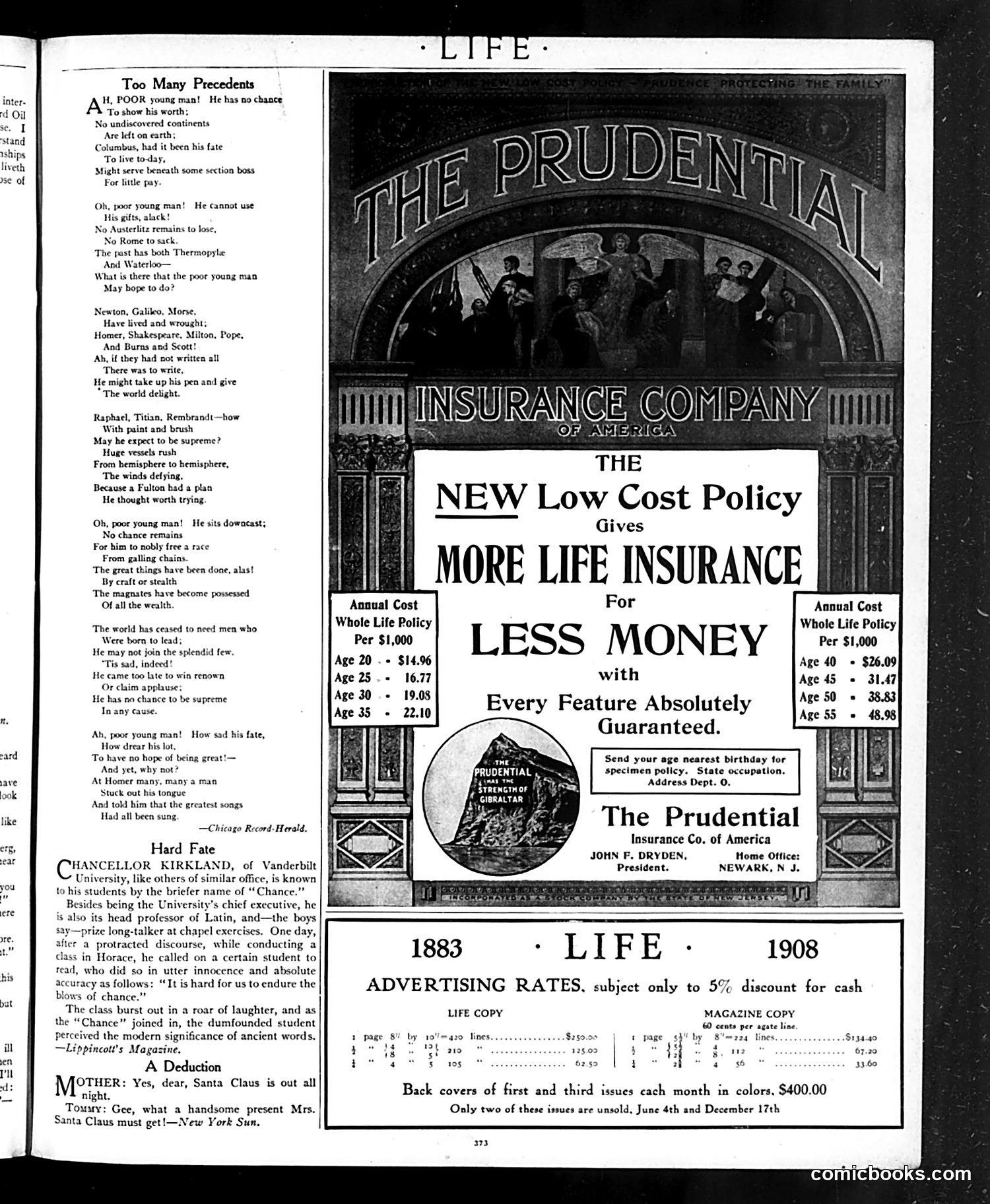
This poem mocks a common late 19th-century anxiety: that all great achievements had already been accomplished by historical figures (Columbus, Newton, Shakespeare, Fulton), leaving young men with no opportunity for distinction. The satire suggests this fatalistic thinking is absurd—great accomplishments still await those with ambition. The accompanying jokes target pomposity: Chancellor Kirkland's lengthy chapel speeches, and a pun about Santa Claus's wife receiving gifts because he's "out all night." The page primarily consists of a **Prudential Insurance advertisement** promoting affordable whole-life policies, which occupies most space. The ads emphasize low annual costs at various ages to appeal to young workers concerned about financial security. This is essentially a mixed editorial/advertising page typical of *Life* magazine's format—satirical content alongside commercial promotions.
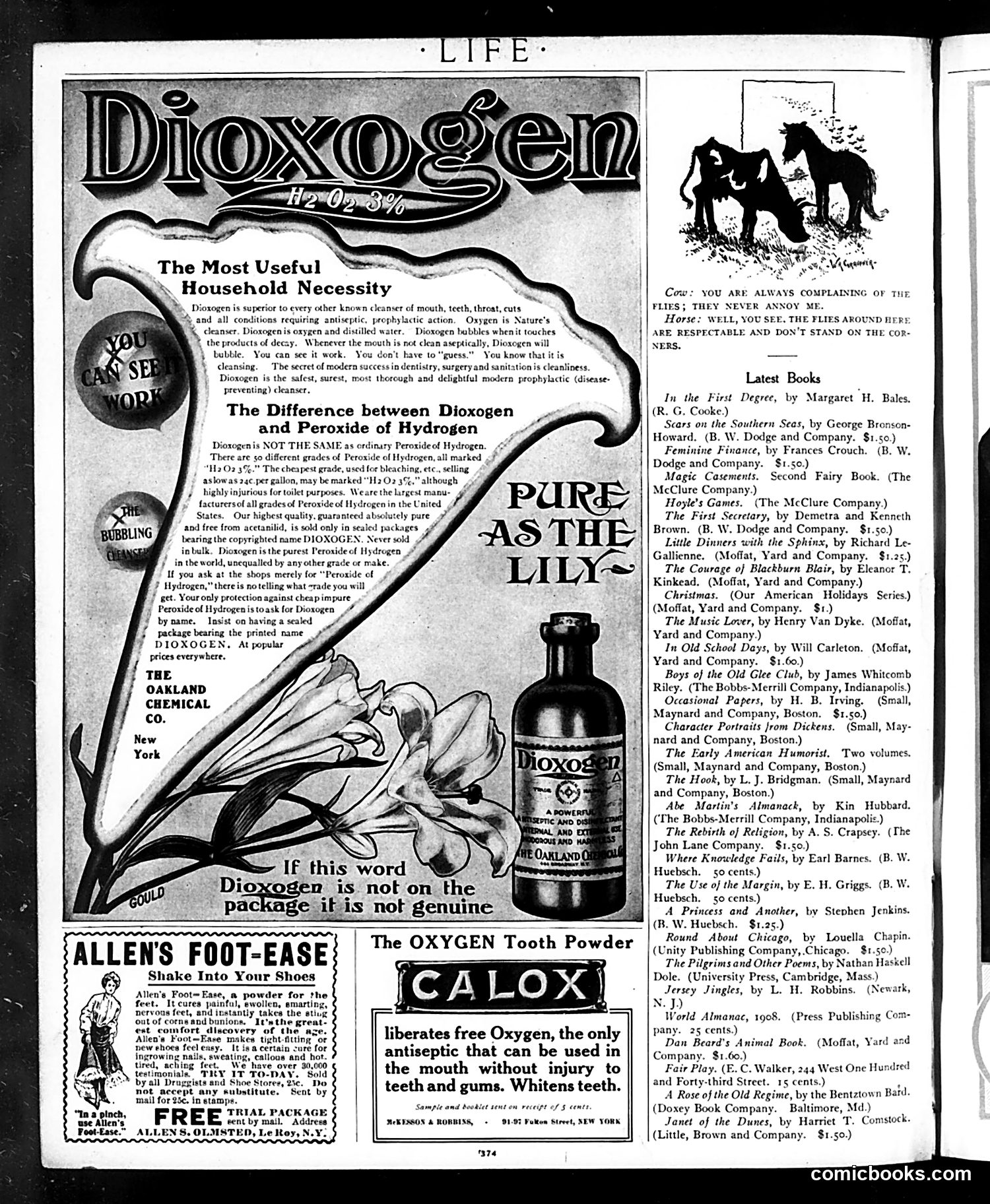
This is primarily a **advertising page** from an early 1900s *Life* magazine, dominated by product promotions rather than political satire. The main advertisement touts **Dioxogen**, a hydrogen peroxide-based mouthwash marketed as a superior cleaning agent. The company emphasizes it's the "genuine" branded product (contrasting with cheap generic competitors), highlighting concerns about product authenticity and purity—issues that preoccupied early 20th-century consumers before modern FDA regulations. The **small cartoon** (top right) shows a cow and horse; the joke reflects period attitudes about farm animals and pest control, with the horse complaining about flies—a mundane rural humor reference. Below are other period advertisements: **Allen's Foot-Ease** powder and **Calox** tooth powder. The right column lists **current book releases**, suggesting this reflects early 1900s popular literature. The page is essentially a commercial product showcase, not political commentary. The "satire" of *Life* magazine in this era was lighter and consumer-focused rather than hard-hitting political critique.
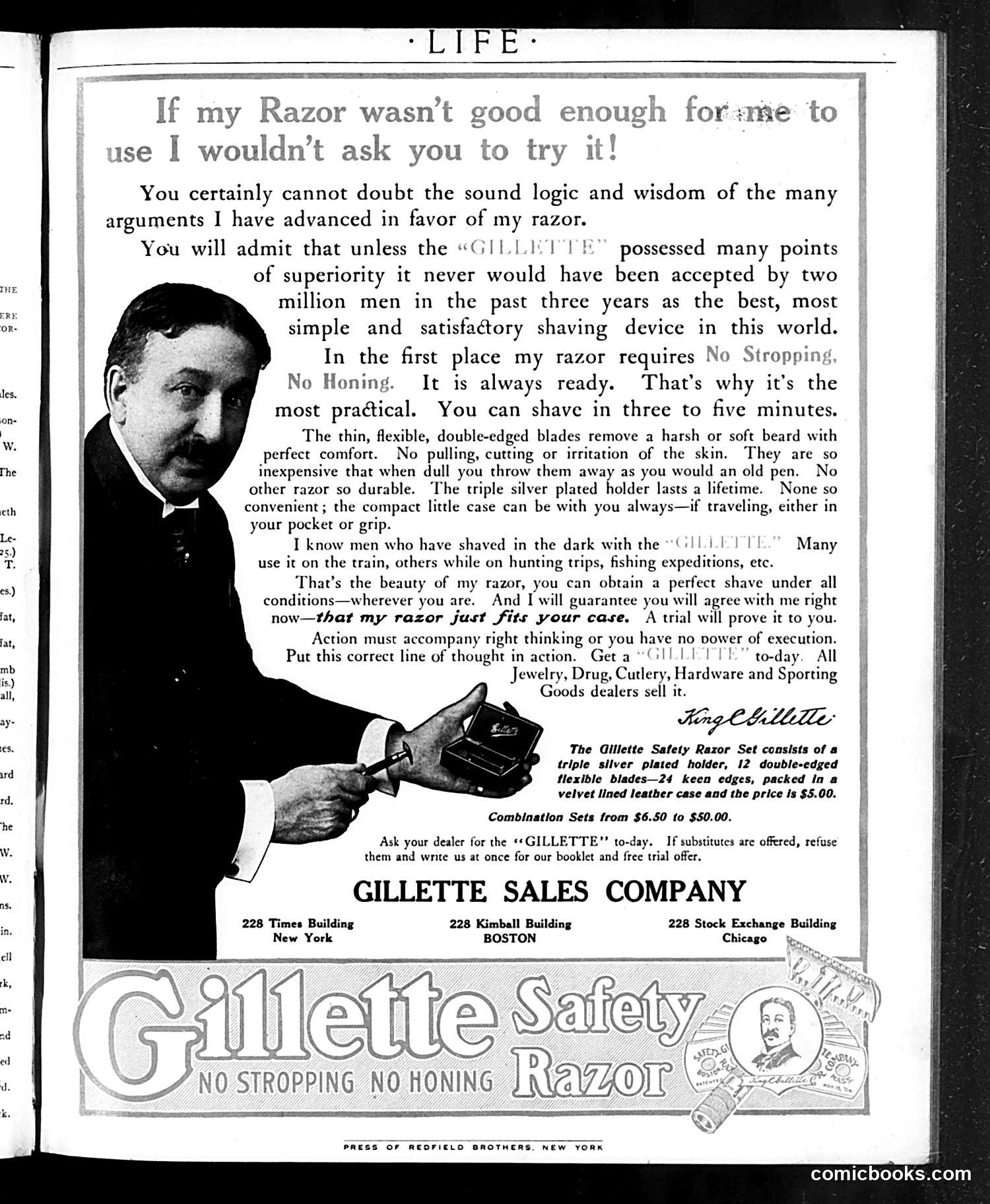
This is a **straightforward advertisement**, not satire or political commentary. It's a Gillette Safety Razor company testimonial, likely from the early 1900s (the ad claims the razor has been accepted by "two million men in the past three years"). The page features a well-dressed man in formal attire demonstrating the razor and its case. The ad emphasizes practical selling points: no stropping or honing required, quick shaving (3-5 minutes), disposable blades, and portability for travel or outdoor use. The phrase "If my Razor wasn't good enough for me to use I wouldn't ask you to try it!" frames this as a personal endorsement from someone of apparent social standing. The text uses direct-address rhetoric common in early 20th-century advertising, appealing to logic and practicality while suggesting the product enables masculine self-sufficiency. The Gillette Safety Razor Set is priced at $5.00, with combination sets up to $50.00—substantial sums for the era.
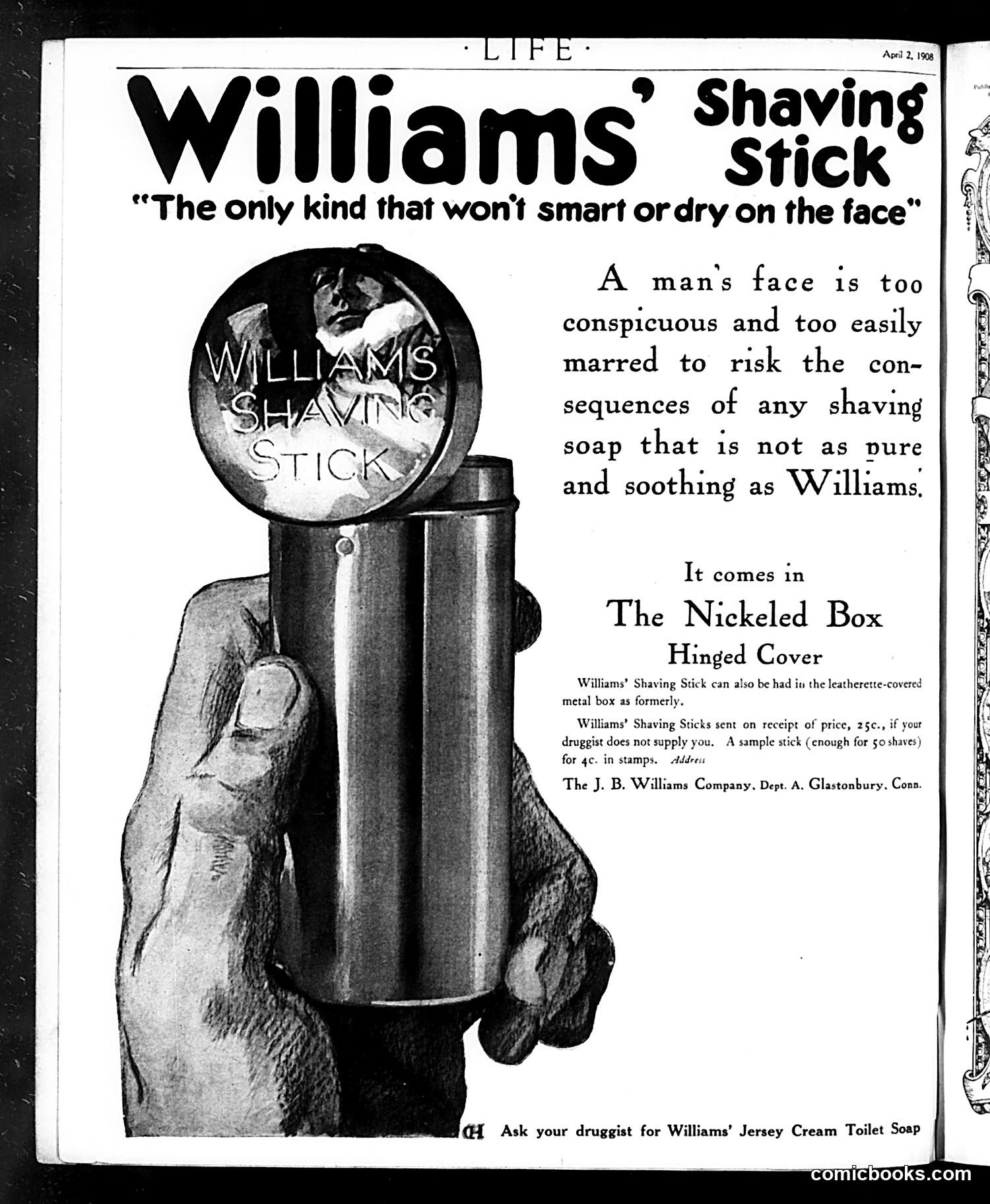
This is a **product advertisement**, not political satire. It promotes Williams' Shaving Stick, a solid shaving soap product. The image shows a hand holding a cylindrical metal container with a hinged, nickeled cover. The advertisement's selling point is that Williams' soap won't "smart or dry on the face"—addressing common complaints about inferior shaving products of the era that reportedly caused irritation or uncomfortable drying. The marketing emphasizes purity and gentleness, arguing a man's face is "too conspicuous and too easily marred" to risk inferior soaps. The product cost 25 cents, with sample sticks available for 4 cents in stamps from J.B. Williams Company in Glastonbury, Connecticut. This reflects early 1900s grooming standards and mail-order commerce practices.