
Life, 1908-04-02 · page 30 of 44
Life — April 2, 1908 — page 30: what you’re looking at
What you’re looking at
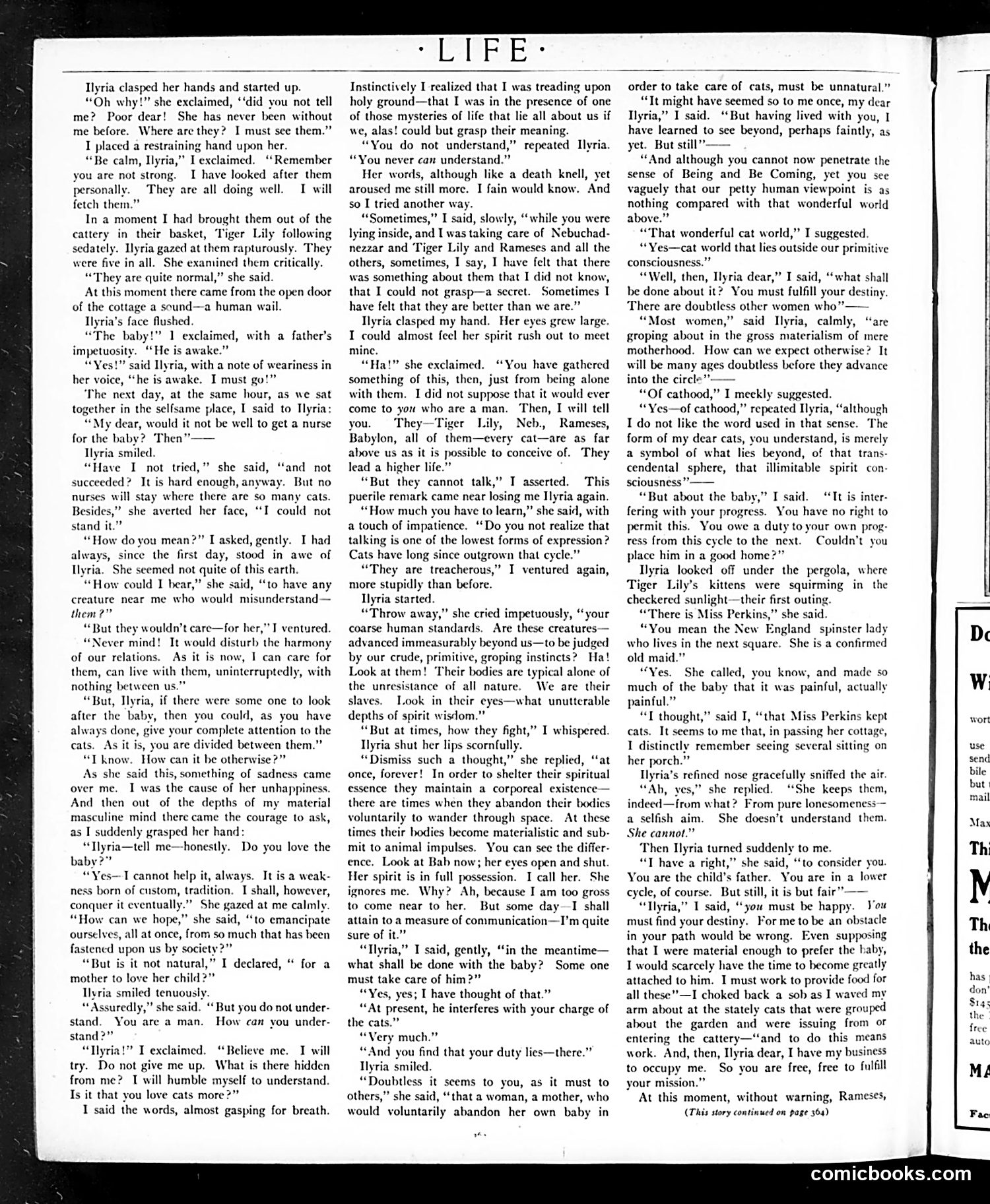
This page appears to be a serialized short story rather than political satire or comics. The narrative follows a man attempting to understand his wife Ilyria's unusual devotion to her cats over their human infant. The story satirizes **late 19th/early 20th-century feminist and "New Woman" ideology**. Ilyria represents an exaggerated version of women seeking emancipation from traditional motherhood—she explicitly states her love for her baby is a "weakness" she'll "conquer eventually" and prioritizes her cats' emotional needs over her child's care. The satire mocks this movement by presenting Ilyria as almost mystically devoted to cats, speaking cryptically about their superiority to humans and suggesting maternal instinct is merely "custom" and "society" rather than natural. The narrator, a conventional man, struggles helplessly to comprehend her worldview. This reflects anxieties of the era about women rejecting traditional domestic roles.
📄 Transcribed text from this page (OCR, searchable)
Machine-transcribed from the original scan — historical spelling and the odd misread are preserved.
LIFE: Ilyria clasped her hands and started up. “Oh why!” she exclaimed, ‘‘did you not tell me? Poor dear! She has never been without me before. Where are they? I must see them.” I placed a restraining hand upon her. “Be calm, Ilyria,” L exclaimed. ‘Remember you are not strong. I have looked after them personally. ‘They are all doing well. I will fetch them.” In a moment I had brought them out of the cattery in their basket, ‘Tiger Lily following sedately. Ilyria gazed at them rapturously. They were five in all. She examined them critically. “They are quite normal,” she said. At this moment there came from the open door of the cottage a sound—a human wail. Ilyria’s face flushed. “The baby!” 1 exclaimed, with a father’s impetuosity. ‘He is awake.” sk said Ilyria, with a note of weariness in her voice, “he is awake. I must go! ‘The next day, at the same hour, as we sat together in the selfsame place, I said to Ilyria: “My dear, would it not be well to get a nurse for the bab Then”—— Ilyria smiled. “Have I not tried,” she said, “and not succeeded? It is hard enough, anyway. But no will stay where there are so many cats. ”” she averted her face, “I could not nurs Besides, stand it.” “How do you mean?” I asked, gently. I had always, since the first day, stood in awe of Ilyria. She seemed not quite of this earth. “How could I bear,” she said, “to have any creature near me who would misunderstand— them ?”” “But they wouldn’t care—for her,” I ventured. “Never mind! It would disturb the harmony of our relations. As it is now, I can care for them, can live with them, uninterruptedly, with nothing between us.” “But, Ilyria, if there were some one to look after the baby, then you could, as you have always done, give your complete attention to the cats. As it is, you are divided between them.” “T know. How can it be otherwise?” As she said this, something of sadness came over me. I was the cause of her unhappiness. And then out of the depths of my material masculine mind there came the courage to ask, as I suddenly grasped her hand: “Tyria—tell me—honestly. Do you love the baby?” “Yes— 1 cannot help it, always. It is a weak- ness born of custom, tradition. I shall, however, conquer it eventually.” She gazed at me calmly. “How can we hope,” she said, ‘to emancipate ourselves, all at once, from so much that has been fastened upon us by society?” “But is it not natural,” I declared, “ for a mother to love her child?” liyria smiled tenuously. “Assuredly,” she said. “But you do not under- stand. You are a man. How can you under- stand?” “Tiyria!” I exclaimed. “Believe me. I will try. Do not give me up. What is there hidden from me? I will humble myself to understand. Is it that you love cats more?” I said the words, almost gasping for breath. Instinctively I realized that I was treading upon holy ground—that I was in the presence of one of those mysteries of life that lie all about us if we, alas! could but grasp their meaning. “You do not understand,” repeated Iyria. “You never can understand.” Her words, although like a death knell, yet aroused me still more. I fain would know. And so I tried another way. “Sometimes,” I said, slowly, “while you were lying inside, and I was taking care of Nebuchad- nezzar and Tiger Lily and Rameses and all the others, sometimes, I say, I have felt that there was something about them that I did not know, that I could not grasp—a secret. Sometimes I have felt that they are better than we are.” Tlyria clasped my hand. Her eyes grew large. I could almost feel her spirit rush out to meet mine. “Ha!” she exclaimed. “You have gathered something of this, then, just from being alone with them. I did not suppose that it would ever come to you who are a man. Then, I will tell you. They—Tiger Lily, Neb., Rameses, Babylon, all of them—every cat—are as far above us as it is possible to conceive of. They lead a higher life.” “But they cannot talk,” I asserted. This puerile remark came near losing me Ilytia again. “How much you have to learn,” she said, with a touch of impatience. ‘‘Do you not realize that talking is one of the lowest forms of expression? Cats have long since outgrown that cycle.” “They are treacherous,” I ventured again, more stupidly than before. Illyria started. “Throw away,” she cried impetuously, “your coarse human standards. Are these creatures— advanced immeasurably beyond us—to be judged by our crude, primitive, groping instincts? Ha! Look at them! Their bodies are typical alone of the unresistance of all nature. We are their slaves. Look in their eyes—what unutterable depths of spirit w “But at times, how they fight,” I whispered. Hyria shut her lips scornfully. “Dismiss such a thought,” she replied, “at once, forever! In order to shelter their spiritual essence they maintain a corporeal existence— there are times when they abandon their bodies voluntarily to wander through space. At these times their bodies become materialistic and sub- mit to animal impulses. You can see the differ- ence. Look at Bab now; her eyes open and shut. Her spirit is in full possession. I call her. She ignores me. Why? Ah, because I am too gross to come near to her. But some day~I shall attain to a measure of communication—I’m quite sure of it.” “Tiyria,” I said, gently, “in the meantime— what shall be done with the baby? Some one must take care of him?” “Yes, yes; I have thought of that.” “At present, he interferes with your charge of the cats.” “Very much.”” “And you find that your duty lies—there.” Hyria smiled. “Doubtless it seems to you, as it must to others,” she said, ‘that a woman, a mother, who would voluntarily abandon her own baby in order to take care of cats, must be unnatural.” “Tt might have seemed so to me once, my dear Ilyria,” I said. “But having lived with you, I have learned to see beyond, perhaps faintly, as yet. But still”—— “And although you cannot now penetrate the sense of Being and Be Coming, yet you see vaguely that our petty human viewpoint is as nothing compared that wonderful world above.” “That wonderful cat world,” I suggested. “Yes—cat world that lies outside our primitive consciousness.” “Well, then, Ilyria dear,” I said, ‘‘what shall be done about it? You must fulfill your destin: There are doubtless other women who”—— “Most women,” said Ilyria, calmly, “are groping about in the gross materialism of mere motherhood. How can we expect otherwise? It will be many ages doubtless before they advance into the circle” “Of cathood,” I meckly suggested. “Yes—of cathood,” repeated Ilyria, “although I do not like the word used in that sense. The form of my dear cats, you understand, is merel a symbol of what lies beyond, of that trans cendental sphere, that illimitable spirit con- sciousness’’—— “But about the baby,” I said. “Tt is inter- fering with your progress. You have no right to permit this. You owe a duty to your own prog- ress from this cycle to the next. Couldn't you place him in a good home?” Ilyria looked off under the pergola, where Tiger Lily's kittens were squirming in the checkered sunlight—their first outing. “There is Miss Perkins,” she said. “You mean the New England spinster lady who lives in the next square. She is a confirmed old maid.” “Yes. She called, you know, and made so much of the baby that it was painful, actually painful.” “T thought,” said I, “that Miss Perkins kept cats. It seems to me that, in passing her cottage, I distinctly remember seeing several sitting on her porch. Ilyria’s refined nose gracefully sniffed the air. s,”" she replied. ‘She keeps them, indeed—from what? From pure lonesomeness— a selfish aim. She doesn’t understand them. She cannot.” Then Ilyria turned suddenly to me. “T have a right,” she said, ‘‘to consider you. You are the child’s father. You are in a lower cycle, of course. But still, it is but fair’ —— “Ilyria,” I said, “you must be happy. Vou must find your destiny. For me to be an obstacle in your path would be wrong. Even supposing that I were material enough to prefer the baby, I would scarcely have the time to become greatly attached to him. I must work to provide food for all these’”’—I choked back a sob as I waved my arm about at the stately cats that were grouped about the garden and were issuing from or entering the cattery—‘‘and to do this means work. And, then, Ilyria dear, I have my business to occupy me. So you are free, free to fulfill your mission.” At this moment, without warning, Rameses, (This story continued on page 364) comicbooks.com