
Life, 1908-04-02 · page 25 of 44
Life — April 2, 1908 — page 25: what you’re looking at
What you’re looking at
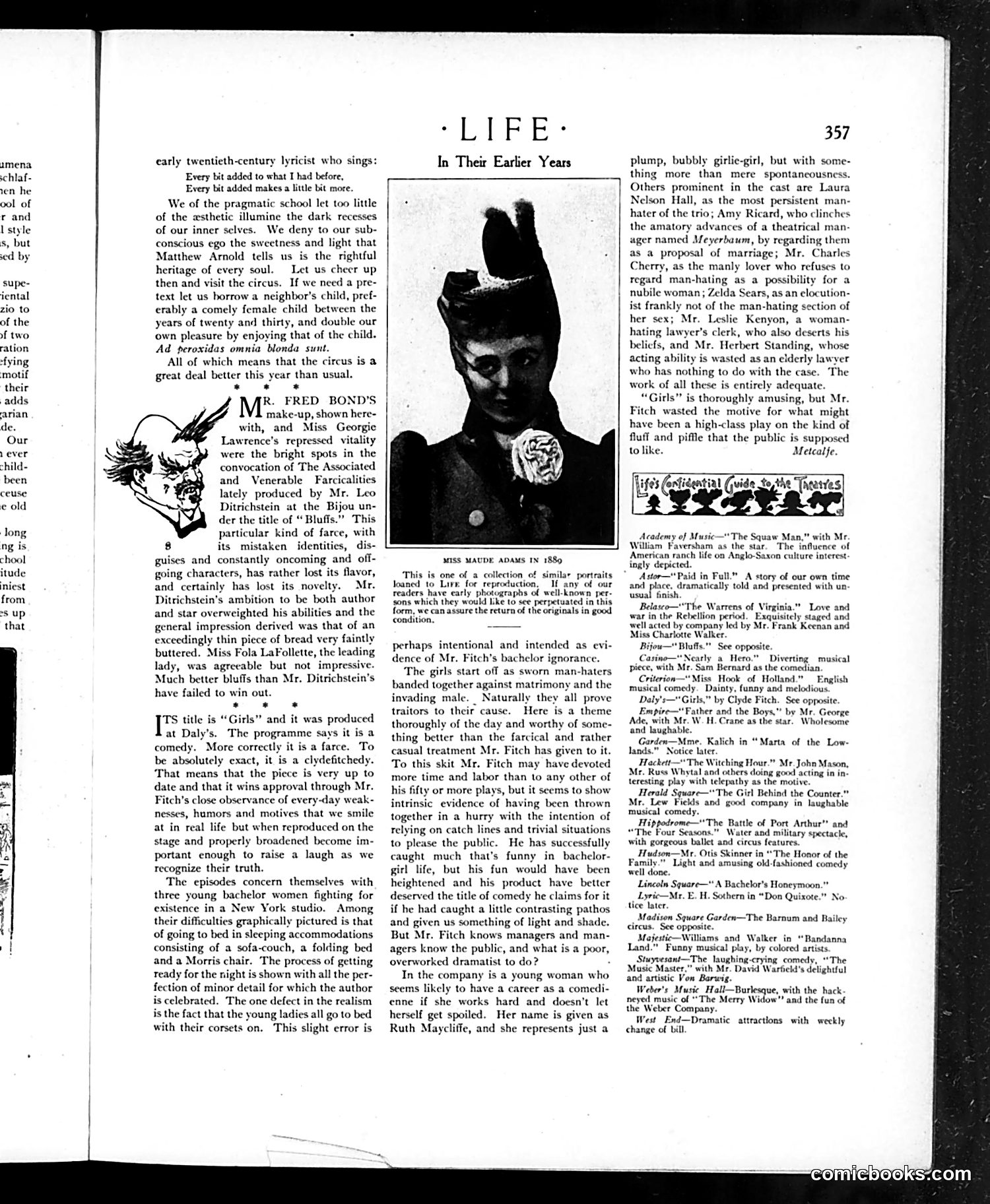
This page reviews theatrical productions from early 1900s New York. The main content discusses three plays: "Bluffs," "Girls," and includes a historical photograph of actress Maude Adams from 1889. The cartoon/caricature shows **Fred Bond** (identified in text), an actor in "Bluffs." The review criticizes the play as thin farce with tired conventions of mistaken identities and disguises. It praises Bond's makeup and performance but faults author-star Leo Ditrichstein's overreach. The "Girls" review discusses a Clyde Fitch comedy about three unmarried women sharing studio housing in New York—a modern social scenario for the era. The satire mocks their sleeping arrangements (sofa, folding bed, Morris chair) and their hypocrisy: they swear off men but all eventually betray that pledge through romance. The historical photograph of Maude Adams represents Life's practice of publishing early images of famous performers, inviting readers to contribute similar archival photographs for publication.
📄 Transcribed text from this page (OCR, searchable)
Machine-transcribed from the original scan — historical spelling and the odd misread are preserved.
amena chlaf- ren he ool of rand I style s, but ed by supe- iental zio to of the of two. ration fying motif their adds arian de. Our ever hild- been ceuse e old Jong ng is, chool itude nicest from up that carly twentieth-century lyricist who sings: Every bit added to what I had before, Every bit added makes a little bit more. We of the pragmatic school let too little of the aesthetic illumine the dark recesses of our inner selves. We deny to our sub- conscious ego the sweetness and light that Matthew Amold tells us is the rightful heritage of every soul. Let us cheer up then and visit the circus. If we need a pre- text let us borrow a neighbor's child, pref erably a comely female child between the years of twenty and thirty, and double our own pleasure by enjoving that of the child. Ad peroxidas omnia blonda sunt. All of which means that the circus is a great deal better this year than usual. * 8 «& R. FRED BOND'S make-up, shown here- with, and Miss Georgie Lawrence's repressed. vitality were the bright spots in the convocation of The Associated and Venerable Farcicalities lately produced by Mr. Leo Ditrichstein at the Bijou un- der the title of “ Bluffs.” This. particular kind of farce, with 8 its mistaken identities, dis- guises and constantly oncoming and off- going characters, has rather lost its flavor, and certainly has lost its novelty. Mr. Ditrichstein’s ambition to be both author and star overweighted his abilities and the general impression derived was that of an exceedingly thin piece of bread very faintly buttered. Miss Fola LaFollette, the leading lady, was agreeable but not impressive. Much better bluffs than Mr, Ditrichstein’s have failed to win out. * 8 « TS title is “Girls” and it was produced at Daly's. The programme says it is a comedy. More correctly it is a farce. To. be absolutely exact, it is a clydefitchedy. ‘That means that the piece is very up to date and that it wins approval through Mr. Fitch’s close observance of every-day weak- nesses, humors and motives that we smile at in real life but when reproduced on the stage and properly broadened become im- portant enough to raise a laugh as we recognize their truth. The episodes concern themselves with three young bachelor women fighting for existence in a New York studio. Among their difficulties graphically pictured is that of going to bed in sleeping accommodations consisting of a sofa-couch, a folding bed and a Morris chair. ‘The process of getting ready for the night is shown with all the per- fection of minor detail for which the author is celebrated. The one defect in the realism is the fact that the young ladies all go to bed with their corsets on. This slight error is *LIPE * In Their Earlier Years MISS MAUDE ADAMS IN. 1889 This is one of a collection of similar portraits loaned to Lire for reproduction. If any of our readers have early photographs of well-known per- sons which they would like to see perpetuated in this form, we can assure the return of the originals in good condition. perhaps intentional and intended as evi- dence of Mr. Fitch’s bachelor ignorance. The girls start off as sworn man-haters banded together against matrimony and the invading male. _ Naturally they all prove traitors to their cau: Here is a theme thoroughly of the day and worthy of some- thing better than the farcical and rather casual treatment Mr. Fitch has given to it. To this skit Mr. Fitch may have devoted more time and labor than to any other of his fifty or more plays, but it seems to show intrinsic evidence of having been thrown together in a hurry with the intention of relying on catch lines and trivial situations to please the public. He has successfully caught much that’s funny in bachelor- girl life, but his fun would have been heightened and his product have better deserved the title of comedy he claims for it if he had caught a little contrasting pathos and given us something of light and shade. But Mr. Fitch knows managers and man- agers know the public, and what is a poor, overworked dramatist to do? In the company is a young woman who seems likely to have a career as a comedi- enne if she works hard and doesn’t let herself get spoiled. Her name is given as Ruth Maycliffe, and she represents just a 357 plump, bubbly girlic-girl, but with some- thing more than mere spontancousness. Others prominent in the cast are Laura Nelson Hall, as the most persistent man- hater of the trio; Amy Ricard, who clinches the amatory advances of a theatrical man- ager named Meyerbaum, by regarding them as a proposal of marriage; Mr. Charles Cherry, as the manly lover who refuses to regard man-hating as a possibility for nubile woman ; Zelda Sears, as an elocution- ist frankly not of the man-hating section of her sex; Mr. Leslie Kenyon, a woman- hating lawyer’s clerk, who also deserts his belicfs, and Mr. Herbert Standing, whose acting ability is wasted as an elderly lawyer who has nothing to do with the case. The work of all these is entirely adequate. 3irls” is thoroughly amusing, but Mr. Fitch wasted the motive for what might have been a high-class play on the kind of fluff and piffle that the public is supposed to like. Metcalfe. [ses Geafigentinn Guide tephe Treaties! Academy of Music—""The Squaw William Faversham as the star. The influence American ranch life on Anglo-Saxon culture interest ingly depicted. Astor—"Paid in Full.” A story of our own time and place, dramatically told and presented with un ve Warrens of Virginia.” Love and war in the Rebellion period. Exquisitely staged and well acted by company led by Mr. Frank Keenan and Miss Charlotte Walker. Bijow—" Bluffs." See opposite. Casino—"* Nearly a Hero.” Diverting musical piece, with Mr. Sam Bernard as the comedian. Criterion—" Miss Hook of Holland.” — English musical comedy. Dainty, funny and melodious. Daly's—"Girls,” by Clyde Fitch. See opposite. Empire—'Father and the Boys," by Mr. George Ade, with Mr. W. H. Crane as the star. Wholesome and laughable. Garden—Mme. Kalich in “Marta of the Low- lands.” Notice later. Hackett— The Witching Hour.” Mr. John Mason, Mr. Russ Whytal and others doing good acting in in teresting play with telepathy as the motive. Herald Squar—""The Girl Behind the Counter."* Mr. Lew Fields and good company in laughable musical comedy. Hippodrome—"The Battle of Port Arthur’ and “The Four Seasons.” Water and military spectacle, with gorgeous ballet and circus features. Hudson—Mr. Otis Skinner in “The Honor of the Family.” Light and amusing old-fashioned comedy well done. Lincoln Square—" A Bachelor's Honeymoon." Lyric—Mr. E. H. Sothern in “Don Quixote.” No. tice later. Madison Square Garden—The Barnum and Bailey circus. See opposite. Mojestic—Williams and Walker in “Bandana Land.” Funny musical play, by colored artists Stuyvesant—The laughing-crying comedy, “The Music Master.” with Mr. David Warfield’s delightful and artistic Von Barwig. Weber's Music Hall—Burlesque, with the hack neyed music of “The Merry Widow"? and the fun of the Weber Company. West End—Dramatic attractions with weekly change of bill.