
Life, 1908-04-02 · page 24 of 44
Life — April 2, 1908 — page 24: what you’re looking at
What you’re looking at
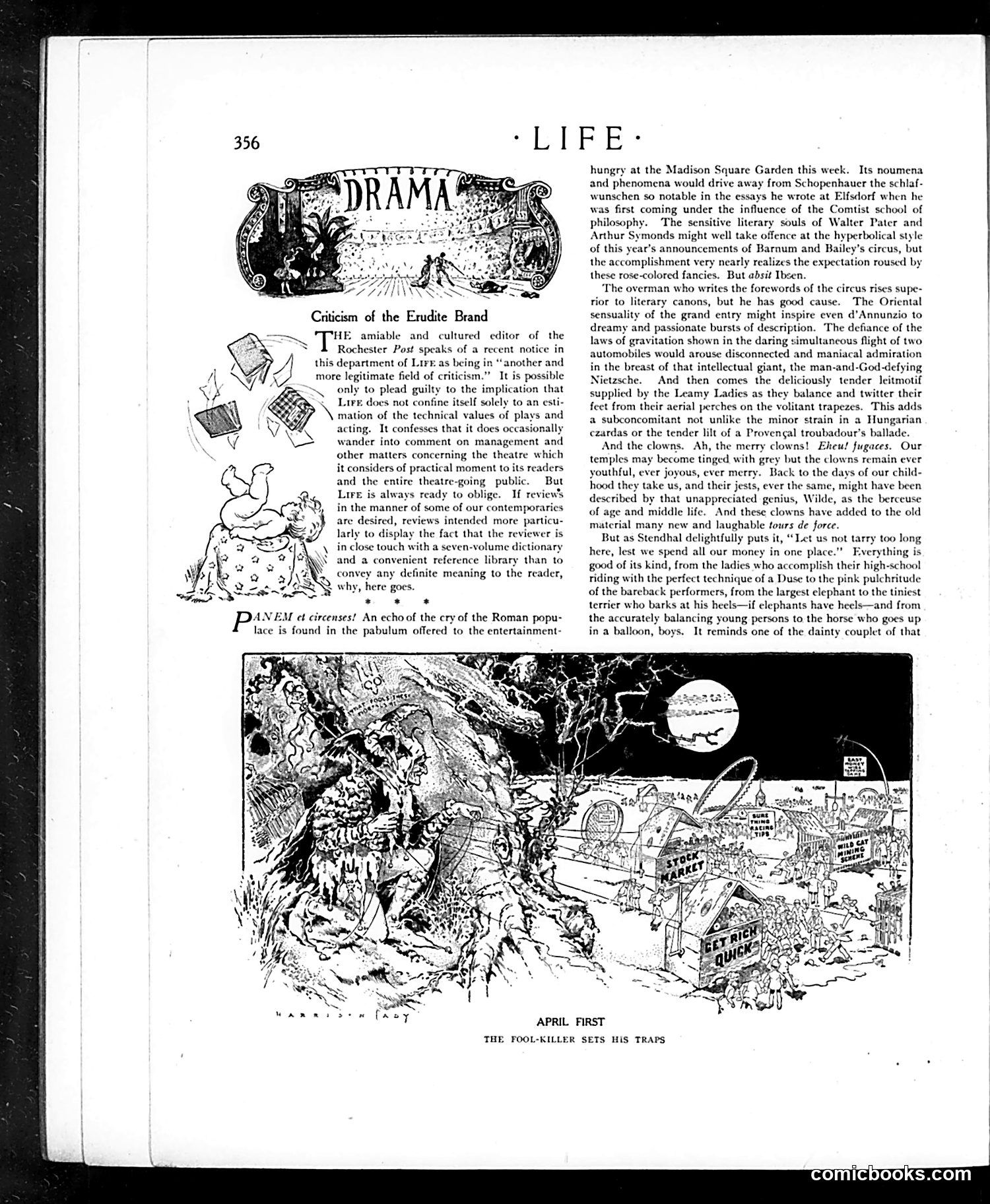
This is a **drama criticism column** from *Life* magazine's April 1st issue, using deliberately pretentious language to mock both overly erudite literary critics and the Barnum & Bailey Circus. ## The Satire The editor of the Rochester Post had criticized *Life*'s theater coverage as "another and more legitimate field of criticism." The *Life* writer responds sarcastically by praising the circus in absurdly flowery, name-dropping language—referencing Schopenhauer, Pater, Nietzsche, d'Annunzio, and Wilde—treating circus acts (acrobats, clowns, elephants) with the same overwrought reverence critics apply to serious theater. ## The Point The joke is twofold: (1) mocking self-important critics who use obscure references to sound intelligent rather than communicate clearly, and (2) suggesting the circus is actually worthy of serious aesthetic consideration. The title "The Fool-Killer Sets His Traps" indicates the author is catching pretentious fools in their own verbose nonsense. The large illustration below shows a typical circus scene, reinforcing the absurdity of applying haute-culture discourse to popular entertainment.
📄 Transcribed text from this page (OCR, searchable)
Machine-transcribed from the original scan — historical spelling and the odd misread are preserved.
«LIP E « hungry at the Madison Square Garden this week. Its noumena and phenomena would drive away from Schopenhauer the schlaf- wunschen so notable in the essays he wrote at Elfsdorf when he was first coming under the influence of the Comtist school of philosophy. ‘The sensitive literary souls of Walter Pater and Arthur Symonds might well take offence at the hyperbolical style of this year’s announcements of Barnum and Bailey’s circus, but the accomplishment very nearly realizes the expectation roused by these rose-colored fancies. But absit Ibzen. ‘The overman who writes the forewords of the circus rises supe- rior to literary canons, but he has good cause. The Oriental Criticism of the Erudite Brand sensuality of the grand entry might inspire even d’Annunzio to dreamy and passionate bursts of description. The defiance of the SY (THE amiable and cultured editor of the jaws of gravitation shown in the daring simultancous flight of two <4. Rochester Post speaks of a recent notice in automobiles would arouse disconnected and maniacal admiration / NY this department of Lire as being in “another and jn the breast of that intellectual giant, the man-and-God-defying more legitimate field of criticism.” It is possible Nietzsche. And then comes the deliciously tender leitmotif supplied by the Leamy Ladies as they balance and twitter their feet from their aerial perches on the volitant trapezes. This adds a subconcomitant not unlike the minor strain in a Hungarian ceardas or the tender lilt of a Provenal troubadour’s ballade. And the clowns. Ab, the merry clowns! Eheu! fugaces. Our temples may become tinged with grey but the clowns remain ever youthful, ever joyous, ever merry. Back to the days of our child- hood they take us, and their jests, ever the same, might have been 1 . described by that unappreciated genius, Wilde, as the berccuse in the manner of some of our contemporaries of age and middle life. And these clowns have added to the old are desired, reviews intended more particu- material many new and laughable tours de force. larly to display the fact that the reviewer is But ndhal delightfully puts it, “Let us not tarry too long in close touch with a seven-volume dictionary pend all our money in one place." Everything is and a convenient reference library than to good of its kind, from the ladies who accomplish their high-school convey any definite meaning to the reader, —_Fiding with the perfect technique of a Duse to the pink pulchritude only to plead guilty to the implication that Lire docs not confine itself solely to an esti- \\ mation of the technical values of plays and acting. It confesses that it docs occasionally wander into comment on management and other matters concerning the theatre which it considers of practical moment to its readers and the entire theatre-going public. But Lire is always ready to oblige. If review’s here, lest v why, here goes. of the bareback performers, from the largest elephant to the tiniest " * * terrier who barks at his heels—if elephants have heels—and from PPANEM at crcensest An echo of the ery of the Roman popu- the accurately balancing young persons to the horse who goes up lace is found in the pabulum offered to the entertainment- in a balloon, boys. It reminds one of the dainty couplet of that APRIL FIRST THE FOOL-KILLER SETS HiS TRAPS