
Life, 1908-04-02 · page 19 of 44
Life — April 2, 1908 — page 19: what you’re looking at
What you’re looking at
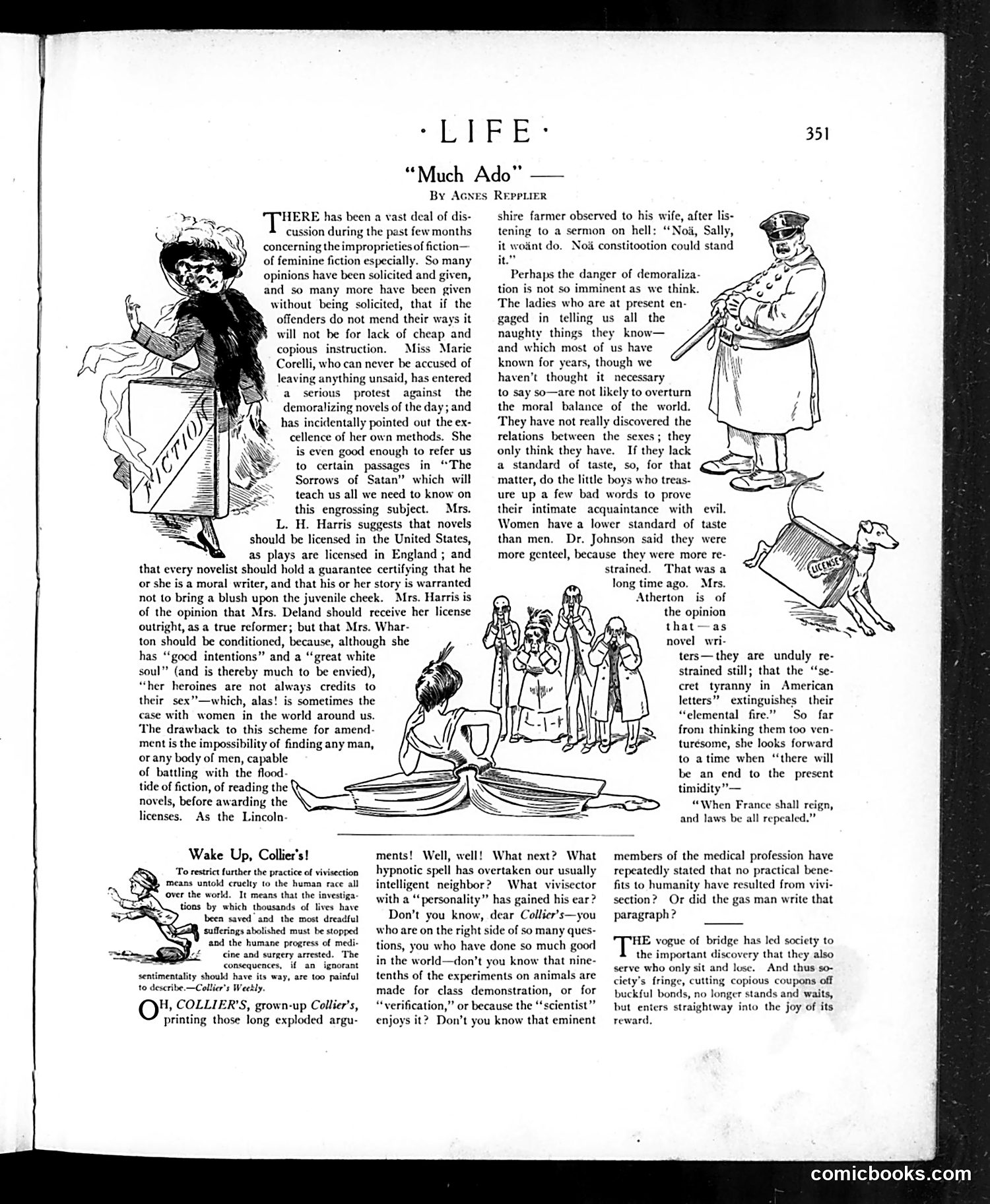
This page contains two distinct satirical commentaries on contemporary debates: **"Much Ado"** (top): Agnes Repplier critiques the moral panic over "immoral" fiction by women writers. She mocks the proposal to license novelists and morally vet their work before publication—suggesting it's impossible to find qualified censors. The satire targets those like Mrs. Harris who want government oversight of novels they deem scandalous (like works by Marie Corelli or Edith Wharton). Repplier argues women readers aren't actually corrupted by such fiction and that society's concern is overblown. **"Wake Up, Collier's!"** (bottom): This attacks *Collier's* magazine for apparently defending animal vivisection in medical research. Life's editors sarcastically chide their rival publication, questioning whether some charismatic scientist has influenced them. They challenge the claim that most animal experiments serve genuine medical purposes, suggesting many are merely for classroom demonstration or professional verification—not humanitarian advancement. Both pieces exemplify Life's muckraking, anti-censorship stance and skepticism toward institutional authority.
📄 Transcribed text from this page (OCR, searchable)
Machine-transcribed from the original scan — historical spelling and the odd misread are preserved.
E has been cussion during the past few months concerning the improprieties of fiction— of feminine fiction especially. Somany _ it. opinions have been solicited and given, and so many more without being solicited, that if the offenders do not mend their ways it will not be for lack of cheap and copious instruction. Corelli, who can never be accused of leaving anything u a serious is even good ¢1 to certain passages in “The Sorrows of Satan” which will teach us all we protest demoralizing novels of the day; and has incidentally pointed out the ex- cellence of her own methods. She © PE EY “Much Ado” By AGNes REPPLIER a vast deal of dis- it woant do, have been given Miss Marie nsaid, has entered against the nough to refer us need to know on shire farmer observed to his wi! tening to a sermon on hell: Noi constitootion could stand fe, after lis- Noi, Sally, Perhaps the danger of demoraliza- tion is not so imminent as we think. The ladies who are at present en- gaged in telling us all the naughty things they know— and which most of us have known for years, though we haven't thought it necessary to say so—are not likely to overturn the moral balance of the world. They have not really discovered the relations between the sexes; they only think they have. a standard of taste, so, for that matter, do the little boys who treas- ure up a few bad words to prove If they lack this engrossing subject. Mrs. L. H. Harris suggests that novels should be licensed in the United States, as plays are licensed in England ; and that every novelist should hold a guarantee certifying that he or she is a moral writer, and that his or her story is warranted their intimate acquaintance with evil. Women have a lower standard of taste than men. Dr. Johnson said they were more genteel, because they were more re- strained. That was a long time ago. Mrs. Atherton is of not to bring a blush upon the juvenile cheek. Mrs. Harris is of the opinion that Mrs. Deland should receive her license outright, as a true reformer; but that Mrs. Whar- ton should be conditioned, because, although she has “good intentions” and a ‘great white soul” (and is thereby much to be envied), “her heroines are not always credits to their sex’”—which, alas! is sometimes the case with women in the world around us. ‘The drawback to this scheme for amend- ment is the impossibility of finding any man, or any body of men, capable of battling with the flood- tide of fiction, of reading the novels, before awarding the licenses. As the Lincoln- Wake Up, Collier's! To restrict further the practice of vivisection means untold cruelty to the human race all over the world. It means that the investiga. tions by which thousands of lives have been saved’ and the most dreadful sufferings abolished must be stopped and the humane progress of medi- cine and surgery arrested. ‘The consequences, if an ignorant sentimentality should have its way, are too painful to describe.—Collier’s Weekly. H, COLLIER'S, grown-up Collier’s, ments! Well, well! What next? What hypnotic spell has overtaken our usually intelligent neighbor? What vivisector with a “personality” has gained his ear? Don’t you know, dear Collier’s—you who are on the right side of so many ques- tions, you who have done so much good in the world—don’t you know that nine- tenths of the experiments on animals are made for class demonstration, or for “verification,” or because the ‘‘scientist”’ the opinion that—as novel wri- ters—they are unduly re- strained still; that the “se- cret tyranny in American letters” extinguishes their “elemental fire.” So far from thinking them too ven- turésome, she looks forward to atime when “there will be an end to the present timidity”’— “When France shall reign, and laws be all repealed.” members of the medical profession have repeatedly stated that no practical bene- fits to humanity have resulted from vivi- section? Or did the gas man write that paragraph? HE vogue of bridge has led society to the important discovery that they also serve who only sit and lose. And thus so- ciety’s fringe, cutting copious coupons off buckful bonds, no longer stands and waits, but enters straightway into the joy of its reward, printing those long exploded argu- — enjoys it? Don’t you know that eminent comicbooks.com