
A complete issue · 36 pages · 1908
Life — March 5, 1908
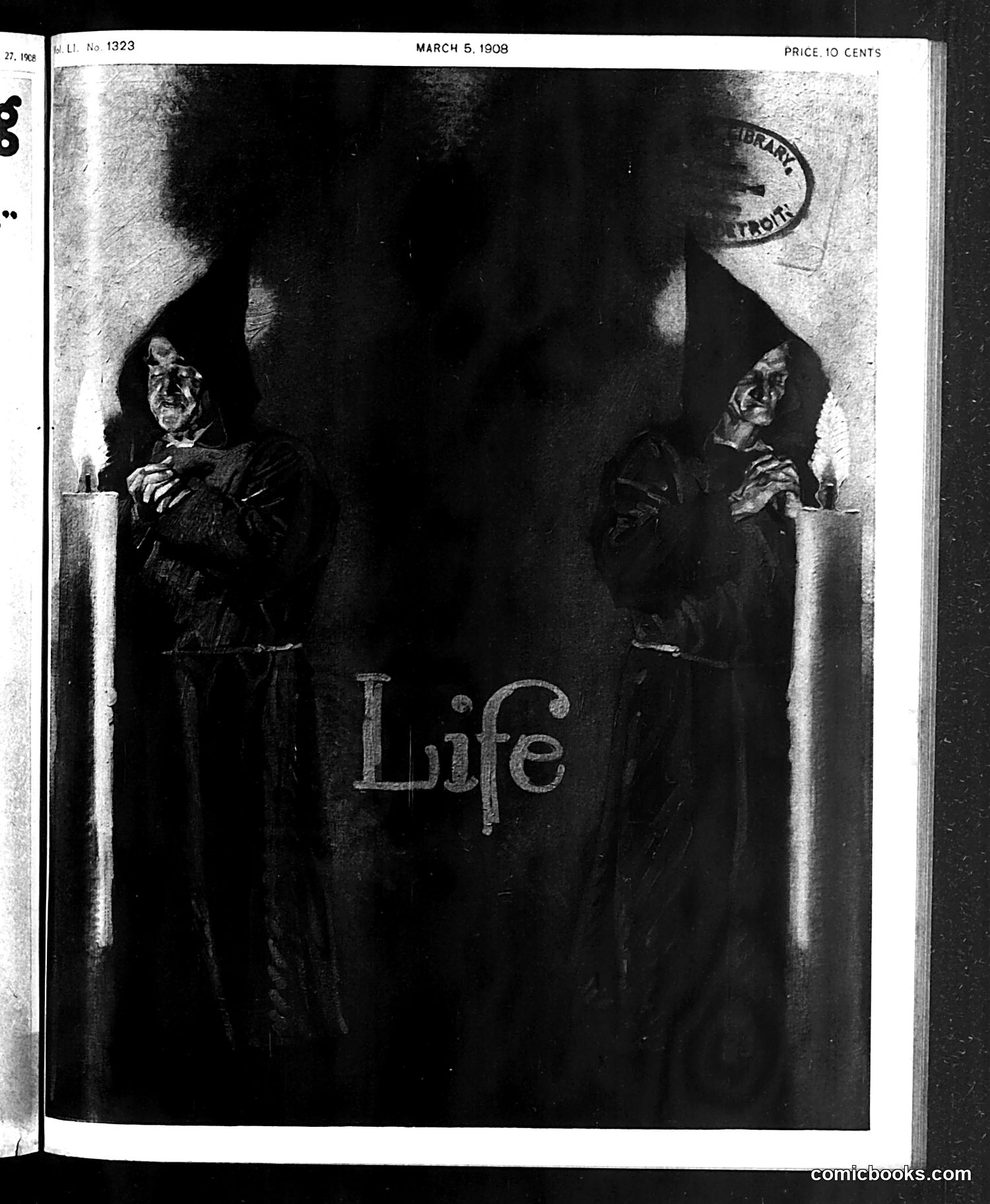
I can see this is a Life magazine cover from March 5, 1908, priced at 10 cents. The image shows two dark, menacing figures in formal dress standing on either side of a large dark space, holding what appear to be torches or candles. The word "Life" appears prominently in the center. However, I cannot clearly identify the specific figures or determine with certainty what political or social event this satirizes from the image alone. The ominous tone and shadowy composition suggest commentary on something foreboding or dangerous from that era, but without clearer details or additional text identifying the subjects, I cannot confidently explain the specific satire intended. The artistic style indicates social or political critique typical of Life magazine's approach.
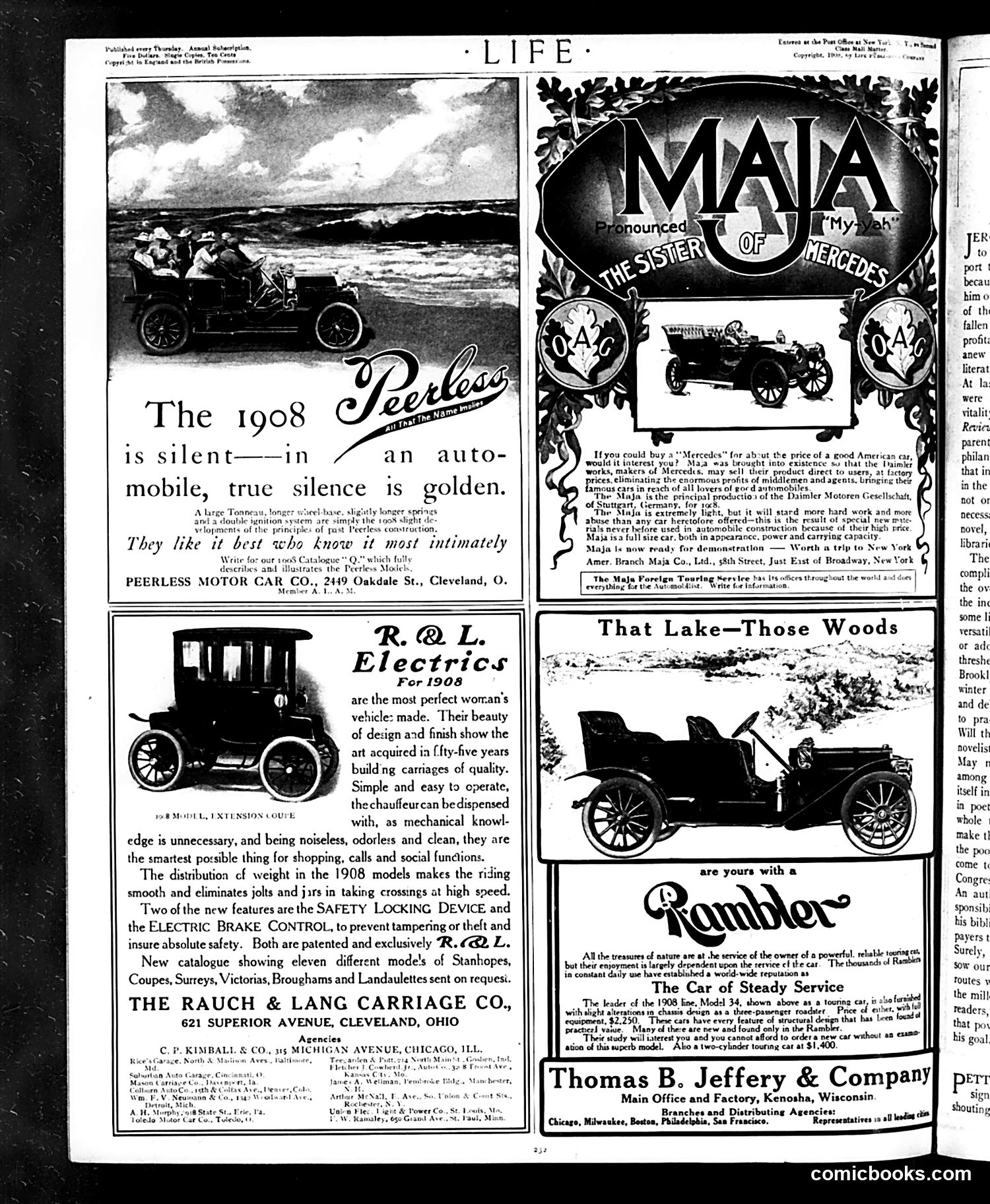
This page consists entirely of **automobile advertisements**, not political cartoons or satire. Four different car manufacturers advertise their 1908 models: 1. **Peerless Motor Car Co.** emphasizes silence as a luxury feature 2. **R. & L. Electrics** markets electric vehicles to women, highlighting ease of operation and cleanliness 3. **Rambler** emphasizes reliability and "steady service" 4. **Thomas B. Jeffery & Company** promotes their car as dependable The advertisements reflect early automotive industry concerns: mechanical reliability, ease of use (particularly for female drivers), and silence as a desirable feature. There is **no political satire or social commentary** present—this is purely commercial content showcasing competing automobile manufacturers vying for consumers in the emerging automotive market.
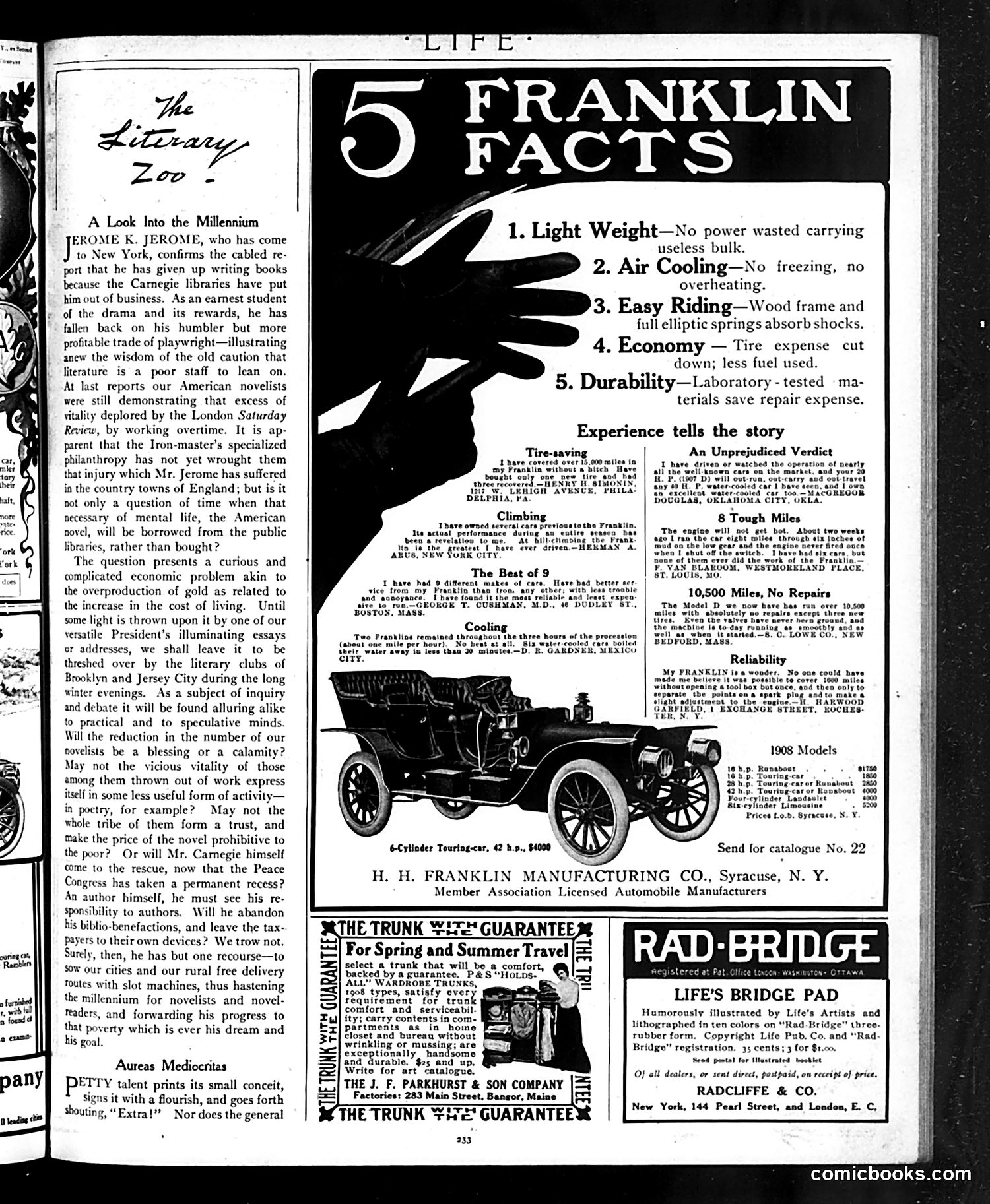
This page is **primarily advertising**, not satire or political commentary. The main content is a large advertisement for the Franklin automobile, highlighting "5 Franklin Facts" about its technical superiority: light weight, air cooling, easy riding, economy, and durability. Customer testimonials support these claims. The left column contains "The Literary Zoo," a brief essay by Jerome K. Jerome critiquing English novelists and discussing literature's role in society—unrelated to the car ads. Below are additional advertisements: one for steamer trunks by J.F. Parkhurst & Son, and one for "Rad-Bridge" life's bridge pad by Radcliffe & Co. **There is no political cartoon on this page.** The Franklin automobile illustration is promotional, not satirical.
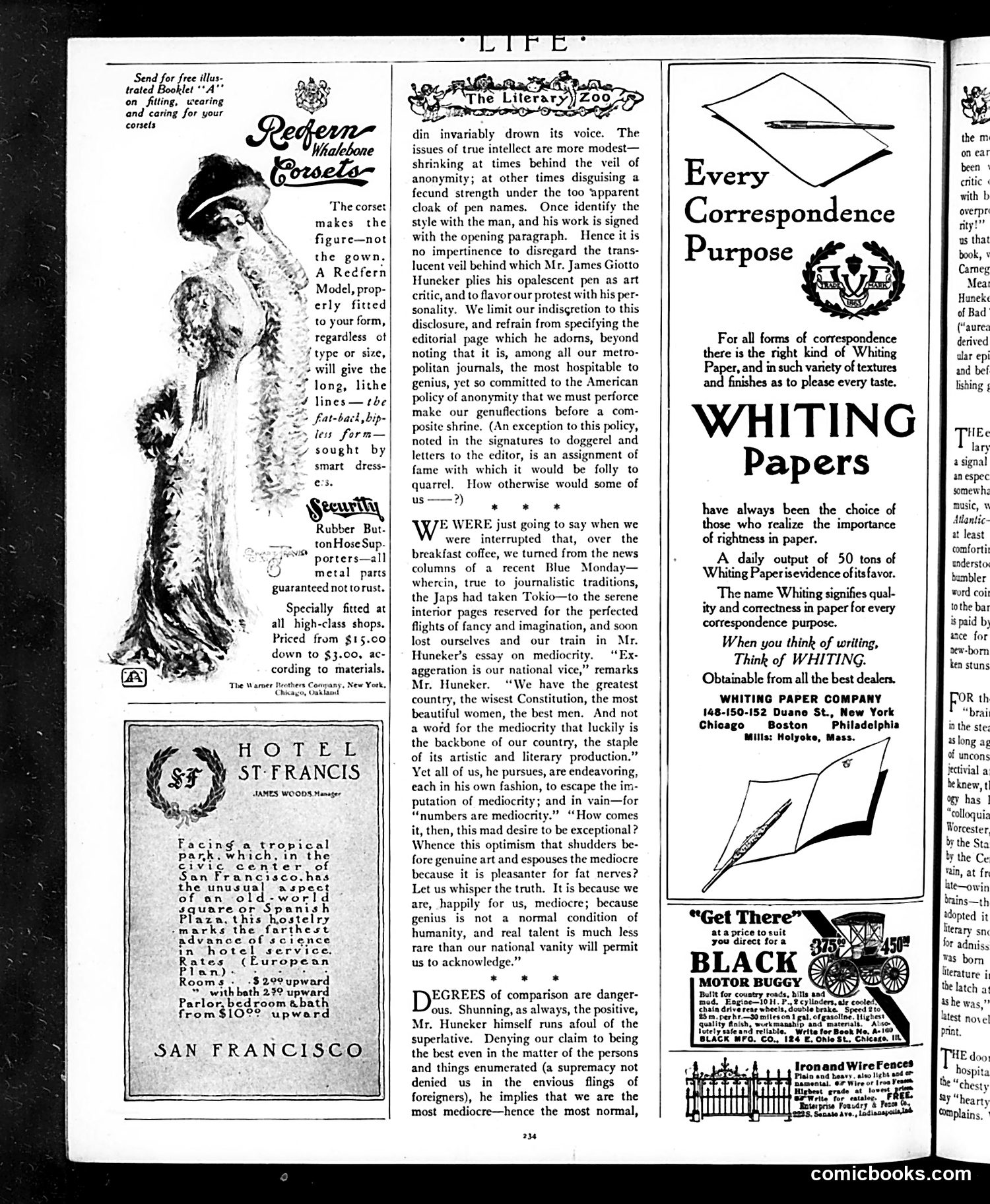
This Life magazine page is primarily **advertising and editorial content rather than political satire**. The main cartoon depicts a fashionable woman in an elaborate dress, advertising "Redfern Whalebone Corsets" — a product claim that the corset creates the "figure-not of the gown" by shaping the wearer's body. The other content includes advertisements for Hotel St. Francis (San Francisco), Whiting Papers, and a Black Motor Buggy. The only potentially satirical element appears in the middle section, which critiques James Giotto Huneker's journalism style, discussing anonymity and mediocrity in literary criticism. However, this is **editorial commentary rather than visual satire**. The page reflects early 20th-century consumer culture and fashion advertising conventions.
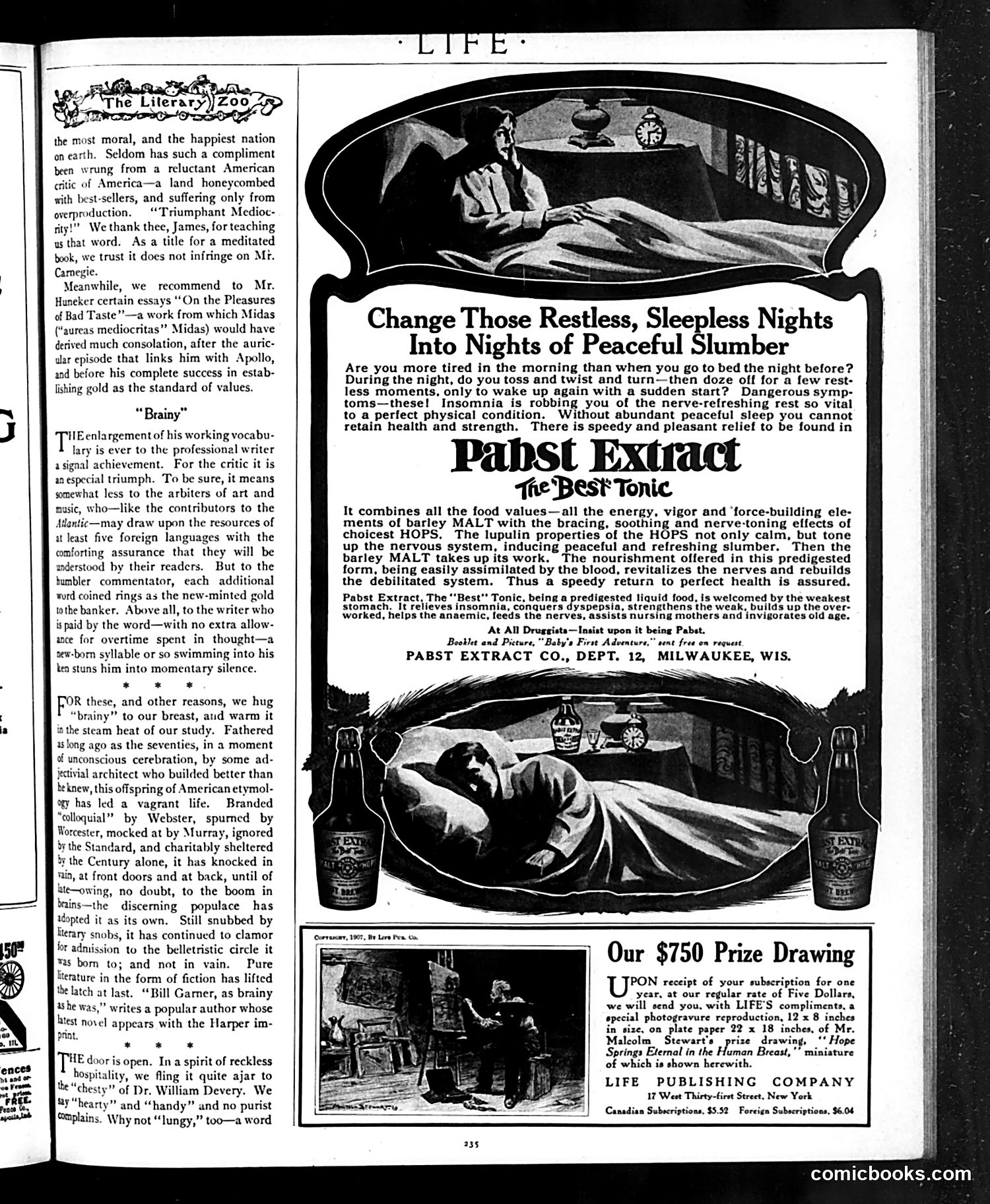
This page is **primarily advertising**, not satire or political commentary. The dominant content is a large Pabst Extract advertisement promoting the product as a tonic to cure insomnia and nervous exhaustion. The ad uses before-and-after imagery—a restless, awake person above, a peacefully sleeping person below—to market the extract's supposed restorative properties. The left column contains literary discussion about vocabulary and American writers, including references to "Bill Nyegun" and other authors, but this is editorial content unrelated to the imagery. The bottom section advertises Life Publishing Company's "$750 Prize Drawing" subscription offer. There is **no political cartoon or satire present** on this page—it's a straightforward mix of magazine articles and commercial advertising typical of early 20th-century publications.
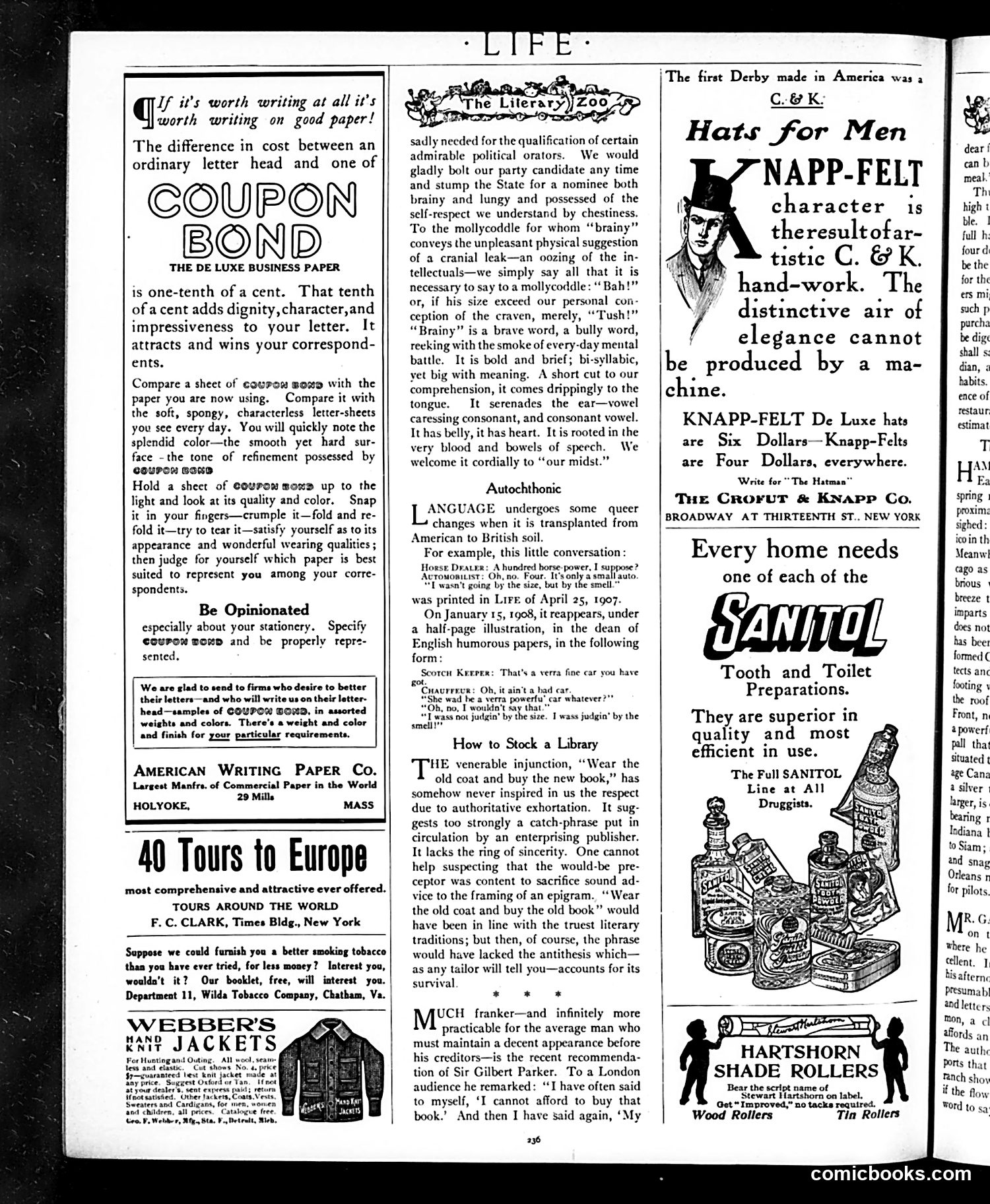
This page is **primarily advertising** with one significant satirical section titled "Autochthonic Language." The satire mocks how American English borrows and transforms British expressions when transplanted to American soil. The example provided contrasts British and American usage: a "Horse Dealer" asking about "a hundred horse power" becomes "Automobile" in American vernacular, illustrated as a humorous miscommunication. The joke reflects early 20th-century anxieties about American cultural independence from Britain—specifically how Americans adapted foreign terms through their own practical, colloquial lens rather than maintaining "proper" British usage. The remaining content consists of advertisements for business paper (Coupon Bond), C&K hats, Sanitol products, European tours, and other goods typical of the era's commercial messaging.
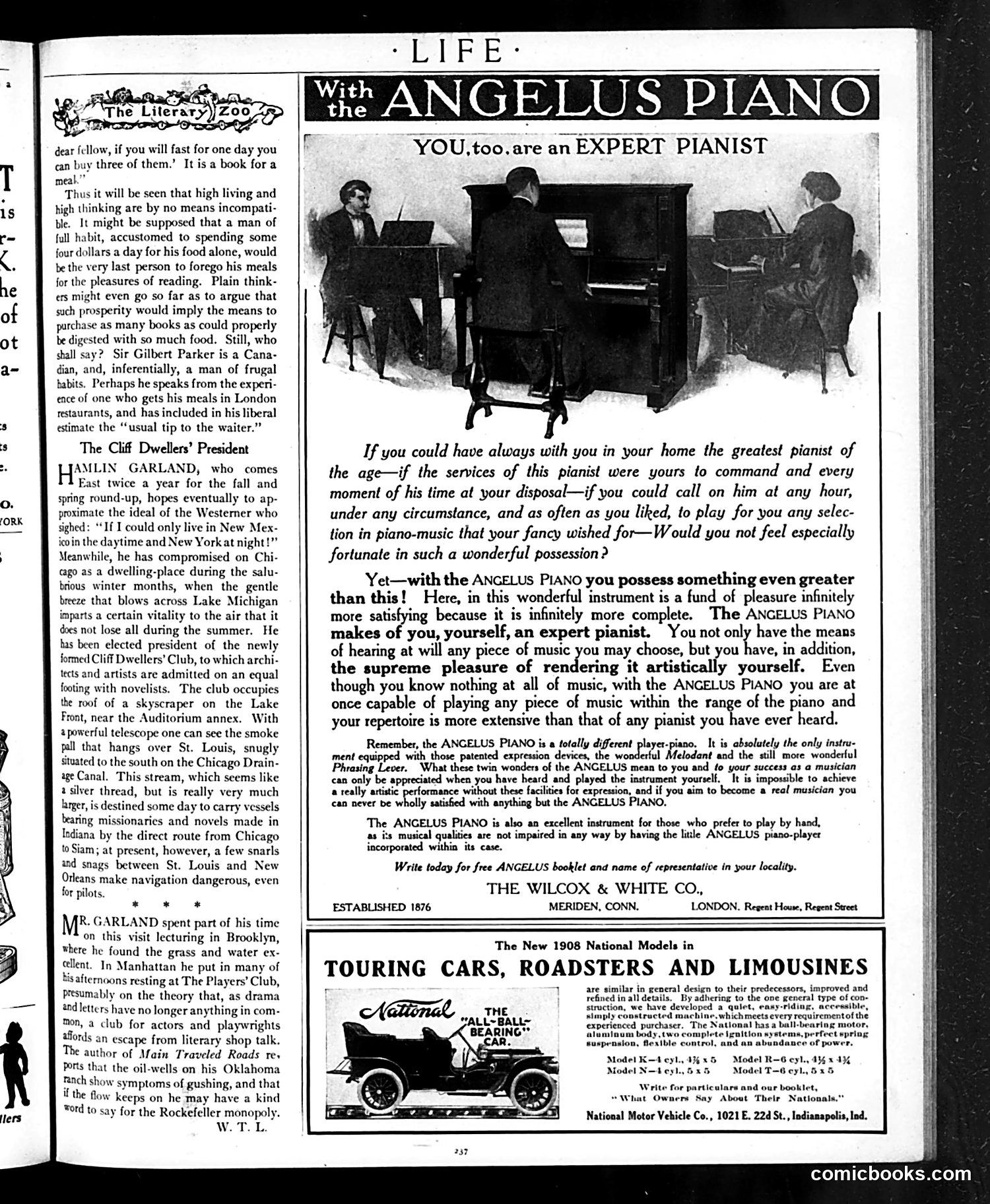
This page is **primarily advertising**, not political satire. The dominant content is a large advertisement for the Angelus Piano, which claims to make any owner "an expert pianist" through some unspecified mechanical means (likely referring to player-piano technology). The ad uses aspirational language about having a world-class pianist available at home. The left column contains brief literary/cultural commentary unrelated to the ads—mentions of "The Literary Zoo," Sir Gilbert Parker, and Mr. Garland's travels. These are editorial filler. Below the piano ad is a smaller automobile advertisement for National touring cars. **No political cartoon or satire is present.** The page represents typical early 20th-century *Life* magazine content mixing light commentary with consumer advertising.
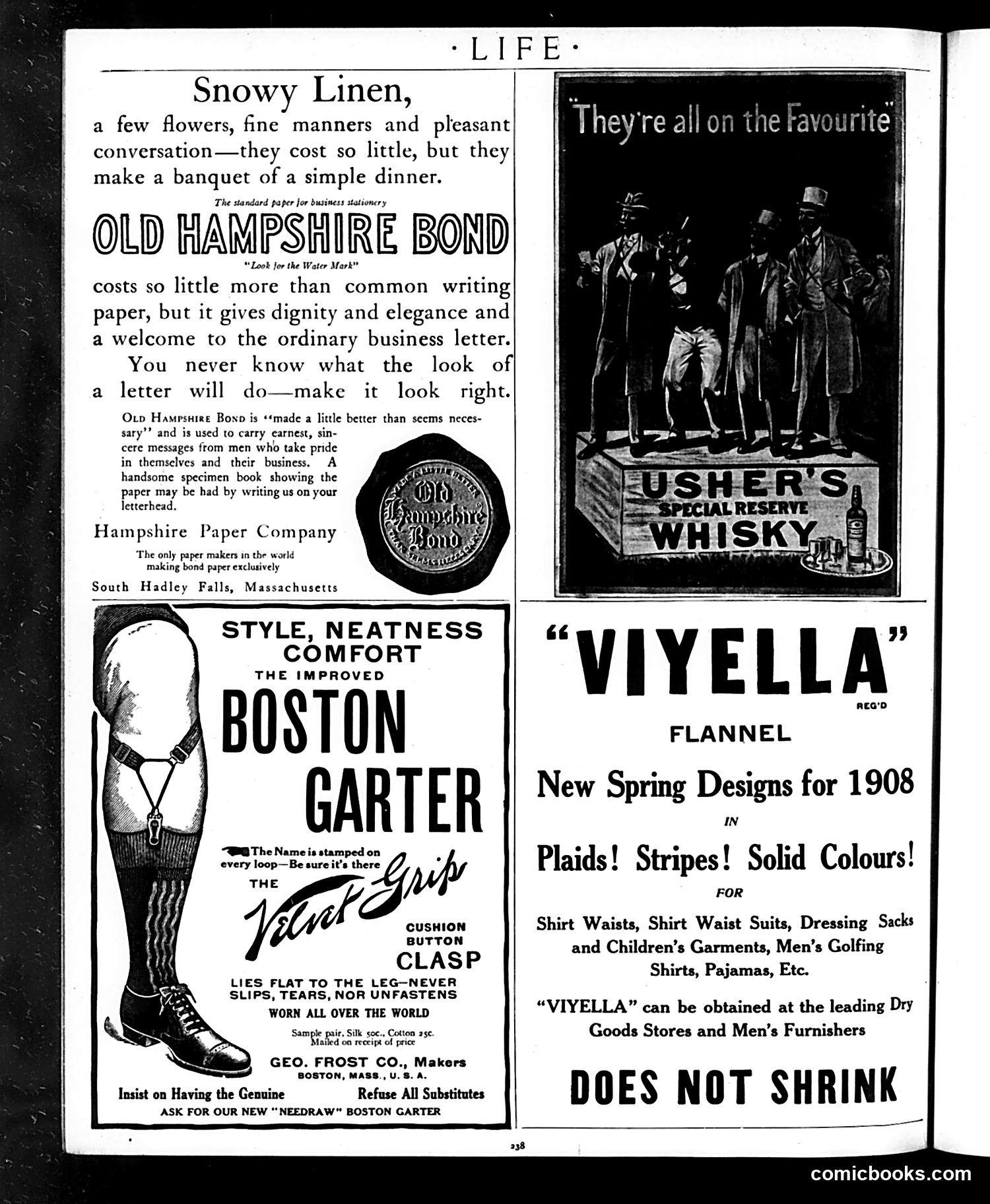
This page is primarily **advertisements**, not satirical content. It contains four product ads from approximately 1908: 1. **Old Hampshire Bond** (writing paper) — emphasizes business respectability through quality stationery 2. **Usher's Special Reserve Whisky** — features well-dressed men in top hats 3. **Boston Garter** — promotes a men's garter with a "Velvet Grip" clasp that doesn't slip 4. **Viyella Flannel** — advertises new spring fabric designs for clothing The ads reflect early 20th-century concerns: business propriety, gentlemen's fashion and grooming, and quality textiles. There is **no political satire or cartoon commentary** on this page—it's a straightforward advertisement section typical of Life magazine's commercial content from this era.
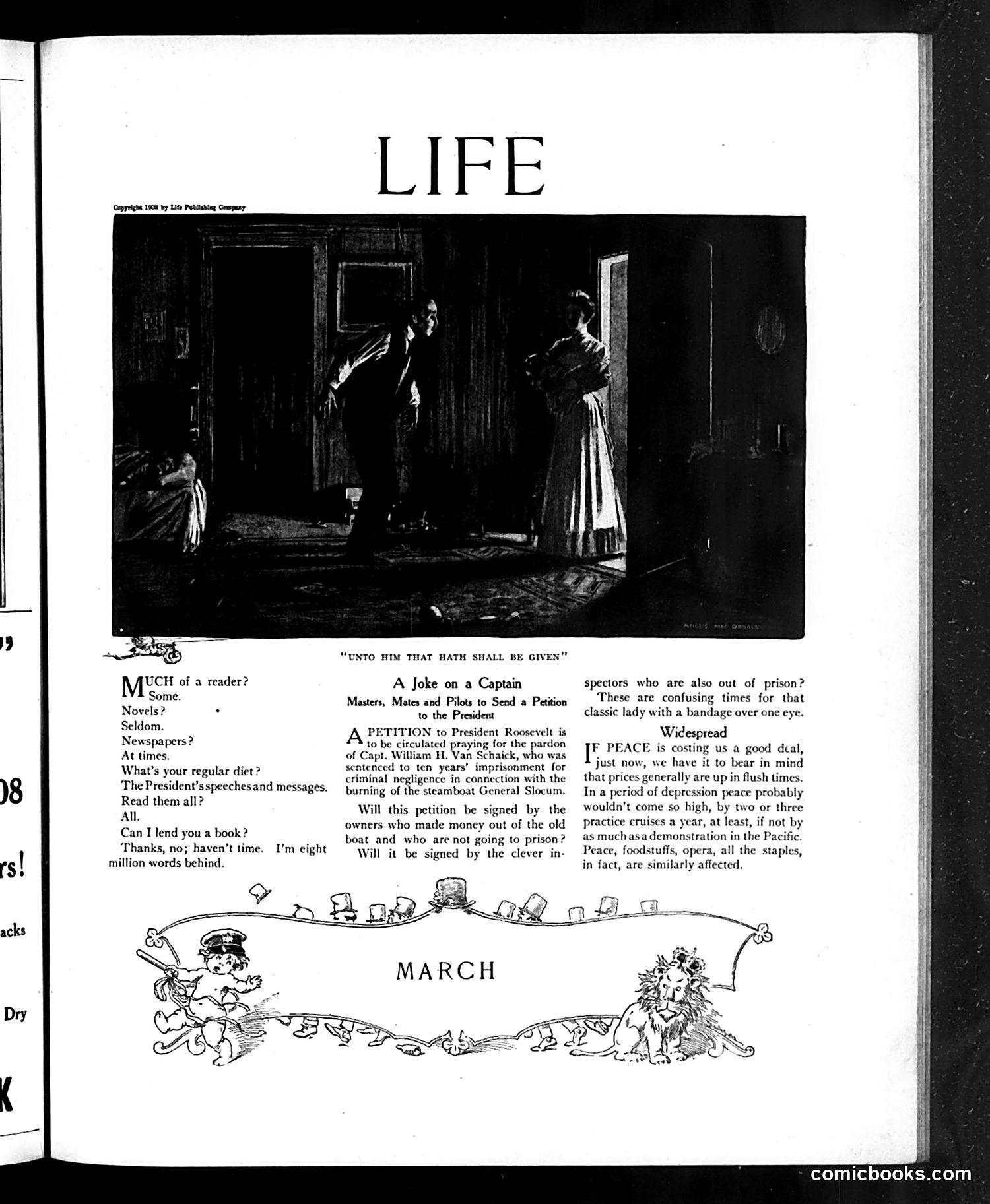
This page from Life magazine (copyright 1908) contains political commentary about a petition regarding Captain Ill-Starred and imprisoned crew members of the steamboat General Slocum. The text discusses whether boat owners—who profited from the vessel—will sign a petition to President Roosevelt for pardons of those imprisoned for ten years in connection with the General Slocum disaster. The satirical point critiques the hypocrisy of wealthy owners potentially refusing to support their employees' release. The accompanying dramatic photograph shows an interior scene, likely depicting the petition or related legal proceeding. The "Unto Him That Hath Shall Be Given" headline suggests commentary on economic inequality and how the wealthy escape consequences while working-class people suffer imprisonment.
The main cartoon depicts a figure labeled "While there is Life there's Hope" at the top. The accompanying article discusses William Randolph Hearst's recent Supreme Court decisions and his influence on Democratic politics. The satire criticizes Hearst's outsized political power despite losing electoral bids. The article notes Hearst controlled newspapers that could shape Democratic candidates and party direction—he opposed Bryan and reportedly could block any candidate he didn't endorse. The cartoon appears to mock Hearst's persistent political ambitions and influence despite repeated failures. Life's editors are clearly skeptical of his ability to determine Democratic party outcomes, portraying his continued involvement as somewhat absurd or delusional, hence the "hope" reference suggesting futile persistence.
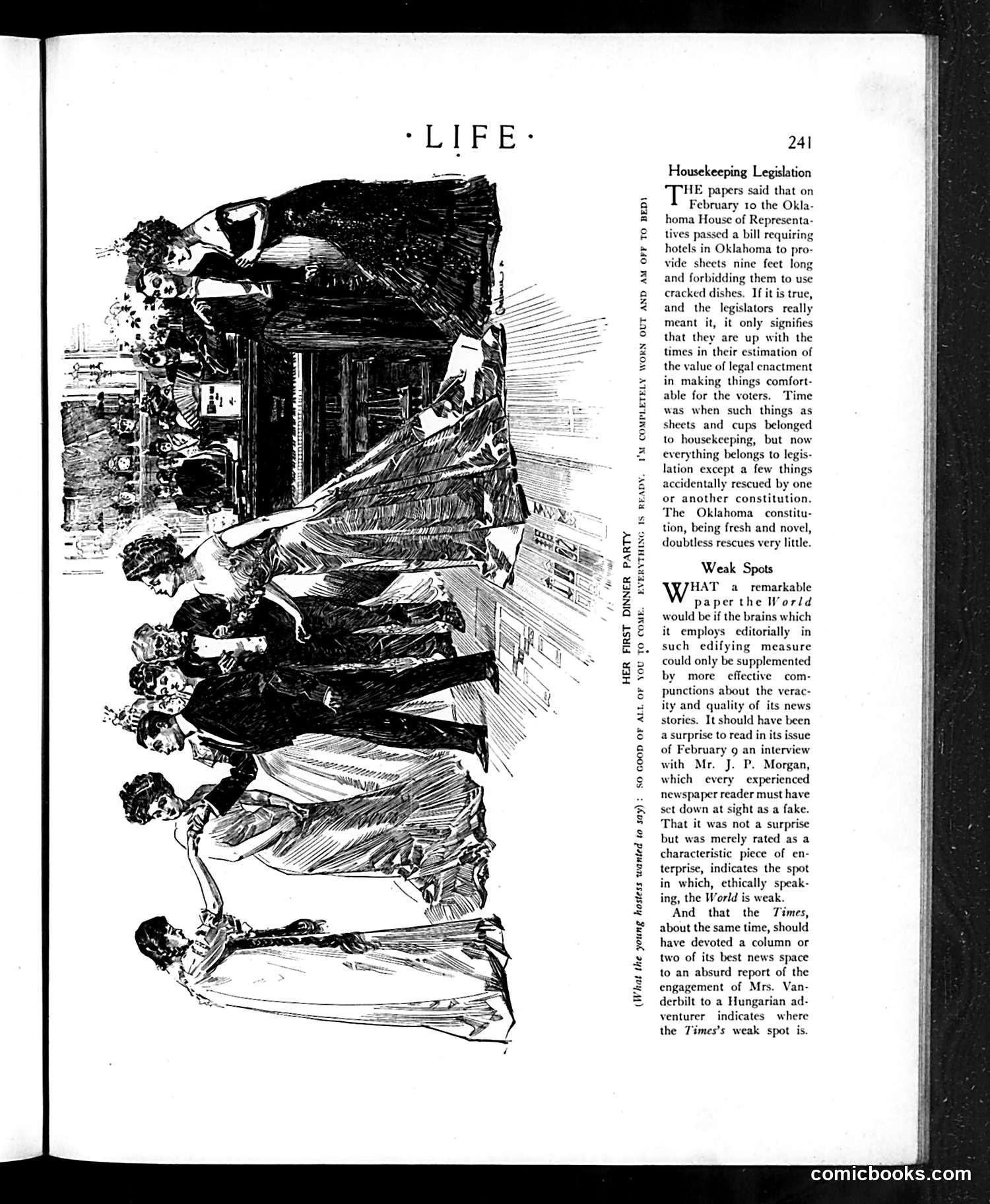
This page from *Life* magazine (page 241) contains a satirical illustration and two articles critiquing American newspapers and legislation. The large cartoon depicts figures emerging from or surrounding a doorway, shown upside-down, suggesting chaos or disorder. It appears to accompany commentary on newspaper editorial standards. The text discusses two topics: 1. **"Housekeeping Legislation"**: Oklahoma legislators passed a bill requiring sheets nine feet long and forbidding cracked dishes—absurd regulations that satirize legislative overreach and trivial lawmaking. 2. **"Weak Spots"**: The article criticizes the *World* newspaper for publishing an interview with J.P. Morgan (a prominent banker) and the *Times* for covering an engagement involving a Hungarian adventurer—suggesting these prestigious papers waste space on frivolous society news rather than substantive reporting. The satire targets both governmental and journalistic failures in prioritizing content.
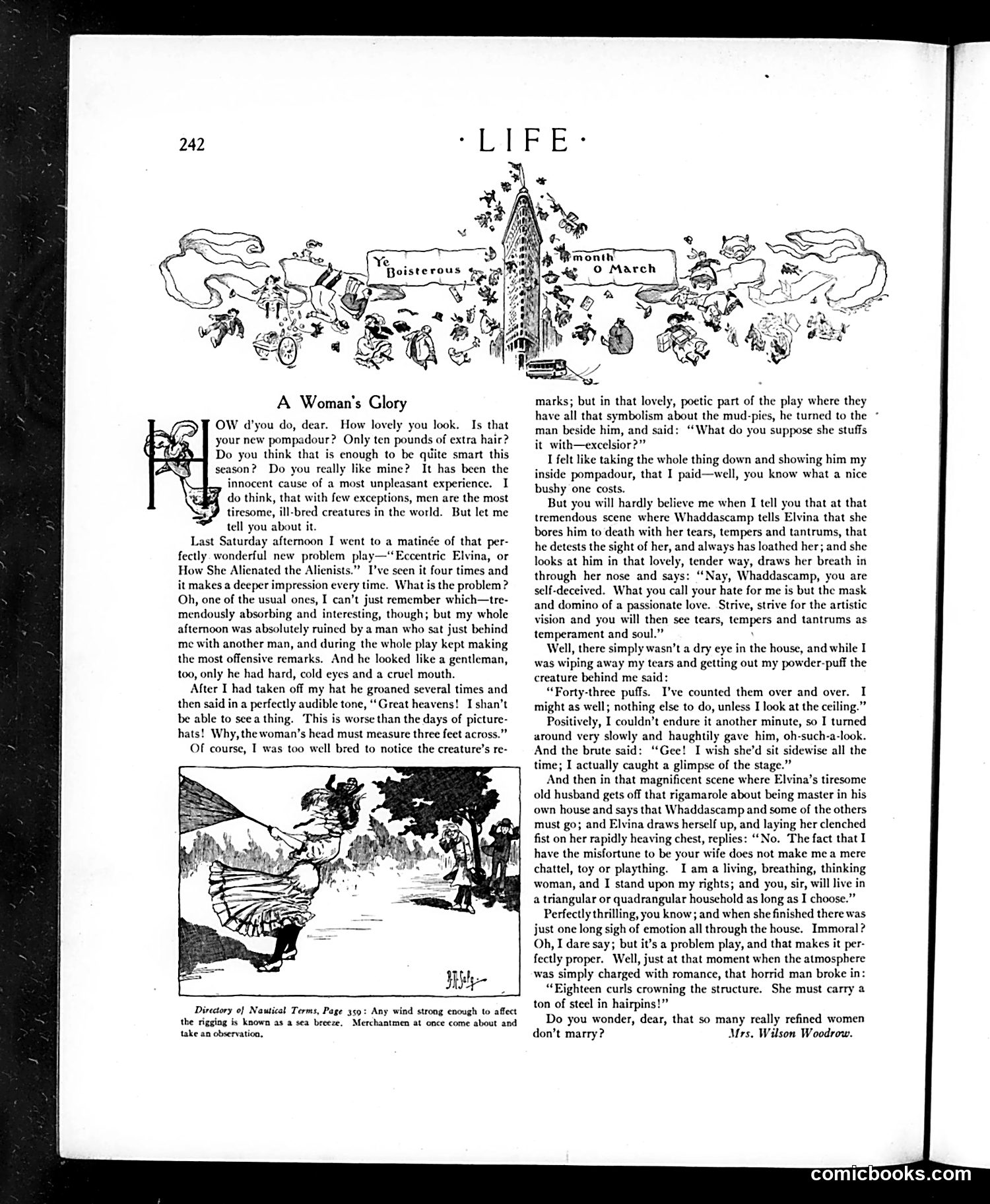
This article by Mrs. Wilson Woodrowe critiques women who attend theatrical matinees, particularly commenting on a production of "Puccini's Elina, or How the Alienated the Alienists." The author satirizes female theater-goers for their emotional responses and perceived lack of intellectual engagement. The accompanying illustration depicts a woman in an elaborate dress, likely emphasizing the fashion-consciousness the author associates with such attendees. The piece's central satire targets women's supposed emotional irrationality—the author describes how a female character (Elina) manipulates her husband through tears and tenderness, and how real women in the audience similarly lose themselves in sentiment. The author concludes sarcastically: "Do you wonder, dear, that so many really refined women don't marry?"—suggesting that excessive emotionalism makes women undesirable as wives.
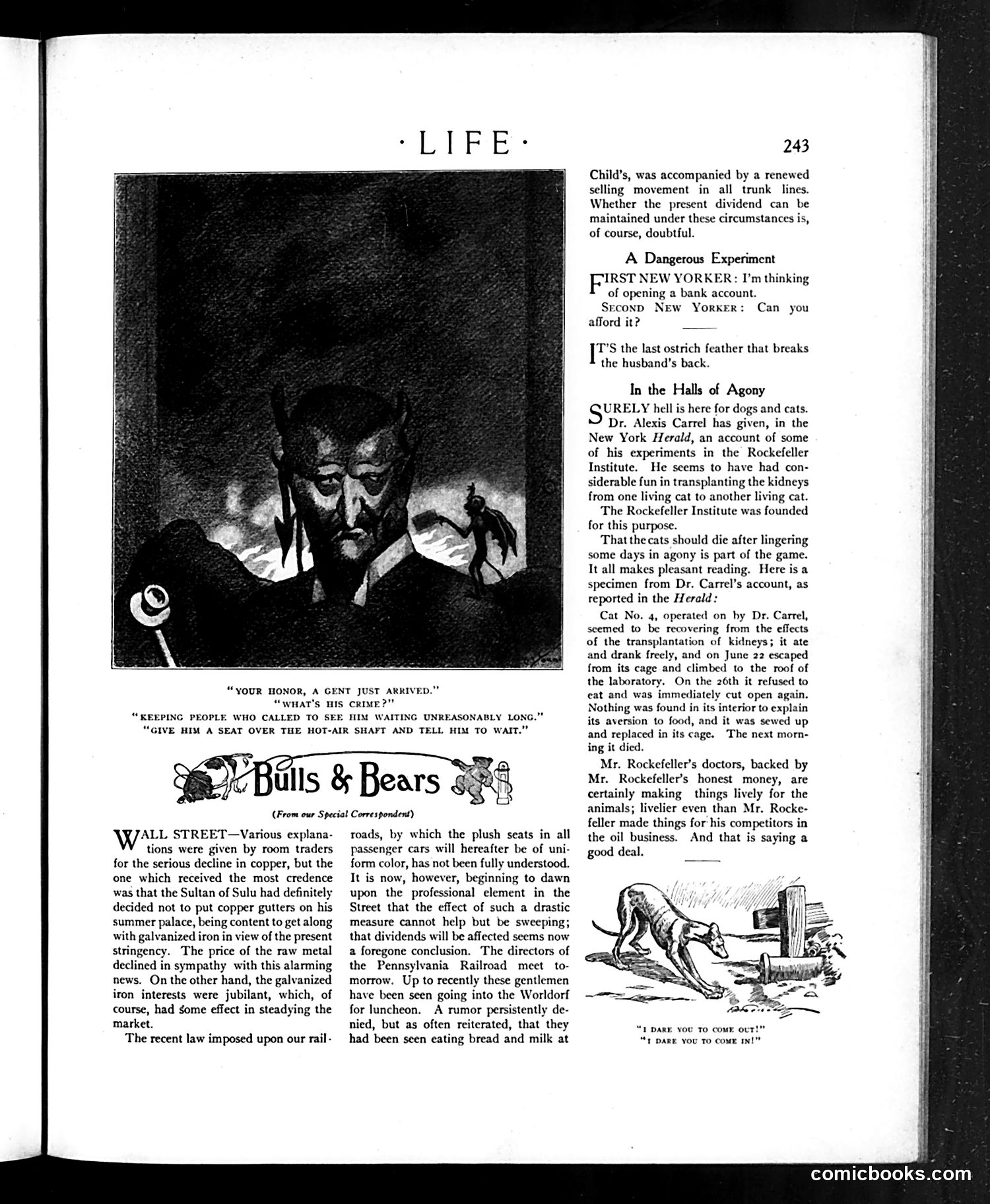
The page contains satirical commentary on two topics: **"A Dangerous Experiment"** mocks a newlywed couple's plan to open a bank account—presented as financially risky for a young marriage. **"In the Halls of Agony"** critiques Dr. Alexis Carrel's transplant experiments at the Rockefeller Institute, specifically his kidney transplants between cats. The passage sarcastically notes the cats died after suffering, calling it "pleasant reading." The satire targets both the cruelty of the experiments and the Rockefeller family's competitive business practices—implying they fund such research to outdo competitors. **"Bulls & Bears"** discusses Wall Street copper trading and railroad business practices, criticizing the Pennsylvania Railroad directors' alleged bread-and-milk lunches at the Waldorf hotel as idle speculation. The cartoons and text together critique wealth, scientific ethics, and business excess during the early 20th century.
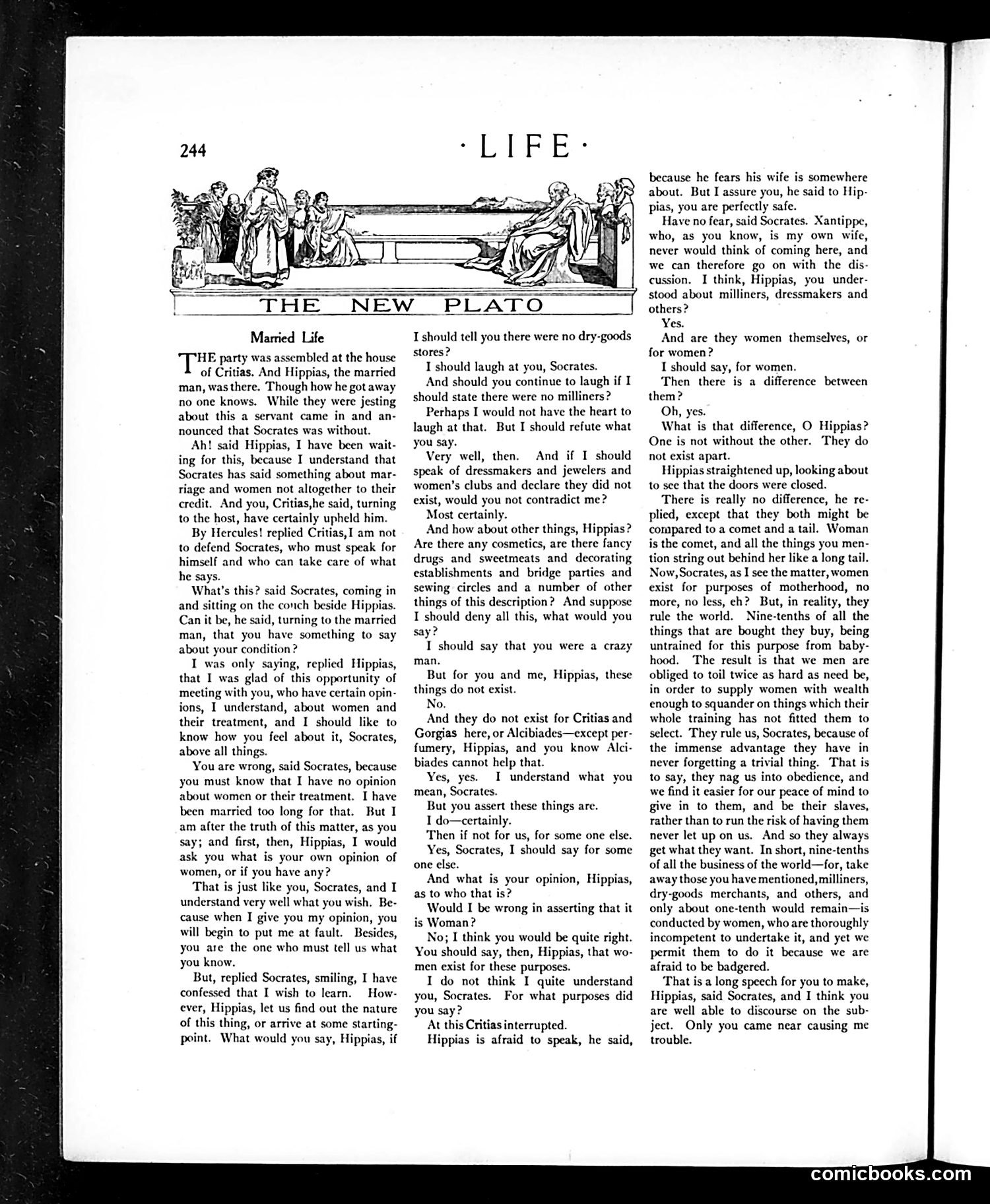
This satirical piece mimics Plato's dialogues, presenting Socrates questioning Hippias (a married man) about women's social role. The satire operates on multiple levels: **The Setup**: Socrates feigns ignorance while leading Hippias into logical traps—a classic Socratic method. He establishes that women patronize milliners, dressmakers, jewelers, cosmetics shops, and sewing circles, then concludes women exist *for these purposes*. **The Joke**: The satire mocks both 1) men who view women primarily as consumers and decorative objects, and 2) the pretense of philosophical debate around women's treatment. Hippias fears his wife's disapproval, while Socrates brags that his wife Xantippe wouldn't dare attend—referencing the historical figure's reputation for shrewishness. **Social Critique**: The piece satirizes contemporary attitudes reducing women to their consumption habits and ornamental function, while simultaneously critiquing male anxiety about female independence and opinion.
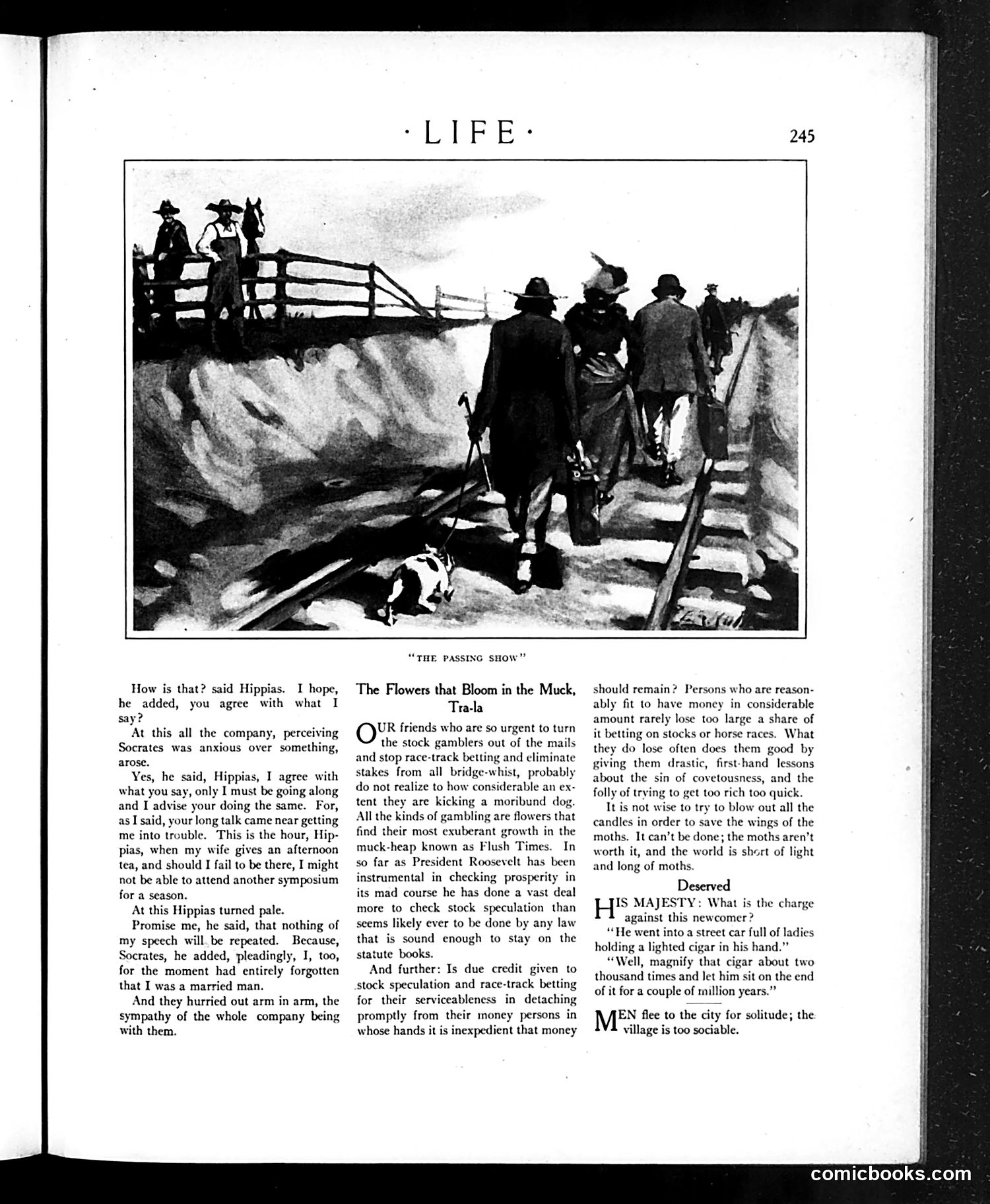
This page contains satirical commentary on gambling and social hypocrisy circa the Progressive Era (likely early 1900s, given Roosevelt reference). **The main cartoon** ("The Passing Show") depicts well-dressed figures observing what appears to be a railroad or industrial scene—likely representing wealthy observers of labor or commercial activity. **The text satirizes anti-gambling reformers** who seek to eliminate stock speculation and horse-race betting from the mails. The author argues these crusaders miss the point: gambling naturally flourishes during economic booms ("Flush Times") and actually serves a social purpose by redistributing money from the unfit to hold it. The piece cynically suggests losing at betting provides moral lessons about covetousness. **A secondary joke** mocks a man smoking a cigar in a streetcar full of ladies—punishment suggested is magnifying his offense absurdly (sitting on an enlarged cigar for "a couple million years"). The satire targets Progressive-era moral reformism, suggesting well-intentioned but naive efforts to legislate morality miss economic and social realities.
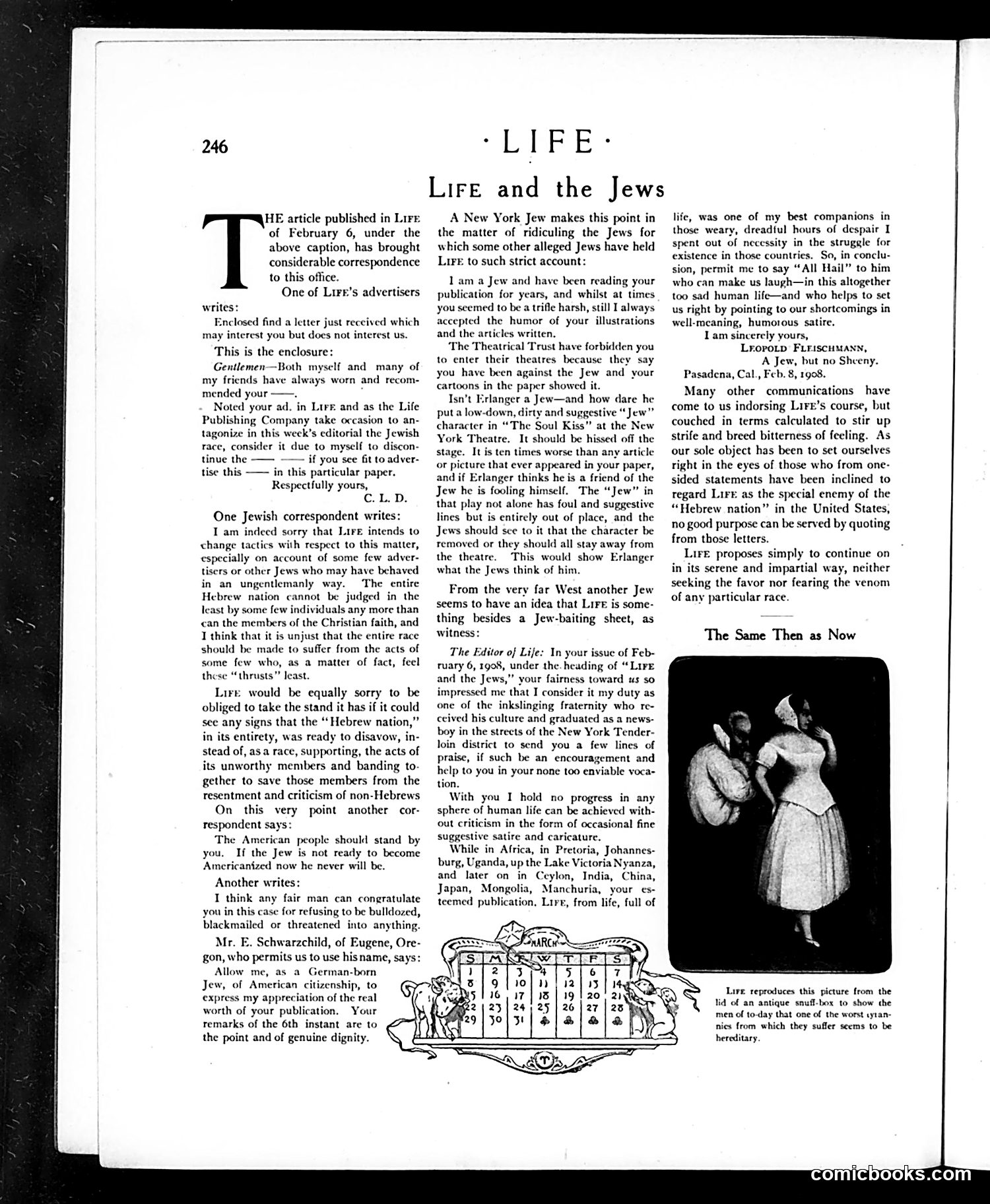
This page documents readers' responses to Life's February 6, 1908 article criticizing Jewish behavior. The controversy reveals early 20th-century tensions around Jewish assimilation and ethnic stereotyping. **Key points:** - Life apparently published satirical cartoons depicting Jews negatively, prompting complaints from both Jewish and non-Jewish readers - One advertiser threatened to withdraw support over Life's "antagonizing" the Jewish race - Responses vary: some Jewish readers defend Life's right to satirize, others demand internal Jewish community accountability ("disavow...unworthy members") - A German-born Jewish citizen praises Life's "dignity" and "fairness" - The debate centers on whether ethnic groups should self-police their members to avoid collective blame **The underlying assumption:** that ethnic/religious communities bear collective responsibility for individual members' behavior—a prejudicial framework Life's defenders seemingly endorse. The page itself becomes evidence of period anti-Jewish sentiment masquerading as reasonable critique.
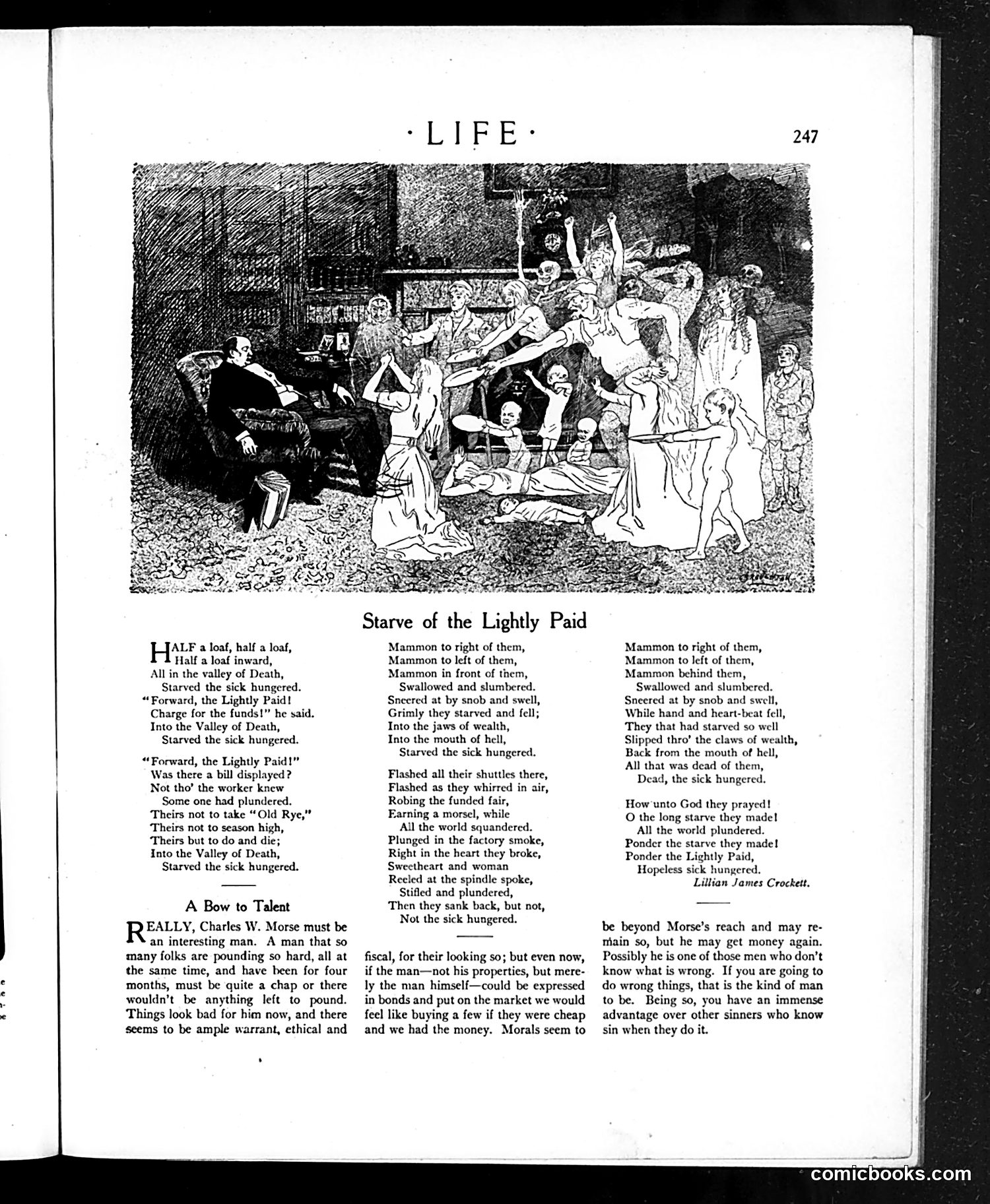
This page contains two satirical pieces critiquing industrial-era labor conditions and wealthy financiers. **"Starve of the Lightly Paid"** is a dark parody of Tennyson's "Charge of the Light Brigade," replacing military heroism with factory workers' exploitation. The poem depicts underpaid laborers—mill workers, spinners—starving while enriching "Mammon" (wealth/greed personified). The imagery shows them "plunged in factory smoke," their bodies breaking, yet continuing to labor. The repeated refrain "Starved the sick hungered" emphasizes their desperation and the indifference of the wealthy "snobs." **"A Bow to Talent"** discusses Charles W. Morse, a financier apparently under attack for four months (timing unclear from this page alone). The author notes Morse faces ethical criticism, yet remarks cynically that if his personal character could be "put on the market...we would feel like buying" if cheap enough—satirizing how wealth transcends morality. The piece suggests those who commit wrongs without recognizing them as such gain an "immense advantage" over conscience-stricken sinners. Both pieces critique class inequality and financial amorality.
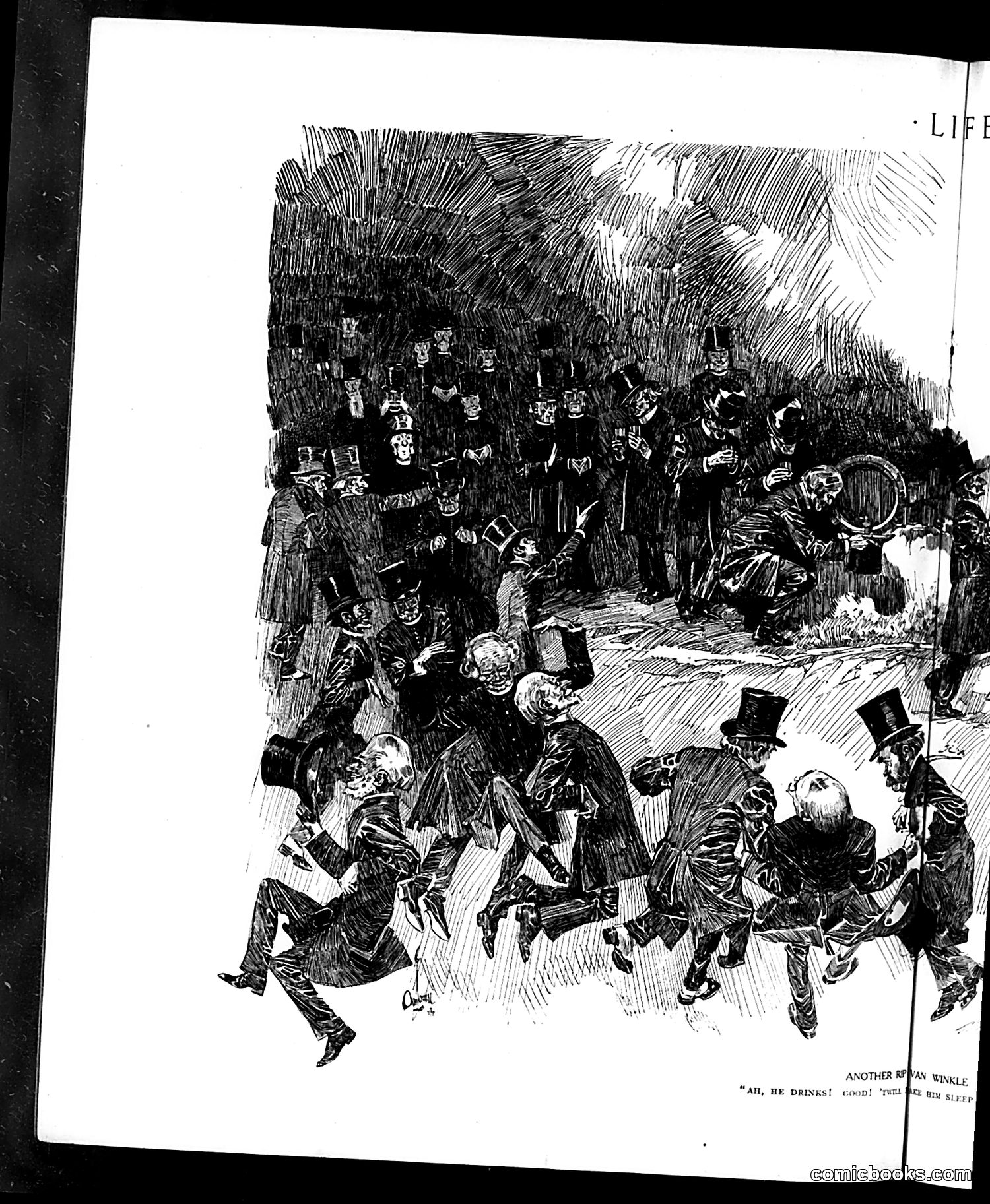
This appears to be a satirical illustration titled "Another Ryan Winkle" (likely referencing Rip Van Winkle). The caption reads: "Ah, he drinks! Good! 'Tis all him siper" (possibly "superior"). The cartoon depicts a large gathering of formally dressed men in top hats and military uniforms, arranged in a crowd formation. A central figure in the foreground appears intoxicated or stumbling. The satire seems to mock either: 1. Social hypocrisy—elite society accepting or even praising excessive drinking among their members 2. A specific political figure or public person whose drinking was notorious or newly revealed 3. The normalization of vice among the upper classes Without clearer context about the publication date or specific reference, the exact target remains unclear, though the composition and style suggest early-to-mid 20th century American political commentary.
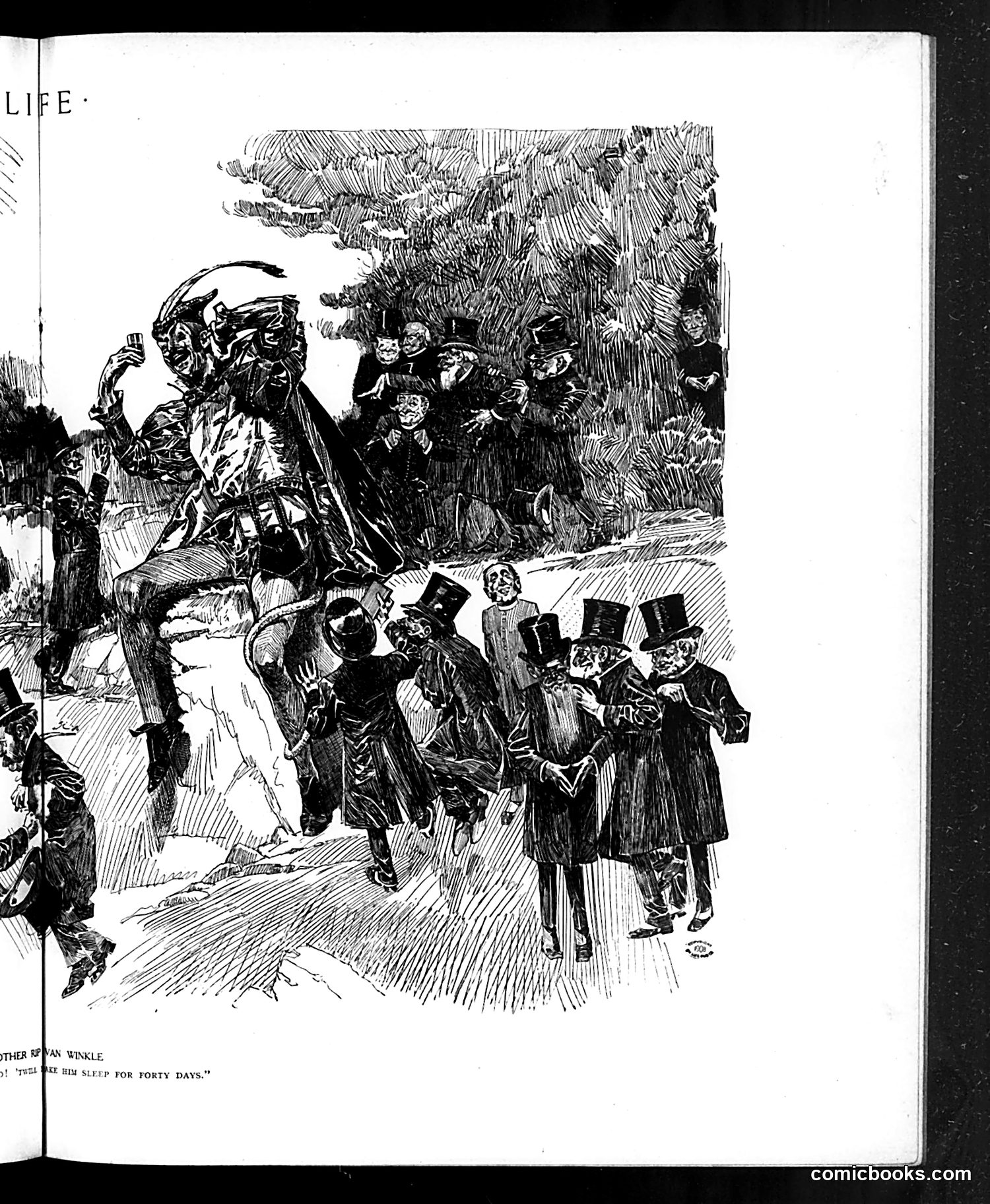
This appears to be an illustration related to Rip Van Winkle, the famous Washington Irving character who famously slept for forty years (the OCR text says "forty days," likely an error). The cartoon shows a disheveled, long-haired figure on the left—presumably Rip Van Winkle upon awakening—gesturing in confusion at a crowd of formally dressed gentlemen wearing top hats in the background. The satire likely comments on the disorientation and social/political changes one experiences after a long absence from public life, using the Rip Van Winkle legend as a vehicle for commentary on contemporary events or social upheaval. Without the full caption and context, the specific political reference remains unclear, but the contrast between Rip's wild appearance and the civilized crowd suggests themes of bewilderment at social transformation.
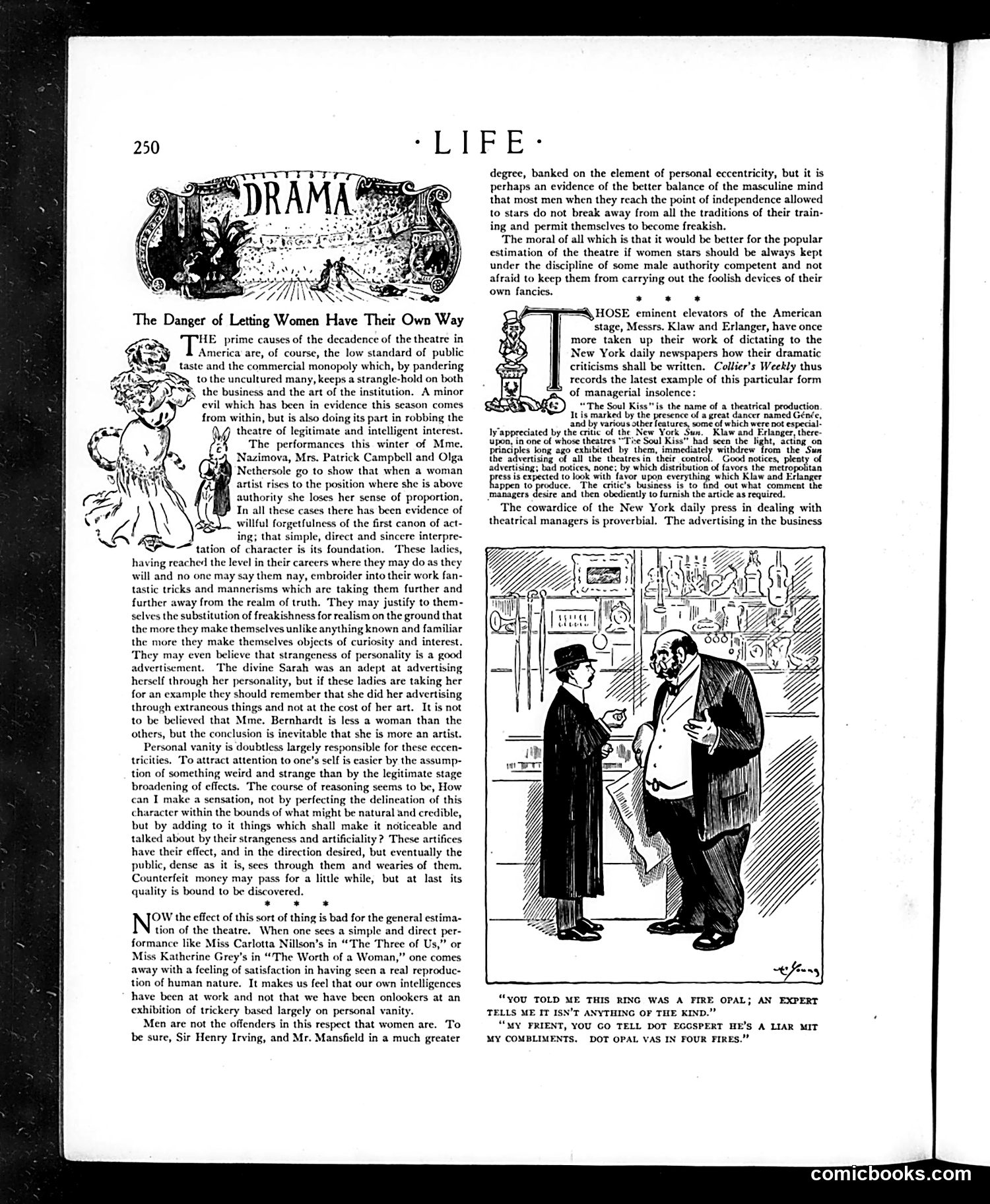
This article criticizes prominent actresses—specifically naming **Nazimova, Mrs. Patrick Campbell, and Olga Nethersole**—for prioritizing eccentric theatrical mannerisms and self-promotion over genuine, truthful acting once they achieved star status. The author argues these women have abandoned the "first canon of acting: simple, direct and sincere interpretation of character." Instead, they employ "fantastic tricks and mannerisms" to attract attention through strangeness rather than artistic merit. The piece contrasts their approach unfavorably with **Sarah Bernhardt**, who maintained artistic integrity despite her celebrated personality. The accompanying cartoon depicts two men discussing a fraudulent ring, using this as a metaphor: just as counterfeit money eventually fails, so too will these actresses' artificial performances eventually lose audience credibility. The author suggests male stars (Irving, Mansfield) engage in similar behavior but to lesser degree, implying women lack masculine "balance." This reflects period sexism about female ambition and vanity.
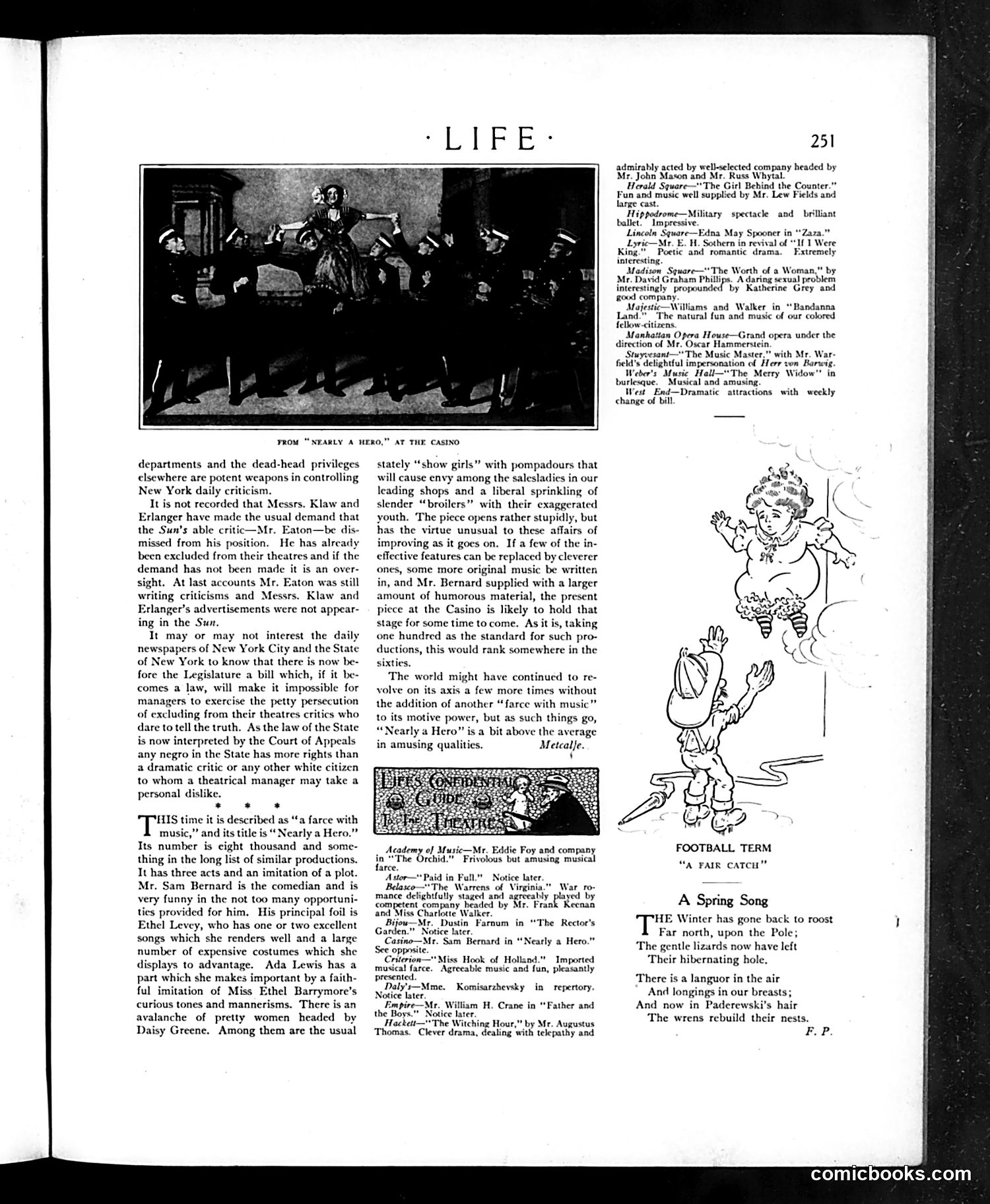
This page reviews a Broadway farce titled "Nearly a Hero," performed at the Casino theater, starring Sam Bernard and Ethel Levey. The critic (Metcalfe) describes it as a typical musical comedy—one of "eight thousand" similar productions—with standard elements: comedians, pretty chorus girls ("show girls" with fashionable pompadours), and expensive costumes. The review offers backhanded praise: the plot is thin and opening "rather stupid," but it improves as it progresses. Bernard provides humor where opportunities allow; Levey performs well despite limited material. Overall, ranking such productions at 100 as standard, this rates around sixty. The page also contains significant commentary criticizing theatrical managers Klaw and Erlanger for excluding critics from their theaters—a petty form of censorship targeting those who "dare to tell the truth." The illustration shows a scene from the production.
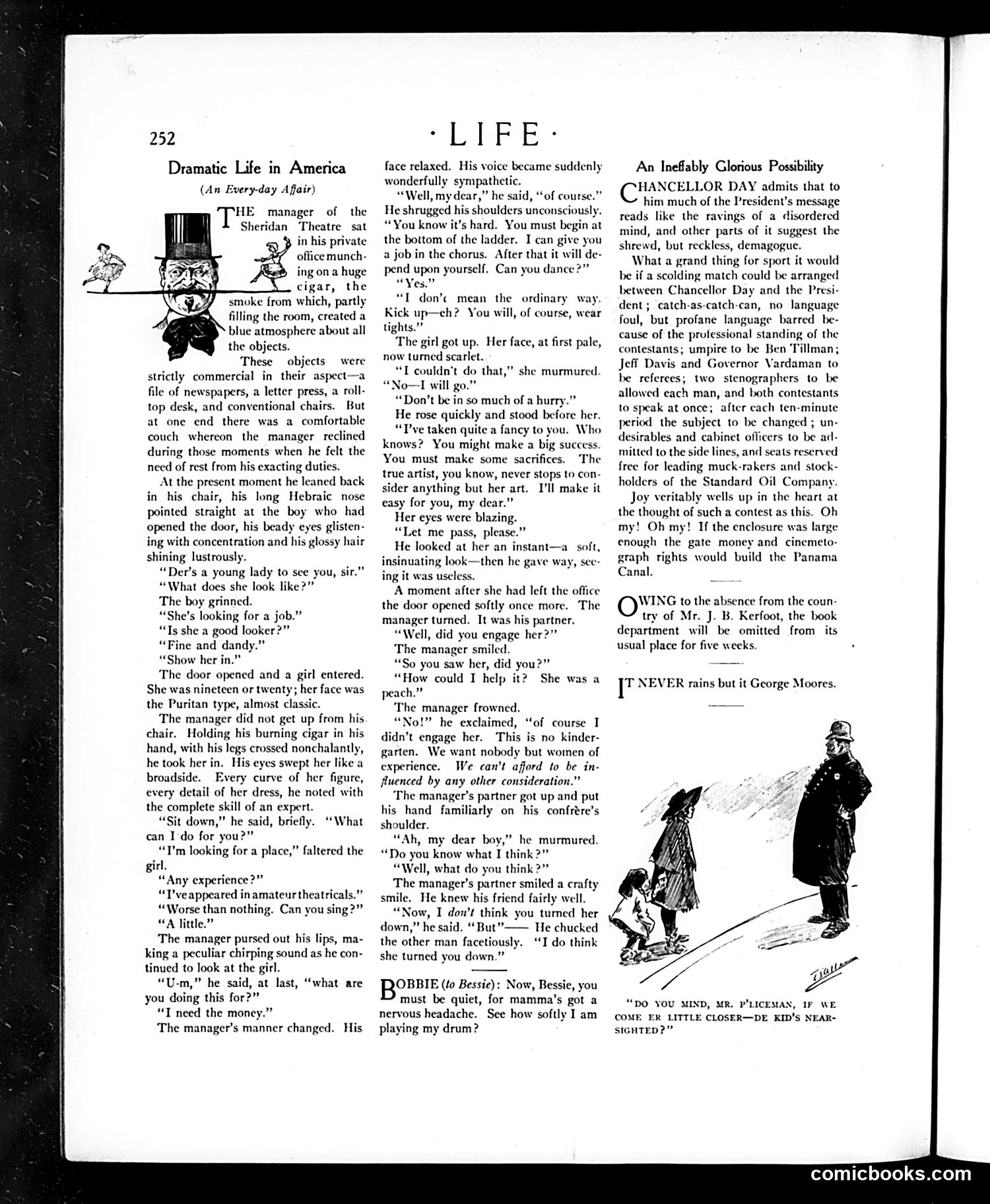
This page satirizes predatory behavior by theater managers toward aspiring actresses. A young, innocent girl seeking work at the Sheridan Theatre encounters a cigar-smoking manager who initially refuses her due to lack of experience. When she reveals financial desperation, his manner shifts to sympathy—a transparent manipulation tactic. He then proposes she perform in the chorus wearing tights and makes an "insinuating" advance. She refuses and leaves. His partner later suggests the manager was actually rejected by the girl, not the reverse—a humorous reversal that exposes the manager's self-deception about his failed seduction. The satire critiques the systemic exploitation of economically vulnerable women in early 20th-century theater, where managers leveraged casting power to coerce sexual favors. The Puritan-typed protagonist's resistance frames this predation as morally wrong.
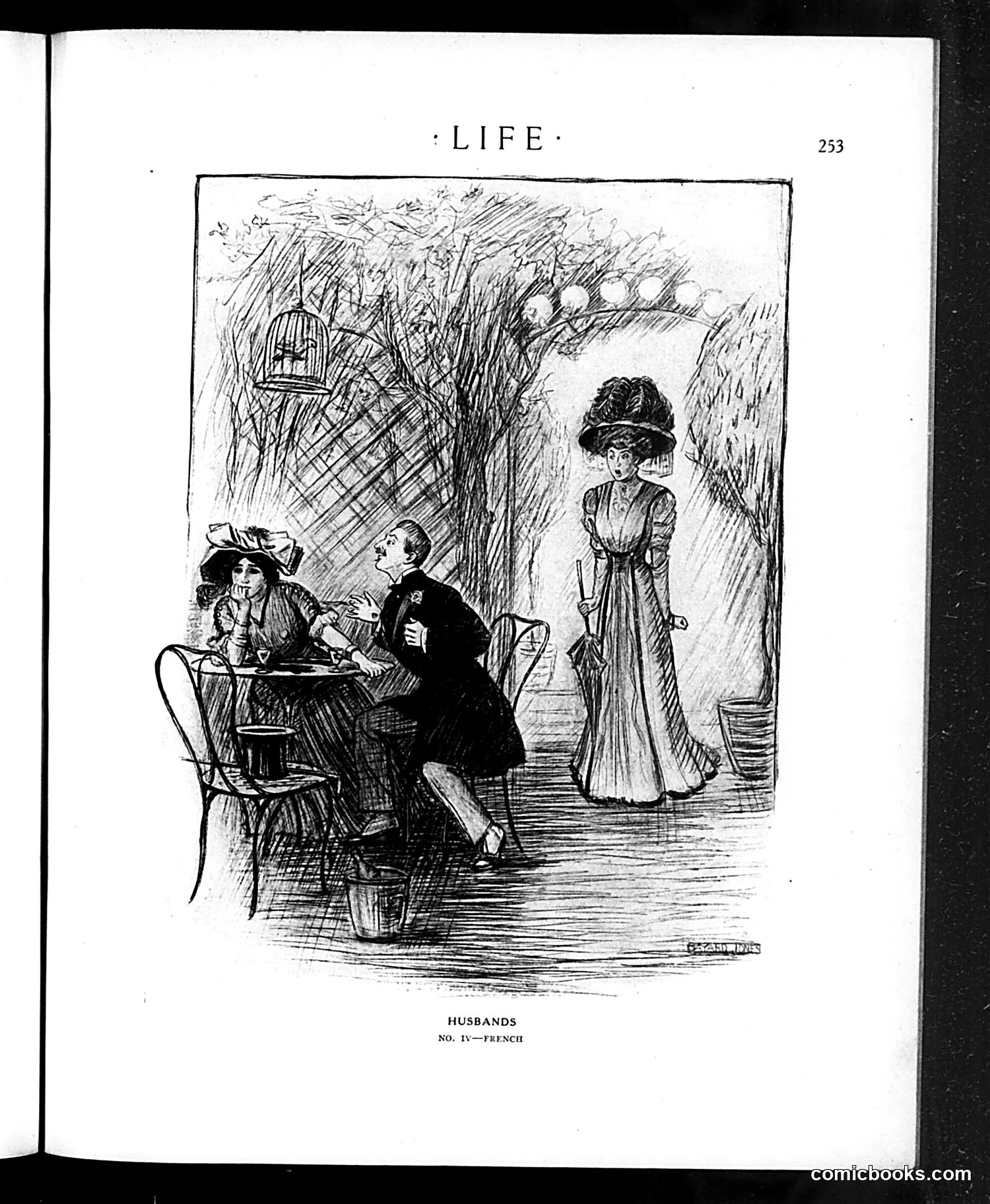
This cartoon satirizes French husbands through a domestic scene. A man sits at a small table with a woman while a stylishly dressed woman stands nearby, observing the couple. The caption indicates this depicts the "French" type of husband, suggesting Life magazine was running a series contrasting husbands from different nationalities or cultures. The satire appears to mock French marital customs, possibly implying infidelity, flirtation, or unconventional domestic arrangements—stereotypes commonly applied to the French in early 20th-century American humor. The standing woman's prominent position and fashionable appearance suggest she represents a romantic interest or mistress, highlighting the satirical point about French husbands' behavior or attitudes toward marriage. The cartoon trades on ethnic stereotyping typical of the era's popular humor.
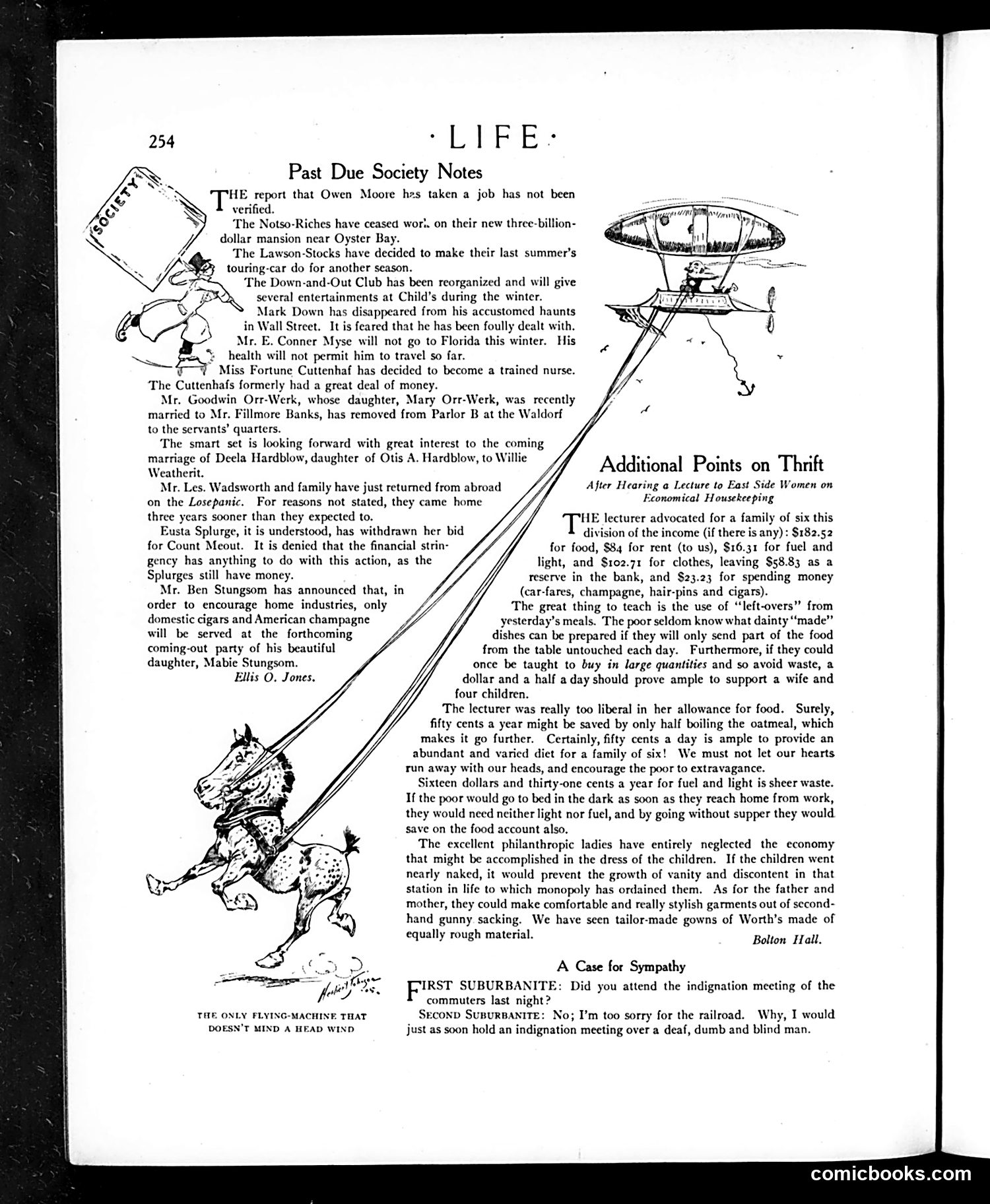
This page satirizes the wealthy elite's financial decline during an economic downturn. "Past Due Society Notes" uses punny, fake-sounding names (Notso-Riches, Mark Down, E. Conner Myse, Miss Fortune) to mock rich families reducing expenses—canceling mansion construction, reusing cars, moving from luxury hotels to servants' quarters. The humor lies in wealthy people experiencing modest hardship. The cartoon of a flying machine with a cow illustrates the caption "THE ONLY FLYING-MACHINE THAT DOESN'T MIND A HEAD WIND"—absurdist humor about an impractical contraption. "Additional Points on Thrift" viciously satirizes wealthy women's condescending advice to poor families. A lecturer recommends families survive on $1.50 daily; the response sarcastically endorses even more brutal suggestions: half-boiling oatmeal, eliminating light/fuel, dressing children nearly naked in gunny sacking. This exposes the hypocrisy and cruelty of wealthy philanthropists offering patronizing poverty advice while themselves accustomed to luxury.
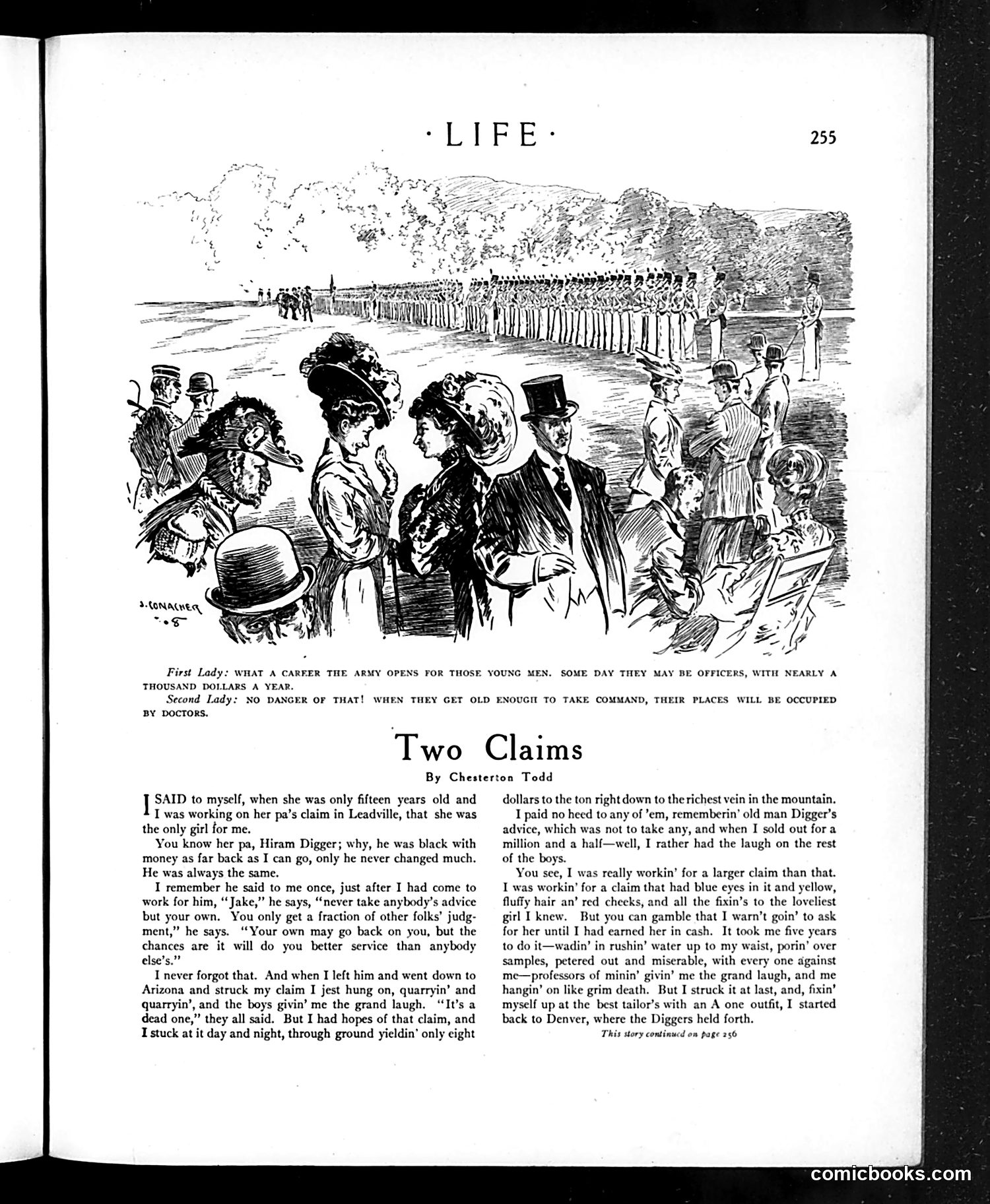
The cartoon at top satirizes society ladies' casual dismissal of military careers. One woman notes the army offers young men officer prospects worth "nearly a thousand dollars a year"—presented as substantial advancement. The second lady replies such danger is unlikely: by the time soldiers reach command rank, doctors will have taken their places, implying military men die young or face displacement by medical professionals. Below, "Two Claims" by Chesterton Todd begins a story about a miner's dual pursuits: striking a valuable mining claim and winning a wealthy man's daughter. The narrative (continuing next page) juxtaposes material and romantic ambition—both requiring persistence despite others' ridicule. The setup reflects early 20th-century American themes of self-made success and courtship as economic achievement.
This page presents a serialized short story (continuing from a previous issue) rather than political satire. The narrative follows a American prospector named Jake who has struck it rich in gold and travels from Denver to Athens, Greece, to propose to Nellie Digger—a woman he knew years ago. The "satire" here is social rather than political: it mocks the contrast between Jake's rough, colloquial American frontier manner ("I struck my claim") and the educated, cosmopolitan refinement Nellie has acquired through college and European travel. The humor derives from class anxiety—Jake fears his "natural" American roughness won't match Nellie's cultivated European sophistication. The story reflects early-20th-century American attitudes about education, travel abroad, and social aspiration, but contains no identifiable political figures or events. It's primarily entertainment for Life's readers.
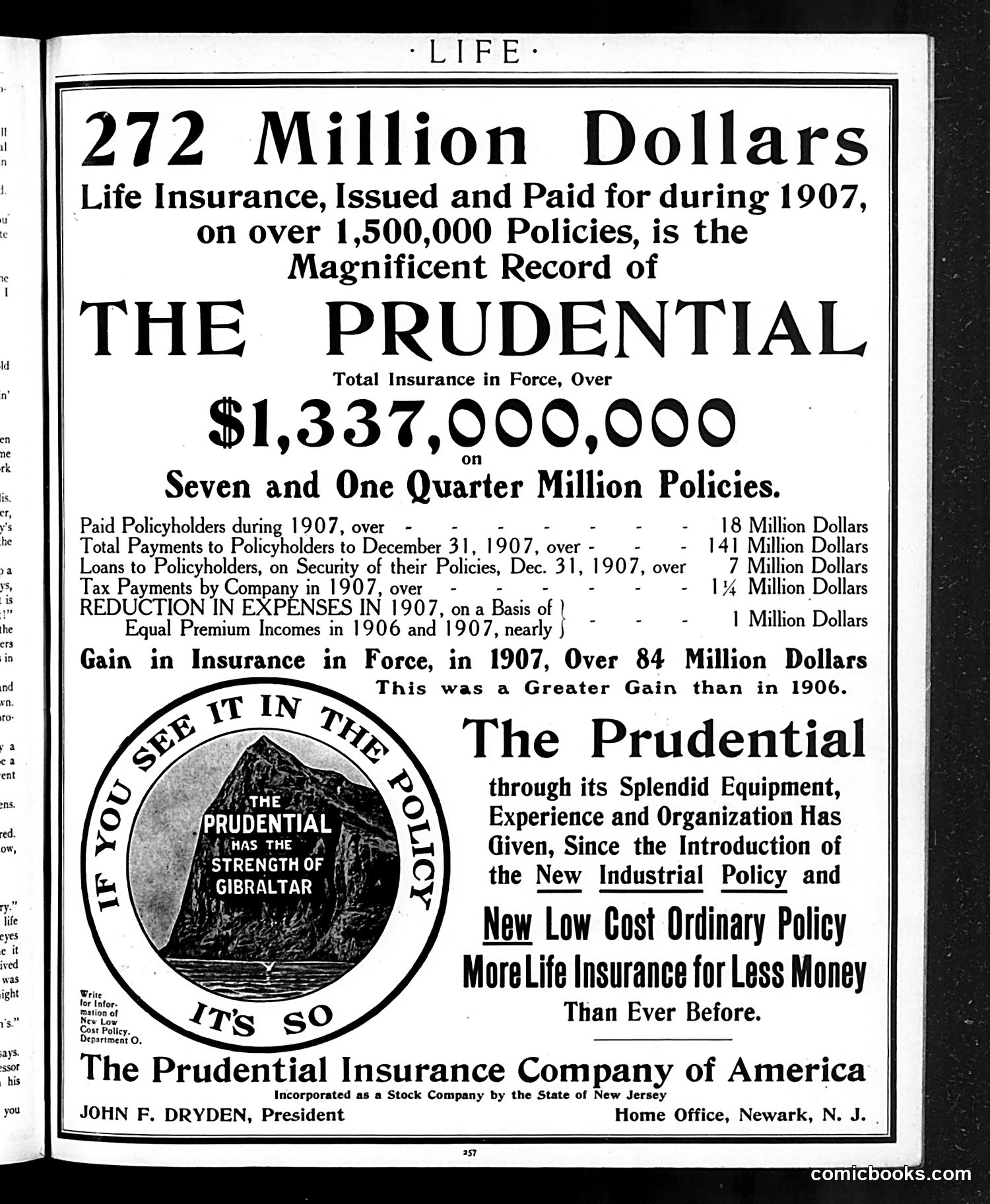
This is **a full-page advertisement**, not satire—it's a straightforward corporate promotion for The Prudential Insurance Company of America (1907). The circular image depicts **Gibraltar**, a famous rock formation symbolizing strength and stability. The caption "If you see it in the policy, it's so" emphasizes trustworthiness. This was Prudential's actual logo/branding strategy of the era. The page lists impressive financial statistics: $272 million in life insurance issued, $1.337 billion total in force, and $141 million paid to policyholders cumulatively. It highlights new "Industrial Policy" and "Low Cost Ordinary Policy" offerings as making "More Life Insurance for Less Money." **For modern readers**: This represents early 20th-century corporate advertising emphasizing financial solidity during an era before government insurance regulation. The Gibraltar image—still Prudential's trademark today—was chosen to assure Americans that the company was as rock-solid as a famous natural fortification.
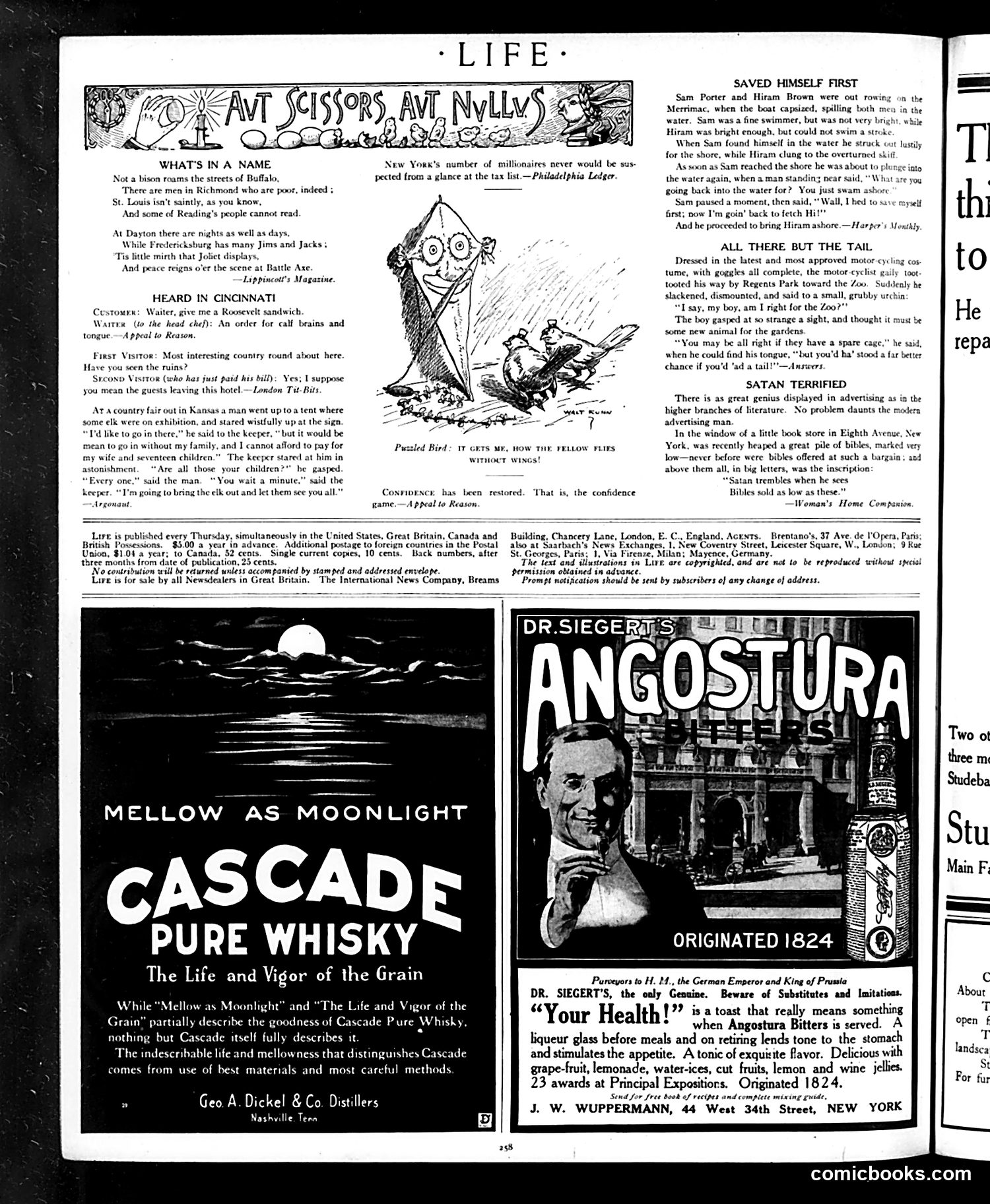
This page from *Life* magazine contains several brief satirical pieces mocking American place names and contemporary figures: **"What's in a Name"** jokes that American cities don't match their names—Buffalo has no bison, Richmond has poor people despite its dignified name, etc. It's gentle wordplay satire on civic identity. **"Heard in Cincinnati"** includes a joke about ordering a "Roosevelt sandwich" (calf brains and tongue)—a crude insult to President Theodore Roosevelt, suggesting he was brainless or two-faced. **The other anecdotes** are simple humor about misunderstandings and absent-mindedness, typical of early-20th-century magazine filler. The cartoon of a bird with large eyes appears to illustrate one of these brief jokes about misidentification. **The advertisements** for Cascade Whisky and Dr. Siegert's Angostura Bitters occupy significant space—this was standard revenue for magazines of the era. Overall, this is a typical *Life* page: light satirical commentary on American life, political jabs at Roosevelt, and substantial advertising.
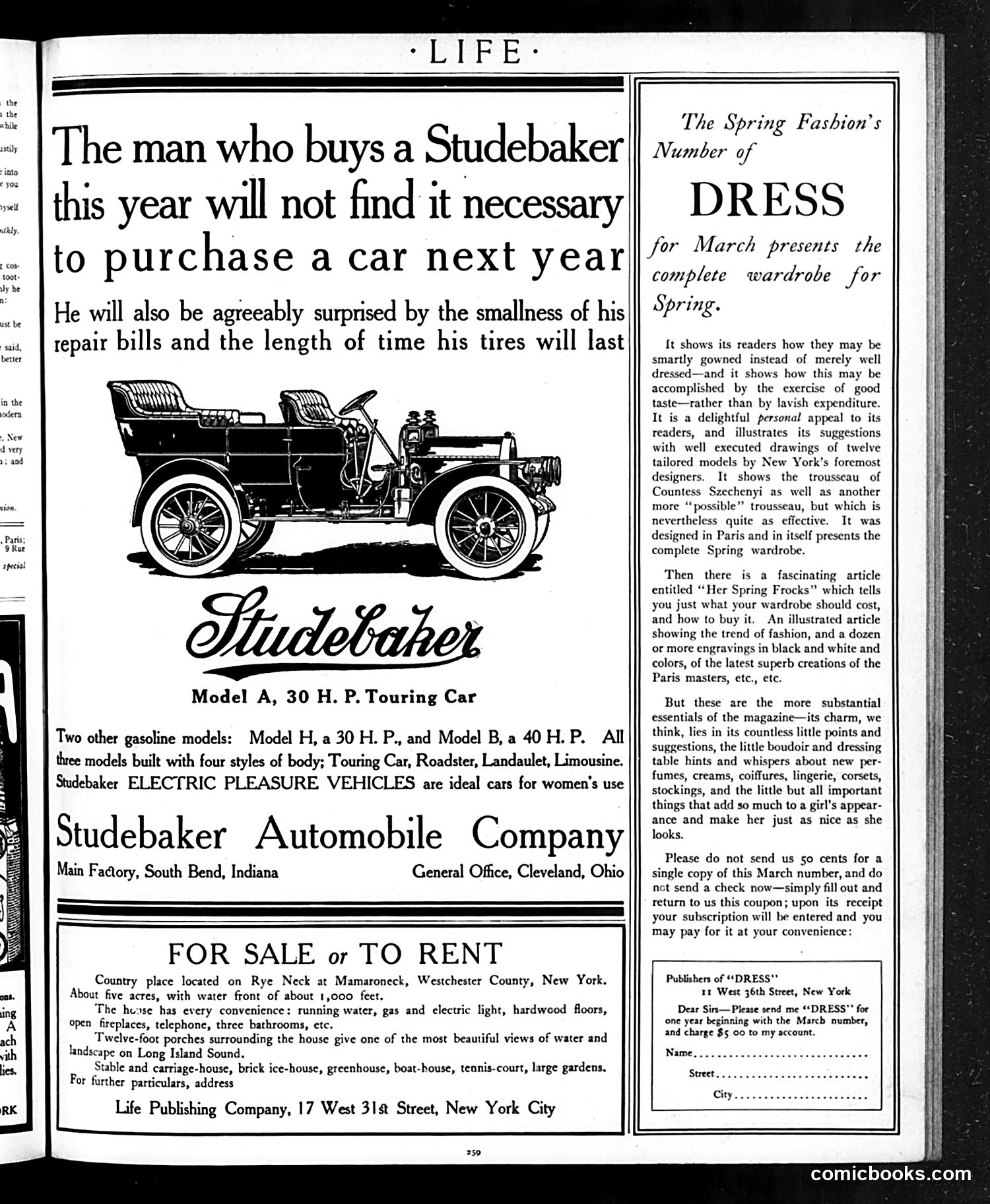
This is primarily **advertising and promotional content**, not satire or political commentary. The left side features a **Studebaker automobile advertisement** emphasizing durability and low maintenance costs—a sales pitch claiming buyers won't need to purchase another car soon. The car illustration is straightforward product promotion. The right side promotes **"Dress" magazine's Spring Fashion issue**, positioning it as practical styling guidance for women of moderate means. The text emphasizes achieving elegant appearance through "good taste" rather than "lavish expenditure"—appealing to middle-class readers wanting to appear fashionable affordably. References to Countess Szechenyi's trousseau suggest aspirational content mixing high-society fashion with accessible alternatives. Below is a **property listing** for a Mamaroneck estate, again targeting affluent readers. The page reflects **early 20th-century consumer culture**: automobiles as luxury goods, women's fashion magazines as lifestyle guides, and real estate as status symbol—all marketed through Life's pages to its educated, relatively wealthy readership.
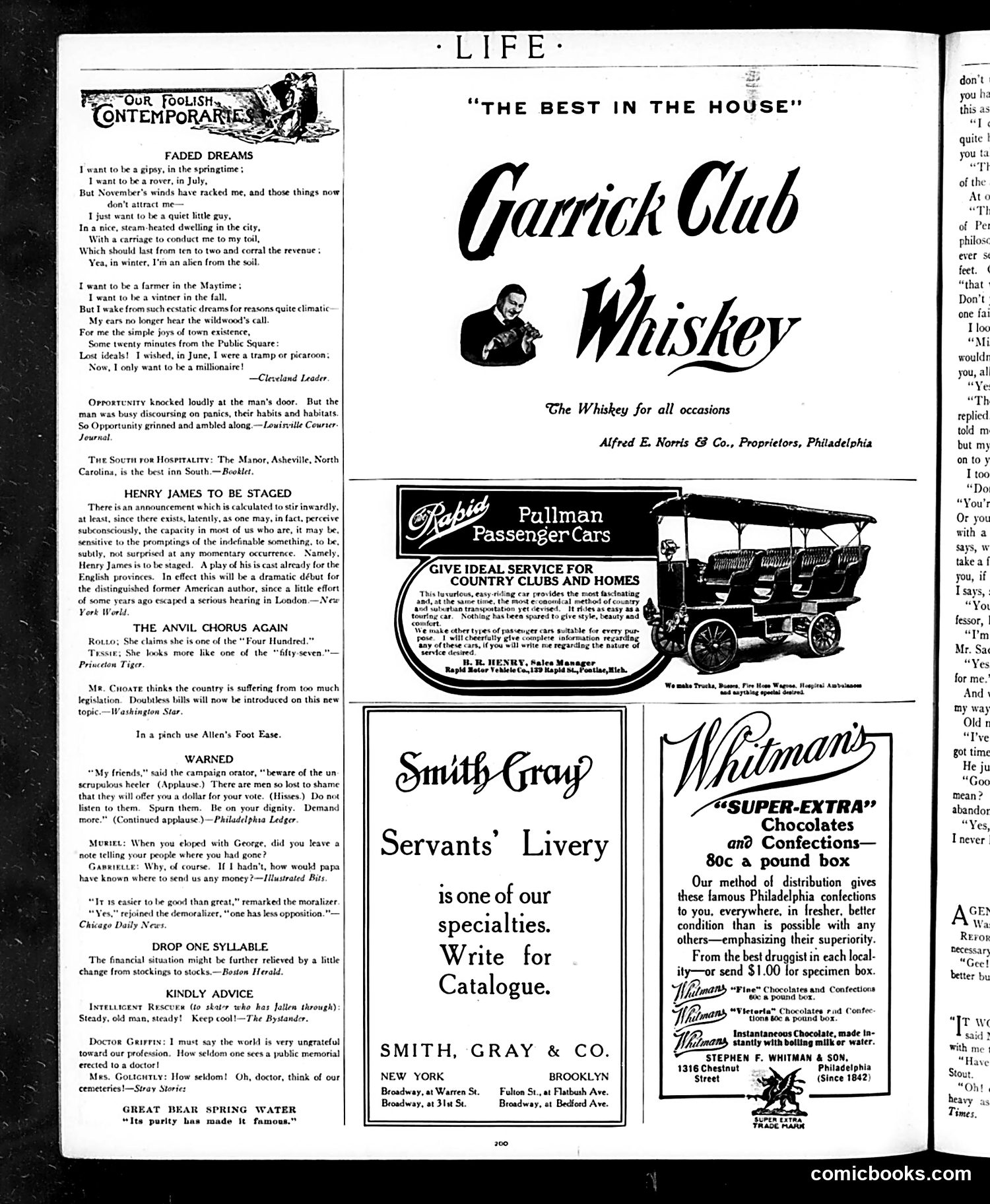
This is primarily an **advertising and humor page** from Life magazine, not a political cartoon. The main content is satirical short pieces and ads. The opening poem "Faded Dreams" satirizes **changing American aspirations**: a speaker romanticizes vagabond lifestyles (gypsy, farmer, tramp) but admits winter and age have made him desire comfort—a "quiet little guy" with a steam-heated city home and carriage, working only 10 AM to 2 PM. The punchline: "Now, I only want to be a millionaire!" It mocks both youthful idealism and middle-class materialism. Other brief jokes target: **campaign corruption** (a politician ironically warns against vote-buying while demanding higher bribes), **social pretension** (a woman claims "Four Hundred" society status but looks like common stock), and **incompetent doctors** (a widow notes cemeteries are doctors' best monuments). The advertisements—for Garrick Club whiskey, Pullman cars, Smith-Gray servants' livery, and Whitman's chocolates—represent period luxury goods marketed to affluent readers. **No significant political figures or events are referenced.** This is period humor and consumer culture.
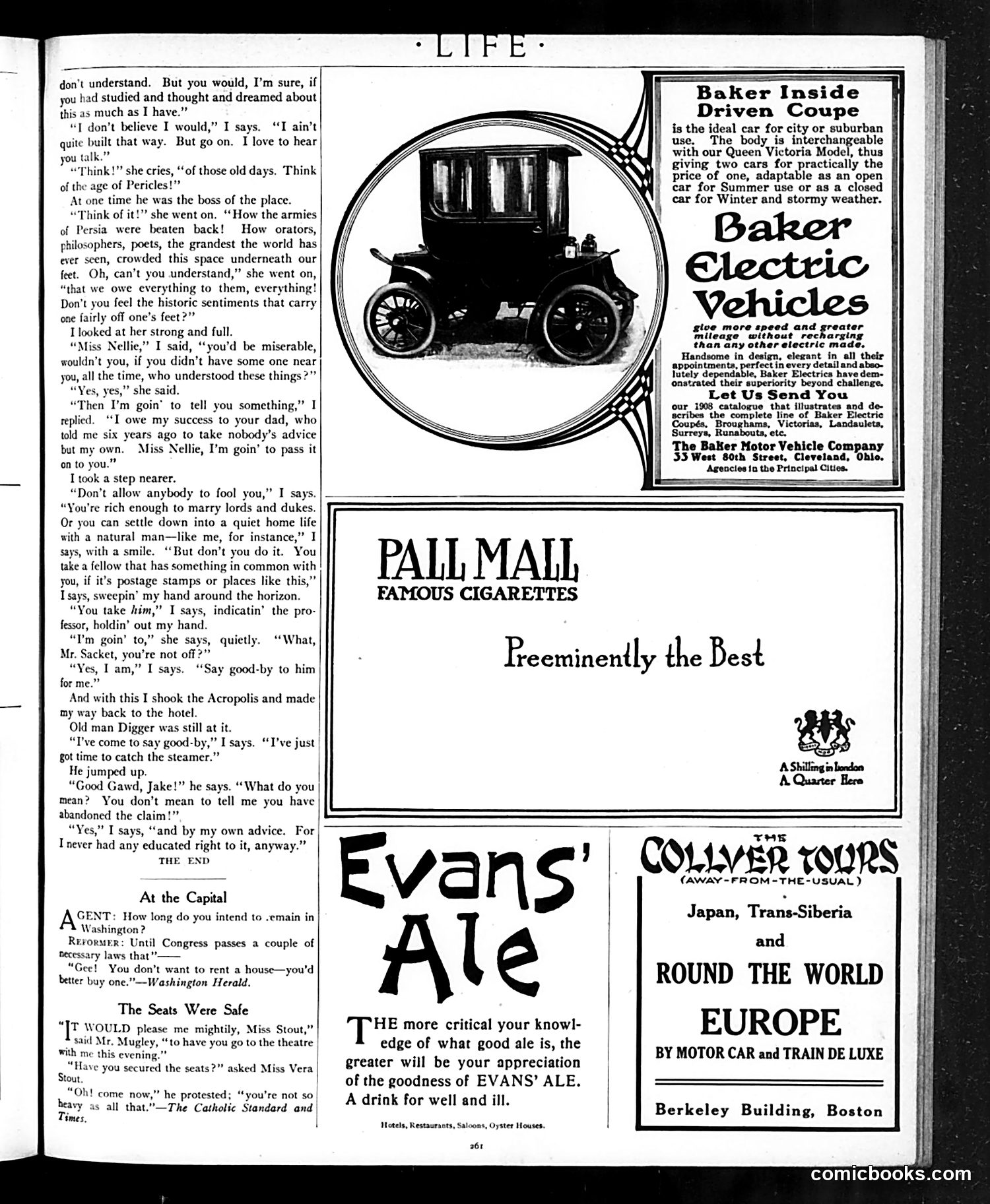
This page contains primarily **advertising and brief satirical vignettes** rather than political cartoons. The main narrative excerpt depicts a romantic scene at the Acropolis in Athens, where a man named Sacket advises a wealthy young woman (Miss Nellie) against marrying for intellectual pretension. The satire targets educated elites who romanticize ancient history while ignoring practical wisdom. Below are three **short comic exchanges**: 1. **"At the Capital"**: A joke about Congressional gridlock—a visitor says he'll stay in Washington until necessary laws pass, prompting the response that he should buy rather than rent a house (implying Congress never accomplishes anything). 2. **"The Seats Were Safe"**: A crude joke where Mr. Mugley invites Miss Stout to theater; when she asks if he's "secured the seats," she's implying he couldn't support her weight on theater seats. The page is dominated by **period advertisements** for Baker Electric Vehicles, Pall Mall cigarettes, and Cook's Tours—typical of early 1900s Life magazine's revenue model.
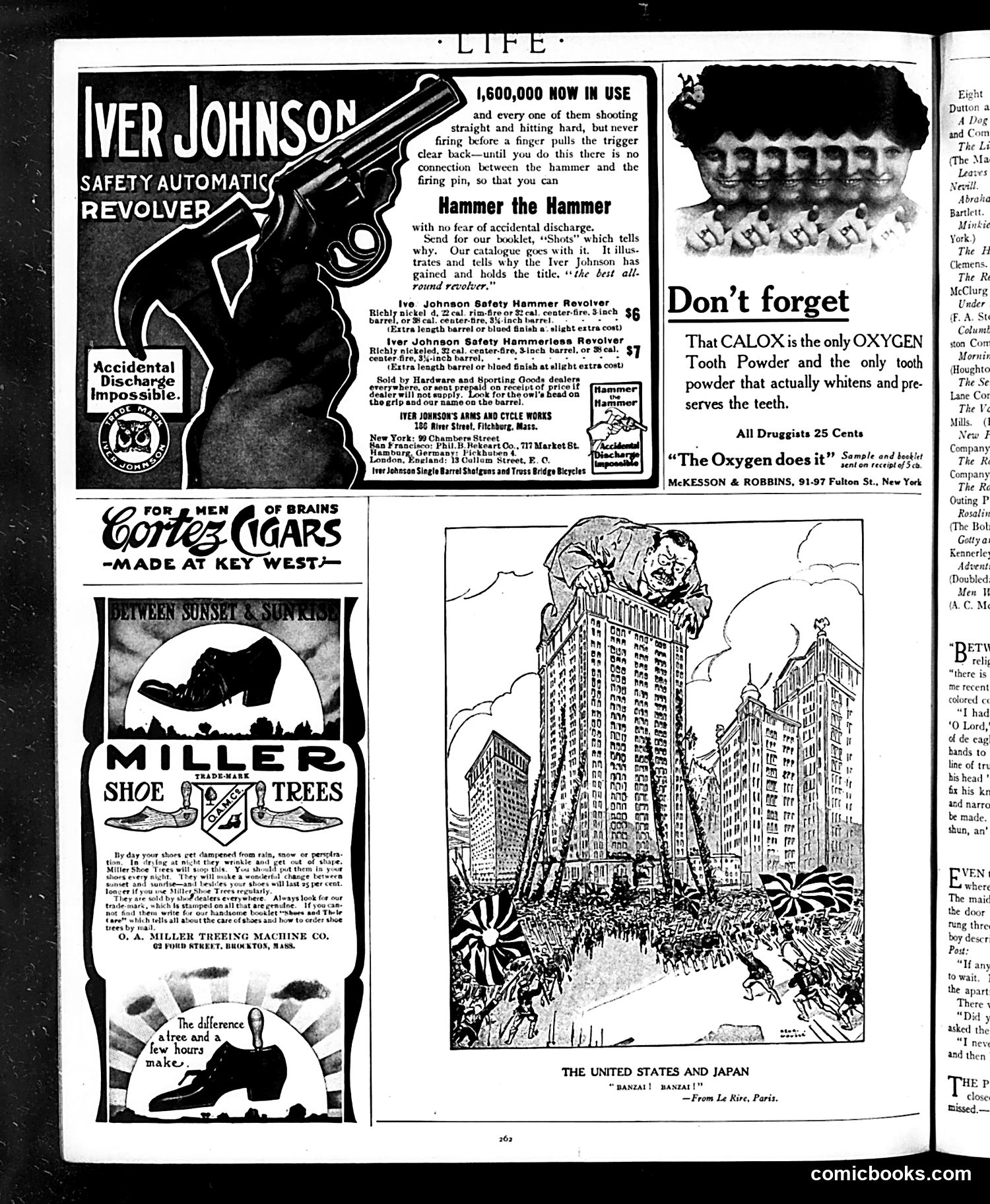
This page contains three distinct advertisements and one political cartoon. **Advertisements:** The Iver Johnson Safety Revolver ad emphasizes the gun's safety mechanism—a hammer that won't fire without deliberately pulling the trigger, marketed to assure accidental discharge is "impossible." Below are ads for Cortez cigars (Key West-made), Miller Shoe Trees, and Calox Oxygen Tooth Powder. **Political Cartoon:** The bottom image, credited "From Le Rire, Paris," depicts "The United States and Japan" with the caption "Banzai! Banzai!" It shows tall American skyscrapers with a figure (likely representing Japan) appearing small or subordinate beside them. This reflects early 20th-century anxieties about American-Japanese relations and American economic/industrial superiority—a commentary on geopolitical power dynamics of the era, likely referencing Japan's emerging military ambitions.
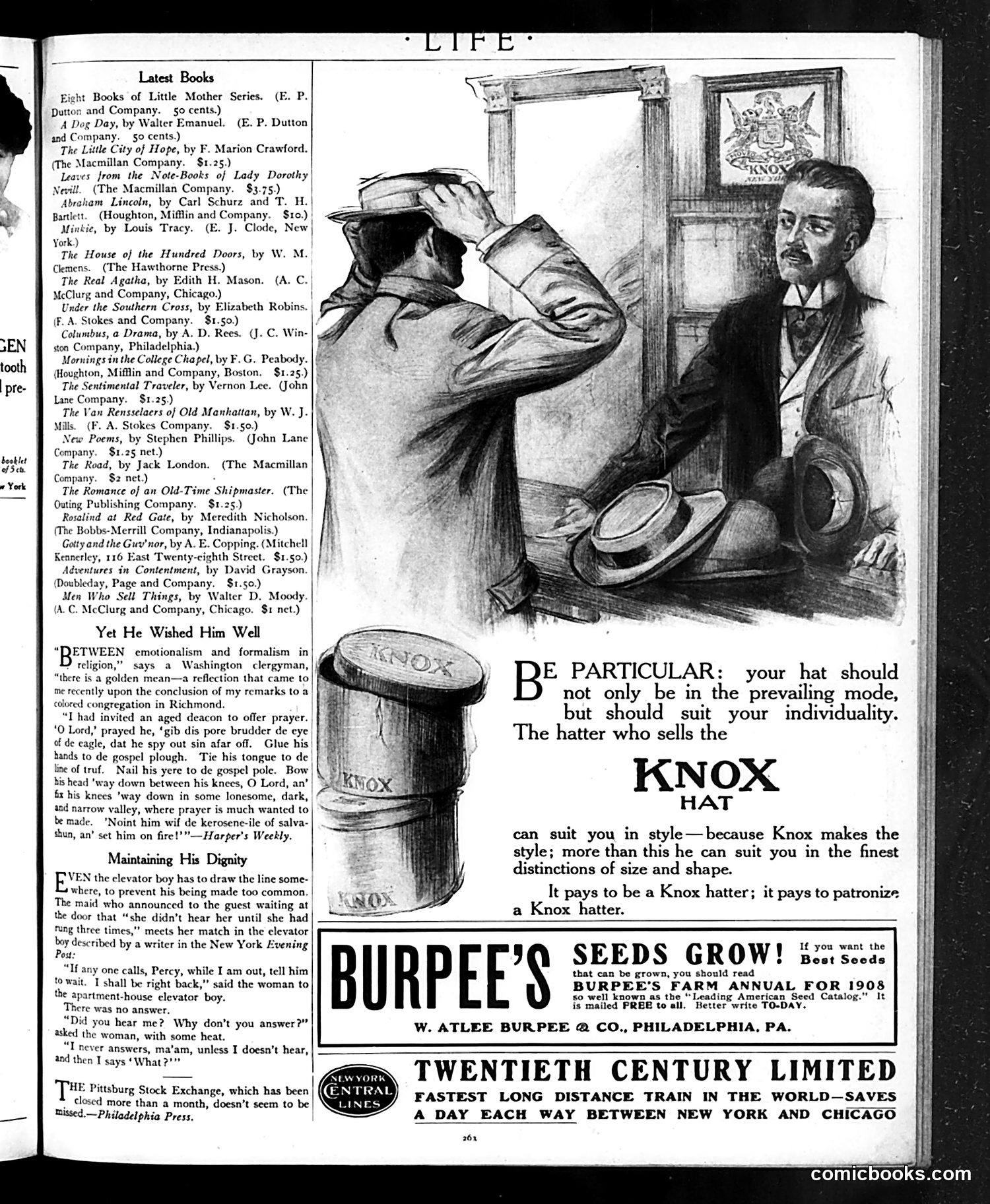
This page consists primarily of **advertisements and literary notices**, not political satire. The main content includes: **Book listings**: A "Latest Books" section advertising recent publications from major publishers. **Two humorous anecdotes**: Short, genteel stories about social propriety—one depicting a Black deacon's exuberant prayer (employing dialect), another about an elevator boy's dignified silence. These are mild humor pieces, not satire. **Advertisements**: The dominant visual content features Knox hat advertising (with a sketch of a well-dressed man) and Burpee's Seeds catalog promotion, along with a notice about the Twentieth Century Limited train. The page reflects early 1900s *Life* magazine style—a mix of light social commentary, literature promotion, and advertisements aimed at educated, middle-class readers. The dialect humor in the anecdote reflects period conventions now considered offensive.
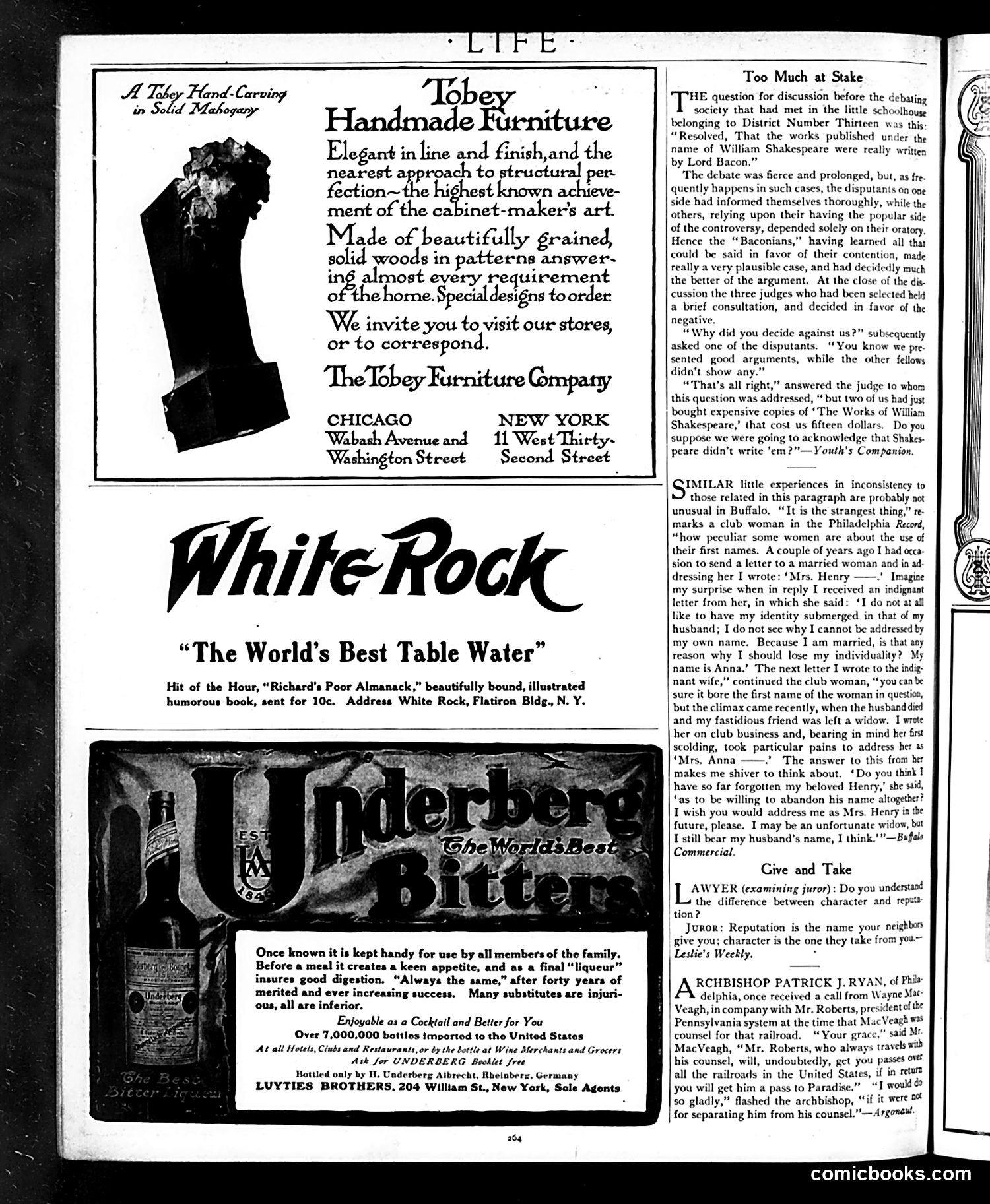
This page is primarily **advertisements** interspersed with two short humor pieces. The **Tobey Handmade Furniture** ad features a silhouette of a furniture piece carved in mahogany, marketing high-end furniture to wealthy readers. The text content consists of two satirical anecdotes: 1. **"Too Much at Stake"**: A rural schoolhouse debate team argues the Bacon-wrote-Shakespeare theory. Despite presenting better arguments, they lose because the three judges had just purchased expensive Shakespeare collections and couldn't bear to validate that Shakespeare didn't write them—illustrating how financial self-interest trumps intellectual honesty. 2. **"Give and Take"**: A follow-up about a widow's name preferences, showing social hypocrisy regarding women's identity after marriage. Both pieces mock human inconsistency and self-serving logic. The page also advertises **White Rock** table water and **Underberg** liqueur, using period marketing language emphasizing purity and digestive benefits—typical early 20th-century advertising claims.
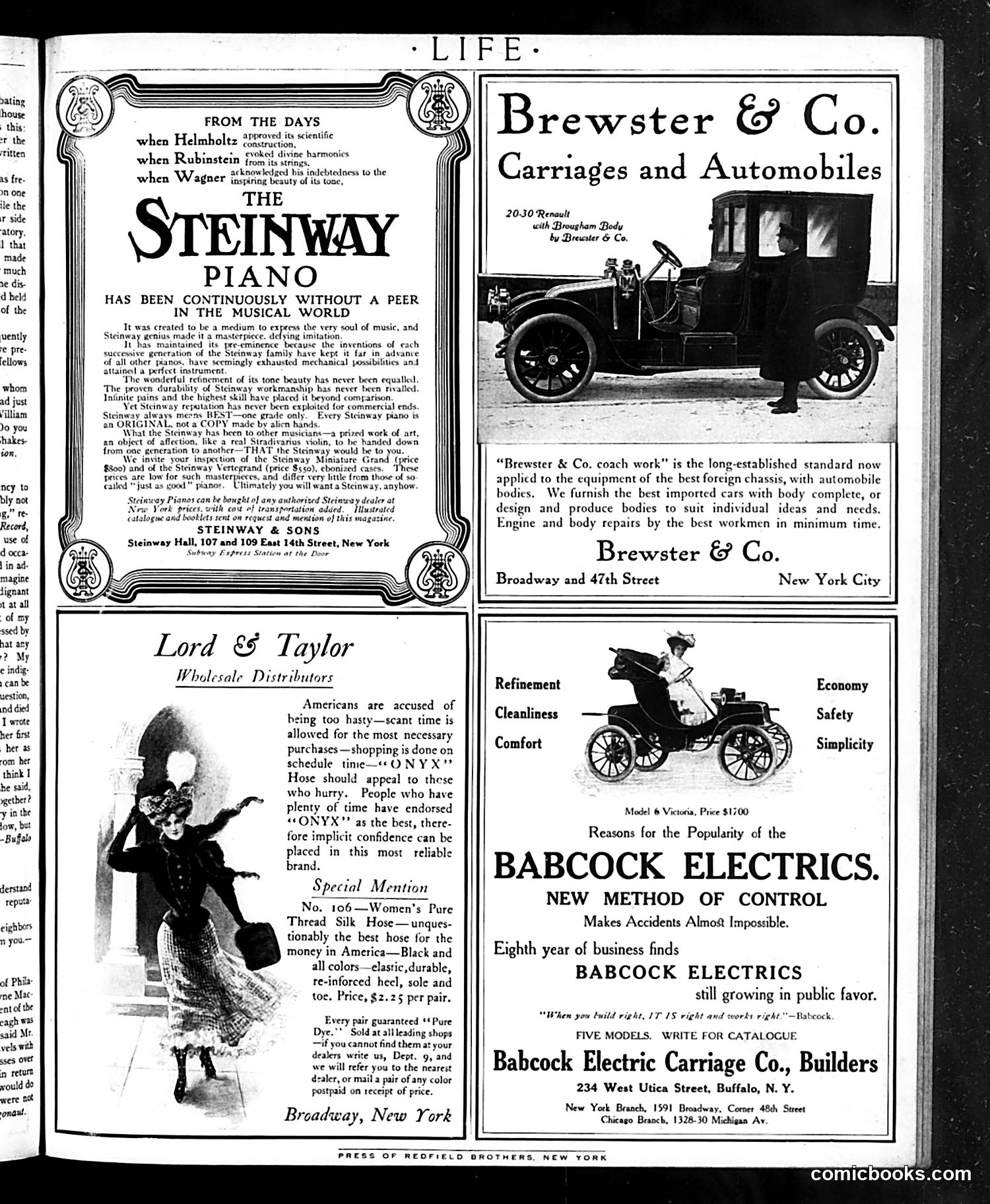
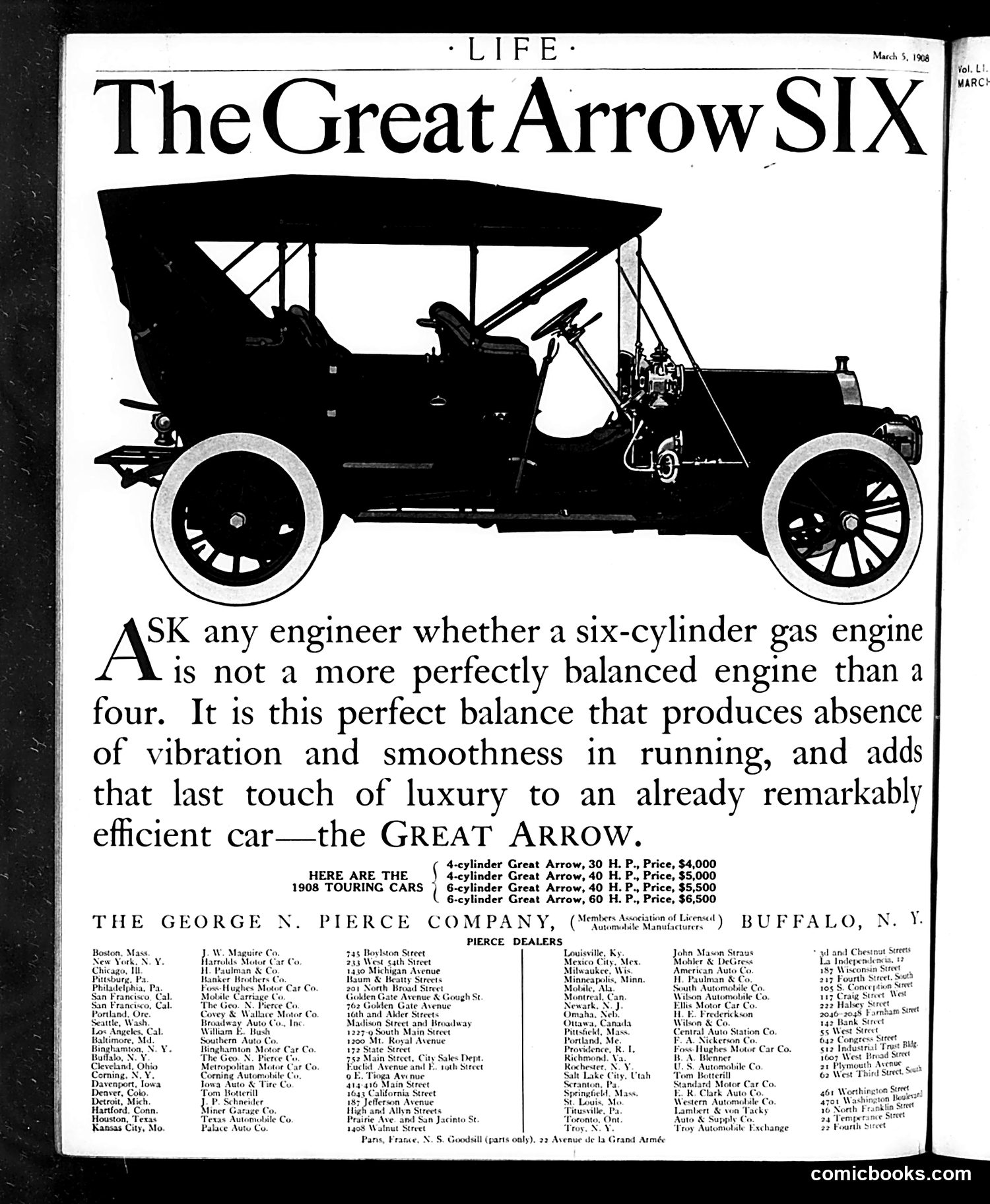
This is **not a political cartoon or satire**—it's a straightforward automobile advertisement for the Great Arrow, manufactured by the George N. Pierce Company of Buffalo, New York. The page promotes the Great Arrow's six-cylinder engine as a luxury feature, claiming superior balance and smoothness compared to four-cylinder models. The ad appeals to affluent buyers by positioning the vehicle as the pinnacle of automotive engineering and comfort ("that last touch of luxury"). The silhouette illustration shows a touring car typical of the era—an open vehicle with canvas canopy, large spoke wheels, and prominent mechanical details visible. Four models are listed at prices ranging from $4,000 to $6,500 (roughly $130,000-$210,000 in modern dollars), targeting wealthy consumers. The extensive dealer list across American cities indicates Pierce's nationwide market presence during the early automobile boom. This represents early 1900s automotive marketing before mass production made cars affordable to average Americans.