
Life, 1908-03-05 · page 10 of 36
Life — March 5, 1908 — page 10: what you’re looking at
What you’re looking at
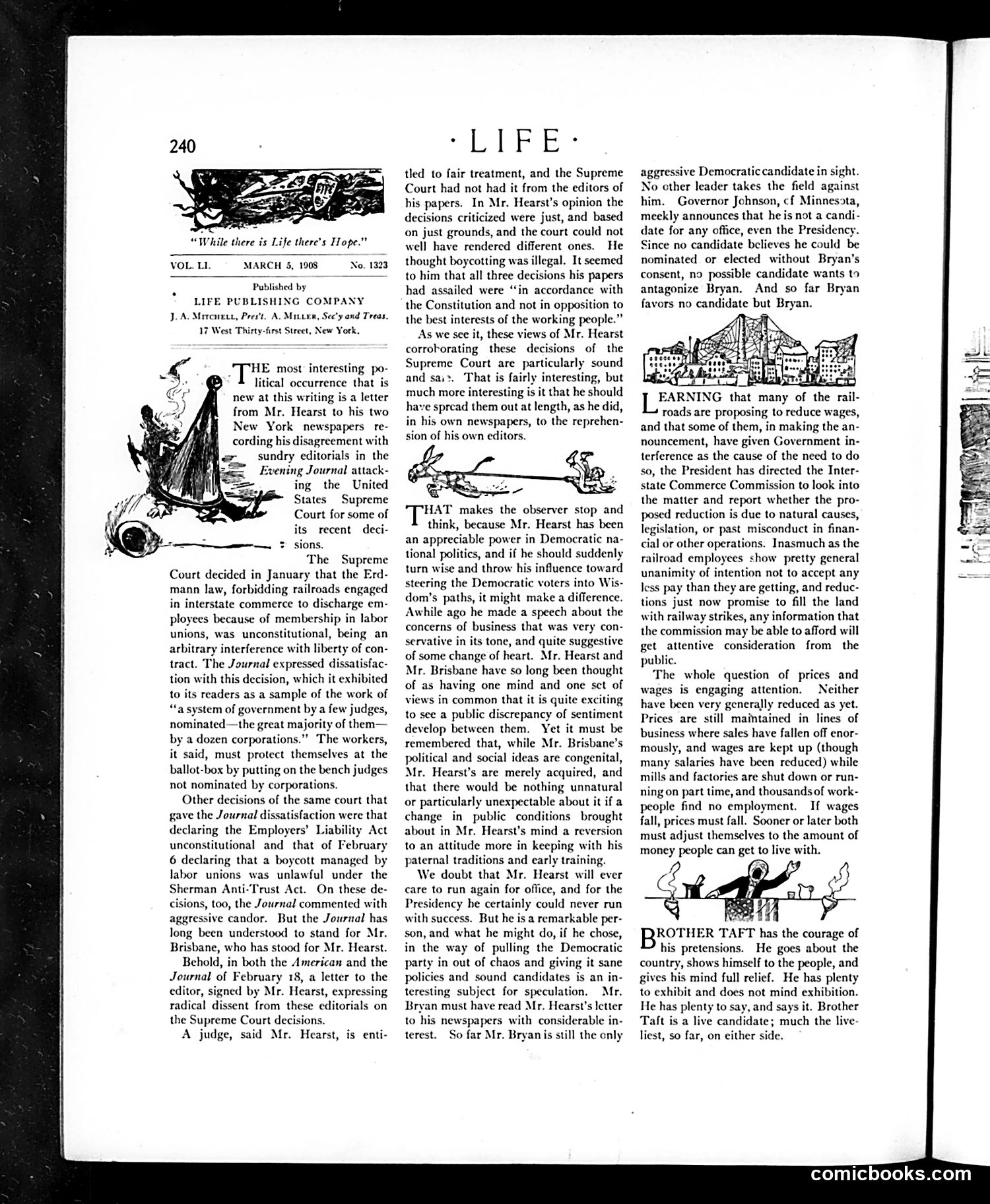
The main cartoon depicts a figure labeled "While there is Life there's Hope" at the top. The accompanying article discusses William Randolph Hearst's recent Supreme Court decisions and his influence on Democratic politics. The satire criticizes Hearst's outsized political power despite losing electoral bids. The article notes Hearst controlled newspapers that could shape Democratic candidates and party direction—he opposed Bryan and reportedly could block any candidate he didn't endorse. The cartoon appears to mock Hearst's persistent political ambitions and influence despite repeated failures. Life's editors are clearly skeptical of his ability to determine Democratic party outcomes, portraying his continued involvement as somewhat absurd or delusional, hence the "hope" reference suggesting futile persistence.
📄 Transcribed text from this page (OCR, searchable)
Machine-transcribed from the original scan — historical spelling and the odd misread are preserved.
“While there is Life there's Hope.” VOL. LI. MARCH 5, 1908 No, 1323 Published by LIFE PUBLISHING COMPANY J.A. Mrrenene, Prest, A. Mr y-first Street, New York, un, Sec'y and Treas, TE most interesting po- litical occurrence that is new at this writing is a letter from Mr. Hearst to his two New York newspapers. re- cording his disagreement with sundry editorials in the Evening Journal attack- ing the United States Supreme Court for some of its recent deci- ons. The Supreme Court decided in January that the Erd- mann law, forbidding railroads engaged in interstate commerce to discharge em- ployees because of membership in labor unions, was unconstitutional, being an arbitrary interference with liberty of con- tract. The Journal expressed dissatisfac- tion with this decision, which it exhibited to its readers as a sample of the work of “a system of government by a few judges, nominated—the great majority of them— by a dozen corporations.” The workers, it said, must protect themselves at the ballot-box by putting on the bench judges not nominated by corporations. Other decisions of the same court that gave the Journal dissatisfaction were that declaring the Employers’ Liability Act unconstitutional and that of February 6 declaring that a boycott managed by labor unions was unlawful under the Sherman Anti-Trust Act. On these de- cisions, too, the Journal commented with aggressive candor. But the Journal has long been understood to stand for Mr. Brisbane, who has stood for Mr. Hearst. Behold, in both the American and the Journal of February 18, a letter to the editor, signed by Mr. Hearst, expressing radical dissent from these editorials on the Supreme Court decisions. A judge, said Mr. Hearst, is enti- “Le IAF IB * tled to fair treatment, and the Supreme Court had not had it from the editors of his papers. In Mr. Hearst’s opinion the decisions criticized were just, and based on just grounds, and the court could not well have rendered different ones. He thought boycotting was illegal. It seemed to him that all three decisions his papers had assailed were “in accordance with the Constitution and not in opposition to the best interests of the working people.” As we sec it, these views of Mr. Hearst corroborating these decisions of the Supreme Court are particularly sound and sas:. That is fairly interesting, but much more interesting is it that he should have spread them out at length, as he did, in his own newspapers, to the reprehen- sion of his own editors. HAT makes the observer stop and think, because Mr. Hearst has been an appreciable power in Democratic na- tional politics, and if he should suddenly turn wise and throw his influence toward steering the Democratic voters into Wis- dom’s paths, it might make a difference. Awhile ago he made a speech about the concerns of business that was very con- servative in its tone, and quite suggestive of some change of heart. Mr. Hearst and Mr. Brisbane have so long been thought of as having one mind and one sct of views in common that it is quite exciting to sce a public discrepancy of sentiment develop between them. Yet it must be remembered that, while Mr. Brisbane’s political and social ideas are congenital, Mr. Hearst’s are merely acquired, and that there would be nothing unnatural or particularly unexpectable about it if a change in public conditions brought about in Mr. Hearst’s mind a reversion to an attitude more in keeping with his paternal traditions and early training. We doubt that Mr. Hearst will ever care to run again for office, and for the Presidency he certainly could never run with success. But he is a remarkable per- son, and what he might do, if he chose, in the way of pulling the Democratic party in out of chaos and giving it sane policies and sound candidates is an in- teresting subject for speculation, Mr. Bryan must have read Mr. Hearst's letter to his newspapers with considerable in- terest. So far Mr. Bryanis still the only aggressive Democratic candidate in sight. No other leader takes the field against him. Governor Johnson, cf Minnesota, meekly announces that he is not a candi- date for any office, even the Presidency. Since no candidate believes he could be nominated or elected without Bryan’s consent, no possible candidate wants to antagonize Bryan. And so far Bryan favors no candidate but Bryan. roads are proposing to reduce wages, and that some of them, in making the an- nouncement, have given Government in- terference as the cause of the need to do so, the President has directed the Inter- state Commerce Commission to look into the matter and report whether the pro- posed reduction is due to natural causes, legislation, or past misconduct in finan- cial or other operations. Inasmuch as the railroad employees show pretty general unanimity of intention not to accept any Icss pay than they are getting, and reduc- tions just now promise to fill the land with railway strikes, any information that the commission may be able to afford wi get attentive consideration from the public. The whole question of prices and wages is engaging attention. Neither have been very generally reduced as yet. Prices are still maintained in lines of business where sales have fallen off enor- mously, and wages are kept up (though many salaries have been reduced) while mills and factories are shut down or run- ning on part time, and thousands of work- people find no employment. If wages fall, prices must fall. Sooner or later both must adjust themselves to the amount of money people can get to live with. ROTHER TAFT has the courage of his pretensions. He goes about the country, shows himself to the people, and gives his mind full relief. He has plenty to exhibit and does not mind exhibition. He has plenty to say, and says it. Brother Taft is a live candidate; much the live- liest, so far, on either side. comicbooks.com