
Life, 1908-03-05 · page 22 of 36
Life — March 5, 1908 — page 22: what you’re looking at
What you’re looking at
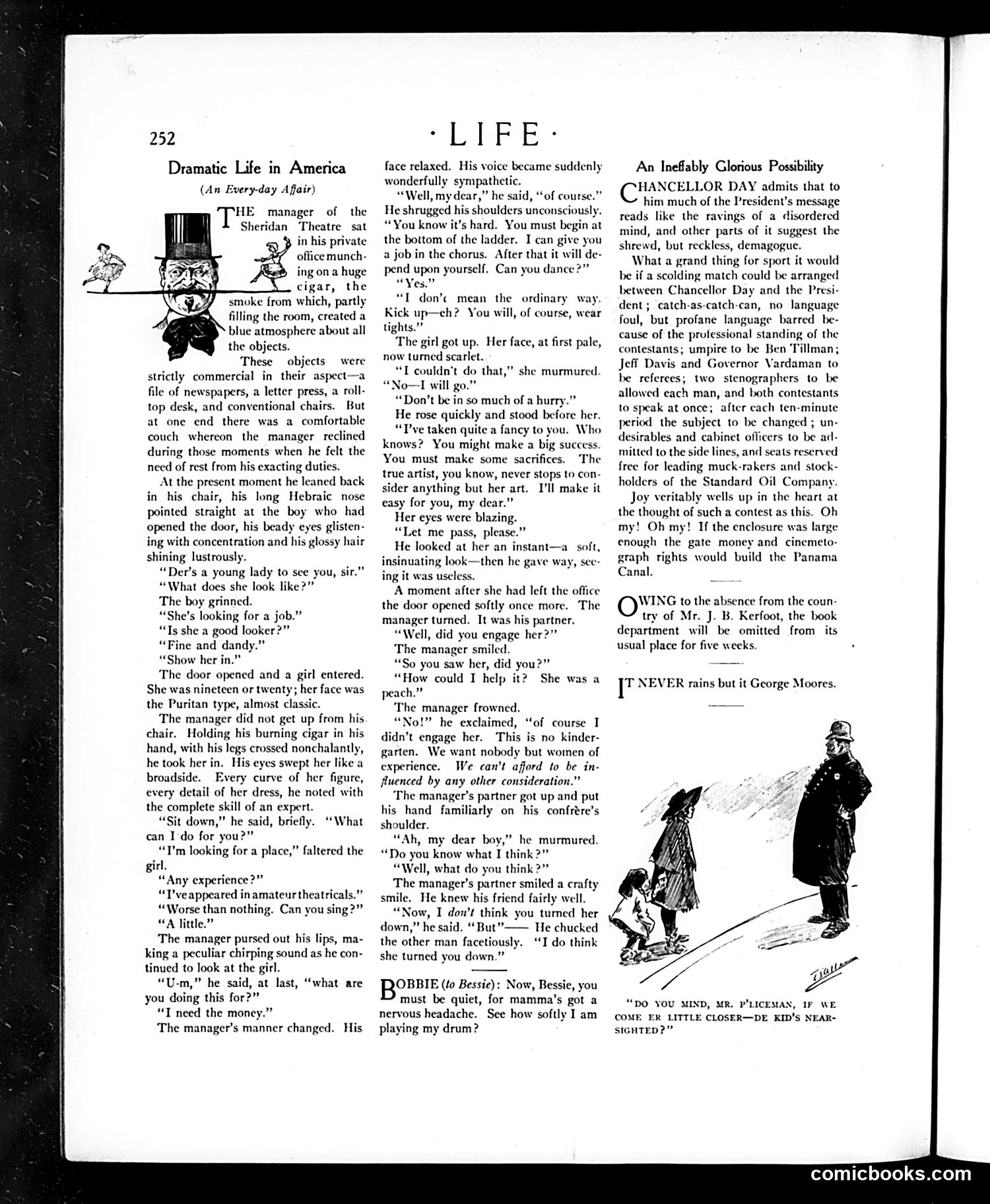
This page satirizes predatory behavior by theater managers toward aspiring actresses. A young, innocent girl seeking work at the Sheridan Theatre encounters a cigar-smoking manager who initially refuses her due to lack of experience. When she reveals financial desperation, his manner shifts to sympathy—a transparent manipulation tactic. He then proposes she perform in the chorus wearing tights and makes an "insinuating" advance. She refuses and leaves. His partner later suggests the manager was actually rejected by the girl, not the reverse—a humorous reversal that exposes the manager's self-deception about his failed seduction. The satire critiques the systemic exploitation of economically vulnerable women in early 20th-century theater, where managers leveraged casting power to coerce sexual favors. The Puritan-typed protagonist's resistance frames this predation as morally wrong.
📄 Transcribed text from this page (OCR, searchable)
Machine-transcribed from the original scan — historical spelling and the odd misread are preserved.
252 Dramatic Life in America (An Bvery-day Affair) THe manager of the Sheridan Theatre sat in his private ” office munch- ing ona huge cigar, the smoke from which, partly filling the room, created a blue atmosphere about all the objects. These objects strictly commercial in their aspect—a file of newspapers, a letter press, a roll- top desk, and conventional chairs. But at one end there was a comfortable couch whereon the manager reclined during those moments when he felt the need of rest from his exacting duties. At the present moment he leaned back in his chair, his long Hebraic nose pointed straight at the boy who had opened the door, his beady eyes glisten- ing with concentration and his glossy hair shining lustrously. “Der’s a young lady to sce you, sir.” “What does she look like?” The boy grinned. She’s looking for a job.” Is she a good looker?” “Fine and dandy. “Show her i The door opened and a girl entered. She was nineteen or twenty; her face was the Puritan type, almost classic. The manager did not get up from his. chair. Holding his burning cigar in his hand, with his legs crossed nonchalantly, he took her in. His swept her [i broadside. Every curve of her figure, every detail of her dress, he noted with the complete skill of an expert. “Sit down,” he said, briefly. ‘What can I do for you?” “T’m looking for a place,” faltered the girl. “Any experience?” “T’veappeared in amateur theatricals.” “Worse than nothing. Can you sing?” “A little.” The manager pursed out his lips, ma- king a peculiar chirping sound as he con- tinued to look at the girl. “U-m,” he said, at last, “what are you doing this for?” “I need the money.” The manager’s manner changed. His were “LIFE - face relaxed. His voice became suddenly wonderfully sympathetic. “Well, my dear,” he said, “‘of course.” He shrugged his shoulders unconsciously. “You know it’s hard. You must begin at the bottom of the ladder. I can give you a job in the chorus. After that it will de- pend upon yourself. Can you dance?” “Yes” “T don’¢ mean the ordinary Kick up—eh? You will, of cours ar tights.” The girl got up. Her face, at first pale, now tumed scarlet. “T couldn't do that, “No—I will go.” “Don’t be in so much of a hurry.” He rose quickly and stood before her. “Pve taken quite a fancy to you. Who knows? You might make a big success. You must make some sacrifices. The true artist, you know, never stops to con- sider anything but her art. I'll make it easy for you, my dear.” Her eyes were blazing. “Let me pass, ple He looked at her an instant—: insinuating look—then he g: ing it was use! A moment after she had left the office the door opened softly once more. The manager turned. It was his partner. “Well, did you engage her?” ‘The manager smiled. “So you saw her, did you?” “How could I help it? She was a peach.” ‘The manager frowned. “No!” he exclaimed, “of course I didn’t engage her. This is no kinder- garten. We want nobody but women of experience. We can't afford to be in- fluenced by any other consideration.” ‘The manager’s partner got up and put his hand familiarly on his confrére’s shoulder. “Ah, my dear boy,” he murmured. “Do you know what I think?” “Well, what do you think?” The manager's partner smiled a crafty smile. He knew his friend fairly well. “Now, I don’t think you tumed her down,” he said. “But”—— He chucked the other man facetiously. ‘I do think she turned you down.” she murmured. OBBIE (to Bessie): Now, Bessie, you must be quiet, for mamma’s got a nervous headache. See how softly I am playing my drum? An Ineffably Glorious Possibility HANCELLOR DAY admits that to him much of the President’s message reads like the ravings of a disordered mind, and other parts of it suggest the shrewd, but reckless, demagogue. What a grand thing for sport it would be if a scolding match could be arranged between Chancellor Day and the Pre dent ; catch-as-catch-can, no language foul, but profane language barred be- cause of the professional standing of the contestants; umpire to be Ben Tillman; Jeff Davis and Governor Vardaman to be referees; two stenographers to be allowed each man, and both contestants. to speak at once; after each ten-minute period the subject to be changed ; un- desirables and cabinet officers to be ad- mitted to the side lines, and seats reserved free for leading muck-rakers and stock- holders of the Standard Oil Company. Joy veritably wells up in the heart at the thought of such a contest as this, Oh my! Oh my! If the enclosure was large enough the gate money and cinemeto- graph rights would build the Panama Canal. WING to the absence from the coun- try of Mr. J. B. Kerfoot, the book department will be omitted from its usual place for five weeks I" NEVER rains but it George Moores. “DO YOU MIND, MR. P'LICEMAN, IF WE COME ER LITTLE CLOSER—DE KID’S NEAR- SIGHTED?” comicbooks.com