
Life, 1908-03-05 · page 21 of 36
Life — March 5, 1908 — page 21: what you’re looking at
What you’re looking at
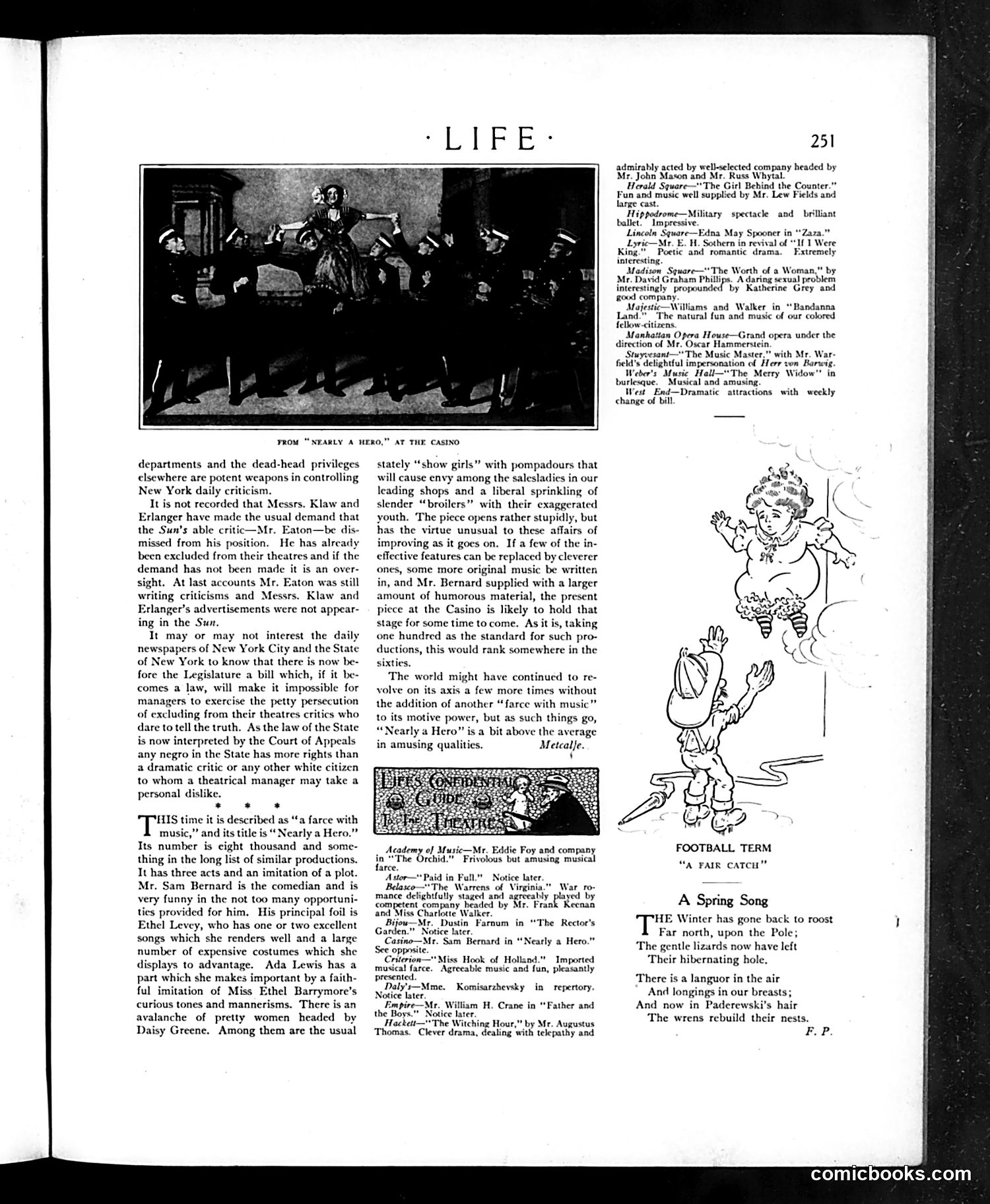
This page reviews a Broadway farce titled "Nearly a Hero," performed at the Casino theater, starring Sam Bernard and Ethel Levey. The critic (Metcalfe) describes it as a typical musical comedy—one of "eight thousand" similar productions—with standard elements: comedians, pretty chorus girls ("show girls" with fashionable pompadours), and expensive costumes. The review offers backhanded praise: the plot is thin and opening "rather stupid," but it improves as it progresses. Bernard provides humor where opportunities allow; Levey performs well despite limited material. Overall, ranking such productions at 100 as standard, this rates around sixty. The page also contains significant commentary criticizing theatrical managers Klaw and Erlanger for excluding critics from their theaters—a petty form of censorship targeting those who "dare to tell the truth." The illustration shows a scene from the production.
📄 Transcribed text from this page (OCR, searchable)
Machine-transcribed from the original scan — historical spelling and the odd misread are preserved.
YROM “NEARLY A HERO," AT THE CASINO departments and the dead-head privileges elsewhere are potent weapons in controlling New York daily criticism. It is not recorded that Messrs. Klaw and Erlanger have made the usual demand that the Sun’s able critic—Mr. Eaton—be dis- missed from his position. He has already been excluded from their theatres and if the demand has not been made it is an over: sight. At last accounts Mr. Eaton was still writing criticisms and Messrs. Klaw and Erlanger’s advertisements were not appear- ing in the Sun. It may or may not interest the daily newspapers of New York City and the State of New York to know that there is now be- fore the Legislature a bill which, if it be- comes a law, will make it impossible for managers to exercise the petty persecution of excluding from their theatres critics who dare to tell the truth. As the law of the State is now interpreted by the Court of Appeals any negro in the State has more rights than a dramatic critic or any other white citizen to whom a theatrical manager may take a personal dislike. * 8 8 'HIS time it is described as “ta farce with music,” and ‘tle is “ Nearly a Hero.” Its number is cight thousand and some- thing in the long list of similar productions. It has three acts and an imitation of a plot. Mr. Sam Bernard is the comedian and is very funny in the not too many opportuni- tics provided for him. His principal foil is Ethel Levey, who has one or two excellent songs which she renders well and a large number of expensive costumes which she displays to advantage. Ada Lewis has a part which she makes important by a faith- ful imitation of Miss Ethel Barrymore's curious tones and mannerisms. There is an avalanche of pretty women headed by Daisy Greene. Among them are the usual stately “show girls” with pompadours that will cause envy among the salesladies in our leading shops and a liberal sprinkling of slender “broilers” with their exaggerated youth. ‘The piece opens rather stupidly, but has the virtue unusual to these affairs of improving as it gocs on. If a few of the in- effective features can be replaced by cleverer ‘ones, some more original music be written in, and Mr. Bernard supplied with a larger amount of humorous material, the present piece at the Casino is likely to hold that stage for some time to come. As it is, taking one hundred as the standard for such pro- ductions, this would rank somewhere in the sixtie The world might have continued to re- volve on its axis a few more times without the addition of another “farce with music” to its motive power, but as such things go, “Nearly a Hero” is a bit above the average in amusing qualities. Metcalfe. ' Academy of Music—Mr. Eddie Foy and company in'The Orchid.” Frivolous but amusing musical farce. Astor—"Paid in Full."” Notice later. Belasco—"The Warrens of Virginia.” War ro- mance delightfully staged and agreeably played by competent company headed by Mr. Frank Kecaan and Miss Charlotte Walker. Bijow—Mr. Dustin Farnum in “The Rector's Garden.” Notice later. Casino—Mr. Sam Bernard in “Nearly a Hero.” See opprsite Criterion—" Miss Hook of Holland." Imported musical farce. Agreeable music and fun, pleasantly presented. Daly's—Mme. Notice later. Empire—Mr. William H. Crane in “Father and the Boys." Notice later. Heckett—" The Witching Hour,” by Mr. Augustus ‘Thomas. Clever drama, dealing with telepathy and Komisarzhevsky in repertory. 251 admirably acted by wellsselected company headed by Mr. John Mason and Mr. Russ Whytal. Herald Square—""The Girl Behind the Counter.” Fun and music well supplied by Mr. Lew Fields and large cast. Hippodrome—Military ballet. Impressive. Lincoln Square—Eaina May Spooner in **Zaza.”" Lyric—Mr. E. H. Sothern in revival of “If 1 Were i&."" Poetic and romantic drama. Extremely interesting Madison Square—""The Worth of a Woman,” by 1. David Graham Phillips. A daring sexual problem interestingly propounded by Katherine Grey and good company Majestic—Williams and Walker in “Bandana Land.” ‘The natural fun and music of our colored fellow -citizens. Manhattan Opera House—Grand opera under the direction of Mr. Oscar Hammerstein. Stuyvesant—"The Music Master.” with Mr. War- field's delightful impersonation of Herr von Barwig. Weber's Music Hell—"The Merry Widow" in burlesque. “Musical and amusing West End—Dramatic attractions with weekly change of bill. spectacle and brilliant FOOTBALL TERM “A PAIR CATCH” A Spring Song HE Winter has gone back to roost Far north, upon the Pole; The gentle lizards now have left Their hibernating hole. ‘There is a languor in the air And longings in our breasts; And now in Paderewski’s hair The wrens rebuild their nests. F. P. comicbooks.com