
Life, 1908-03-05 · page 20 of 36
Life — March 5, 1908 — page 20: what you’re looking at
What you’re looking at
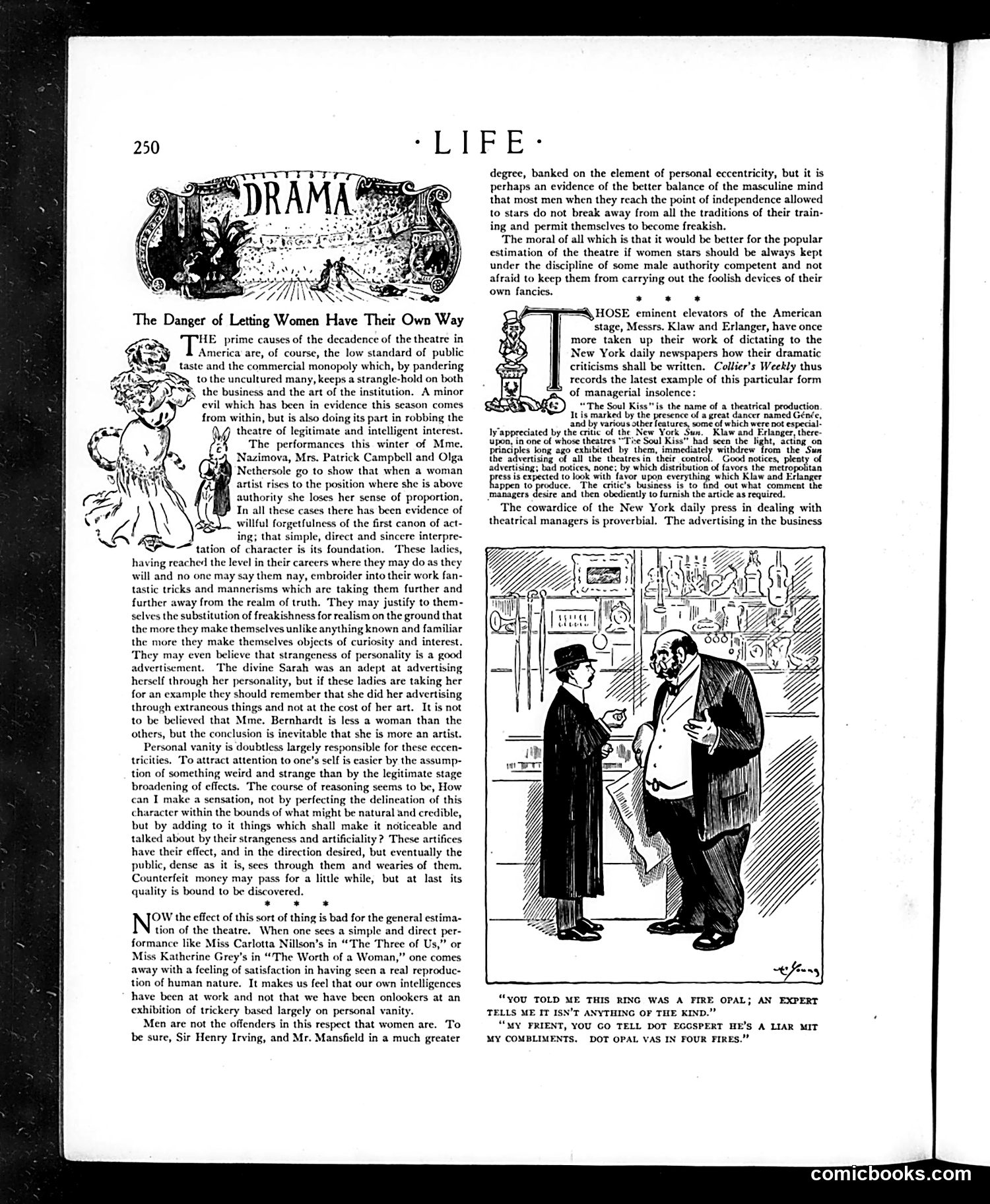
This article criticizes prominent actresses—specifically naming **Nazimova, Mrs. Patrick Campbell, and Olga Nethersole**—for prioritizing eccentric theatrical mannerisms and self-promotion over genuine, truthful acting once they achieved star status. The author argues these women have abandoned the "first canon of acting: simple, direct and sincere interpretation of character." Instead, they employ "fantastic tricks and mannerisms" to attract attention through strangeness rather than artistic merit. The piece contrasts their approach unfavorably with **Sarah Bernhardt**, who maintained artistic integrity despite her celebrated personality. The accompanying cartoon depicts two men discussing a fraudulent ring, using this as a metaphor: just as counterfeit money eventually fails, so too will these actresses' artificial performances eventually lose audience credibility. The author suggests male stars (Irving, Mansfield) engage in similar behavior but to lesser degree, implying women lack masculine "balance." This reflects period sexism about female ambition and vanity.
📄 Transcribed text from this page (OCR, searchable)
Machine-transcribed from the original scan — historical spelling and the odd misread are preserved.
*LIPE* : HE, prime causes of the decadence of the theatre in aS America: are, of course, the low standard of public Siee@__taste and the commercial monopoly which, by pandering to the uncultured many, keeps a strangle-hold on both 54 DY TR, the business and the art of the institution. A minor y/” evil which has been in evidence this season comes 4) from within, but is also doing its part in robbing the M theatre of legitimate and intelligent interest. 7 y} “a9 The performances this winter of Mme. Nazimova, Mrs. Patrick Campbell and Olga Nethersole go to show that when a woman artist rises to the position where she is above authority she loses her sense of proportion, In all these cases there has been evidence of willful forgetfulness of the first canon of act- ing; that simple, direct and sincere interpre- f character is its foundation. ‘These ladies, having reached the level in their carcers where they may do as the will and no one may say them nay, embroider into their work fan- tastic tricks and mannerisms which are taking them further and further away from the realm of truth. ‘They may justify to them- selves the substitution of freakishness for realism on the ground that the more they make themselves unlike anything known and familiar the more they make themselves objects of curiosity and interest. They may even believe that strangeness of personality is a good advertisement. ‘The divine Sarah was an adept at advertising herself through her personality, but if these ladies are taking her for an example they should remember that she did her advertising through extrancous things and not at the cost of her art. It is not to be believed that Mme, Bernhardt is less a woman than the others, but the conclusion is inevitable that she is more an artist. Personal vanity is doubtless largely responsible for these eccen- tricities. To attract attention to one’s self is easier by the assump- tion of something weird and strange than by the legitimate stage broadening of effects. The course of reasoning seems to be, How can I make a sensation, not by perfecting the delineation of this character within the bounds of what might be natural and credible, but by adding to it things which shall make it noticeable and talked about by their strangeness and artificiality ? These artifices have their effect, and in the direction desired, but eventually the public, dense as it is, secs through them and wearies of them. Counterfeit. money may pass for a little while, but at last its quality is bound to be discovered. + * 8 No“ the effect of this sort of thing is bad for the general estima- tion of the theatre. When one secs a simple and direct per- formance like Miss Carlotta Nillson’s in “The Three of Us,” or Miss Katherine Grey’s in “The Worth of a Woman,” one comes away with a feeling of satisfaction in having scen a real reproduc- tion of human nature. It makes us feel that our own intelligences been at work and not that we have been onlookers at an ery based largely on personal vanity. Men are not the offenders in this respect that women are. ‘To be sure, Sir Henry Irving, and Mr. Mansfield in a much greater degree, banked on the element of personal eccentricity, but it is perhaps an evidence of the better balance of the masculine mind that most men when they reach the point of independence allowed to stars do not break away from all the traditions of their train- ing and permit themselves to become freakish. ‘The moral of all which is that it would be better for the popular estimation of the theatre if women stars should be always kept under the discipline of some male authority competent and not afraid to keep them from carrying out the foolish devices of their own fancies. cs € “<Q, HOSE eminent elevators of the American stage, Messrs. Klaw and Erlanger, have once more taken up their work of dictating to the New York daily newspapers how their dramatic criticisms shall be written. Collier’s Weekly thus q records the latest example of this particular form of managerial insolence: “The Soul Kiss" is the name of a theatrical production, It is marked by the presence of a great dancer named Gé . and by various other features, some of which were not especial ly‘appreciated by the critic of the New York Sux. Klaw and Erlanger, there- uppa, in one of whose theatres “Tse Soul Kiss" had seen the light, acting on Principles long ago exhibited by them, immediately withdrew trom the Sum the advertising of all the theatres in their control. Good notices, plenty of advertising; bad notices, none; by which distribution of favors the metropolitan press is expected to look with favor upon everything which Klaw and Erlanger ppen to produce. The critic's business is to find out what comment the managers desire and then obediently to furnish the article as required. The cowardice of the New York daily press in dealing with theatrical managers is proverbial. The advertising in the business “YOU TOLD ME THIS RING WAS A FIRE OPAL; AN EXPERT TELLS ME IT ISN’T ANYTHING OF THE KIND.” “MY FRIENT, YOU GO TELL DOT EGGSPERT HE’S A LIAR MIT MY COMBLIMENTS. DOT OPAL VAS IN FOUR FIRES.” comicbooks.com