
Life, 1908-03-05 · page 14 of 36
Life — March 5, 1908 — page 14: what you’re looking at
What you’re looking at
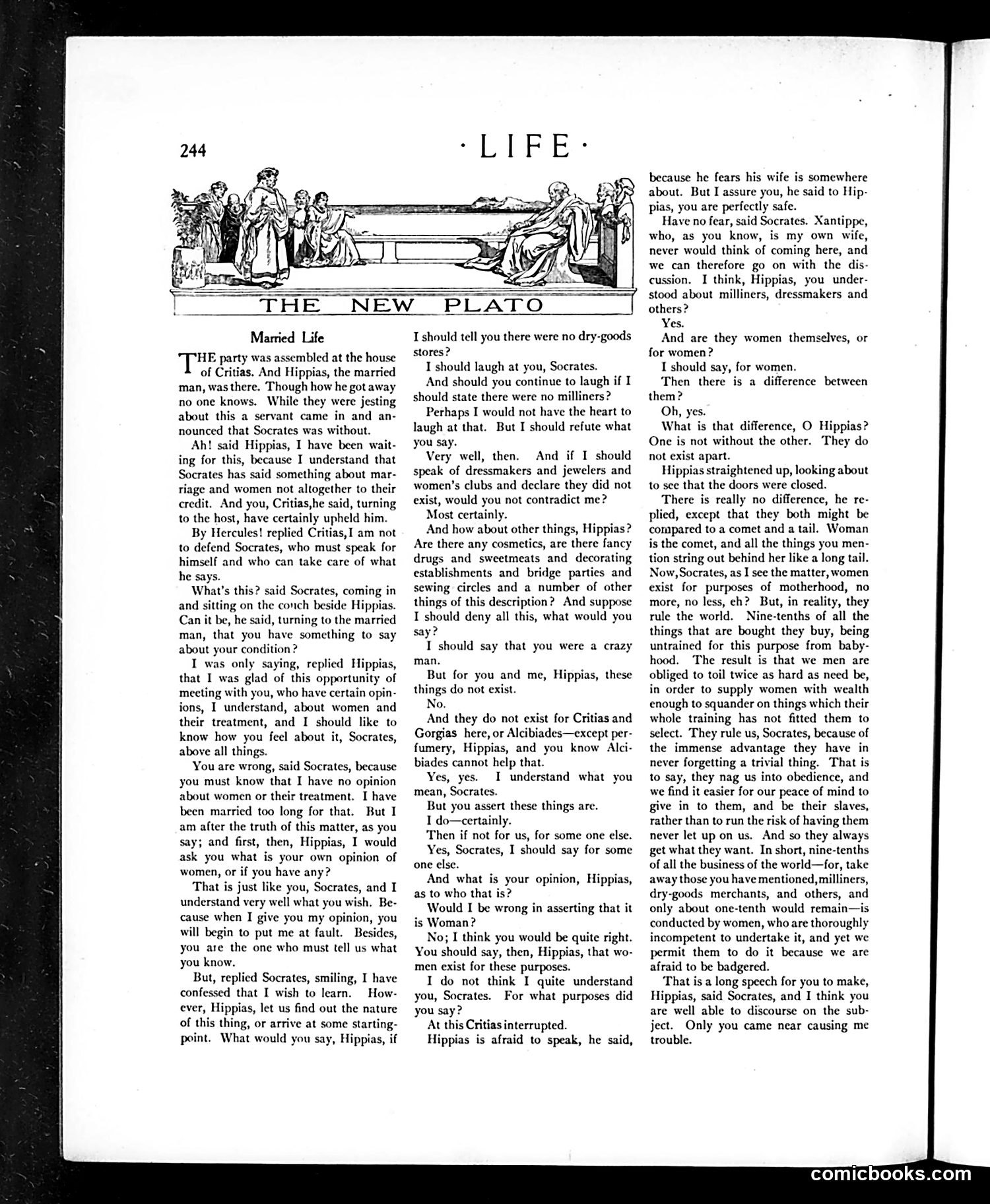
This satirical piece mimics Plato's dialogues, presenting Socrates questioning Hippias (a married man) about women's social role. The satire operates on multiple levels: **The Setup**: Socrates feigns ignorance while leading Hippias into logical traps—a classic Socratic method. He establishes that women patronize milliners, dressmakers, jewelers, cosmetics shops, and sewing circles, then concludes women exist *for these purposes*. **The Joke**: The satire mocks both 1) men who view women primarily as consumers and decorative objects, and 2) the pretense of philosophical debate around women's treatment. Hippias fears his wife's disapproval, while Socrates brags that his wife Xantippe wouldn't dare attend—referencing the historical figure's reputation for shrewishness. **Social Critique**: The piece satirizes contemporary attitudes reducing women to their consumption habits and ornamental function, while simultaneously critiquing male anxiety about female independence and opinion.
📄 Transcribed text from this page (OCR, searchable)
Machine-transcribed from the original scan — historical spelling and the odd misread are preserved.
Married Life TH party was assembled at the house of Critias. And Hippias, the married man, was there. Though how he got away no one knows. While they were jesting about this a servant came in and an- nounced that Socrates was without. Ah! said Hippias, I have been wait- ing for this, because I understand that Socrates has said something about mar- riage and women not altogether to their credit. And you, Critias,he said, turning to the host, have certainly upheld him. By Hercules! replied Critias,I am not to defend Socrates, who must speak for himself and who can take care of what he says. What's this? said Socrates, coming in and sitting on the conch beside Hippias. Can it be, he said, turning to the married man, that you have something to say about your condition? I was only saying, replied Hippias, that I was glad of this opportunity of meeting with you, who have certain opin- ions, I understand, about women and their treatment, and I should like to know how you feel about it, Socrates, above all things. You are wrong, said Socrates, because you must know that I have no opinion about women or their treatment. I have been married too long for that. But I am after the truth of this matter, as you say; and first, then, Hippias, I would ask you what is your own opinion of women, or if you have any? That is just like you, Socrates, and I understand very well what you wish. Be- cause when I give you my opinion, you will begin to put me at fault. Besides, you are the one who must tell us what you know. But, replied Socrates, smiling, I have confessed that I wish to learn. How- ever, Hippias, let us find out the nature of this thing, or arrive at some starting- point. What would you say, Hippias, if I should tell you there were no dry-goods stores? I should laugh at you, Socrates. And should you continue to laugh if I should state there were no milliners? Perhaps I would not have the heart to laugh at that. But I should refute what you say. Very well, then. And if I should speak of dressmakers and jewelers and women’s clubs and declare they did not exist, would you not contradict me? Most certainly. ‘And how about other things, Hippias? Are there any cosmetics, are there fancy drugs and sweetmeats and decorating establishments and bridge parties and sewing circles and a number of other things of this description? And suppose I should deny all this, what would you say? I should say that you were a crazy man. But for you and me, Hippias, these things do not exist. No. And they do not exist for Critias and Gorgias here, or Alcibiades—except per- fumery, Hippias, and you know Alci- biades cannot help that. Yes, yes. I understand what you mean, Socrates. But you assert these things are. I do—certainly. Then if not for us, for some one else. Yes, Socrates, I should say for some one else. And what is your opinion, Hippias, as to who that is? Would I be wrong in asserting that it is Woman? No; I think you would be quite right. You should say, then, Hippias, that wo- men exist for these purposes. I do not think I quite understand you, Socrates. For what purposes did you say? At this Critias interrupted. Hippias is afraid to speak, he said, because he fears his wife is somewhere about. But I assure you, he said to Hip- pias, you are perfectly safe. Have no fear, said Socrates. Xantippe, who, as you know, is my own wife, never would think of coming here, and we can therefore go on with the dis- cussion. I think, Hippias, you under- stood about milliners, dressmakers and others? Yes. And are they women themselves, or for women? I should say, for women. Then there is a difference between them? Oh, yes. What is that difference, O Hippias? One is not without the other. They do not exist apart. Hippias straightened up, looking about to sce that the doors were closed. There is really no difference, he re- plied, except that they both might be compared to a comet and a tail. Woman is the comet, and all the things you men- tion string out behind her like a long tail. Now, Socrates, as I see the matter, women exist for purposes of motherhood, no more, no less, eh? But, in reality, they rule the world. Nine-tenths of all the things that are bought they buy, being untrained for this purpose from baby- hood. The result is that we men are obliged to toil twice as hard as need be, in order to supply women with wealth enough to squander on things which their whole training has not fitted them to select. They rule us, Socrates, because of the immense advantage they have in never forgetting a trivial thing. That is to say, they nag us into obedience, and we find it easier for our peace of mind to give in to them, and be their slaves, rather than to run the risk of having them never let up on us. And so they always get what they want. In short, nine-tenths of all the business of the world—for, take away those you have mentioned, milliners, dry-goods merchants, and others, and only about one-tenth would remain—is conducted by women, who are thoroughly incompetent to undertake it, and yet we permit them to do it because we are afraid to be badgered. That is a long speech for you to make, Hippias, said Socrates, and I think you are well able to discourse on the sub- ject. Only you came near causing me trouble. comicbooks.com