
Life, 1908-03-05 · page 17 of 36
Life — March 5, 1908 — page 17: what you’re looking at
What you’re looking at
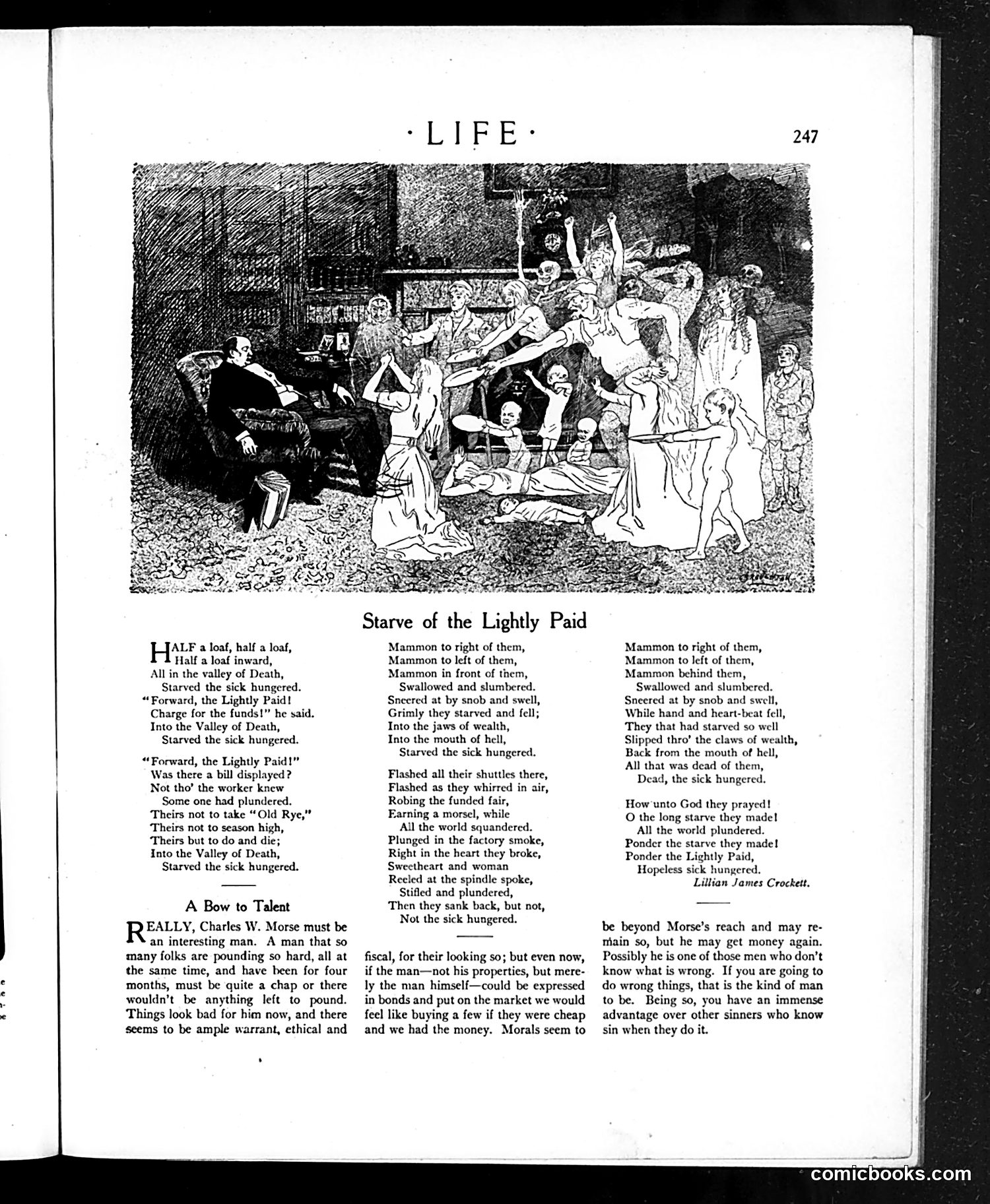
This page contains two satirical pieces critiquing industrial-era labor conditions and wealthy financiers. **"Starve of the Lightly Paid"** is a dark parody of Tennyson's "Charge of the Light Brigade," replacing military heroism with factory workers' exploitation. The poem depicts underpaid laborers—mill workers, spinners—starving while enriching "Mammon" (wealth/greed personified). The imagery shows them "plunged in factory smoke," their bodies breaking, yet continuing to labor. The repeated refrain "Starved the sick hungered" emphasizes their desperation and the indifference of the wealthy "snobs." **"A Bow to Talent"** discusses Charles W. Morse, a financier apparently under attack for four months (timing unclear from this page alone). The author notes Morse faces ethical criticism, yet remarks cynically that if his personal character could be "put on the market...we would feel like buying" if cheap enough—satirizing how wealth transcends morality. The piece suggests those who commit wrongs without recognizing them as such gain an "immense advantage" over conscience-stricken sinners. Both pieces critique class inequality and financial amorality.
📄 Transcribed text from this page (OCR, searchable)
Machine-transcribed from the original scan — historical spelling and the odd misread are preserved.
‘ALF a loaf, half a loaf, Half a loaf inward, All in the valley of Death, Starved the sick hungered. “Forward, the Lightly Paid! Charge for the funds!” he said. Into the Valley of Death, Starved the sick hungered. “Forward, the Lightly Paid!” Was there a bill displayed ? Not tho’ the worker knew Some one had plundered. Theirs not to take “Old Rye,” ‘Theirs not to season high, Theirs but to do and die; Into the Valley of Death, Starved the sick hungered. A Bow to Talent EALLY, Charles W. Morse must be an interesting man. A man that so many folks are pounding so hard, all at the same time, and have been for four months, must be quite a chap or there wouldn’t be anything left to pound. Things look bad for him now, and there seems to be ample warrant, ethical and Starve of the Lightly Paid Mammon to right of them, Mammon to left of them, Mammon in front of them, Swallowed and slumbered. Sncered at by snob and swell, Grimly they starved and fell; Into the jaws of wealth, Into the mouth of hell, Starved the sick hungered. Flashed all their shuttles there, Flashed as they whirred in air, Robing the funded fair, Earning a morsel, while All the world squandered. Plunged in the factory smoke, Right in the heart they broke, Sweetheart and woman Reeled at the spindle spoke, Stifled and plundered, Then they sank back, but not, Not the sick hungered. fiscal, for their looking so; but even now, if the man—not his properties, but mere- ly the man himself—could be expressed in bonds and put on the market we would feel like buying a few if they were cheap and we had the money. Morals seem to Mammon to right of them, Mammon to left of them, Mammon behind them, Swallowed and slumbered. Sneered at by snob and swell, While hand and heart-beat fell, They that had starved so well Slipped thro’ the claws of wealth, Back from the mouth of hell, All that was dead of them, Dead, the sick hungered. How unto God they prayed! O the long starve they made! All the world plundered. Ponder the starve they made! Ponder the Lightly Paid, Hopeless sick hungered. Lillian James Crockett. be beyond Morse’s reach and may re- miain so, but he may get money again. Possibly he is one of those men who don’t know what is wrong. If you are going to do wrong things, that is the kind of man to be. Being so, you have an immense advantage over other sinners who know sin when they do it. comicbooks.com