
Life, 1908-03-05 · page 16 of 36
Life — March 5, 1908 — page 16: what you’re looking at
What you’re looking at
This page documents readers' responses to Life's February 6, 1908 article criticizing Jewish behavior. The controversy reveals early 20th-century tensions around Jewish assimilation and ethnic stereotyping. **Key points:** - Life apparently published satirical cartoons depicting Jews negatively, prompting complaints from both Jewish and non-Jewish readers - One advertiser threatened to withdraw support over Life's "antagonizing" the Jewish race - Responses vary: some Jewish readers defend Life's right to satirize, others demand internal Jewish community accountability ("disavow...unworthy members") - A German-born Jewish citizen praises Life's "dignity" and "fairness" - The debate centers on whether ethnic groups should self-police their members to avoid collective blame **The underlying assumption:** that ethnic/religious communities bear collective responsibility for individual members' behavior—a prejudicial framework Life's defenders seemingly endorse. The page itself becomes evidence of period anti-Jewish sentiment masquerading as reasonable critique.
📄 Transcribed text from this page (OCR, searchable)
Machine-transcribed from the original scan — historical spelling and the odd misread are preserved.
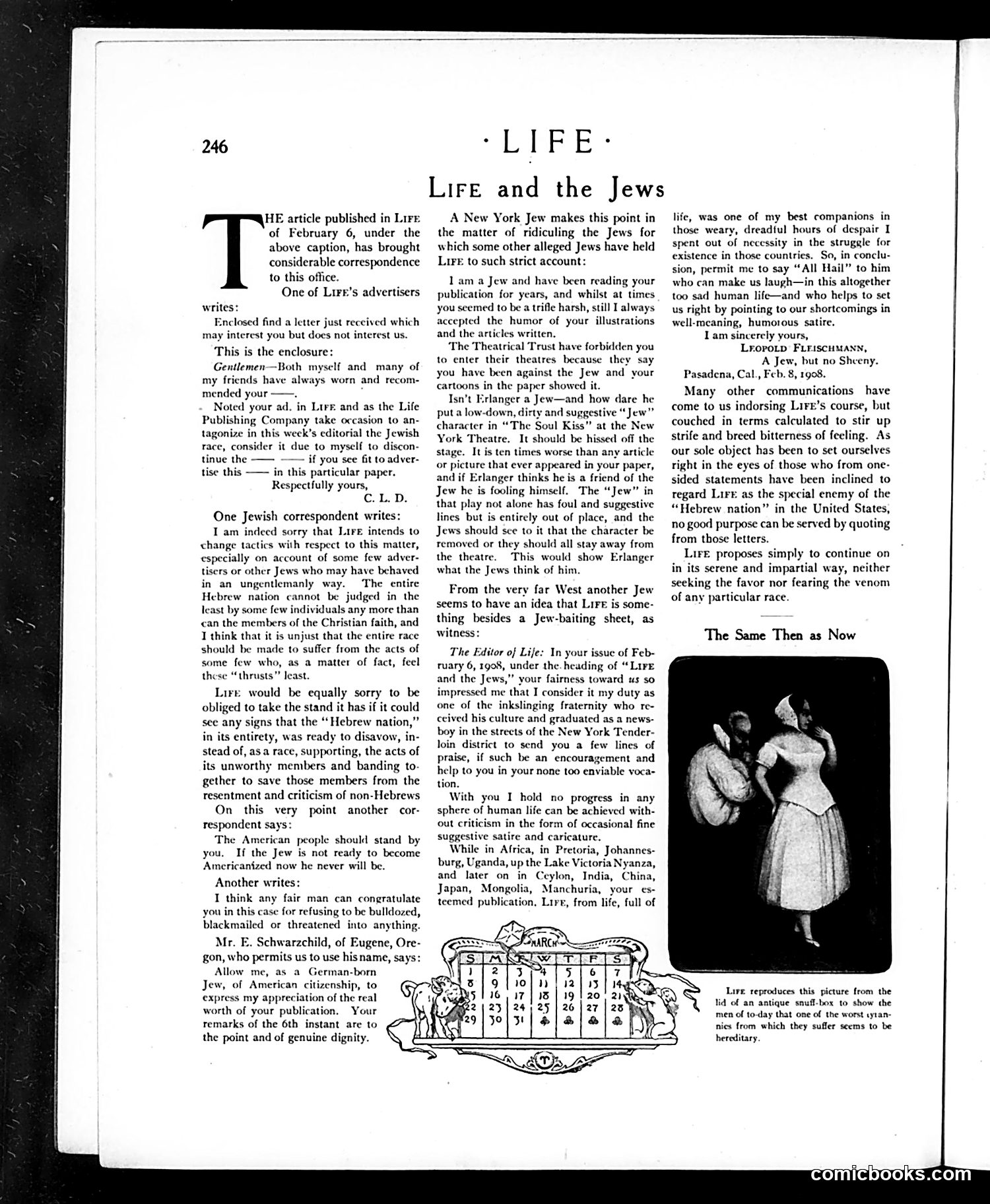
HE article published in Lire of February 6, under the above caption, has brought considerable correspondence to this office. One of Lirr’s advertisers writes: nclosed find a letter just received which may interest you but does not interest us. This is the enclosure: Gentlemen—Both myself and many of my friends have always worn and recom- mended your —. Noted your ad. in Lire. and as the Life Publishing Company take occasion to an- tagonize in this week's editorial the Jewish race, consider it due to myself to discon- tinue the — if you sce fit to adver- tise this in this particular paper. Respectfully yours, Cc. L. D. One Jewish correspondent writes: I am indeed sorry that Lire intends to change tactics with respect to this matter, especially on account of some few adver- tisers or other Jews who may have behaved in an ungentlemanly way. ‘The entire Hebrew nation cannot be judged in the least by some few individuals any more than can the members of the Christian faith, and I think that it is unjust that the entire race should be made to suffer from the acts of some few who, as a matter of fact, feel these “thrusts” least. Lire would be equally sorry to be obliged to take the stand it has if it could see any signs that the “Hebrew nation,” in its entirety, was ready to disavow, in- stead of, asa race, supporting, the acts of its unworthy members and banding to- gether to save those members from the resentment and criticism of non-Hebrews On this very point another cor- respondent says: The American people should stand by you, If the Jew is not ready to become Americanized now he never will be. Another writes: I think any fair man can congratulate you in this case for refusing to be bulldozed, blackmailed or threatened into anything. Mr. E. Schwarzchild, of Eugene, Ore- gon, who permits us to use hisname, says: Allow me, as a German-born Jew, of American citizenship, to express my appreciation of the real worth of your publication. Your remarks of the 6th instant are to the point and of genuine dignity. ~LIPE~ Lire and the Jews A New York Jew makes this point in the matter of ridiculing the Jews for which some other alleged Jews have held Lire to such strict account: 1 am a Jew and have been reading your publication for years, and whilst at times you seemed to be a trifle harsh, still I always, accepted the humor of your illustrations and the articles written. ‘The Theatrical Trust have forbidden you to enter theit theatres because they say you have been against the Jew and your cartoons in the paper showed it. Isn’t Erlanger a Jew—and how dare he puta low-down, dirty and suggestive “Jew” character in “The Soul Kiss” at the New York Theatre. It should be hissed off the stage. It is ten times worse than any article or picture that ever appeared in your paper, and if Erlanger thinks he is a friend of the Jew he is fooling himself. The “Jew” in that play not alone has foul and suggestive lines but is entirely out of place, and the Jews should sce to it that the character be removed or they should all stay away from the theatre. This would show Erlanger what the Jews think of him. From the very far West another Jew seems to have an idea that Lire is some- thing besides a Jew-baiting sheet, as witness The Editor of Lije: In your issuc of Feb- ruary 6, 1908, under the. heading of “Lire and the Jews,” your fairness toward us so impressed me that I consider it my duty as one of the inkslinging fraternity who re- ceived his culture and graduated as a news- boy in the strects of the New York Tender- loin district to send you a few lines of praise, if such be an encouragement and help to you in your none too enviable voca- tion. With you I hold no progress in any sphere of human life can be achieved with- out criticism in the form of occasional fine suggestive satire and caricature, While in Africa, in Pretoria, Johannes- burg, Uganda, up the Lake Victoria Nyanza, and later on in Ceylon, India, China, Japan, Mongolia, Manchuria, your es- teemed publication, Lire, from life, full of life, was one of my best companions in those weary, dreadiul hours of despair I spent out of necessity in the struggle for existence in those countries. So, in conclu- sion, permit me to say “All Hail” to him who can make us laugh—in this altogether too sad human life—and who helps to set us right by pointing to our shortcomings in well-meaning, humoious satire. Iam sincerely yours, Lropotp FLriscuna: A Jew, but no Sheeny. Pasadena, Cal., Feb. 8, 1908. Many other communications have come to us indorsing Lirr’s course, but couched in terms calculated to stir up strife and breed bitterness of feeling. As our sole object has been to set ourselves right in the eyes of those who from one- sided statements have been inclined to regard Lirr as the special enemy of the “Hebrew nation” in the United States, no good purpose can be served by quoting from those letters. Lire proposes simply to continue on in its serene and impartial way, neither seeking the favor nor fearing the venom of any particular race. The Same Then as Now Lire. reproduces this picture from the lid of an antique snuf-box to show the men of to-day that one of the worst cytan- nies from which they suffer seems to be hereditary.