
A complete issue · 36 pages · 1907
Life — May 16, 1907
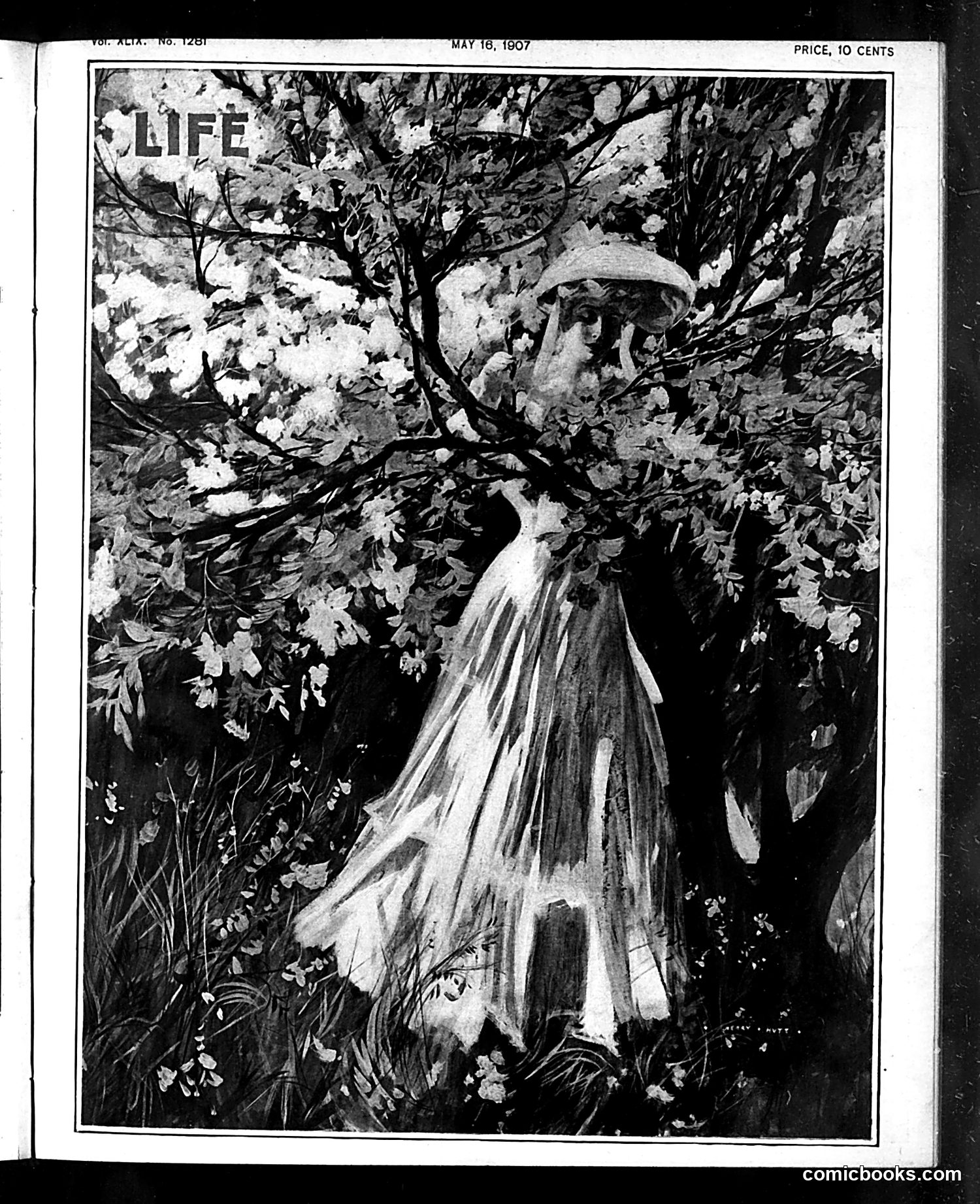
This Life magazine cover from May 16, 1907 shows a woman in an elegant white dress and hat standing among flowering bushes and trees. The image appears to be a romanticized illustration rather than political satire or commentary. Without visible text identifying the subject, I cannot definitively state who this figure represents or what specific social/political message, if any, the image conveys. It may be: - A fashion or lifestyle illustration typical of Life's non-satirical content - A reference to a contemporary society figure or event - Decorative seasonal artwork celebrating spring The artistic style is consistent with early 1900s magazine illustration, but the satirical intent—if present—is unclear from the image alone. Additional context or caption text would be needed to determine the intended meaning.
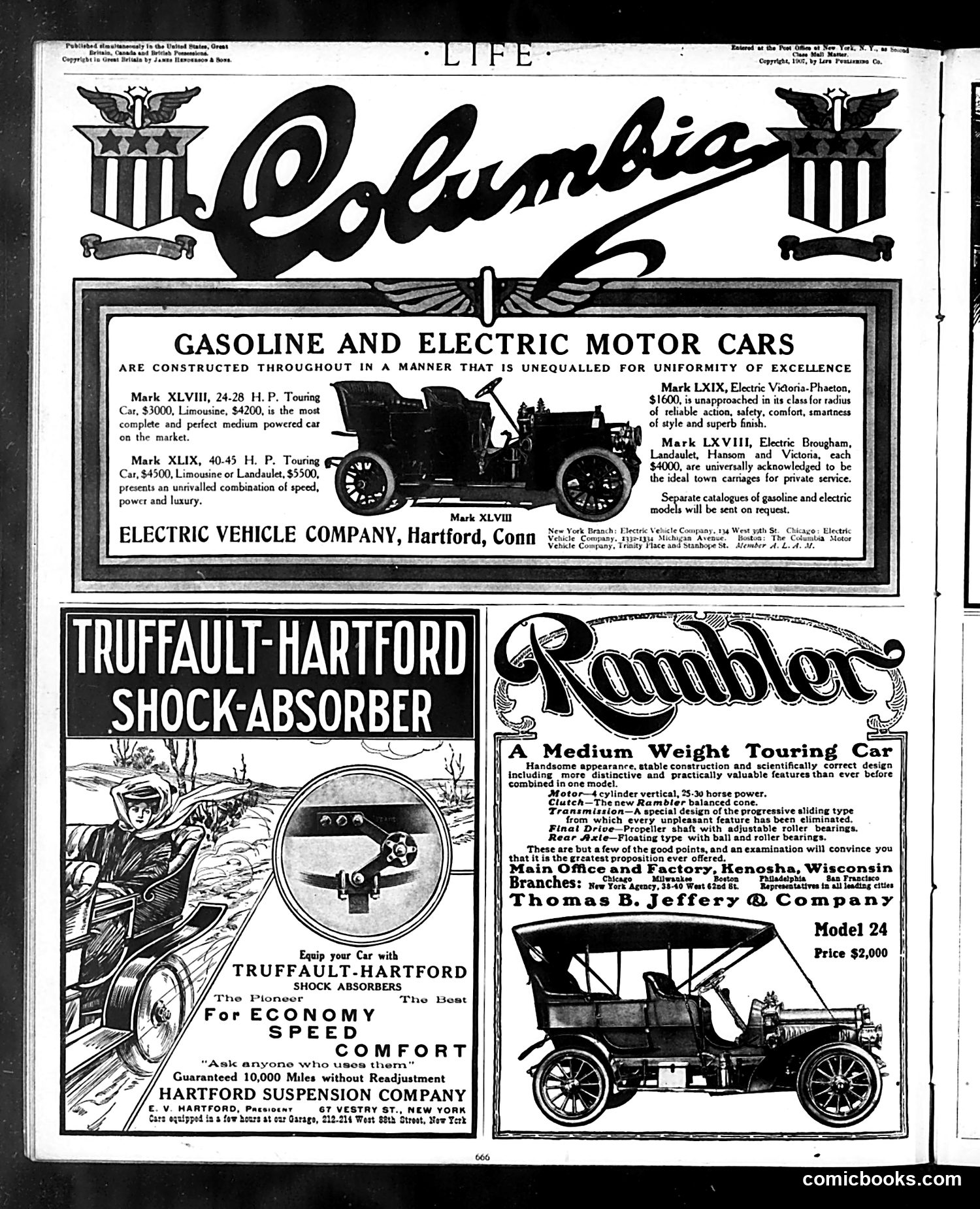
This page is **primarily advertising**, not satirical content. It features three automobile advertisements from the early 1900s: 1. **Columbia** (top): Promotes gasoline and electric motor cars, emphasizing quality and uniformity across models like the Mark XLVIII and Mark XLIX. 2. **Truffault-Hartford Shock-Absorber** (bottom left): Shows a driver being jostled, advertising suspension improvements for "economy, speed, comfort." 3. **Rambler** (bottom right): A medium-weight touring car priced at $2,000, manufactured by Thomas B. Jeffery Company in Kenosha, Wisconsin. The page reflects the early automotive era when electric cars competed alongside gasoline vehicles, and manufacturers heavily advertised technical innovations like shock absorbers as selling points. No political satire is evident here—it's a straightforward commercial publication.
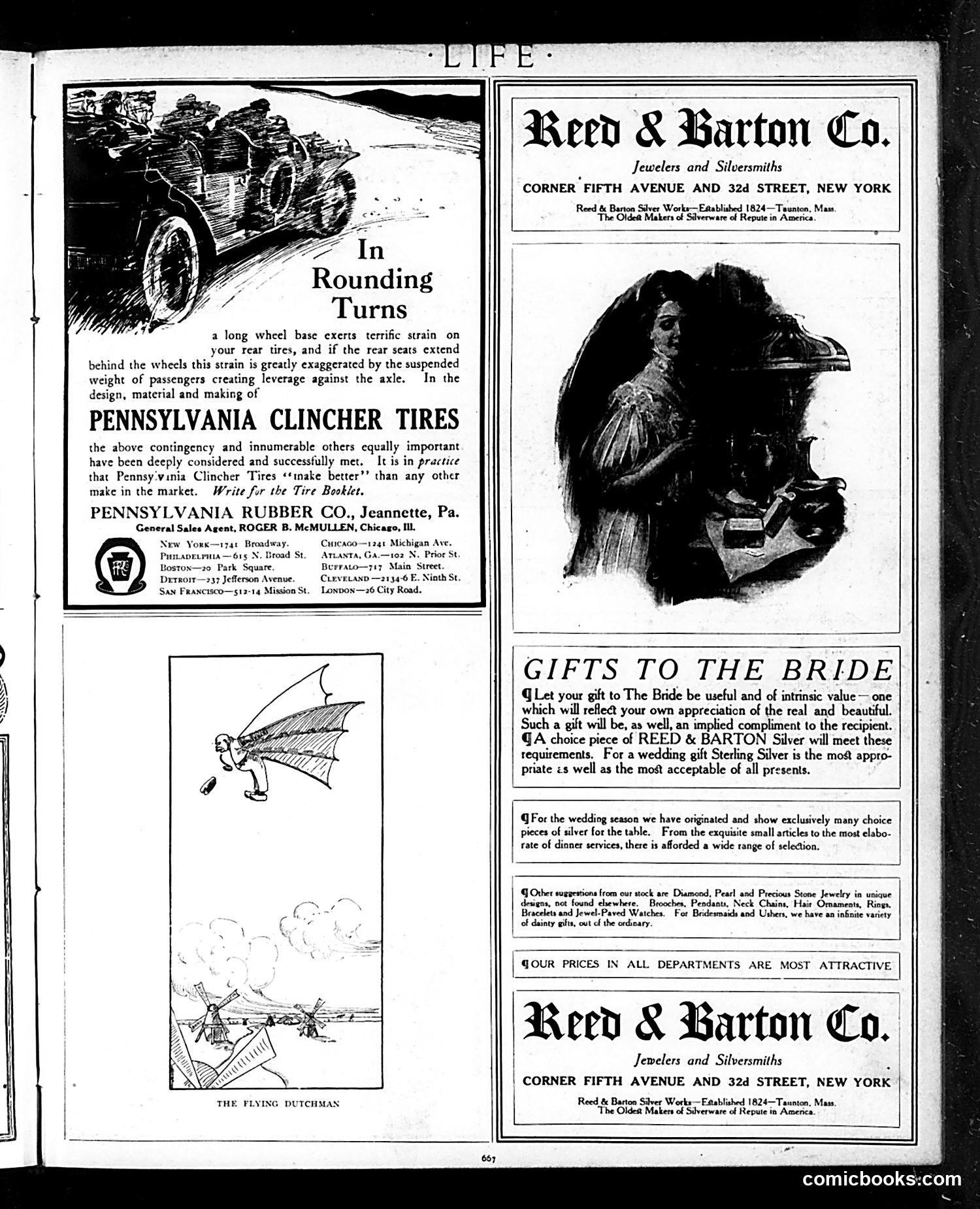
This page is primarily **advertising**, not political satire. The left side features a Pennsylvania Clincher Tires advertisement emphasizing durability during sharp turns, with an illustration labeled "The Flying Dutchman" showing a vintage car and windmill scene—likely a whimsical reference rather than political commentary. The right side contains two Reed & Barton Co. advertisements promoting silverware and jewelry as wedding gifts. The illustrations show decorative items and a woman's portrait. There is **no political cartoon or satire** on this page. "Life" magazine, while known for satirical content, regularly included commercial advertisements. This appears to be a standard issue page mixing product promotion with occasional humorous illustrations, reflecting early 20th-century magazine publishing practices.
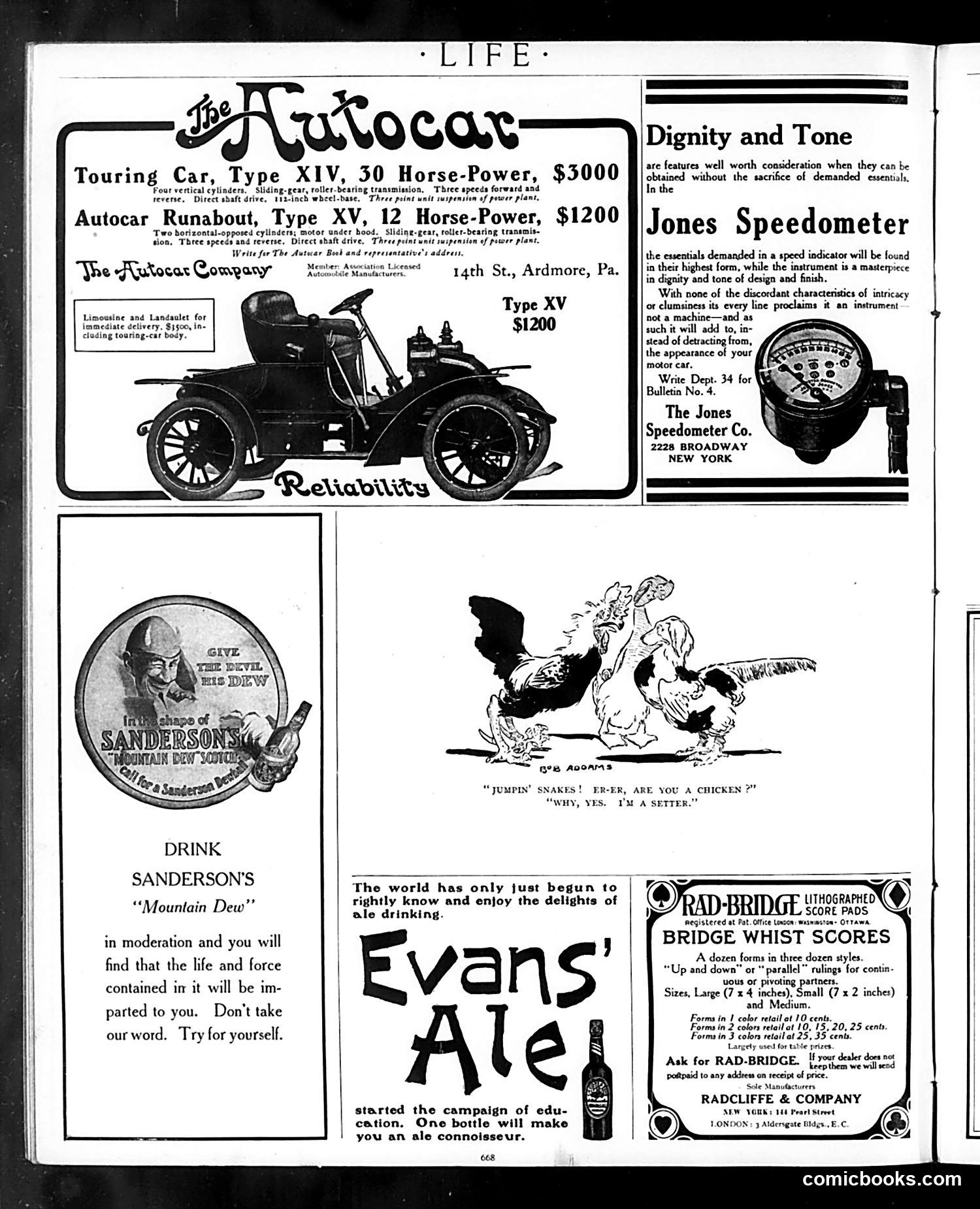
This page is predominantly **advertising**, not political satire. The main content includes: **Autocar automobile ads** (top) promoting three car models at various prices ($1200-$3000), emphasizing reliability and features. **Jones Speedometer ad** (right), marketing precision instruments for automobiles. **Sanderson's Mountain Dew** (left), advertising a beverage for consumption "in moderation." **Evans' Ale** (center), promoting beer as educational—the ad humorously claims one bottle makes you "an ale connoisseur." **Rad-Bridge whist score cards** (lower right) for the card game bridge. The only cartoon is a small humorous illustration (credited "O'E Adams") showing animals in some interaction, with dialogue about chickens and setters—appears to be simple animal humor unrelated to politics.
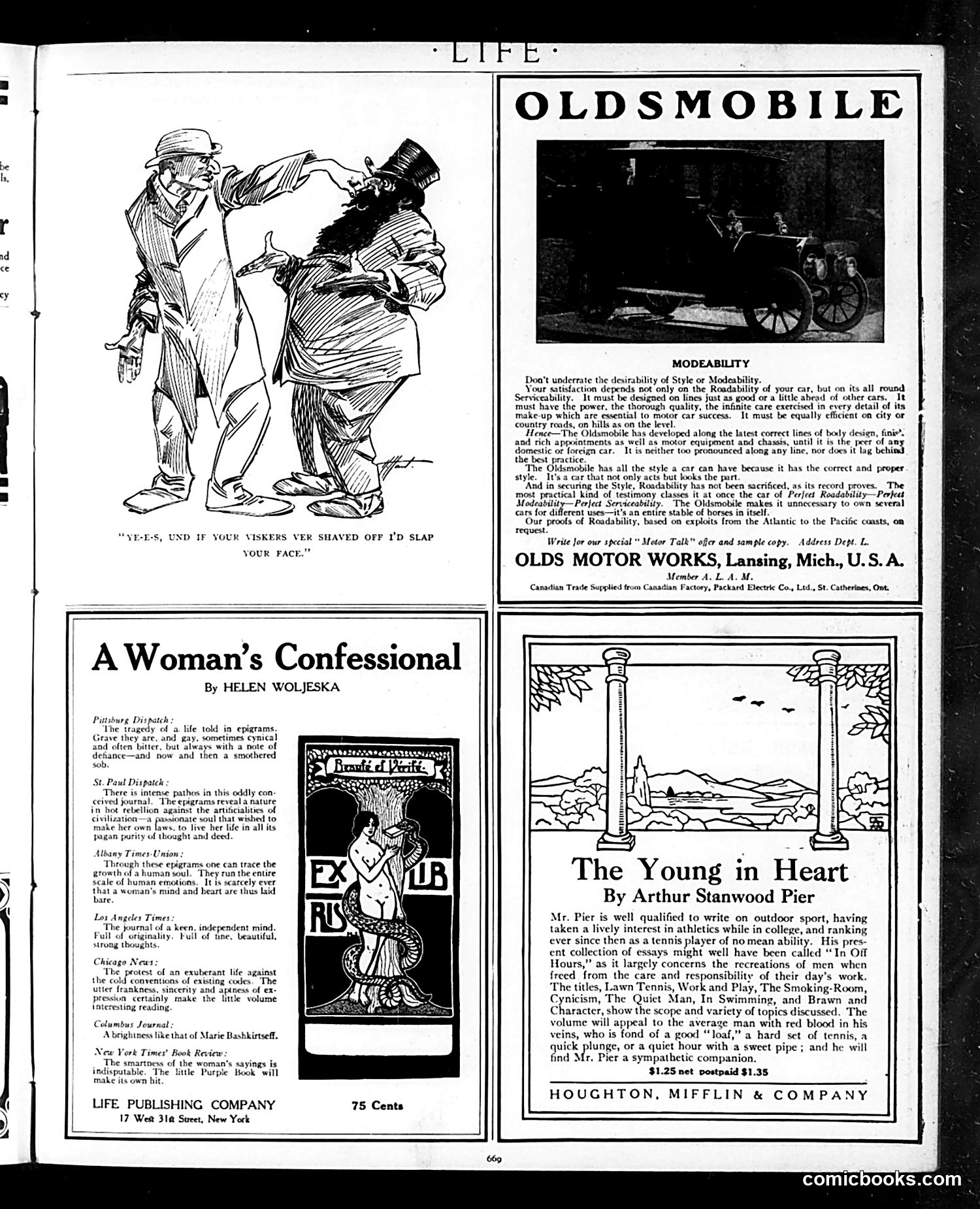
The page is primarily **advertisements and book reviews** rather than political satire. The cartoon at top-left appears to be a humorous illustration accompanying the caption "YE-S, UND IF YOUR VISKERS VER SHAVED OFF I'D SLAP YOUR FACE," depicting an exaggerated confrontation between two men. The accent suggests mockery of German or Eastern European speech patterns, likely reflecting early 20th-century immigrant humor common in American satirical magazines. The rest of the page contains book advertisements: "A Woman's Confessional" by Helen Woljeska, an Oldsmobile car advertisement emphasizing "Modeability," and Arthur Stanwood Pier's "The Young in Heart." These are straightforward commercial promotions rather than satirical commentary.
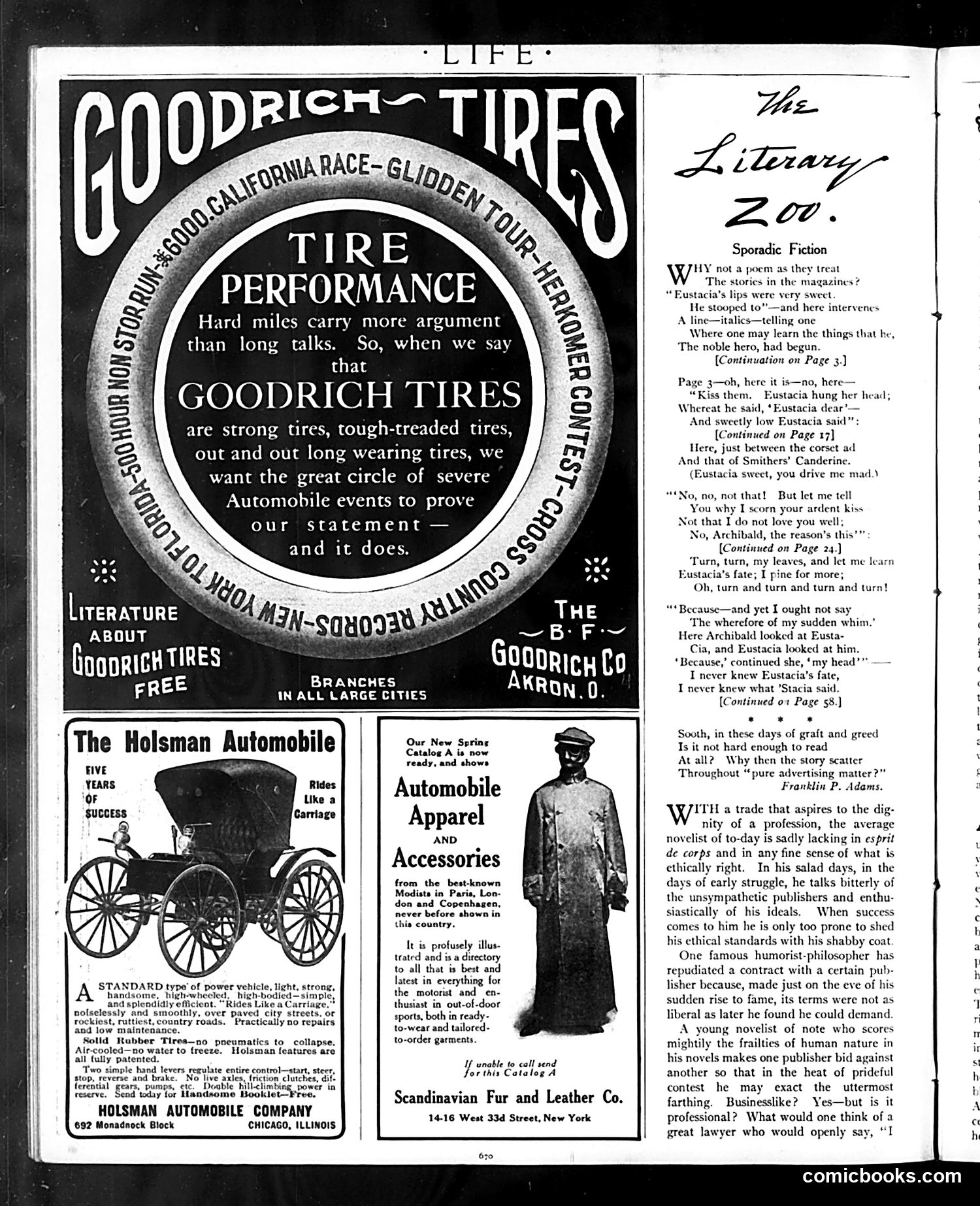
This page is primarily **advertising**, not satire or political commentary. The major content consists of three advertisements: 1. **Goodrich Tires** - emphasizes durability through performance testing ("Hard miles carry more argument than long talks") 2. **Holsman Automobile** - promotes a vehicle model with "five years of success," highlighting rubber tires and smooth operation on city streets 3. **Scandinavian Fur and Leather Co.** - advertises apparel and accessories The right column contains "The Literary Zoo," a satirical fiction piece about characters named Eustacia and Archibald—literary satire unrelated to the advertisements. The editorial commentary critiques contemporary novelists for lacking "esprit de corps" and ethical standards in their work. This is a typical early-20th-century magazine page mixing consumer advertising with literary content.
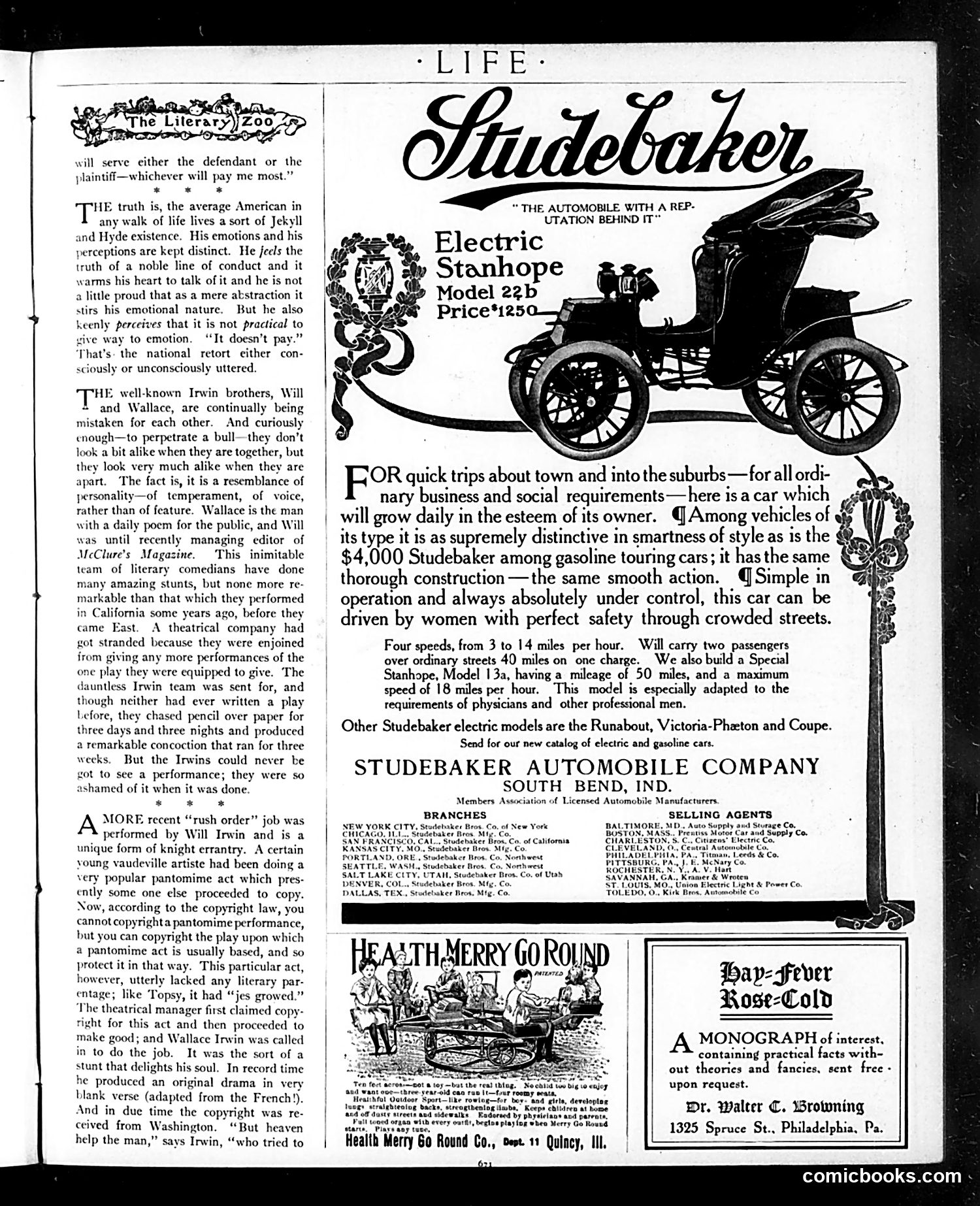
This page is primarily **advertising and literary content**, not political satire. The main feature is a **Studebaker Electric automobile advertisement** (Model 22b, priced at $1,250), emphasizing it as safe for women drivers in crowded streets—a notable marketing angle for early 1900s vehicles. The left column contains a **"Literary Zoo" essay** about American temperament, using Jekyll-and-Hyde imagery to discuss how Americans balance conduct with emotion. It discusses the Irwin brothers (Will and Wallace), theatrical comedians who were frequently mistaken for one another. Below is an anecdote about copyright law and pantomime performance rights. The page also includes advertisements for a "Health Merry Go Round" medical device and "Hay-Fever Rose-Cold" pamphlet by Dr. Walter C. Browning. **No political cartoons appear on this page.**
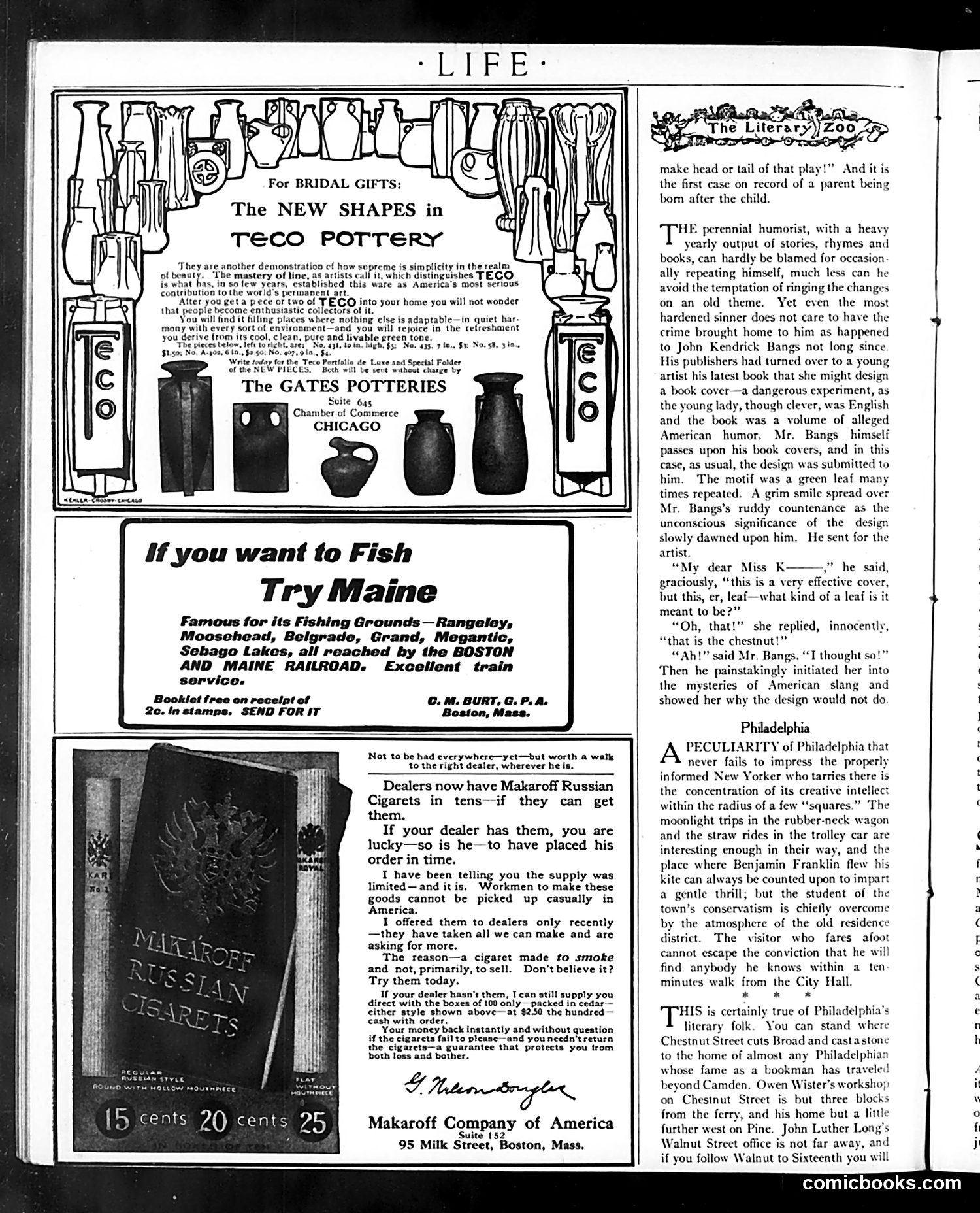
This page is **primarily advertising** with minimal satirical content. The main advertisements are: 1. **Teco Pottery** - promoting new ceramic shapes for bridal gifts 2. **Maine Fishing** - travel promotion via Boston and Maine Railroad 3. **Makaroff Russian Cigarettes** - a cigarette ad claiming scarcity in America The right side contains a literary article about humorist John Kendrick Bangs and his book cover design featuring a green leaf motif. A subsequent section discusses Philadelphia's literary and cultural landmarks. There is **no political cartoon** on this page. The Makaroff ad includes product imagery but serves only as commerce, not satire. The page represents typical *Life* magazine content from the early 20th century: advertisements interspersed with cultural commentary and literary discussion.
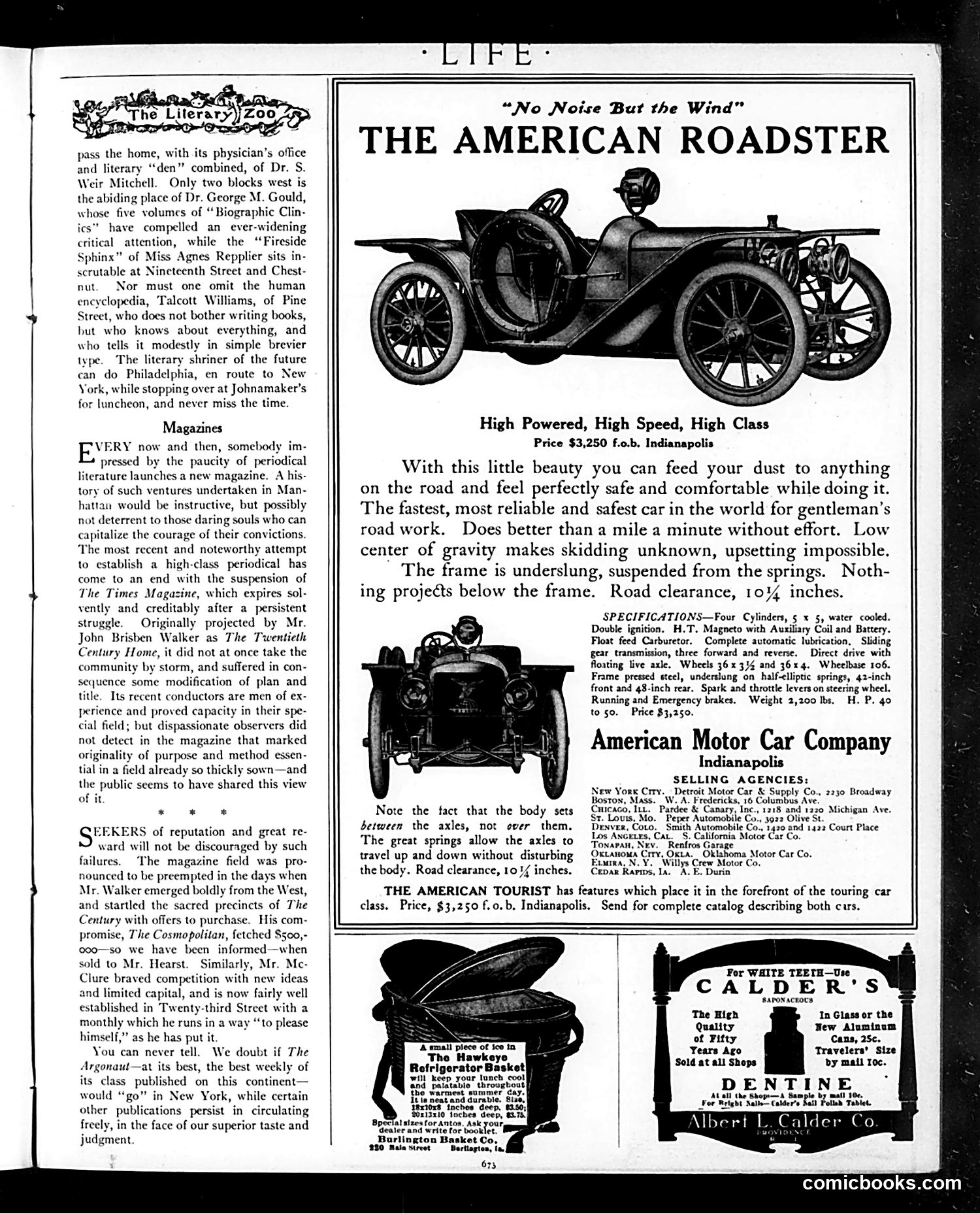
This page is primarily **advertising, not satire**. It features two car advertisements for the American Motor Car Company of Indianapolis: 1. **"The American Roadster"** - A high-powered automobile priced at $3,250, marketed as "the fastest, most reliable and safest car in the world for gentleman's road work." The ad emphasizes low center of gravity and road clearance. 2. **"The American Tourist"** - A touring car variant priced at $1,250. The left column contains **"The Literary Zoo,"** editorial commentary about Philadelphia's literary figures and periodicals, including mentions of *The Times Magazine* and *The Cosmopolitan*. Below the car ads are smaller advertisements for **Calder's toothpaste** and the **Hawkeye Refrigerator Basket**. The page reflects early 1900s consumer culture and advertising strategy in a satirical magazine.
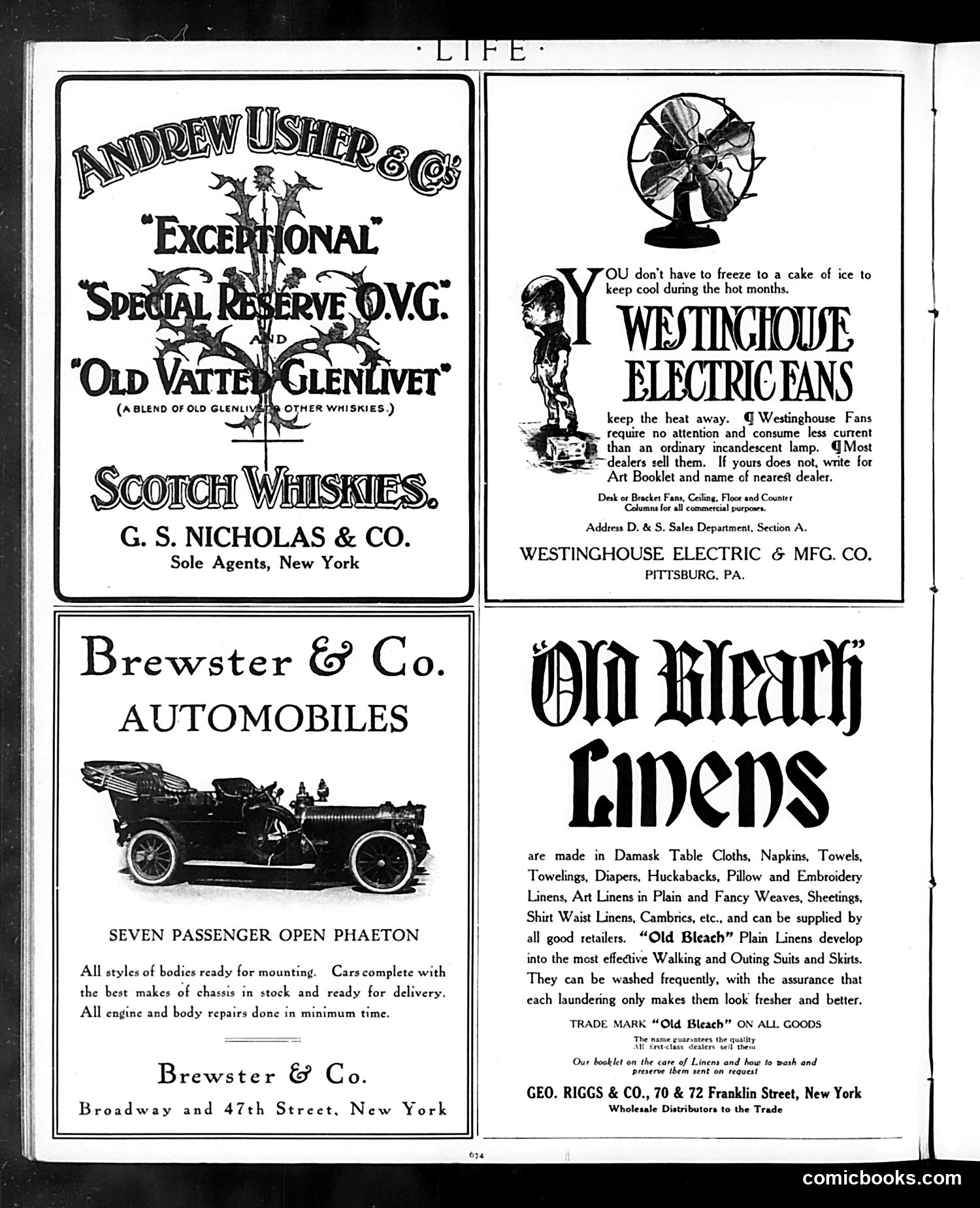
This is primarily an **advertising page** from Life magazine, containing four commercial advertisements with no political cartoons or satirical content. The ads feature: 1. **Andrew Usher & Co.** - Scotch whisky distributor 2. **Westinghouse Electric Fans** - Cooling appliances for hot weather 3. **Brewster & Co.** - Automobiles (seven-passenger open phaeton) 4. **Old Bleach Linens** - Household textiles and clothing materials Each advertisement uses period-appropriate typography and imagery typical of early 20th-century marketing. The page number visible is 614. There are **no cartoons, caricatures, or satirical commentary** present. This appears to be a standard revenue page of advertising content rather than editorial material.
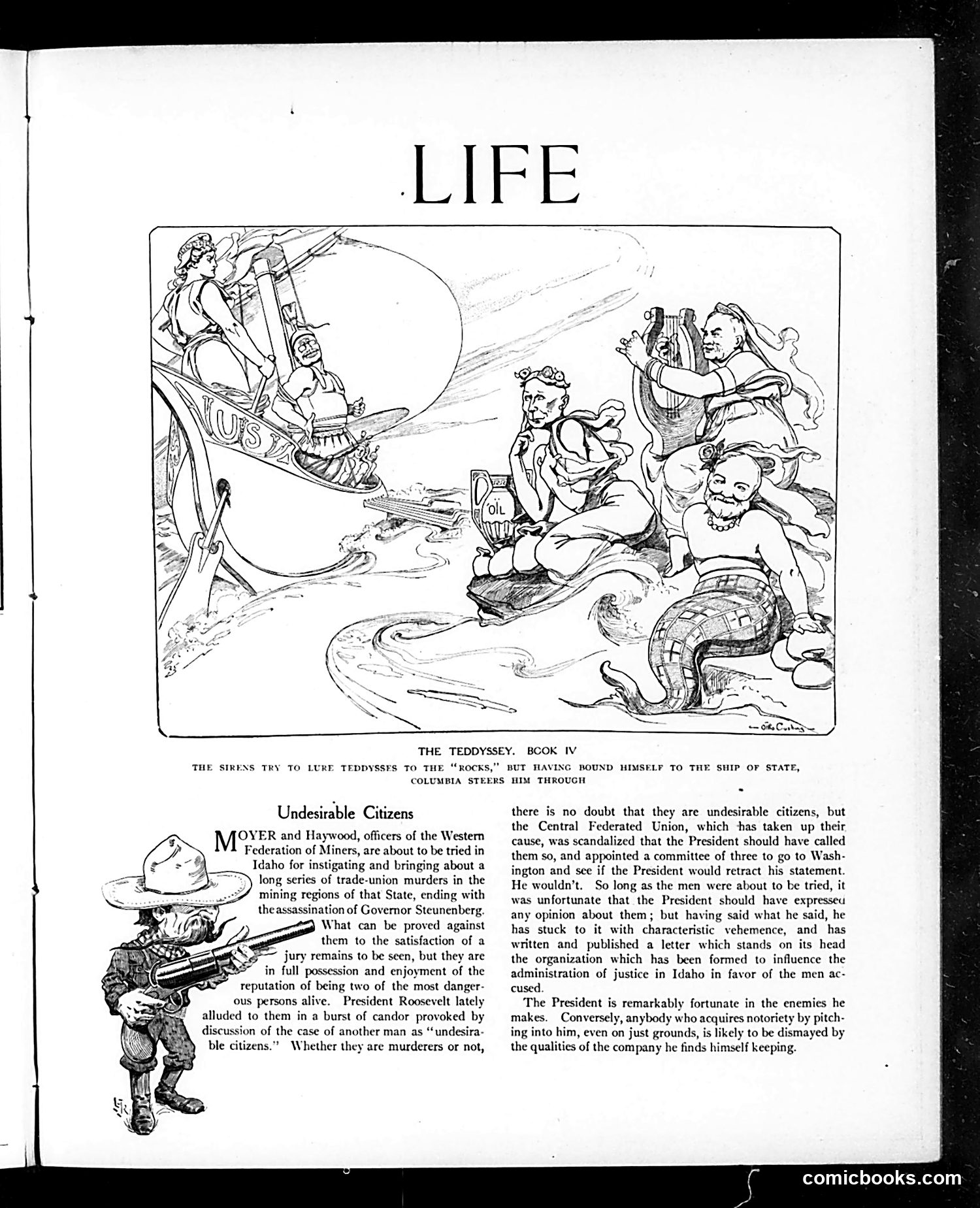
This page from *Life* magazine satirizes President Theodore Roosevelt's handling of labor unrest in Idaho's mining regions. The top cartoon, titled "The Teddyssey, Book IV," shows sirens (mythological temptresses) attempting to lure Roosevelt's ship of state ("Columbia") onto rocks—a classical reference suggesting labor agitators pose dangerous threats to the nation. The article "Undesirable Citizens" criticizes Roosevelt for allegedly calling Western Federation of Miners leaders murderers without evidence, then refusing to retract the statement. The text argues Roosevelt's intemperate language and published letters have unfairly damaged these men's reputations. The accompanying caricatured figure (left) appears to represent a labor agitator or miner, illustrating the "undesirable citizens" being discussed.
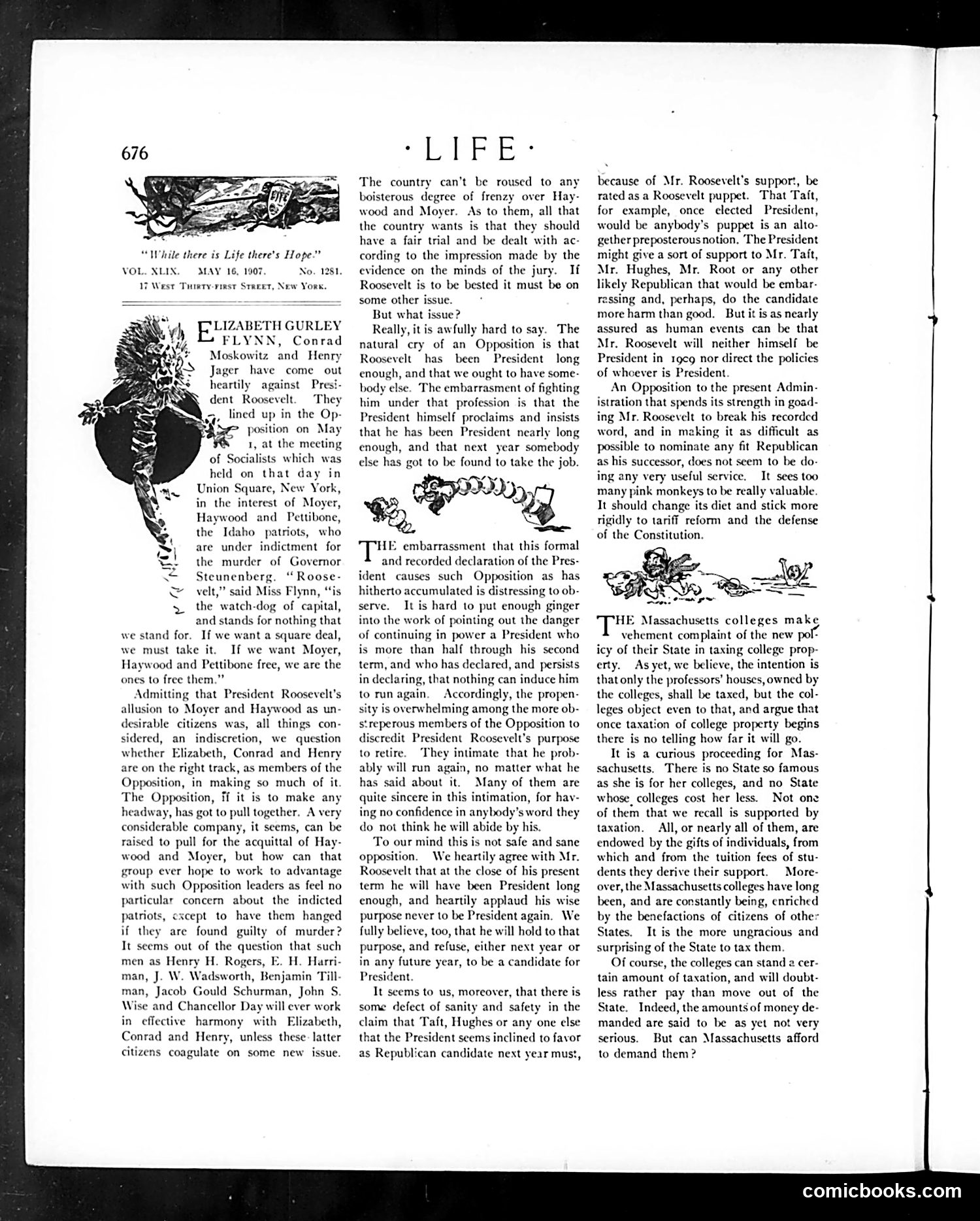
This page contains an article by Elizabeth Gurley Flynn criticizing President Roosevelt's position on the 1908 presidential succession. The text discusses how the Opposition party is using Roosevelt's statement that he won't run again as ammunition against him, while simultaneously suggesting he should endorse a successor. The article argues this creates an untenable situation: Roosevelt insists he won't seek another term, yet opposing factions (likely referring to potential candidates like Taft, Hughes, or others mentioned) are maneuvering to either draft him or discredit his chosen successor. Flynn advocates that Roosevelt should decisively name his preferred candidate to prevent chaos and maintain party unity—though the specific endorsement remains unclear from this excerpt alone.
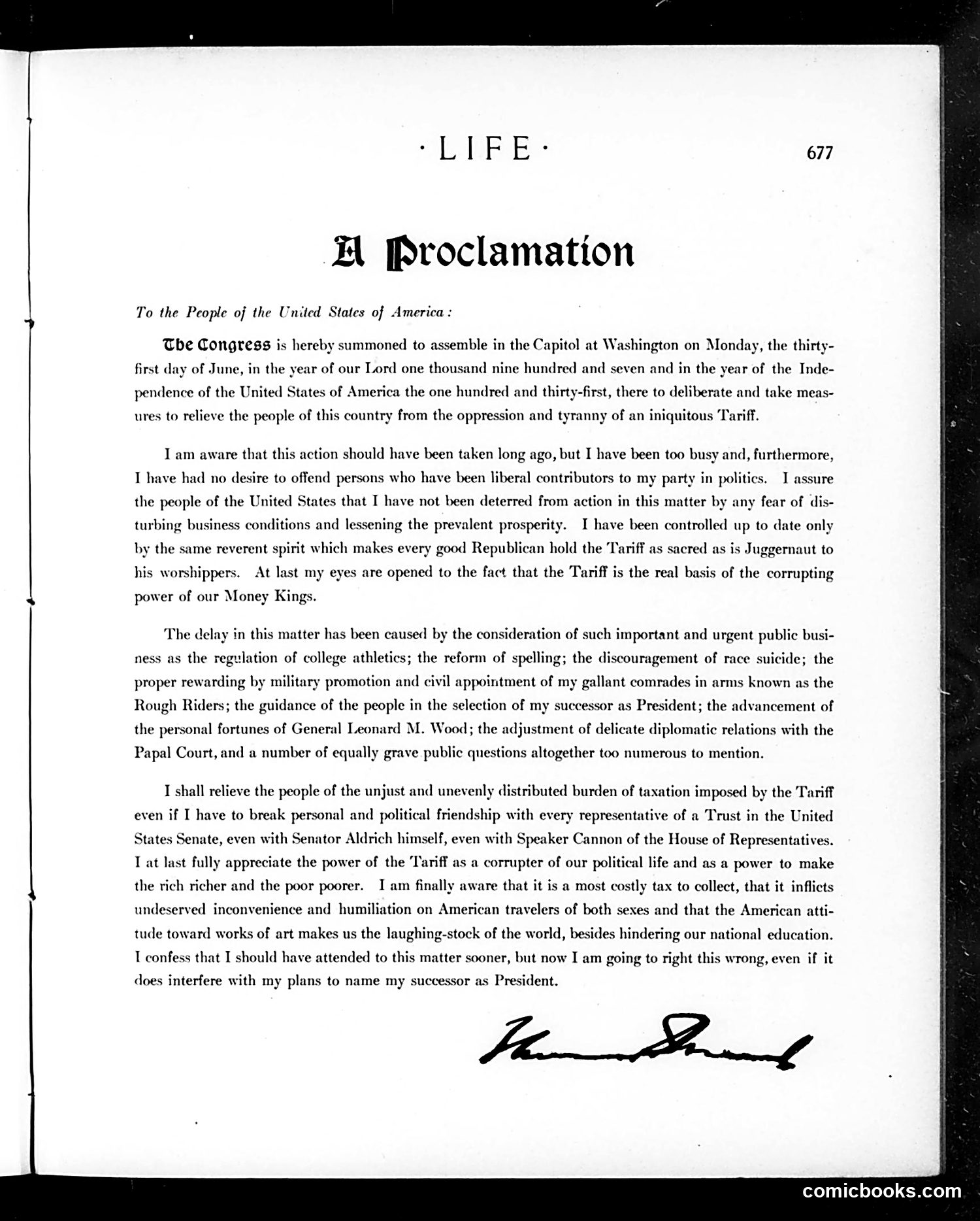
This is a faux-official proclamation satirizing a political figure (the signature appears to be Theodore Roosevelt based on historical context of Life magazine). The satire mocks the author's delayed action on tariff reform despite claiming it as a priority. The humor lies in the self-aware admission that various trivial matters—college athletics, spelling reform, race suicide prevention, and military promotions—took precedence over addressing what the author calls "the real basis of the corrupting power of our Money Kings": the tariff system. The sarcasm escalates when the author admits he might break friendships with senators and even Speaker Cannon to address this "grave public question," yet admits this confession itself interferes with his plans to name a successor as President. The satire critiques political procrastination and misplaced priorities in high office.
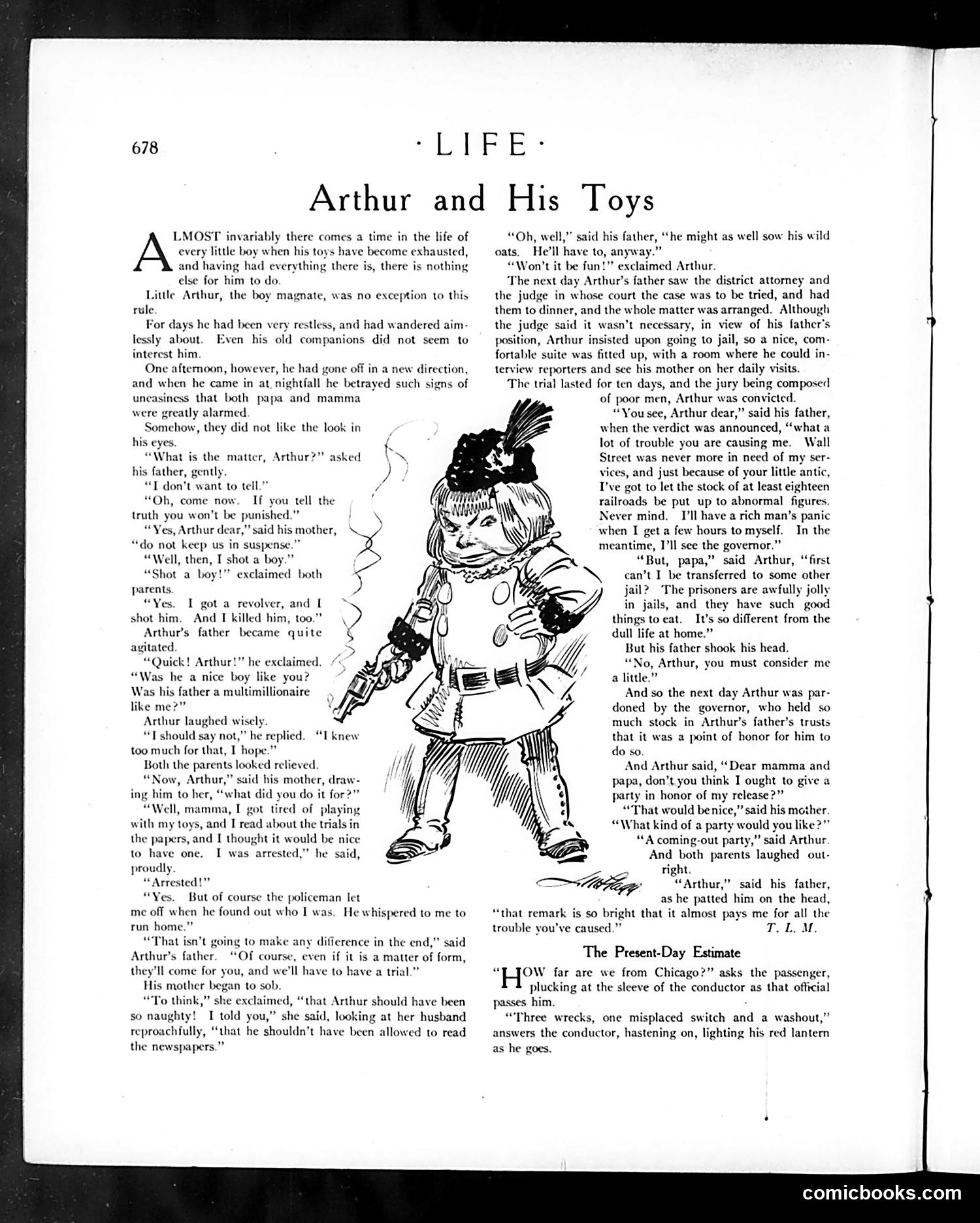
This is a satirical story mocking the corruption of the Gilded Age wealthy elite and their immunity from justice. Young Arthur, son of a rich "multimillionaire," shoots and kills a poor boy out of boredom with his toys. His parents are initially alarmed, but become *relieved* upon learning the victim wasn't wealthy. The satire escalates: Arthur is arrested but released immediately when authorities learn his identity. A trial proceeds as mere theater—the jury, "composed of poor men," convicts him, but his father simply arranges a pardon from the governor (who holds stock in the father's railroad trusts). The joke targets how wealth and corporate power rendered the legal system meaningless for the rich. Arthur's casual murder, the bought verdict, and the governor's quid pro quo pardon all illustrate that justice was a commodity purchased by the powerful. Even Arthur's preference for jail's "good things to eat" over home life underscores the absurdity—his "punishment" is optional luxury. The story satirizes systemic corruption, class inequality, and the era's robber barons' brazen manipulation of government.
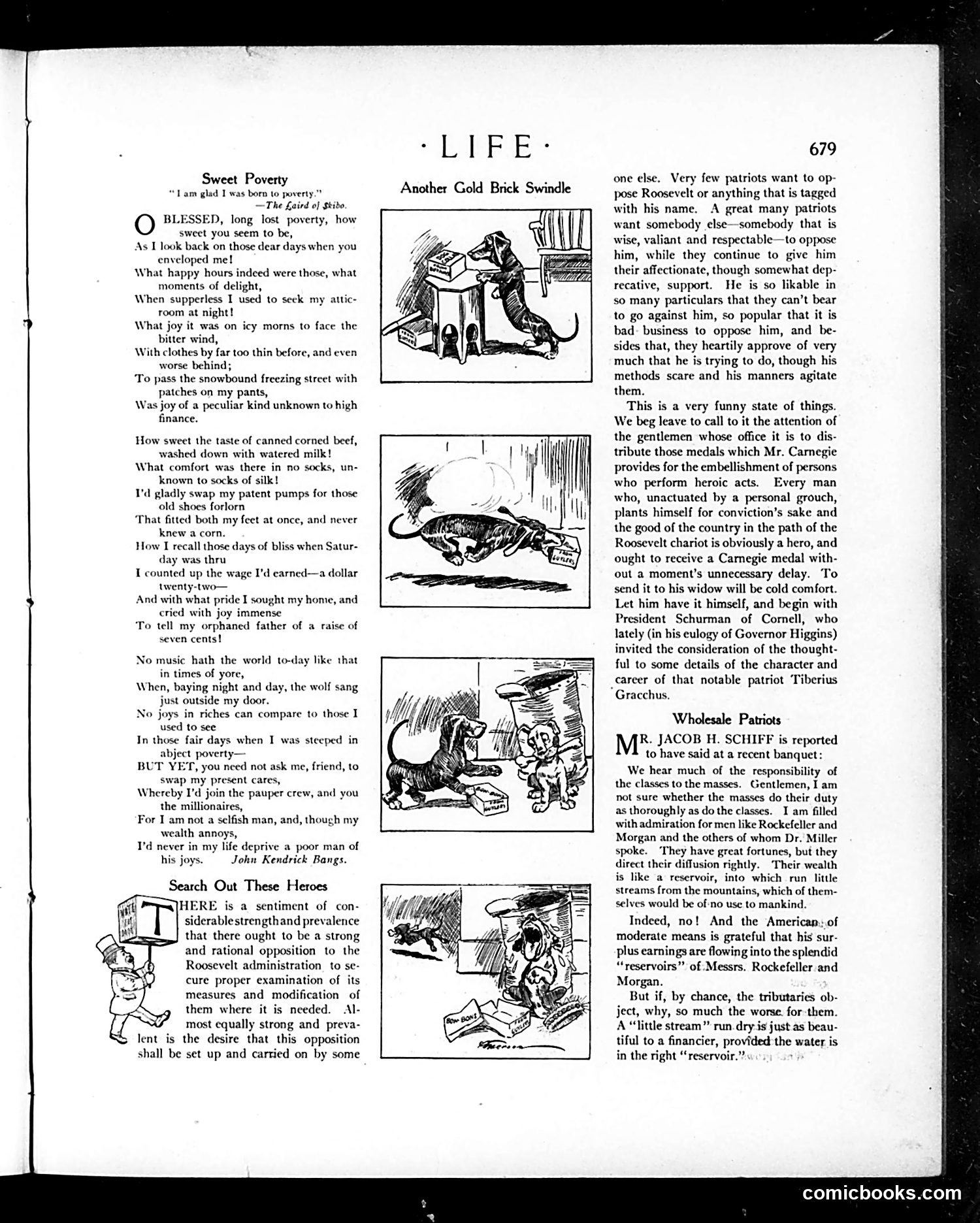
This page contains satirical commentary on early Roosevelt administration politics. The main article, "Search Out These Heroes," mocks the paradox of Roosevelt's popularity: many citizens want to oppose his policies but lack courage to do so publicly. The satire suggests they hope someone else—a "hero"—will do the opposing for them. The piece specifically names President Schurman of Cornell as such a potential hero for criticizing Roosevelt, comparing him to Tiberius Gracchus (a Roman reformer). It sarcastically suggests Carnegie medals should be awarded to those brave enough to publicly challenge Roosevelt. The accompanying cartoons (titled "Another Gold Brick Swindle") appear to illustrate con artists or schemes, likely representing corrupt activities the opposition might expose. The poem "Sweet Poverty" is unrelated satire celebrating hardship—a common genre mocking nostalgia for difficult circumstances while refusing to actually experience them. The Jacob Schiff quote at bottom discusses class responsibility, contextualizing wealthy philanthropists' role in governance debates of the era.
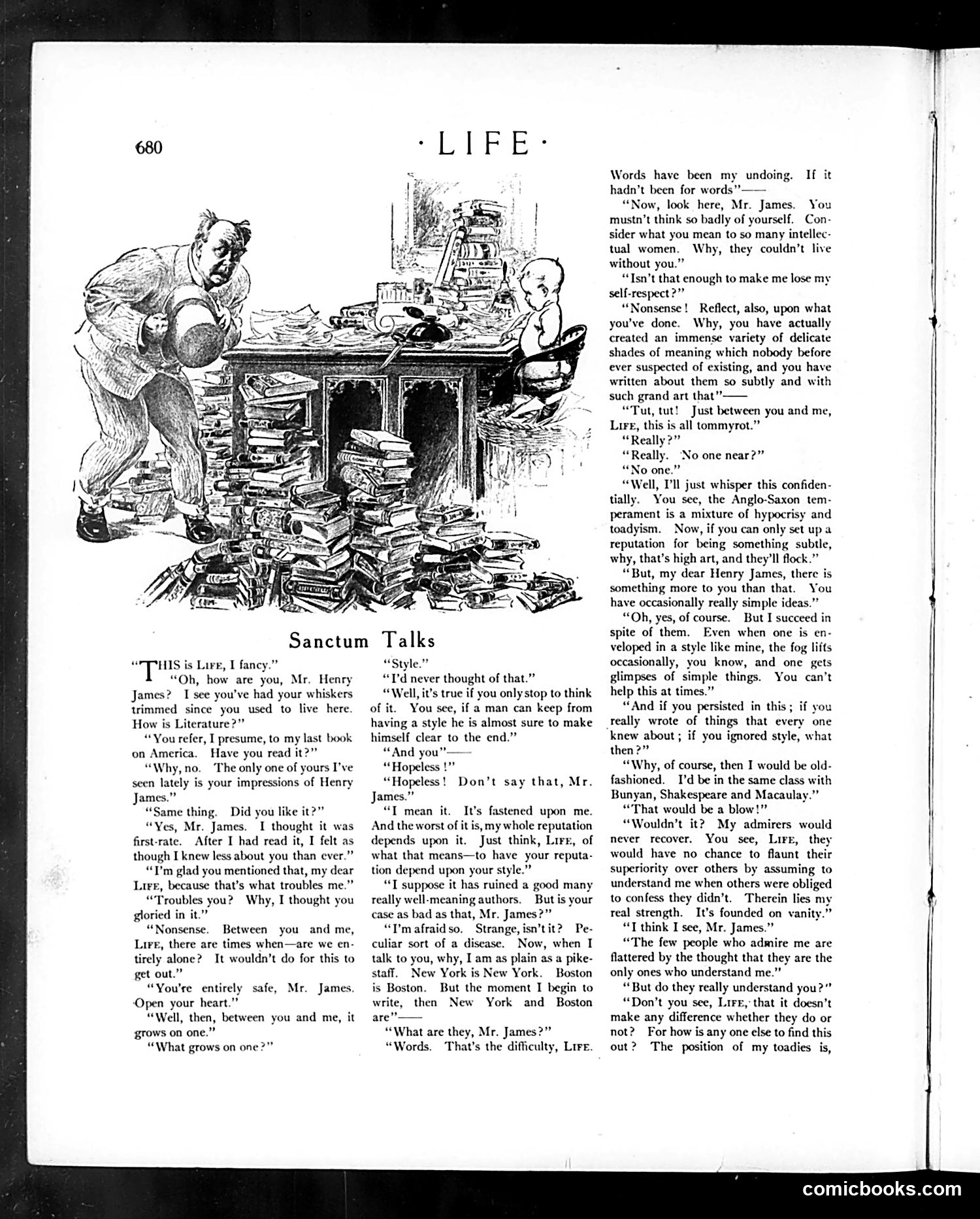
This page satirizes the famous novelist **Henry James** through a dialogue between "Life" (the magazine's personified voice) and James himself. The cartoon depicts two figures at a desk surrounded by books and papers. The satire targets James's notoriously **complex, ornate prose style**—his elaborate sentences and obscure vocabulary that made his work difficult to read. James self-mockingly admits that his style has become a disease; he cannot write plainly even when he tries. The joke's sting comes in James's cynical confession: his elaborate style isn't artistic brilliance but a calculated strategy. By writing obscurely, he flatters his readers' vanity—they feel intellectually superior for "understanding" him and can smugly assume others don't. James admits his reputation rests entirely on this pretense, comparing his admirers to snobs who prize incomprehensibility as a status marker. The satire suggests James himself recognizes the emperor-has-no-clothes reality: his dense writing conceals simple (or absent) ideas beneath decorative language.
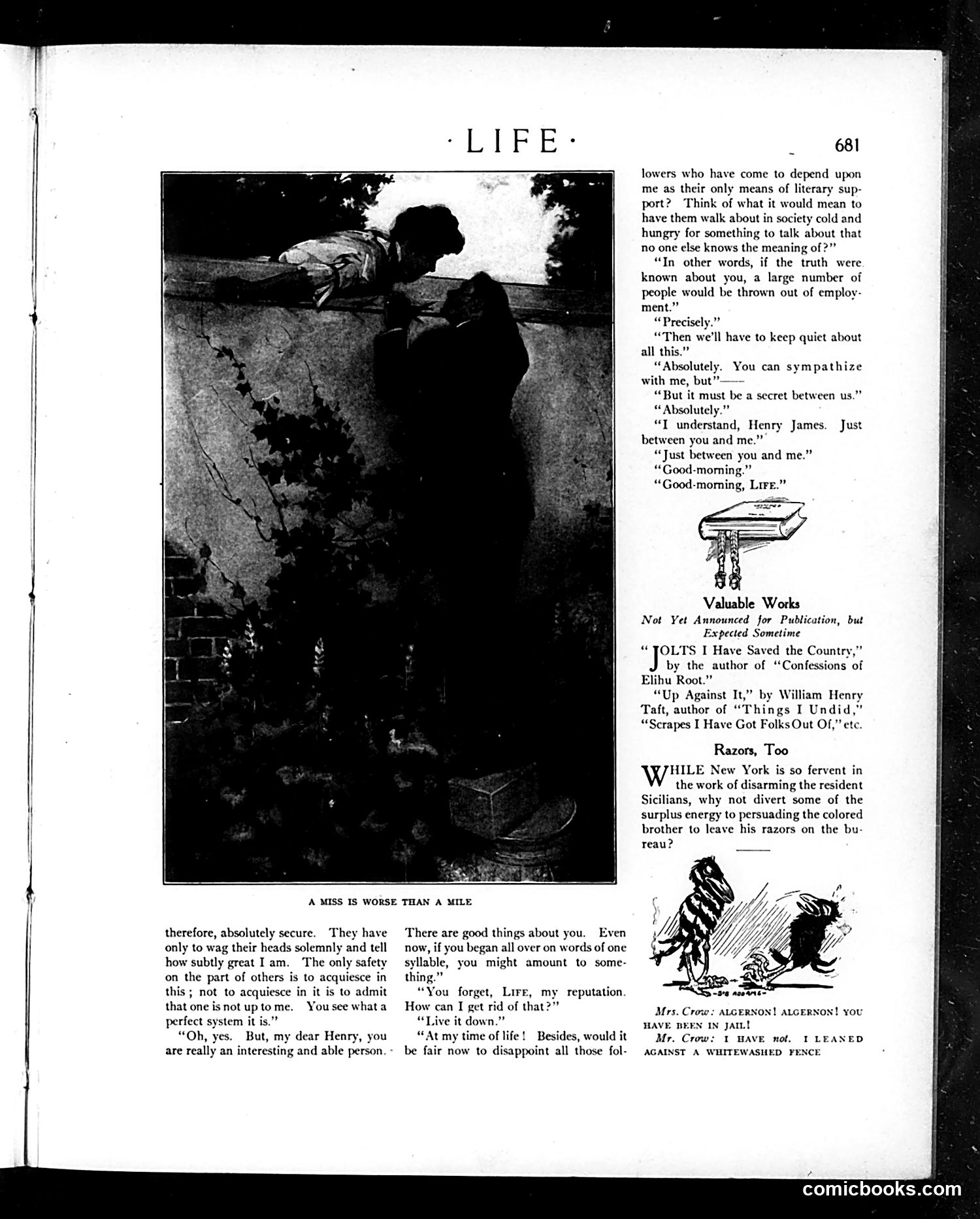
**Main Dialogue Cartoon ("A Miss Is Worse Than a Mile"):** A silhouetted conversation between two figures—one appears to be Henry James (the famous writer), identified by name in the text. The satire mocks literary pretension: James argues he must keep scandalous secrets about himself because many people depend on him professionally for "literary support." The joke is that his reputation—however unearned—is what sustains his followers' livelihoods. Life ridicules both James's vanity and the parasitic relationship between celebrated authors and those who profit from their notoriety. **Secondary Elements:** - "Valuable Works" section parodies unpublished books by political figures (Elihu Root, William Howard Taft), suggesting they have embarrassing secrets worth concealing - "Razors, Too" section satirizes New York's efforts to disarm Sicilian immigrants, sarcastically suggesting similar "disarmament" efforts target African Americans - The crow cartoon appears unrelated political commentary The page satirizes celebrity culture, political hypocrisy, and ethnic stereotypes typical of early 20th-century American satire.
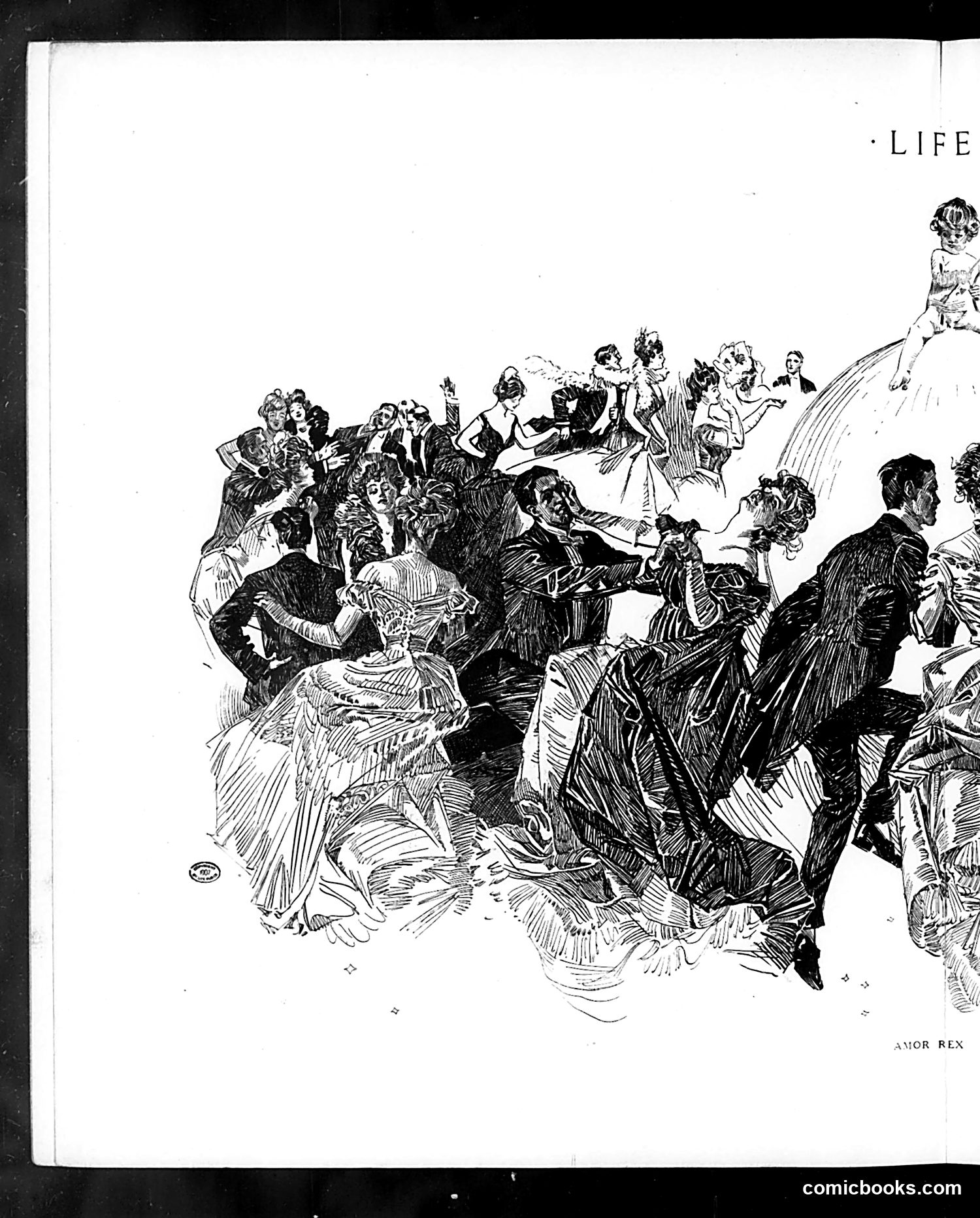
This page from *Life* magazine features a single satirical illustration titled "Amor Rex" (Latin for "Love King"). The sketch depicts a crowded, chaotic social scene—appears to be a formal gathering or ball—rendered in the magazine's characteristic pen-and-ink style. The composition shows numerous figures in period dress (likely early 20th century) interacting in an elaborate social scramble. The "Amor Rex" title suggests the cartoon satirizes romantic entanglement or the dominance of love/desire in high society. The crowded, tangled composition emphasizes confusion and social chaos around matters of romance and courtship among the upper classes. Without additional context or visible artist signature, the specific targets of satire remain unclear, though it appears to mock fashionable society's romantic preoccupations.
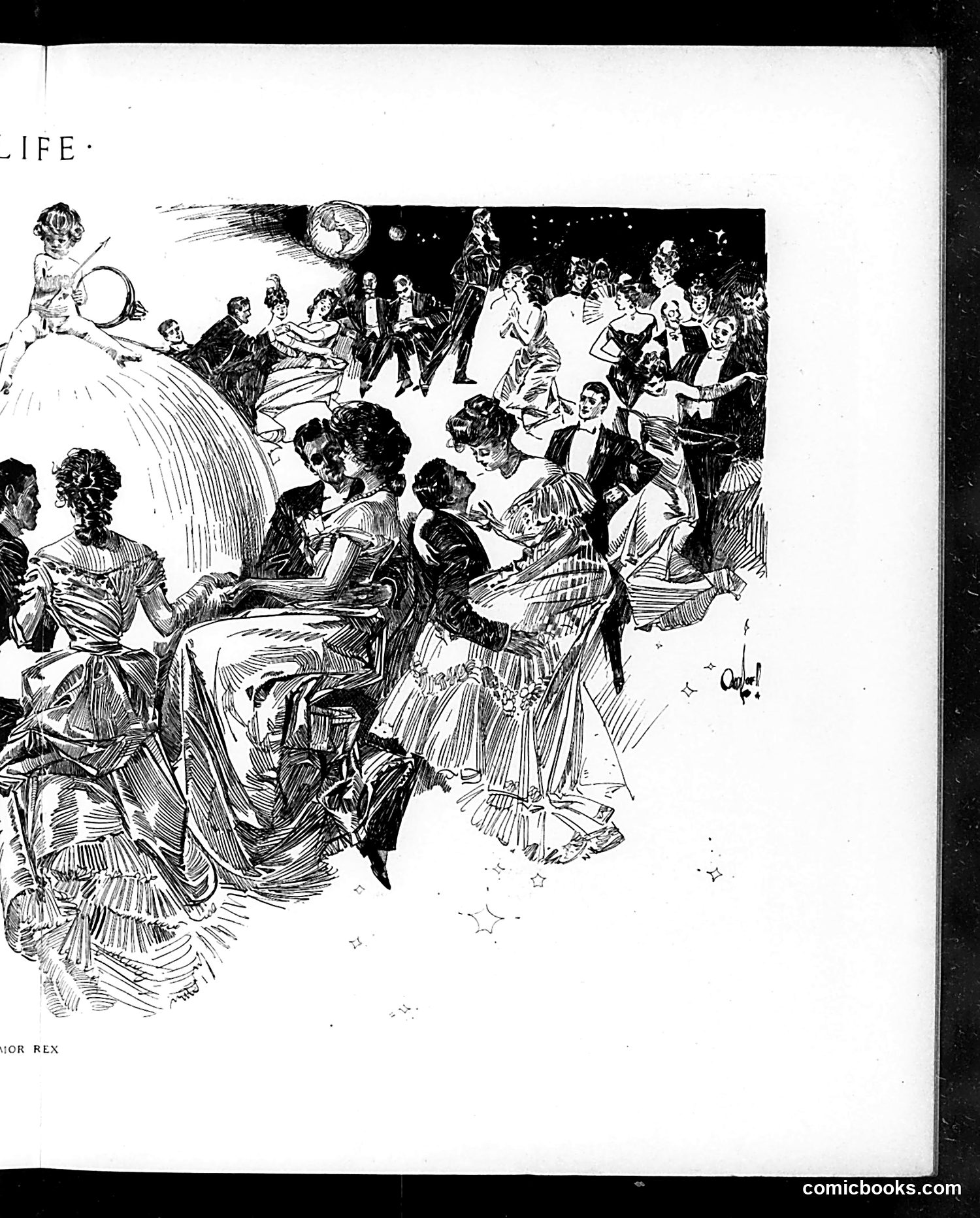
This is a satirical illustration from *Life* magazine depicting an elaborate formal social gathering or ball. The drawing shows elegantly dressed men and women in late 19th or early 20th-century attire engaged in dancing and socializing. A cherub or cupid figure appears at the upper left, suggesting romantic themes. The caption "MOR REX" (likely "Amor Rex"—Love King) indicates the satire targets romantic or amorous behavior among the upper classes at such exclusive social events. The detailed cross-hatching technique and crowded composition emphasize the pretension and artificiality of high-society gatherings. Without additional context or visible bylines, the specific social commentary remains somewhat unclear, though the illustration likely mocks the vanity, romance-seeking, or social posturing of wealthy elites at formal balls.
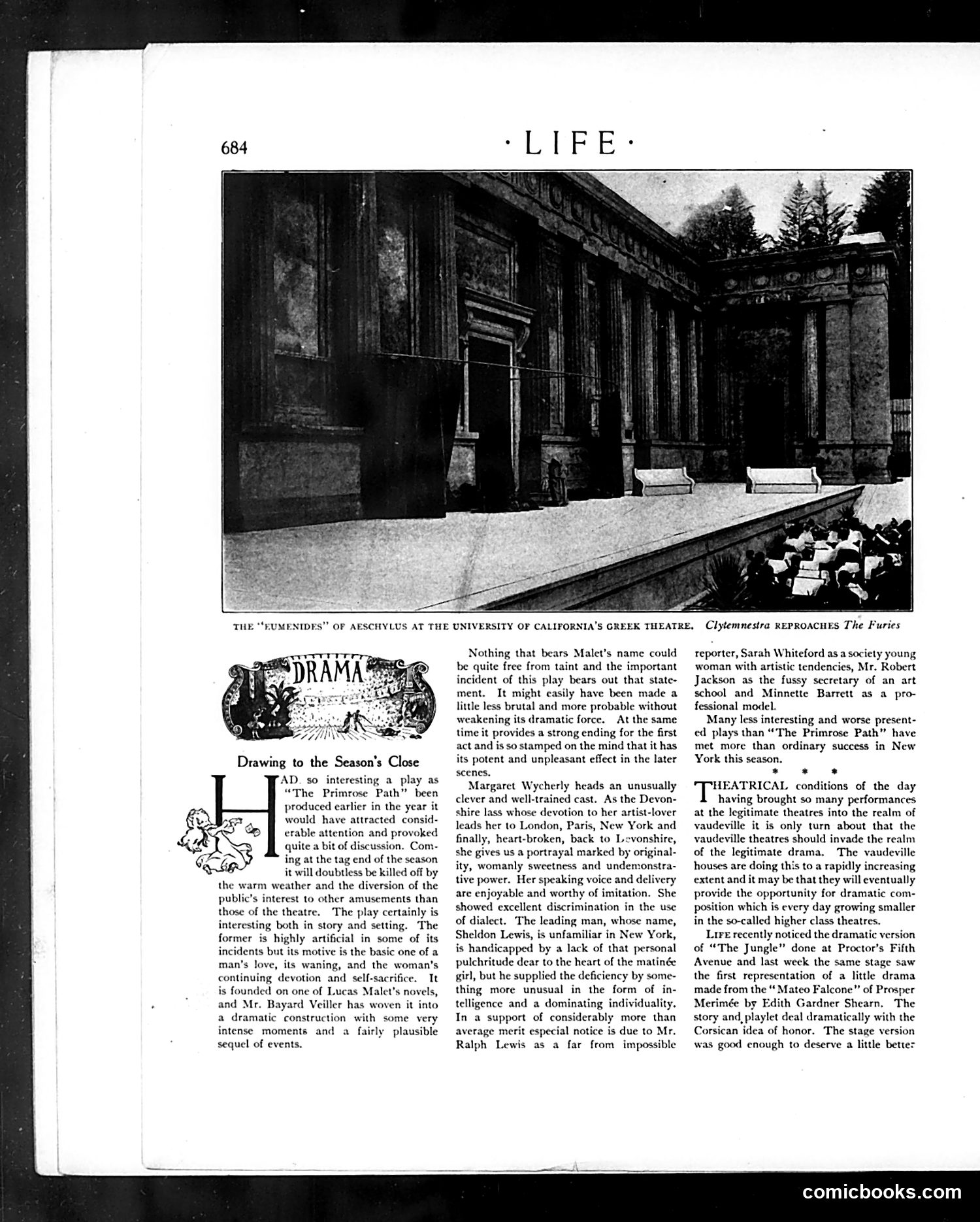
This theater review column discusses the closing of Broadway's spring season. The main topic is "The Primrose Path," a play adapted from Lucas Malet's novel by Bayard Veiller, starring Margaret Wycherly. The critic praises Wycherly's performance as a devoted Devonshire woman following her unfaithful artist-lover across continents, and notes actor Sheldon Lewis compensates for lack of conventional attractiveness through intelligence and stage presence. The secondary commentary critiques theatrical conditions: legitimate theaters increasingly present vaudeville acts, while vaudeville houses now stage dramatic productions. The critic observes this trend may eventually provide more opportunities for new dramatic works, as traditional theater venues shrink. The photograph shows the Greek Theater at UC California staging Aeschylus's "Eumenides," demonstrating classical theater's continued cultural presence. The overall message reflects early 20th-century concerns about theater's commercialization and changing entertainment hierarchies.
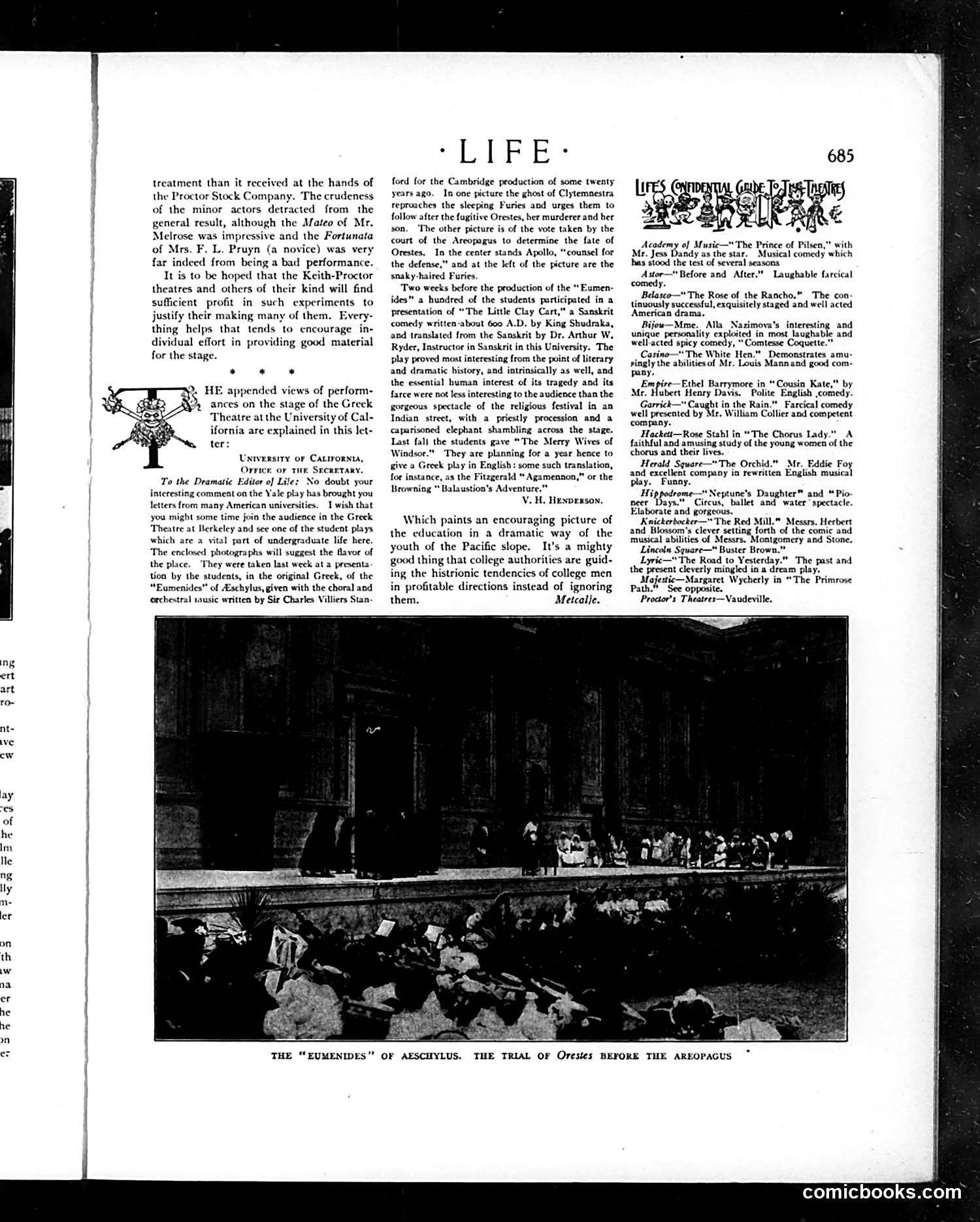
This page documents a University of California Greek Theatre production of Aeschylus's *Eumenides*, staged by students in the original Greek with period-appropriate music. The photograph shows the famous trial scene where the court of the Areopagus votes on Orestes' fate, with Apollo (as "counsel for the defense") and the Furies visible. The letter's author celebrates this as exemplary undergraduate education—arguing that college theaters should channel students' dramatic talents toward "profitable directions" rather than ignore such interests. The accompanying editorial commentary praises institutions guiding "histrionic tendencies" productively. The page also notes the university's recent Sanskrit comedy production (*The Little Clay Cart*) and planned English-language Greek drama, positioning classical theater as integral to liberal education on the Pacific Coast.
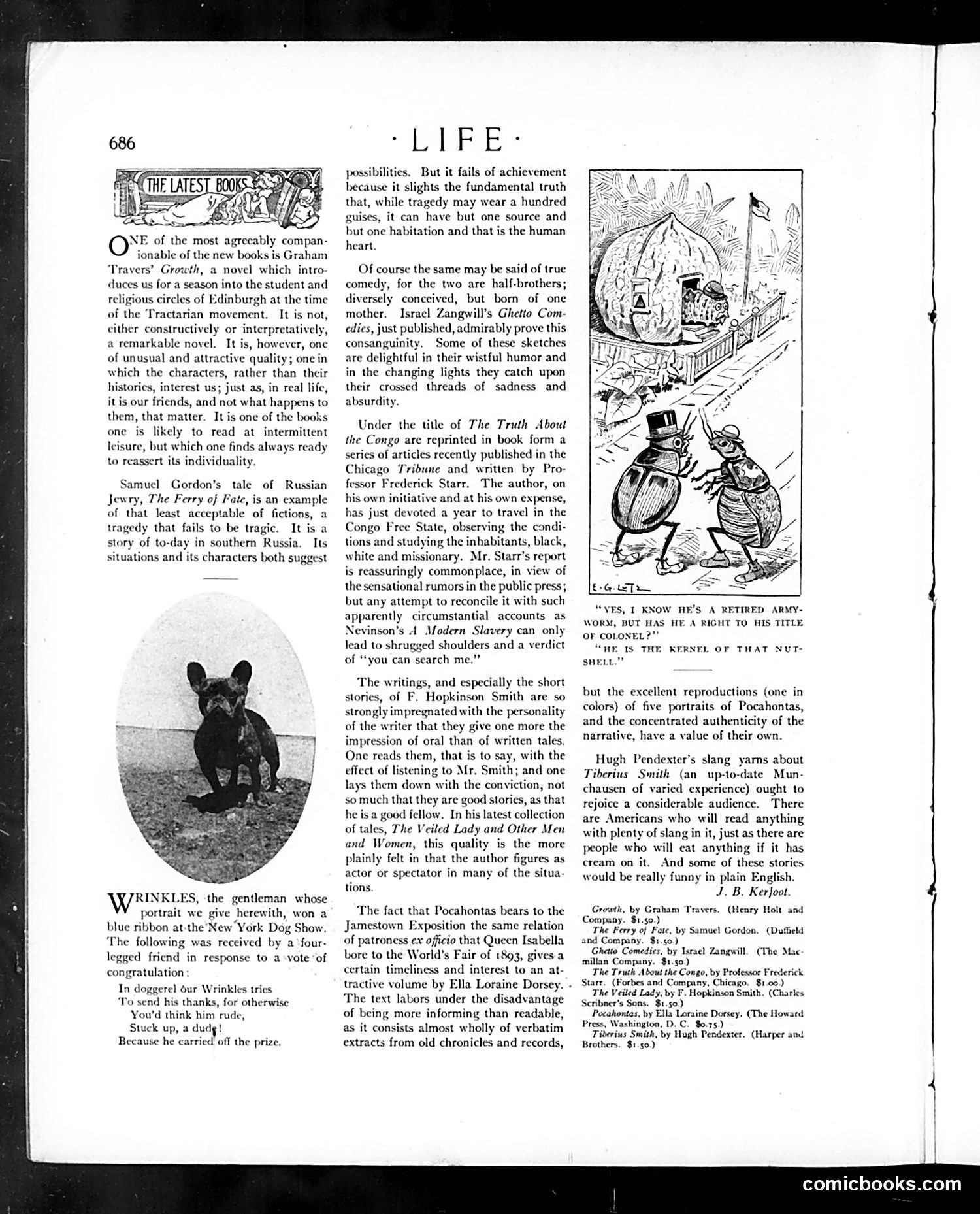
This is a **book review section** from Life magazine, not primarily a political cartoon page. The main content discusses recently published novels and non-fiction works. The **cartoon** shows two insects discussing a retired "army-worm" who won a prize—a humorous play on words. The accompanying doggerel verse congratulates "Wrinkles," a prize-winning dog from the New York Dog Show, written in deliberately clumsy rhyme as mock-formal congratulations. The **book reviews** cover Graham Travers's *Growth* (set during the Tractarian religious movement), Samuel Gordon's tragedy *The Ferry of Fate*, Israel Zangwill's *Ghetto Comedies*, Frederick Starr's *The Truth About the Congo* (defending Congo conditions against sensational press accounts), F. Hopkinson Smith's *The Veiled Lady*, and Ella Loraine Dorsey's work on Pocahontas and the Jamestown Exposition. The page reflects **Progressive-era literary tastes** and contemporary interest in colonial American history and African colonial politics.
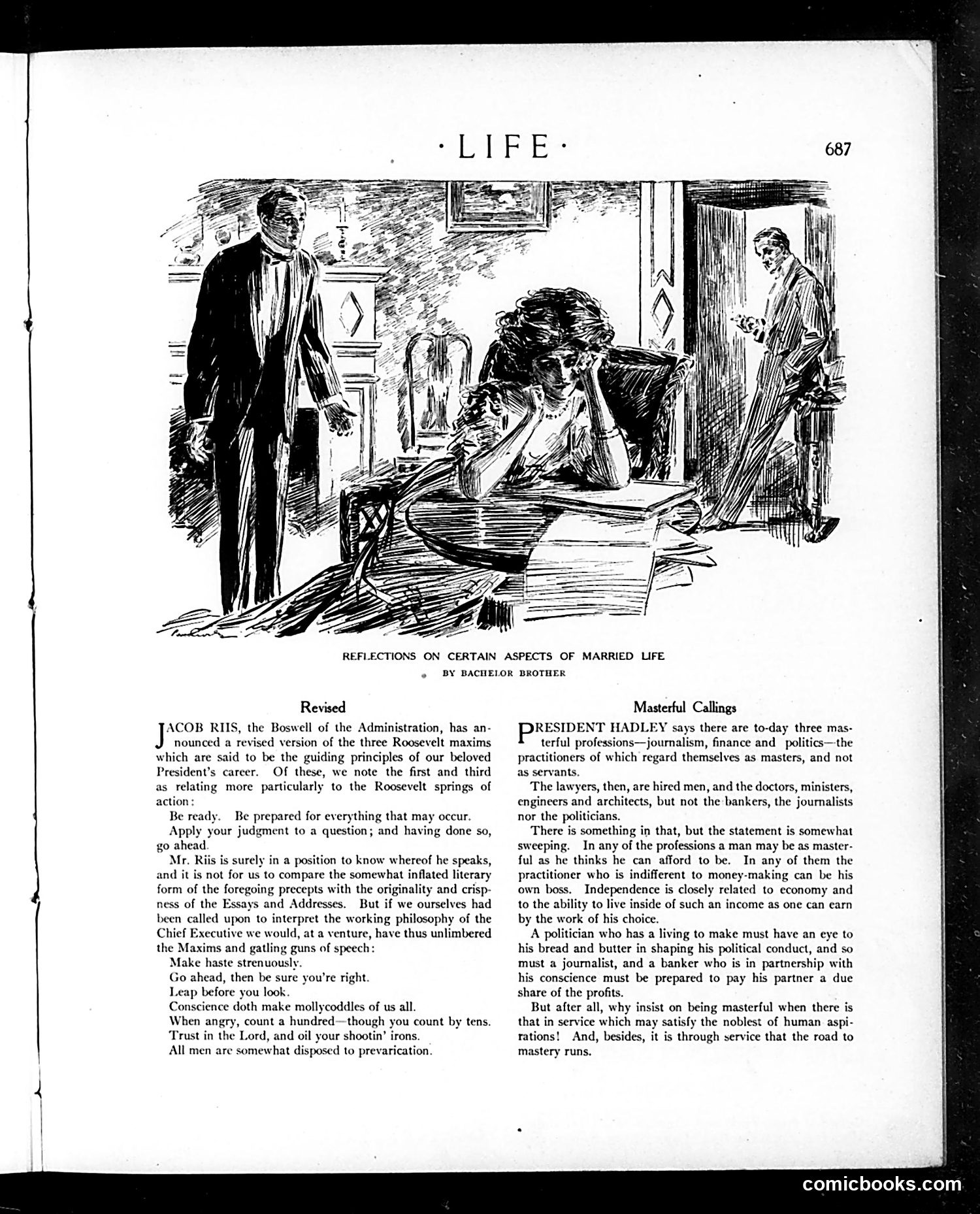
This page contains two satirical pieces about professional conduct and authority, likely from the Theodore Roosevelt era (based on references to "the Chief Executive" and Jacob Riis, Roosevelt's associated biographer). **"Revised"** mocks Roosevelt's famous maxims by presenting absurdist parodies—"Make haste strenuously," "Leap before you look"—suggesting Roosevelt acts rashly and recklessly without proper deliberation. The satire implies his philosophy prioritizes action over thoughtfulness. **"Masterful Callings"** critiques claims by President Hadley that journalists, financiers, and politicians uniquely regard themselves as "masters" rather than servants. The piece argues this self-aggrandizement is false; all professionals can be independent only if they prioritize ethics over profit. The commentary suggests these "masterful" professions are actually compromised by financial interests and lack genuine integrity. Both pieces satirize early-20th-century American leadership and professional pretension, arguing that true mastery comes through humble service, not arrogant self-promotion.
This page presents several satirical pieces mocking contemporary American society: **"Burbanked Humanity"** references Luther Burbank, a famous horticulturist, imagining if his plant-breeding techniques could "improve" humans. The poem satirizes specific social annoyances: overweight men taking two train seats, vain women obsessed with fashion, corrupt politicians, and office-seekers who lie. It's social criticism wrapped in whimsical verse. **"One from the Gallery"** is an anecdote joke about a Napoleon play where cannon shots announce a baby's gender. A third unexpected shot prompts a street urchin to shout "triplets!"—humor derived from the absurd confusion. **"Couldn't Forget Wall Street"** mocks financier James R. Keene's obsession with stock markets. Even relaxing under moonlight, he compulsively mutters the moon is "too high" (likely a trading reference), unable to escape professional preoccupation. The page also includes advertisement for White Rock water and Knapp-Felt hats. Overall, it's typical early 20th-century satirical magazine content targeting human foibles and professional obsession.
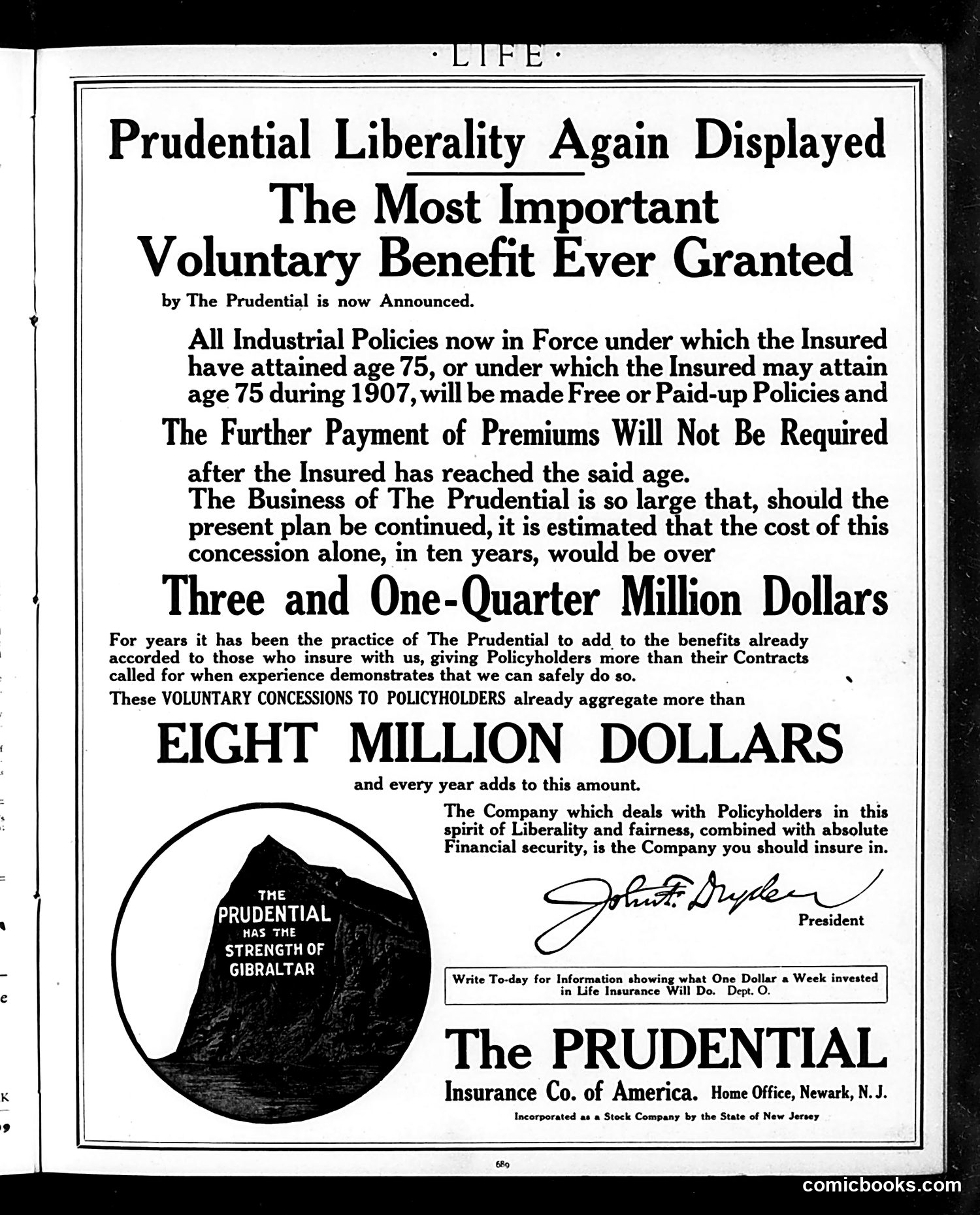
This is primarily a **full-page insurance advertisement**, not satire or political commentary. The Prudential Insurance Company announces a major policy benefit: policyholders reaching age 75 will have premiums waived, converting their policies to "paid-up" status. The ad emphasizes the company's generosity by highlighting that voluntary concessions to policyholders already total **eight million dollars**, with an estimated additional three-and-a-quarter million cost over ten years for this new benefit alone. The only visual element is a **Gibraltar rock symbol** labeled "The Prudential Has the Strength of Gibraltar"—a marketing metaphor comparing the company's financial stability to the famous, immovable fortress. The signature of the President (appears to be John Dryden) lends authority. This is straightforward corporate marketing leveraging the company's size and benevolence to attract customers—there is no satirical intent visible.
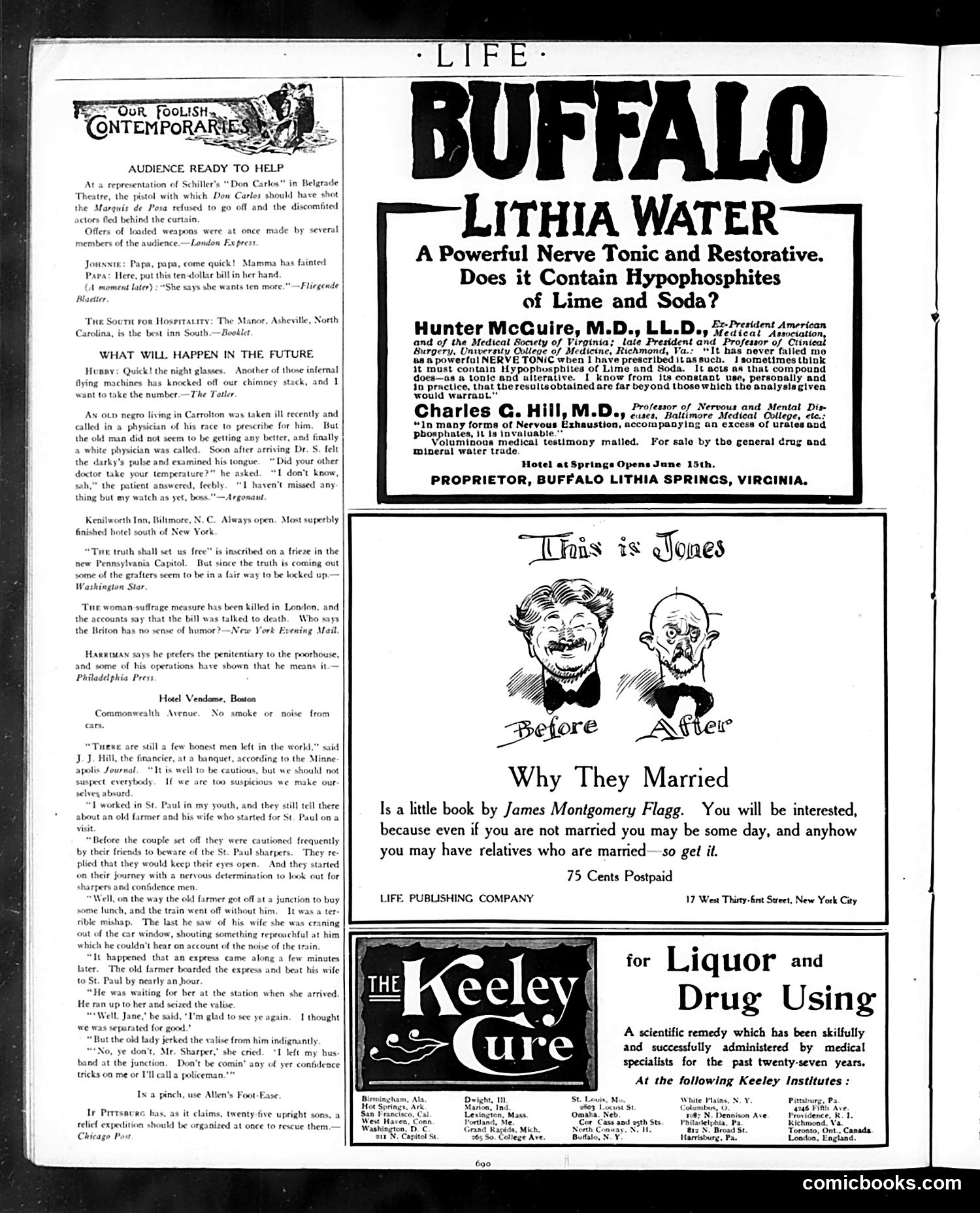
This page contains several short satirical anecdotes under "Our Foolish Contemporaries," a recurring humor feature. The jokes mock human folly and social absurdities: **Key Content:** - A Belgian theater audience offers loaded weapons to fix a gun prop malfunction—mocking both theatrical incompetence and audience interference - A woman faints at financial news but recovers when bribed with money—satirizing greed - A story about a suspicious couple boarding a train to St. Paul, so paranoid about "confidence men" (con artists) that they mistake each other for criminals—the joke being their own suspicion defeats them **The Advertisements:** The page is dominated by period medical ads: Buffalo Lithia Water (mineral tonic), "This is Jones" before/after book, and the Keeley Cure (for alcohol/drug addiction). These reflect early-1900s marketing of dubious patent medicines. **Historical Context:** This predates modern consumer protections. The satirical tone contrasts sharply with the pseudoscientific medical claims alongside it—ironically illustrating the "foolishness" Life critiques.
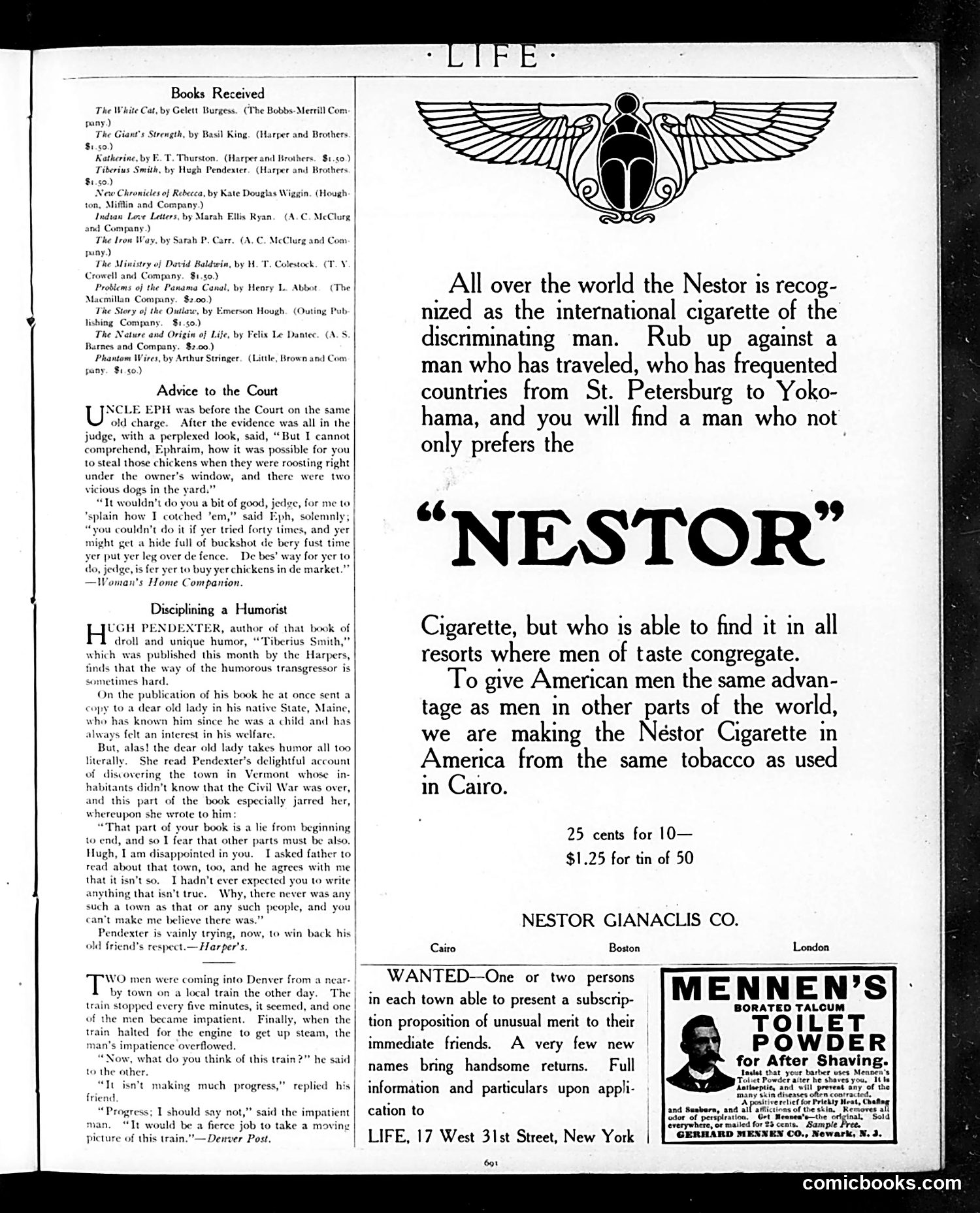
This page is primarily **advertising and book reviews**, not political satire. The main content features a **Nestor Cigarette advertisement** with an winged scarab logo (Egyptian motif). The ad claims Nestor is the "international cigarette of the discriminating man," available globally from St. Petersburg to Yokohama, and made from tobacco sourced in Cairo. It promises American consumers access to the same product as sophisticated international travelers. The page also includes book reviews (titles by Gelett Burgess, Basil King, and others) and two humorous anecdotes: one about an enslaved man stealing chickens and another about impatient train travelers. These appear to be reprinted humor pieces rather than original satire. The small **Mennen's Borated Talcum Toilet Powder advertisement** appears in the bottom right corner. There are no political cartoons or political satire visible on this page.
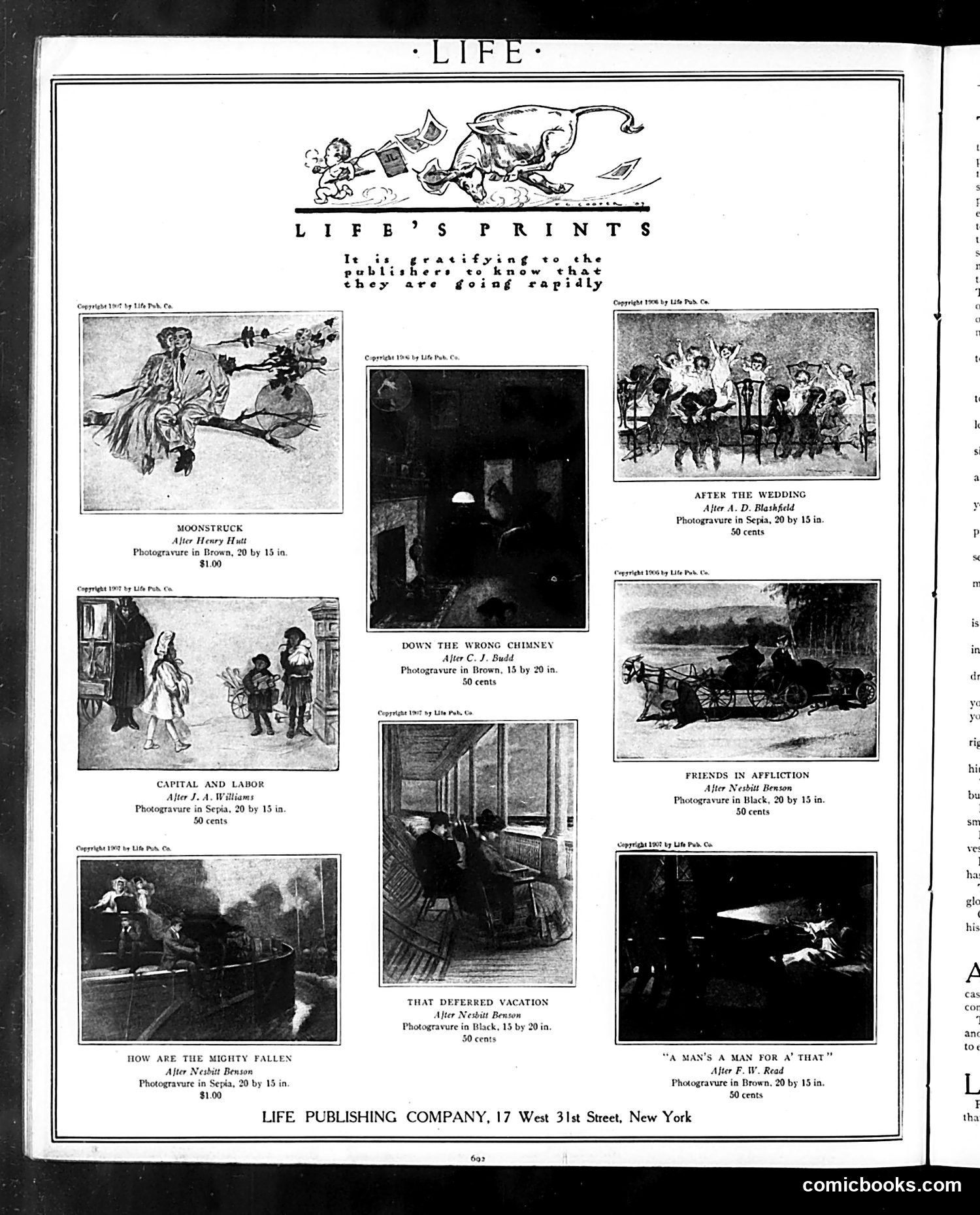
This is a **catalog page advertising satirical prints** from Life Publishing Company, not political cartoons themselves. Life offered photogravure reproductions of editorial illustrations by prominent cartoonists (Nesbitt Benson, Henry Hutt, J.A. Williams, and others) for home purchase. The titles suggest turn-of-the-century social humor: "Capital and Labor" addresses class tensions; "How Are the Mighty Fallen" likely mocks social decline; "Down the Wrong Chimney" appears to be holiday-themed mischief; "After the Wedding" suggests marital comedy; and "A Man's a Man for a' That" references Robert Burns's egalitarian poem. Rather than satire, this **demonstrates Life's business model**: converting popular magazine illustrations into affordable art prints for middle-class consumers. The prices (50 cents to $1.00) made them accessible to ordinary households during the Progressive Era.
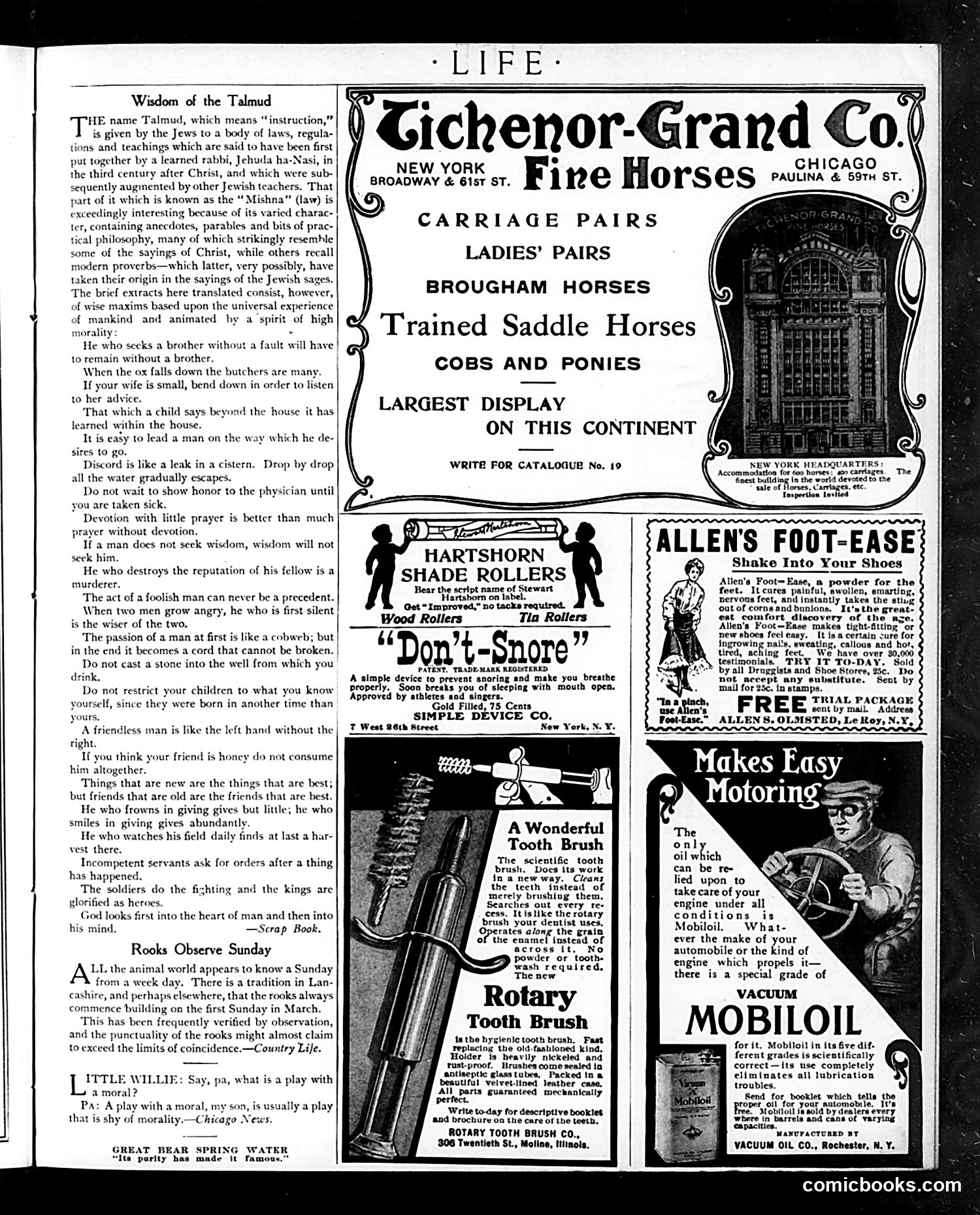
This page is primarily **educational and advertising content**, not political satire. The left column features "Wisdom of the Talmud"—a straightforward compilation of Jewish ethical teachings and proverbs from ancient rabbinic literature, presented to American readers as universal moral instruction. Passages like "He who seeks a brother without a fault will have to remain without a brother" and "When two men grow angry, he who is first silent is the wiser" reflect practical wisdom on human relationships. The right side contains period advertisements: Eichenor-Grand Co. (fine horses), Allen's Foot-Ease (powder for feet), Rotary Tooth Brush, and Mobiloil (motor oil). A small humor section includes a "Little Willie" joke about morality in theater. The "Rooks Observe Sunday" brief notes animal behavior folklore. Overall, this represents *Life*'s educational mission alongside commercial content—no cartoon satire or political commentary appears on this particular page.
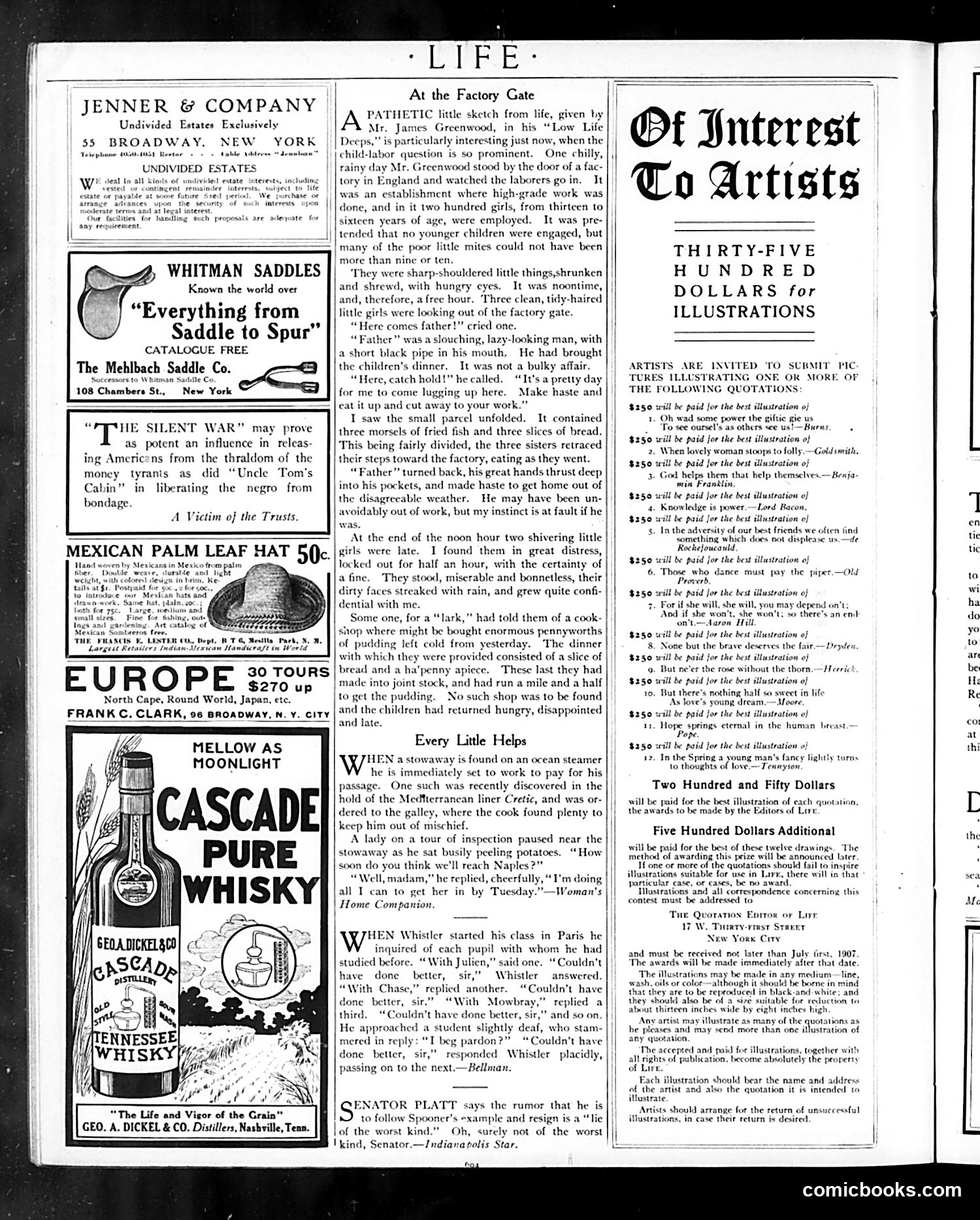
This page from *Life* magazine combines satirical stories with period advertisements. The main content addresses **child labor**, a prominent social issue of the era. **"At the Factory Gate"** presents a bleak sketch of industrial child exploitation. It describes 200 girls aged 13-16 (with some as young as 9-10) working in a factory. The satire centers on the father's negligence: he brings his daughters meager lunch (fried fish and bread), shows no real concern for their welfare, and appears deliberately lazy. The story implies parental indifference compounds the children's suffering—they're underfed, poorly clothed, and penalized for lateness. The accompanying anecdotes ("Every Little Helps," the Whistler story) provide lighter relief, though the stowaway piece also touches on labor exploitation. **The advertisements**—for saddles, real estate, and whisky—create ironic contrast with the serious social critique, typical of *Life*'s satirical approach: capitalist commerce thrives while children suffer. The piece advocates for child-labor reform by exposing systemic neglect at multiple levels: employers, parents, and society.
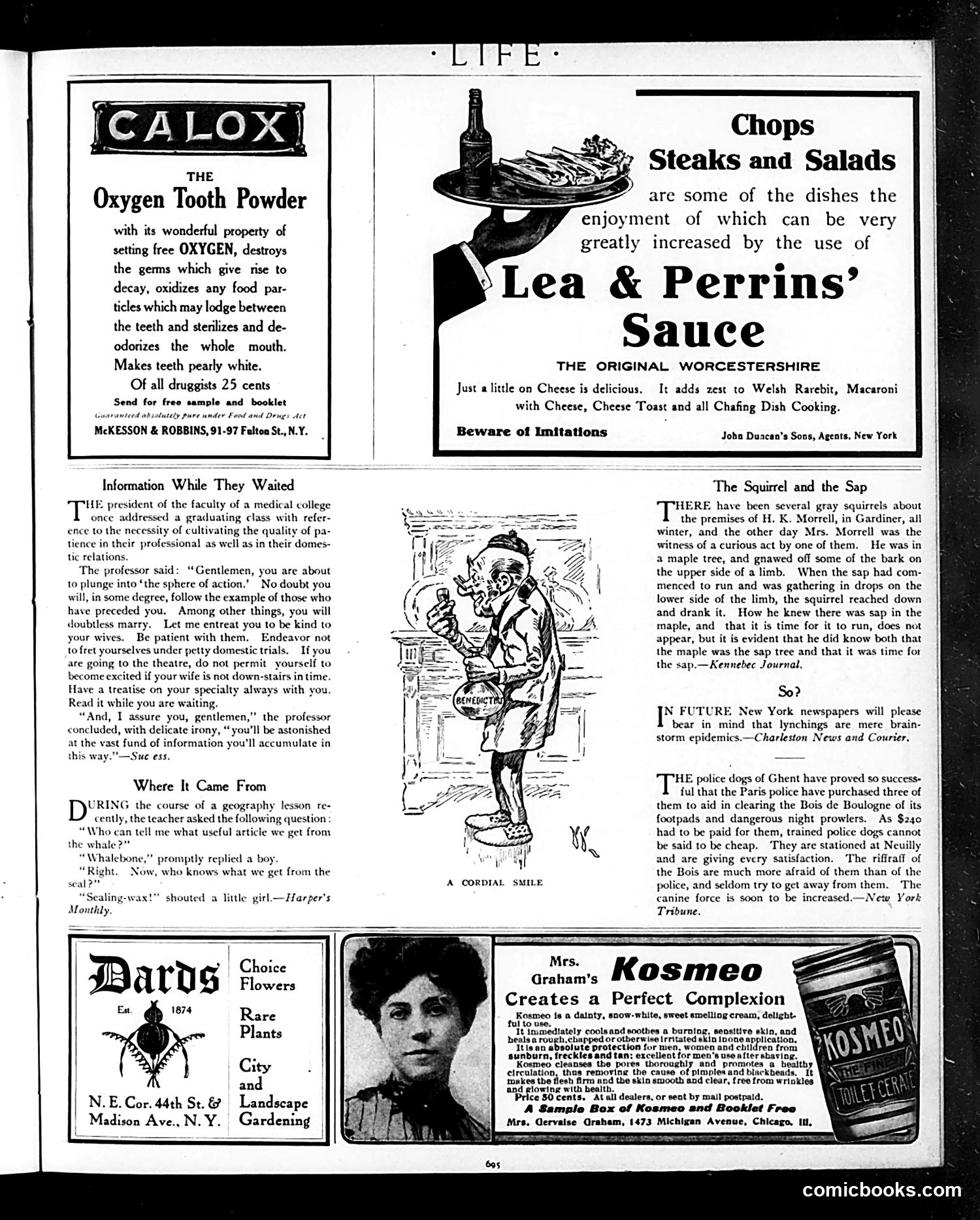
This page combines advertisements with humorous editorial content typical of early-20th-century Life magazine. **The cartoons and jokes:** The main illustration shows a man labeled "A Cordial Smile"—likely depicting a satisfied diner—promoting Lea & Perrins' Worcestershire Sauce. **The humor pieces** include: 1. "Information While They Waited"—a joke about a medical professor ironically advising young doctors to read while waiting for their impatient wives, implying they'll be waiting frequently. 2. "Where It Came From"—a schoolroom joke where a child answers "sealing-wax" when asked what comes from a whale, playing on the nonsensical Victorian children's poem "The Walrus and the Carpenter." 3. Brief satirical observations about squirrel behavior, lynching epidemics, and police dogs. **Advertisements** for Calox tooth powder, Dards flowers, and Kosmeo complexion cream fill the remaining space—typical period marketing emphasizing scientific claims and beauty standards.
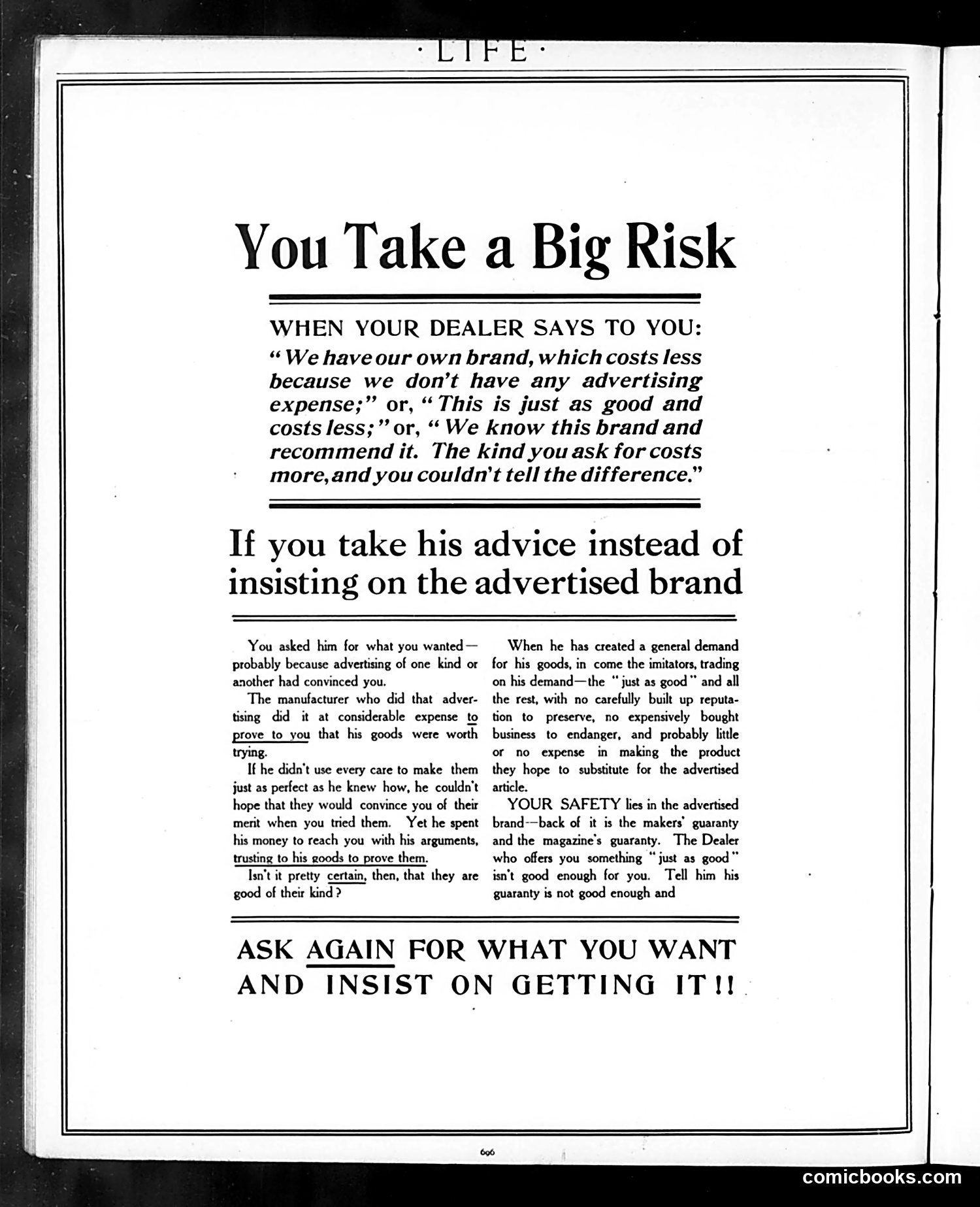
This is an **advertisement masquerading as consumer advice**, published in Life magazine (likely early-to-mid 20th century). It's a meta-advertisement *defending* the advertising industry itself. The piece warns readers against accepting store clerks' suggestions to buy cheaper "house brand" or generic alternatives instead of nationally advertised products. The argument: advertised brands cost more because manufacturers invested heavily in proven quality and advertising to build reputation and consumer trust. Generic alternatives exploit that demand without the reputation risk or manufacturing standards to protect. The satire is unintentional or ironic: the piece uses scare tactics ("You Take a Big Risk," "Your Safety") to argue that consumers should trust *advertising* as a guarantee of quality—essentially arguing that ads themselves prove product superiority, since manufacturers wouldn't spend money advertising inferior goods. This reflects early advertising-industry logic: national brands = trustworthy; generics = risky knockoffs. Modern readers would recognize this as circular reasoning and brand-protection marketing.
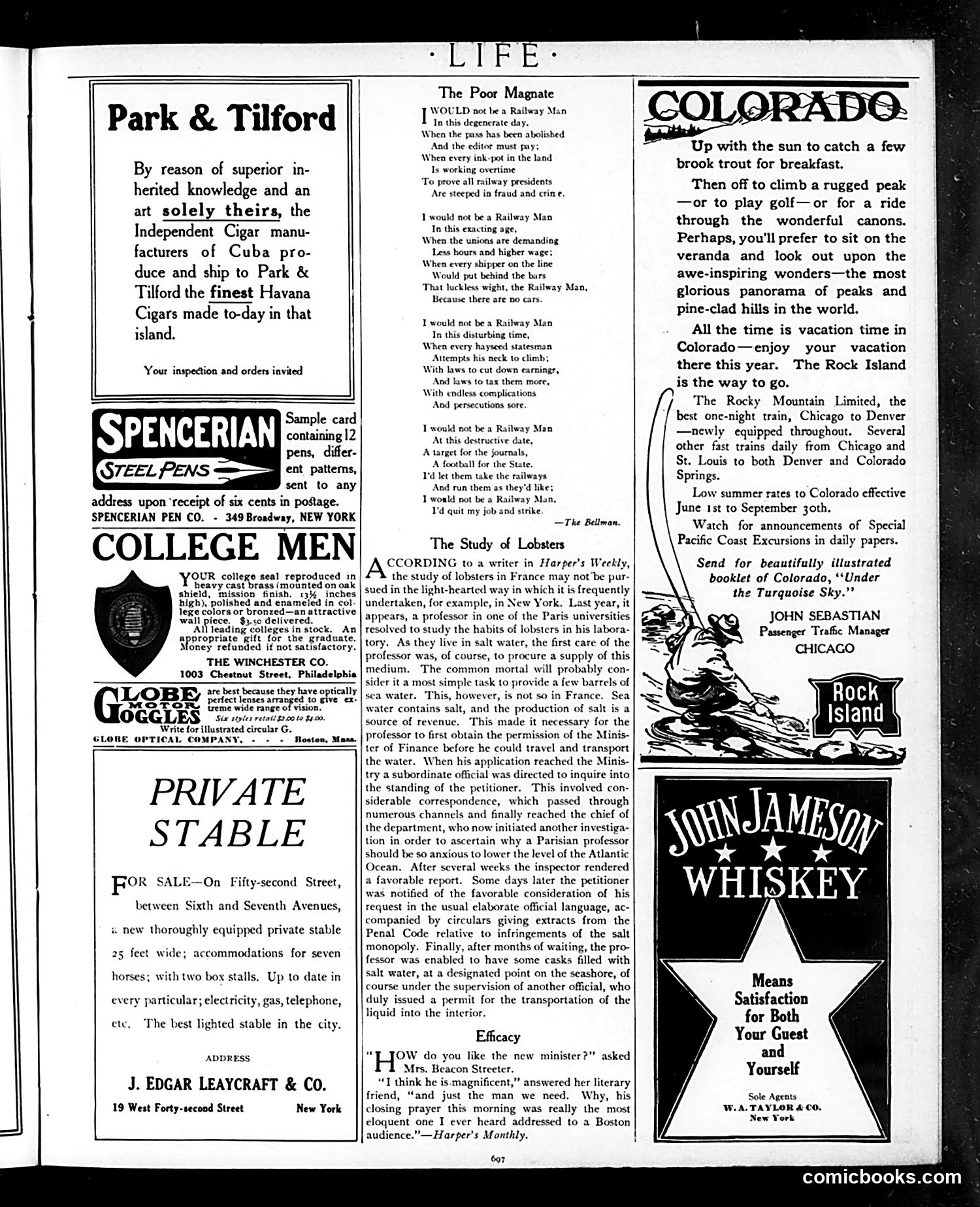
This page is primarily **advertising and light satirical content** rather than political commentary. The main satirical piece is "The Poor Magnate," a poem by The Bellman criticizing railroad executives. It satirizes the difficult position of railroad magnates in the early 1900s, who faced: - Abolished railway passes (no free travel) - Demands to pay editors like ordinary citizens - Labor unions demanding higher wages and shorter hours - Angry shippers blaming them for car shortages - Hostile politicians and journalists - Government regulation and taxation The poem's ironic point: the speaker wouldn't want to be a railroad president anymore—he'd "quit my job and strike." "The Study of Lobsters" is **bureaucratic satire**, mocking French governmental red tape. A Parisian professor needs permission from the Minister of Finance merely to transport salt water for lobster research, triggering absurd official investigations questioning why he'd "lower the level of the Atlantic Ocean." The remaining content consists of period advertisements for cigars, pens, college seals, eyeglasses, and a private stable.
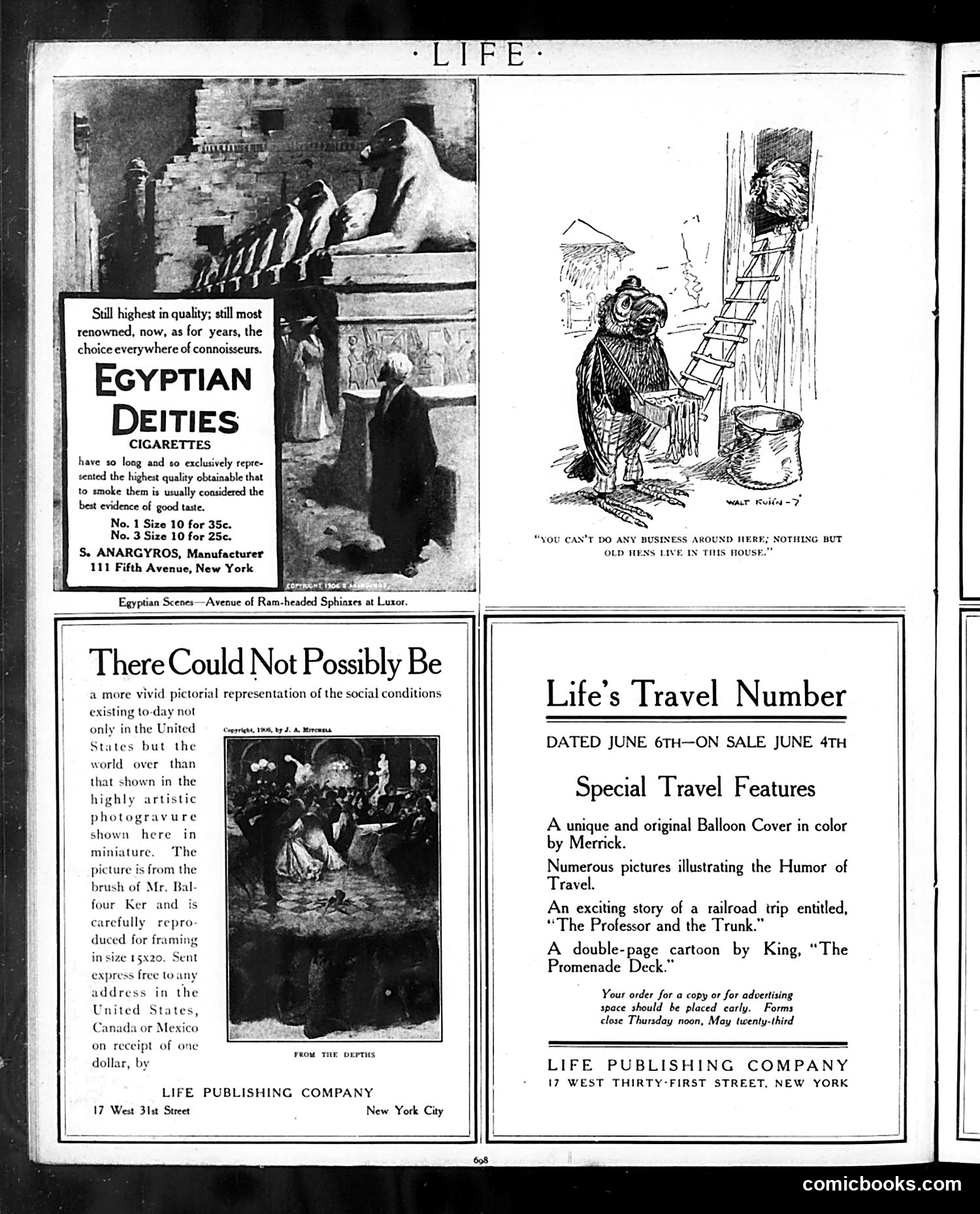
This page mixes advertisements with content promotion. The main cartoon depicts a man confronting an elderly woman at a house, complaining he "can't do any business" because "nothing but old hens live in this house." The joke appears to play on the phrase "old hens"—simultaneously referring to actual poultry and elderly women—suggesting the man's business (unclear what type) is being disrupted by the household's residents. The page also advertises Egyptian Deities cigarettes, positioning them as a luxury product for "connoisseurs," and promotes an upcoming "Travel Number" of Life magazine (dated June 6th) featuring travel humor, cartoons, and stories. The left section advertises a photogravure reproduction titled "From the Depths" by Balfour Ker, described as depicting contemporary "social conditions"—likely a serious artwork contrasting with the magazine's satirical tone.
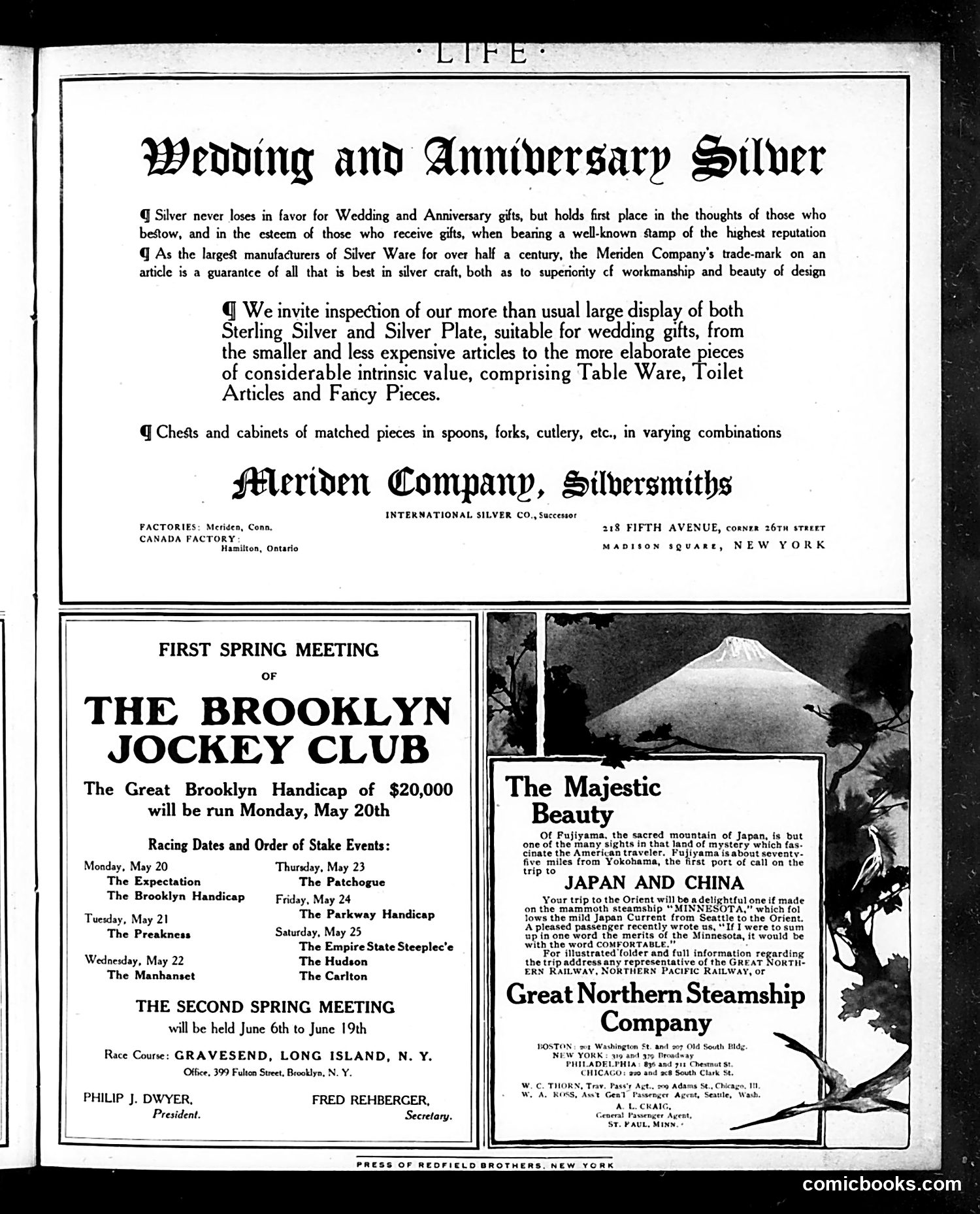
This is primarily an **advertising page**, not a satirical cartoon page. It contains three unrelated advertisements typical of early 20th-century Life magazine: 1. **Meriden Company Silver** (top): A luxury goods advertisement emphasizing that sterling silver and silver plate are prestigious wedding and anniversary gifts, promoting the company's reputation and product range. 2. **Brooklyn Jockey Club** (bottom left): An announcement of horse racing events at Brooklyn's racing venue, listing spring meeting dates and stake races like "The Great Brooklyn Handicap" ($20,000 purse). 3. **Great Northern Steamship Company** (bottom right): A travel advertisement promoting cruises to Japan and China, featuring Mount Fujiyama. The ad highlights the comfort of their ship "Minnesota" and appeals to American travelers seeking exotic Orient experiences. **No satire or political commentary is present.** This reflects early 1900s consumer culture targeting wealthy readers—silver purchases, horse racing, and international luxury travel.
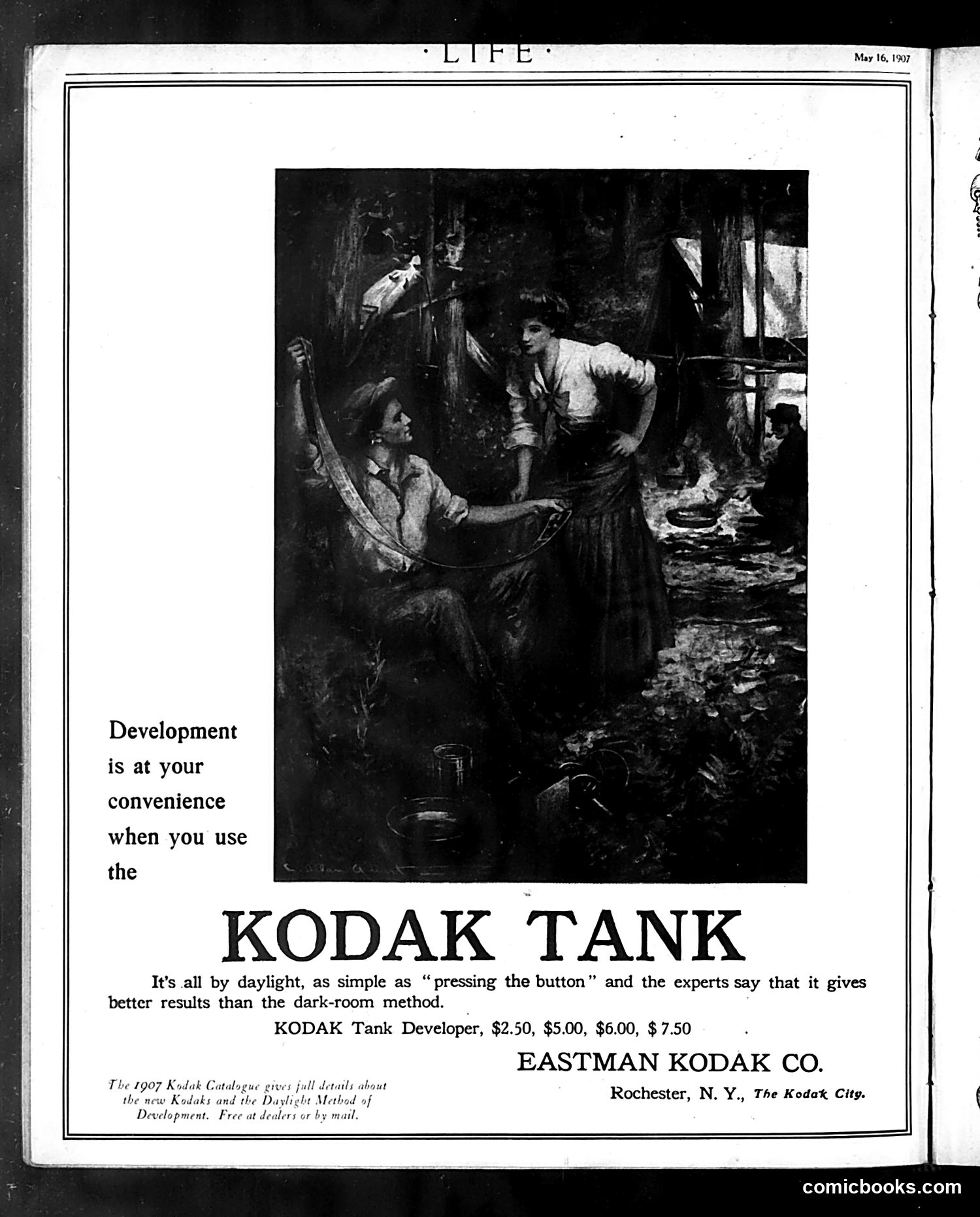
This is a **Kodak advertisement**, not a political cartoon. The page shows a product advertisement for the Kodak Tank developer, published in *Life* magazine on May 16, 1907. The dramatic black-and-white photograph depicts what appears to be a domestic or working-class scene—figures in an interior space with casual dress and modest furnishings. However, this image serves purely as an **atmospheric backdrop** to advertise Kodak's new developing technology. The advertisement's appeal was revolutionary for its time: Kodak's Tank developer promised to simplify film development by eliminating the need for a darkroom. Users could develop photographs "by daylight" through a simple mechanical process—"as simple as pressing the button," echoing Kodak's famous marketing slogan. The ad positions this as convenient and superior to traditional "dark-room methods," marketing modernization and ease of use to amateur photographers. There is no satire, caricature, or political commentary present on this page.