
Life, 1907-05-16 · page 15 of 36
Life — May 16, 1907 — page 15: what you’re looking at
What you’re looking at
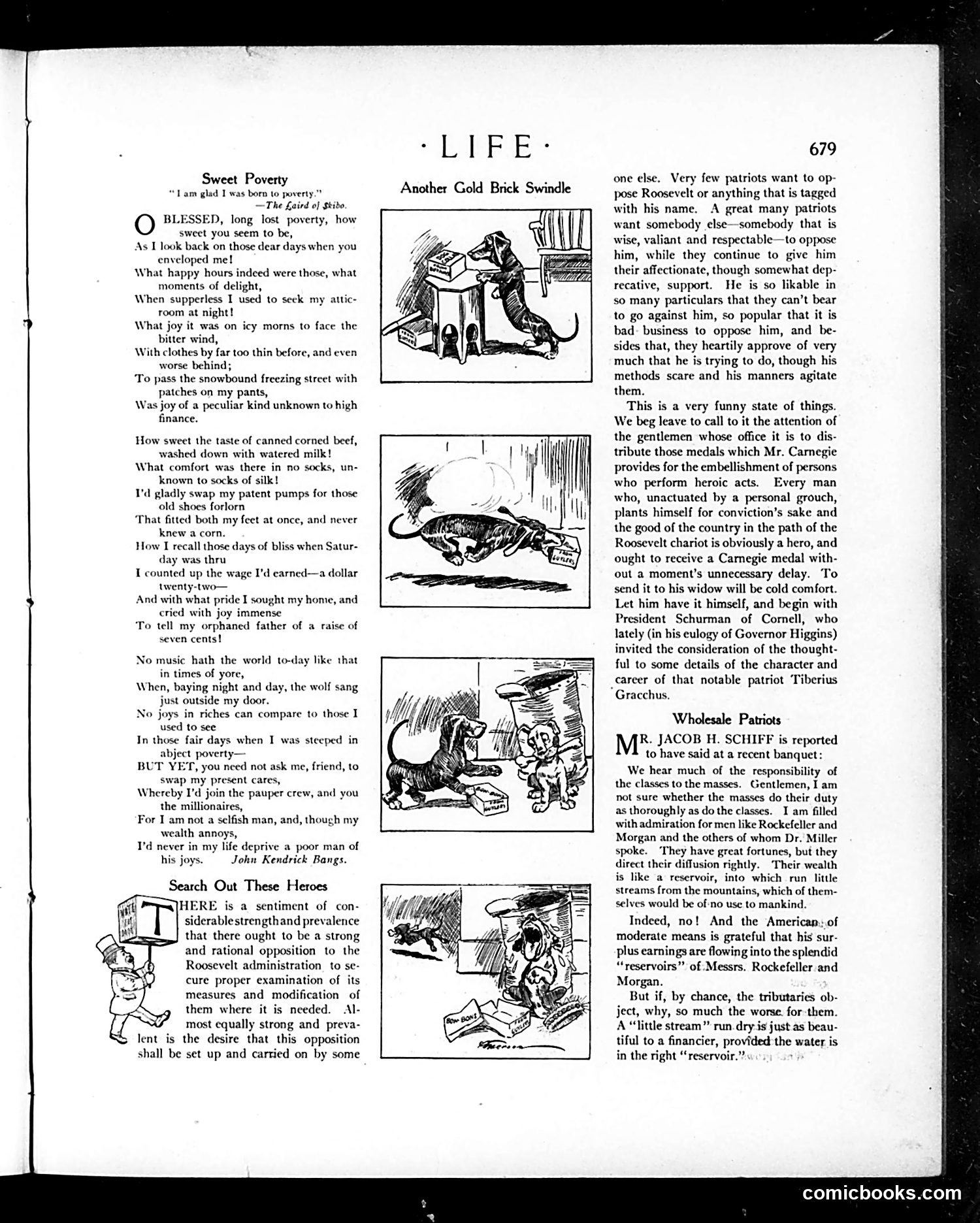
This page contains satirical commentary on early Roosevelt administration politics. The main article, "Search Out These Heroes," mocks the paradox of Roosevelt's popularity: many citizens want to oppose his policies but lack courage to do so publicly. The satire suggests they hope someone else—a "hero"—will do the opposing for them. The piece specifically names President Schurman of Cornell as such a potential hero for criticizing Roosevelt, comparing him to Tiberius Gracchus (a Roman reformer). It sarcastically suggests Carnegie medals should be awarded to those brave enough to publicly challenge Roosevelt. The accompanying cartoons (titled "Another Gold Brick Swindle") appear to illustrate con artists or schemes, likely representing corrupt activities the opposition might expose. The poem "Sweet Poverty" is unrelated satire celebrating hardship—a common genre mocking nostalgia for difficult circumstances while refusing to actually experience them. The Jacob Schiff quote at bottom discusses class responsibility, contextualizing wealthy philanthropists' role in governance debates of the era.
📄 Transcribed text from this page (OCR, searchable)
Machine-transcribed from the original scan — historical spelling and the odd misread are preserved.
Sweet Poverty “Tam glad I was born to poverty.” —The Laird of $tibo. BLESSED, long lost poverty, how sweet you seem to be, As I look back on those dear days when you enveloped me! What happy hours indeed were those, what moments of delight, When supperless I used to seck my attic- room at night! What joy it was on icy morns to face the bitter wind, With clothes by far too thin before, and even worse behind; To pass the snowbound freezing street with patches on my pants, Was joy of a peculiar kind unknown to high finance. How sweet the taste of canned corned beef, washed down with watered milk! What comfort was there in no socks, un- known to socks of silk! I'd gladly swap my patent pumps for those old shoes forlorn ‘That fitted both my feet at once, and never knew a corn. How I recall those days of bliss when Satur- day was thru I counted up the wage I'd carned—a dollar twenty-two And with what pride I sought my home, and cried with joy immense To tell my orphaned father of a raise of seven cents! No music hath the world to-day like that in times of yore, When, baying night and day, the wolf sang just outside my door. No joys in riches can compare to those I used to see In those fair days when I was steeped in abject poverty— BUT YET, you nced not ask me, friend, to swap my present cares, Whereby I'd join the pauper crew, and you the millionaires, For I am not a selfish man, and, though my wealth annoys, I'd never in my life deprive a poor man of his joys. John Kendrick Bangs. Search Out These Heroes HERE is a sentiment of con- siderable strengthand prevalence that there ought to be a strong and rational opposition to the Roosevelt administration to se- cure proper examination of its measures and modification of them where it is needed. Al- most equally strong and preva- the desire that this opposition shall be set up and carried on by some ge Bald cl ip Another Gold Brick Swindle 679 one else. Very few patriots want to op- pose Roosevelt or anything that is tagged with his name. A great many patriots want somebody ¢lse—somebody that is wise, valiant and respectable—to oppose him, while they continue to give him their affectionate, though somewhat dep- recative, support. He is so likable in so many particulars that they can’t bear to go against him, so popular that it is bad: business to oppose him, and be- sides that, they heartily approve of very much that he is trying to do, though his methods scare and his manners agitate them. This is a very funny state of things. We beg leave to call to it the attention of the gentlemen whose office it is to dis- tribute those medals which Mr. Carnegie provides for the embellishment of persons who perform heroic acts. Every man who, unactuated by a personal grouch, plants himself for conviction’s sake and the good of the country in the path of the Roosevelt chariot is obviously a hero, and ought to receive a Carnegie medal with- out a moment's unnecessary delay. To send it to his widow will be cold comfort. Let him have it himself, and begin with President Schurman of Cornell, who lately (in his eulogy of Governor Higgins) invited the consideration of the thought- ful to some details of the character and carcer of that notable patriot Tiberius “Gracchus. Wholesale Patriots M® JACOB H. SCHIFF is reported to have said at a recent banquet: We hear much of the responsibility of the classes to the masses. Gentlemen, I am not sure whether the masses do their duty as thoroughly as do the classes. I am filled with admiration for men like Rockefeller and Morgan and the others of whom Dr. Miller spoke. They have great fortunes, but they direct their diffusion rightly. ‘Their wealth is like a reservoir, into which run little streams from the mountains, which of them- selves would be of-no use to mankind. Indeed, no! And the American:.of moderate means is grateful that his sur- plus earnings are flowing into the splendid “reservoirs” of Messrs. Rockefeller and Morgan. But if, by chance, the tributaries ob- ject, why, so much the worse. for-them. A “little stream” run. dry is just as beau- tiful to a financier, provided the water is in the right “reservoir.” a comicbooks.com