
Life, 1907-05-16 · page 21 of 36
Life — May 16, 1907 — page 21: what you’re looking at
What you’re looking at
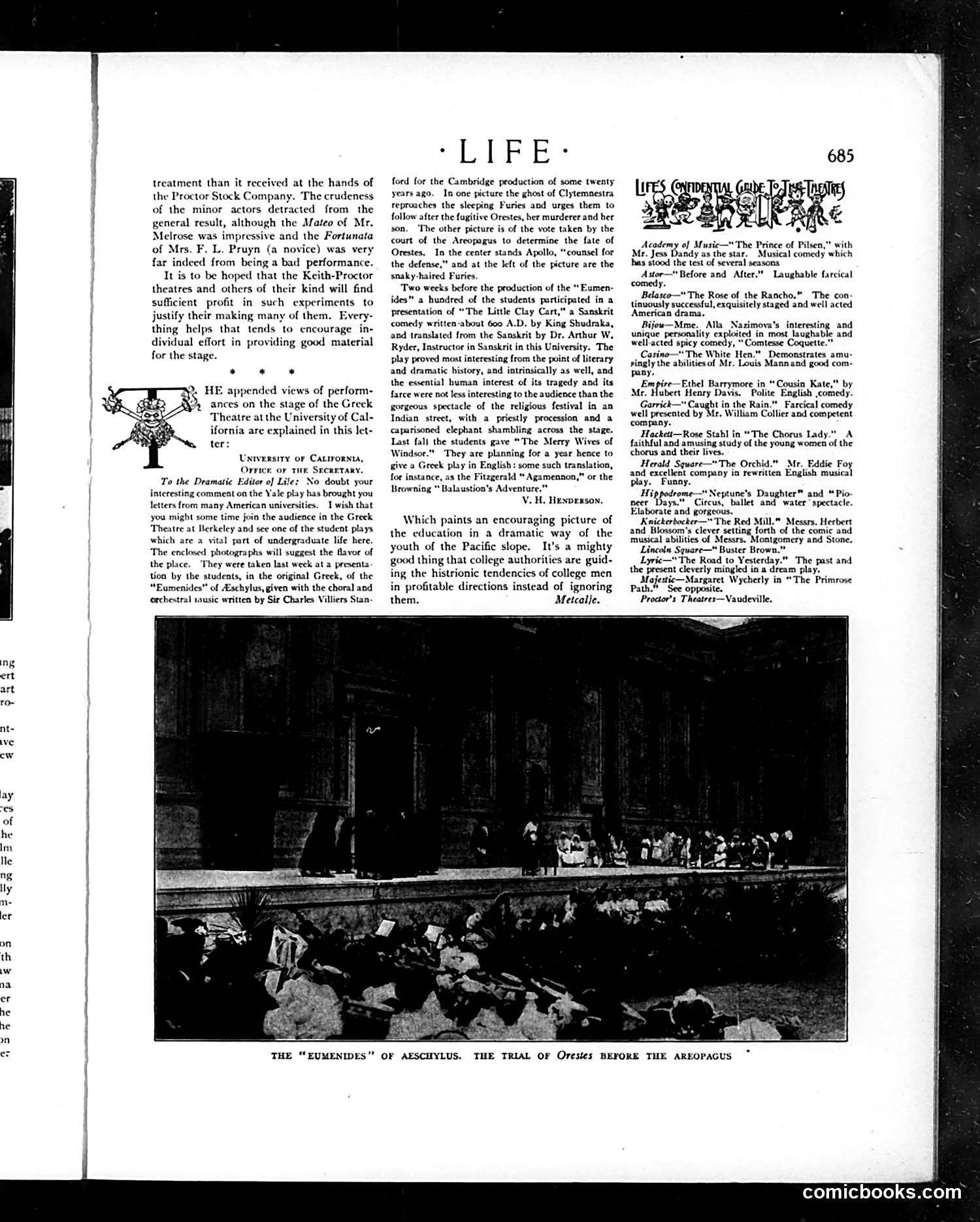
This page documents a University of California Greek Theatre production of Aeschylus's *Eumenides*, staged by students in the original Greek with period-appropriate music. The photograph shows the famous trial scene where the court of the Areopagus votes on Orestes' fate, with Apollo (as "counsel for the defense") and the Furies visible. The letter's author celebrates this as exemplary undergraduate education—arguing that college theaters should channel students' dramatic talents toward "profitable directions" rather than ignore such interests. The accompanying editorial commentary praises institutions guiding "histrionic tendencies" productively. The page also notes the university's recent Sanskrit comedy production (*The Little Clay Cart*) and planned English-language Greek drama, positioning classical theater as integral to liberal education on the Pacific Coast.
📄 Transcribed text from this page (OCR, searchable)
Machine-transcribed from the original scan — historical spelling and the odd misread are preserved.
ng, ert art rO- nt- ve cw es of he Im le ng lly n- jer on, we na, treatment than it received at the hands of the Proctor Stock Company. ‘The crudeness of the minor actors detracted from the general result, although the Mateo of Mr. Melrose was impressive and the Fortunate of Mrs. F. L. Pruyn (a novice) was very far indeed from being a bad performance. It is to be hoped that the Keith-Proctor theatres and others of their kind will find sufficient profit in such experiments to justify their making many of them. Every- thing helps that tends to encourage in- dividual effort in providing good material for the stage. + 8 «@ 2. HE appended views of perform >, ances on the stage of the Greck ‘Theatre at the University of Cal- ifornia are explained in this let- ter: Ustversity or Catirornia, Orrice or THE SECRETARY. To the Dramatic Editor of Lile: No doubt your interesting comment on the Yale play has brought you letters from many American universities. I wish that you might some time join the audience in the Greek ‘Theatre at Berkeley and see one of the student plays which are a vital part of undergraduate life here. ‘The enclosed photographs will suggest the flavor of the place. ‘They were taken last week at a presenta tion by the students, in the original Greek, of the “Eumenides” of schylus, given with the choral and orchestral sausic written by Sir Charles Villiers Stan- *LIPE* ford for the Cambridge production of some twenty years ago, In one picture the ghost of Clytemnestra reproaches the sleeping Furies and urges them to follow after the fugitive Orestes, her murderer and her son. The other picture is of the vote taken by the court of the Areopagus to determine the fate of Orestes. In the center stands Apollo, “counsel for the defense," and at the left of the picture are the snaky-haired Furies ‘Two weeks before the production of the" Eumen- ides” a hundred of the students participated in a presentation of “The Little Clay Cart,” a Sanskrit comedy written about 600 A.D. by King Shudraka, and translated from the Sanskrit by Dr. Arthur W. Ryder, Instructor in Sanskrit in this University. The play proved most interesting from the point of literary and dramatic history, and intrinsically as well, and the essential human interest of its tragedy and its farce were not less interesting to the audience than the gorgeous spectacle of the religious festival in an Indian street, with a priestly procession and a caparisoned elephant shambling across the stage. Last fall the students gave “The Merry Wives of Windsor.” They are planning for a year hence to give a Greek play in English : some such translation, for instance, as the Fitzgerald “ Agamennon,” or the Browning “ Balaustion’s Adventure.” V. H, Hexprson, Which paints an encouraging picture of the education in a dramatic way of the youth of the Pacific slope. It’s a mighty good thing that college authorities are guid- ing the histrionic tendencies of college men in profitable directions instead of ignoring them. Metcalje. Academy of Music—“'The Prince of Pilsen,” with Mr. Jess Dandy as the star. Musical comedy which has stood the test of several seasons Astor—" Before and After.” Laughable farcical comedy. Belasco—" The Rose of the Rancho." The con- tinuously successful, exquisitely staged and weil acted American drama. Bijow—Mme. Alla Nazimova's interesting and unique personality exploited in most laughable and well-acted spicy comedy, "Comtesse Coquette.” Casino—"The White Hen." Demonstrates amu- singly the abilitiesof Mr. Louis Mann and good com- pany. Empire—Ethel Barrymore in “Cousin Kate,” by Mr. Hubert Henry Davis. Polite English ,comedy. Garrick— Caught in the Rain.” Farcical comedy well presented by Mr. William Collier and competent company. Hackett—Rose Stabl in “The Chorus Lady." A faithful and amusing study of the young women of the chorus and their lives. Herald Square—"The Orchid." Mr. Eddie Foy and excellent company in rewritten English musical play. Funny. Hippodrome—"' Neptune's Daughter” and “Pio neer Days.” Circus, ballet and water spectacle. Elaborate and gorgeous. Knickerbocker—"The Red Mill," Messrs. Herbert and Blossom’s clever setting forth of the comic and musical abilities of Messrs. Montgomery and Stone, Lincoln Square— Buster Brown.” Lyric—"'The Road to Yesterday." ‘The past and the present cleverly mingled in a dream play. Mojestic—Margaret Wycherly in “The Primrose Path." See opposite. Proctor’s Theatres—Vaudeville. EUMENIDES" OF AESCHYLUS. THE TRIAL OF Orestes BEFORE THE AREOPAGUS comicbooks.com