
Life, 1907-05-16 · page 14 of 36
Life — May 16, 1907 — page 14: what you’re looking at
What you’re looking at
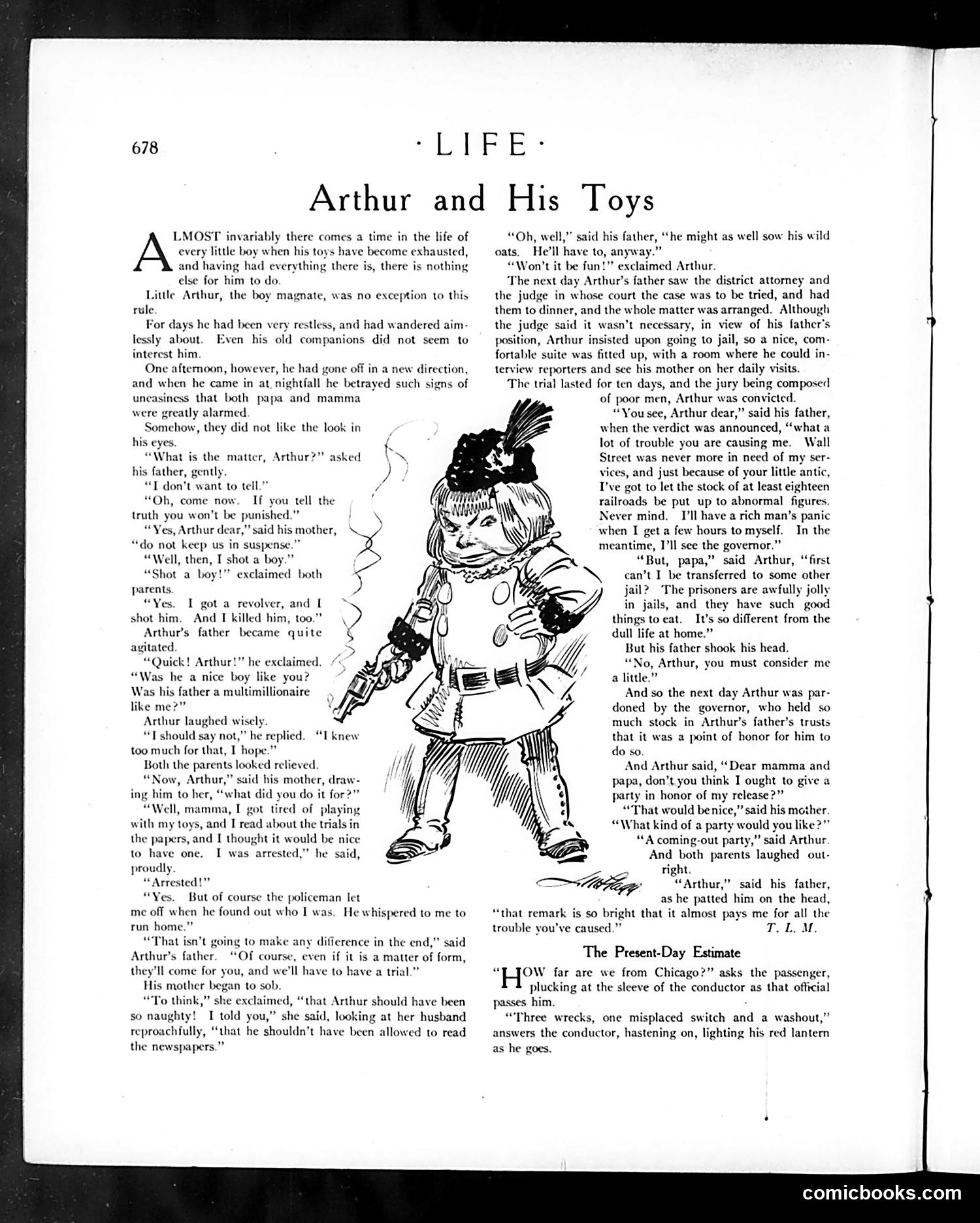
This is a satirical story mocking the corruption of the Gilded Age wealthy elite and their immunity from justice. Young Arthur, son of a rich "multimillionaire," shoots and kills a poor boy out of boredom with his toys. His parents are initially alarmed, but become *relieved* upon learning the victim wasn't wealthy. The satire escalates: Arthur is arrested but released immediately when authorities learn his identity. A trial proceeds as mere theater—the jury, "composed of poor men," convicts him, but his father simply arranges a pardon from the governor (who holds stock in the father's railroad trusts). The joke targets how wealth and corporate power rendered the legal system meaningless for the rich. Arthur's casual murder, the bought verdict, and the governor's quid pro quo pardon all illustrate that justice was a commodity purchased by the powerful. Even Arthur's preference for jail's "good things to eat" over home life underscores the absurdity—his "punishment" is optional luxury. The story satirizes systemic corruption, class inequality, and the era's robber barons' brazen manipulation of government.
📄 Transcribed text from this page (OCR, searchable)
Machine-transcribed from the original scan — historical spelling and the odd misread are preserved.
“Lite E * Arthur and His Toys LMOST invariably there comes a time in the life of A every little boy when his toys have become exhausted, and having had everything there is, there is nothing else for him to do. Little Arthur, the boy magnate, was no exception to this rule. For days he had been very restless, and had wandered aim lessly about. Even his old companions did not seem to interest him. One afternoon, however, he had gone off in a new direction, and when he came in at, nightfall he betrayed such signs of uneasiness that both papa and mamma were greatly alarmed. Somehow, they did not like the look in his eyes. “What is the matter, Arthur?” asked his father, gently. “T don’t want to tell.” “Oh, come now. If you tell the truth you won't be punished.” “Yes, Arthur dear,” said his mother, \_ “do not keep us in suspense. “Well, then, I shot a boy. “Shot a boy!” exclaimed both parents. “Yes. I got a revolver, and I shot him. And I killed him, too.” Arthur’s father became quite agitated. “Quick! Arthur!” he exclaimed. “Was he a nice boy like you? Was his father a multimillionaire like me Arthur laughed wisely. “T should say not,” he replied. “I knew too much for that, I hope.” Both the parents looked relieved. “Now, Arthur,” said his mother, draw- ing him to her, “what did you do it for?” “Well, mamma, I got tired of playing with my toys, and T read about the trials in the papers, and I thought it would be nice to have one. I was arrested,” he said, proudly. “Arrested !”” “Yes. But of course the policeman let me off when he found out who I was. He whispered to me to run home.” “That isn’t going to make any difierence in the end,” said Arthur’s father. “Of course, even if it is a matter of form, they'll come for you, and we'll have to have a trial.” His mother began to sob. “To think,” she exclaimed, “that Arthur should have been so naughty! I told you,” she said, looking at her husband reproachfully, “that he shouldn’t have been allowed to read the newspapers.” “Oh, well,” said his father, “he might as well sow his wild oats, He'll have to, anyway.” “Won't it be fu claimed Arthur. The next day Arthur’s father saw the district attorney and the judge in whose court the case was to be tried, and had them to dinner, and the whole matter was arranged. Although the judge said it wasn’t necessary, in view of his father’s position, Arthur insisted upon going to jail, so a nice, com- fortable suite was fitted up, with a room where he could in- terview reporters and sce his mother on her daily visits. The trial lasted for ten days, and the jury being composed of poor men, Arthur was convicted. “You see, Arthur dear,” said his father, when the verdict was announced, “what a lot of trouble you are causing me. Wall Street was never more in need of my ser- vices, and just because of your little antic, I’ve got to let the stock of at least eighteen railroads be put up to abnormal figures. Never mind. I'll have a rich man’s panic when I get a few hours to myself. In the meantime, I'll see the governor.” “But, papa,” said Arthur, “first can’t I be transferred to some other ‘The prisoners are awfully jolly in jails, and they have such good things to eat. It’s so different from the dull life at home.” But his father shook his head. “No, Arthur, you must consider me a little.” And so the next day Arthur was par- doned by the governor, who held so much stock in Arthur’s father’s trusts that it was a point of honor for him to do so, And Arthur said, ‘Dear mamma and papa, don’t you think I ought to give a party in honor of my release?” “That would benice,” said his mother. “What kind of a party would you like?” “A coming-out party,” said Arthur. Ca And toms parents laughed out- right. >i “Arthur,” said his. father, as he patted him on the head, “that remark is so bright that it almost pays me for all the trouble you've caused.”” de BEAL. The Present-Day Estimate “RO far are we from Chicago?” asks the passenger, plucking at the sleeve of the conductor as that official passes him. “Three wrecks, one misplaced switch and a washout,” answers the conductor, hastening on, lighting his red lantern as he goes. comicbooks.com