
Life, 1907-05-16 · page 12 of 36
Life — May 16, 1907 — page 12: what you’re looking at
What you’re looking at
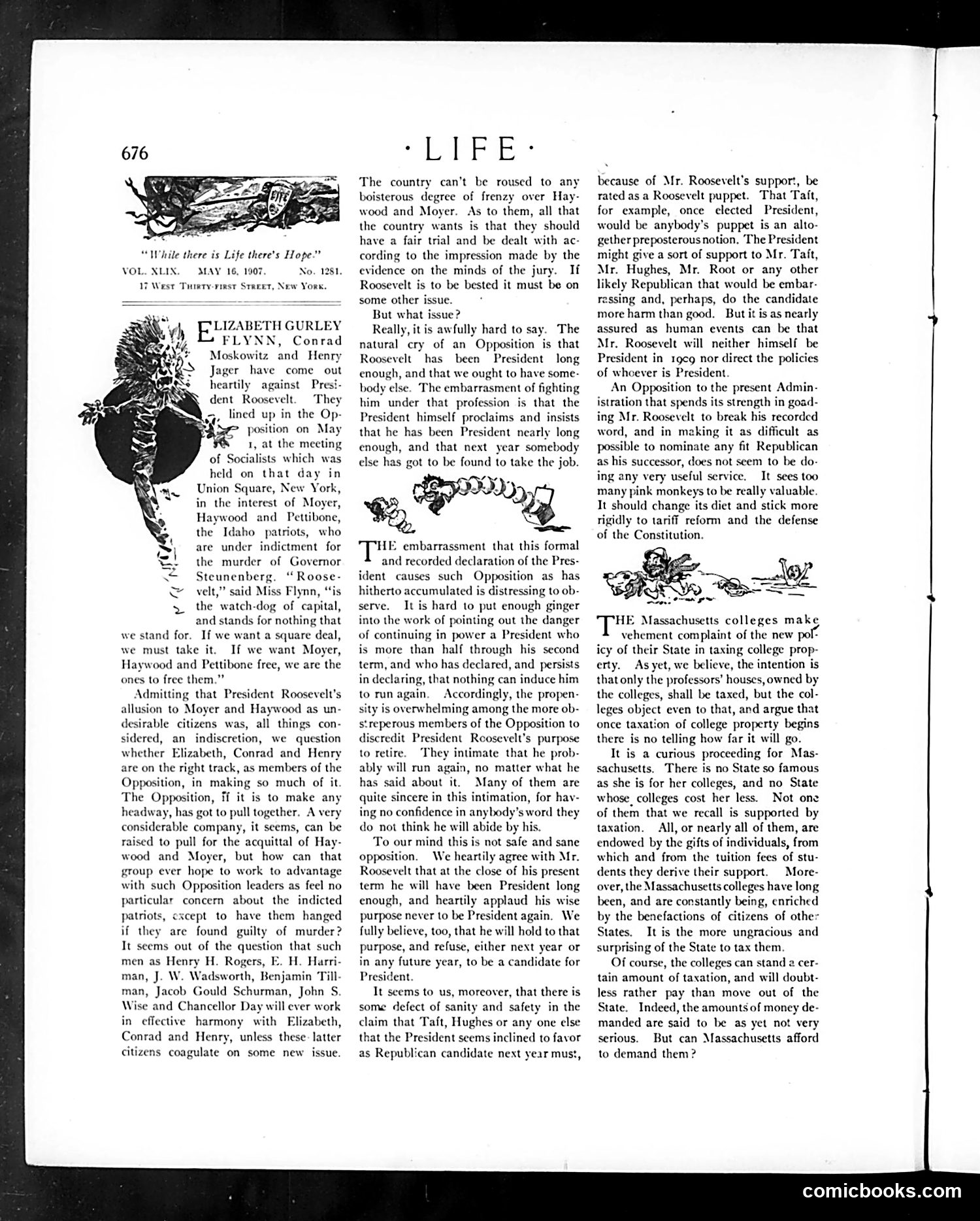
This page contains an article by Elizabeth Gurley Flynn criticizing President Roosevelt's position on the 1908 presidential succession. The text discusses how the Opposition party is using Roosevelt's statement that he won't run again as ammunition against him, while simultaneously suggesting he should endorse a successor. The article argues this creates an untenable situation: Roosevelt insists he won't seek another term, yet opposing factions (likely referring to potential candidates like Taft, Hughes, or others mentioned) are maneuvering to either draft him or discredit his chosen successor. Flynn advocates that Roosevelt should decisively name his preferred candidate to prevent chaos and maintain party unity—though the specific endorsement remains unclear from this excerpt alone.
📄 Transcribed text from this page (OCR, searchable)
Machine-transcribed from the original scan — historical spelling and the odd misread are preserved.
“While there is Life VOL. XLIX. MAY 16, 1907 No. 1281. West Titety-riest Stacet, New Yorx. LIZABETH GURL! FLYNN, Conrad Moskowitz and Henry SS Jager have come out s heartily against Presi- dent Roosevelt. They =, lined up in the Op- position on M 1, at the meeting jalists which was held on that day in Union Square, New York, in the interest of Moyer, Haywood and Pettibone, . the Idaho patriots, who ~~) are under indictment for | the murder of Governor = Steunenberg. “Roos > velt,” said Miss Flynn, 3 the watch-dog of capital, and stands for nothing that we stand for. If we want a square deal, we must take it. If we want Moyer, Haywood and Pettibone free, we are the ones to free them.” Admitting that President Roosevelt's allusion to Moyer and Haywood as un- desirable citizens was, all things con- sidered, an indiscretion, we question whether Elizabeth, Conrad and Henry are on the ri , as members of the Opposition, in making so much of it The Opposition, ff it is to make any headway, has got to pull together. A very considerable company, it seems, can be raised to pull for the acquittal of Hay- wood and Moyer, but how can that group ever hope to work to advantage with such Opposition leaders as feel no particular concern about the indicted patriots, except to have them hanged if they are found guilty of murder? It seems out of the question that such men as Henry H. Rogers, E. H. Harri- man, J. W. Wadsworth, Benjamin Till man, Jacob Gould Schurman, John S. Wise and Chancellor Day will ever work in effective harmony with E Conrad and Henry, unless these: latter zens coagulate on some new issue. = LPF as The country can't be roused to any boisterous degree of frenzy over Hay- wood and Moyer. As to them, all that the country wants is that they should have a fair trial and be dealt with ac- cording to the impression made by the evidence on the minds of the jury. If Roosevelt is to be bested it must be on some other issue. But what issue? Really, it is awfully hard to say. The natural cry of an Opposition is that Roosevelt has been President long enough, and that we ought to have some- body else. The embarrasment of fighting him under that profession is that the President himself proclaims and insists that he has been President nearly long enough, and that next year somebody else has got to be found to take the job. an HE embarrassment that this formal and recorded declaration of the Pres- ident causes such Opposition as has hitherto accumulated is distressing to ob- serve. It is hard to put enough ginger into the work of pointing out the danger of continuing in power a President who is more than half through his second term, and who has declared, and persists in declaring, that nothing can induce him to run again, Accordingly, the propen- sity is overwhelming among the more ob- streperous members of the Opposition to discredit President Reosevelt’s purpose to retire. They intimate that he prob- ably will run again, no matter what he has said about it. Many of them are quite sincere in this intimation, for hav- ing no confidence in anybody’s word they do not think he will abide by his. To our mind this is not safe and sane opposition. We heartily agree with Mr. Roosevelt that at the close of his present term he will have been President long enough, and heartily applaud his wise purpose never to be President again. We fully believe, too, that he will hold to that purpose, and refuse, either next year or in any future year, to be a candidate for President It seems to us, moreover, that there is some defect of sanity and safety in the claim that Taft, Hughes or any one else that the President seems inclined to favor as Republican candidate next year must, because of Mr. Roosevelt's support, be rated as a Roosevelt puppet. That Taft, for example, once elected President, would be anybody's puppet is an alto- gether preposterous notion, The President might give a sort of support to Mr. Taft, Mr. Hughes, Mr. Root or any other likely Republican that would be embar- ressing and, perhaps, do the candidate more harm than good. But it is as nearly assured as human events can be that Mr. Roosevelt will neither himself be President in 19¢9 nor direct the policies of whoever is President An Opposition to the present Admin- istration that spends its strength in goad- ing Mr. Roosevelt to break his recorded word, and in making it as difficult as possible to nominate any fit Republican as his successor, does not seem to be do- ing any very useful service. It sees too many pink monkeys to be really valuable It should change its diet and stick more rigidly to tariff reform and the defense of the Constitution. HE Massachusetts colleges make vehement complaint of the new pol- icy of their State in taxing college prop- erty. As yet, we believe, the intention is that only the professors’ houses, owned by the colleges, shall be taxed, but the col- leges object even to that, and argue that once taxation of college property begins there is no telling how far it will go. It is a curious proceeding for Mas- sachusetts. There is no State so famous as she is for her colleges, and no State whose, colleges cost her less. Not one of them that we recall is supported by taxation. All, or nearly all of them, are endowed by the gifts of individuals, from which and from the tuition fees of stu- dents they derive their support. More- over, the Massachusetts colleges have long been, and are constantly being, enriched by the benefactions of citizens of other States, It is the more ungracious and surprising of the State to tax them. Of course, the colleges can stand a cer- tain amount of taxation, and will doubt- less rather pay than move out of the te. Indeed, the amounts of money de- manded are said to be as yet not very serious. But can Massachusetts afford to demand them? comicbooks.com