
Life, 1907-05-16 · page 16 of 36
Life — May 16, 1907 — page 16: what you’re looking at
What you’re looking at
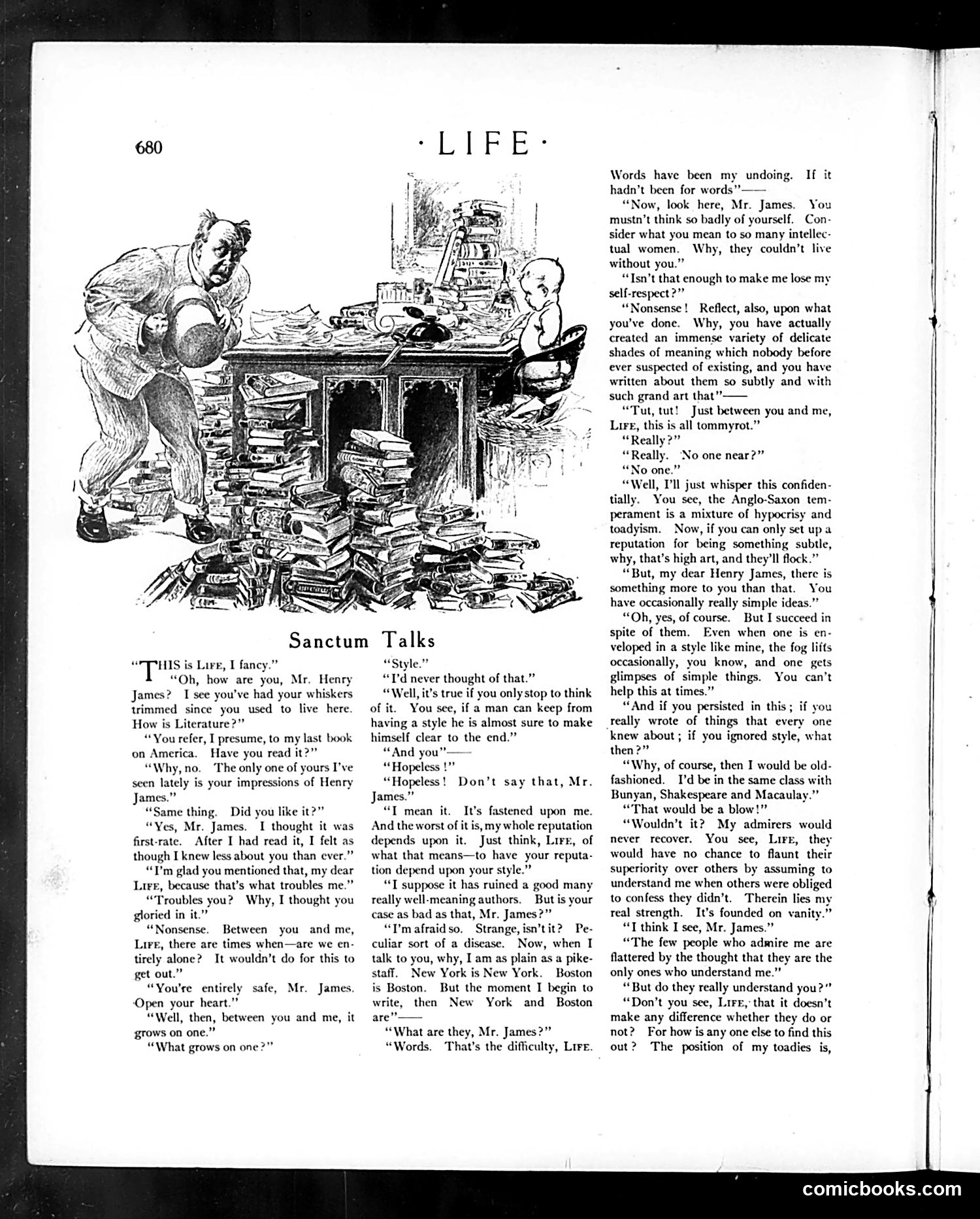
This page satirizes the famous novelist **Henry James** through a dialogue between "Life" (the magazine's personified voice) and James himself. The cartoon depicts two figures at a desk surrounded by books and papers. The satire targets James's notoriously **complex, ornate prose style**—his elaborate sentences and obscure vocabulary that made his work difficult to read. James self-mockingly admits that his style has become a disease; he cannot write plainly even when he tries. The joke's sting comes in James's cynical confession: his elaborate style isn't artistic brilliance but a calculated strategy. By writing obscurely, he flatters his readers' vanity—they feel intellectually superior for "understanding" him and can smugly assume others don't. James admits his reputation rests entirely on this pretense, comparing his admirers to snobs who prize incomprehensibility as a status marker. The satire suggests James himself recognizes the emperor-has-no-clothes reality: his dense writing conceals simple (or absent) ideas beneath decorative language.
📄 Transcribed text from this page (OCR, searchable)
Machine-transcribed from the original scan — historical spelling and the odd misread are preserved.
Sanctum Talks “OPHIS is Lire, I fancy. “Oh, how are you, Mr. Henry James? I see you've had your whiskers trimmed since you used to live here How is Literature?” “You refer, I presume, to my last book on America. Have you read it?” “Why,no. The only one of yours I’ve seen lately is your impressions of Henry James.” “Same thing. Did you like it?” “Yes, Mr. James. I thought it was first-rate. After I had read it, I felt as though I knew less about you than ever.” “T'm glad you mentioned that, my dear Lire, because that’s what troubles me.”” “Troubles you? Why, I thought you gloried in it.” “Nonsense. Between you and me, Lire, there are times when—are we en- tirely alone? It wouldn’t do for this to get out.” “You're entirely safe, Mr. James. Open your heart.” “Well, then, between you and me, it grows on one.” “What grows on one?” “Style.” “T’d never thought of that.” “Well, it’s true if you only stop to think of it. You see, if a man can keep from having a style he is almost sure to make himself clear to the end.” “And you” — “Hopeless !”” “Hopeless! Don’t say that, Mr. James.” “T mean it. It’s fastened upon me. And the worst of it is, my whole reputation depends upon it. Just think, Lirr, of what that means—to have your reputa- tion depend upon your style.” “T suppose it has ruined a good many really well-meaning authors. But is your case as bad as that, Mr. James?” “T’m afraid so. Strange, isn’tit? Pe- culiar sort of a disease. Now, when I talk to you, why, I am as plain as a pike- staff. New York is New York. Boston is Boston. But the moment I begin to write, then New York and Boston are” —— “What are they, Mr. James?” “Words. That's the difficulty, Lrre. Words have been my undoing. If it hadn’t been for words”—— “Now, look here, Mr. James. You mustn’t think so badly of yourself. Con- sider what you mean to so many intellec- tual women. Why, they couldn’t live without you.” “Isn't that enough to make me lose my self-respect ?”” “Nonsense! Reflect, also, upon what you've done. Why, you have actually created an immense variety of delicate shades of meaning which nobody before ever suspected of existing, and you have written about them so subtly and with such grand art that”——. “Tut, tut! Just between you and me, Lire, this is all tommyrot.” “Really?” “Really. ‘No one near?” “No one.” “Well, I'll just whisper this confiden- tially. You see, the Anglo-Saxon tem- perament is a mixture of hypocrisy and toadyism. Now, if you can only set up a reputation for being something subtle, why, that’s high art, and they’ll flock.” “But, my dear Henry James, there is something more to you than that. You have occasionally really simple ideas.” “Oh, yes, of course. But I succeed in spite of them, Even when one is en- veloped in a style like mine, the fog lifts occasionally, you know, and one gets glimpses of simple things. You can’t help this at times.” “And if you persisted in this; if you really wrote of things that every one knew about ; if you ignored style, what then?” “Why, of course, then I would be old- fashioned. _I’d be in the same class with Bunyan, Shakespeare and Macaulay.” “That would be a blow!” “Wouldn’t it? My admirers would never recover. You see, Lire, they would have no chance to flaunt their superiority over others by assuming to understand me when others were obliged to confess they didn’t. Therein lies my real strength. It's founded on vanity.” “T think I see, Mr. James.” “The few people who admire me are flattered by the thought that they are the only ones who understand me.” “But do they really understand you?” “Don’t you see, Lire, that it doesn’t make any difference whether they do or not? For how is any one else to find this out? The position of my toadies is, comicbooks.com