
Life, 1907-05-16 · page 32 of 36
Life — May 16, 1907 — page 32: what you’re looking at
What you’re looking at
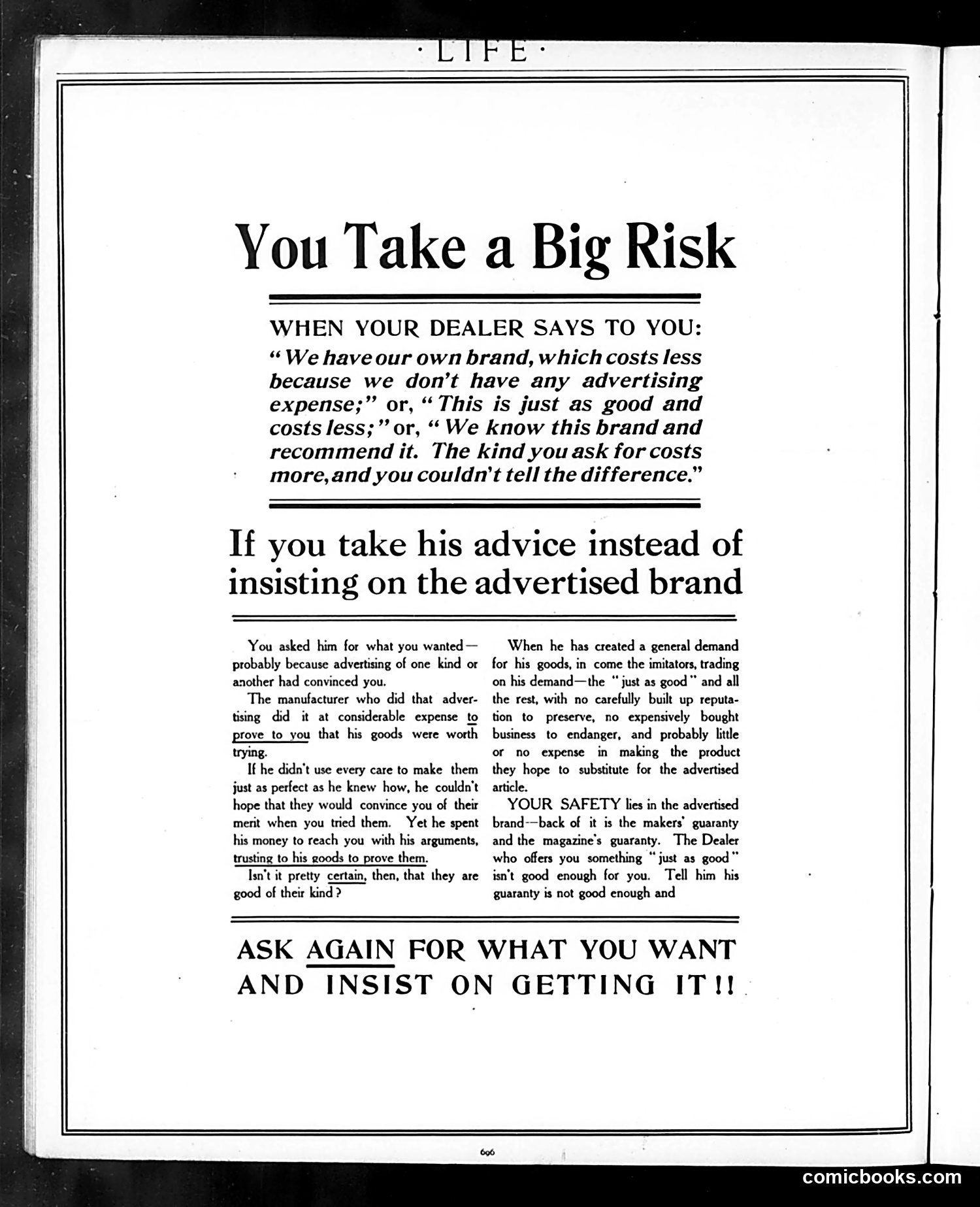
This is an **advertisement masquerading as consumer advice**, published in Life magazine (likely early-to-mid 20th century). It's a meta-advertisement *defending* the advertising industry itself. The piece warns readers against accepting store clerks' suggestions to buy cheaper "house brand" or generic alternatives instead of nationally advertised products. The argument: advertised brands cost more because manufacturers invested heavily in proven quality and advertising to build reputation and consumer trust. Generic alternatives exploit that demand without the reputation risk or manufacturing standards to protect. The satire is unintentional or ironic: the piece uses scare tactics ("You Take a Big Risk," "Your Safety") to argue that consumers should trust *advertising* as a guarantee of quality—essentially arguing that ads themselves prove product superiority, since manufacturers wouldn't spend money advertising inferior goods. This reflects early advertising-industry logic: national brands = trustworthy; generics = risky knockoffs. Modern readers would recognize this as circular reasoning and brand-protection marketing.
📄 Transcribed text from this page (OCR, searchable)
Machine-transcribed from the original scan — historical spelling and the odd misread are preserved.
You Take a Big Risk WHEN YOUR DEALER SAYS TO YOU: “ We have our own brand, which costs less because we don’t have any advertising expense;” or, “This is just as good and costs less;” or, “ We know this brand and recommend it. The kind you ask for costs more, and you couldn't tell the difference.” If you take his advice instead of insisting on the advertised brand You asked him for what you wanted — probably because advertising of one kind or another had convinced you. The manufacturer who did that adver- tising did it at considerable expense to prove to you that his goods were worth trying. If he didn’t use every care to make them just as perfect as he knew how, he couldn't hope that they would convince you of their merit when you tried them. Yet he spent his money to reach you with his arguments, trusting to his goods to prove them. Isn't it pretty certain, then, that they are good of their kind > ‘When he has created a general demand for his goods, in come the imitators, trading on his demand—the “ just as good" and all the rest, with no carefully built up reputa- tion to preserve, no expensively bought business to endanger, and probably little or no expense in making the product they hope to substitute for the advertised article. YOUR SAFETY lies in the advertised brand-—back of it is the makers’ guaranty and the magazine's guaranty. The Dealer who offers you something “just as good” isn’t good enough for you. Tell him his guaranty is not good enough and ASK AGAIN FOR WHAT YOU WANT AND INSIST ON GETTING IT!! comicbooks.com