
Life, 1907-05-16 · page 20 of 36
Life — May 16, 1907 — page 20: what you’re looking at
What you’re looking at
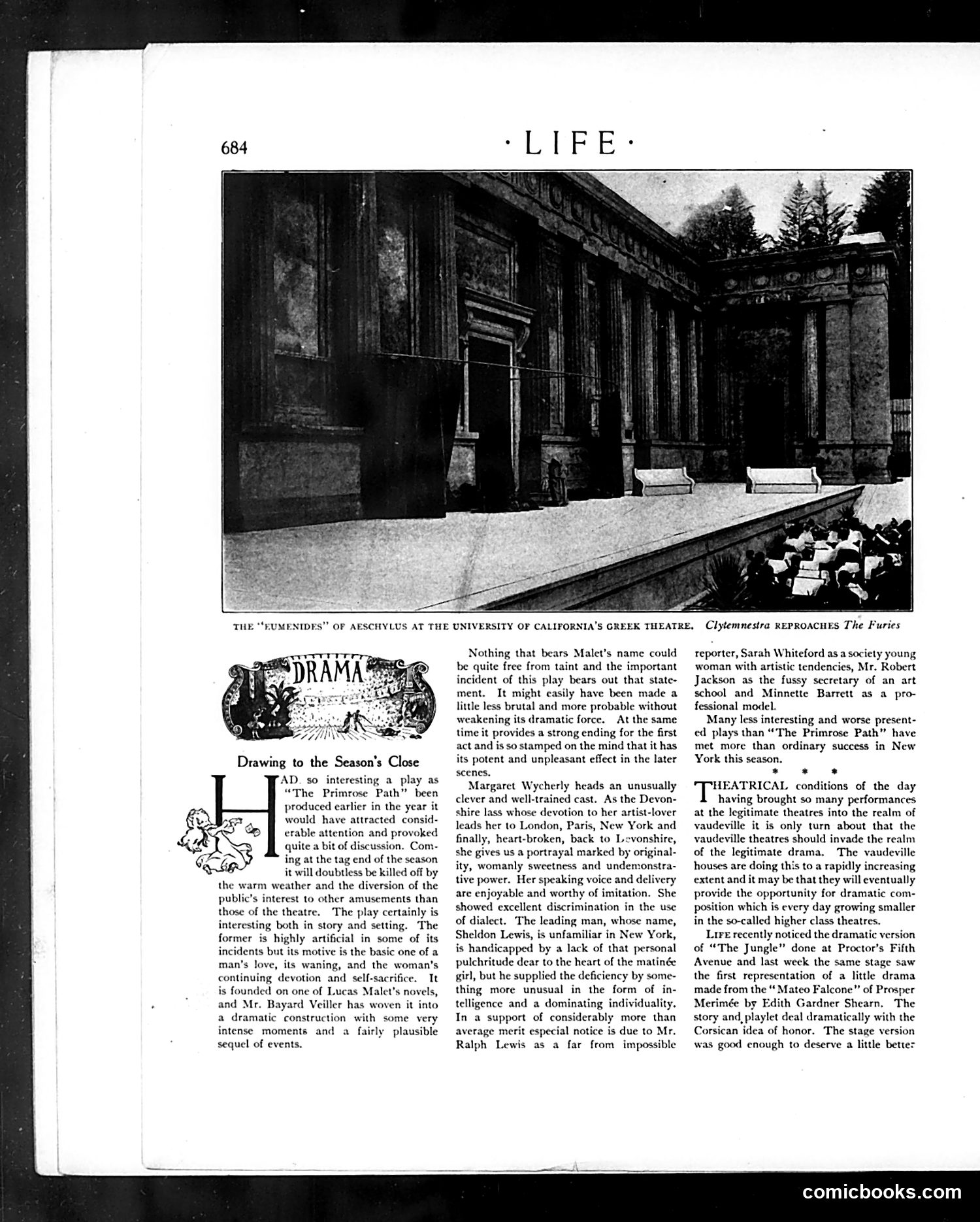
This theater review column discusses the closing of Broadway's spring season. The main topic is "The Primrose Path," a play adapted from Lucas Malet's novel by Bayard Veiller, starring Margaret Wycherly. The critic praises Wycherly's performance as a devoted Devonshire woman following her unfaithful artist-lover across continents, and notes actor Sheldon Lewis compensates for lack of conventional attractiveness through intelligence and stage presence. The secondary commentary critiques theatrical conditions: legitimate theaters increasingly present vaudeville acts, while vaudeville houses now stage dramatic productions. The critic observes this trend may eventually provide more opportunities for new dramatic works, as traditional theater venues shrink. The photograph shows the Greek Theater at UC California staging Aeschylus's "Eumenides," demonstrating classical theater's continued cultural presence. The overall message reflects early 20th-century concerns about theater's commercialization and changing entertainment hierarchies.
📄 Transcribed text from this page (OCR, searchable)
Machine-transcribed from the original scan — historical spelling and the odd misread are preserved.
THE “EUMENIDES” OF AESCHYLUS AT THE UNIVERSITY OF CALIFORNIA'S GREE! Drawing to the Season’s Close ‘AD, so interesting a play “The Primrose Path” been produced earlier in the year it would have attracted consid- erable attention and provoked quite a bit of discussion. Com- ing at the tag end of the season it will doubtless be killed off by the warm weather and the diversion of the public’s interest to other amusements than those of the theatre. The play certainly is interesting both in story and setting. The former is highly artificial in some of its incidents but its motive is the basic one of a man’s love, its waning, and the woman's continuing devotion and self-sacrifice. It is founded on one of Lucas Malet’s novels, and Mr. Bayard Veiller has woven it into a dramatic construction with some very intense moments and a fairly plausible sequel of events. Nothing that bears Malet’s name could be quite free from taint and the important incident of this play bears out that state- ment. It might easily have been made a little less brutal and more probable without weakening its dramatic force. At the same time it provides a strong ending for the first act and is so stamped on the mind that it has its potent and unpleasant effect in the later scenes. Margaret Wycherly heads an unusually clever and well-trained cast. As the Devon- shire lass whose devotion to her artist-lover leads her to London, Paris, New York and finally, heart-broken, back to Levonshire, she gives us a portrayal marked by original- ity, womanly sweetness and undemonstra- tive power. Her speaking voice and delivery are enjoyable and worthy of imitation. She showed excellent discrimination in the use of dialect. The leading man, whose name, Sheldon Lewis, is unfamiliar in New York, is handicapped by a lack of that personal pulchritude dear to the heart of the matinée girl, but he supplied the deficiency by son thing more unusual in the form of in- telligence and a dominating individuality. In a support of considerably more than average merit especial notice is due to Mr. Ralph Lewis as a far from impossible THEATRE, Clytemnestra REPROACHES The Furies reporter, Sarah Whiteford as a society young woman with artistic tendencies, Mr. Robert Jackson as the fussy secretary of an art school and Minnette Barrett as a pro- fessional model. Many less interesting and worse present- ed plays than “The Primrose Path” have met more than ordinary success in New York this season, + * 8 'HEATRICAL conditions of the day having brought so many performances at the legitimate theatres into the realm of vaudeville it is only turn about that the vaudeville theatres should invade the realm of the legitimate drama, The vaudeville houses are doing this to a rapidly increasing extent and it may be that they will eventually provide the opportunity for dramatic com- position which is every day growing smaller in the so-called higher class theatres. Lire recently noticed the dramatic version of “The Jungle” done at Proctor’s Fifth Avenue and last week the same stage saw the first representation of a little drama made from the “ Mateo Falcone” of Prosper Merimée by Edith Gardner Shearn, The story and, playlet deal dramatically with the Corsican idea of honor. The stage version was good enough to deserve a little better comicbooks.com