
Life, 1907-05-16 · page 22 of 36
Life — May 16, 1907 — page 22: what you’re looking at
What you’re looking at
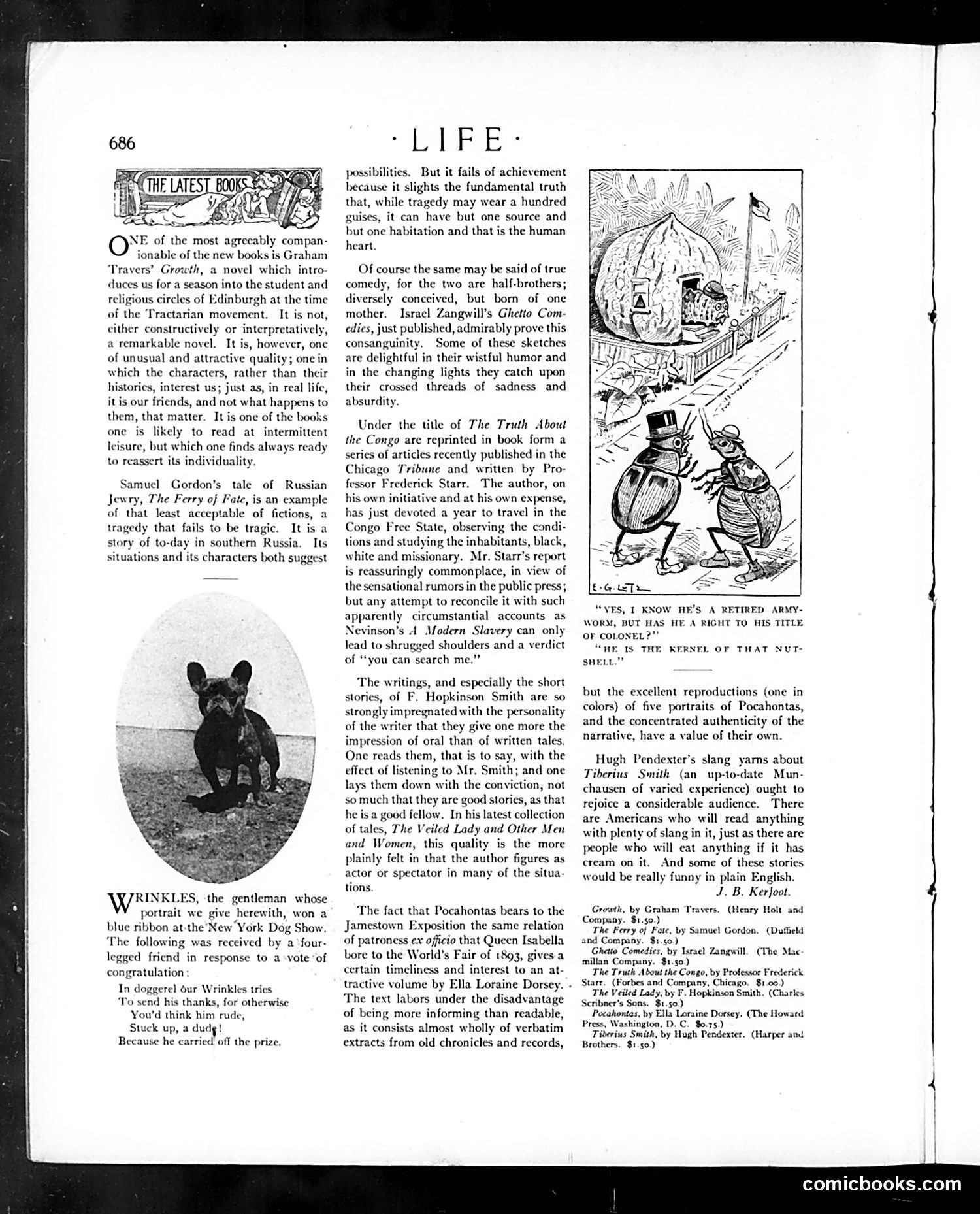
This is a **book review section** from Life magazine, not primarily a political cartoon page. The main content discusses recently published novels and non-fiction works. The **cartoon** shows two insects discussing a retired "army-worm" who won a prize—a humorous play on words. The accompanying doggerel verse congratulates "Wrinkles," a prize-winning dog from the New York Dog Show, written in deliberately clumsy rhyme as mock-formal congratulations. The **book reviews** cover Graham Travers's *Growth* (set during the Tractarian religious movement), Samuel Gordon's tragedy *The Ferry of Fate*, Israel Zangwill's *Ghetto Comedies*, Frederick Starr's *The Truth About the Congo* (defending Congo conditions against sensational press accounts), F. Hopkinson Smith's *The Veiled Lady*, and Ella Loraine Dorsey's work on Pocahontas and the Jamestown Exposition. The page reflects **Progressive-era literary tastes** and contemporary interest in colonial American history and African colonial politics.
📄 Transcribed text from this page (OCR, searchable)
Machine-transcribed from the original scan — historical spelling and the odd misread are preserved.
of the most agrecably compan- ionable of the new books is Graham ‘avers’ Growth, a novel which intro- duces us for a season into the student and religious circles of Edinburgh at the time of the Tractarian movement. It is not, cither constructively or interpretative a remarkable novel. It is, however, one of unusual and attractive quality; one in which the characters, rather than their histories, interest us; just as, in real life, it is our friends, and not what happens to them, that matter. Itis one of the books one is likely to read at intermittent s ready leisure, but which one finds alwa: to reassert its individuality. amucl Gordon’s tale of Russian Jewry, The Ferry of Fate, is an example of that least acceptable of fictions, a tragedy that fails to be tragic. It is a story of to-day in southern Russia. Its situations and its characters both suggest RINKLES, the gentleman whose portrait we give herewith, won a blue ribbon at-the’New York Dog Show. The following was received by a four- legged friend in response to a-vote ‘of congratulation : In doggerel Our Wrinkles tries ‘To send his thanks, for otherwise You'd think him rude, Stuck up, a dudg! Because he carried off the prize. “ETRE = possibilities. But it fails of achievement because it slights the fundamental truth that, while tragedy may wear a hundred guises, it can have but one source and but one habitation and that is the human heart. Of course the same may be said of true comedy, for the two are half-brothers; diversely conceived, but born of one mother. Israel Zangwill’s Ghetto Com- edies, just published, admirably prove this consanguinity. Some of these sketches are delightful in their wistful humor and in the changing lights they catch upon their crossed threads of sadness and absurdity. Under the title of The Truth About the Congo are reprinted in book form a series of articles recently published in the Chicago Tribune and written by Pro- fessor Frederick Starr. The author, on his own initiative and at his own expense, has just devoted a year to travel in the Congo Free State, observing the condi- tions and studying the inhabitants, black, white and missionary. Mr. Starr’s report is reassuringly commonplace, in view of the sensational rumors in the public press; but any attempt to reconcile it with such apparently circumstantial accounts as Nevinson’s Modern Slavery can only lead to shrugged shoulders and a verdict of “you can search me.” The writings, and especially the short stories, of F. Hopkinson Smith are so strongly impregnated with the personality of the writer that they give one more the impression of oral than of written tales. One reads them, that is to say, with the effect of listening to Mr. Smith; and one lays them down with the conviction, not so much that they are good stories, as that he is a good fellow. In his latest collection of tales, The Veiled Lady and Other Men and Women, this quality is the more plainly felt in that the author figures as actor or spectator in many of the situa- tions. The fact that Pocahontas bears to the Jamestown Exposition the same relation of patroness ex officio that Queen Isabella bore to the World’s Fair of 1893, gives a certain timeliness and interest to an at- tractive volume by Ella Loraine Dorsey. - The text labors under the disadvantage of being more informing than readable, as it consists almost wholly of verbatim extracts from old chronicles and records, “YES, I KNOW HE'S A RETIRED ARMY- WORM, BUT HAS HE A RIGHT TO HIS TITLE OF COLONEL?"” “HE IS THE KE! SHELL.” | OP THAT NUT- but the excellent reproductions (one in colors) of five portraits of Pocahontas, and the concentrated authenticity of the narrative, have a value of their own. Hugh Pendexter’s slang yarns about Tiberius Smith (an up-to-date Mun- chausen of varied experience) ought to rejoice a considerable audience. There are Americans who will read anything with plenty of slang in it, just as there are people who will eat anything if it has cream on it. And some of these stories would be really funny in plain English. J.B. Kerfoot. Growth, by Graham ‘Travers. (Henry Holt and Company. $1.50.) The Ferry oj Fete, by Samuel Gordon. and Company. $1.50.) Ghetto Comedies, by Israel Zangwill. millan Company. $1.50.) The Truth About the Congo, by Professor Frederick Start. (Forbes and Company, Chicago. $1.00.) The Veiled Lady, by F. Hopkinson Smith. (Charles Scribner's Sons. $1.50.) Pocahontas, by Ella Loraine Dorsey. (The Howard Press, Washington, D. C. $0.75.) Tiderius Smith, by Hugh Pendexter. (Harper and Brothers. $1.50.) (Dufield (The Mac comicbooks.com