
A complete issue · 48 pages · 1906
Life — January 4, 1906
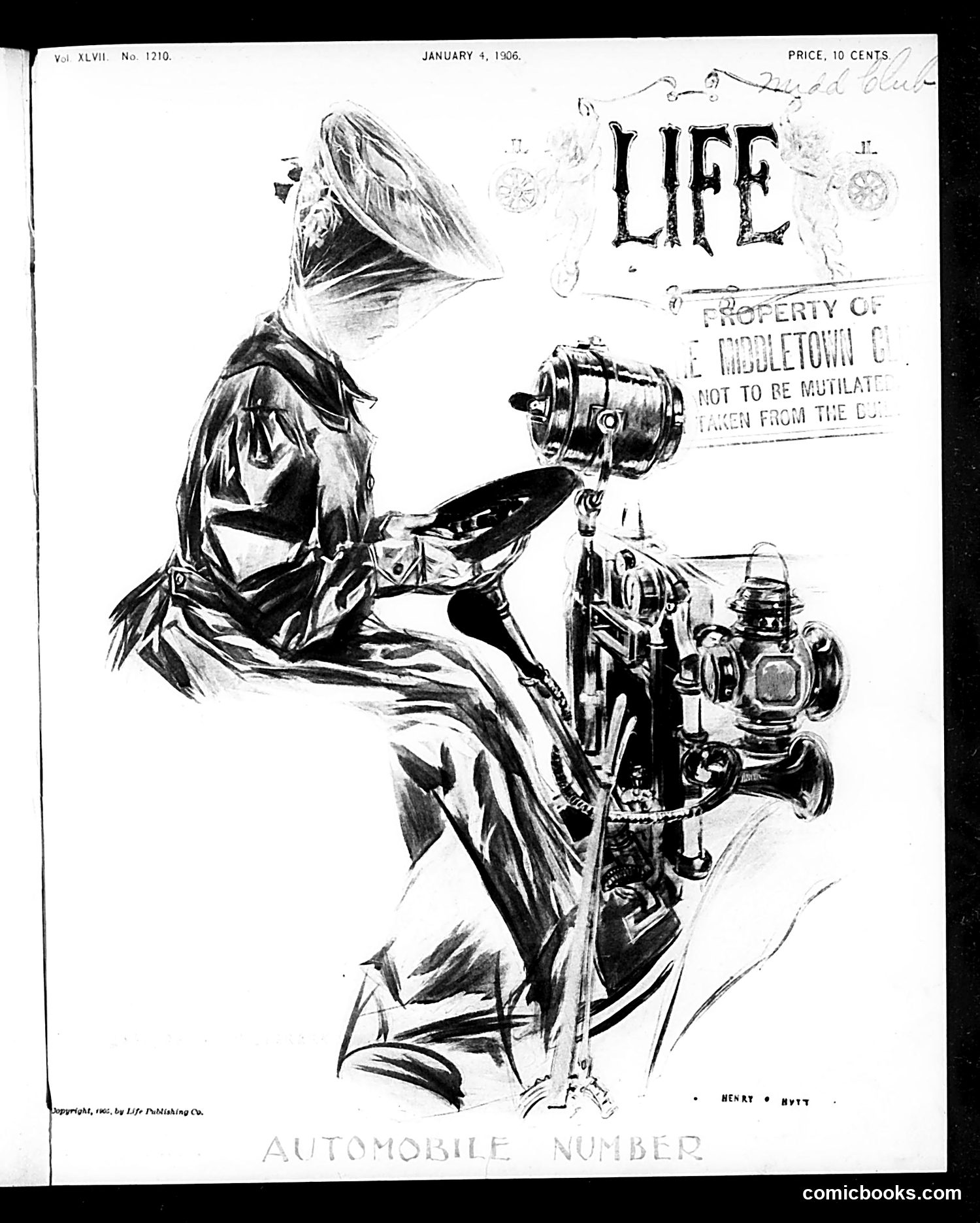
This is the cover of *Life* magazine's "Automobile Number" issue, featuring a satirical illustration by Henry Hutt. The cartoon depicts a fashionably dressed woman in an elaborate feathered hat operating an early automobile with multiple engine cylinders visible. The satire appears to critique the emerging automobile culture and its association with wealth and fashion. The exaggerated hat and elegant clothing juxtaposed with mechanical complexity suggests mockery of wealthy women adopting this new technology as a status symbol. The prominent display of the car's mechanical components emphasizes the novelty and fascination with automobiles in the early 1900s, when they were expensive luxury items primarily accessible to the affluent.
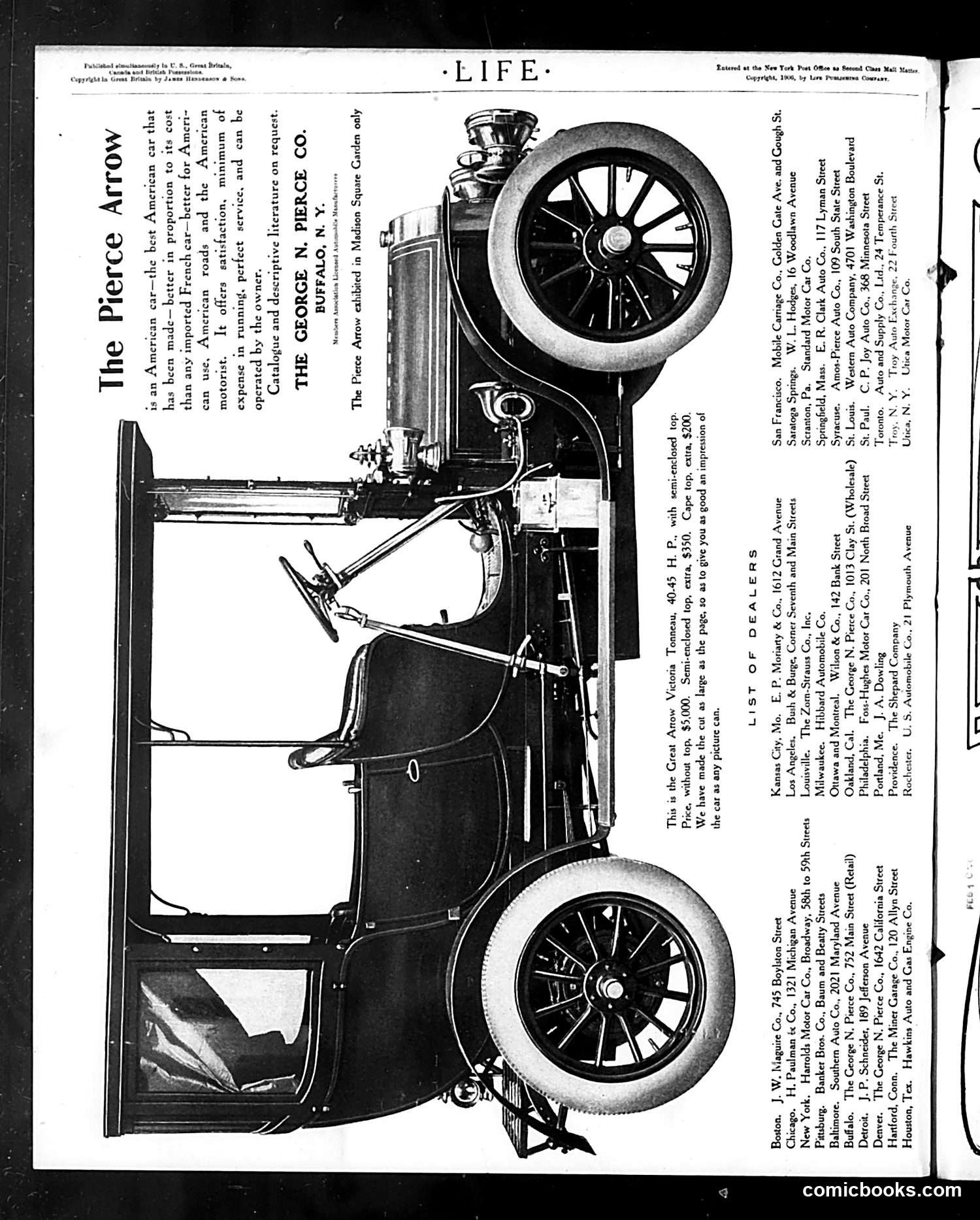
This page is primarily a **commercial advertisement**, not political satire. It showcases "The Pierce Arrow," an early automobile manufactured by the Pierce-Arrow Motor Car Company. The ad highlights the vehicle's features and craftsmanship, emphasizing it as a premium American automobile. The image shows the car from a side view, displaying its prominent large wheel, open cabin design, and mechanical details typical of early 1900s automobiles. The heading "The Pierce Arrow" and accompanying text describe the car's specifications and the company's reputation. This appears in *Life* magazine, which, despite its satirical reputation, regularly featured luxury advertisements targeting affluent readers. No political commentary or caricature is present—this is straightforward product marketing from the early automotive era.
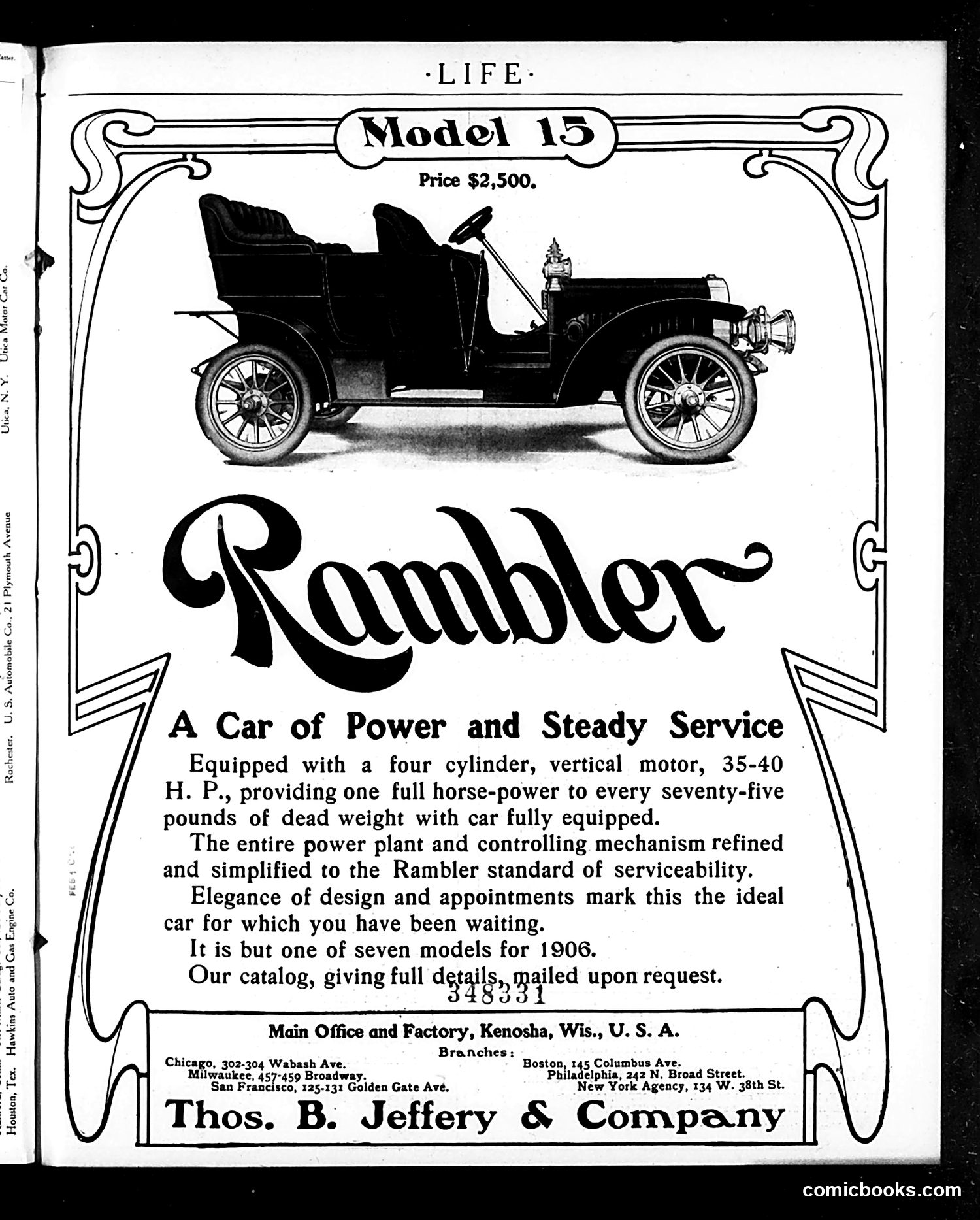
This page is **primarily an advertisement**, not satirical content. It promotes the Rambler Model 15 automobile, priced at $2,500, manufactured by Thos. B. Jeffery & Company in Kenosha, Wisconsin. The ad emphasizes the car's "power and steady service" with a four-cylinder vertical motor producing 35-40 horsepower. The marketing copy highlights engineering refinement and "serviceability"—practical appeals to early-1900s buyers concerned with reliability. The decorative Art Nouveau border and large ornamental typography are typical of 1906 automotive advertising design. This represents one of seven Rambler models available that year, positioned as an "ideal car" for quality-conscious purchasers during the early automobile market's competitive expansion.
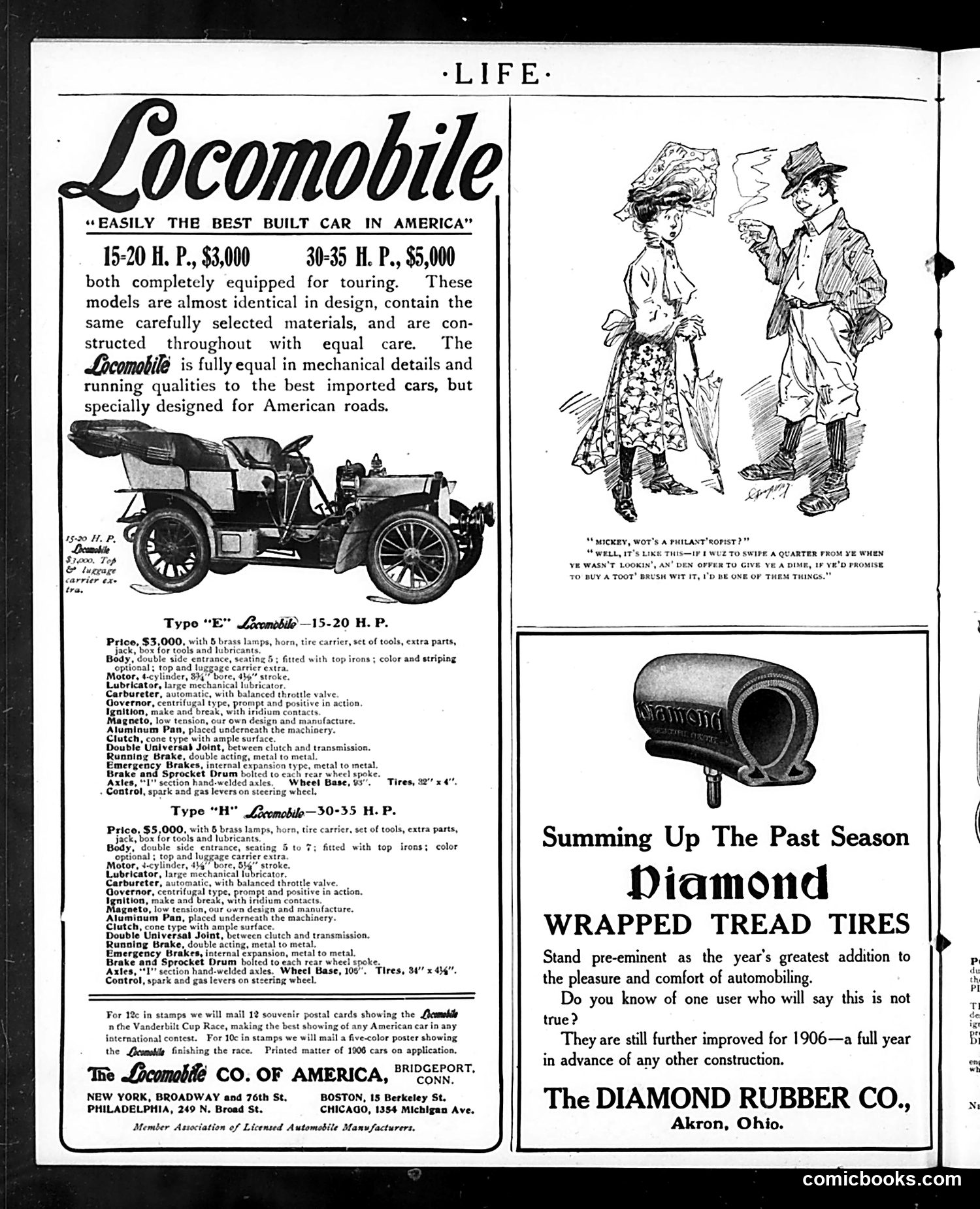
This page is primarily **advertising**, not satire or political commentary. The left side features a Locomobile automobile ad highlighting two models (15-20 H.P. at $3,000 and 30-35 H.P. at $5,000), with detailed mechanical specifications and company information. The right side contains two elements: a humorous sketch of three people (a woman and two men in period dress) with dialogue about borrowing money for a tooth brush, and an advertisement for Diamond Wrapped Tread Tires from the Diamond Rubber Company in Akron, Ohio. The small illustration appears to be social humor typical of Life magazine's lighter content, but the page's primary purpose is advertising automobiles and automobile accessories to wealthy readers.
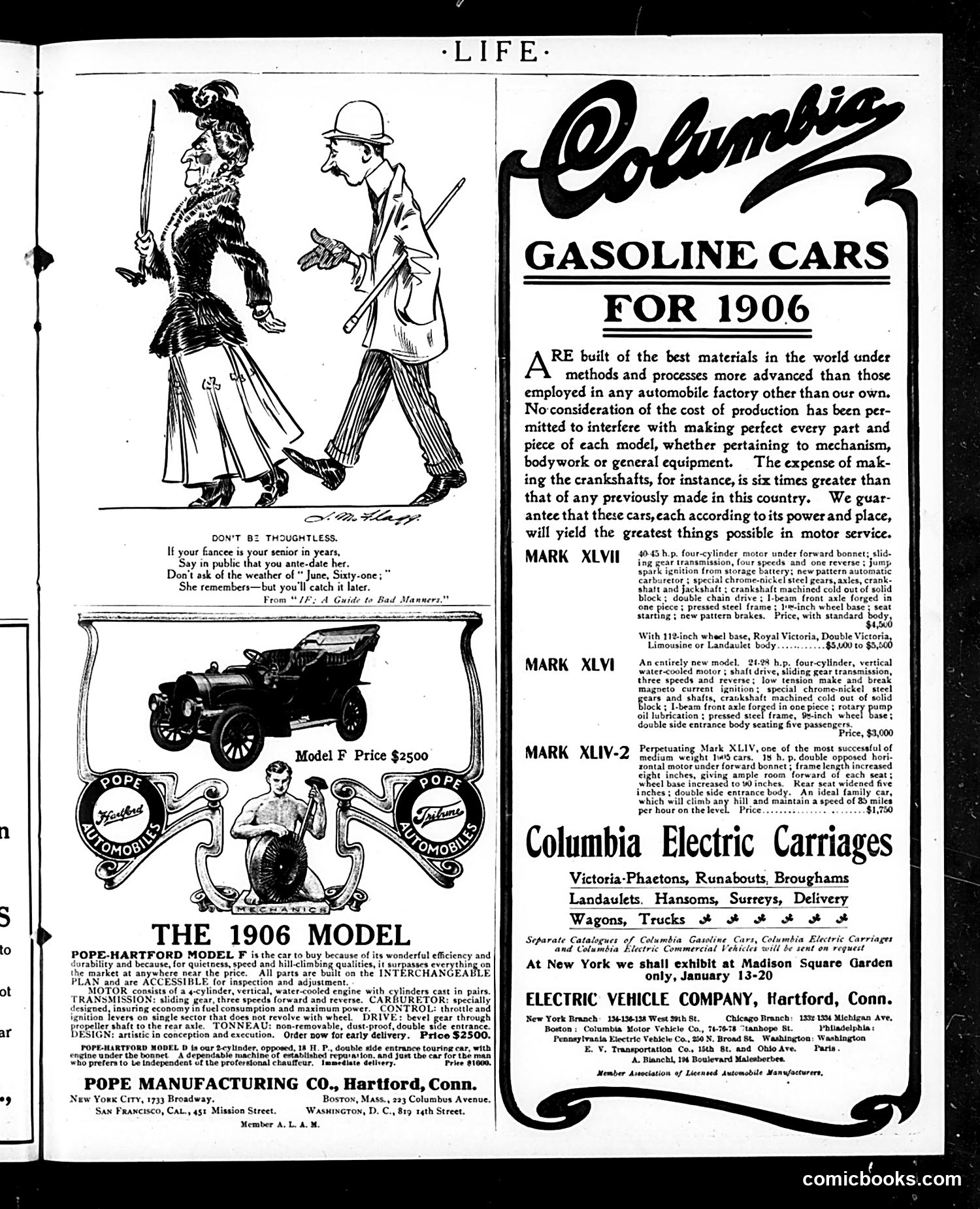
This cartoon satirizes gender relations and etiquette in early 1900s society. It depicts a fashionably dressed woman confronting a man about his public behavior toward her. The caption reads: "If your fiancée is your escort in public that you ante-date her. Say in public that you ante-date her... Don't ask of the weather of 'Love, Sausage;' She remembers—but you'll catch it later." The joke targets men's thoughtlessness in romantic relationships—specifically, publicly discussing a woman's age or making casual, demeaning remarks to their fiancées in front of others. The cartoon mocks masculine social insensitivity and warns that such behavior, though apparently forgotten, will be remembered and punished later. It's a commentary on courtship manners and male obliviousness to women's feelings.
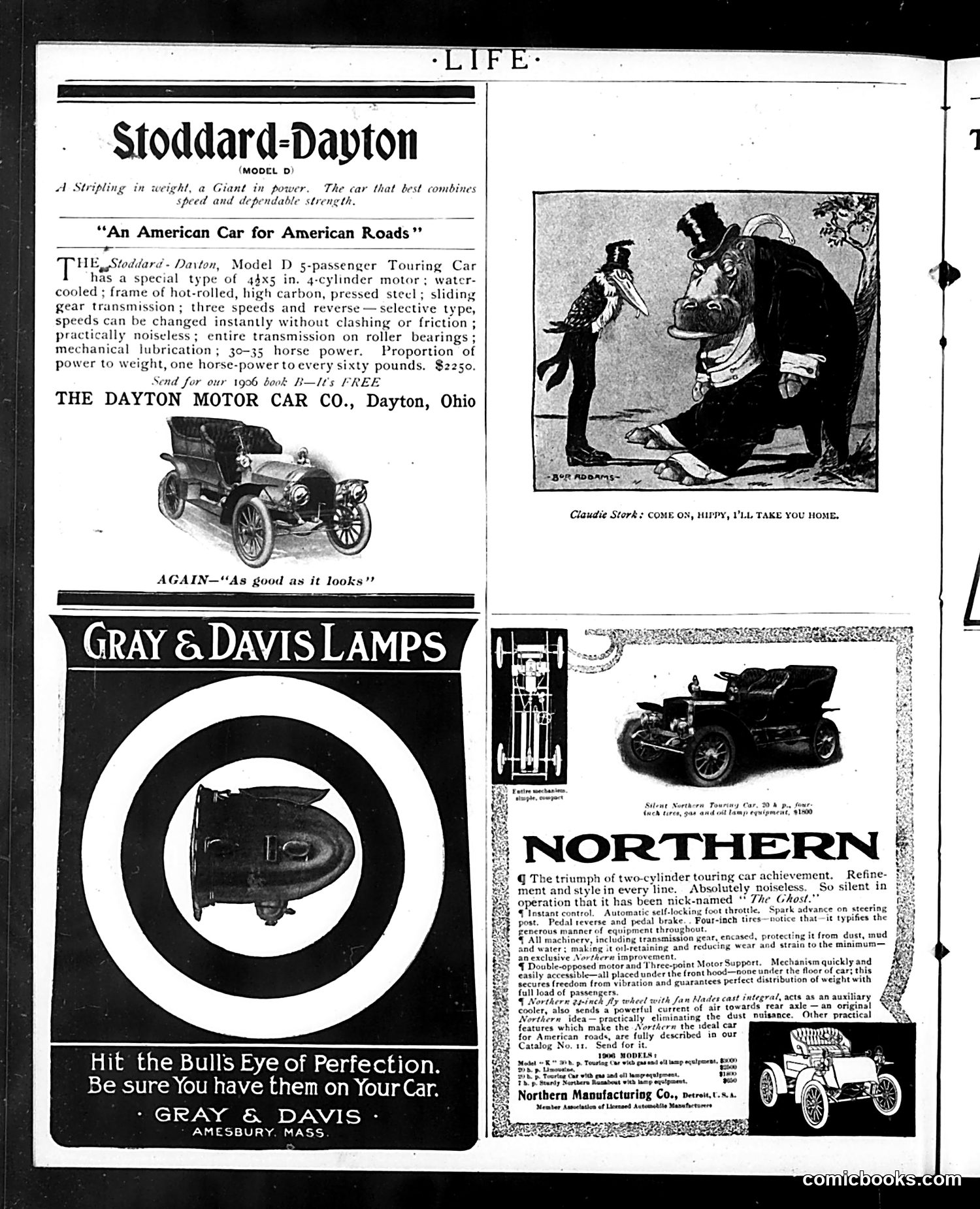
This page is primarily **advertising**, not satire or political commentary. It contains three automobile advertisements from the early 1900s: 1. **Stoddard-Dayton Model D** - marketed as "An American Car for American Roads," emphasizing its engine power and affordability ($2250). 2. **Gray & Davis Lamps** - advertising car headlamps with the slogan "Hit the Bull's Eye of Perfection." 3. **Northern Manufacturing Company** - promoting a two-cylinder touring car called "The Ghost," highlighting its refinement and smooth operation. The only illustration that might be considered humorous is the small cartoon showing **Claudie Stork** (a likely reference to a contemporary figure or stereotype) offering to drive a woman home, playing on early automotive-era social customs. Otherwise, the page reflects early-20th-century automobile industry marketing.
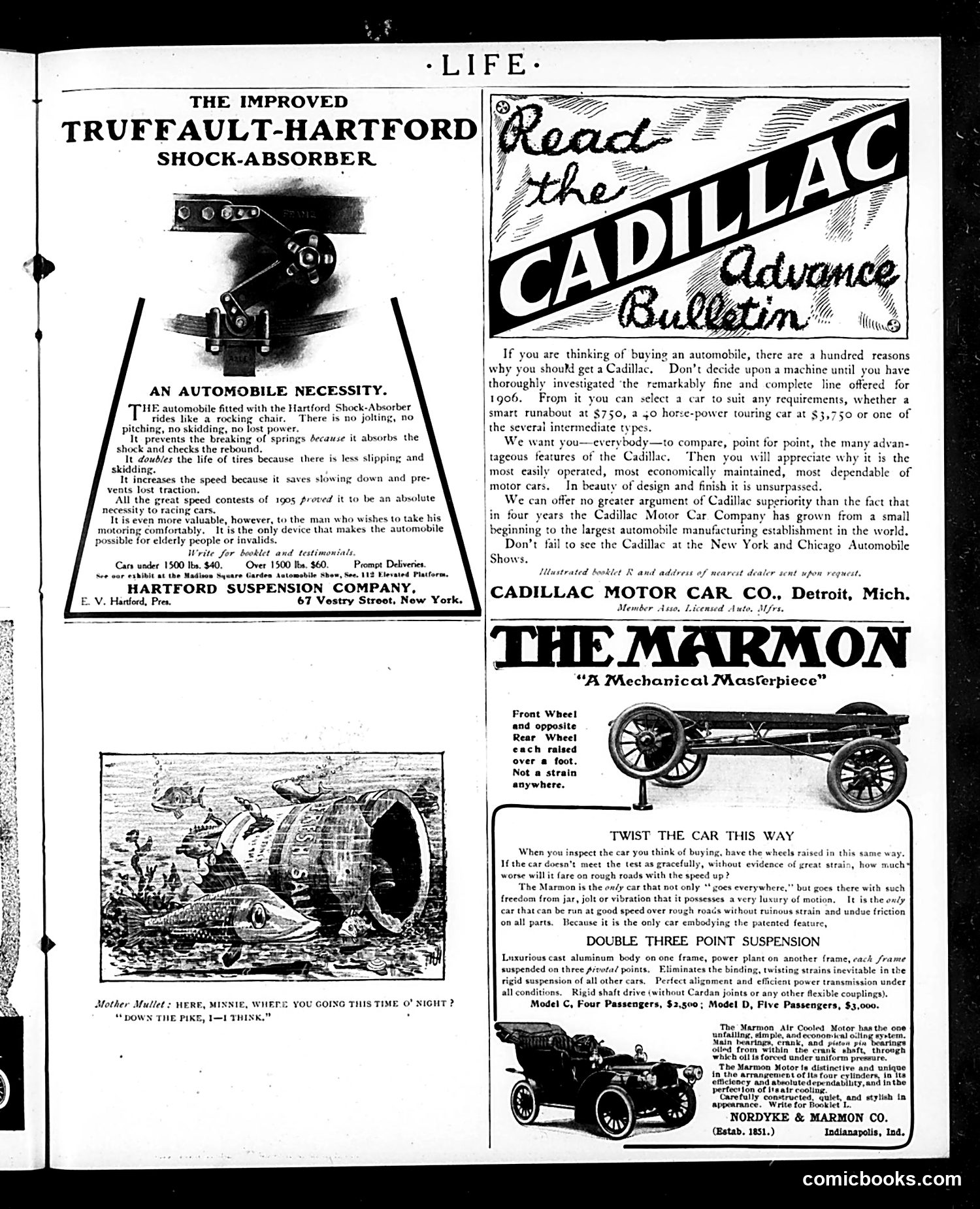
This page is primarily **automobile advertising** from an early 1900s issue of *Life* magazine, not political satire. The advertisements feature: 1. **Truffault-Hartford Shock-Absorber** — marketed as "an automobile necessity," emphasizing ride comfort and control 2. **Cadillac Motor Car Co.** — promoting their vehicles' reliability and design superiority 3. **The Marmon** — advertised as "a mechanical masterpiece," highlighting its suspension system that allows the entire car to twist without strain There is one **cartoon** (lower left) showing a mother and child, captioned "HERE, MINNIE, WHERE YOU GOING THIS TIME O' NIGHT? 'DOWN THE PIKE, I—I THINK.'" This appears to be a humorous domestic scene unrelated to the automotive content. The page essentially showcases competing automobile manufacturers targeting wealthy early-1900s consumers.
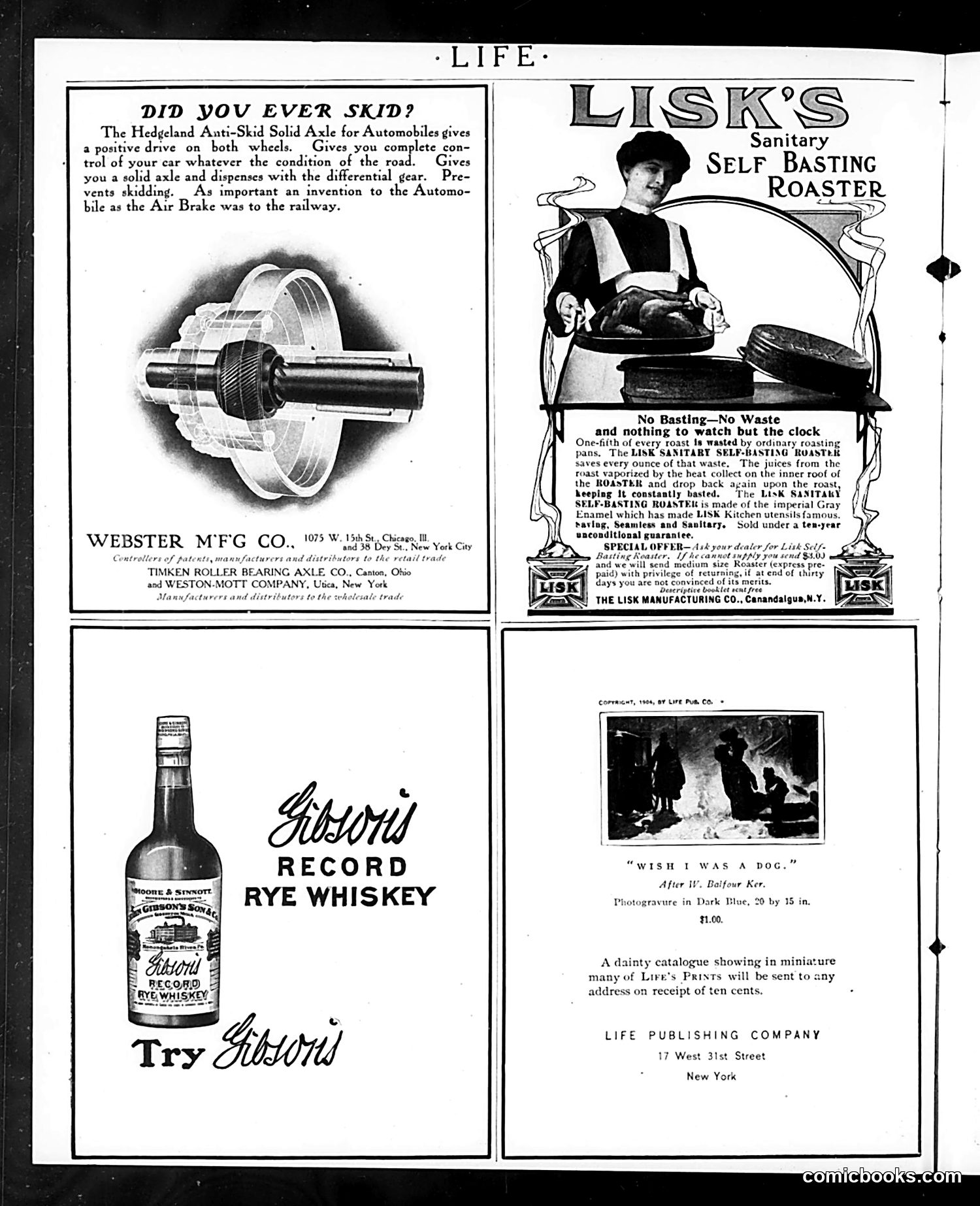
This page contains primarily **advertisements** rather than satirical cartoons. **Top left**: Webster Mfg Co. advertises an automobile axle, comparing it to the railway's air brake—a technical innovation pitch. **Top right**: Lisk Manufacturing promotes a "Sanitary Self-Basting Roaster," showing a woman with the cooking device. The copy emphasizes waste reduction and constant basting efficiency—appealing to Depression-era or early 20th-century domestic economy concerns. **Bottom left**: Gibson's Record Rye Whiskey advertisement (likely pre-Prohibition or early Prohibition era, given the prominent bottle display). **Bottom right**: A photogravure titled "Wish I Was a Dog" by Alfred Belfort Ker, available for purchase. The page represents typical Life magazine content mixing light humor, domestic innovation, and consumer goods targeting middle-class households.
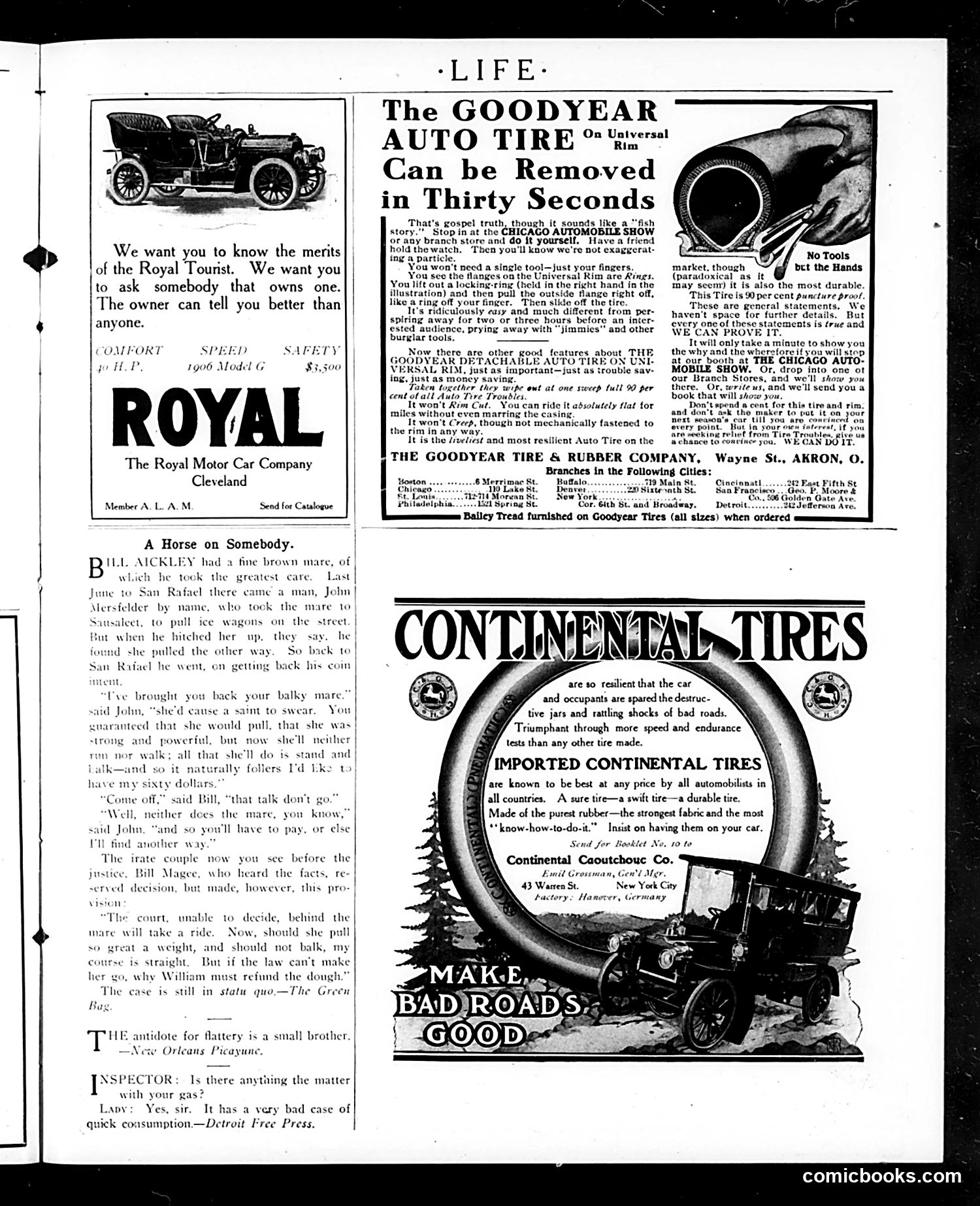
This page is primarily **advertising**, not satire or political commentary. It contains three automobile tire/car advertisements: 1. **Royal Motor Car Company** (top left): promoting a 1906 Model G with features like comfort, speed, and safety. 2. **Goodyear Auto Tire** (top right): highlighting a tire with a "Universal Rim" that can be removed in thirty seconds without tools—presented as a major convenience innovation. 3. **Continental Tires** (bottom): featuring imported German tires, emphasizing durability and quality rubber, with the slogan "Make Bad Roads Good." The page also includes a brief humorous story titled "A Horse on Somebody" about a dispute over a mule, and a short joke about battery consumption. This reflects early 1900s automotive advertising when tire technology and quick-change mechanisms were genuine selling points.
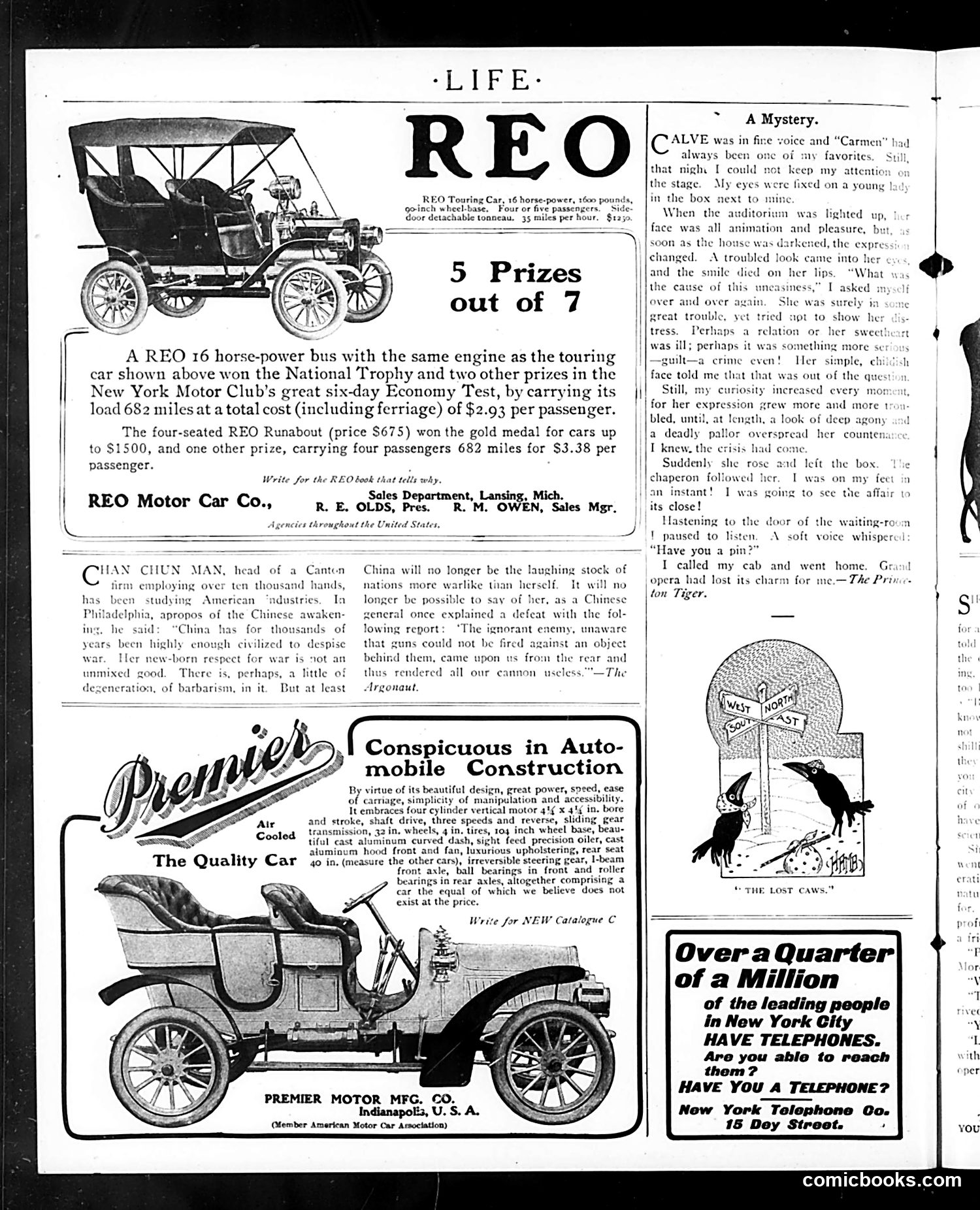
This page is primarily **advertising**, not satire or political commentary. It features: 1. **REO automobiles** - advertising their economy and reliability, highlighting a "5 Prizes out of 7" win in a New York Motor Club economy test 2. **Premier automobiles** - emphasizing quality construction features 3. **A short news item** about Chan Chun Man, a Chinese businessman in Philadelphia, making a mild jab at Chinese culture's "barbarism" 4. **A short story titled "A Mystery"** about opera-goers and romantic intrigue 5. **A cartoon illustration** titled "The Lost Caw" showing what appears to be a bird, though its satirical meaning is unclear from the visible portion The page is dominated by car advertisements typical of early 20th-century Life magazine, which served both satirical and commercial purposes.
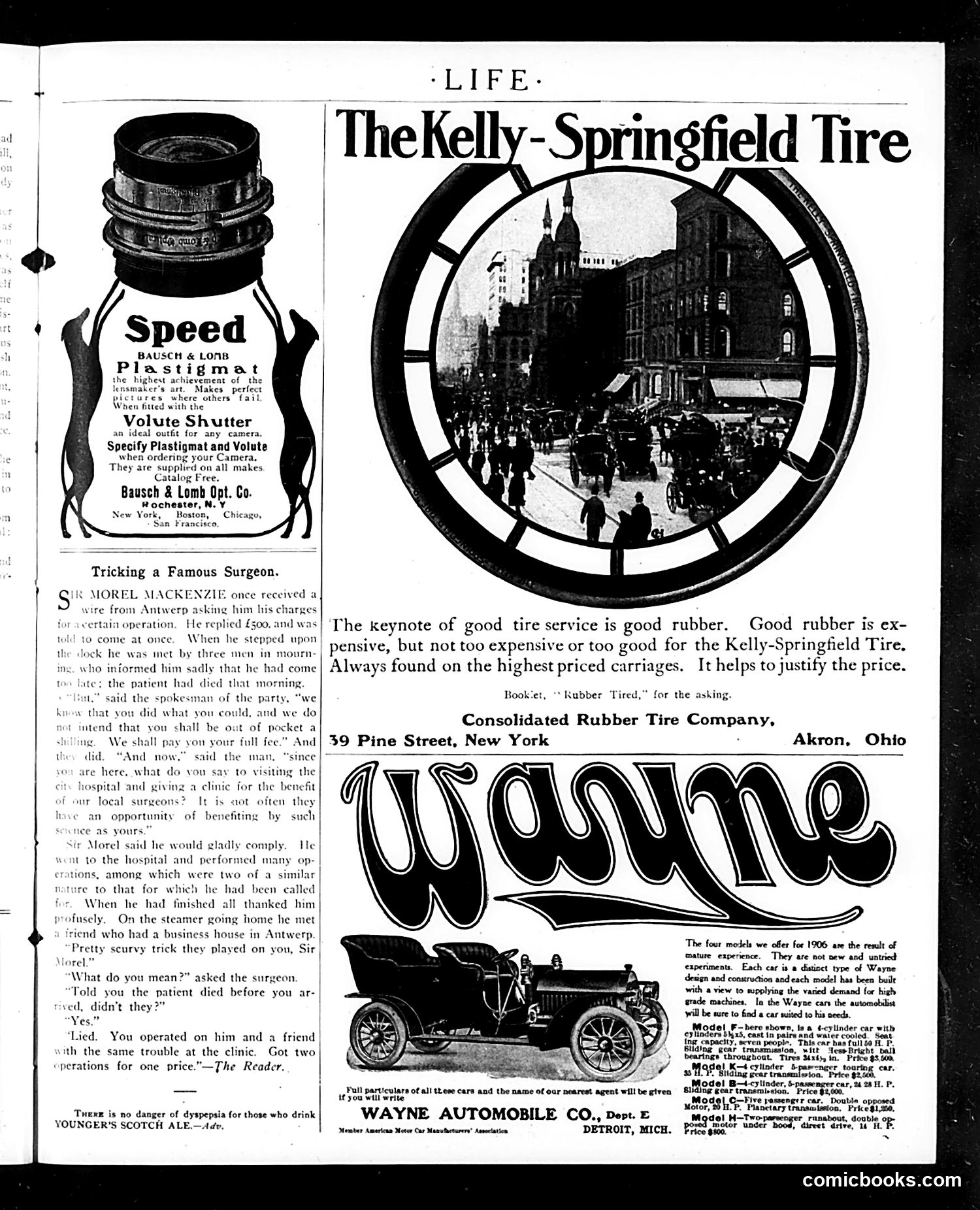
This page is primarily **advertising**, not satire or political commentary. It contains: 1. **Speed Plastigmat camera advertisement** (top left) - promoting a Bausch & Lomb camera accessory 2. **Kelly-Springfield Tire advertisement** (top right) - featuring a tire framed around a city street scene, emphasizing quality rubber as justification for price 3. **"Tricking a Famous Surgeon" article** (left column) - a humorous anecdote about Sir Morel Mackenzie, apparently involving a medical prank played on him in Antwerp 4. **Wayne Automobile advertisement** (bottom) - showcasing four 1906 car models with technical specifications The single non-advertising element is a brief satirical story about deceiving a surgeon, but it lacks clear political relevance. The page reflects early 1900s consumer culture and automotive innovation.
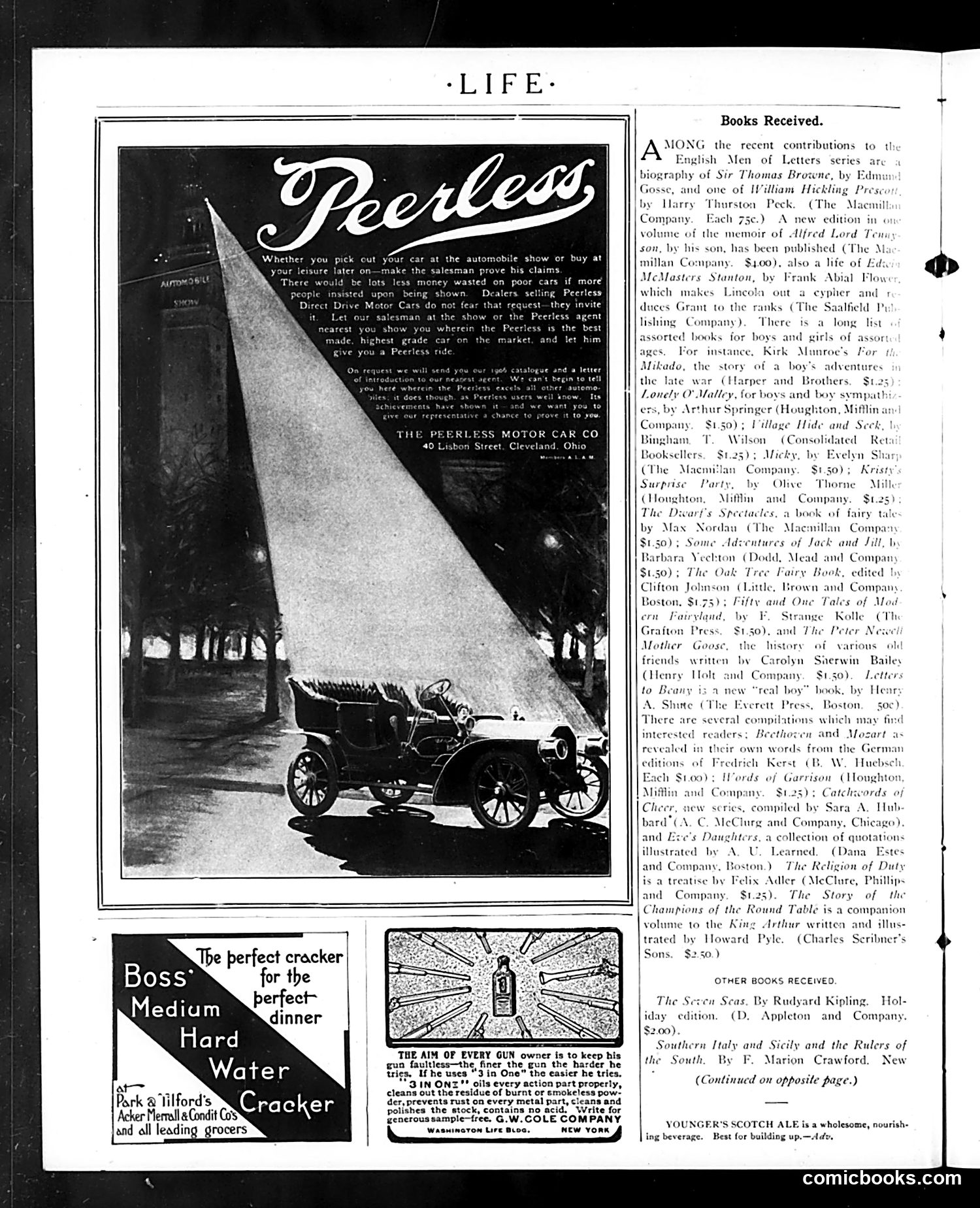
This page is primarily **advertising and book reviews**, not political satire. The dominant image is a **Peerless Motor Car advertisement** from Cleveland, Ohio. It shows an elegant early automobile and pitches the car as superior quality—emphasizing that buyers should let the Peerless salesman demonstrate why it's "the highest grade car on the market." Below are two smaller ads: one for "Boss" crackers (promoted as perfect for dinner with hard water) and another for a G.W. Cole Company gun product about proper maintenance. The right column contains **"Books Received,"** listing recent publications including biographies, children's books, and literary works. This appears to be a standard **Life magazine page mixing advertisements with book notices**—typical of early 20th-century publishing, where ads subsidized content.
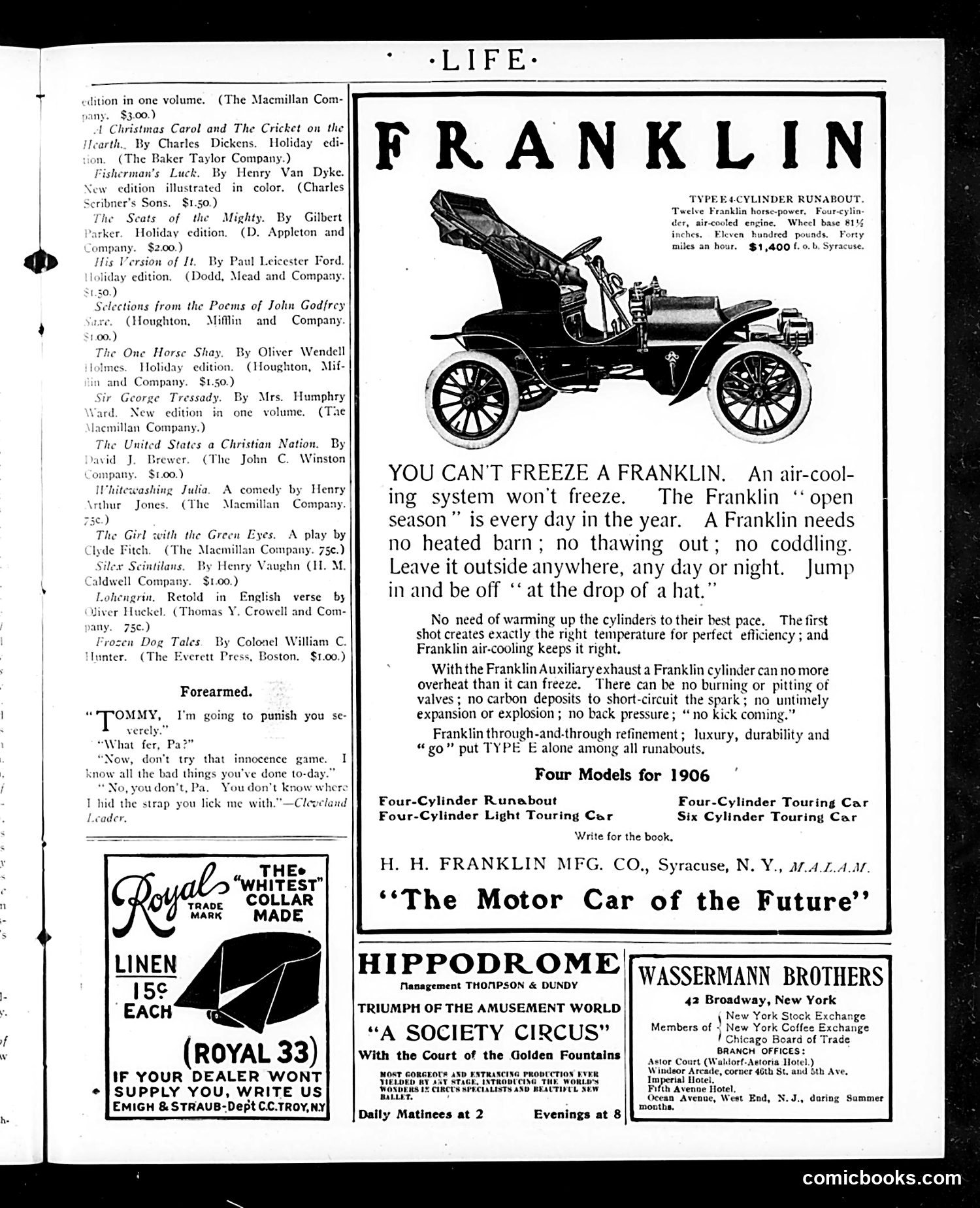
This page is primarily **advertising and book listings** rather than editorial satire. The left column lists recently published books with holiday editions. Below that is a small humorous dialogue titled "Foreformed" about punishment—not political satire. The main content features a **Franklin automobile advertisement** (center-right), highlighting the Type E 4-cylinder runabout as "The Motor Car of the Future." The ad emphasizes the Franklin's air-cooling system, which allegedly eliminates winter freeze-up problems—a genuine technological advantage over water-cooled competitors of that era. Additional advertisements include **Royal 33 linen collars** (left) and the **Hippodrome circus** (bottom). This appears to be a circa-1906 magazine page mixing literary notices with contemporary automotive and consumer advertising.
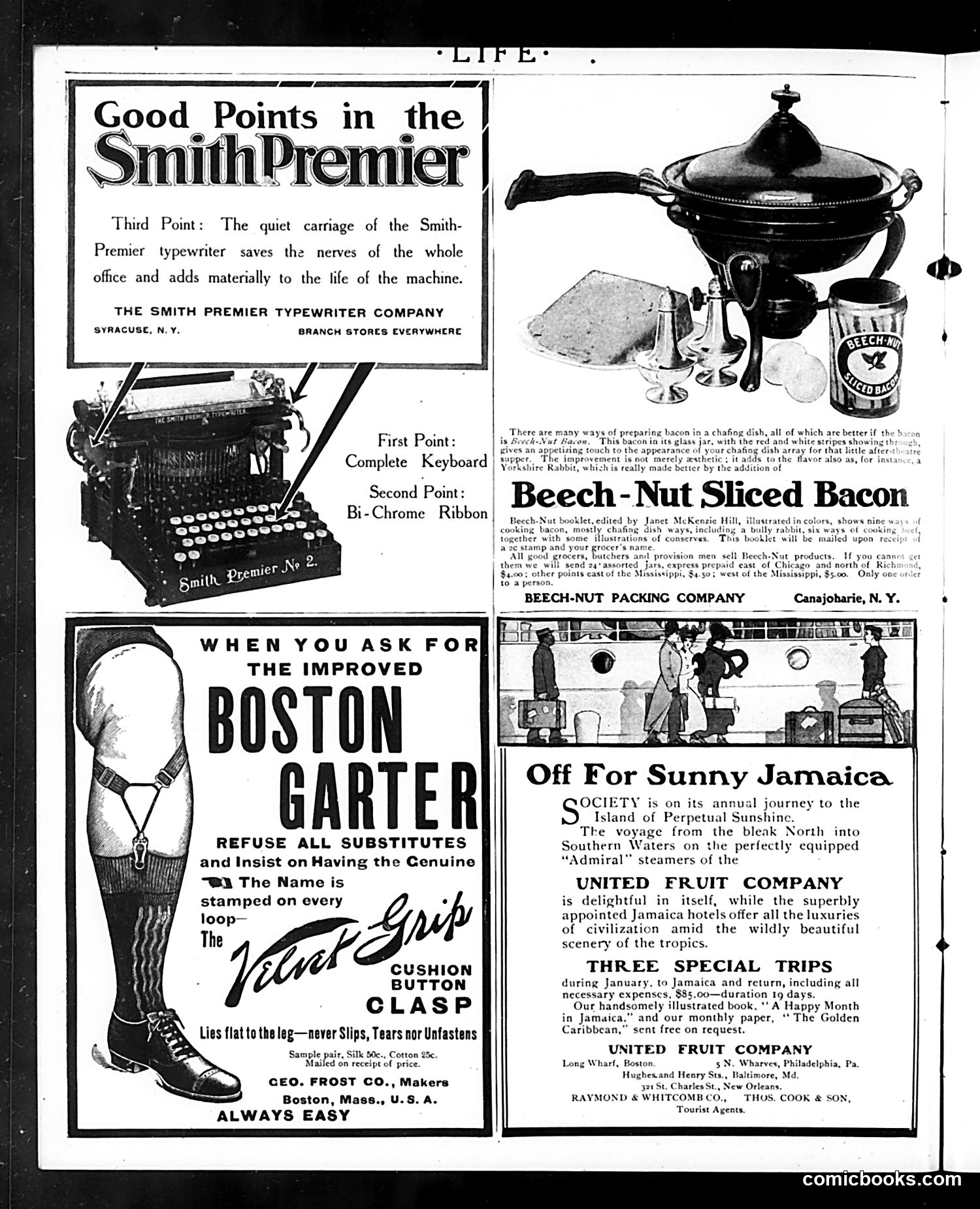
This is primarily an **advertising page** from an early 20th-century American magazine, containing no political cartoons or satire—just product and travel advertisements. The ads promote: 1. **Smith-Premier typewriters** — highlighting quiet operation and reliability 2. **Boston Garter** — men's sock garters emphasizing they don't slip or tear, with a detailed illustration of a leg/shoe 3. **Beech-Nut Sliced Bacon** — featuring preparation methods 4. **Jamaica cruises** — luxury winter travel via United Fruit Company steamers The social context: these ads reflect early 1900s consumer culture targeting middle-class professionals and affluent travelers. The typewriter ad suggests office workplace concerns; the garter ad addresses men's clothing practicality; and the Jamaica cruise advertises exotic tropical leisure—then an expensive luxury associated with wealth. There is no satire or caricature present. This is straightforward period advertising reflecting contemporary products and aspirations.
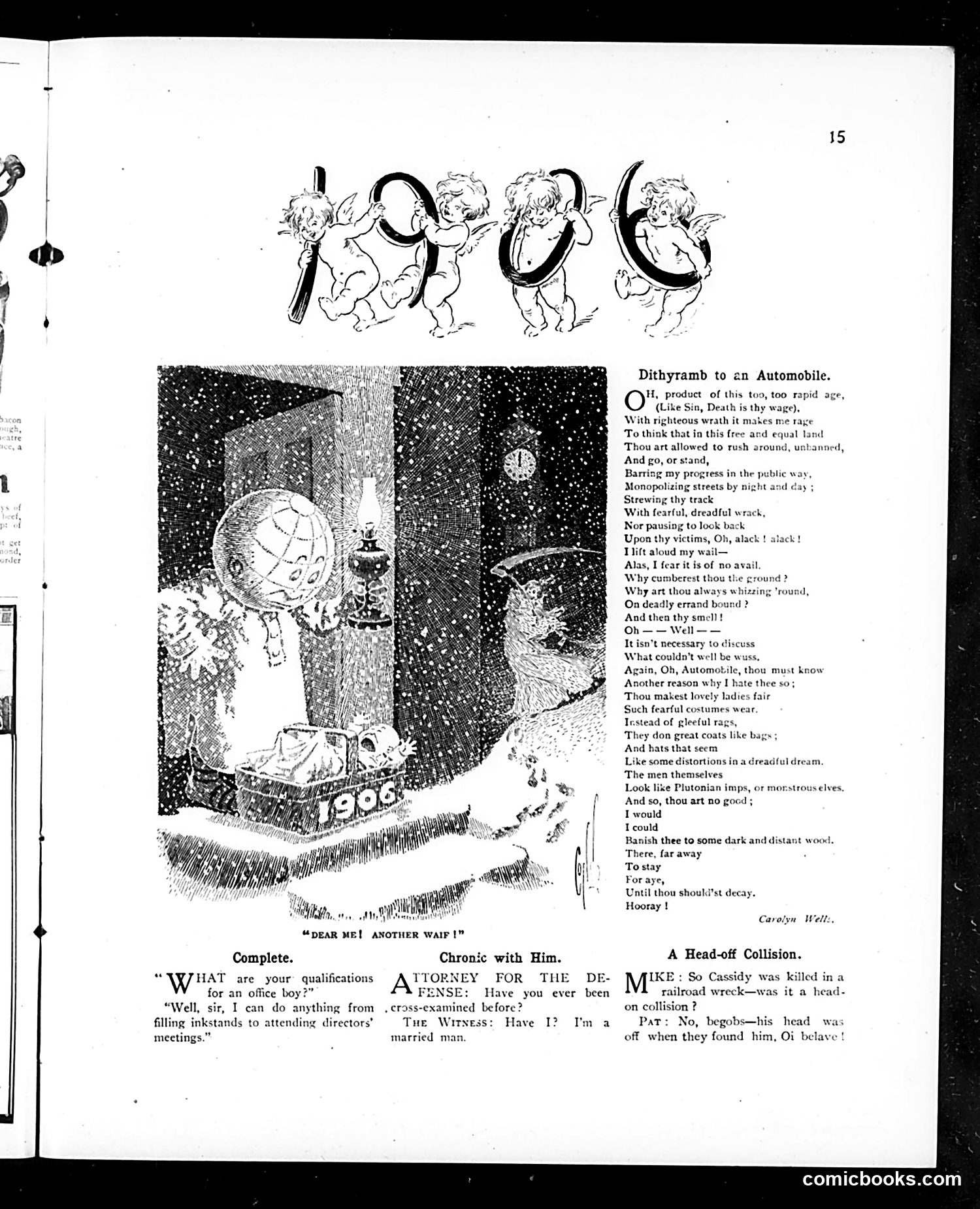
This page contains three separate humorous pieces typical of early 20th-century American satirical magazines: 1. **"Dear Me! Another Waif!"** - A cartoon showing cherubs carrying various objects (numbered 1909), depicting children as street urchins or orphans. 2. **Three brief comedic dialogues:** - An office boy interview where the applicant claims ability to handle any task - A lawyer's courtroom exchange about witness credibility and marital status - A brief ethnic joke (featuring "Pat" and "Oi") about an Irishman's death in a railroad accident 3. **"Dithyramb to an Automobile"** - A lengthy satirical poem mocking automobiles as dangerous, polluting, noisy hazards that endanger pedestrians and force women into unflattering "fearful costumes" (protective driving clothes). The poem reflects early 1900s anxiety about automobiles as reckless menaces to public safety and traditional ways of life. The overall tone reflects common complaints about rapid modernization—automobiles' speed, pollution, and social disruption—expressed through Victorian-style poetic mockery.
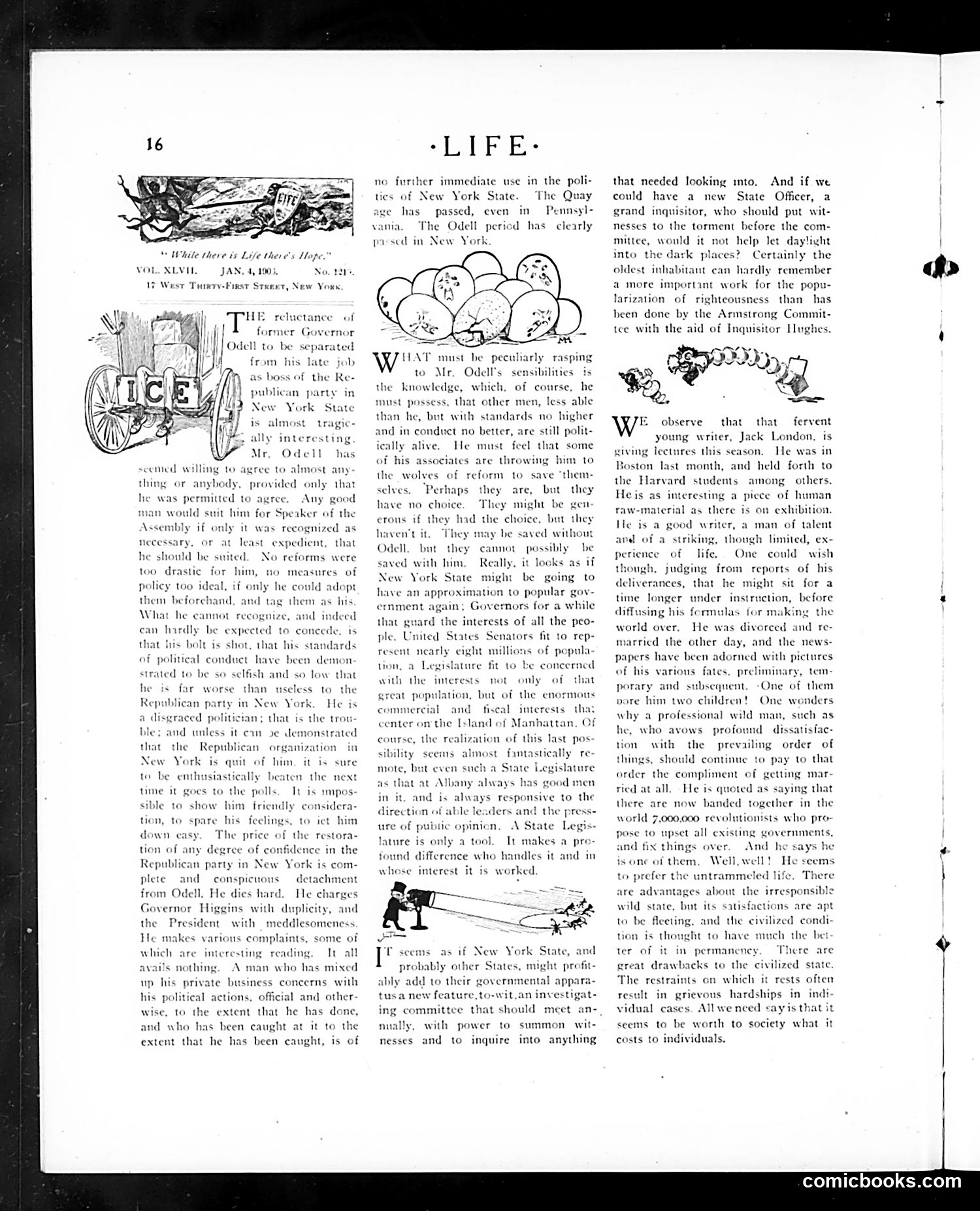
This Life magazine page (1905) attacks **former Governor Benjamin B. Odell Jr.**, the recently ousted boss of New York's Republican Party machine. The text denounces Odell as a corrupt, self-serving politician whose "standards" are so low and whose conduct so "selfish" that he has become a liability to the party itself. The cartoons illustrate Odell's downfall: one shows him as an "ICE" wagon (melting away/losing power), while another depicts him being dragged or pulled down by ropes—visual metaphors for political collapse. The article argues that Odell mixed private business interests with public office so egregiously that the Republican Party cannot win while he remains influential. It compares him unfavorably to other fallen political machines (the "Quay" machine in Pennsylvania), suggesting his era of control has definitively ended. The piece calls for governmental reforms including investigative committees with real power—positioning such oversight as necessary to prevent future Odell-style corruption.
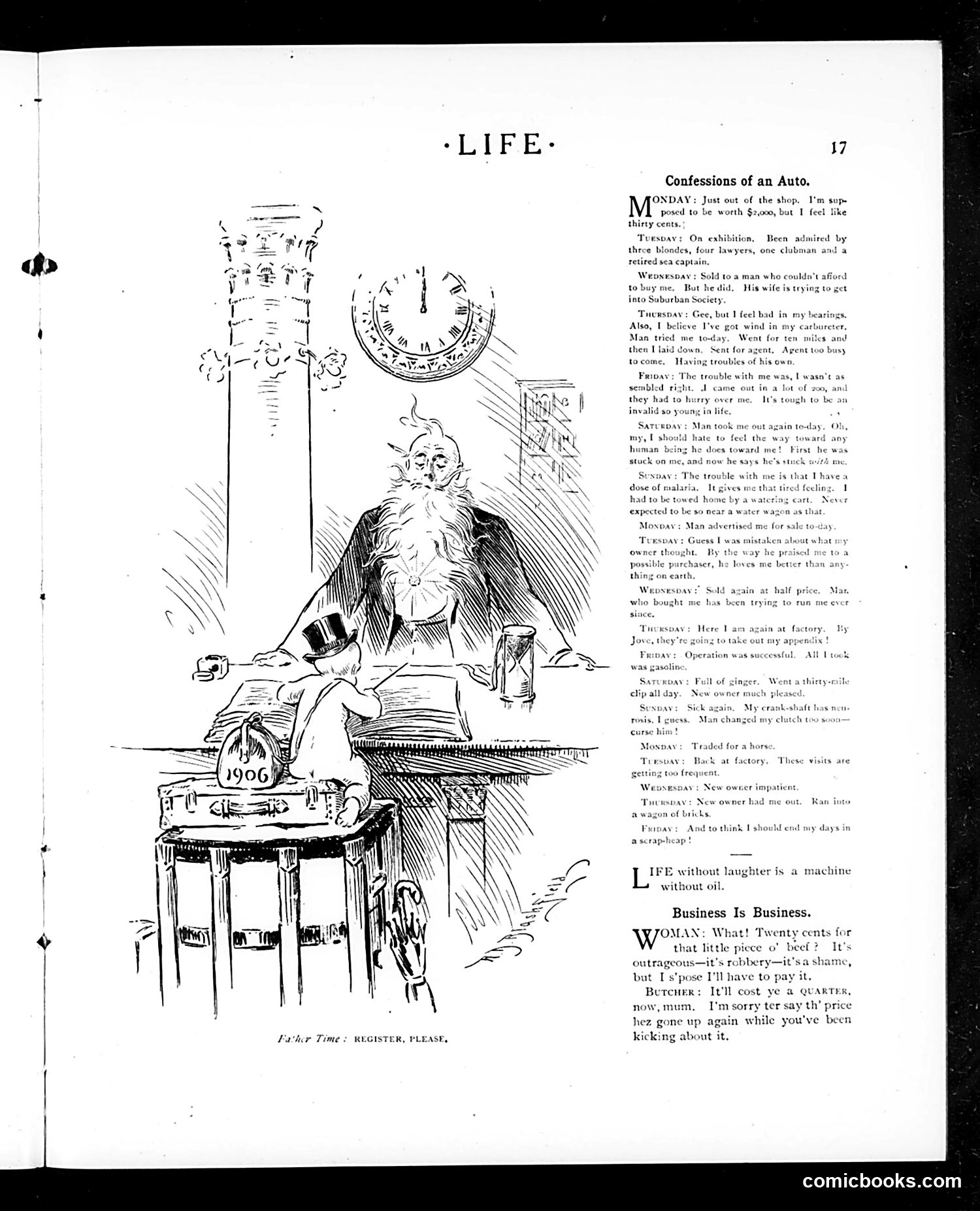
This page satirizes early automobile ownership through two pieces: **Main Cartoon ("Father Time: Register, Please"):** An elderly, bedraggled figure (Father Time, symbolizing 1906) sits exhausted at a desk with a large ledger, surrounded by automotive debris and a broken-down car marked "1906." The joke satirizes how quickly the new automobile technology breaks down and becomes a financial burden—the car owner must perpetually "register" complaints and repairs. **Text Section ("Confessions of an Auto"):** A diary-format satire where a $2,000 automobile describes its miserable week: purchased by someone who couldn't afford it, constantly breaking down (requiring towing), generating massive repair bills, and causing marital strife. The final entry jokes it should "end my days in a scrap-heap." **Context:** This mocks the automobile as an unreliable, expensive luxury item (1906 was early in auto adoption). The satire targets both the technology's poor reliability and middle-class aspirations to own vehicles beyond their means—a common source of financial strain and domestic conflict.
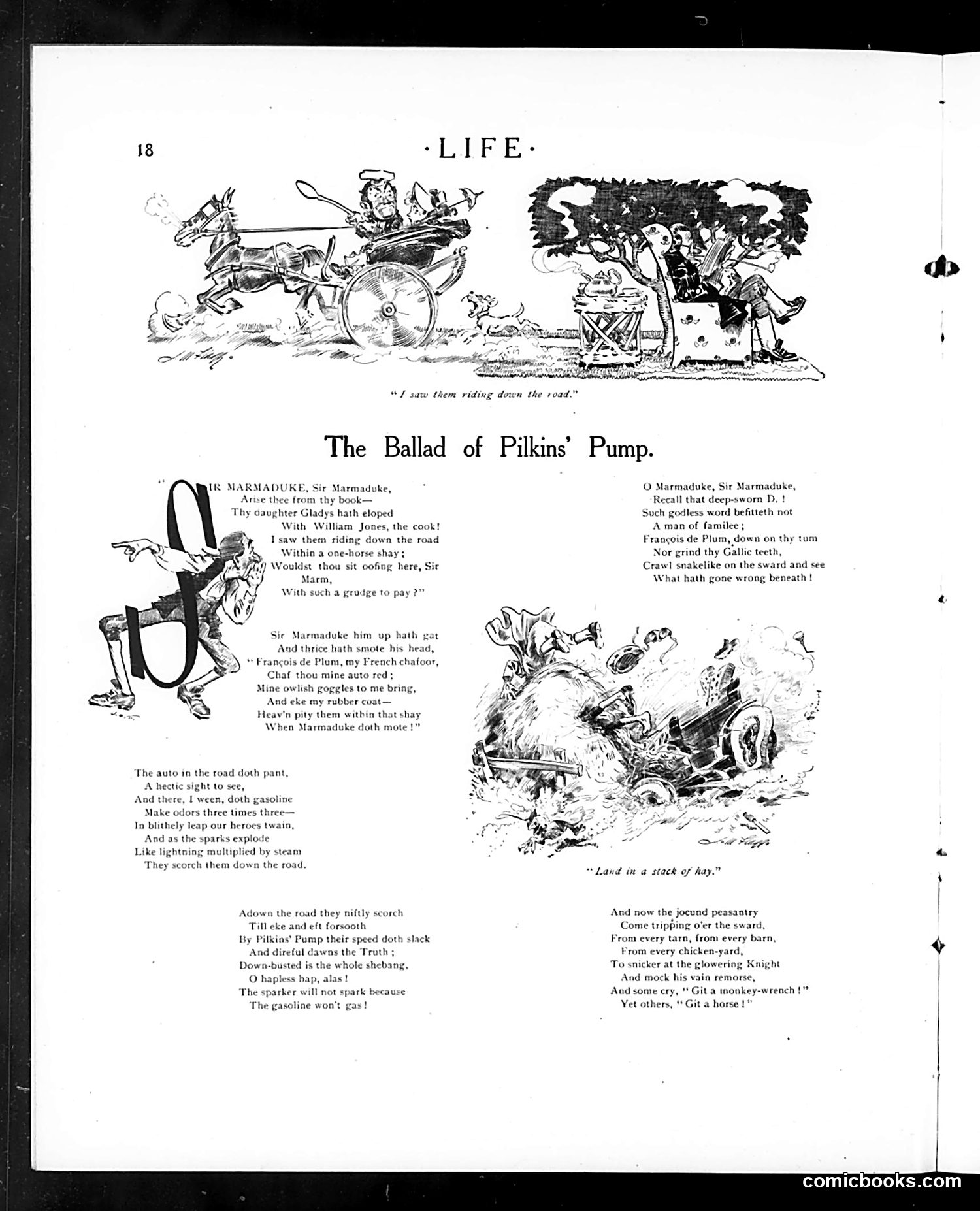
This satirical poem mocks the early automobile craze and the pretensions of the wealthy. Sir Marmaduke, a nobleman, pursues his daughter Gladys (who has eloped with a cook) in a newfangled motorcar driven by his French chauffeur François de Plum. The automobile—temperamental, smelly, and unreliable—breaks down at "Pilkins' Pump," stranding the knight. Local peasants gather to jeer at him, their mockery emphasizing the gap between automobile enthusiasm and reality. The satire targets both the pomposity of the upper class and the mechanical failures of early cars. The archaic language (mock-Shakespearean diction like "forsooth" and "hath") undercuts the modernity of the automobile, suggesting the old world's collision with technological progress. The joke: newfangled machines and their owners deserve ridicule equally.
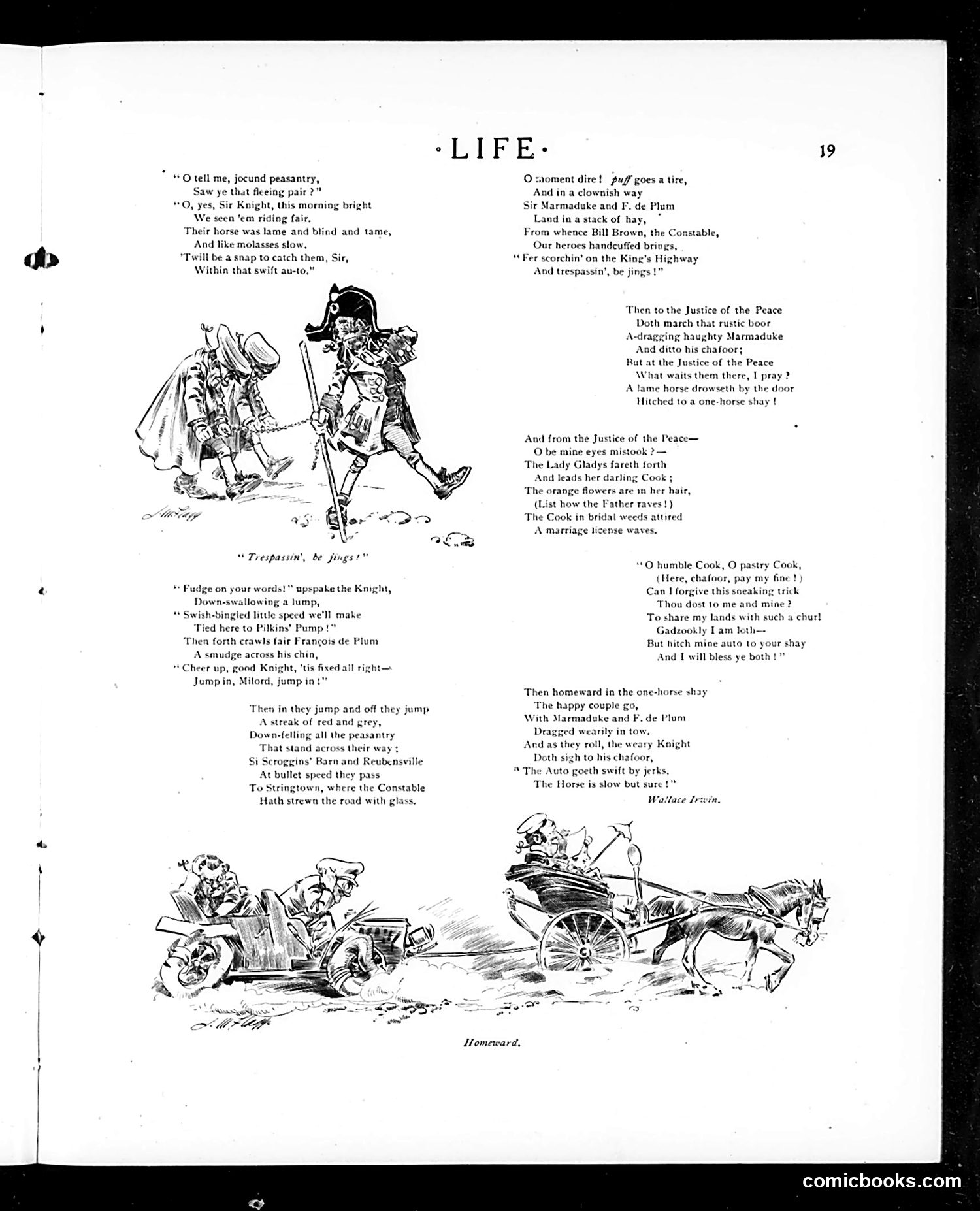
This humorous poem by Wallace Irwin mocks the early automobile era by contrasting speedy motorcars with traditional transportation. Two aristocratic gentlemen (Sir Marmaduke and "F. de Plum") pursue fleeing trespassers in a newfangled auto, which initially seems superior to the peasants' lame horse. However, the auto suffers a blowout and crashes into a haystack, landing the knights in legal trouble. The satirical twist: the Justice of the Peace resolves everything by marrying off the wealthy nobleman to a cook—a social reversal typical of Life magazine's class commentary. The story ends with the humbled aristocrats being towed homeward by the very lame horse they initially mocked. The joke targets both automotive unreliability and class pretension: modern technology fails, yet tradition (and common folk) ultimately prevail.
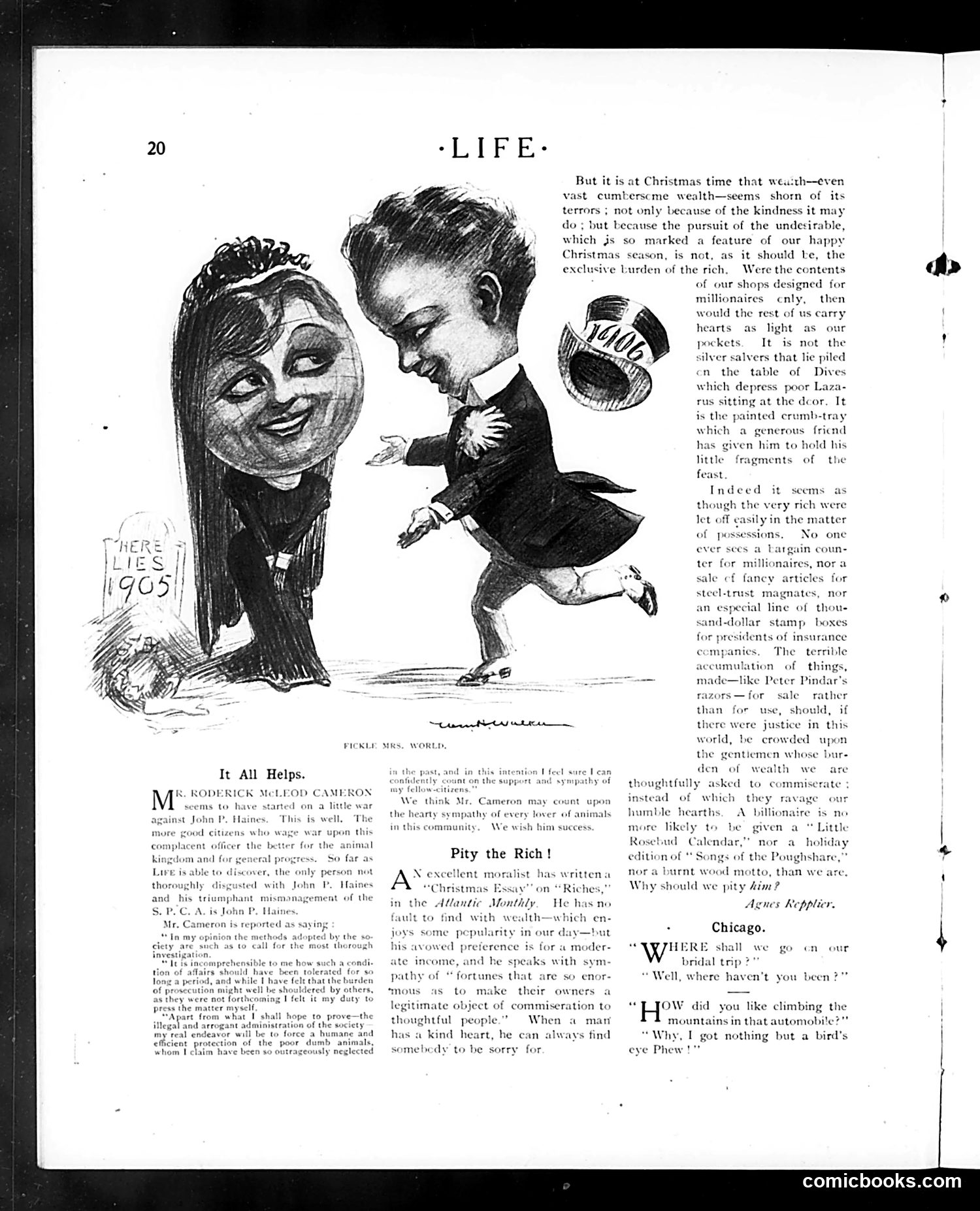
The main cartoon depicts a small boy confronting a grotesque, mask-faced figure labeled "HERE LIES 1905"—personifying the dying year 1905. The boy appears to be the New Year arriving, suggesting the cyclical transition between years and the hope that a new year might improve upon the last. The surrounding text discusses wealth at Christmas, arguing ironically that the very rich should *pity* themselves, not the poor. The author (likely Agnes Repplier, credited at bottom) notes that while wealthy people receive expensive gifts they don't need, poor people at least escape the burden of accumulating useless possessions. The satire critiques both ostentatious gift-giving among the wealthy and the expectation that riches automatically bring happiness. The "Chicago" section contains brief humorous dialogue about an automobile excursion, unrelated to the main themes.
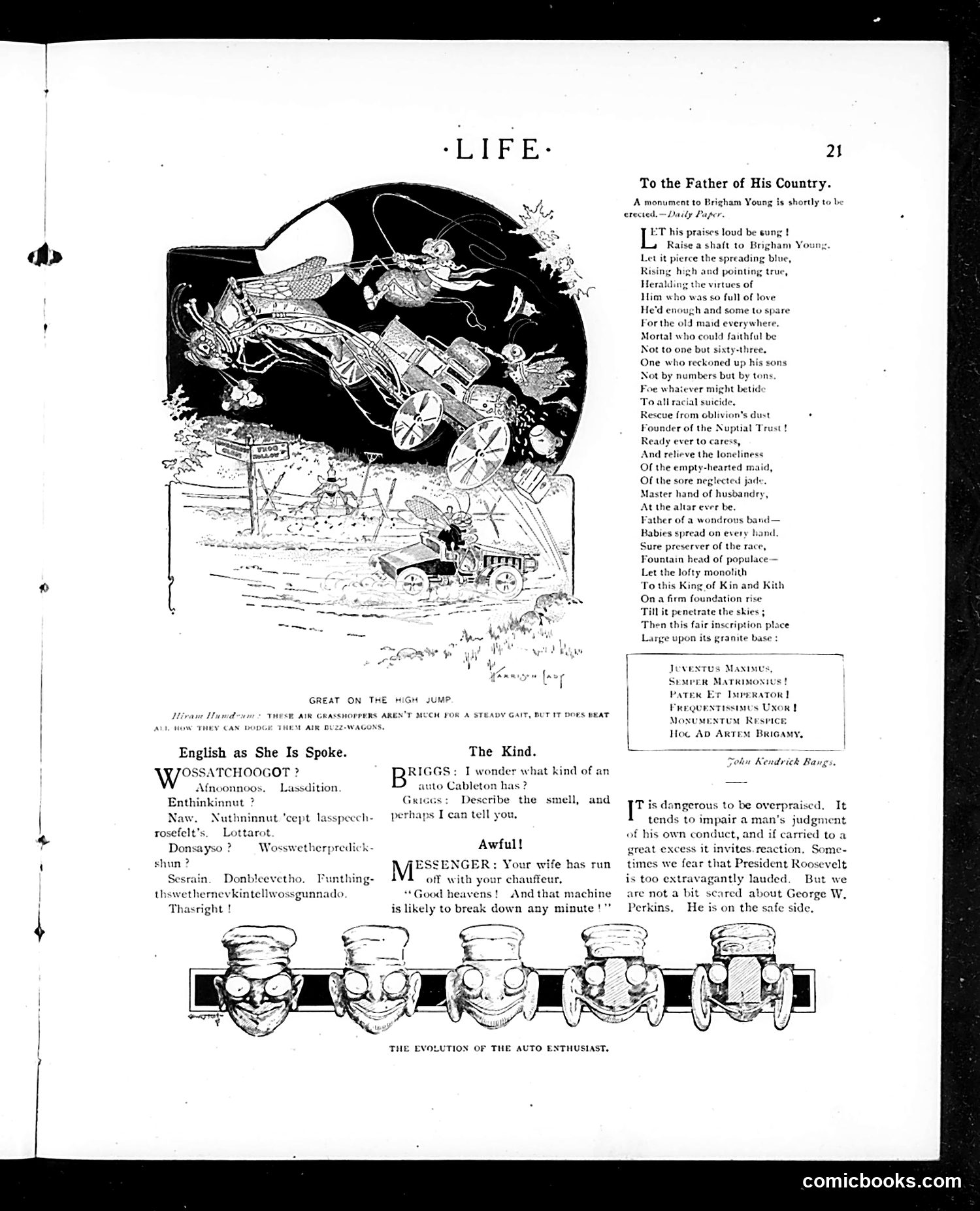
This page contains three satirical pieces: **"English as She Is Spoke"** mocks rural/working-class American dialect through incomprehensible phonetic spelling—a common turn-of-the-century humor device targeting non-standard speech. **"Great on the High Jump"** satirizes early automobiles as unreliable contraptions, comparing them to grasshoppers. The joke about the chauffeur running off with the wife, with the husband's primary concern being the car breaking down, mocks automotive obsession. **"To the Father of His Country"** is a mock-heroic poem about Brigham Young (Mormon leader), praising his polygamy and large family in grandiose language. The Latin inscription at bottom parodies classical monuments. This targets both Young's polygamy and contemporary praise of large American families/population growth. **"Evolution of the Auto Enthusiast"** depicts changing facial expressions across five automobile designs, suggesting how car design (or obsession) literally transforms owners' appearances—satirizing automotive enthusiasm as deforming. The page reflects early-1900s concerns: automobile mania, class-based dialect humor, and debates over immigration/population growth.
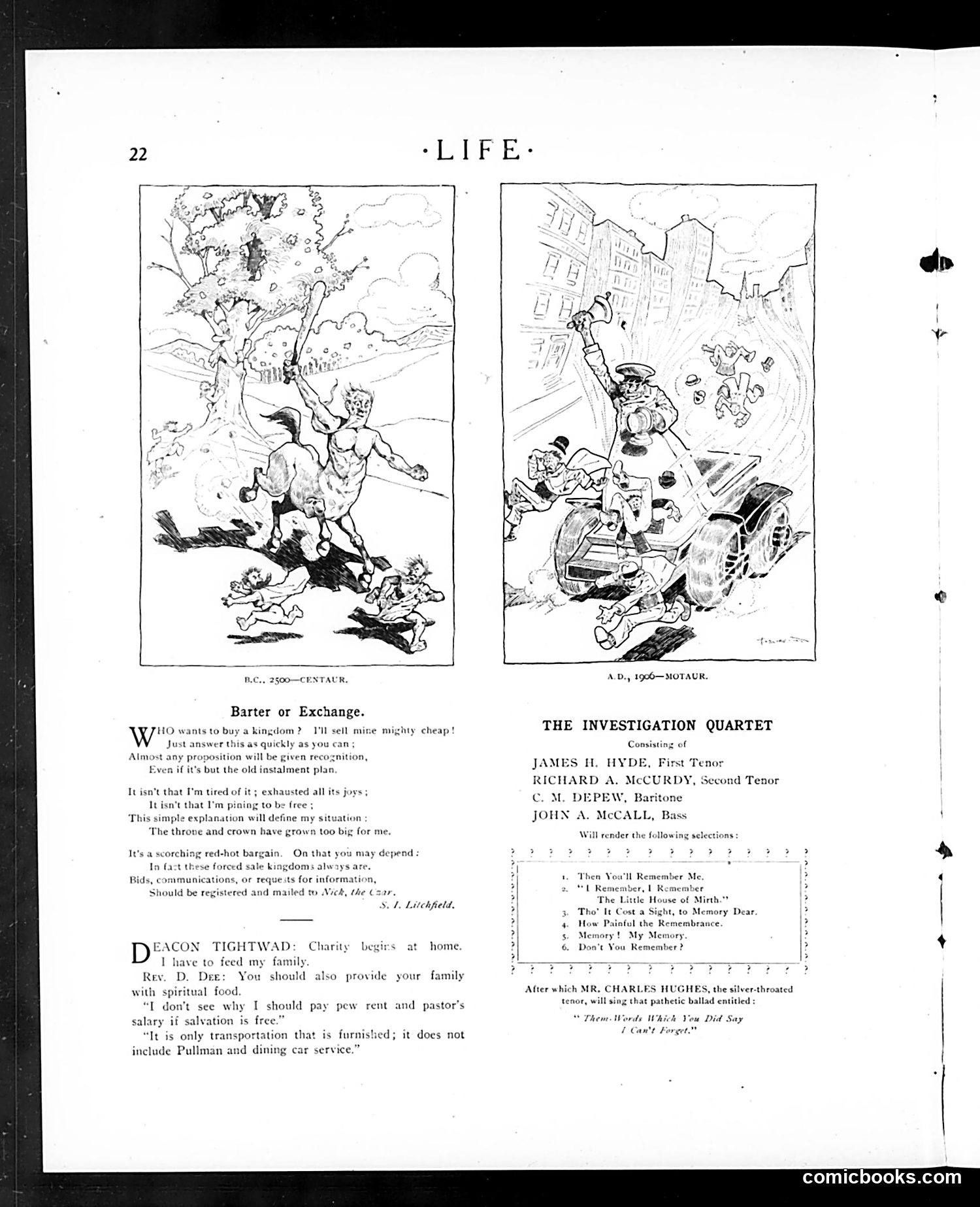
This page contains three distinct satirical pieces from early 1900s Life magazine: **Left cartoon ("Barter or Exchange"):** A centaur offers to sell his kingdom cheap, willing to accept installment payments. The satire mocks monarchy as an outdated, burdensome institution—the throne has "grown too big" for him. This reflects Progressive Era skepticism toward hereditary rule. **Center ("Deacon Tightwad"):** A wealthy man refuses to pay church fees, claiming salvation should be free. The minister's retort—that churches only provide "transportation" like trains with dining cars—satirizes commercialized religion and the hypocrisy of the wealthy avoiding financial obligations to churches. **Right ("The Investigation Quartet"):** Names HYDE, McCURDY, DEPEW, and McCALL as a singing group. These appear to be figures involved in late-1900s insurance company scandals (unclear from image alone which specific investigation), performing darkly comic songs about their questionable dealings. The reference to "Words Which You Did Say / I Can't Forget" suggests public testimony or damaging statements made during investigations. The page satirizes wealth, institutional corruption, and evasion of responsibility.
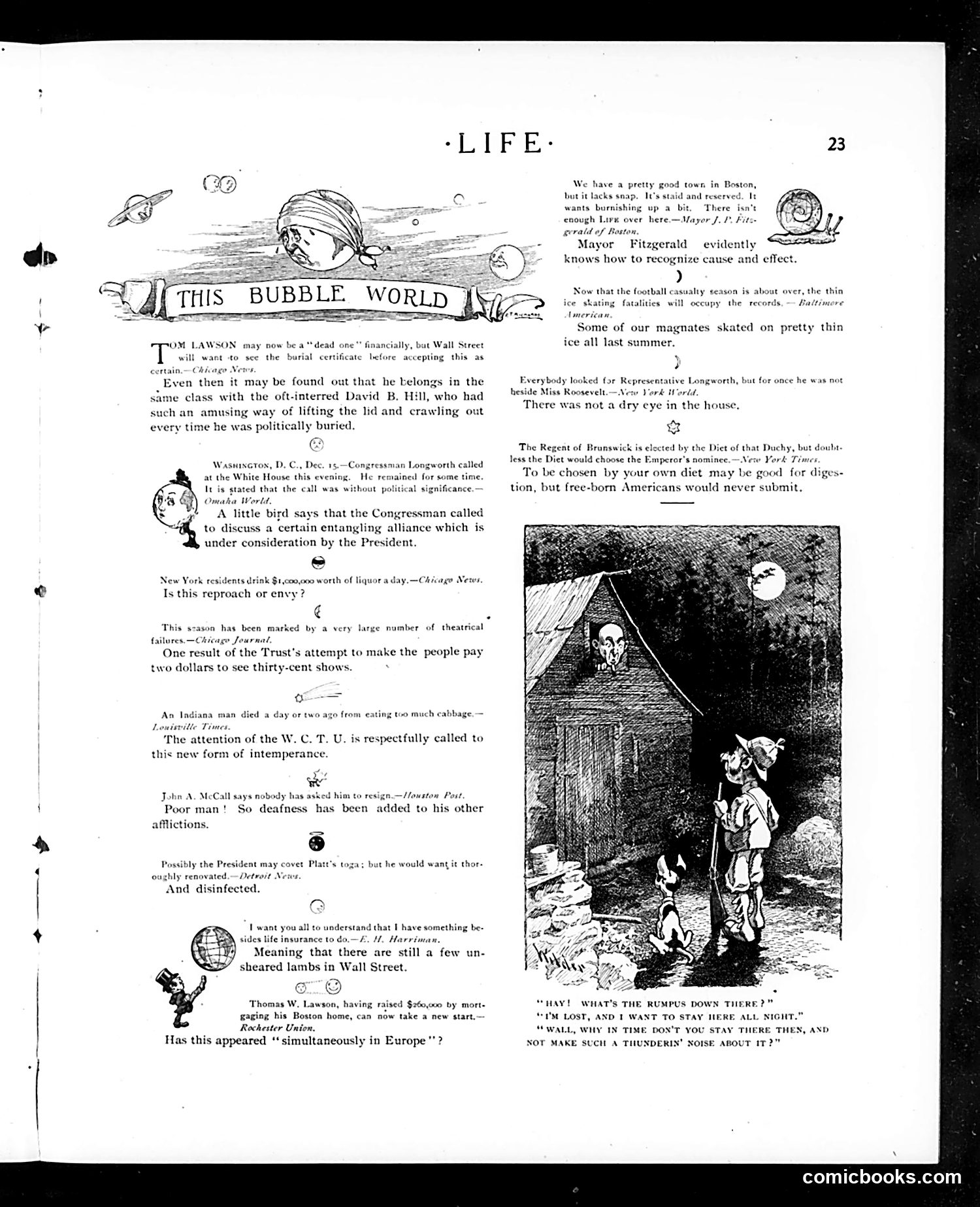
This page from *Life* magazine (early 1900s) collects brief satirical quips mocking contemporary figures and social issues: **Key targets include:** - **Tom Lawson**: A financier pronounced "dead" by Wall Street; the satire questions whether he'll actually stay buried, referencing David B. Hill (a politician known for political comebacks). - **Mayor Fitzgerald of Boston**: Mocked for acknowledging his city lacks "snap" and needs improvement—satirizing his self-aware mediocrity. - **Representative Longworth**: A joke about him being absent from a social event while Miss Roosevelt attended, implying romantic gossip. - **Wall Street/finance**: Multiple jabs at financial corruption, including references to Thomas Lawson (a stock manipulator) and John McCall (insurance executive), satirizing their claimed ignorance of wrongdoing. - **The cartoon (right)**: Shows a lost child at night—a dark humor piece on urban dangers and parental negligence. The page's tone reflects *Life*'s role as a satirical commentary on Gilded Age excess, corruption, and social pretension.
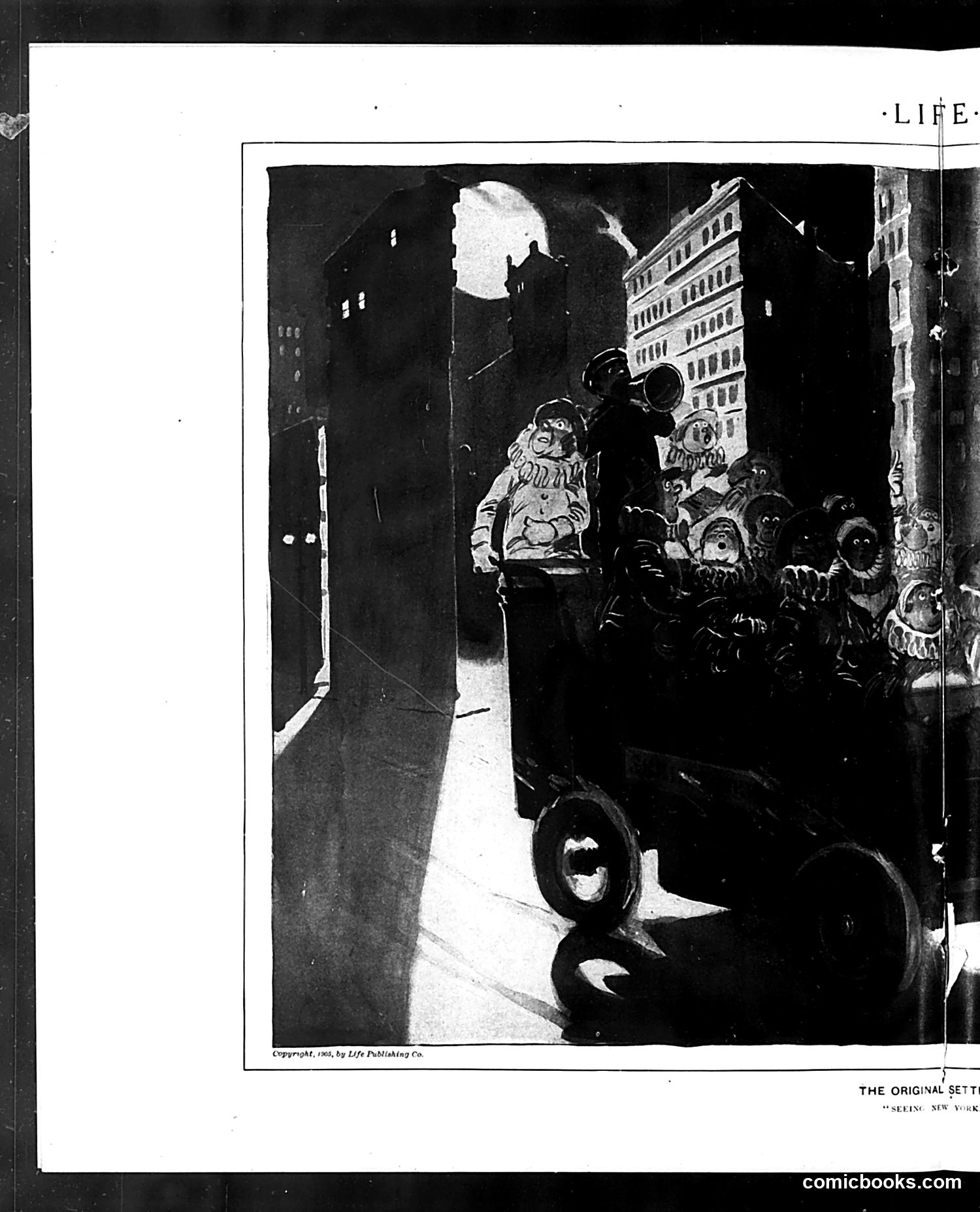
This appears to be a satirical illustration from *Life* magazine (copyright 1905, based on visible text) titled "The Original Settlement: Seeing New York." The image depicts a nighttime urban scene with tall buildings framing a street. A well-dressed man in a top hat holds a megaphone, addressing a group of what appear to be caricatured figures (possibly depicting immigrants or working-class New Yorkers) gathered on the street below. The moon illuminates the tall buildings. The satire likely mocks tourist guides or self-appointed "explainers" of New York City to newcomers or outsiders. The megaphone and theatrical posturing suggest pompous, exaggerated commentary on urban life. The "original settlement" reference may ironically contrast New York's development with its early colonial history. The specific identities of the figures and precise social commentary remain unclear without additional context.
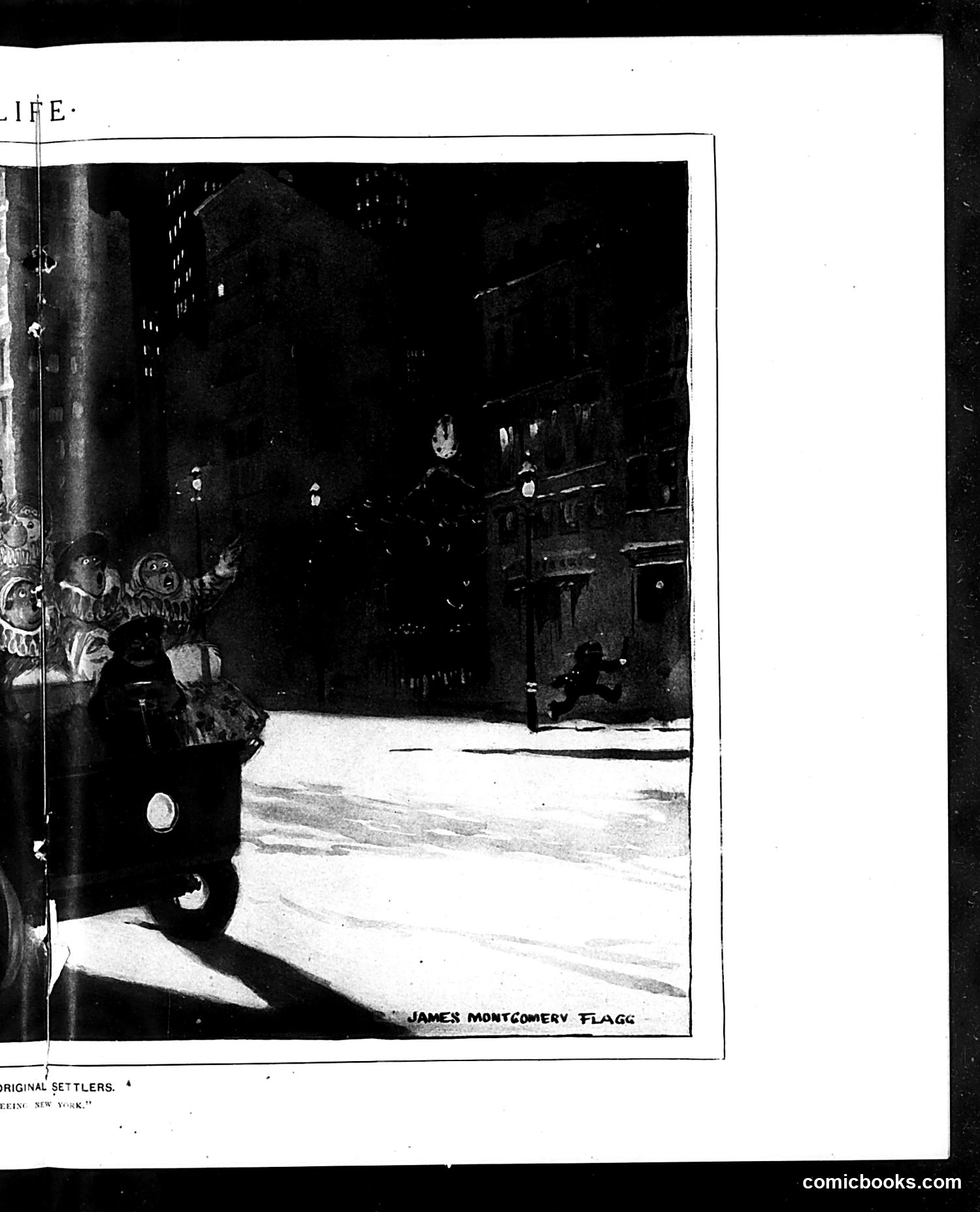
This appears to be a nighttime street scene photograph or illustration credited to James Montgomery Flagg, the renowned American illustrator. The image shows an urban street at night with tall buildings, some pedestrians, and what appears to be early 20th-century New York City architecture and street lamps. The caption references "Original Settlers" and "Seeing New York," suggesting this is part of a satirical or observational piece about New York City life. However, without additional context or visible text explaining the specific satirical point, I cannot definitively identify particular figures or the exact social/political commentary intended. The photograph's atmospheric nighttime quality and urban setting suggest commentary on city life, but the specific targets of any satire remain unclear from this image alone.
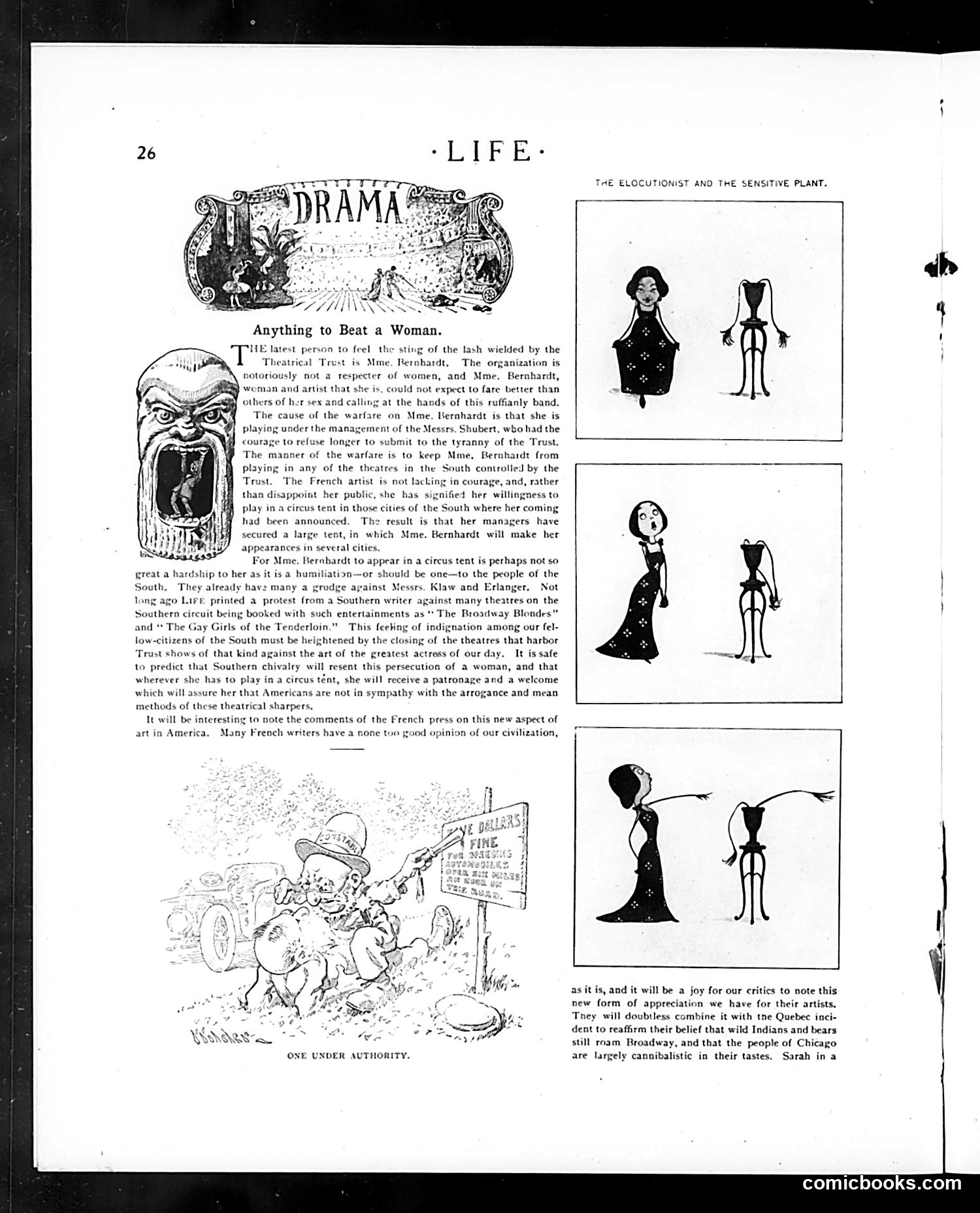
This 1900s satire criticizes the **Theatrical Trust** (a monopoly controlling American theaters) for persecuting **Sarah Bernhardt**, the renowned French actress. The Trust, run by Messrs. Klaw and Erlanger, controlled Southern theaters and refused to book her performances because she worked with the rival Shubert brothers. Rather than capitulate, Bernhardt agreed to perform in a **circus tent**—a humiliating arrangement that Life's editors present as an insult to both the actress and American dignity. The savage caricatured face at left represents the Trust's ruthless methods. The satire's deeper point: this petty persecution of a woman artist will embarrass America internationally. French critics already view Americans as uncivilized; this treatment will confirm their stereotype that America harbors "wild Indians and bears" and cannibals. The right-side illustrations labeled "The Elocutionist and the Sensitive Plant" appear to mock contrasting theatrical styles—likely Bernhardt's dramatic intensity versus lighter entertainment fare.
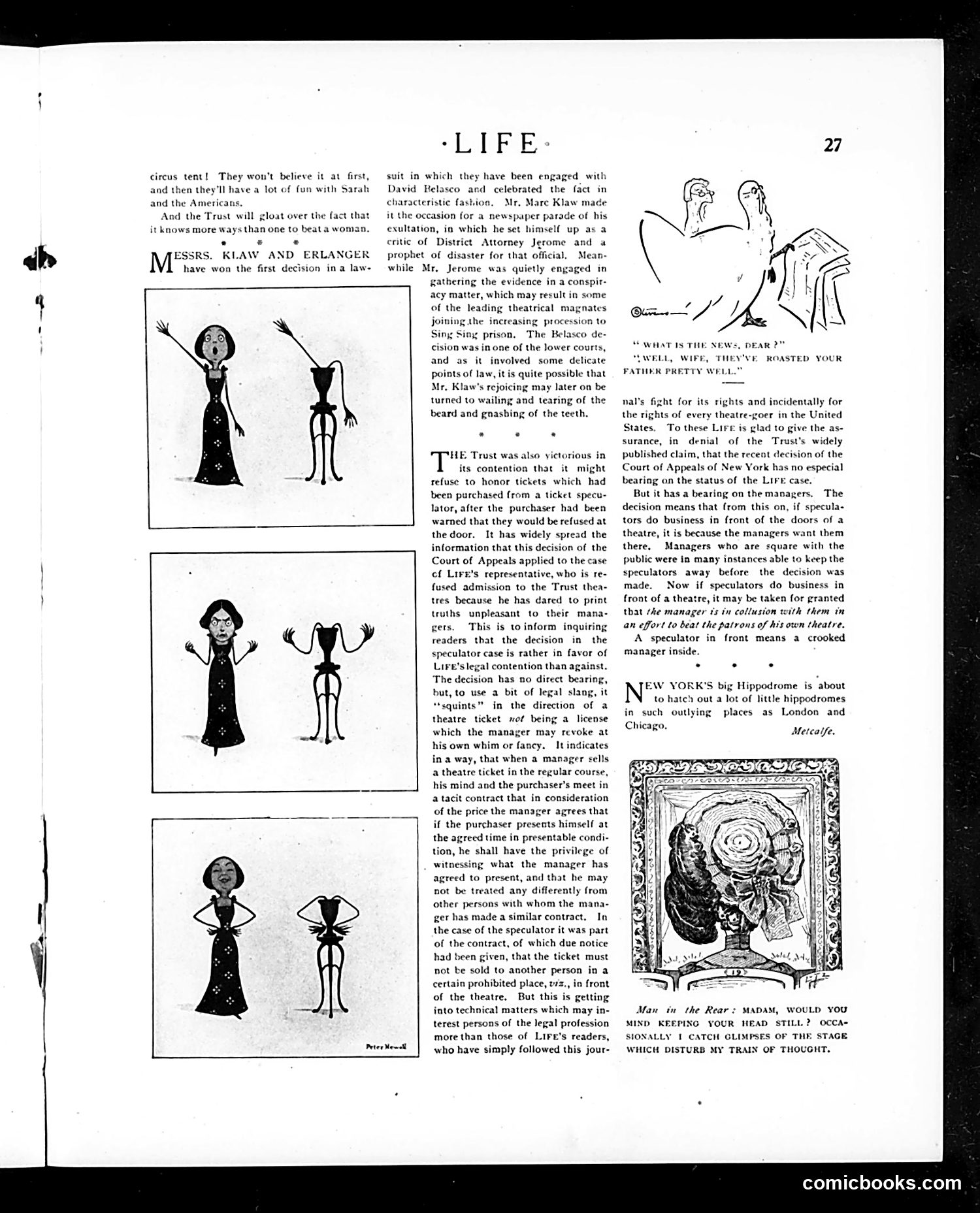
This page documents a legal dispute between Life magazine and the theatrical "Trust" (a monopolistic consortium of theater owners including Klaw, Erlanger, and Belasco). The cartoons on the left—drawn by Peter Newell—mock the theatrical magnates through exaggerated caricatures of elegantly dressed women paired with skeletal male figures, likely symbolizing the Trust's exploitation or the contrast between showmanship and substance. The main text celebrates Life's partial victory: though Klaw and Erlanger won their case against Belasco, Life argues the appeals court decision actually supports its own legal position regarding theater access and ticket resale rights. Life frames this as a fight for ordinary theater-goers against monopolistic control. The small cartoon at top right shows a wife congratulating her husband on roasting her father—likely referencing the Trust's public humiliation in the dispute. The satirical thrust: Life positions itself as defending public rights against powerful theatrical interests who control what audiences can see and how tickets are sold.
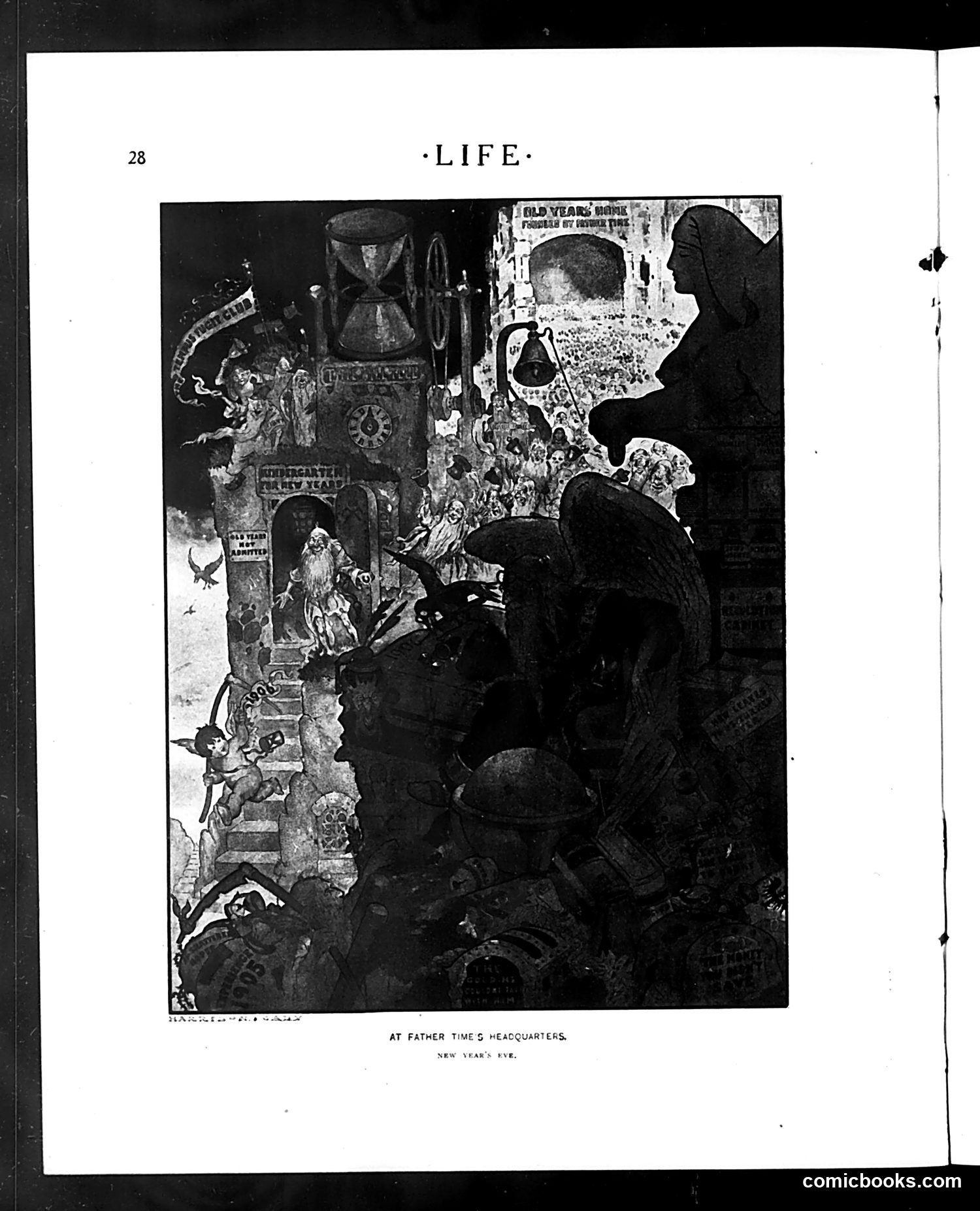
This satirical illustration depicts Father Time's headquarters on New Year's Eve. The cartoon shows a cluttered, chaotic interior filled with various symbolic objects and figures. The central tower or structure appears decorated with seasonal imagery, clocks, and what appear to be references to the outgoing year's events and figures. The composition suggests commentary on the year passing and transition to a new one. Various architectural and decorative elements—including what appears to be hourglass imagery and festive markers—reinforce the New Year's theme. The crowded, somewhat frenzied nature of the scene likely satirizes the social commentary or major events of the year being left behind. Without clearer identification of specific figures or readable text on individual elements, the exact political or social references remain unclear from the image alone.
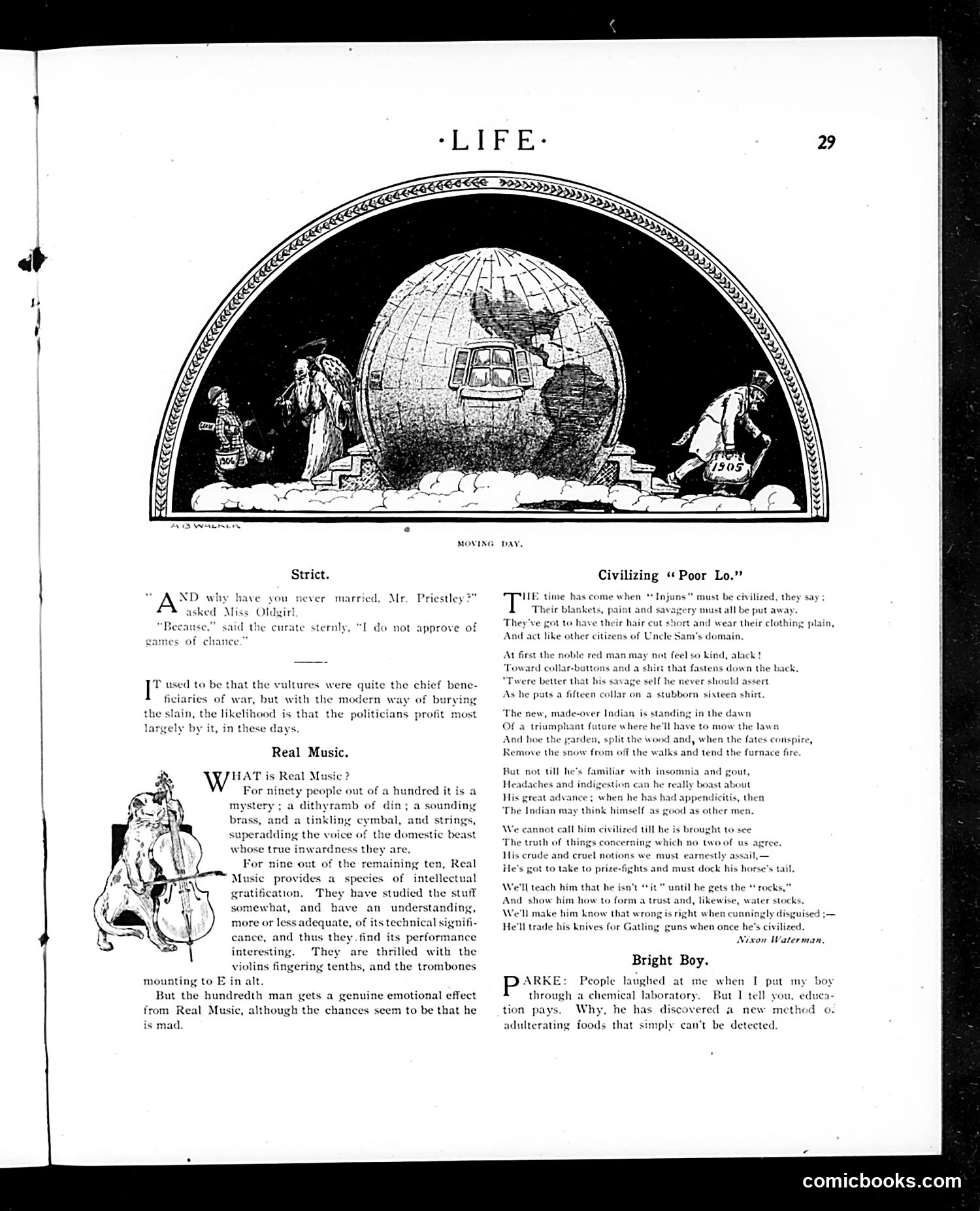
This page contains three separate satirical pieces typical of early 20th-century American humor: **"Strict"** mocks rigid Victorian morality through a curate who disapproves of games of chance—suggesting religious hypocrisy about what constitutes acceptable behavior. **"Real Music"** is a humorous essay satirizing different classes' appreciation of classical music. It suggests that 90 of 100 people either don't understand music or pretend to, while only one person genuinely feels emotional connection—and that person is "mad." This critiques both intellectual pretension and the disconnect between claimed sophistication and actual feeling. **"Civilizing 'Poor Lo'"** (Lo = Native American) satirizes assimilationist policies. The poem mocks efforts to "civilize" Indigenous peoples by imposing Western clothing, labor, and hygiene standards. It presents the irony: the Indian gains "civilization" only by adopting uncomfortable shirts, insomnia, gout, and appendicitis—suggesting that Western "civilization" brings disease and suffering rather than genuine improvement. **"Bright Boy"** jokes about a child discovering food adulteration methods through chemistry—implying scientific knowledge enables deception.
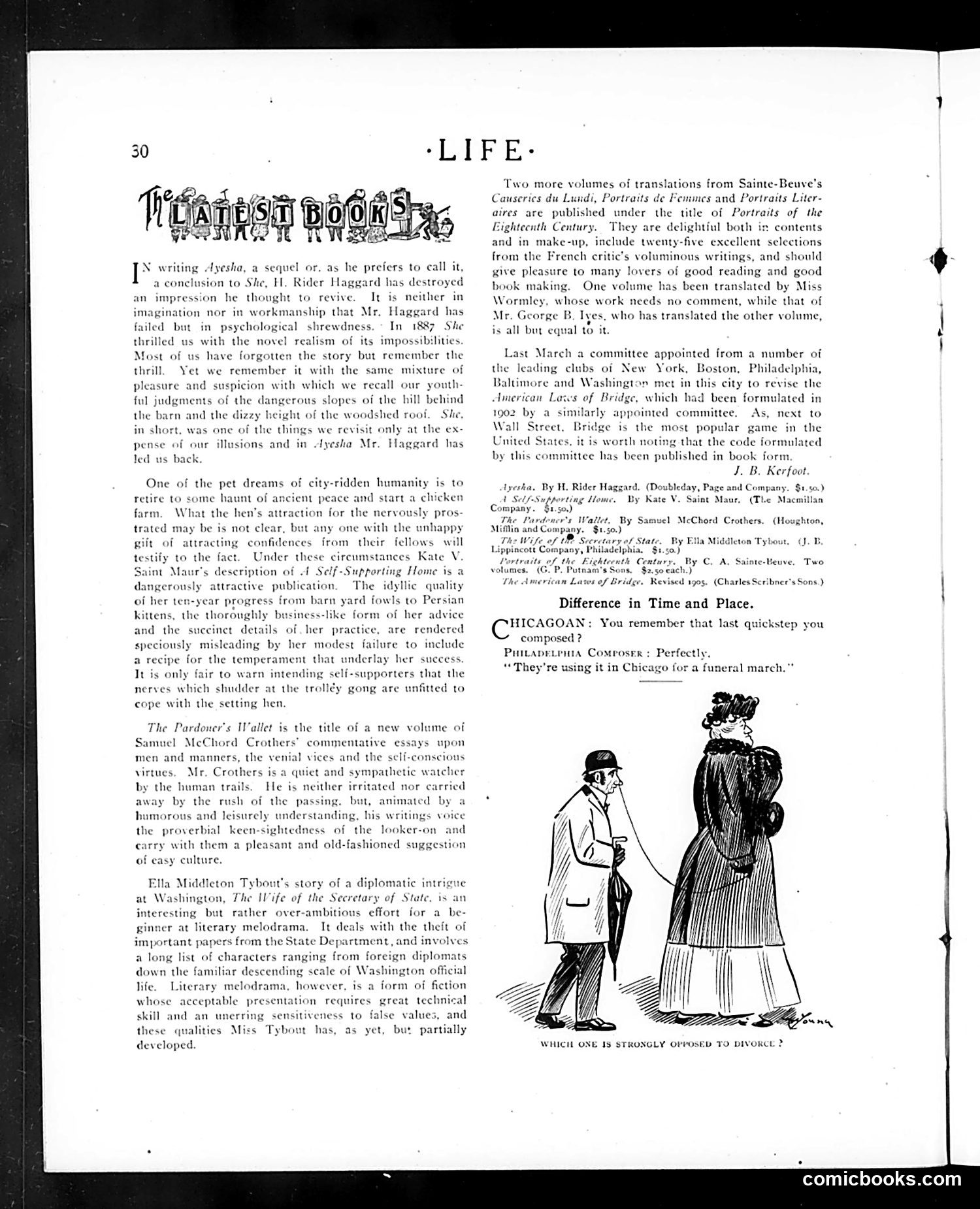
This page contains book reviews and a single cartoon titled "Which One Is Strongly Opposed to Divorce?" **The Cartoon:** The illustration shows a man and woman in period dress (appears to be early 1900s), with the woman towering over the man. The caption asks which figure opposes divorce. The joke is visual satire about gender dynamics—likely mocking either the man's apparent weakness/submission to his wife, or satirizing contemporary debates about women's rights and marriage. The humor depends on viewers' assumptions about which gender would traditionally oppose divorce. **The Reviews:** The page discusses several books: H. Rider Haggard's sequel *Ayesha*, works about self-supporting farms, Samuel McChord Crothers' essay collection, and Ella Middleton Tybout's Washington political thriller. The tone is literary criticism typical of Life magazine's cultural commentary for educated readers. The specific political/social references are unclear without additional context about these authors' prominence at the time.
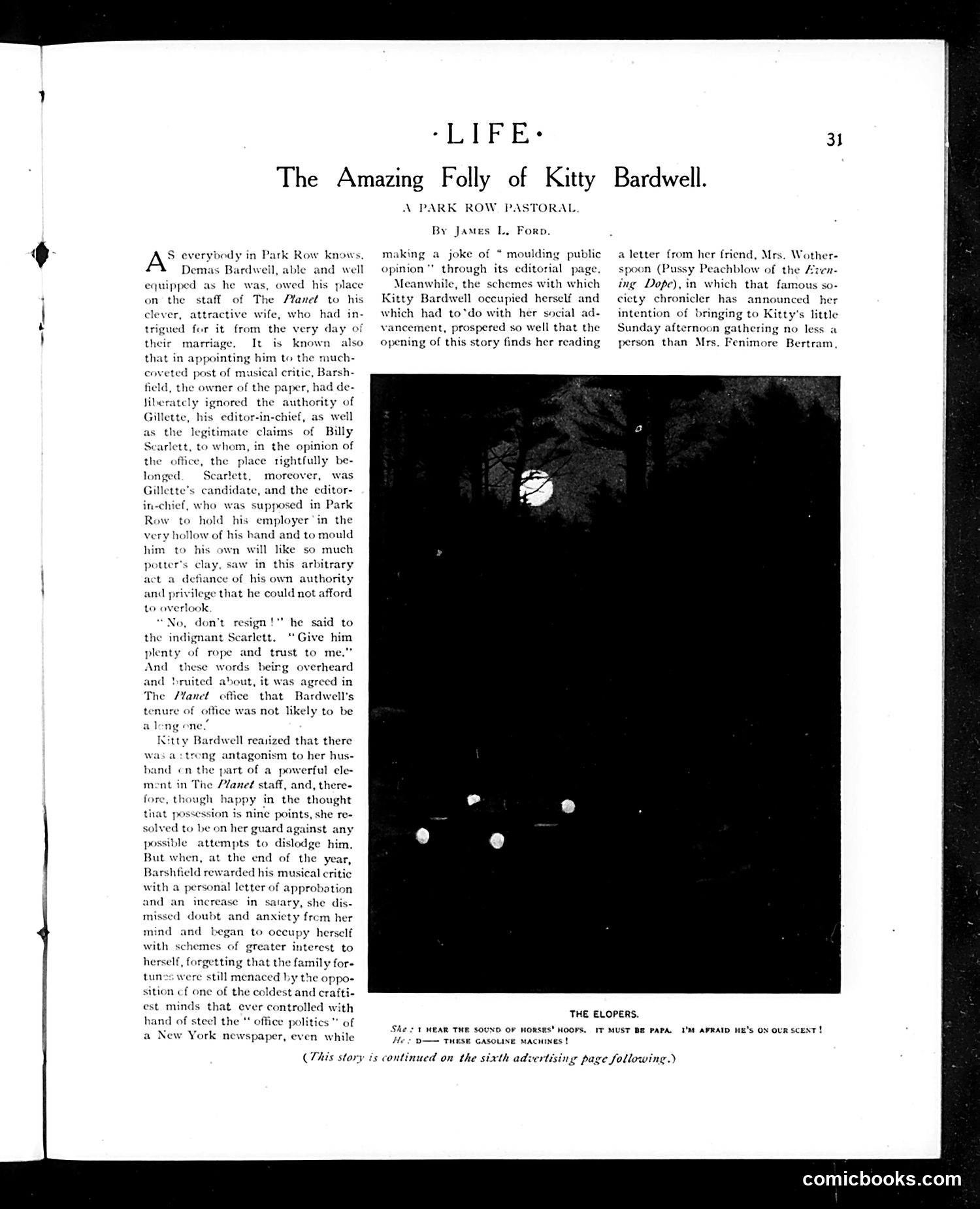
This page presents a serialized satirical story about newspaper office politics in early 20th-century New York (specifically at a publication called "The Planet" on "Park Row," the newspaper district). The narrative mocks Kitty Bardwell, whose social ambitions and scheming have distracted her from protecting her husband Demas's job security. Though she successfully intrigued to get him hired as music critic, she's now preoccupied with social advancement—notably arranging for a society chronicler to bring the prestigious Mrs. Fenimore Bertram to her Sunday gathering. The text suggests she's forgotten that powerful enemies in the newspaper office still threaten her husband's position. The small cartoon below, captioned "The Elopers," appears unrelated—showing a couple fleeing, with the woman hearing "horses' hoops" (her father approaching) while the man curses "gasoline machines" (automobiles), likely commentary on modern courtship and pursuit. The satire targets both newspaper workplace machinations and the vanities of social climbing among the middle class.
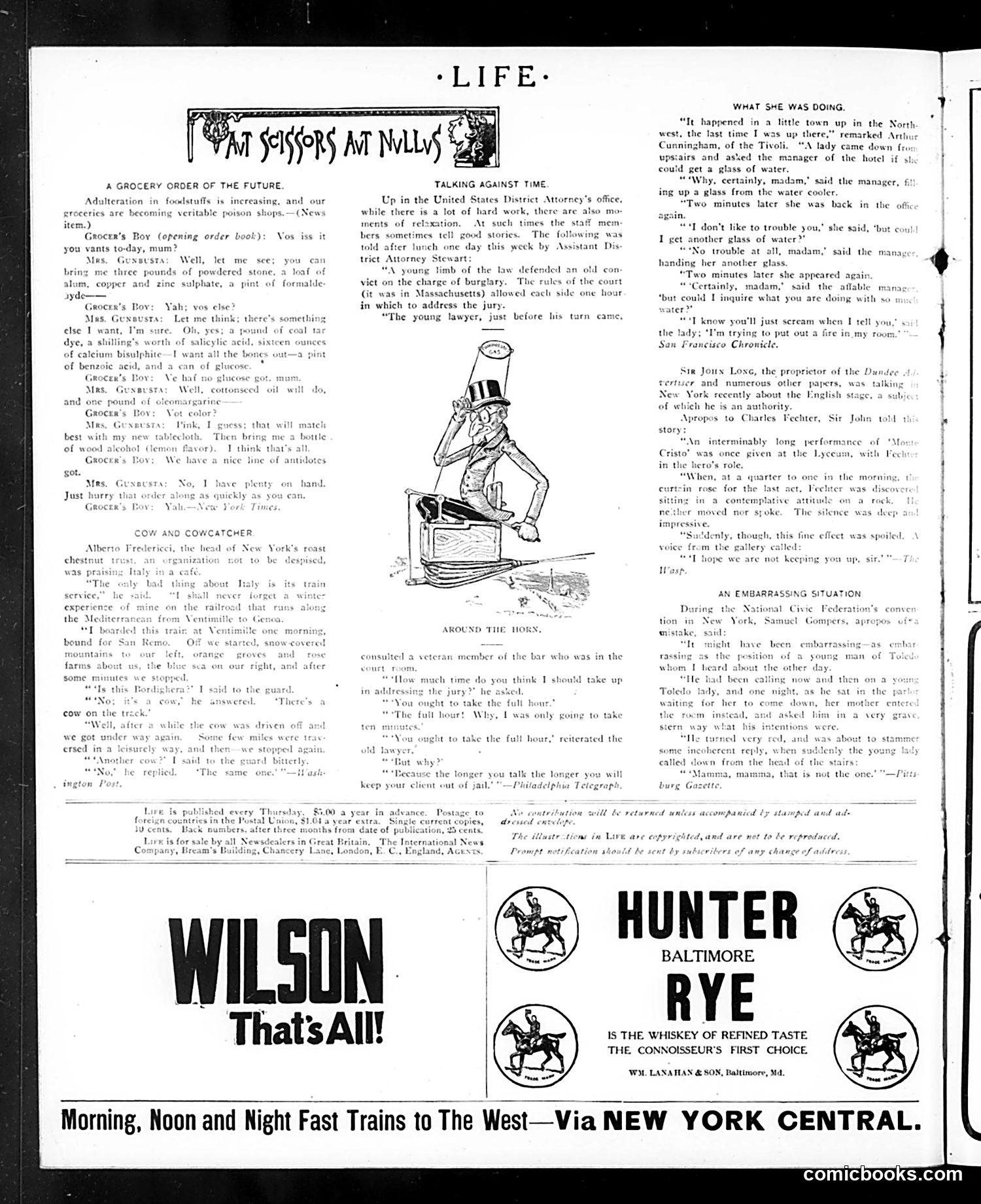
This page from *Life* magazine contains several satirical pieces aimed at contemporary social concerns: ## "A Grocery Order of the Future" A dialogue mocking food safety scandals. The "Mrs. Gussusta" character orders groceries containing dangerous adulterants—alum, copper, formaldehyde, coal tar, benzoic acid—presented as routine ingredients. This satirizes real 1900s-era food contamination scandals and "poison shop" grocery practices, referencing actual public anxiety about unregulated food production and adulteration. The joke highlights how normalized food poisoning had become. ## "Talking Against Time" A courtroom anecdote where a young lawyer seeks advice on jury address timing. The veteran lawyer's paradoxical response—speak longer to confuse jurors into dismissal—mocks legal procedure's absurdities and suggests the legal system rewards verbose obfuscation over justice. The remaining stories appear to be humorous anecdotes about everyday situations. **Advertisements** for Wilson whiskey and Hunter Baltimore Rye occupy the lower portion.
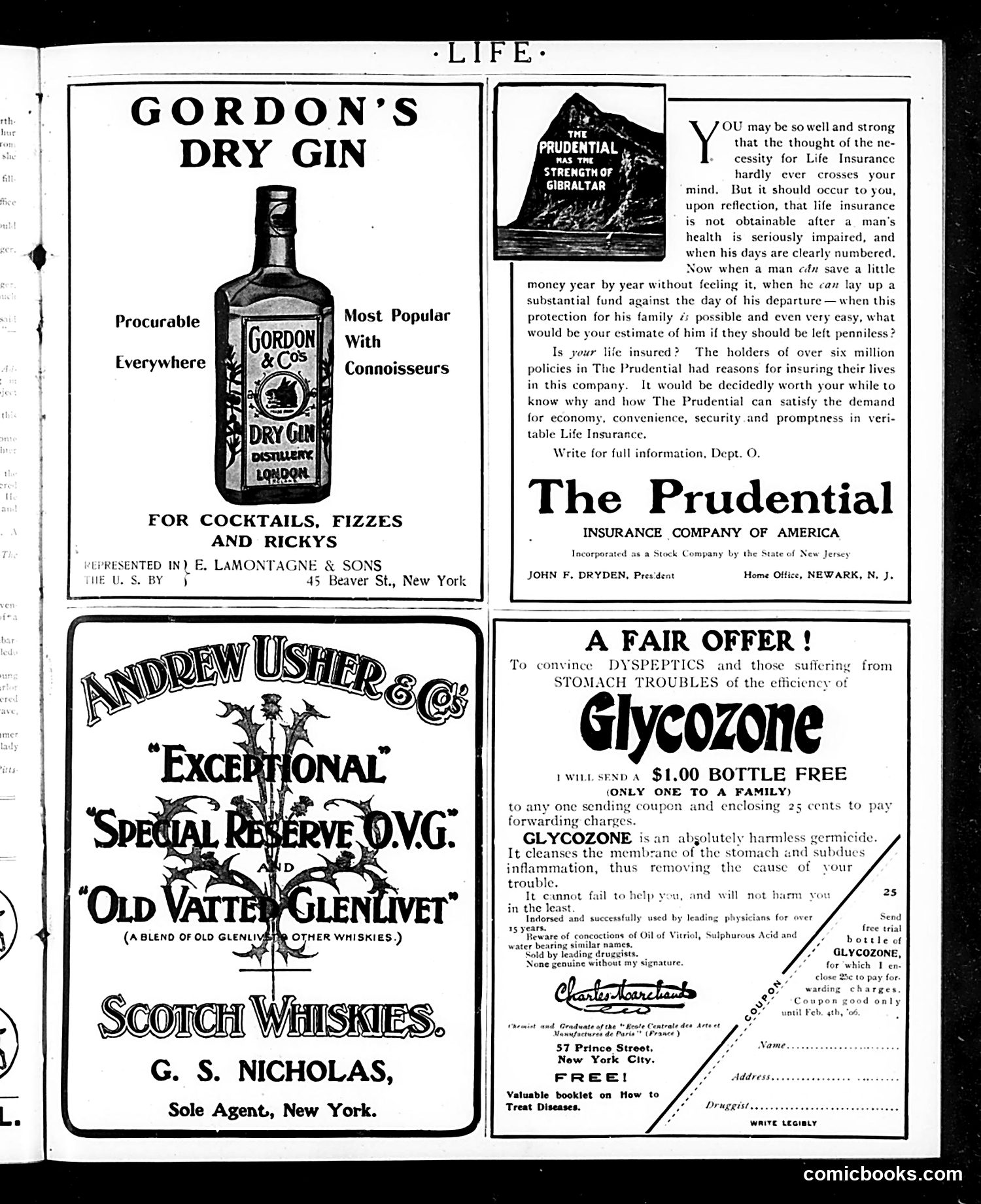
This page consists entirely of **advertisements**, not editorial cartoons or satire. It contains four distinct product promotions typical of early 20th-century American magazines: 1. **Gordon's Dry Gin** — spirits advertisement emphasizing the product's popularity among connoisseurs 2. **The Prudential Insurance Company** — a persuasive pitch urging readers to secure life insurance while healthy, using moral reasoning about family protection 3. **Andrew Usher & Co. Scotch Whiskies** — liquor advertisement 4. **Glycozone** — a patent medicine claiming to cure stomach troubles and dyspepsia, offering a free $1 trial bottle The Prudential ad is the most rhetorically elaborate, appealing to masculine responsibility and family duty. Glycozone represents the era's unregulated patent medicine industry, making health claims (germicide, inflammation reduction) that would face modern FDA scrutiny. No satire or political commentary is evident—this is straightforward period advertising reflecting contemporary consumer products and marketing strategies.
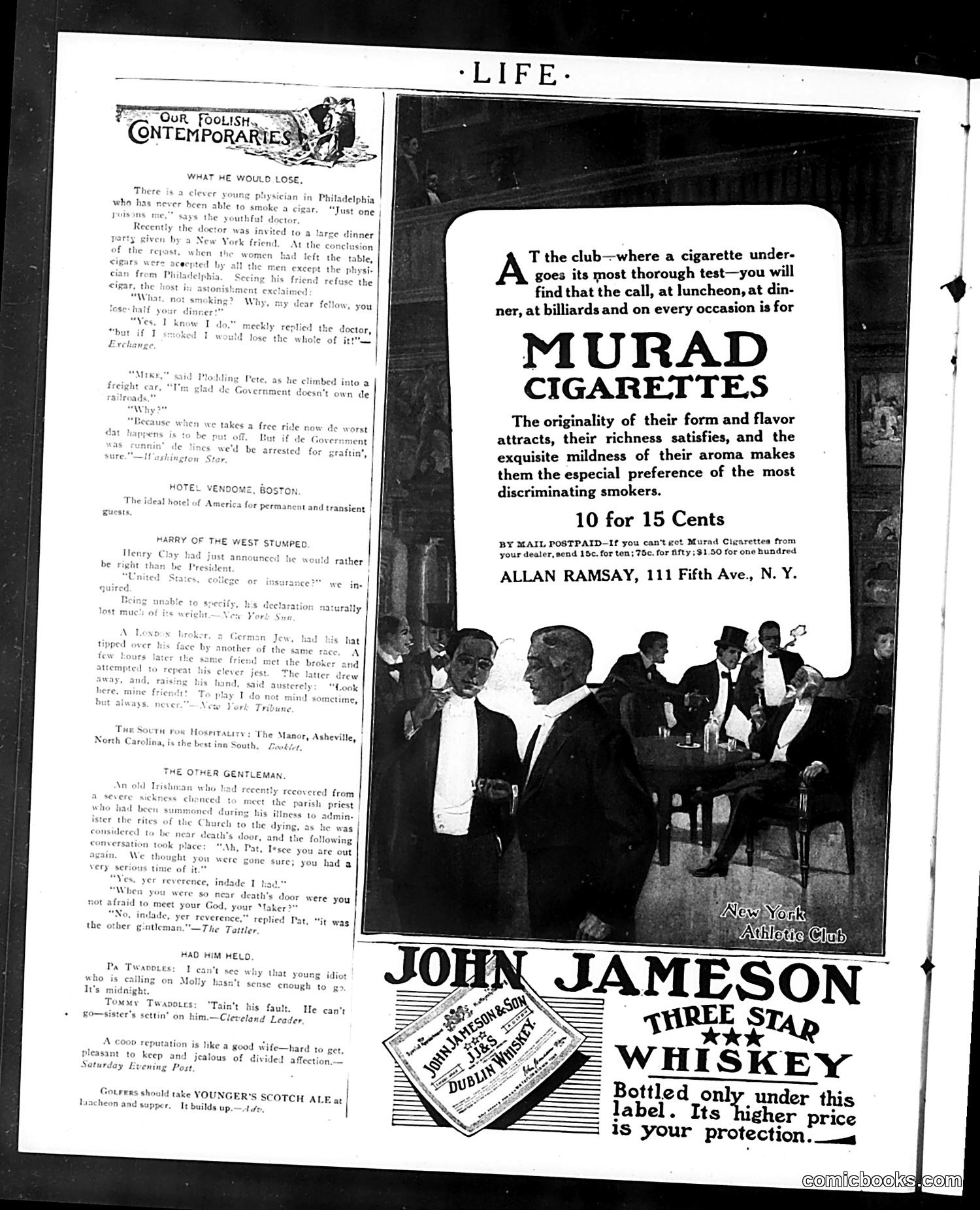
This page is primarily **advertising**, not political satire. It contains two major product advertisements: 1. **Murad Cigarettes** (center-right): A large ad emphasizing that discriminating smokers prefer Murad cigarettes, which are available "at the club...at luncheon, at dinner, at billiards." The accompanying photograph shows well-dressed men at what appears to be the New York Athletic Club, positioned as aspirational consumers. 2. **John Jameson Three Star Whiskey** (bottom-right): An advertisement for Irish whiskey, emphasizing authenticity through the label guarantee. The left column contains **"Our Foolish Contemporaries,"** Life's humor section featuring short anecdotes mocking various social types—including a Philadelphia doctor, a New York dinner guest, and various gentlemen. These are generic social observations rather than references to specific public figures. The page reflects early 20th-century consumer culture, targeting affluent male readers through appeals to exclusivity and club life.
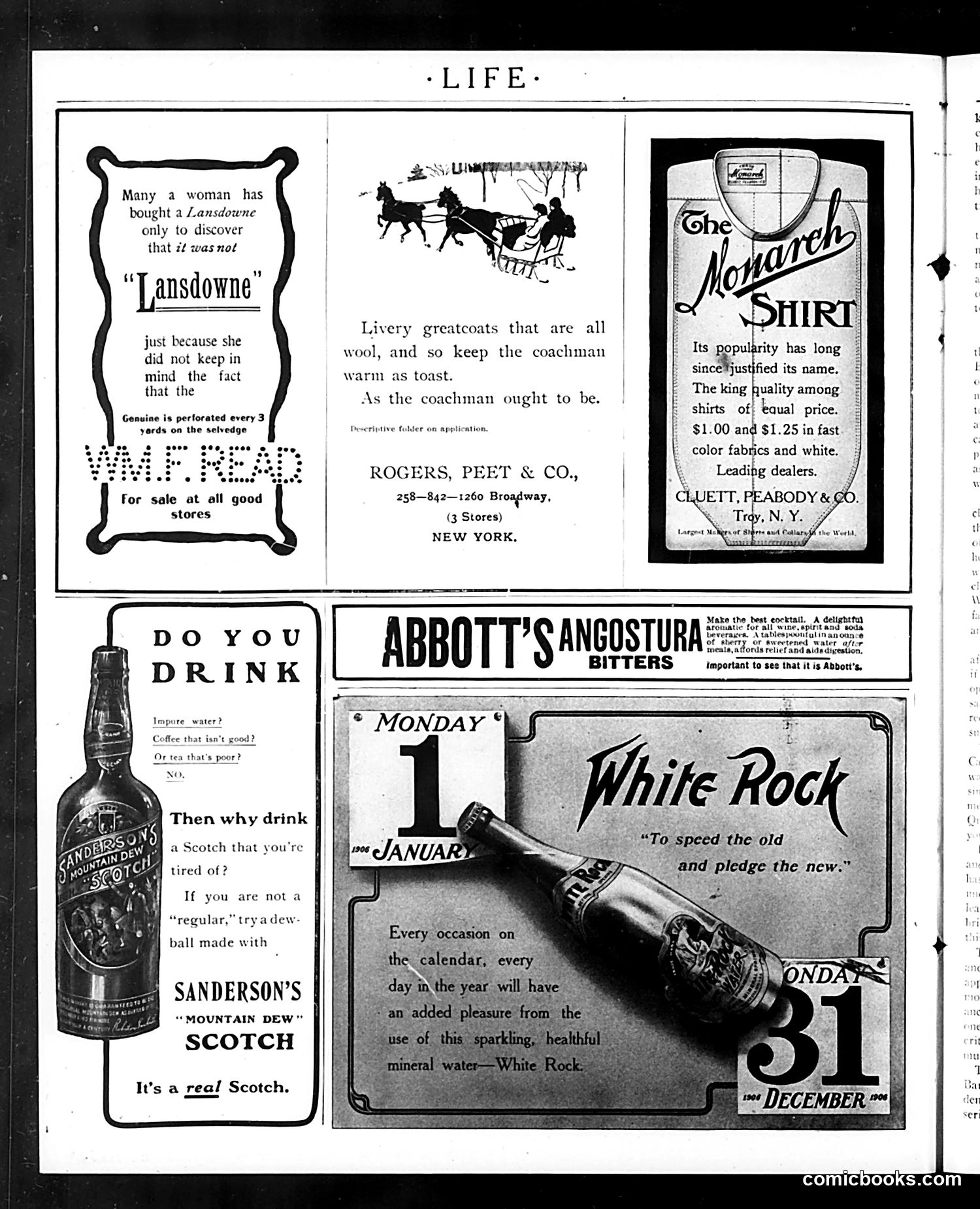
This page consists entirely of **advertisements**, not editorial cartoons or satire. It's a collection of early 20th-century product ads: **Lansdowne** (top left): A fabric brand emphasizing that genuine products have perforations every three yards—warning against counterfeits. **Rogers, Peet & Co.** (top center): Menswear retailer advertising wool coats for coachmen. **Monarch Shirt** (top right): Dress shirt brand claiming royal quality at affordable prices ($1.00-$1.25). **Sanderson's Mountain Dew Scotch** (bottom left): Whisky brand using humor—asking why drink inferior Scotch when you could try theirs. **Abbott's Angostura Bitters** (center): Digestive/cocktail ingredient. **White Rock** (bottom right): Mineral water advertised as a New Year's resolution product ("speed the old and pledge the new"). The page reflects early 1900s consumer culture, with emphasis on authenticity (fighting counterfeits) and aspirational branding.
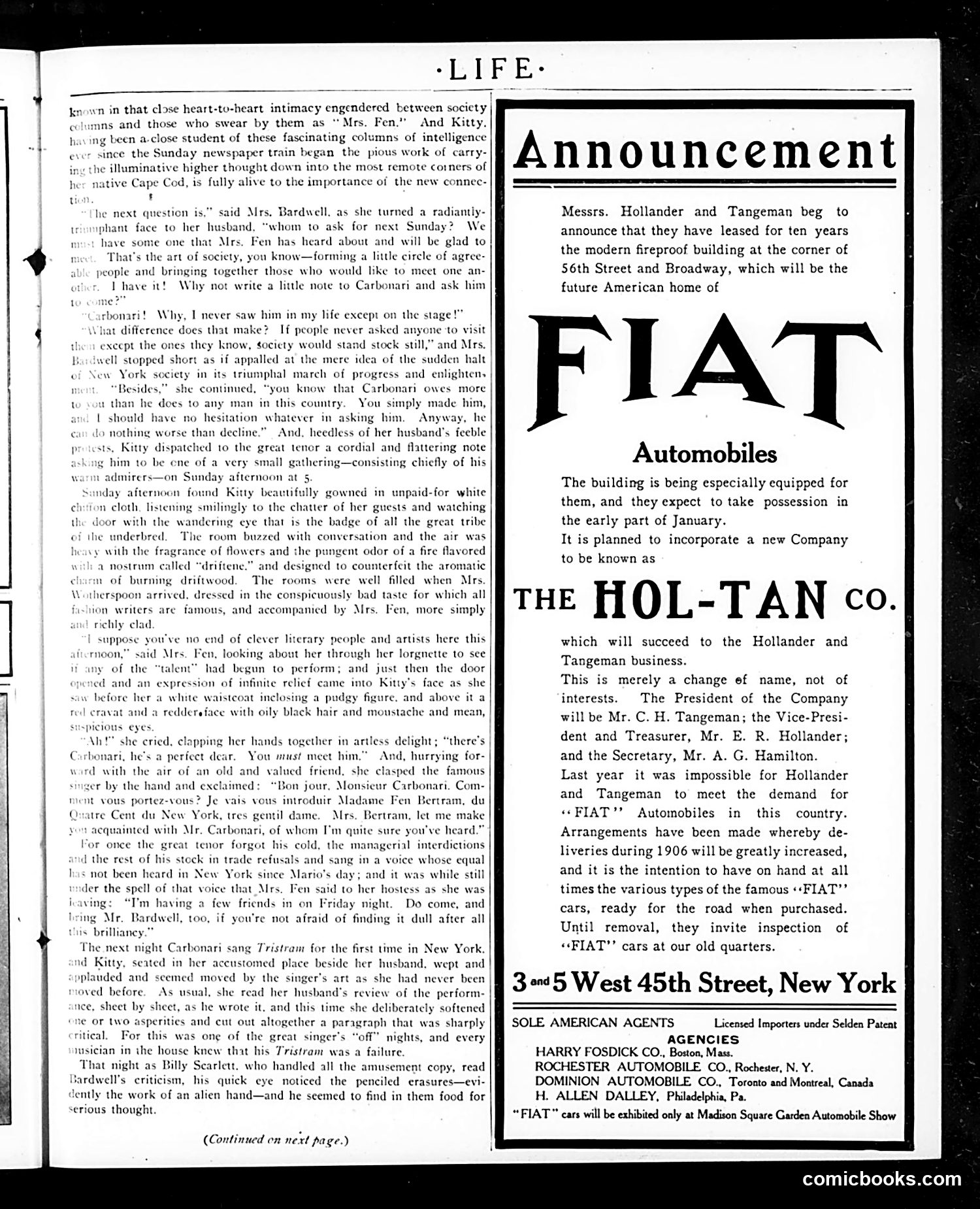
This page is primarily **advertising**, not editorial satire. The dominant feature is a large **FIAT Automobiles announcement** occupying the right half of the page. The announcement describes the establishment of "THE HOL-TAN CO." — a new company formed by Messrs. Hollander and Tangeman to distribute FIAT automobiles in America from their new fireproof building at 56th Street and Broadway in New York. The text emphasizes that this is merely a name change ("not of interests"), lists company officers, and notes increased 1906 deliveries planned, with cars available for inspection at their old quarters. The **left side contains prose fiction** — apparently a serialized story about New York society, featuring characters like Mrs. Bardwell, Mrs. Fen, Kitty, and a famous tenor named Carbonari. The narrative depicts upper-class social maneuvering and name-dropping typical of society columns. The page reflects early 1900s American consumer culture and social commentary through both commercial promotion and literary entertainment.
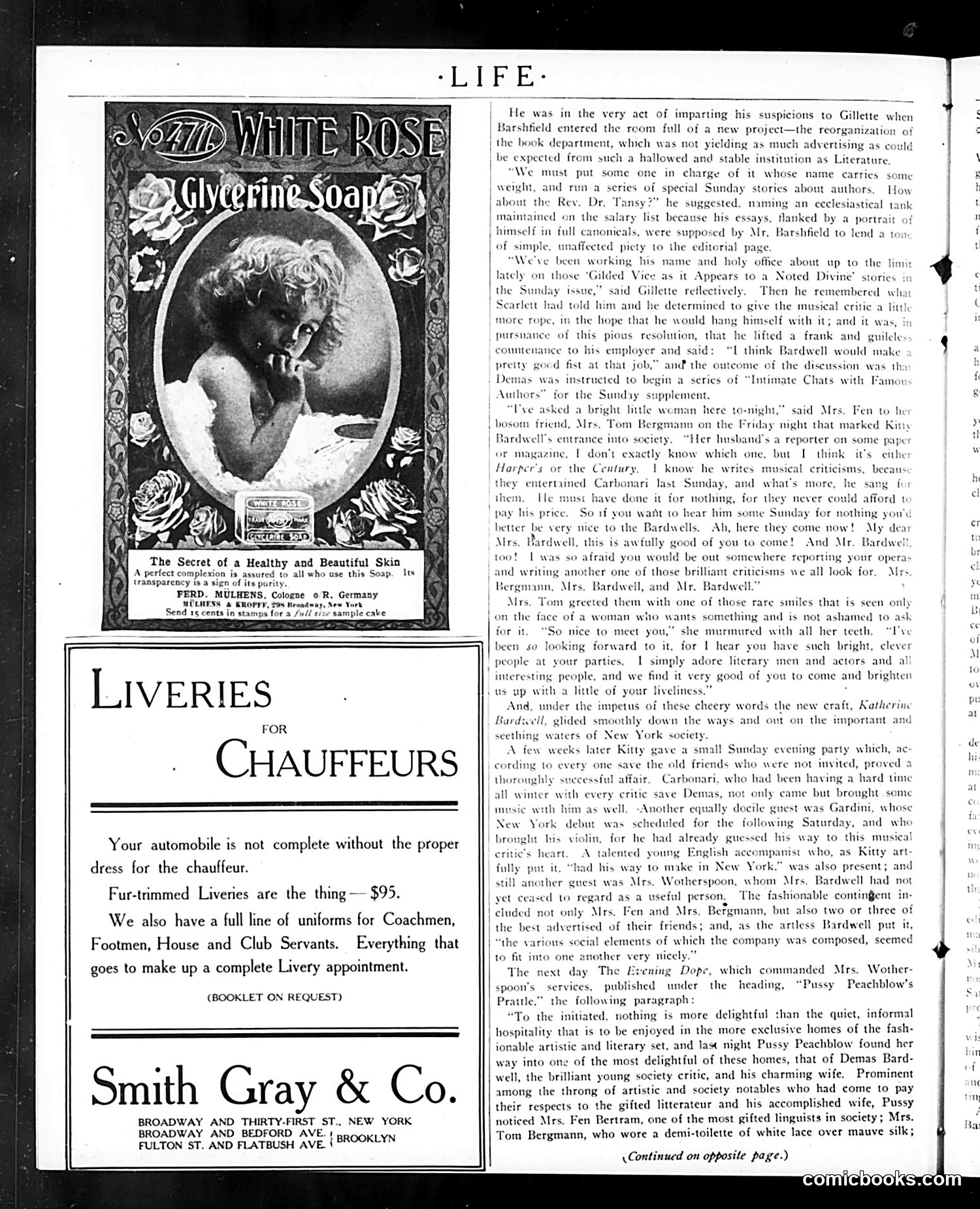
This page is primarily **advertising and serialized fiction** rather than political satire or editorial cartooning. The top features a **White Rose Glycerine Soap advertisement** with decorative rose imagery—standard product marketing of the era. Below are **two business advertisements**: one for chauffeur liveries by Smith Gray & Co. (reflecting the early 1900s luxury automobile culture where wealthy households employed uniformed drivers) and one for coachmen and footmen uniforms. The **bulk of the page contains serialized fiction** about social climbing in New York society. The narrative follows Katherine Bardwell's entry into exclusive circles through strategic socializing, depicting turn-of-the-century upper-class maneuvering. Characters include music critics, literary figures (references to *Harper's* and *Century* magazines), and society hostesses engaged in calculated social positioning. The humor is gentle satire of **nouveau riche social aspiration and literary pretension**—showing how ambitious people leveraged cultural credentials (critics, musicians, authors) to gain social standing, not actual political commentary.
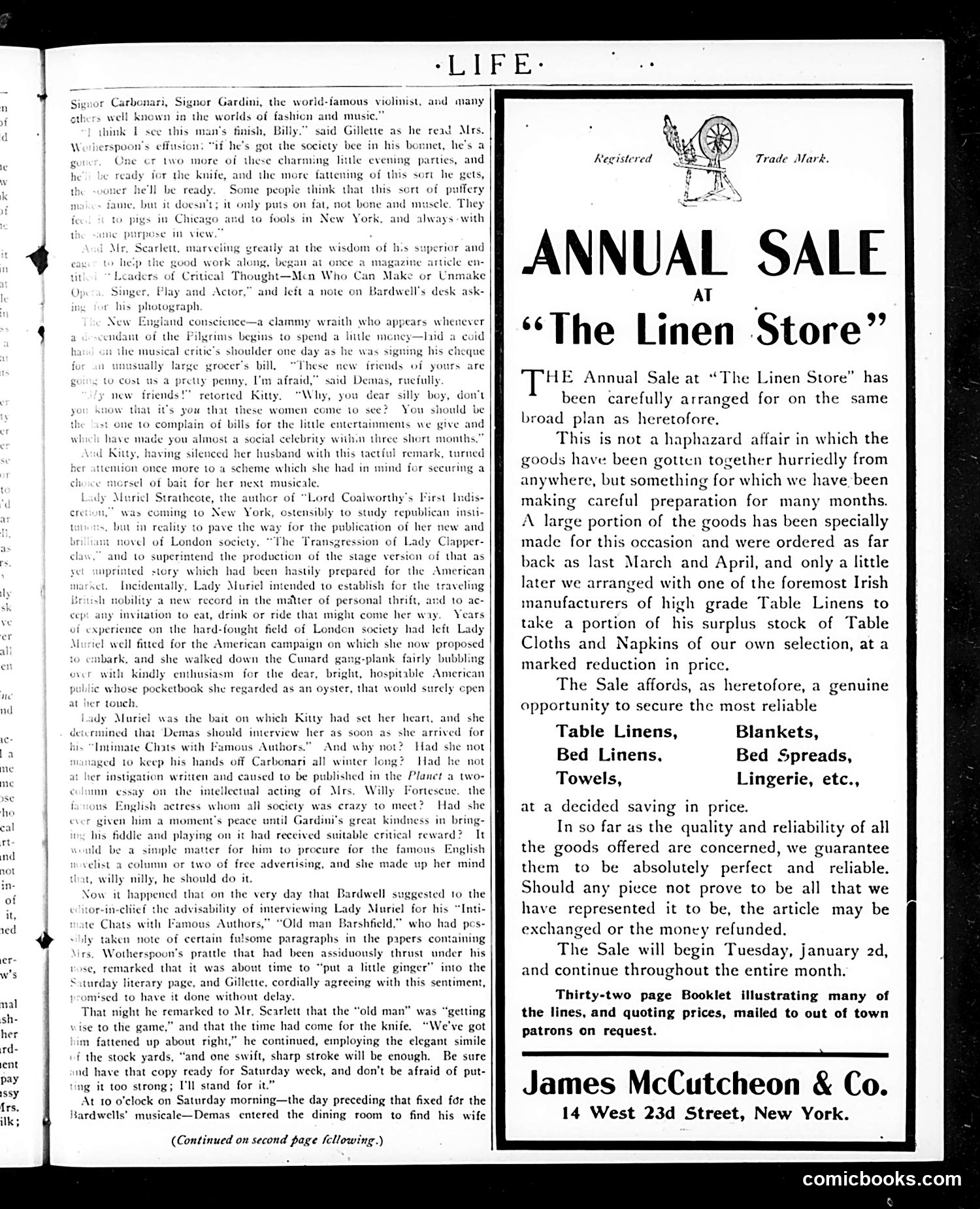
This page is primarily **advertising**, not satire or political commentary. The right side features a full-page ad for "The Linen Store's" annual sale by James McCutcheon & Co. in New York, promoting table linens, bed linens, blankets, and related goods at reduced prices, with a 32-page illustrated booklet available by mail. The left side contains narrative fiction—an excerpt from a serialized story in *Life* magazine about society figures named Kitty, Demas, and Lady Muriel Strathcote. The passage depicts domestic comedy involving a wife (Kitty) who manipulates her music-critic husband (Demas) into interviewing a visiting British author (Lady Muriel) for his column, while Lady Muriel cynically exploits American hospitality for free meals and entertainment. There is no political cartoon visible. The content reflects early 20th-century upper-class social satire about ambition, marriage dynamics, and transatlantic cultural pretension.
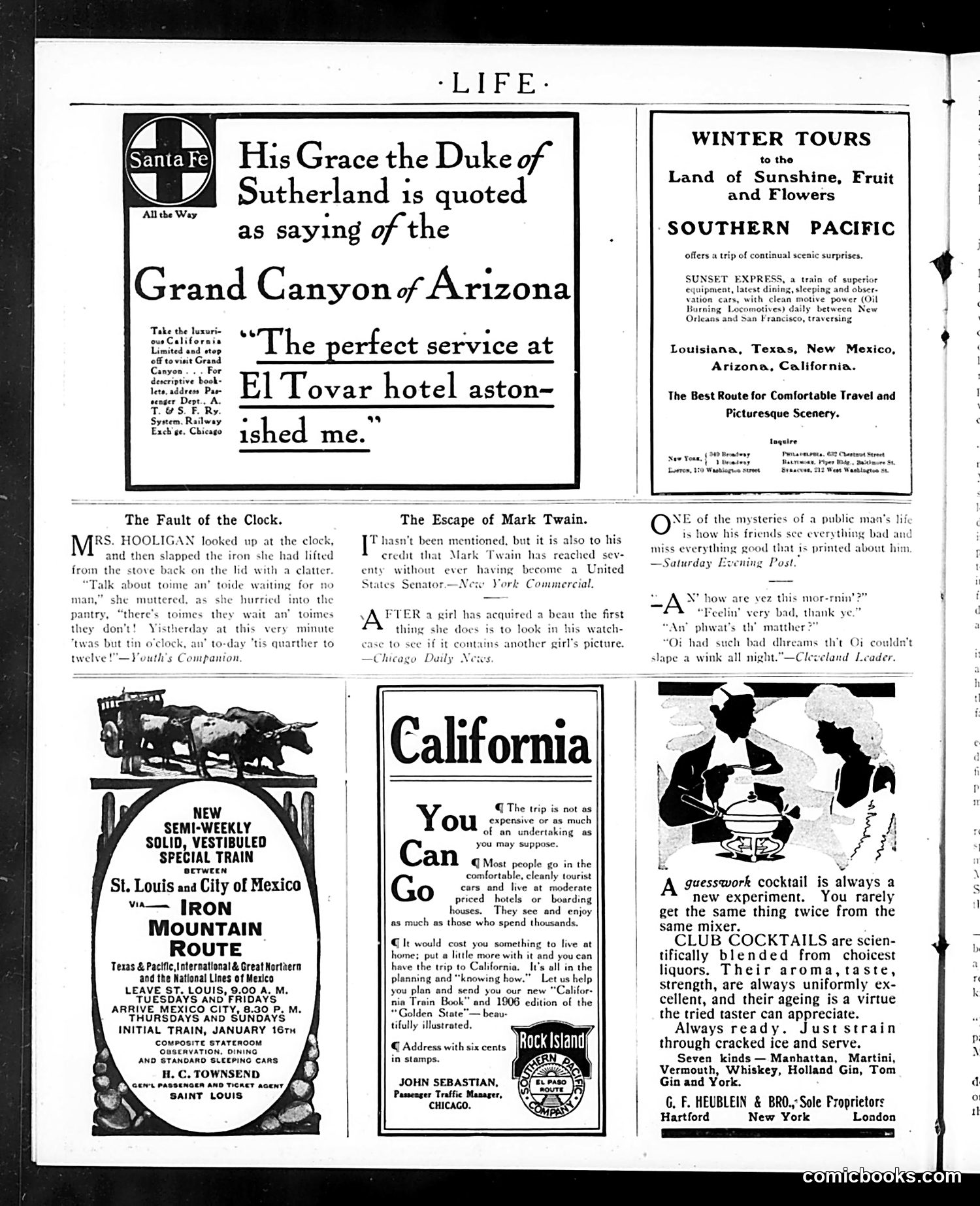
This page consists primarily of **advertisements and brief humorous anecdotes**, not political cartoons. The content includes: **Short comedic pieces**: "The Fault of the Clock" depicts an Irish domestic worker (identifiable by dialect: "toimes," "Oi") frustrated that her employer's clock runs slow. "The Escape of Mark Twain" jokes that the famous writer avoided becoming a Senator—a lighthearted jab at political corruption. Other quips mock vanity (girls checking for rival photos in suitors' watches) and the mystery of why public figures' friends only hear negative gossip. **Travel advertisements**: Competing railroad and steamship companies promote luxury winter tours to the American Southwest and Mexico, emphasizing comfort, scenic beauty, and reasonable costs. **Product ads**: Heublein cocktails and the Rock Island railway line. The page reflects early 1900s consumer culture and gentle humor targeting domestic life and social pretension, rather than political satire. The Irish-dialect humor was standard for the era, though considered ethnic comedy.
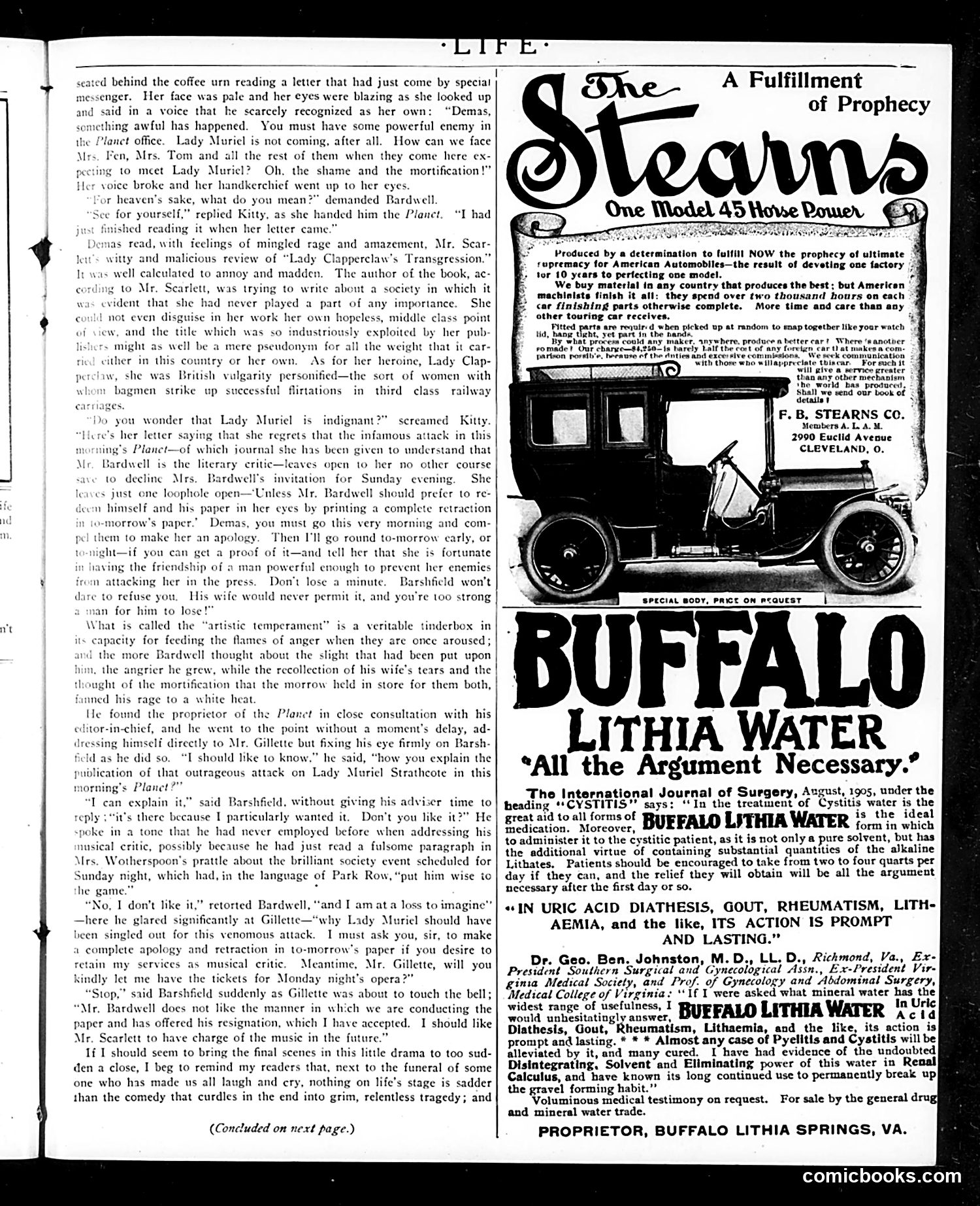
This page contains a serialized story about social embarrassment in early 20th-century high society. The narrative describes how a scathing literary review of a book called "Lady Clapperclaw's Transgression"—published in a newspaper called *the Planet*—causes Lady Muriel to cancel her attendance at an important social event hosted by the Bardwell family. The plot hinges on wounded pride: the book's author is reportedly connected to Lady Muriel, and the harsh critic (Mr. Scarlett) has damaged her reputation by association. The protagonist Demas Bardwell must now pressure the newspaper's proprietor to print a retraction to salvage his wife's social standing. The satire targets the vanity and interconnectedness of upper-class social circles, where newspaper reviews carry real social consequences and personal relationships drive editorial decisions—suggesting that journalistic integrity is secondary to maintaining social alliances among the elite. The remainder of the page contains unrelated period advertisements for automobiles and medicinal water.
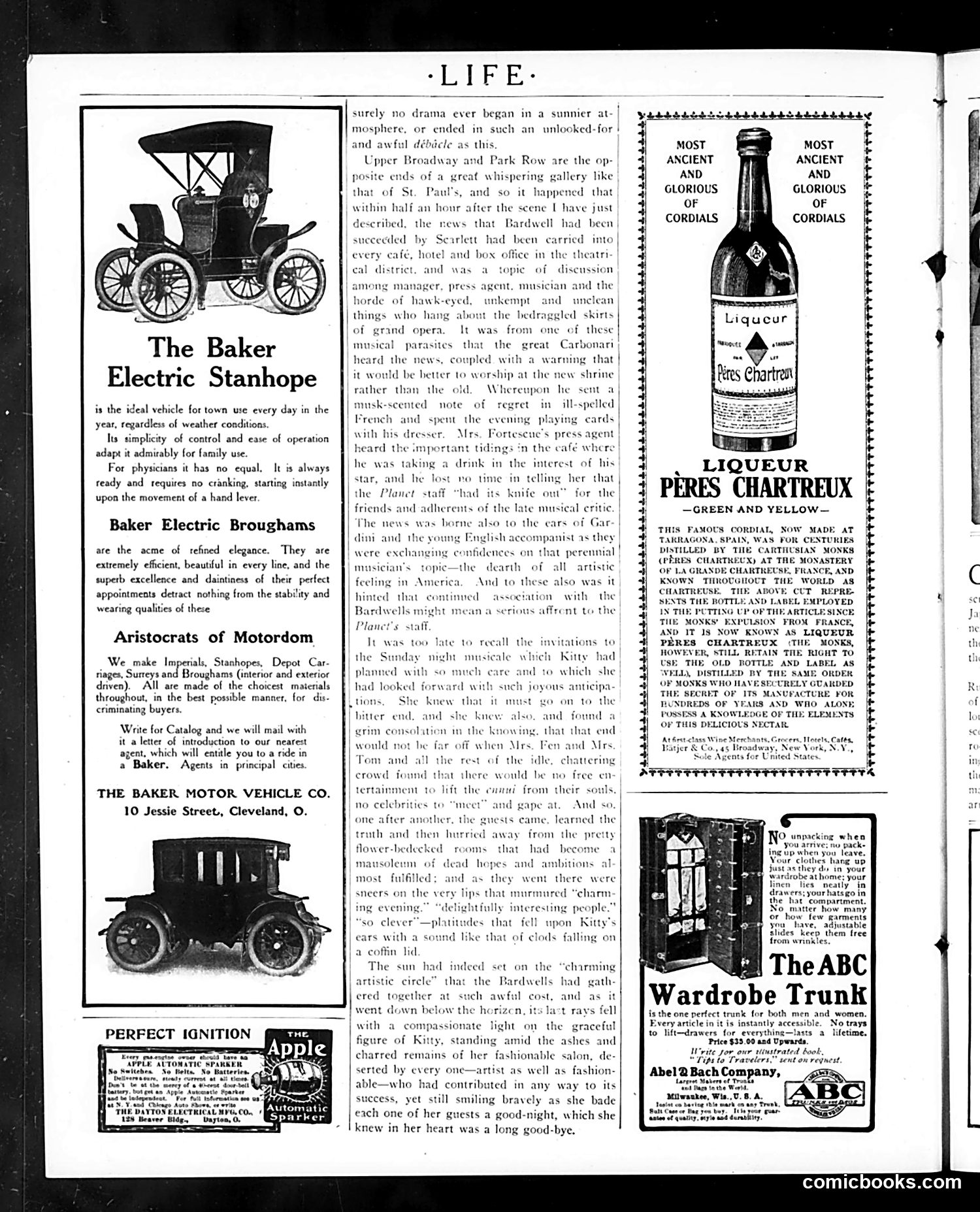
This page is primarily **advertisements** for early 1900s automobiles and luxury goods, not political satire. The left side features ads for **Baker Electric vehicles**—motorized carriages marketed as refined, reliable transportation. The copy emphasizes elegance and practicality for "town use" and physicians. The right side advertises **Liqueur Pères Chartreux**, a cordial historically made by Carthusian monks in France. The ornate advertisement explains its centuries-old origins and current Spanish production following the monks' expulsion from France. A small **ABC Wardrobe Trunk** advertisement appears at bottom-right. The body text describes an operatic drama involving character named Kitty and various theatrical figures, but this appears to be serialized fiction rather than satire or commentary. No political cartoon is visible. The page documents early-20th-century consumer marketing to affluent readers rather than satirical content.
This page is primarily **advertisements and commercial notices** rather than satirical content. The only narrative piece is "Insistent Politeness," a short story about Japanese-Russian military conduct during an apparent conflict (likely the Russo-Japanese War, 1904-1905). The story describes a Japanese soldier encountering a captured Russian soldier. Rather than showing aggression, the Japanese soldier politely offers the Russian his fan to cool himself in hot weather. The Russian initially refuses but eventually accepts. The piece illustrates Japanese cultural politeness even in wartime—the soldier covers his gesture with a revolver, suggesting underlying caution despite outward courtesy. The remainder of the page consists of period advertisements for luxury goods (chocolates, preserved fruits, speedometers) and financial services (insurance, banking, trust companies), typical of *Life* magazine's revenue model. These ads target affluent readers and reflect early 20th-century consumer culture.
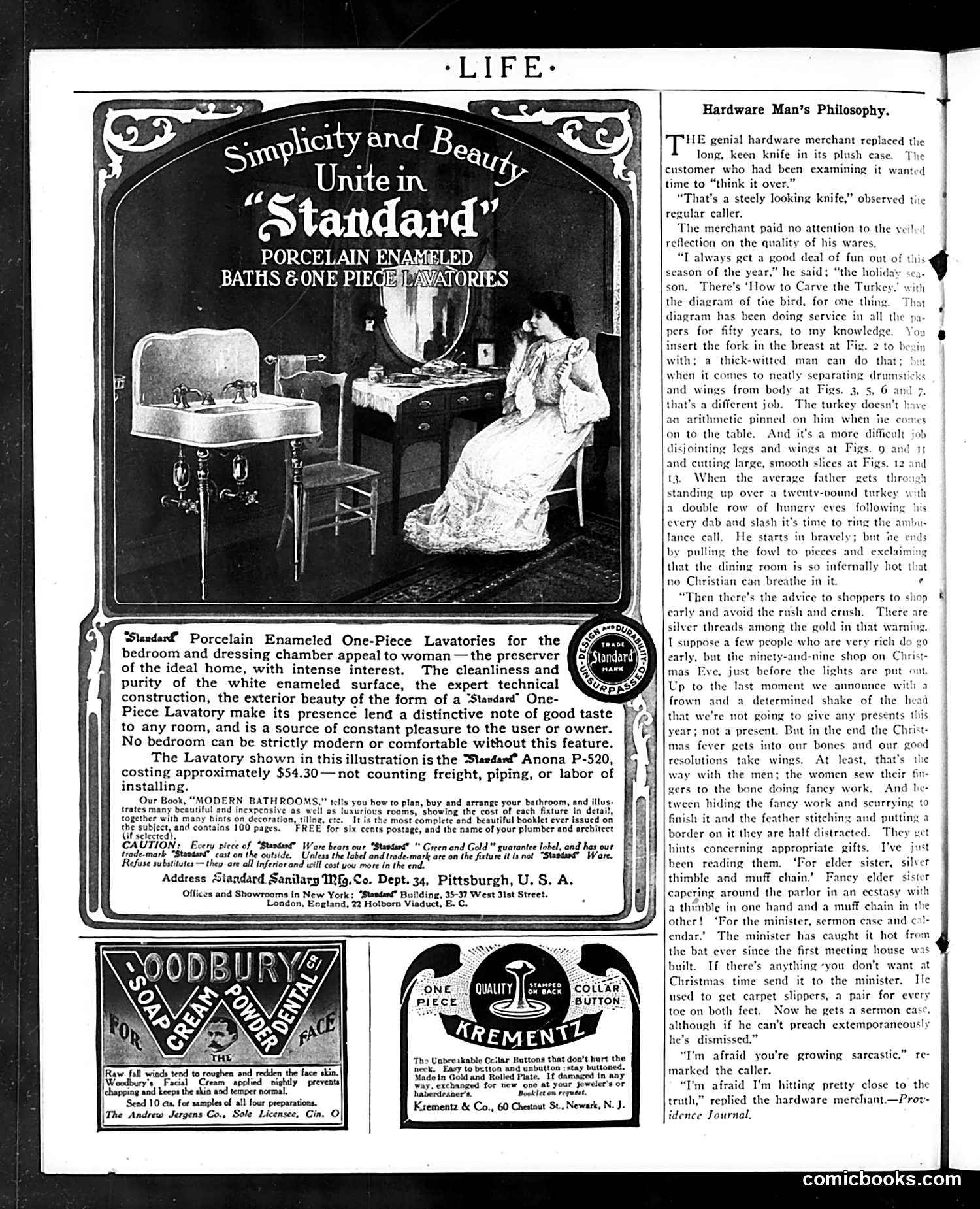
This page is primarily **advertising** for bathroom fixtures and household products, with one editorial humor piece. The main advertisement features "Standard" porcelain-enameled bathtubs and lavatories, marketed to women as symbols of modern domestic purity and good taste. Additional ads promote Woodbury's Facial Cream, Krementz collar buttons, and related products. The editorial content, titled "Hardware Man's Philosophy," is a humorous short piece about a hardware merchant and his customer. The merchant uses Thanksgiving turkey-carving instructions as an extended metaphor to explain the absurdity of domestic tasks—noting that carving a turkey requires more skill than instruction diagrams suggest, and that exhausted fathers typically end up frustrated and overheated. The satire gently mocks both elaborate instructional culture and the gap between theoretical guidance and practical reality in holiday cooking. The humor relies on relatable domestic frustration rather than political commentary.
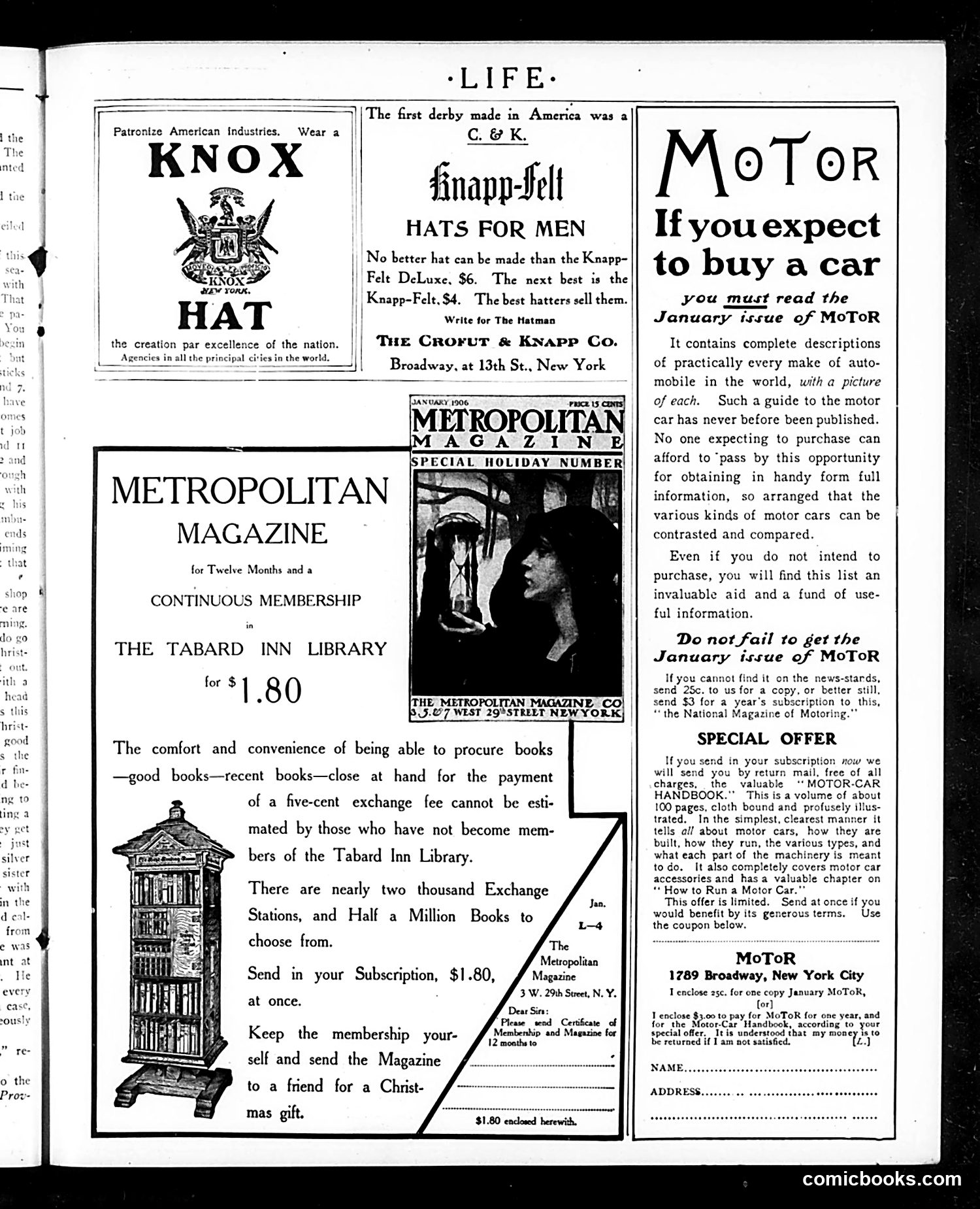
This page is **primarily advertising**, not satire or political commentary. It contains four commercial advertisements from approximately 1906: 1. **Knox Hat** – promotes American-made hats as patriotic consumption ("Patronize American Industries") 2. **Knapp-Felt Hats** – appeals to hat buyers with quality tiers ($6 deluxe, $4 standard) 3. **Metropolitan Magazine & Tabard Inn Library** – subscription offer ($1.80) for a book-lending library membership with 2,000 exchange stations and half a million books available 4. **Motor Magazine** – promotes the January issue as an essential guide for automobile purchasers, offering a free "Motor-Car Handbook" with subscription The page reflects early 1900s consumer culture: patriotic appeals to buy American goods, emerging leisure activities (magazine subscriptions), and the nascent automobile industry. The ads target middle-class readers with disposable income for hats, reading materials, and information about the new motor car technology.
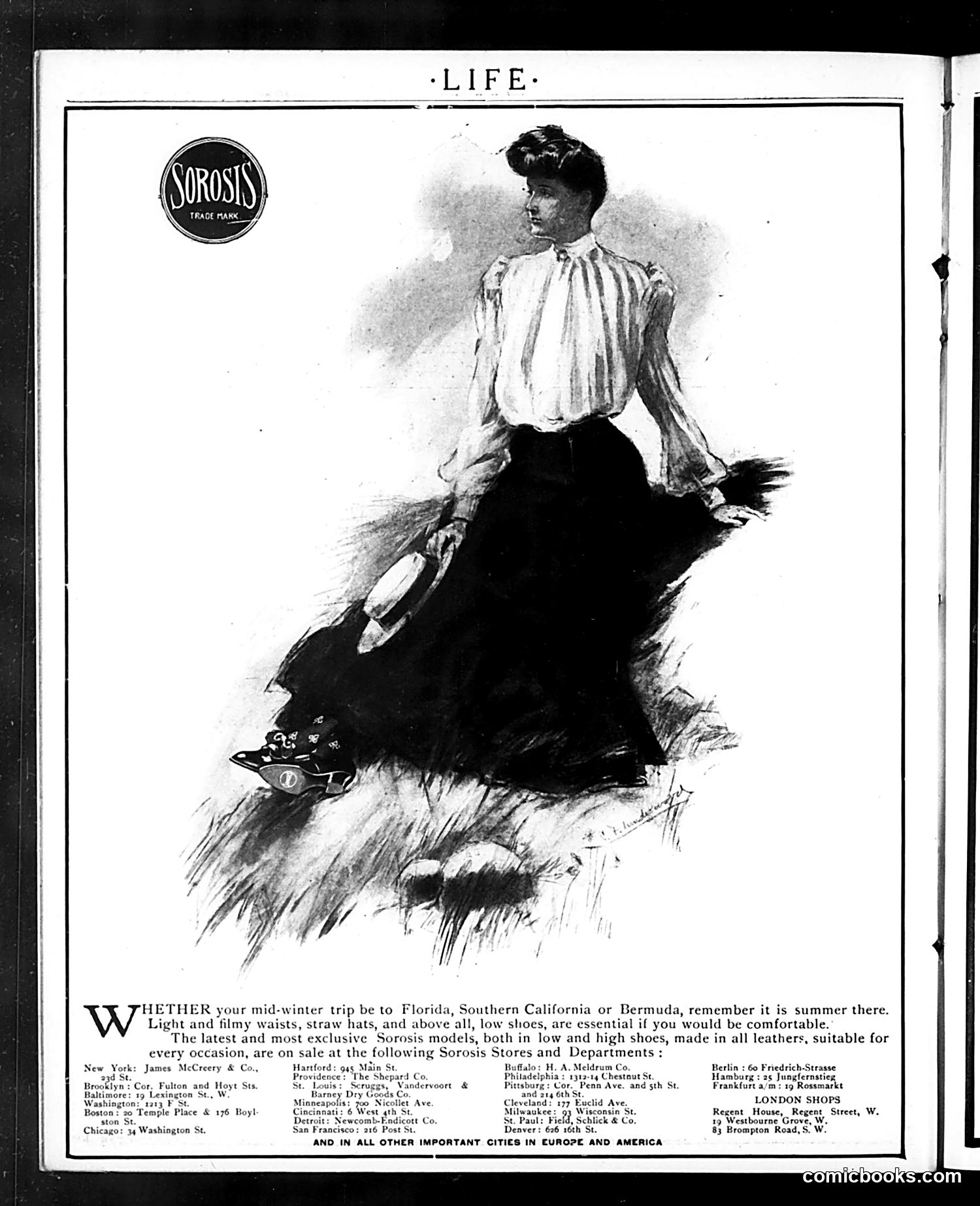
This page is primarily a **Sorosis shoe advertisement**, not a political cartoon. It features an elegant illustration of a well-dressed woman in early 1900s attire—a white blouse with puffy sleeves and a long black skirt—holding a shoe. The advertisement appeals to wealthy travelers by suggesting that lightweight Sorosis shoes are essential for winter trips to warm destinations like Florida, Southern California, and Bermuda. The copy emphasizes that quality footwear ensures comfort "on every occasion." The only satirical element is implicit: the ad subtly mocks women's fashion constraints by promoting "practical" shoes while depicting an obviously fashionable woman—suggesting that even comfortable shoes could be stylish. However, this is mild product positioning rather than sharp satire. The page primarily showcases Sorosis's extensive retail network across major American and European cities, indicating the brand's upscale market positioning during this era.
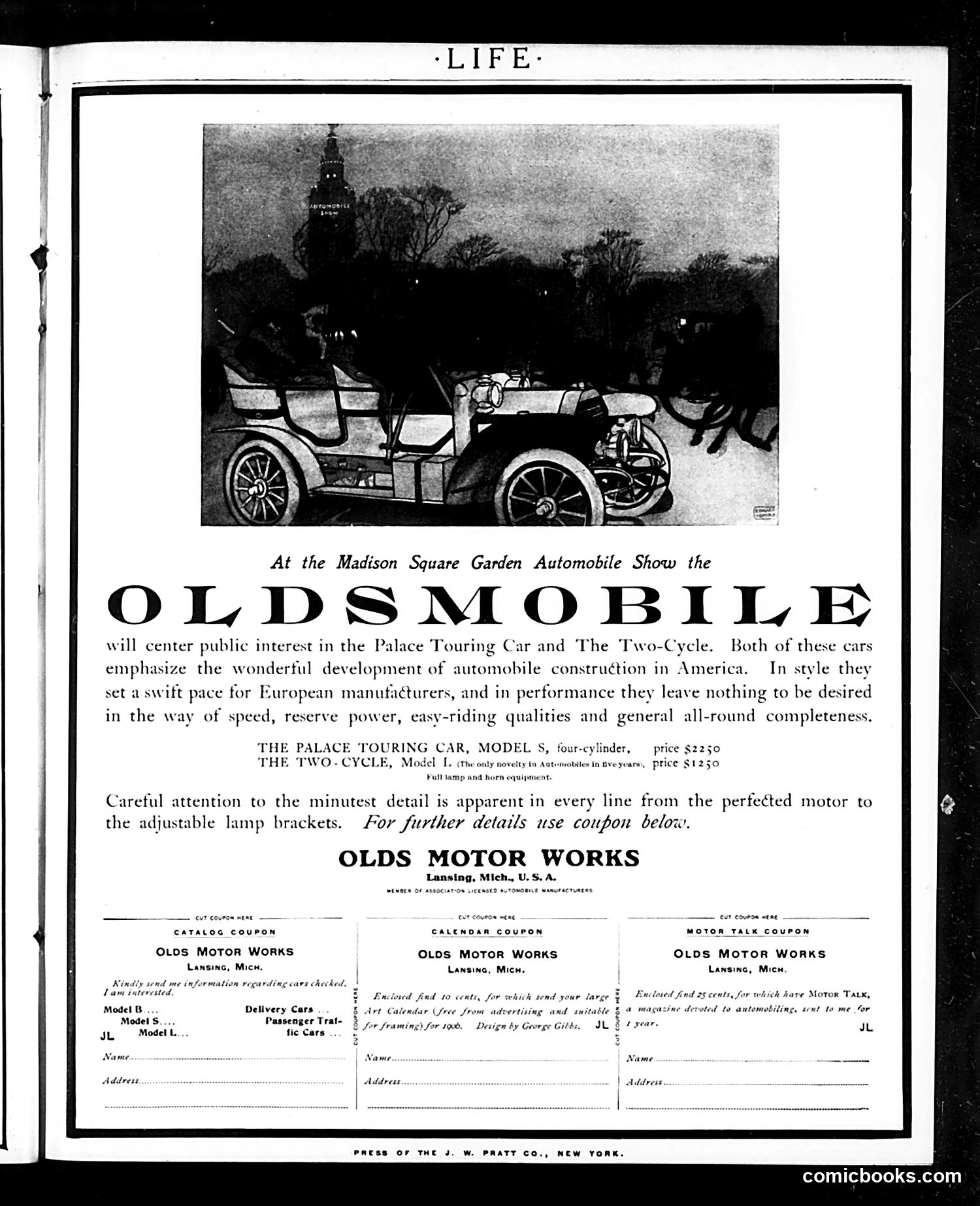
This is **not a cartoon or satire**—it's a straightforward automobile advertisement from Life magazine's early automotive era (likely early 1900s, based on the vehicle design and pricing). The page promotes Oldsmobile's two models displayed at the Madison Square Garden Automobile Show: the Palace Touring Car (Model S, $2,250) and the Two-Cycle ($1,250). The advertisement emphasizes American manufacturing superiority, claiming these vehicles outpace European competitors in style and performance. The photograph shows an open-air touring car typical of the era. Three detachable coupons at the bottom allow readers to request a catalog, calendar, or subscription to "Motor Talk" magazine. This reflects the early-20th-century fascination with automobiles as technological marvels and status symbols. The ad targets middle-to-upper-class readers by positioning American cars as equal to—or superior to—European imports, appealing to both pride and aspiration.
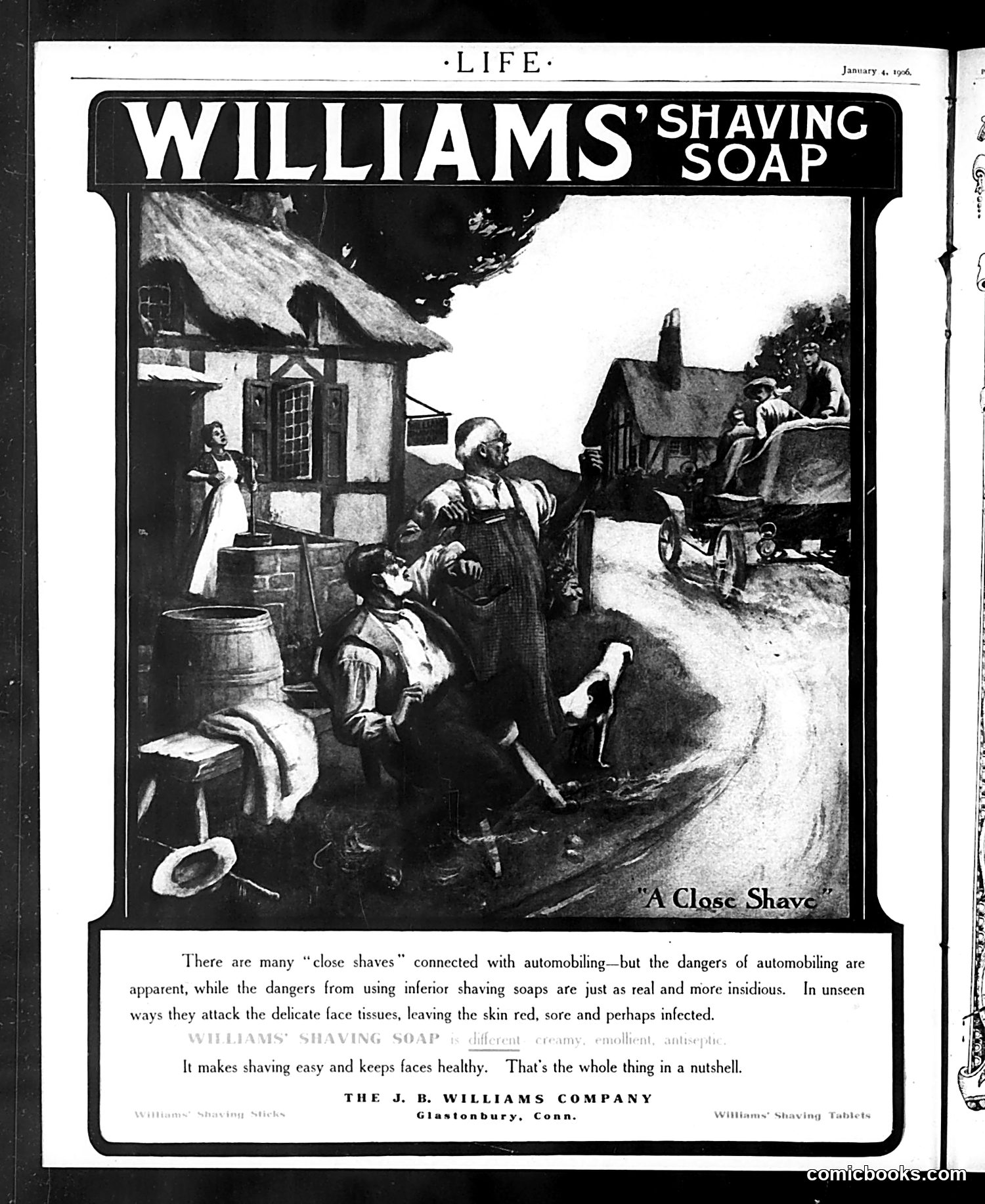
This is primarily a **product advertisement**, not political satire. The page uses a visual pun to sell shaving soap. The illustration depicts a rural village scene with a barber shaving a customer outside a cottage—a "close shave" in the literal, traditional sense. The ad's cleverness lies in its title: it equates the dangers of automobiling (a modern hazard of the 1906 era) with the dangers of using inferior shaving soap. The argument is that while car accidents are visibly dangerous, poor soap causes hidden damage to facial skin—redness, soreness, and infection. Williams' soap allegedly prevents this by being "creamy, emollient, antiseptic." The humor is gentle wordplay rather than satire: a "close shave" means both a near-miss accident and a close shaving experience. For a modern reader, the automobile reference dates this to when cars were still novel enough to warrant such comparisons.